
Key Takeaways
- Quilty Space projects a 150-launch shortfall outside China through 2030, with capacity constraints peaking in 2028.
- SpaceX’s Falcon 9 wind-down and Vulcan’s November 15 failure leave defense and commercial manifests exposed.
- Rising prices and multiyear waitlists are driving satellite operators toward vertical integration and pooled launch.
The Anatomy of the 2026–2029 Launch Crunch Paradox
Over a 48-hour span in November 2026, the global orbital launch market exposed its central contradiction. On November 14, SpaceX achieved the first midair tower catch of a returning orbital upper stage during Starship Flight 15, capturing Ship 42 at Starbase in Texas after nearly a full day in orbit and the deployment of 26 Starlink V3 satellites. Less than 24 hours later, on November 15, United Launch Alliance suffered its first outright mission failure when a Vulcan Centaur rocket carrying 40 Amazon Leo broadband satellites fell back to Earth roughly 10 minutes after liftoff from Cape Canaveral, as documented in Spaceflight Now’s mission report.
That single weekend illustrated the 2026–2029 launch crunch paradox. On paper, the space economy is standing on the threshold of abundant, fully reusable super-heavy-lift capacity that should drive per-kilogram orbital delivery costs down by an order of magnitude. In practice, commercial satellite operators, civil space agencies, and defense planners face the tightest rocket supply bottleneck in more than a decade. Between October and November 2026, three converging shocks turned a manageable transition into an acute structural squeeze: SpaceX began winding down new commercial and military contracts for its workhorse Falcon 9, ULA’s Vulcan entered a fresh mishap investigation just as it returned from a nine-month stand-down, and Blue Origin delayed New Glenn’s return to flight until January 2027.
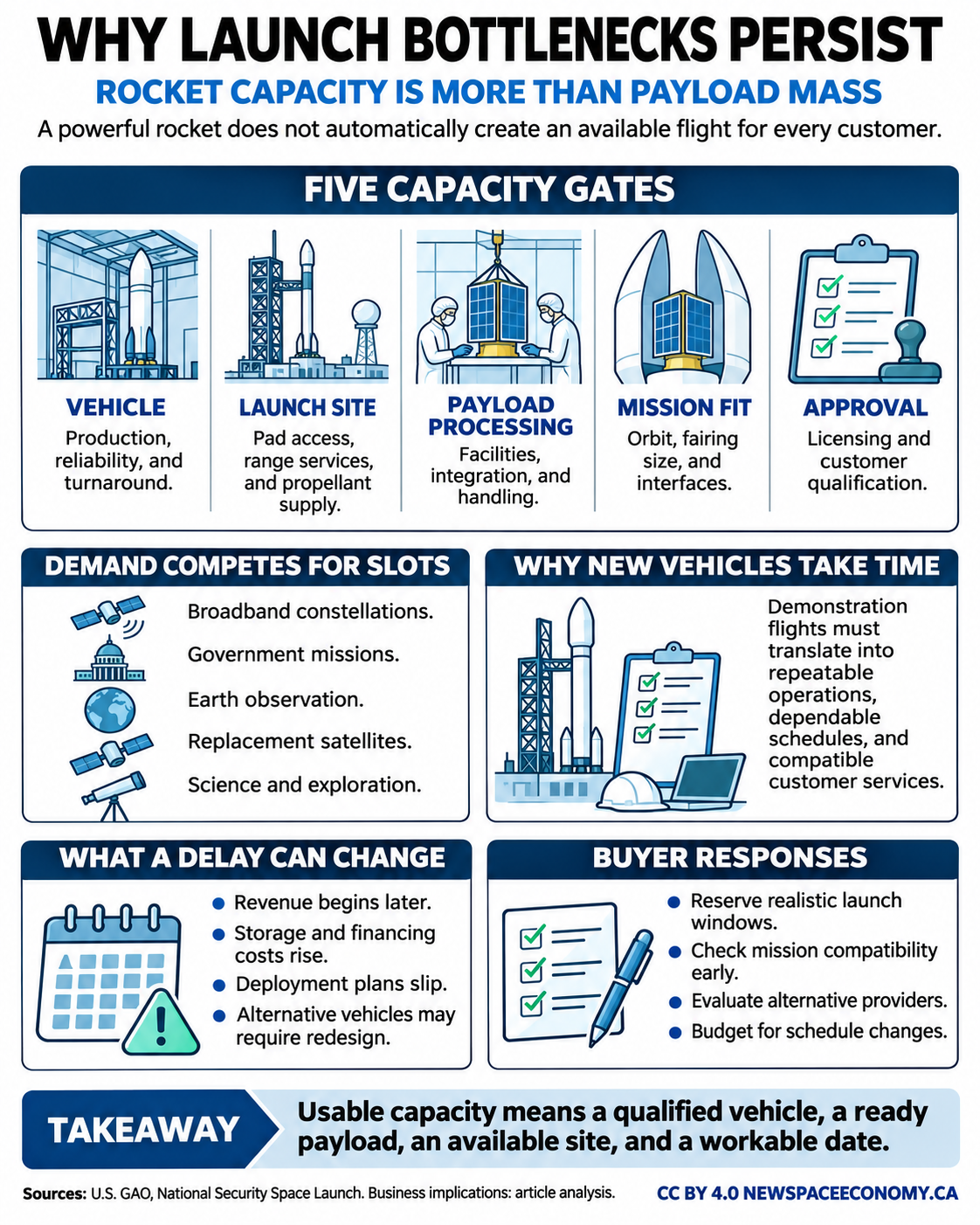
The paradox arises from a timing mismatch between retirement schedules, internal fleet priorities, and industrial ramp-up curves. Launch capacity is not fungible. A satellite built to fit a Falcon 9 fairing for a 2027 orbital plane cannot simply wait for a super-heavy Starship flight in 2030, nor can a national security payload certified for Vulcan migrate overnight to an unflown medium-lift vehicle. As Ars Technica’s coverage of the catch highlighted, proving that a giant spacecraft can return to its launch tower de-risks long-term reusability, yet it does not immediately create open manifest slots for external customers.
Across the global space economy outside China, the consequence is a four-year scarcity window running from late 2026 through 2029. Launch prices are rising even as reusability matures, booking lead times now stretch to three years, and major satellite operators are committing billions of dollars to acquire or co-develop their own rockets simply to secure rides to orbit. Understanding the mathematics behind this gap requires dissecting both the demand surge and the fragile supply chain attempting to serve it.
Quantifying the 150-Launch Supply and Demand Gap
The quantitative foundation of the 2026–2029 launch crunch rests on an October 29, 2026 market study by Quilty Space. Assessing publicly disclosed backlogs across 10 leading medium-lift, heavy-lift, and super-heavy-lift vehicles outside China, Quilty Space’s launch shortfall analysis projected that available orbital supply will fall roughly 150 missions short of commercial and civil demand through 2030. The analysis identifies 2028 as the single most constrained year, and notes that unmet national security requirements could widen the effective deficit further if military manifest growth accelerates.
Breaking down the 150-launch deficit reveals where the bottleneck sits. Exactly 113 missing flights, representing 75.3% of the total shortfall, stem from established launch providers failing to hit planned flight rates or retiring active vehicles before replacements mature. Another 25 missing flights, or 16.7% of the gap, come from dedicated rideshare missions serving small satellite constellations and technology demonstrators. Only 12 missing launches, or 8.0% of the deficit, originate from emerging launch providers. The numbers refute a common misconception: the launch crunch is not primarily a shortage of rocket startups, because startups carry relatively modest near-term payload volumes. It is a production, reliability, and transition deficit among incumbent heavy-lift operators.
On the demand side, satellite manufacturing has outpaced launch pad throughput. Global orbital launch cadence expanded by nearly 50% in just two years, rising from 223 launches in 2023 to 330 launches in 2025, yet demand still outstripped supply. Market research firm Analysys Mason forecasts that nearly 41,000 satellites will require orbital deployment between 2026 and 2034, an average of approximately 4,556 spacecraft per year. That pipeline combines massive broadband and direct-to-device constellations, Earth observation radar fleets, proliferated military missile-tracking layers, and emerging orbital compute demonstrations.
The table below summarizes the structural components of the projected non-Chinese launch shortfall through 2030 alongside the primary demand drivers competing for slots.
| Shortfall Segment | Missing Missions | Share of Gap | Primary Structural Driver |
|---|---|---|---|
| Established Providers | 113 launches | 75.3% | Falcon 9 wind-down, Vulcan grounding, New Glenn and Ariane 6 cadence limits |
| Rideshare Missions | 25 launches | 16.7% | SpaceX halting commercial Falcon 9 rideshare bookings beyond late 2028 |
| Emerging Providers | 12 launches | 8.0% | First-flight delays for Neutron, Nova, Terran R, and Eclipse into 2027 |
| Total Non-Chinese Gap | 150 launches | 100.0% | Projected peak scarcity in 2028 with 30- to 36-month booking lead times |
Booking lead times illustrate how rapidly the market tightened. Quilty Space research director Caleb Henry cited standard commercial lead times of 30 to 36 months as of late 2026. Any satellite operator signing a new launch contract in November 2026 is effectively purchasing a slot in mid-2029 or 2030. Because satellite financing, customer service-level agreements, and spectrum regulatory milestones are tied to fixed deployment dates, a 12-month launch slip cascades into working-capital strain, delayed revenue recognition, and potential regulatory penalties.
Ground infrastructure compounds the vehicle bottleneck. A Federal Aviation Administration request for information examined in New Space Economy’s spaceport capacity analysis noted that 83% of United States launch activity remains concentrated at just three sites. Even when rocket factories scale engine production, range scheduling, propellant logistics, payload processing bays, and airspace clearance ceilings impose hard physical caps on annual flight cadence.
Starship’s Reusability Milestone and the Falcon 9 Retirement Squeeze
The single largest swing variable in the global launch market is SpaceX’s deliberate transition from its Falcon fleet to Starship. To appreciate the scale of that transition, consider the baseline that Falcon 9 established. In 2025, SpaceX conducted 165 Falcon 9 flights, accounting for roughly 85% of all United States orbital launch attempts, and delivered 2,213 metric tons of payload mass across 170 combined Falcon 9 and Falcon Heavy missions, as detailed in New Space Economy’s Falcon 9 transition profile. On October 30, 2026, the vehicle completed its 700th orbital mission, reinforcing its status as the backbone of Western space access.
Yet SpaceX is actively winding down new commercial commitments for that workhorse. On September 28, 2026, NASA Administrator Jared Isaacman stated publicly that SpaceX intends to sunset Falcon and Dragon as engineering and capital shift toward Starship. SpaceX has already stopped accepting new commercial Falcon 9 rideshare reservations past late 2028, and in late 2026 the company began declining new Falcon 9 and Falcon Heavy contracts across both commercial and military customer segments. Even in Florida, shifting East Coast launch infrastructure toward Starship reduced SpaceX’s regional Falcon 9 Starlink tempo from roughly eight or nine flights per month down to about two per month.
Starship Flight 15 on November 13 and 14, 2026 showed why SpaceX is willing to execute such an aggressive pivot. Ship 42 reached orbit, deployed 26 next-generation Starlink V3 satellites, completed roughly 14 orbits over nearly 22 hours, survived atmospheric reentry, and descended directly into the Starbase tower catch arms. Although Super Heavy Booster 22 aborted its own catch attempt over a guidance issue and was lost at sea, SpaceX had already demonstrated booster recovery on earlier flights. With both stages now proven recoverable at the launch pad, SpaceX management is targeting upper-stage reflight in early 2027, weekly Starship flights in the first half of 2027, and twice-weekly cadence thereafter.
From a supply-demand perspective Starship’s technical success does not solve the 2026–2029 launch crunch for third-party buyers. Two internal demands will absorb the overwhelming majority of early Starship manifest capacity. First, SpaceX’s own Starlink V3 constellation represents a massive captive customer. Deploying 26 Starlink V3 satellites on Starship Flight 14 delivered network bandwidth equivalent to roughly 10 Falcon 9 Starlink launches, giving SpaceX an overwhelming financial incentive to dedicate early Starship flights to its own broadband and direct-to-device expansion.
Second, NASA’s Artemis lunar campaign requires an intensive orbital propellant transfer architecture. During an October 2026 quarterly meeting of NASA’s Aerospace Safety Advisory Panel, panel member Charlie Precourt cited estimates that supporting a single Starship lunar landing for Artemis IV could require up to 22 Starship refueling launches. SpaceX Chief Executive Officer Elon Musk countered that the real requirement will be closer to six to eight flights. Even at the lower bound of six to eight tanker launches per lunar mission, cryogenic propellant transfer testing, depot operations, and Artemis flight demonstrations will consume dozens of Starbase and Florida pad slots between 2027 and 2029.
Consequently, Quilty Space co-CEO Chris Quilty cautioned that external satellite operators counting on Starship to resolve their manifest shortages should plan on waiting until the 2030 timeframe for routine commercial access. That creates the exact chasm defining the crunch: Falcon 9 commercial availability is contracting sharply in 2027 and 2028, whereas Starship’s open commercial availability arrives in 2029 and 2030.
Vulcan’s Failure and the Fragility of Established Second Sources
If SpaceX’s transition explains half of the 2026–2029 launch crunch, the operational fragility of established competitors explains the other half. United Launch Alliance’s Vulcan Centaur was designed to serve as the dependable American second source for both commercial megaconstellations and high-priority national security payloads. With a six-solid-booster configuration rated for 27,200 kilograms to a reference low Earth orbit, as outlined in New Space Economy’s ULA company profile, Vulcan accumulated a backlog of roughly 70 launches over the coming years.
That schedule unraveled across 2026. Following a solid-rocket-booster nozzle anomaly during the February 12, 2026 USSF-87 mission, ULA stood Vulcan down for nine months to implement nozzle modifications with Northrop Grumman and incorporate BE-4 engine adjustments. When Vulcan finally returned to flight on November 15, 2026 carrying 40 Amazon Leo satellites, low first-stage thrust doomed the vehicle roughly 10 minutes after liftoff. On November 16, the Federal Aviation Administration mandated a formal mishap investigation.
Two days later, on November 18, ULA released preliminary flight-data findings showing that the low thrust resulted from inadequate fuel supply to the BE-4 engines rather than a malfunction of the Blue Origin-built engines themselves, a detail corroborated in Ars Technica’s technical follow-up. Although that preliminary diagnosis spared Blue Origin’s New Glenn program from a fresh engine redesign, it left ULA confronting another prolonged grounding and deeper questions regarding its long-term commercial viability. Even before the November failure, ULA had been working to activate a second Vulcan launch complex at Vandenberg Space Force Base in California in early 2027 to support five to six annual West Coast national security missions. Every month Vulcan remains grounded pushes its 70-flight backlog deeper into the 2028 bottleneck.
Blue Origin’s New Glenn faces a parallel ramp-up challenge. After completing three flights through April 19, 2026, New Glenn suffered a major pad test accident on May 28, 2026 traced to a BE-4 main oxygen valve, damaging the lightning tower, transporter-erector, and hydraulic systems at Launch Complex 36. As detailed in New Space Economy’s New Glenn return-to-flight assessment, reconstruction delays pushed New Glenn’s fourth mission from late 2026 into January 2027. To prepare for high-tempo operations, Blue Origin unveiled a $330 million Florida infrastructure expansion on October 16, 2026, adding two more Cape Canaveral launch pads, two additional landing vessels, and an upper-stage factory designed to build up to 150 stages annually once completed in summer 2027. Those investments position New Glenn as a formidable heavy-lift workhorse by 2028 and 2029, yet they cannot deliver high-volume flights in early 2027.
Across the Atlantic, Europe’s Ariane 6 has demonstrated steady operational reliability, including deploying 36 Amazon Leo satellites on a single Ariane 64 flight equipped with upgraded P160C boosters in June 2026. Arianespace scheduled the rocket’s 10th flight for November 23, 2026 following a liquid-hydrogen turbopump fix. Even so, Ariane 6 was already heavily booked across 2026 and 2027, with limited 2028 availability, leaving minimal spare capacity to absorb displaced American commercial payloads.
National Security Space Launch Exposure and Defense Procurement
The 2026–2029 launch crunch is no longer strictly a commercial pricing problem; it has become a direct operational constraint for Western defense planners. Under the United States Space Force’s National Security Space Launch program, assured access to space has historically depended on maintaining at least two independent, certified heavy-lift families so that an anomaly on one vehicle cannot halt critical intelligence, navigation, and missile-warning deployments.
In October 2026, that two-provider doctrine collided with market reality. According to Politico’s reporting on military launch bids, the U.S. Space Force solicited launch services for three upcoming national security missions, including two batches for the Space Development Agency’s proliferated low Earth orbit missile-tracking and transport network, and SpaceX declined to submit a bid. No competing launch provider stepped forward to take the missions either. Acting Space Force portfolio acquisition executive Brig. Gen. Eric Zarybnisky acknowledged the near-term friction as the service waits for alternative vehicles to mature.
The Pentagon’s immediate exposure is quantifiable. Following Vulcan’s February 2026 booster anomaly, the Space Force paused national security flights on ULA’s rocket and began reassigning task orders. By October 2026, six missions originally allocated to Vulcan had been shifted onto SpaceX Falcon 9 and Falcon Heavy rockets, starting with the GPS III-8 reassignment in March 2026 and extending to a Space Development Agency tracking-layer batch, the Oracle-M cislunar pathfinder stack, and a Next-Generation Overhead Persistent Infrared missile-warning satellite. Vulcan remains on contract for roughly half of the Space Force’s national security manifest over the next few years, meaning the November 15 failure puts additional NSSL schedules at risk at the exact moment SpaceX is curtailing new Falcon commitments.
Military procurement officials have responded by expanding contract flexibility and funding alternative launch ecosystems. On November 17, 2026, Space Systems Command added $985 million to NSSL Phase 3 Lane 2 ceilings across SpaceX, United Launch Services, and Blue Origin through April 2033, expanding financial headroom for complex mission integration without obligating immediate funds. Separately, the Pentagon’s Office of Strategic Capital extended a $150 million loan to Rocket Lab in November 2026, its second launch infrastructure loan following Stoke Space, explicitly aimed at accelerating medium-lift production capacity.
Allied governments are moving in the same direction to hedge against single-country launch bottlenecks. On November 17, 2026, NATO unveiled its Starlift commercial launch brokerage alongside a Global Data Marketplace, pooling military launch slots across 11 allied countries including Canada, Germany, Italy, the United Kingdom, and South Korea, backed by approximately $2.7 billion in NATO technology agency contracts over two years. In a tight launch market, aggregated sovereign demand gives commercial providers multiyear revenue visibility while allowing smaller allied nations to secure responsive launch access without building national heavy-lift vehicles.
Commercial Constellation Math and Rising Launch Prices
Nowhere is the arithmetic of the 2026–2029 launch crunch more unforgiving than in commercial low Earth orbit broadband and direct-to-device constellations. Amazon Leo, formerly known as Project Kuiper, illustrates the exact cadence math confronting non-SpaceX constellation operators. Amazon holds Federal Communications Commission authorization for a 3,236-satellite broadband network. Although the agency issued an order waiving Amazon’s July 30, 2026 interim milestone in June 2026 while temporarily demoting spectral priority for delayed spacecraft, Amazon still faces a July 30, 2029 deadline to deploy its full constellation.
As of November 2026, Amazon Leo had approximately 396 production satellites in orbit, leaving roughly 2,840 spacecraft still to launch in about 32 months. The arithmetic is stark. At 40 satellites per Vulcan VC6L flight, deploying 2,840 satellites requires 71 dedicated heavy-lift launches. At 36 satellites per Ariane 64 flight, the requirement rises to roughly 79 launches. Averaged across the roughly 2.7 years remaining until late July 2029, Amazon needs between 26 and 29 successful heavy-lift launches per year solely for its broadband constellation.
Amazon had already moved proactively to diversify its manifest, ordering six additional Ariane 64 launches from Arianespace in September 2026 to lift its European total to 24 flights, alongside 38 contracted Vulcan launches and multi-launch agreements with Blue Origin’s New Glenn. Yet losing 40 satellites on the first Vulcan Leo mission compounds the schedule risk just weeks after the FCC approved Amazon Leo’s $11.57 billion Globalstar acquisition on October 27, 2026 to expand into direct-to-device mobile spectrum. Spectrum licenses generate no return until rockets place payloads in orbit.
Scarcity is simultaneously driving an upward repricing across the commercial launch market. Despite long-term expectations that full reusability will crush launch prices, near-term transaction prices are moving higher. On November 9, 2026, Rocket Lab disclosed $515 million in new Q3 Neutron contracts covering eight dedicated flights across ICEYE, Muon Space, Starcloud, Kepler Communications, and the U.S. Space Force. Alongside those bookings, which filled Neutron’s first 16 missions and pushed the next open slots into the 2030s, Rocket Lab raised Neutron’s base price by 27.3%, from $55 million to $70 million per dedicated flight. Based on Neutron’s 13,000-kilogram reusable low Earth orbit payload rating, that shift lifted implied per-kilogram dedicated pricing from roughly $4,231 to $5,385 per kilogram before the rocket has completed its inaugural flight.
Similar pricing pressure is visible in rideshare and orbital compute bookings. Industry estimates place Falcon 9 rideshare pricing near $6,500 to $7,000 per kilogram to low Earth orbit, with analysts warning that a 25-mission rideshare shortfall could push spot rates sharply higher between 2027 and 2028. Even hyperscale technology companies are locking in slots years ahead: on November 19, 2026, Google booked Blue Origin’s New Glenn for a 2029 launch of its Project Suncatcher solar-powered artificial intelligence compute satellites, securing capacity before commercial heavy-lift manifests fill through the end of the decade.
The table below compares the operational status, reference payload capacity, and backlog constraints across the primary Western medium-, heavy-, and super-heavy-lift vehicles as of November 21, 2026.
| Launch Vehicle | Status as of Nov 2026 | LEO Payload | Key Backlog or Pricing | 2027–2029 Bottleneck |
|---|---|---|---|---|
| SpaceX Falcon 9 | Operational, winding down | Up to 22,800 kg | 700+ flights; no new rideshare past 2028 | Deliberate phase-out toward Starship |
| SpaceX Starship | Orbital test, upper stage caught | 100,000+ kg reusable | Starlink V3 and Artemis priority | External commercial access likely 2029–2030 |
| ULA Vulcan VC6L | Grounded after Nov 15 failure | 27,200 kg | Roughly 70 booked flights (38 Amazon Leo) | FAA mishap probe and fuel-feed redesign |
| Blue Origin New Glenn | Return to flight Jan 2027 | 45,000 kg | Amazon Leo, NSSL Lane 2, Google 2029 | Pad rebuild and upper-stage factory ramp |
| Arianespace Ariane 64 | Operational, 10th flight Nov 23 | 21,600 kg | 24 Amazon Leo flights plus European gov | Manifest nearly full through 2028 |
| Rocket Lab Neutron | In development, debut 2027 | 13,000 kg reusable | 16 flights sold out; $70M base price | Next open commercial slots in 2030s |
Emerging Medium-Lift Challengers, Vertical Integration, and Relief Scenarios
Because established rockets cannot close a 150-launch deficit alone, attention has shifted to a new wave of medium-lift challengers and an unprecedented surge of vertical integration by satellite operators. Four American medium-lift rockets are racing toward orbital debuts in 2027: Rocket Lab’s Neutron, Stoke Space’s fully reusable Nova, Relativity Space’s Terran R, and the Eclipse vehicle jointly developed by Firefly Aerospace and Northrop Grumman.
Technical progress accelerated across this cohort in late 2026, even as first-flight dates converged on 2027. Rocket Lab pushed Neutron’s inaugural flight to 2027 on October 14, 2026 to resolve composite tank dome voids. Stoke Space completed development of its methane-fueled Zenith booster engine in November 2026 and began shipping acceptance-tested flight engines weekly to Cape Canaveral for Nova’s first stage, backed by a $1 billion Series E round closed in September 2026. Relativity Space completed Terran R’s 13-engine first-stage thrust structure and conducted its first all-up second-stage hot-fire test at NASA’s Stennis Space Center in November 2026.
Yet historical launch ramps show that a 2027 debut rarely translates into double-digit annual cadence before 2029. Recognizing that third-party launch capacity will remain rationed through the decade, capital-rich satellite operators have begun buying or building their own lift. Two landmark transactions in November 2026 signaled this structural shift. On November 6, AST SpaceMobile signed a $1.3 billion rocket engine agreement and intellectual property license with Firefly Aerospace to develop Blacklift, a partially reusable medium-lift rocket designed to carry up to five BlueBird direct-to-device satellites per flight starting in late 2028. Less than two weeks later, on November 17, Finnish radar-satellite leader ICEYE announced its intent to acquire Italian Vega C manufacturer Avio for more than $2.2 billion, aiming to create Europe’s first vertically integrated end-to-end satellite and launch company as Falcon 9 retirement approaches.
These moves reflect a rational response to scarcity, but they also carry execution risk. Developing or scaling a launch vehicle consumes billions in capital expenditure and takes years to reach reliable cadence. To evaluate how the 2026–2029 launch crunch might resolve, analysts and operators can model three distinct supply scenarios across the next three years.
The table below outlines three quantitative relief scenarios for the 2026–2029 launch crunch, mapping technical triggers against projected backlog clearance and commercial pricing trends.
| Scenario | Key Operational Triggers | Estimated 2028–2029 Impact | Pricing and Manifest Effect |
|---|---|---|---|
| Base Case (Managed Scarcity) | New Glenn flies 10–15 times by 2028; Vulcan resumes mid-2027; two medium rockets debut in 2027 | Shortfall remains near 120–150 missions through 2030; 2028 stays peak bottleneck | Dedicated medium-lift holds $65M–$75M; rideshare near $7,000–$8,500/kg |
| Rapid Relief (Accelerated Scale) | Starship opens external commercial slots by late 2028; Blue Origin hits 25+ annual flights | Shortfall narrows below 75 missions; Amazon Leo and NSSL clear backlogs by 2029 | Heavy-lift spot prices stabilize; rideshare premiums compress after 2028 |
| Prolonged Crunch (Compounded Delays) | Vulcan grounded past late 2027; Starship locked to Starlink and Artemis; medium debuts slip to 2028 | Shortfall exceeds 200 missions including defense; FCC constellation waivers widen | Rideshare approaches $9,000+/kg; SpaceX forced to extend Falcon 9 government flights |
For satellite operators, investors, and defense agencies navigating this window, three strategic realities stand out. First, multi-vehicle payload compatibility is no longer optional: spacecraft designed to fit only one fairing or dispenser interface face existential schedule exposure when that rocket experiences a mishap or retirement. Second, early contract reservations carry option value, because 30- to 36-month lead times mean that waiting for a new launcher’s maiden flight guarantees missing the 2028–2029 deployment window. Third, capital allocation across the space economy is shifting back toward launch and propulsion infrastructure, evidenced by Space Capital’s Q3 2026 investment data showing $92.5 billion invested across the space sector through the third quarter of 2026 alone.
Summary
The 2026–2029 launch crunch paradox reflects a structural transition rather than a collapse in rocket technology. SpaceX’s midair catch of Starship’s upper stage on November 14, 2026 confirmed that full orbital reusability is moving from experimental ambition to operational engineering, yet the simultaneous wind-down of commercial Falcon 9 bookings, ULA’s November 15 Vulcan failure, and multi-month recovery timelines for Blue Origin’s New Glenn have created an acute medium-term capacity gap. With Quilty Space projecting a 150-launch shortfall outside China through 2030 and booking lead times stretching to three years, pricing power has temporarily shifted back to launch providers with credible 2027–2029 manifests. Until Starship opens broad commercial access and next-generation medium-lift vehicles achieve repeatable flight cadence, satellite operators and national security agencies will operate in a rationed launch market defined by higher prices, multi-provider hedging, and accelerated vertical integration.
