- Key Takeaways
- ISS Module Cracking and the Pressurized Leak Problem
- How the PrK Tunnel Became the Focus of Station Safety
- Why Stopping Air Loss Does Not Solve the Structural Mystery
- Why NASA and Roscosmos Do Not See the Same Risk
- Operational Choices When a Docking Tunnel Becomes a Risk Boundary
- What Aging Hardware Means for ISS Operations Through 2030
- Space Economy Lessons From a Small Structural Problem
- Summary
- Appendix: Useful Books Available on Amazon
- Appendix: Top Questions Answered in This Article
- Appendix: Glossary of Key Terms
Key Takeaways
- ISS module cracking remains unresolved even after leak-control progress inside Zvezda.
- The PrK tunnel matters because it connects Zvezda to a Russian docking port.
- The issue affects station safety planning, cargo access, and ISS operations through 2030.
ISS Module Cracking and the Pressurized Leak Problem
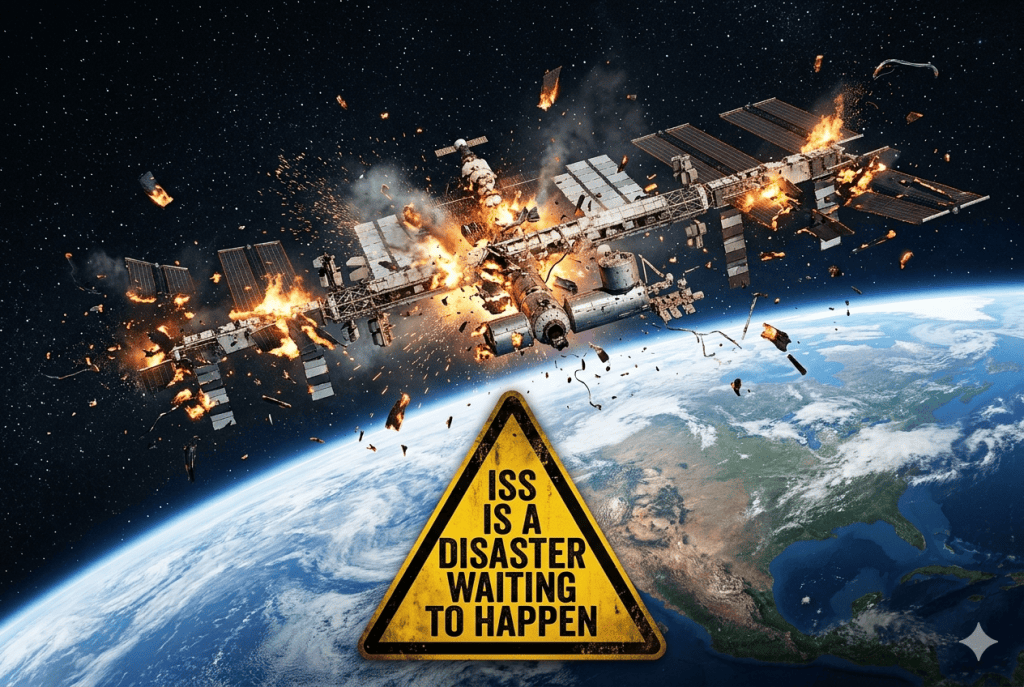
September 2019 marked the first detection of the long-running air leak associated with the Russian segment of the International Space Station. ISS module cracking later became tied to the PrK transfer tunnel, a small pressurized passage in the aft end of the Russian Zvezda Service Module. The issue has drawn attention because air leakage can be patched, measured, and operationally managed, but cracks inside a pressure vessel raise a harder engineering question: why did the cracks form in the first place?
The International Space Station is not a single spacecraft built all at once. It is a linked orbital facility assembled over many missions, operated by partner agencies from the United States, Russia, Europe, Japan, and Canada. NASA describes the station as continuously occupied since November 2000, with an international crew living and working in orbit as the facility circles Earth about every 90 minutes. Zvezda reached the station in July 2000 and enabled permanent human habitation by providing living quarters, life support, communications equipment, and docking connections.
The specific leak concern centers on the Service Module Transfer Tunnel, commonly referred to by its Russian acronym, PrK. This tunnel connects Zvezda to an aft docking area used by Russian spacecraft. The affected zone matters because it sits inside the Russian Orbital Segment, but the ISS operates as an integrated structure. Air pressure, crew movement, cargo handling, docking schedules, emergency planning, and partner decision-making all connect across national hardware boundaries.
NASA’s Office of Inspector General reported in 2024 that cracks and air leaks in the Service Module Transfer Tunnel had become a top safety risk for sustaining station operations through 2030. That does not mean the station was judged unsafe for immediate crew presence. It means the agency classified the unresolved crack and leak problem at the highest level in its risk-management system because the root cause, crack behavior, and long-term consequences remained unsettled.
The distinction between a leak and a crack is important. A leak is the measurable escape of air from the station. A crack is a structural feature in the metal that may or may not keep growing. A successful patch can reduce or stop measurable air loss without explaining whether the underlying structure has stabilized. That is why the problem remains relevant after repair attempts appear to improve pressure readings.
How the PrK Tunnel Became the Focus of Station Safety
The PrK tunnel is small compared with the full station, but its location gives it operational weight. It sits near the aft end of Zvezda, a module that supports Russian segment functions and connects to visiting vehicles. Zvezda’s design role has included life support, flight control, data processing, electrical distribution, propulsion support, and docking access. A problem inside that module does not automatically threaten every station function, but it affects a part of the station with high operational value.
NASA and Roscosmos have managed the issue for years by monitoring leak rates, inspecting suspected areas, applying sealants, and using hatch procedures to isolate the tunnel when direct access is not required. NASA’s 2025 station update on Axiom Mission 4 launch planning said pressure in the transfer tunnel had become stable after the most recent repair effort. The same NASA update made the qualification that stable pressure could mean the leaks had been sealed, or it could reflect a small amount of air crossing the hatch seal from the main station into the transfer tunnel.
That qualification explains why engineers treat the issue with caution. A pressure reading tells teams what is happening in the moment. It does not automatically identify the physical cause. Engineers need to understand whether the sealant closed the leak path, whether the measurement was affected by hatch behavior, whether unseen cracks remain, and whether structural loads are still acting on the affected metal.
The tunnel also sits within a broader station-aging picture. The first ISS modules launched in 1998, Zvezda arrived in 2000, and assembly continued for more than a decade. The station has endured thousands of thermal cycles, dockings, attitude-control maneuvers, vibration events, mechanical loads, pressure cycles, and small impacts from micrometeoroids and orbital debris. Engineers designed the station with margins, maintenance procedures, and inspection practices, but age changes the risk profile of any long-duration human spacecraft.
The PrK issue is different from routine maintenance because the cause remains debated. Replacing pumps, valves, computers, batteries, or experiment hardware fits a normal maintenance model. A crack in a pressurized module requires a structural explanation. Teams need to know whether the crack came from fatigue, residual stress, material behavior, environmental exposure, weld features, mechanical loading, pressure cycles, or a combination of causes.
The operational question is direct: can the station continue normal use of the aft Zvezda docking area without accepting an unknown structural risk? NASA and Roscosmos have continued station operations, but the hatch procedures and elevated risk rating show that the issue sits in a special category of station safety management.
The main hardware elements can be organized in a compact way to show how the affected tunnel fits inside the larger station architecture.
| Element | Location | Function | Relevance to the Issue |
|---|---|---|---|
| Zvezda Service Module | Russian Segment | Provides Living, Control, Propulsion, and Docking Functions | Contains the Affected Aft Transfer Area |
| PrK Transfer Tunnel | Aft End of Zvezda | Links Zvezda to the Aft Docking Port | Area Associated With Cracks and Air Leaks |
| Aft Docking Port | Behind the PrK Tunnel | Supports Visiting Russian Vehicles | May Be Affected if the Tunnel Requires Isolation |
| Segment Hatches | Between Station Sections | Control Internal Access and Isolation | Used to Limit Exposure During PrK Access |
Why Stopping Air Loss Does Not Solve the Structural Mystery
A spacecraft cabin is a pressure vessel. Its walls hold an internal atmosphere against the vacuum of space. Any through-wall leak requires attention because the crew depends on stable pressure, oxygen supply, nitrogen balance, and controlled atmospheric composition. The ISS can tolerate small leaks because it carries reserves and can receive supplies, but a leak changes consumables planning and can become more consequential if the rate increases.
The harder problem is crack behavior. Metal cracks can remain stable, grow slowly, grow under repeated loading, or connect with other defects. Engineers use inspection data, stress models, materials testing, fracture mechanics, and operational history to judge that behavior. A sealant patch can reduce air escape through a visible path, but it does not necessarily remove the stress field that produced the crack. It also may not reveal whether another crack path exists behind a panel, near a weld, or outside the visible interior surface.
NASA’s 2024 safety-panel report described the PrK hull cracking as a significant safety concern and said NASA and Russian teams did not share a common understanding of root cause. The panel said Russia viewed the cracking as fatigue driven by micro-vibrations, and NASA believed the cause was more complex. That difference matters because the correct repair strategy depends on the cause. Fatigue from repeated vibration points toward load cycling, monitoring, and crack-arrest analysis. A combined cause involving residual stress, material properties, pressure loading, and environmental exposure points toward a broader structural investigation.
The pressure-stability result after repairs creates a useful but incomplete sign. If the PrK tunnel holds pressure after sealing, the immediate air-loss problem may be reduced. If pressure stability results from air crossing the hatch seal into the tunnel, the apparent improvement may not mean every leak path has closed. NASA’s public wording in 2025 avoided overclaiming the result for that reason.
The distinction matters for crew risk, but it also matters for station availability. Docking ports are part of traffic management. The ISS relies on crew spacecraft, cargo spacecraft, and station-keeping support. Losing routine access through one Russian aft location would not end all ISS operations, but it would constrain Russian logistics, visiting vehicle planning, propellant use, and operational scheduling.
NASA’s 2021 ISS management audit stated that teams had not identified a full root cause at that time and that micrometeoroid or orbital debris impact appeared unlikely. The report also noted that identified cracks occurred in an area viewed as low stress based on existing models. That detail increases the engineering challenge: if cracks appear where models say they should not, teams must revisit assumptions, loads, material data, inspections, or all of those elements.
Stopping measurable air loss is valuable. It protects consumables, reduces operational burden, and lowers immediate pressure-management concerns. Yet the structural mystery remains until engineers can explain why the cracks formed, whether they have stopped growing, how much margin remains, and what operational restrictions keep the risk within acceptable limits.
Why NASA and Roscosmos Do Not See the Same Risk
The ISS partnership has survived political shocks, technical disagreements, and national program changes because the station depends on continuous cooperation. Crew safety requires coordination between NASA and Roscosmos, especially because the station’s U.S. Orbital Segment and Russian Orbital Segment remain physically connected and functionally interdependent. The PrK issue tests that cooperation because technical uncertainty has produced different risk interpretations.
NASA’s International Space Station Advisory Committee and U.S.-Russian safety discussions have described a disagreement over root cause and consequences. A public account of U.S.-Russian technical disagreement reported that Russian and American technical teams did not have a common understanding of the likely cause or severity of the PrK leaks. The Russian position emphasized high-cycle fatigue from micro-vibrations. NASA’s position treated the cracks as potentially multi-causal, involving pressure and mechanical stress, residual stress, material properties, and environmental exposure.
Two agencies can examine the same hardware and reach different risk judgments because engineering risk is a combination of evidence, models, margins, experience, and uncertainty. A leak that has remained small and manageable over years may support one view that operational controls are adequate. A crack in a pressure boundary with incomplete root-cause understanding may support another view that consequence severity demands conservative action.
NASA’s Office of Inspector General also identified an unresolved threshold question. NASA and Roscosmos had not agreed on the leak rate at which the condition would become untenable. That disagreement matters because emergency and contingency planning require decision points. If one partner believes a leak rate remains operationally manageable and another believes structural risk has moved beyond an acceptable limit, the partnership needs pre-agreed procedures to avoid delay during a pressure event.
The station crews have used procedural mitigations. When access to the PrK area is needed, NASA has used hatch-closure practices to reduce exposure of the U.S. segment. The purpose is to isolate risk during operations that require opening the affected area. This is not routine convenience; it is a protective step built around uncertainty.
Risk disagreement does not mean either agency is acting irresponsibly. It shows that root-cause uncertainty has not been closed. Roscosmos owns and operates much of the relevant hardware. NASA has responsibility for its astronauts, the integrated station, and U.S. segment operations. Each agency views the hardware through its own engineering data, design history, risk tolerance, and institutional responsibilities.
The most constructive path is a shared technical basis. Independent review, materials evidence, inspection data, pressure testing, crack-growth modeling, and transparent operational thresholds can narrow the disagreement. The ISS has always depended on technical trust. The PrK issue shows that trust requires common evidence, not simply diplomatic commitment.
Operational Choices When a Docking Tunnel Becomes a Risk Boundary
The ISS can operate with hatches closed, but hatch closures change the station’s daily rhythm. Crew members need access routes for transfers, cargo movement, inspections, maintenance, emergency response, and vehicle servicing. The PrK hatch can isolate the affected tunnel from the rest of Zvezda, but isolation changes how teams use the aft docking port and how they plan visiting vehicle operations.
NASA’s 2024 audit noted that the ISS could function if the Service Module hatch were closed permanently, but such a step would remove one cargo delivery port and require more propellant to maintain station altitude and attitude. That point illustrates why the PrK issue is not only about a small leak. The tunnel is part of a larger operational chain that includes Russian cargo vehicles, propulsion support, station reboost, vehicle traffic, and crew procedures.
The station has multiple visiting vehicle systems, but they are not interchangeable in a simple way. U.S. cargo vehicles, commercial crew vehicles, Russian Progress cargo craft, and Soyuz crew craft use different ports, interfaces, mission roles, and operational plans. Russian Progress vehicles have historically supported cargo delivery, waste removal, propellant functions, and station reboost. Any restriction on a Russian docking location affects more than storage space.
A hatch-first mitigation strategy gives operators flexibility. They can close the affected area during normal operations, open it for defined tasks, and isolate other station areas as a precaution. This approach allows work to continue without treating the leak as a station-ending condition. It also creates crew workload, planning complexity, and a recurring reminder that a pressure-boundary issue remains unresolved.
The main operating choices can be compared across safety benefit, access benefit, and practical tradeoff.
| Decision Area | Operational Option | Benefit | Tradeoff |
|---|---|---|---|
| Leak Monitoring | Track Pressure Behavior Over Time | Shows Whether Air Loss Has Returned | Does Not Prove Root Cause |
| Hatch Isolation | Keep the PrK Hatch Closed by Default | Limits Air Loss and Segment Exposure | Restricts Routine Access |
| Docking Port Use | Open the Tunnel for Defined Vehicle Tasks | Preserves Russian Traffic Capability | Requires Added Crew Procedures |
| Permanent Closure | Isolate the Tunnel Long Term | Removes the Affected Zone From Daily Use | Reduces Docking and Propulsion Flexibility |
| Independent Review | Use Outside Structural Experts | Could Align Technical Understanding | Needs Data Access and Partner Agreement |
These choices show why a small physical area can have a station-level effect. Engineers may be able to manage the leak, but station managers must decide how much operational flexibility to trade for safety margin. The answer can change as new pressure data, inspection evidence, and crack-growth analysis become available.
The PrK issue also affects launch planning. NASA and partners delayed the private Axiom Mission 4 launch opportunity in June 2025 to evaluate the latest repair and pressure behavior. That decision showed how station configuration can influence missions that are not directly part of the Russian segment. A visiting crew mission requires confidence in station conditions at arrival, docking, mission execution, and departure.
What Aging Hardware Means for ISS Operations Through 2030
NASA and its partners intend to operate the ISS through 2030, subject to safety and partner commitments. The United States plans to transition low Earth orbit activity from the government-owned station to commercially owned and operated destinations, as described in NASA’s ISS transition plan. The PrK cracking issue does not erase that plan, but it makes the remaining years of ISS operation more demanding.
Aging spacecraft do not fail simply because they pass a calendar date. They accumulate wear through cycles, loads, radiation, contamination, vibration, maintenance actions, repairs, and changing operating conditions. Engineers decide whether continued operation is acceptable by looking at inspection results, failure modes, spare parts, margins, consumables, logistics, crew procedures, and emergency options. The station’s age makes every unresolved structural question more important because the remaining operating period is finite and replacement platforms are not yet fully operational.
NASA’s 2024 audit described supply-chain and maintenance concerns as the station approaches 2030. Parts become harder to source as suppliers leave production, hardware ages beyond original planning horizons, and operational budgets shift toward new programs. A leak in an older module fits this wider pattern. The station can keep producing science and supporting crews, but managers must spend more effort preserving margins.
The planned end of ISS operations also shapes the risk calculus. If the station were intended to operate for decades more, partners might face pressure to design a deep structural repair or replacement architecture. With retirement planned near 2030, the main question becomes whether the PrK issue can be managed safely through the remaining operating period without sacrificing too much capability or accepting too much uncertainty.
NASA selected SpaceX in 2024 to develop the U.S. Deorbit Vehicle, with a total potential contract value of $843 million, excluding the future launch service. The vehicle is intended to help deorbit the station in a controlled manner after the end of its operational life. That deorbit planning is connected to the PrK issue in a practical way: NASA needs the station to remain controllable and safe long enough to reach an orderly retirement.
Commercial station planning is the other half of the transition. NASA’s commercial space stations strategy depends on new destinations becoming available so research, astronaut training, technology demonstrations, and private activity in low Earth orbit can continue after ISS retirement. If ISS risks grow faster than commercial stations mature, the United States and its partners could face a gap in crew-capable orbital research infrastructure.
The PrK cracks do not by themselves decide the future of low Earth orbit. They do show why transition timing matters. The ISS remains productive, but its most difficult maintenance problems are becoming strategic issues. They affect science scheduling, commercial missions, deorbit planning, partner trust, and the pace at which replacement stations need to move from development into service.
Space Economy Lessons From a Small Structural Problem
A crack in a Russian transfer tunnel may sound like a narrow engineering issue, yet it carries lessons for the wider space economy. Human spaceflight infrastructure depends on maintenance, standards, inspection, logistics, insurance, procurement, data-sharing, and independent verification. The ISS has spent more than two decades proving the value of orbital research, but the PrK problem shows that long-duration infrastructure is a continuing service obligation, not a one-time construction achievement.
Commercial low Earth orbit providers will inherit some of these lessons. Future stations will need inspection access, replaceable components, conservative pressure-vessel design, hatch isolation plans, docking redundancy, spare-part strategies, data transparency, and clear customer-safety rules. A commercial station selling services to governments, researchers, pharmaceutical companies, media producers, manufacturers, and private astronaut providers cannot treat structural health as an internal technical matter alone. Customers, insurers, regulators, and public agencies will need confidence in the operator’s safety case.
The ISS experience also shows the value of operational redundancy. Multiple docking ports, multiple crew vehicles, multiple cargo providers, and segmented pressure boundaries give managers options. Redundancy costs money and adds mass, but it can preserve operations when one area becomes restricted. A future commercial station optimized only for low cost could face hard tradeoffs if it lacks backup access routes or isolation zones.
Regulation will also adapt. Commercial stations will sit at the boundary between spacecraft licensing, crew safety, customer protection, government procurement, export controls, liability, and international agreements. NASA will become one customer among others, but it will remain a demanding customer because astronaut safety and national research continuity require documented margins. The PrK issue gives future buyers a concrete reason to ask how station operators will inspect pressure structures after years of service.
Insurance and finance also intersect with the issue. Investors funding commercial stations will look at technical risk, revenue timing, customer concentration, and station lifetime. Structural-health monitoring can become part of the financial case because it affects availability, mission cadence, and lifetime revenue. A station with better inspection systems and clearer repair procedures may be more bankable than a station with lower upfront cost and weaker long-term maintenance visibility.
The defense and security dimension should not be overlooked. Human-tended platforms in low Earth orbit can support research, communications demonstrations, Earth-observation technology development, and operational knowledge that matters to national space capabilities. A station hardware issue that disrupts crew access or forces early retirement could affect government research plans and allied cooperation. Civilian space infrastructure has security value because it sustains skills, industrial capacity, and orbital operations experience.
ISS module cracking inside the PrK tunnel is a reminder that orbital infrastructure ages in public view. The issue is small in physical size, but it touches the future of human activity in low Earth orbit. The next generation of stations will be judged partly by how well they learn from this kind of unresolved engineering problem.
Summary
The PrK leak story has moved from air loss to structural uncertainty. Recent repair activity may have stopped measurable leakage, but the central question remains open: what caused the cracks, and what do they mean for the remaining operating life of the station? Until NASA and Roscosmos share a common technical explanation, hatch procedures, pressure monitoring, independent review, and conservative mission planning will remain part of the operating environment.
The ISS has always been more than a laboratory. It is a diplomatic project, an engineering testbed, a cargo and crew transportation hub, a commercial platform, and a bridge to future stations. Its aging hardware now offers a practical lesson for the next era: long-duration space infrastructure needs inspectability, redundancy, transparent risk thresholds, and repair strategies that address causes rather than symptoms.
The station can continue producing value through research, technology testing, international cooperation, and commercial missions. Its final years require disciplined risk management. A leak can be sealed. A structural mystery demands a stronger answer.
Appendix: Useful Books Available on Amazon
- Endurance
- The International Space Station
- International Space Station: Architecture Beyond Earth
- Creating the International Space Station
- The Story of Space Station Mir
Appendix: Top Questions Answered in This Article
What Part of the ISS Has Been Leaking?
The leak concern is associated with the PrK transfer tunnel in the Russian segment of the International Space Station. The PrK is a small pressurized passage at the aft end of the Zvezda Service Module. It connects Zvezda to a docking area used by Russian visiting vehicles.
Does Stopping the Leak Mean the Crack Problem Is Solved?
Stopping measurable air loss does not automatically solve the structural problem. A sealant can block a leak path without identifying why the crack formed. Engineers still need to understand root cause, crack stability, possible crack growth, and the remaining safety margin in the affected metal.
Is the Crew in Immediate Danger?
Public NASA and safety-panel discussions have treated the issue as a high station risk, but not as an immediate crew-danger condition requiring evacuation. The operational response has focused on monitoring, repair attempts, hatch isolation, and conservative procedures during access to the affected area.
Why Do NASA and Roscosmos Disagree?
NASA and Roscosmos have interpreted the likely cause and consequences differently. Russian specialists have emphasized fatigue driven by micro-vibrations. NASA has described the likely cause as more complex, involving factors such as mechanical stress, residual stress, material properties, and environmental exposure.
Why Is the PrK Tunnel Operationally Important?
The PrK tunnel connects Zvezda to an aft docking area used by Russian spacecraft. If the tunnel were permanently isolated, the station could lose access to one docking pathway. That would affect cargo planning, visiting vehicle schedules, and some station-control operations tied to Russian segment functions.
What Does Hatch Isolation Do?
Hatch isolation limits the effect of air loss or a pressure problem by separating one pressurized area from another. Crews can keep the PrK hatch closed during normal operations and open it only for defined tasks. NASA has also used extra hatch precautions when the tunnel is accessed.
Why Does the ISS Still Matter if It Will Retire Near 2030?
The ISS remains a major research, training, and technology platform. It supports astronaut operations, microgravity science, commercial missions, and international cooperation. Its final years also shape the transition to commercial low Earth orbit stations and the controlled deorbit plan.
What Is the U.S. Deorbit Vehicle?
The U.S. Deorbit Vehicle is a spacecraft NASA selected SpaceX to develop for controlled ISS disposal after the station’s operational life ends. The vehicle is intended to help guide the large orbital facility safely into Earth’s atmosphere rather than leaving deorbit control to aging station systems alone.
How Does This Issue Affect Commercial Space Stations?
Future commercial stations can learn from the PrK problem by designing for inspection, isolation, redundancy, and long-term repair access. Operators will need clear safety cases for customers, insurers, regulators, and government users. Structural-health monitoring will become part of station business credibility.
What Is the Main Lesson From ISS Module Cracking?
The main lesson is that orbital infrastructure needs long-term structural management. Air leaks can sometimes be patched, but unexplained cracking requires deeper analysis. Future stations will need better ways to detect, explain, repair, and certify pressure-boundary issues after many years in orbit.
Appendix: Glossary of Key Terms
International Space Station
The International Space Station is a crewed orbital laboratory operated by a partnership involving NASA, Roscosmos, the European Space Agency, the Japan Aerospace Exploration Agency, and the Canadian Space Agency. It has supported continuous human presence in orbit since November 2000.
Zvezda Service Module
Zvezda is a Russian module of the International Space Station that arrived in 2000. It provides living space, life support, flight-control functions, communications support, propulsion-related functions, and docking access within the Russian segment.
PrK Transfer Tunnel
The PrK transfer tunnel is a small pressurized passage at the aft end of Zvezda. It connects the main service module to an aft docking area and has been associated with the station’s long-running crack and leak concern.
Pressure Vessel
A pressure vessel is a structure that holds gas at a different pressure from its surroundings. In a spacecraft, pressurized modules hold breathable atmosphere against the vacuum of space, making crack behavior and leak control important safety concerns.
Roscosmos
Roscosmos is Russia’s state space corporation and NASA’s main Russian counterpart for ISS operations. It operates the Russian segment of the station and coordinates with NASA on crew operations, visiting vehicles, technical investigations, and station safety.
NASA Office of Inspector General
The NASA Office of Inspector General is an independent oversight office that audits NASA programs and investigates management issues. Its reports have examined ISS operations, aging hardware, deorbit planning, commercial low Earth orbit transition, and station safety risks.
Aerospace Safety Advisory Panel
The Aerospace Safety Advisory Panel is an independent body that advises NASA on safety matters. Its annual reports review human spaceflight risks, program management concerns, technical hazards, and agency responses to safety issues.
Commercial Low Earth Orbit Destinations
Commercial Low Earth Orbit Destinations are privately owned or operated orbital platforms intended to succeed some ISS functions. NASA plans to buy services from these stations rather than own the next generation of low Earth orbit research infrastructure.
U.S. Deorbit Vehicle
The U.S. Deorbit Vehicle is NASA’s planned spacecraft for controlled disposal of the International Space Station after its operational life. SpaceX was selected to develop the vehicle under a NASA contract announced in 2024.
Hatch Isolation
Hatch isolation is the practice of closing internal station hatches to separate one pressurized area from another. It can reduce air loss, limit crew exposure, and preserve time for response if a pressure anomaly occurs.