Key Takeaways
- The Artemis II crew consists of Reid Wiseman, Victor Glover, Christina Koch, and Jeremy Hansen, representing diverse backgrounds.
- This mission marks the first time a woman, a person of color, and an international partner will travel beyond low Earth orbit.
- The four astronauts will validate the Orion spacecraft’s life support and manual piloting systems during a lunar flyby.
Introduction
The selection of the crew for the Artemis II mission marks a distinct shift in the history of human spaceflight. For the first time in over half a century, humans are preparing to leave the protective embrace of low Earth orbit to venture toward the Moon. The four individuals chosen for this assignment – Commander Reid Wiseman, Pilot Victor Glover, Mission Specialist Christina Koch, and Mission Specialist Jeremy Hansen – represent a significant evolution from the astronaut corps of the Apollo era. Their collective experience encompasses naval aviation, engineering, biological science, and international cooperation. This article examines the professional histories, specific roles, and training backgrounds of these four astronauts who are tasked with validating the Orion spacecraft and the Space Launch System for future lunar landings.
Commander G. Reid Wiseman
Leading the mission is Gregory Reid Wiseman, a seasoned naval aviator and former Chief of the Astronaut Office. Wiseman brings a wealth of leadership experience and technical operational knowledge to the commander’s seat. His path to the Moon began in Baltimore, Maryland, and led him through the rigorous academic environment of Rensselaer Polytechnic Institute, where he earned a Bachelor of Science degree in Computer and Systems Engineering. He later obtained a Master of Science in Systems Engineering from Johns Hopkins University.
Wiseman commissioned through the Reserve Officers’ Training Corps (ROTC) and became a Naval Aviator in 1999. His military career is defined by high-performance flight operations. He flew the F/A-18F Super Hornet with Strike Fighter Squadron 103, known as the “Jolly Rogers,” and deployed to the Middle East. Following his operational tours, Wiseman attended the United States Naval Test Pilot School. As a test pilot, he worked on various programs, including the F-35C Lightning II and the F/A-18 weapons separation programs. This background in developmental flight testing is directly applicable to Artemis II, which is fundamentally a test flight designed to wring out the systems of a new spacecraft.
NASA selected Wiseman as an astronaut in 2009. His first journey to space occurred in 2014 aboard a Russian Soyuz spacecraft for Expedition 40/41 to the International Space Station. During this 165-day mission, Wiseman conducted numerous scientific experiments and performed two spacewalks totaling nearly 13 hours. His social media presence during this mission was notable for bringing the experience of spaceflight to a broader public audience. Following his return, Wiseman served in various technical capacities before assuming the role of Chief of the Astronaut Office in 2020. In this position, he was responsible for managing Astronaut Office resources, operations, and safety programs. He stepped down from this management role to return to the active flight rotation, a move that positioned him for the Artemis assignment.
As Commander of Artemis II, Wiseman holds primary responsibility for mission success and crew safety. He will oversee all phases of the flight, from launch to splashdown. His role involves coordinating communication between the spacecraft and Mission Control at the Johnson Space Center, making real-time decisions during dynamic flight phases, and monitoring the vehicle’s health. The commander sets the tone for the crew, ensuring that the team remains cohesive and focused during the ten-day journey around the Moon.
Pilot Victor Glover
Occupying the pilot’s seat is Victor J. Glover Jr., an astronaut whose career has been marked by firsts and high-stakes operational roles. Glover hails from Pomona, California, and possesses a deep academic background in engineering. He holds a Bachelor of Science in General Engineering from California Polytechnic State University and multiple master’s degrees, including a Master of Science in Flight Test Engineering form the U.S. Air Force University and a Master of Science in Systems Engineering from the Naval Postgraduate School.
Glover’s military career mirrors the intensity required for lunar missions. He is a captain in the U.S. Navy and served as a test pilot, flying more than 3,000 hours in over 40 different aircraft. He has completed over 400 carrier arrested landings and 24 combat missions. Like Wiseman, Glover is a graduate of the U.S. Naval Test Pilot School. This shared lineage creates a common operational language between the commander and pilot, which is vital for the coordination required to manually fly the Orion capsule during proximity operations.
Selected as an astronaut in 2013, Glover gained significant public attention as the pilot of the SpaceX Crew-1 mission in 2020. This was the first operational flight of the Crew Dragon spacecraft to the International Space Station. During his 168 days in orbit, Glover served as a flight engineer for Expedition 64/65. He participated in four spacewalks and contributed to extensive scientific research. Glover is the first person of color to be assigned to a lunar mission, a milestone that reflects the broader demographics of the modern astronaut corps compared to previous eras.
On Artemis II, Glover’s title of “Pilot” is functional, not just ceremonial. While much of the spacecraft’s trajectory is automated or controlled from the ground, the Artemis II profile includes specific objectives that require manual control. Glover will take the controls of Orion after it separates from the Interim Cryogenic Propulsion Stage (ICPS) to perform a proximity operations demonstration. He will manually maneuver the spacecraft to align with a target on the spent rocket stage, simulating the docking procedures that will be required for future missions involving the Starship HLS lander. This task demands precise hand-eye coordination and a deep understanding of orbital mechanics.
Mission Specialist Christina Koch
Christina Hammock Koch serves as Mission Specialist 1. Her career is characterized by endurance, scientific rigor, and exploration in extreme environments. Born in Grand Rapids, Michigan, and raised in Jacksonville, North Carolina, Koch attended North Carolina State University, where she earned Bachelor of Science degrees in Electrical Engineering and Physics, followed by a Master of Science in Electrical Engineering. Her technical expertise focuses on space science instrument development, a skill set she honed while working at the NASA Goddard Space Flight Center.
Before joining the astronaut corps, Koch’s career took her to some of the most remote locations on Earth. She worked as a Research Associate in the United States Antarctic Program, spending a year and a half on the ice, including a winter-over at the Amundsen-Scott South Pole Station. She also worked as an electrical engineer at the Johns Hopkins University Applied Physics Laboratory and at remote scientific outposts in American Samoa and Greenland for the National Oceanic and Atmospheric Administration. This experience in austere, isolated environments is considered excellent preparation for deep space exploration, where self-reliance and psychological resilience are paramount.
NASA selected Koch as part of the 2013 astronaut class, the same group as Victor Glover. Her first spaceflight set a new standard for female astronauts. Launching in March 2019, she remained on the International Space Station for 328 days, setting the record for the longest single spaceflight by a woman. During this marathon mission, she participated in the first all-female spacewalk alongside Jessica Meir. Koch’s prolonged exposure to microgravity provides researchers with valuable data regarding the long-term effects of spaceflight on the female body, information that is relevant for planning Mars missions.
As a Mission Specialist on Artemis II, Koch brings an engineering mindset to the operation of the spacecraft’s systems. Her responsibilities include monitoring life support metrics, managing cargo and stowage, and assisting with navigation checks. Given her background in electrical engineering and instrument development, she acts as a systems expert capable of troubleshooting hardware issues that might arise during the flight. Koch represents the scientific objectives of the Artemis program, ensuring that even on a test flight, the crew maximizes the opportunity to gather data on the radiation environment of deep space.
Mission Specialist Jeremy Hansen
Rounding out the crew is Mission Specialist 2, Jeremy Hansen. Hansen’s inclusion represents a major geopolitical shift in lunar exploration. He is an astronaut with the Canadian Space Agency, making him the first non-American to travel to the Moon. Born in London, Ontario, and raised on a farm near Ailsa Craig, Ontario, Hansen’s background combines military discipline with scientific curiosity. He holds a Bachelor of Science in Space Science and a Master of Science in Physics from the Royal Military College of Canada.
Hansen served as a fighter pilot in the Royal Canadian Air Force, flying the CF-18 Hornet. His military service included roles in combat operations, similar to his American counterparts. He was selected by the CSA in 2009, making him one of the longest-serving active astronauts in the Canadian corps. Although Artemis II is his first trip to space, Hansen has extensive training experience. He served as a Capcom (Capsule Communicator) at NASA Mission Control, becoming the first Canadian to be entrusted with the lead Capcom role for a specific mission schedule.
Hansen’s training has been multifaceted. He participated in the European Space Agency’s CAVES program, where astronauts live and work in underground cave systems to simulate the isolation and danger of space exploration. He also commanded a NEEMO (NASA Extreme Environment Mission Operations) mission, living underwater off the coast of Florida to test exploration concepts. These analog missions are designed to test crew dynamics and leadership in high-stress environments.
On Artemis II, Hansen’s role as Mission Specialist involves oversight of the spacecraft’s systems and contributing to the timeline of mission activities. His presence validates the international partnership framework of the Artemis Accords. The inclusion of a Canadian astronaut is a direct result of Canada’s contribution of the Canadarm3 robotics system for the future Lunar Gateway. Hansen serves as the representative for the global community, symbolizing the transition from the superpower competition of the 1960s to the cooperative exploration model of the 21st century.
Crew Dynamics and Shared History
The cohesion of a spaceflight crew is a determining factor in mission success. The Artemis II quartet was not thrown together at random. Wiseman, Glover, Koch, and Hansen have known each other for over a decade. Wiseman and Hansen were both selected in 2009 (Wiseman by NASA, Hansen by the CSA) and underwent basic astronaut candidate training around the same time. Glover and Koch were classmates in the 2013 selection group. This long-standing professional familiarity reduces the friction that can occur during high-stress operations.
Their training flow for Artemis II began shortly after their assignment was announced in early 2023. Unlike ISS training, which focuses heavily on orbital maintenance and scientific experiments within a large, stable laboratory, Artemis training focuses on the Orion capsule’s specific flight profiles. The crew spends hundreds of hours in high-fidelity simulators at the Johnson Space Center. These simulations cover every phase of the mission, from launch abort scenarios to lunar trajectory insertion burns and Earth entry interface.
The team also engages in geology training, despite Artemis II being a flyby mission. This training ensures they can accurately observe and photograph lunar features from orbit, refining the observation protocols for the Artemis III surface landing crew. They have conducted field training in geological locations on Earth to practice describing landscapes and identifying geological context, a skill that will be used when they pass within a few thousand miles of the lunar far side.
The Mission Profile and Crew Duties
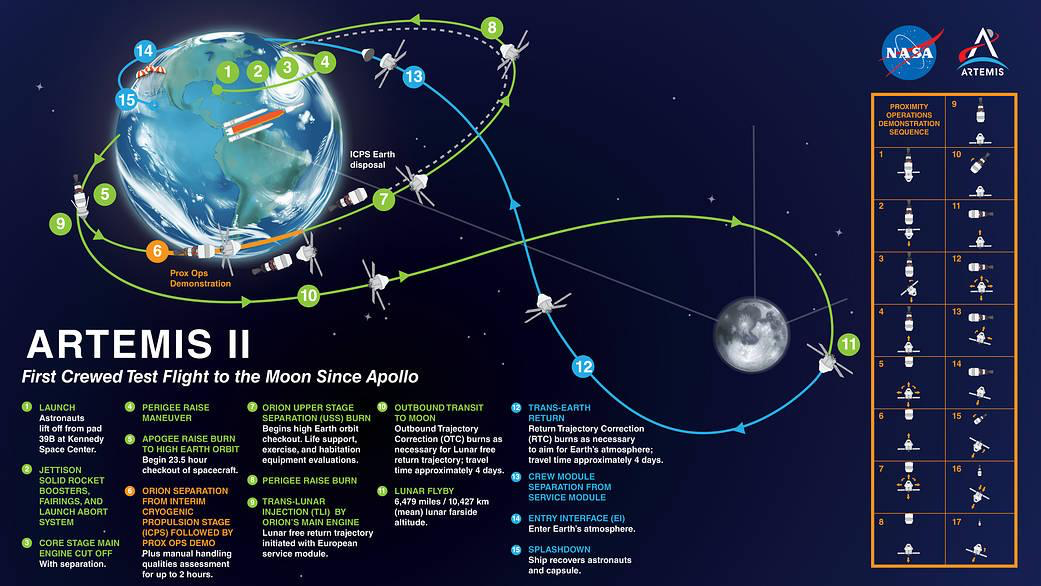
Artemis II is a ten-day mission designed to verify that Orion is safe for humans. The profile is unique compared to Apollo missions. After launching from the Kennedy Space Center atop the SLS rocket, the crew enters a high Earth orbit rather than going immediately to the Moon. This orbit, with an apogee of roughly 37,000 miles, takes about 24 hours to complete.
During this 24-hour period in high Earth orbit, the crew is busiest. Wiseman and Glover conducts the proximity operations demonstration with the ICPS. Koch and Hansen will assist in verifying the functionality of the life support systems, exercise equipment, and radiation sensors. This phase is designed to ensure that if any critical life support system fails, the spacecraft is still in an orbit that allows for a rapid return to Earth – a “free return” trajectory of sorts relative to Earth gravity, before they commit to the lunar injection burn.
Once the systems are verified, the crew executes the Trans-Lunar Injection (TLI) burn. This maneuver propels them away from Earth and toward the Moon. The journey to the Moon takes four days. During the coast phase, the crew monitors systems, performs public outreach broadcasts, and conducts trajectory correction burns if necessary. The flyby does not involve entering lunar orbit. Instead, Orion uses the Moon’s gravity to sling itself back toward Earth. This “hybrid free return” trajectory ensures that the spacecraft returns to Earth naturally without requiring a major propulsion burn at the Moon, adding a layer of safety for this first crewed flight.
The return trip takes another four days, culminating in a high-speed reentry into Earth’s atmosphere. The crew experiences temperatures near 5,000 degrees Fahrenheit as the heat shield ablates. Splashdown occurs in the Pacific Ocean, where U.S. Navy recovery teams, working in coordination with NASA, retrieve the crew and the capsule.
Technical Competency and Vehicle Specifics
The transition from the Space Shuttle and Soyuz eras to the Orion vehicle requires the crew to master a new interface. Orion utilizes a “glass cockpit” with three main display screens and minimal physical switches compared to the Space Shuttle. The crew interacts with the vehicle primarily through software-based procedures. Wiseman and Glover, as the pilots, must master the “cursor control devices” and hand controllers that allow them to interface with the displays and maneuver the spacecraft.
The crew must also be intimately familiar with the European Service Module (ESM), provided by the European Space Agency. The ESM provides power, propulsion, and life support consumables. Understanding the ESM’s schematics and failure modes is a major part of the Mission Specialists’ training. Koch and Hansen study the flow of oxygen, water, and thermal control fluids between the ESM and the crew module. In an emergency, their ability to diagnose a leak or a pump failure could be the difference between mission continuation and an abort.
Physical and Psychological Preparation
Preparation for a lunar mission differs significantly from preparation for the International Space Station. ISS missions are long-duration, requiring stamina and the ability to manage a marathon pace. Artemis II is a sprint. The ten-day duration means the timeline is packed with activities, and the physical confinement is more severe. The Orion capsule offers roughly 316 cubic feet of habitable volume, which is significantly less frequent living space than the sprawling space station. The four astronauts will live in close quarters, sharing hygiene facilities and sleep stations.
The crew trains for this confinement through simulations that mimic the timeline of the actual mission. They practice food preparation, hygiene, and sleep shifts. Psychological support is less about managing long-term isolation and more about managing acute stress and fatigue. The crew must be rested enough to perform critical burns and reentry procedures.
Physical training focuses on upper body strength and cardiovascular health to withstand the high G-forces of launch and reentry. Unlike ISS crews who return with muscle atrophy despite exercise, the Artemis II crew will not experience significant degradation over ten days, but the reentry forces (up to 4G) are higher than what Soyuz or Dragon crews typically experience during standard returns, due to the higher velocity of returning from the Moon (Mach 32 vs Mach 25).
Historical Context and Legacy
The selection of this crew draws inevitable comparisons to the Apollo 8 crew, who were the first humans to orbit the Moon. However, the Artemis II crew reflects a broader cross-section of humanity. The inclusion of Koch and Glover addresses the historical exclusion of women and people of color from the early space age. The inclusion of Hansen signifies the end of the Cold War model of space exploration, where nations competed for dominance.
Books such as The Right Stuff chronicled the era of the Mercury 7, a homogenous group of military test pilots. The Artemis II crew illustrates how the definition of “the right stuff” has expanded to include diverse technical backgrounds and life experiences. While Wiseman and Glover fit the traditional pilot mold, Koch’s background in Antarctic science and Hansen’s role as an international partner broaden the narrative.
Movies like Apollo 13 dramatized the dangers of lunar spaceflight. The Artemis II crew studies these historical precedents to understand the risks. They analyze the failure modes of previous spacecraft to ensure they are prepared for contingencies. The lessons learned from the Apollo program are integrated into their flight rules and emergency procedures.
Summary
The Artemis II crew comprises four distinct individuals united by a single objective: to prove that humanity is ready to return to the Moon. Reid Wiseman, Victor Glover, Christina Koch, and Jeremy Hansen bring a synthesis of piloting skill, engineering acumen, and scientific discipline to the mission. Their flight will test the limits of the Orion spacecraft and pave the way for sustainable lunar exploration. As they prepare to launch, they carry not only the technical responsibility of the machinery they operate but also the aspirations of a global community looking outward to the stars.
10 Best Selling Books About NASA Artemis Program
NASA’s Artemis Program: To the Moon and Beyond by Paul E. Love
This book presents a plain-language tour of the NASA Artemis program, focusing on how the modern Moon campaign connects the Space Launch System, Orion spacecraft, and near-term Artemis missions into a single lunar exploration roadmap. It emphasizes how Artemis fits into long-duration human spaceflight planning, including systems integration, mission sequencing, and the broader Moon-to-Mars framing.
NASA’s Artemis Program: The Next Step – Mars! by Paul E. Love
This book frames Artemis as a stepping-stone campaign, describing how lunar missions are used to mature deep-space operations, crew systems, and mission architectures that can be adapted beyond cislunar space. It connects Artemis mission elements – such as Orion and heavy-lift launch – back to longer-horizon human spaceflight planning and the operational experience NASA expects to build on the Moon.
The Artemis Lunar Program: Returning People to the Moon by Manfred “Dutch” von Ehrenfried
This book provides a detailed narrative of the Artemis lunar program’s rationale, structure, and constraints, including how policy, budget realities, and technical dependencies shape mission design and timelines. It places current lunar exploration decisions in context by contrasting Artemis-era choices with Apollo-era precedents and post-Apollo program history.
Returning People to the Moon After Apollo: Will It Be Another Fifty Years? by Pat Norris
This book examines the practical obstacles to sustained lunar return after Apollo and explains how modern programs – including Artemis – try to solve persistent challenges like cost growth, schedule instability, and shifting political priorities. It focuses on the engineering and program-management realities that determine whether a lunar initiative becomes repeatable human spaceflight or remains a one-off effort.
The Space Launch System: NASA’s Heavy-Lift Rocket and the Artemis I Mission by Anthony Young
This book explains the Space Launch System as the heavy-lift backbone for early Artemis missions and uses Artemis I to illustrate how design tradeoffs translate into flight test priorities. It describes how a modern heavy-lift rocket supports lunar exploration objectives, including Orion mission profiles, integration complexity, and mission assurance requirements for human-rated systems.
NASA’s SPACE LAUNCH SYSTEM REFERENCE GUIDE (SLS V2 – August, 2022): NASA Artemis Program From The Moon To Mars by National Aeronautics and Space Administration
This reference-style book concentrates on the Space Launch System’s role in the NASA Moon program, presenting the vehicle as an enabling capability that links Artemis mission cadence to payload and performance constraints. It is organized for readers who want an SLS-centered view of Artemis missions, including how heavy-lift launch supports Orion and the broader lunar exploration architecture.
RETURN TO THE MOON: ORION REFERENCE GUIDE (ARTEMIS 1 PROJECT) by Ronald Milione
This book focuses on the Orion spacecraft and uses Artemis I as the anchor mission for explaining Orion’s purpose, deep-space design, and how it fits into NASA’s lunar exploration sequencing. It presents Orion as the crewed element that bridges launch, cislunar operations, and reentry, highlighting how Artemis missions use incremental flight tests to reduce risk before crewed lunar flights.
Artemis Plan: NASA’S Lunar Exploration Program Overview: Space Launch System (SLS) – Orion Spacecraft – Human Landing System (HLS) by National Aeronautics and Space Administration
This book presents a program-level overview of Artemis, treating the Space Launch System, Orion, and the Human Landing System as an integrated lunar campaign rather than separate projects. It reads like a structured briefing on how NASA organizes lunar exploration missions, with attention to architecture choices, mission roles, and how the components fit together operationally.
Artemis After Artemis I: A Clear Guide to What’s Next for NASA’s Moon Program, 2026-2027 and Beyond by Billiot J. Travis
This book describes the post–Artemis I pathway and focuses on how upcoming crewed flights and landing preparations change operational demands for Orion, launch operations, and lunar mission readiness. It is written for readers tracking the Artemis schedule and mission sequencing who want a straightforward explanation of what has to happen between major milestones.
Artemis: Back to the Moon for Good: The Complete Guide to the Missions, the Technology, the Risks, and What Comes Next by Frank D. Brett
This book summarizes Artemis missions and associated lunar exploration systems in a single narrative, tying together mission purpose, technology elements, and the operational steps NASA uses to progress from test flights to sustained lunar activity. It emphasizes practical comprehension of Artemis hardware and mission flow for adult, nontechnical readers following lunar exploration and human spaceflight planning.
Appendix: Top 10 Questions Answered in This Article
Who are the members of the Artemis II crew?
The crew consists of Commander Reid Wiseman, Pilot Victor Glover, Mission Specialist Christina Koch, and Mission Specialist Jeremy Hansen. They were selected to represent a diverse range of skills and backgrounds, including naval aviation and engineering.
What is the primary objective of the Artemis II mission?
The main objective is to validate the systems of the Orion spacecraft and the Space Launch System rocket with humans on board. This includes testing life support, manual piloting capabilities, and communication systems during a lunar flyby.
Who is the first woman assigned to a lunar mission?
Christina Koch is the first woman assigned to a lunar mission. She serves as a Mission Specialist and holds the record for the longest single spaceflight by a woman from her previous time on the International Space Station.
Who is the first person of color assigned to a lunar mission?
Victor Glover is the first person of color to be assigned to a lunar mission. He serves as the Pilot for Artemis II and previously flew on the SpaceX Crew-1 mission to the International Space Station.
Why is a Canadian astronaut on the Artemis II crew?
Jeremy Hansen is on the crew as part of the partnership between NASA and the Canadian Space Agency (CSA). His inclusion recognizes Canada’s contributions to the Artemis program, specifically the Canadarm3 robotics system for the Lunar Gateway.
What role does Commander Reid Wiseman play?
As Commander, Reid Wiseman is responsible for the overall success of the mission and the safety of the crew. He oversees communication with Mission Control, makes real-time operational decisions, and manages the crew’s timeline and health.
What specific piloting task will Victor Glover perform?
Victor Glover will perform a proximity operations demonstration in high Earth orbit. He will manually control the Orion spacecraft to maneuver it near the spent Interim Cryogenic Propulsion Stage to simulate docking procedures for future missions.
How does the Artemis II flight profile differ from Apollo missions?
Unlike Apollo missions that went straight to the Moon, Artemis II includes a 24-hour stay in high Earth orbit to check systems before leaving for the Moon. Additionally, Artemis II is a flyby mission that uses a “hybrid free return” trajectory rather than entering a low lunar orbit.
What is Jeremy Hansen’s background before becoming an astronaut?
Jeremy Hansen was a fighter pilot in the Royal Canadian Air Force, flying the CF-18 Hornet. He has a background in Space Science and Physics and has participated in extensive training simulations, including cave and underwater expeditions.
How long will the Artemis II mission last?
The mission is scheduled to last approximately ten days. This duration allows enough time to travel to the Moon, loop around the far side, and return to Earth while verifying all critical spacecraft systems.
Appendix: Top 10 Frequently Searched Questions Answered in This Article
When was the Artemis II crew announced?
The crew for Artemis II was publicly announced in early 2023. This announcement initiated their specific mission training flow at the Johnson Space Center.
Is Artemis II landing on the Moon?
No, Artemis II will not land on the Moon. It is a lunar flyby mission designed to orbit the Moon and return to Earth to test the spacecraft’s systems before a landing attempt on Artemis III.
What spacecraft will the Artemis II crew use?
The crew will travel in the Orion spacecraft. This vehicle is designed specifically for deep space exploration and includes a crew module for the astronauts and a service module for propulsion and power.
Has Jeremy Hansen flown in space before?
No, Artemis II will be Jeremy Hansen’s first trip to space. He is a veteran astronaut regarding tenure and training with the Canadian Space Agency but has not yet flown on a mission.
What records does Christina Koch hold?
Christina Koch holds the record for the longest single spaceflight by a woman, at 328 days. She also participated in the first all-female spacewalk during her time on the International Space Station.
What is the role of the European Service Module?
The European Service Module (ESM) provides electricity, water, oxygen, and propulsion for the Orion spacecraft. The crew, particularly the Mission Specialists, train extensively to understand its systems and monitor its performance.
How far will the Artemis II crew travel from Earth?
The crew will travel approximately 230,000 miles to the Moon and then roughly 6,400 miles beyond the lunar far side. This trajectory will take them further into deep space than any humans have traveled since the Apollo program.
What is the background of the Artemis II pilot?
The pilot, Victor Glover, is a U.S. Navy Captain and test pilot with over 3,000 flight hours. He has an engineering background and previously served as the pilot for the SpaceX Crew-1 mission to the ISS.
How does the crew train for the mission?
The crew trains using high-fidelity simulators at Johnson Space Center that replicate the Orion cockpit. They also practice water survival for splashdown, geology for lunar observation, and medical procedures for in-flight emergencies.
Will the Artemis II crew spacewalk?
No, there are no spacewalks (EVAs) planned for the Artemis II mission. The crew will remain inside the pressurized Orion capsule for the entire ten-day duration of the flight.