- Key Takeaways
- The Name Came First
- What Golden Dome Actually Is
- Why Washington Thinks It Matters
- The Iron Dome Analogy Misleads More Than It Helps
- Coverage Means Different Things
- The Best Early Returns Are Likely in Seeing, Not Shooting
- Boost-Phase Defense Is the Seductive Core
- Space-Based Interceptors and the Math Problem
- Barrages Break Elegant Diagrams
- The Decoy Problem Never Went Away
- Hypersonic Threats Do Not Fit Neatly into Legacy Layers
- Orbit Is Not a Sanctuary
- Software Might Be the Hidden Single Point of Failure
- The Money Problem Is Not Separate from the Engineering Problem
- What a Skeptical Estimate of Coverage Effectiveness Looks Like
- Strategic Side Effects
- Summary
- Appendix: Top 10 Questions Answered in This Article
Key Takeaways
- Golden Dome is still a shifting architecture, not a finished national shield.
- Better sensing is likely sooner than dependable nationwide interception.
- Cost, barrages, decoys, cyber risk, and space attack weaken the grand promise.
The Name Came First
As of March 27, 2026, Golden Dome is less a deployed shield than a political and procurement umbrella for a much broader homeland air and missile defense push. Its formal origin was the January 27, 2025 executive order titled “The Iron Dome for America,” which directed the Pentagon to produce a reference architecture, requirements, and an implementation plan for a next-generation missile defense shield. That order did not create a single finished design. It created a mandate, a deadline, and a list of desired parts.
The order’s list was strikingly ambitious. It called for defense against ballistic missiles, hypersonic glide vehicles, advanced cruise missiles, and other next-generation aerial attacks from peer, near-peer, and rogue adversaries. It also directed acceleration of the Hypersonic and Ballistic Tracking Space Sensor layer, development of proliferated space-based interceptors for boost-phase intercept, underlayer and terminal-phase defenses, a custody layer within the Proliferated Warfighter Space Architecture, pre-launch defeat options, non-kinetic defenses, and a hardened supply chain. In other words, the order asked for a national system of systems, not a single interceptor program.
On May 20, 2025, President Donald Trump said he had selected a design for Golden Dome, put Michael Guetlein in charge, priced the effort at $175 billion, and said it should be operational by the end of his term in January 2029. The announcement came with the kind of certainty political speeches like to project. Industry experts, according to Reuters and AP, were much less certain about both the schedule and the cost.
That skepticism aged well. By January 27, 2026, Reuters reported that large-scale execution of the first $25 billion had barely started and that officials were still debating basic features of the space-based architecture. By March 17, 2026, Reuters reported that the public price tag had already risen from $175 billion to $185 billion, with Lockheed Martin, RTX, and Northrop Grumman added as prime contractors. A program that had been sold as a selected design was still behaving like a moving concept.
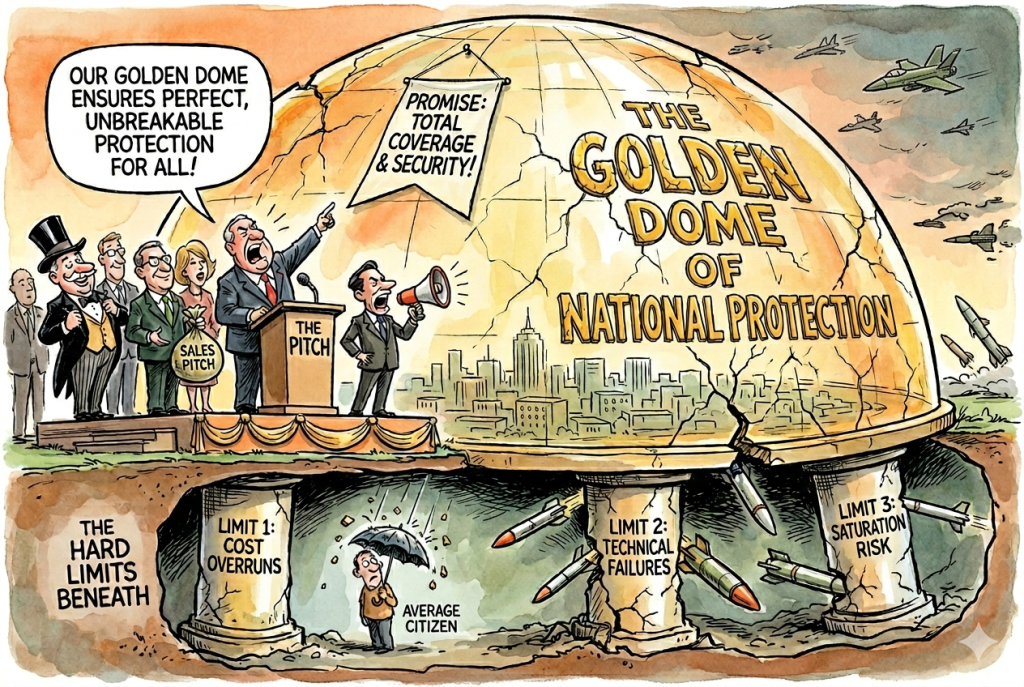
The skeptical case starts there. Golden Dome is not imaginary, and it is not empty branding. Money has been proposed, offices have been created, contracts are being shaped, and real defense companies are chasing real work. Yet the distance between that activity and the public impression of a reliable national protective dome is still very large. The strongest objection is not that missile defense has no value. It is that Golden Dome is being marketed as an answer before the country has even settled the question it is trying to answer.
What Golden Dome Actually Is
The public language around Golden Dome can make it sound like a new wonder weapon. It is not. It is a plan to stitch together existing missile defense layers, new sensors, additional command-and-control links, more terminal defenses, and an orbital layer that remains the most ambitious and least proven part of the whole idea. The Department of Defense has described it as a draft architecture and a “system of systems,” and that phrase matters because it signals that the program is mostly about integration across many pieces rather than a single revolutionary object.
At the homeland level, the current backbone remains Ground-Based Midcourse Defense. The existing fleet consists of 44 ground-based interceptors in Alaska and California. That force was built for a limited mission against a small number of long-range missiles, not for absorbing a major peer-level barrage. The latest planned step beyond that is the Next Generation Interceptor, with the 2025 American Physical Society report describing an expected initial operational capability in 2028, 21 interceptors for deployment, 10 for testing, and a Pentagon lifetime cost estimate of about $18 billion, which works out to more than half a billion dollars per interceptor when development and test rounds are included.
The sensor side is further along. The Space Development Agency says its tracking layer will ultimately use more than 100 satellites in low Earth orbit to provide persistent warning, tracking, and identification of advanced missile threats. Its published fact sheet describes Tranche 1 as 35 satellites in five planes, providing near-global mono coverage and near-global track custody for radar-cueing-quality data. It then describes a larger architecture that moves toward global coverage for warning and tracking.
The Hypersonic and Ballistic Tracking Space Sensor, or HBTSS, is even more revealing about the likely shape of near-term gains. Northrop Grumman describes HBTSS as providing continuously updated high-quality tracks, near-global coverage when cued by other systems, and the fire-control solution needed for intercept of hypersonic glide vehicles. That language points to the most realistic early payoff of Golden Dome: better quality data moving faster into decision systems and interceptor batteries.
That distinction matters. Detection coverage is not the same as interception coverage. A constellation can see a missile, track it, and pass data to other systems without guaranteeing that a kill vehicle will be in the right place, with the right speed, with the right discrimination, at the right moment, under contested conditions. The public discussion often compresses those steps into one neat image of a shield. In practice, the sensor piece is the least implausible part of Golden Dome, while the promise of dependable nationwide interception remains the least grounded.
Why Washington Thinks It Matters
The case for Golden Dome rests on a real change in the threat picture. The White House order called missile attack the most catastrophic threat facing the United States and treated the homeland as exposed to a broader set of missile types than prior policy had accepted. The companion White House fact sheet said past U.S. homeland missile defense policy had largely been limited to staying ahead of rogue-state threats and accidental or unauthorized launches, while adversary delivery systems had grown more complex over the previous four decades. Golden Dome is the formal move away from that narrower doctrine.
That doctrinal expansion is the program’s real significance. The order explicitly called for defenses against peer and near-peer adversaries, not just North Korea-style limited attacks. It also tied the effort to secure second-strike capability, which is strategic language, not just homeland air defense language. The White House was not describing a better radar network. It was describing a shift in how the United States thinks about the survivability of the homeland under modern missile attack.
The 2026 National Defense Strategy makes the ambition even clearer. It says the department will prioritize Golden Dome with specific focus on options to cost-effectively defeat large missile barrages and other advanced aerial attacks. That is not a small-wording change. It means Washington is no longer content to present homeland missile defense as a thin insurance policy against a tiny attack set. It wants a larger architecture that can survive density, speed, and variety.
The desire is understandable. Russia and China field long-range missiles, cruise missiles, and hypersonic systems. Iran and North Korea keep improving regional and long-range strike options. Public Pentagon statements in 2025 and 2026 repeatedly describe a threat environment in which missiles can arrive with conventional or nuclear warheads and from multiple flight regimes. The strategic motivation for a broader defense is not hard to see. The harder issue is whether Golden Dome can match the breadth of the problem it has been built to confront.
The Iron Dome Analogy Misleads More Than It Helps
Golden Dome was inspired, politically and rhetorically, by Israel’s Iron Dome. That analogy is useful for speeches because Iron Dome is famous, visually intuitive, and associated with visible intercept success. It is also deeply misleading. Reuters and AP both described Golden Dome as far broader in scope, including space-based sensors and, potentially, weapons in orbit. The White House order itself makes clear that the U.S. version is supposed to deal with ballistic, hypersonic, and advanced cruise missiles, not only short-range rockets and artillery-style threats.
The defended area is different. The flight profiles are different. The warning times are different. The consequences of failure are different. A system marketed with the vocabulary of Iron Dome but tasked with helping counter intercontinental nuclear delivery systems is not just a bigger Iron Dome. It is a different category of military problem. That difference gets blurred because the phrase “dome” suggests a continuous physical shell. What Golden Dome is actually chasing is an evolving mesh of sensors, command nodes, orbital assets, and interceptor families that would create defended pockets and decision advantages, not a literal dome over every square mile of the country.
This is why the analogy has real policy costs. It encourages the public to think in all-or-nothing images. Either the dome works, or it fails. Real missile defense does not behave that way. It works in sectors, against some threats better than others, at some moments better than others, depending on inventory, geometry, warning, software, and what the attacker is doing at the same time. The analogy simplifies the politics while hiding the engineering tradeoffs. That is useful for selling a program. It is bad for judging one.
Coverage Means Different Things
The most slippery part of the public discussion is the word “coverage.” In ordinary speech it sounds like one thing. In missile defense it means at least four different things: whether a system can detect a launch, whether it can maintain a reliable track, whether it can generate a fire-control-quality solution, and whether an interceptor can actually arrive in time and kill the target. Golden Dome’s public advocates often glide across those categories. The distinction is the difference between seeing danger and stopping it.
Publicly available material suggests the sensor side will cover more of the globe, sooner, than the shooting side. The Space Development Agency says the tracking layer moves from near-global warning and cueing to broader global warning and tracking as more tranches and medium Earth orbit elements come online. Northrop Grumman says HBTSS can provide near-global coverage when cued, with high-quality track handoff for targeting. Those are meaningful capabilities. They are not proof of a nationwide ability to intercept all incoming missiles.
No publicly released U.S. document appears to set a nationwide kill-probability target for Golden Dome. That absence is telling. The official language that does exist is softer. Pete Hegseth said the system would “progressively protect” the nation and would be fielded in phases, prioritizing defense where the threat is greatest. That is not the language of seamless national coverage. It is the language of selective, iterative defense with uneven geographic and mission density.
Reuters reporting on Pentagon slides from August 2025 made that even clearer. The reported concept used four layers, one in space and three on land, and showed 11 short-range batteries across the continental United States, Alaska, and Hawaii. It also said the number of launchers, interceptors, ground stations, and missile sites had not been determined. A program that has not fixed those numbers is not ready to make serious public claims about nationwide defended footprint.
So what kind of coverage is it expected to provide, if the public record is read carefully rather than generously? Better warning coverage, better track custody, better cueing of existing defenses, stronger point and regional protection for selected targets, and some growth in terminal and underlayer interception. That is a meaningful military package. It is not a convincing basis for speaking as though a continental missile shield is close at hand.
The Best Early Returns Are Likely in Seeing, Not Shooting
This is the least glamorous part of the story and probably the most useful. Better sensing and better integration can improve defense even when the interceptor layer remains thin. A missile detected earlier can be classified faster, handed off to more batteries, and paired with more realistic engagement choices. For cruise missiles and maneuvering hypersonic systems, the difference between intermittent track and persistent track can matter as much as the difference between having one interceptor or two.
That helps explain why the software layer has become such a prominent prize. Reuters reported on March 24, 2026, that Anduril and Palantir were working on Golden Dome software, described elsewhere as the “glue layer” connecting radars, sensors, and batteries. Reuters had already reported a week earlier that Lockheed Martin, RTX, and Northrop Grumman had joined as prime contractors, with command-and-control sitting near the center of the architecture. The public image of missile defense is always the interceptor launch. The hidden image is software adjudicating tracks, priorities, and shot opportunities across a fragmented defense web.
Sensor-first gains also fit the schedule better than kill-chain promises do. The Proliferated Warfighter Space Architecture already exists as a real acquisition effort, with launches underway and additional tranches contracted. The Space Development Agency announced in December 2025 that it had awarded about $3.5 billion to build 72 Tranche 3 tracking satellites. That is the kind of concrete, serial, industrial work that can plausibly show results on a calendar. By contrast, a brand-new, reliable, boost-phase orbital interceptor layer still sits in the realm of unresolved concept, integration risk, and disputed scale.
That is why the near-term military value of Golden Dome is likely to be more prosaic than its branding implies. It may help commanders see more, classify faster, and cue defenders better. It may improve the odds against some classes of attack. It may strengthen selected sectors of the homeland defense network. Those are real gains. They just are not the same thing as a dependable shield over the United States.
Boost-Phase Defense Is the Seductive Core
The heart of the Golden Dome fantasy is boost-phase intercept. It has a clean appeal. A missile is hottest and easiest to see while its engines are burning. It has not yet released its warhead or its decoys. If it is stopped there, everything riding on it is stopped too. In theory, that solves some of missile defense’s oldest headaches in a single move. This is why boost-phase defense keeps coming back in American strategic debate, from the Strategic Defense Initiative era to the present.
The physics has never been kind to the idea. The 2025 American Physical Society report revisited decades of work on strategic ballistic missile defense and quoted the 2012 National Academies of Sciences, Engineering, and Medicine conclusion that boost-phase missile defense was not practical or cost-effective under real-world conditions in the foreseeable future. APS did not say the past decade had changed that conclusion for the better. It said the underlying challenges remained, and in some cases had become harder.
A big reason is time. APS wrote that North Korea’s Hwasong-18, a solid-propellant ICBM, has a much shorter burn time than its liquid-fueled predecessors, and that proposed land-, sea-, or air-based boost-phase intercept systems would have little or no ability to defend the entire continental United States against that missile. It also described a severe reach-versus-time problem, where interceptors must be based in survivable locations but still arrive near the target early enough in flight to matter.
APS also flagged a political and geographic wrinkle that gets almost no space in public sales pitches. Some North Korean launch trajectories would require intercept over or near Chinese territory, with missed kill vehicles and stages potentially falling in China or Russia. That is not just a tactical challenge. It is a strategic and diplomatic one. A system designed to fire quickly under grave warning conditions becomes much less tidy when the engagement geometry crosses someone else’s territory.
The hardest part to pin down is whether the orbital interceptor layer is being pursued as a serious engineering path, a bargaining tool to force other parts of the architecture forward, or some unstable mix of both. Public statements treat it as central. The available technical record treats it as the least settled piece. That mismatch should make any sweeping coverage claim feel unfinished.
Space-Based Interceptors and the Math Problem
APS put hard numbers on the scale problem, and they are brutal. The report estimated that a space-based interceptor system able in principle to defend against a single North Korean Hwasong-15 would require at least 400 orbiting interceptors, and about 4,000 would be required against a salvo of 10. For the Hwasong-18, APS estimated at least 1,600 space-based interceptors for a single missile and about 16,000 for a salvo of 10. Those figures were not for Russian or Chinese peer arsenals. They were for a North Korea baseline.
The Congressional Budget Office reached a related conclusion from the cost side. In May 2025 it said lower launch costs could reduce earlier estimates for a space-based boost-phase layer, with the highest-cost alternative dropping from $831 billion to $542 billion over 20 years. Yet the same CBO material said the constellations it examined were sized to counter one or two ICBMs fired by North Korea. The lower launch environment did not make orbital missile defense cheap. It made an already huge bill somewhat less huge for a much smaller threat set than Golden Dome is publicly supposed to cover.
That makes the headline cost figures look less convincing, not more. A $175 billion announcement later raised to $185 billion may be enough to begin procurement, stand up offices, accelerate sensors, and buy additional ground and terminal defenses. It does not read like a settled price for a national orbital interceptor architecture sized for peer threats. If APS is right about the sheer number of space-based interceptors needed even for a North Korea scenario, then the gap between slogan and scale is not a rounding issue. It is the program.
Early industry concept reporting made the same point from a different angle. Reuters reported in April 2025 that a SpaceX-linked proposal discussed 400 to more than 1,000 tracking satellites and a separate fleet of 200 attack satellites, while also raising Pentagon concern over a subscription-style model and long-term control. Reuters reported in June 2025 that SpaceX’s role had become less certain after Elon Musk’s break with Trump. Those numbers were not final architecture. They were evidence of how quickly a serious national missile-defense constellation starts to demand numbers that look more like an orbital ecosystem than a single program office.
This is where a clear position is unavoidable. A large, dependable, space-based interceptor layer at continental scale is not credible on the public budget, timeline, and technical record available as of March 27, 2026. Pieces of it may be procured. Prototypes may fly. Some orbital functions may prove useful. The advertised shield remains far ahead of the demonstrated path.
Barrages Break Elegant Diagrams
Missile defense diagrams almost always look cleaner than wars. A line of satellites sees a launch. A command node fuses data. A battery receives a cue. An interceptor launches. A hit occurs. Golden Dome’s own official and quasi-official language already suggests that the real challenge is not any single intercept. It is density. The 2026 National Defense Strategy singled out large missile barrages as a central design problem. That is where impressive architecture drawings collide with magazine depth, decision latency, and reload reality.
The production numbers in official budget documents help show why this matters. The FY2026 Missile Defense Agency procurement justification says the THAAD request includes 37 interceptors, with an estimated unit cost of $12.4 million in the synergized contract structure. The same budget documents say the FY2026 request for SM-3 Block IIA totals 12 all-up rounds and raises production capacity from two rounds per month to three per month in support of Golden Dome, with a gross weapon system unit cost of about $37.07 million each in FY2026. Those are real missiles and real costs, yet they are still small numbers when measured against the kind of dense, mixed raids now used in modern war planning.
The top layer is no relief valve. APS described the NGI lifetime cost at about $18 billion for 21 deployment rounds and 10 test rounds, with each interceptor costing more than half a billion dollars when the program is viewed in full. Those are homeland interceptors used for the hardest part of the job, not weapons to be thrown around casually in large-volume engagements. A defense with expensive top-tier shots and finite lower-tier magazines is vulnerable to any attacker who can force repeated, ambiguous, or simultaneous engagements.
This is where the much-discussed cost-exchange problem becomes more than a slogan. CSIS noted in 2024 that air and missile defense interceptors are, overall, roughly twice as expensive as offensive missiles when averaging all-up-round unit costs, and that simplistic price comparisons can mislead. That caution is fair. Yet Golden Dome is not being sold as a niche tactical tool. It is being sold as a homeland shield. In that role, the defender’s need to be right repeatedly and the attacker’s ability to force expensive shots across multiple layers creates a structural disadvantage that no branding exercise can erase.
A sophisticated attacker does not need every missile to get through. It only needs to create more hard choices than the defense can solve in time. Golden Dome’s designers know this, which is why they talk about cost-effective defeat of barrages, software integration, underlayers, and pre-launch options. The very vocabulary of the program is an admission that the neat one-for-one intercept picture is not the real fight.
The Decoy Problem Never Went Away
Strategic missile defense has had one recurring nightmare since the Cold War: if a warhead is released into midcourse with decoys and other penetration aids, can the defense tell which object matters before it spends its shots? The APS report answered that question with unusual clarity. It said decoys such as aluminized mylar balloons can be built to mimic the radar, infrared, and visible signatures of a warhead, and that many such lightweight decoys can be deployed with it. That is not a hypothetical nuisance. It is a core reason midcourse defense has never delivered the kind of confidence its advocates often imply.
APS also said a shoot-look-shoot strategy offers little advantage if the defense cannot discriminate the warhead from numerous decoys. That sentence should sit at the center of any serious discussion of Golden Dome. More sensors help. Longer observation helps. Better algorithms help. None of that changes the basic fact that the defense has to decide which object gets the shot and has to do so under time pressure, uncertainty, and a real possibility that the attacker designed the engagement specifically to confuse the sensor picture.
Peer adversaries have not neglected this part of the contest. APS cited Department of Defense assessments that China has pursued technologies intended to counter ballistic missile defense, including maneuvering reentry vehicles, MIRVs, decoys, chaff, jamming, thermal shielding, and hypersonic glide vehicles. Once a missile-defense architecture is advertised as strong enough to matter strategically, the offense has every incentive to invest in the cheapest counter to that architecture.
This is why the public charm of boost-phase intercept is so strong. It seems to skip the decoy problem by killing the missile before separation. But that only shifts the burden to a harder geometry problem and a larger orbital footprint. Golden Dome does not eliminate the old midcourse headache. It tries to route around it, and the route around it is the most expensive and vulnerable piece of the entire concept.
Hypersonic Threats Do Not Fit Neatly into Legacy Layers
The drive to build HBTSS and the Glide Phase Interceptor says something important by itself. The United States did not start those efforts because legacy ballistic missile defenses were good enough. It started them because maneuvering hypersonic threats expose gaps in track continuity, sensor handoff, and intercept geometry that older radar-centric architectures were not built to handle. HBTSS is meant to produce the kind of precise track data needed for those engagements, while GPI is meant to attack hypersonic threats during the glide phase rather than waiting for the terminal phase.
Yet GPI is still a development effort, not a deployed homeland shield. Public descriptions by Northrop Grumman present it as part of the Missile Defense Agency ecosystem for layered defense against hypersonic threats, strongly tied to Aegis concepts rather than a complete answer for nationwide protection. That is consistent with the broader pattern around Golden Dome: a growing set of useful pieces, still far short of a settled continent-scale architecture.
Cruise missiles complicate the picture differently. They fly lower, can exploit terrain, and place more burden on persistent sensing and shorter-range batteries distributed across geography. Reuters reporting on internal 2025 slides showing 11 short-range batteries inside the United States, Alaska, and Hawaii suggests Golden Dome planners understand that lower-tier homeland air defense is too thin for the broader mission set now being advertised. That reported battery footprint also suggests coverage will be selective, because 11 batteries is not how a government talks when it has solved low-altitude continental defense.
The net result is that Golden Dome faces not one missile problem but several. Ballistic missiles stress timing, altitude, and decoy discrimination. Hypersonic glide vehicles stress persistent track custody and handoff. Cruise missiles stress distributed sensing and lower-altitude defense density. A program that treats them as one interchangeable category for public persuasion is compressing very different engineering problems into one branded object.
Orbit Is Not a Sanctuary
Any defense architecture that leans heavily on space must also survive a fight in space. U.S. Space Command said in August 2025 that China and Russia are fielding a wide range of counterspace weapons, from satellite communications jamming, GPS jamming, and cyberattacks to direct-ascent anti-satellite missiles and co-orbital anti-satellite weapons. That statement came from the operational commander responsible for U.S. military space operations, not from an outside critic. It means the same domain Golden Dome increasingly depends on is already treated by major adversaries as a warfighting arena.
The cyber problem is not hypothetical either. On March 23, 2026, Space Systems Command announced new defensive cyber squadrons for the launch ranges at Vandenberg Space Force Base and Patrick Space Force Base. The official statement said adversaries are constantly looking for ways to deny, disrupt, or destroy U.S. ability to launch, and described risks ranging from hijacking satellites or ground systems to malware gaining unauthorized access. A homeland shield that depends on repeated launch, replacement, and resilient ground links is exposed not only in orbit but also in the industrial and software chain that feeds orbit.
This matters because Golden Dome’s most ambitious versions are satellite-heavy by design. Even the more modest public descriptions assume more tracking satellites, more battle management links, more data transport, more orbital sensing, and possibly orbital interceptors. Every added node can improve resilience if the constellation is large enough. Every added node also creates another object to jam, spoof, blind, hack, or physically attack. A distributed space architecture is harder to kill completely than a handful of exquisite satellites. It is not invulnerable. It is just harder to finish in one move.
Costs reinforce the same point. CBO’s missile-defense cost work specifically noted that low orbits decay and require replacement, one reason large constellations remain expensive even in a world of cheaper launch. In peacetime, that is an accounting burden. In wartime, it becomes a resilience burden. A shield that promises long-duration protection has to think about not only initial deployment but replenishment under active contest. Public Golden Dome rhetoric has spent much more time on the first problem than the second.
Software Might Be the Hidden Single Point of Failure
Missile defense attracts attention at the hardware layer because hardware is visible. But large integrated defense systems usually fail, if they fail, in the seams. One sensor timestamps late. One data link drops. One battery gets stale track data. One fusion engine misclassifies a decoy or fails to assign the best shooter. One operator gets an engagement picture that is internally consistent and still wrong. Golden Dome is a seam-heavy system by definition.
That is already showing up in the record. Reuters said the Anduril and Palantir software effort was intended to bind radars, sensors, and missile batteries into a common command-and-control picture. Reuters’ earlier reporting on Pentagon slides showed uncertainty not only about launchers and interceptors but also about ground stations and sites. The Space Development Agency has also acknowledged integration difficulty in its tracking architecture. In May 2025, reporting on SDA’s Tranche 3 described the agency’s decision to bring in an outside mission integrator because satellites from different vendors had to work together despite differing hardware and software. Golden Dome will inherit that problem at a larger and more sensitive scale.
Public discussion of AI fits awkwardly into this story. Reuters reported on March 17, 2026, that officials saw AI and directed energy as potentially useful for cost efficiency and operational scalability. The attraction is obvious. A machine-speed defense network sounds like the right answer to machine-speed attack. Yet AI cannot rescue bad geometry, thin magazines, or corrupted sensor data. It can only act on the picture it is given. If that picture is late, spoofed, incomplete, or overloaded, faster processing just delivers a cleaner mistake.
No public evidence, as of March 27, 2026, shows a homeland-scale integrated Golden Dome test validating the full concept. Reuters and the Wall Street Journal reported that the software effort was targeting a live test by summer 2026. Even if that happens on schedule, it will not prove nationwide defended effectiveness. It will prove that pieces of a battle network can be demonstrated. That is a useful milestone. It is not the same as a proven shield.
The Money Problem Is Not Separate from the Engineering Problem
Golden Dome’s budget story has already become a warning sign. The public price moved from $175 billion in May 2025 to $185 billion in March 2026. At the same time, Reuters reported architecture disputes, unspent early funding, and continued debate over the space-based portion. When a major defense effort changes cost while still debating its bones, that is not a small administrative detail. It is a sign that the final object being bought is still unstable.
The hardware numbers make the challenge plain. THAAD procurement in FY2026 was requested at 37 interceptors with an estimated unit cost of $12.4 million in the main contract structure. SM-3 Block IIA was requested at 12 all-up rounds with a FY2026 gross weapon system unit cost of about $37.07 million. APS described NGI at more than half a billion dollars each when lifetime cost is allocated across deployment and test rounds. Those are not scandalous numbers by Pentagon standards. They are exactly the sort of numbers that make “defeat large missile barrages” a punishing sentence in practice.
Official statements about early funding also need care. Pete Hegseth told Congress in June 2025 that the budget invested $25 billion in Golden Dome as a down payment. Reuters reported in January 2026 that much of the first $25 billion had not yet been spent because architecture decisions were still unresolved. Both statements can be true at once. The money exists as intent. The program still has to decide what it is.
This is why skeptical analysts keep circling back to the same worry. A low early public price tag does not prove a clever, efficient architecture has been found. It can also mean the most expensive and controversial parts have not been fully costed, fully accepted, or fully admitted. Golden Dome’s budget uncertainty is not a side issue. It is evidence about the maturity of the concept itself.
What a Skeptical Estimate of Coverage Effectiveness Looks Like
The direct answer is less cinematic than the sales pitch. No public evidence available by March 27, 2026, supports an expectation that Golden Dome provides dependable protection against a large-scale Russian or Chinese missile strike on the United States. The White House order expanded the mission to peer and near-peer threats. APS showed that even North Korea-sized boost-phase orbital defenses demand very large constellations. The Pentagon itself still describes the system as phased and priority-based rather than finished and universal.
A more defensible expectation is this: nationwide gains in warning and track coverage; better cueing for existing and future interceptors; stronger defense for selected bases, cities, and approach corridors; better odds against a limited number of ballistic missiles from a rogue state; better local or regional defense against some cruise and hypersonic threats as sensors, software, and lower-tier batteries improve. That is a serious package if delivered. It is also much narrower than the public impression of a continent-sized anti-missile dome.
Against larger peer barrages, the likely effectiveness drops fast. More inbound missiles mean more decisions, more chances for decoys and jamming to distort the picture, more magazine depletion, more importance for software triage, and more vulnerability to simultaneous attack on space and ground nodes. Golden Dome’s own official materials and outside scientific analysis point in the same direction here: the hard case is not a single missile. It is raid density plus countermeasures plus contested infrastructure.
Against accidental launches or very small unauthorized launches, the value proposition is stronger. That is not a glamorous answer, but it tracks the history of U.S. homeland missile defense. The older doctrine, by the White House’s own account, focused on rogue-state threats and accidental or unauthorized launches. Expanding that capacity at the margins is plausible. Scaling it into dependable peer-war insulation is where the evidence thins out dramatically.
Against mixed raids that combine ballistic missiles, cruise missiles, hypersonic vehicles, cyber disruption, and pressure on space systems, effectiveness will vary by sector and by what inventory is left at the moment of attack. A layered architecture can complicate an attacker’s job and raise the threshold for success. It can also be forced into hard tradeoffs between defending cities, bases, command nodes, and national infrastructure. Public statements about “any foe” sound absolute. Real defended effectiveness in that kind of war would be partial, local, and intensely contingent.
The best short description is not “national shield.” It is “an expanding homeland defense network with real sensor upside, selective interception value, and an orbital ambition that still outruns the demonstrated path.” That description is less exciting. It is also much closer to the evidence.
Strategic Side Effects
Missile defense is never only about defense. It is also about what adversaries think the defense might become. Reuters reported in April 2025 that Russia condemned the U.S. search for space-based interceptors as a threat to nuclear balance. That reaction was predictable. A strategic force designed to assure retaliation becomes less comfortable with an opponent that speaks openly about defeating not just rogue launches but broader missile attack categories.
APS made the same point in technical language when it warned that weaponization of space and arms-race instability were significant issues alongside the raw engineering challenge. Once a state pursues a defense that appears capable, even in principle, of eroding parts of a rival’s deterrent, the rival has a menu of responses: more missiles, more warheads, more decoys, more maneuver, more jamming, more cyber intrusion, more counterspace systems. The offense does not need to win the whole contest. It only needs to make the defense more expensive and less certain.
This does not mean missile defense is pointless. Limited defenses can complicate coercion, reduce confidence in small attacks, and narrow some pathways for blackmail. The difficulty comes when those limited benefits are packaged as if they are a route to broad strategic invulnerability. At that point the defense may still produce marginal military value while also accelerating the very offensive adaptation that keeps the shield from reaching the level advertised.
Golden Dome could end up reducing danger at the low end while sharpening competition at the high end. That is not a contradiction. It is the pattern strategic missile defense has often produced: some local or limited gains, paired with a larger offense-defense race above them. The more loudly the United States sells the dome image, the more likely competitors are to invest in proving the dome incomplete.
Summary
The deepest problem with Golden Dome is not that it seeks homeland protection. That impulse is easy to understand. The problem is that the public brand suggests a finished answer while the actual program still looks like a stack of partially connected efforts moving at very different speeds. Space tracking layers are real. Integration work is real. Terminal and underlayer improvements are real. The claim that these ingredients add up, on the announced timeline and public budget, to something close to a dependable national anti-missile dome is not supported by the record so far.
A less glamorous path could still produce value. More persistent tracking, better fire-control data, stronger command-and-control, improved cruise-missile warning, more lower-tier batteries in selected sectors, more interceptors in existing lines, and better cyber protection for launch and space infrastructure would all strengthen homeland defense in ways that matter. Those gains would not create invulnerability. They would create friction for an attacker, time for decision-makers, and better odds in some attack sets. That is a serious military return even if it falls far short of the dome imagery.
The real danger is political and conceptual. If Golden Dome is funded and judged as a promise of broad national protection from major peer missile attack, disappointment is built in. If it is treated as a contested, partial, continuously improvable defense network whose best near-term output is better sensing and selected layers rather than perfect coverage, the public case becomes less dramatic and more believable. As of March 27, 2026, the evidence supports the second reading far more than the first.
Appendix: Top 10 Questions Answered in This Article
What is Golden Dome?
Golden Dome is a U.S. homeland air and missile defense initiative created by a January 27, 2025 executive order. It is not a single weapon. It is a planned network of sensors, command systems, existing interceptor layers, and possible new space-based missile defense elements.
Why is Golden Dome considered important?
It matters because it marks a policy shift from limited defense against rogue-state launches toward a broader effort to address ballistic, cruise, and hypersonic missile threats, including peer adversaries. Supporters see it as a way to strengthen deterrence and reduce homeland vulnerability.
Is Golden Dome already built?
No. As of March 27, 2026, Golden Dome is still an evolving architecture with phased plans, growing cost estimates, and unresolved design questions. Some related programs already exist, but the overall shield being described in politics has not been fielded.
How much is Golden Dome expected to cost?
The public price tag moved from $175 billion in May 2025 to $185 billion in March 2026. Independent cost work on major orbital interceptor elements has produced much higher figures for narrower threat scenarios, especially when large satellite constellations are involved.
What kind of coverage is Golden Dome expected to provide?
The most realistic early coverage is better missile warning, stronger tracking, improved command-and-control, and selective protection for key sectors or targets. Public evidence does not support dependable nationwide interception against a large peer-level missile attack.
Why are space-based interceptors so controversial?
They are attractive because boost-phase intercept could stop missiles before warheads and decoys separate. They are controversial because they appear to require very large constellations, large budgets, rapid decision times, and operation in a space domain already vulnerable to jamming, cyberattack, and anti-satellite weapons.
What are Golden Dome’s biggest vulnerabilities?
Its main vulnerabilities are barrage saturation, decoys and other countermeasures, software and integration failure, orbital attack, cyber intrusion, and thin interceptor inventories. Those weaknesses are structural, not cosmetic, because they come from the physics and scale of the mission.
Will Golden Dome solve the hypersonic missile problem?
Not soon. New sensors and programs such as HBTSS and the Glide Phase Interceptor can improve detection and engagement options, but hypersonic threats still strain track custody, handoff, and timing. Golden Dome may improve the defense picture without solving it.
Can Golden Dome stop Russian or Chinese missile forces?
No public evidence shows that. The available record points to partial improvement, not dependable insulation from a major Russian or Chinese strike. That remains the largest gap between Golden Dome rhetoric and its demonstrated path.
What is the strongest skeptical conclusion?
The strongest skeptical conclusion is that Golden Dome is being sold as a national shield before its most ambitious elements have shown they can work at continental scale. Its likely value lies in better sensing and layered improvement, not in the promise of comprehensive protection.