
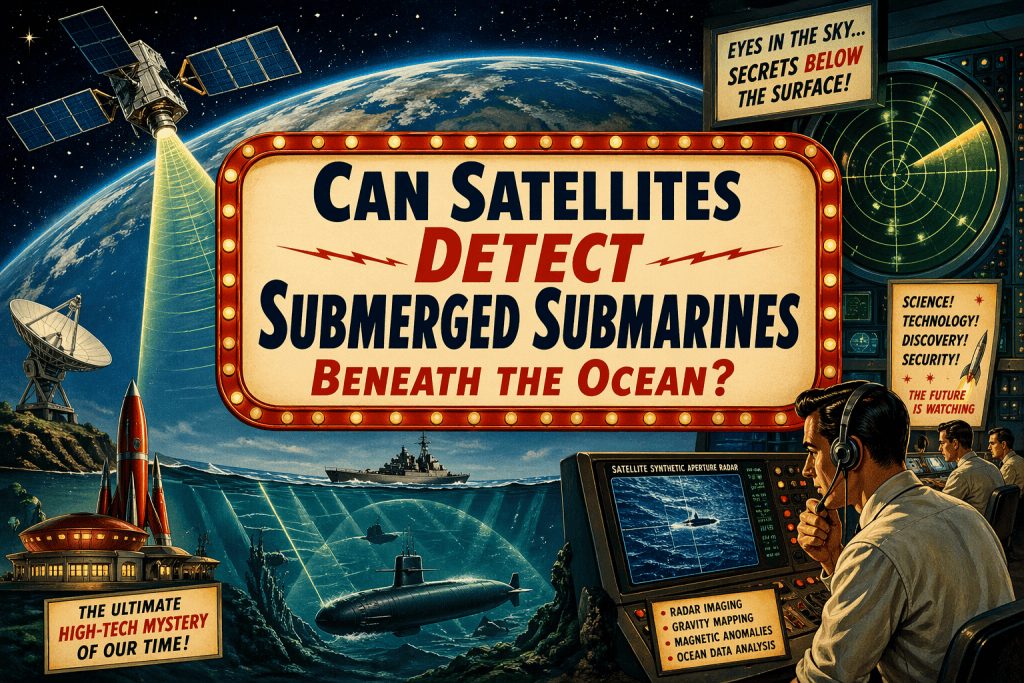
In 2024, the Nuclear Threat Initiative noted that open-source tools now give analysts some ability to monitor submarine fleets. That public record points mainly to submarine bases, surfaced boats, missile launches, shipyard activity, and other associated signals. It does not show a dependable orbital method for directly finding and identifying a deeply submerged submarine moving through the open ocean.
That distinction matters. A satellite in orbit is excellent at watching the sea surface, the weather above it, and the large-scale physical fields around Earth. A submarine at patrol depth sits below a moving, noisy, optically difficult, and often opaque medium. Publicly available material from NOAA, NASA, ESA, and GFZ points to the same conclusion: satellites can sometimes infer surface effects that may be associated with underwater activity, but direct detection of a submarine at meaningful depth remains far beyond what public sources describe as a routine orbital capability.
What Orbiting Sensors Observe Best
Space-based sensors are strongest when they observe the ocean’s outer skin. The Synthetic Aperture Radar Marine User’s Manual explains that spaceborne synthetic aperture radar, or SAR, captures fine detail in the ocean surface and can show the signatures of surface waves, internal waves, upwelling, current boundaries, shallow-water bathymetry, storms, rainfall, and sea ice. That is a powerful set of capabilities, though it is a description of the sea surface rather than a direct view into the deep water below it.
Temperature sensing from orbit works in the same way. NASA’s PO.DAAC program states that infrared measurements of sea-surface temperature come from roughly the top 10 microns of the ocean, and related NASA measurement guidance explains that microwave measurements come from about the top 1 millimeter. Those are remarkably thin layers. A satellite can map fronts, eddies, and warm or cold streaks across wide areas, yet those products describe the ocean’s surface state rather than the position of a submarine operating below it.
Radar altimeters also measure the surface, though at a broader scale. NOAA CoastWatch describes sea-surface-height products as tools for observing ocean topography, currents, storms, and related environmental behavior. That supports major oceanographic analysis, and it can reveal large features that influence naval operations. Even so, it is a long step from identifying an eddy or sea-level anomaly to proving that a particular submerged vessel is present underneath it.
Why Water Defeats Direct Orbital Viewing
The main barrier is the ocean itself. Water blocks, bends, scatters, and distorts the electromagnetic signals that satellites use most effectively. A NASA technical paper on remote sensing over marine environments notes that submerged objects viewed from above the ocean surface are subject to large optical distortions caused by refraction at the air-water interface. A separate NASA study on emerging optical sensing describes advanced imaging methods for shallow marine systems, which is useful for reefs, coastlines, and similar settings, yet that same body of work underscores how difficult it is to image through water from above.
Depth rapidly worsens the problem. Light penetration falls off with turbidity, surface state, sun angle, and wavelength. Ocean color and bathymetric techniques can work in clear, shallow water, and NOAA material on coastal lidar shows how airborne systems can help measure nearshore environments. Those applications are real, but they belong to shallow-water mapping rather than blue-water submarine detection.
Thermal sensing does not solve the problem either. Since orbital thermal sensors mainly register the temperature of the very top layer of the sea, they are suited to tracking fronts and broad thermal patterns. A submarine deep below that surface does not present a clean thermal picture to an infrared instrument in orbit. Any possible disturbance has to travel through a dynamic ocean surface that is already being shaped by wind, waves, currents, rainfall, evaporation, and solar heating.
The Indirect Signatures Public Sources Discuss
Open literature sometimes describes satellite-based submarine detection in terms that sound direct, though the underlying mechanism is usually indirect. A satellite might observe a surface disturbance that analysts then interpret as one possible sign of activity below the surface. That is a very different claim from saying the satellite has seen the submarine itself.
The best-known example is the surface expression of internal waves. ESA has described SAR as capable of identifying surface features associated with underwater internal waves, and the NOAA SAR manual treats internal waves as one of many ocean phenomena whose effects can appear in radar imagery. In plain terms, a satellite can sometimes see the way something below the surface changes the texture or brightness of the surface itself.
That does not make the interpretation easy. Internal waves arise from many natural causes, including density boundaries, tides, seafloor topography, and current interactions. Wind conditions can strengthen or erase a visible surface pattern. Rain can degrade the signal. A front or eddy can produce texture changes that have nothing to do with a submarine. A wake-like mark on the water may come from a ship, a current boundary, or atmospheric forcing instead of an underwater platform. The public sources are useful because they show that the ocean surface contains interpretable patterns. They also show that interpretation is uncertain even when the analyst already knows the setting.
Shallow water produces more possibilities because the sea floor, coastal currents, and the water column can all influence the surface more directly. ESA has stated that radar imagery can help derive coastal bathymetry in water shallower than about 30 meters. That is relevant to coastal remote sensing. It is not evidence that a patrol submarine at depth in the open ocean can be found reliably from orbit.
Why Magnetic and Gravity Detection From Orbit Fall Short
Magnetic and gravity ideas have long attracted attention because a submarine is a large metal object with mass. Public technical material points to the same limitation for both: orbital distance is punishing. Any local signal from an individual submarine becomes extraordinarily small against Earth’s background fields and noise.
The gravity example is especially clear. The GRACE-FO Level-3 handbook states that spatial smoothing for its Level-3 products uses a radius of 300 km over land and 500 km over ocean. That is appropriate for tracking large-scale mass changes in the Earth system, such as water storage and ocean-bottom pressure variations, but it is nowhere near the scale needed to isolate a single submarine. GFZ’s overview of global gravity models makes the broader physics point directly: shorter-wavelength gravity features are damped with increasing distance from Earth, and satellite orbits cannot be arbitrarily low. In other words, orbital gravity measurements are powerful for geodesy and Earth science, yet they are poorly matched to a small moving object in the ocean.
Magnetic detection faces a similar mismatch. Public naval references tie magnetic anomaly detection, or MAD, to aircraft operating much closer to the sea. The NAVAIR page for the P-3C Orion lists MAD among its submarine detection sensors, and a U.S. Navy training text likewise describes MAD gear as part of airborne anti-submarine warfare. That public record matters because it shows where magnetic sensing is actually used in practice: close to the ocean, not hundreds of kilometers above it.
What Satellites Can Detect Around Submarine Operations
Satellites still matter greatly to submarine intelligence. They are simply strongest at observing the support system around submarines rather than the hidden platform at depth. Commercial imagery and SAR can monitor naval bases, piers, dry docks, construction halls, shipyard expansion, and berthing patterns. The Nuclear Threat Initiative survey emphasizes exactly that kind of open-source monitoring, showing how modern imagery can reveal force structure and operational patterns without directly solving deep-ocean tracking.
Surfaced submarines are another matter. Once a submarine is on the surface or at a depth that creates a visible mast, wake, or other surface expression, satellite observation becomes far more plausible. The same is true during transit near ports or chokepoints where analysts can combine orbital imagery with shipping patterns, local geography, and known fleet basing. None of that amounts to a universal orbital answer for submarines at patrol depth, though it does make submarines less opaque during parts of their operating cycle.
Missile launch detection is stronger still because rockets announce themselves. The U.S. Space Force description of SBIRS explains that the Space Based Infrared System supports missile early warning and missile defense. A RAND paper notes that infrared satellites detect launches by observing the bright plume during boost. That means a ballistic missile fired from a submarine can produce a visible space-based warning event, yet the detectable object in that case is the launch plume, not a submerged submarine cruising silently before launch.
Why Anti-Submarine Warfare Still Depends on Closer Sensors
If satellites could reliably detect deep submarines from orbit, anti-submarine warfare would look very different from the public record of current military practice. Instead, open sources still point toward systems that work inside or just above the maritime battlespace. Maritime patrol aircraft, shipborne helicopters, sonobuoys, hull-mounted sonar, towed arrays, and seabed or undersea sensor networks remain central because they operate in the acoustic environment where submarines actually hide.
Aircraft illustrate the pattern well. The P-3C Orion and its successor communities combine radar, acoustic sensors, and magnetic sensing because no single method is enough on its own. Space systems can support that effort by cueing patrol areas, identifying likely departure windows from bases, tracking surface traffic, or providing weather and ocean data. That is a major contribution. It is still a supporting role.
Ocean conditions also favor local sensing. Sound travels through water in ways that can be exploited by sonar, though the same physics also complicates classification and range prediction. Surface patterns visible from orbit are far more ambiguous because the sea surface is already crowded with natural noise. A satellite may help narrow the search area. Confirmation still belongs to sensors and platforms closer to the submarine.
Summary
Publicly available evidence supports a restrained conclusion. Satellites can monitor submarine bases, watch surfaced or near-surface activity, detect missile launches, and observe ocean-surface conditions that may sometimes correlate with underwater disturbances. They are very good at seeing the sea surface and very poor at directly seeing through deep seawater to a hidden submarine.
That gap is driven by physics rather than a lack of interest. Water distorts optical sensing, limits thermal relevance to an extremely thin surface layer, and suppresses the usefulness of orbital magnetic and gravity measurements for small moving targets. SAR can reveal internal waves, roughness changes, and other surface expressions, yet those signatures are indirect and often ambiguous. In the public domain, satellites appear as part of a broader surveillance and cueing system, not as a dependable stand-alone way to find submerged submarines in the open ocean.
