- Key Takeaways
- James Webb Space Telescope Mission and Design
- Webb’s Core Specifications
- Instruments That Turn Infrared Light Into Science
- Discoveries About the Early Universe
- Discoveries About Exoplanets and Planet Formation
- Discoveries About Stars Nebulae and Planetary Systems
- Discoveries Inside the Solar System
- Limits Risks and Operating Realities
- What Webb Has Changed by May 2026
- Summary
- Appendix: Useful Books Available on Amazon
- Appendix: Top Questions Answered in This Article
- Appendix: Glossary of Key Terms
Key Takeaways
- Webb is an active infrared observatory operating near Sun-Earth L2.
- Its four instruments study galaxies, stars, planets, and solar system objects.
- Discoveries through May 2026 include early galaxies and rocky exoplanet data.
James Webb Space Telescope Mission and Design
The James Webb Space Telescope launched on December 25, 2021, reached the Sun-Earth second Lagrange point on January 24, 2022, and remained an active astrophysics mission as of May 2026. NASA leads the mission in partnership with the European Space Agency and the Canadian Space Agency, and the Space Telescope Science Institute operates the observatory for the science community. Webb does not circle Earth like the Hubble Space Telescope. It travels around the Sun about 1.5 million kilometers, or roughly 1 million miles, from Earth near a gravitational balance region known as L2.
Webb was built to study faint infrared light. Infrared astronomy is valuable because light from the early universe stretches toward redder wavelengths as space expands. Dust clouds that block visible light can also become more transparent in infrared wavelengths, allowing Webb to examine star-forming regions, planet-forming disks, and distant galaxies that are difficult to study with visible-light telescopes. NASA describes Webb’s science program as spanning the first luminous objects after the Big Bang, galaxy formation, star and planet formation, planetary systems, and objects in the solar system.
Webb’s role differs from Hubble’s in both wavelength and observing location. Hubble has changed astronomy through visible, ultraviolet, and near-infrared observations from low Earth orbit. Webb focuses on red visible light, near-infrared light, and mid-infrared light, which makes it better suited for cold objects, dust-obscured regions, chemically rich atmospheres, and extremely distant galaxies. The two observatories are complementary rather than interchangeable.
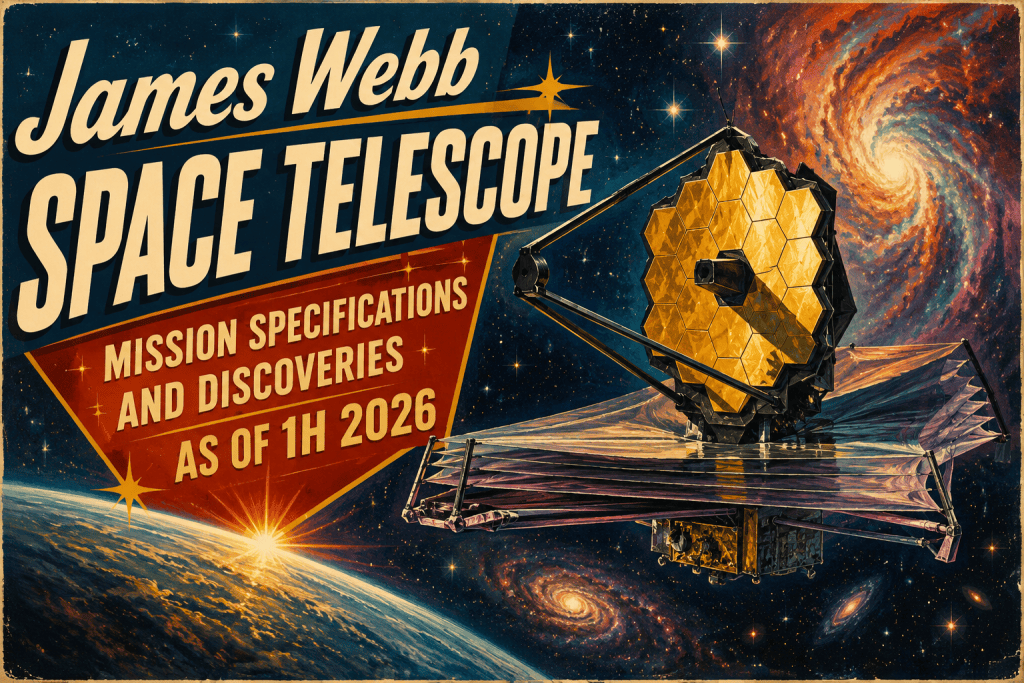
A major design feature is Webb’s thermal separation. The observatory places its telescope optics and instruments on a cold side, shielded from the Sun, Earth, and Moon by a five-layer sunshield. The warm spacecraft bus, which handles power, communication, propulsion, and attitude control, stays on the Sun-facing side. This separation allows the telescope and instruments to detect faint infrared signals without being overwhelmed by the observatory’s own heat. NASA states that the five-layer sunshield protects Webb from infrared radiation from the Sun, Earth, and Moon.
Webb also demonstrates a major engineering tradeoff. Its primary mirror is larger than any single mirror that could fit inside the Ariane 5 fairing, so engineers designed it as 18 hexagonal segments that folded for launch and deployed in space. The sunshield also folded during launch and opened after separation from the rocket. This architecture made the telescope powerful, but it also made the post-launch deployment sequence more complex than most robotic science missions.
The mission entered routine science after commissioning in 2022. NASA released Webb’s first full-color images and data in July 2022, showing the public the telescope’s ability to produce deep-field galaxy images, study exoplanet atmospheres, examine star-forming nebulae, and inspect galaxy interactions. Those early results were a preview, not a finish line. By May 2026, Webb had moved from demonstration to sustained scientific production, with discoveries in cosmology, exoplanet science, star formation, planetary systems, solar system science, and planetary defense.
Webb’s Core Specifications
Webb is a large segmented infrared observatory with a launch mass of about 6,200 kilograms and an overall observatory height of about 8 meters. NASA’s telescope overview lists its sunshield at 21.2 meters by 14.2 meters, which is often compared to the size of a tennis court. Its primary mirror has a listed diameter of 6.6 meters and a collecting area of 25.37 square meters. NASA also lists the primary mirror mass at 705 kilograms.
The mirror is Webb’s most recognizable feature. Its 18 gold-coated beryllium segments act together as a single optical surface after alignment. Beryllium was selected because it combines low mass with stability at very cold temperatures. Gold improves infrared reflectivity, and a thin glass layer protects the coating. Webb’s mirror size gives it far greater light-gathering power than Hubble, which is one reason it can measure extremely faint infrared sources. NASA describes Webb’s primary mirror as 6.5 meters, or 21 feet 4 inches, across on its mirror page, and a separate telescope overview lists 6.6 meters, reflecting rounding and measurement conventions used in mission materials.
The sunshield protects the optical telescope element and instrument module from heat. Each of the five layers uses Kapton film with aluminum coating, and the two hottest Sun-facing layers include doped-silicon coating to help reflect heat. NASA states that the first sun-facing layer is 0.05 millimeters thick and the other four layers are 0.025 millimeters thick. The coatings are much thinner than the membrane layers, with aluminum around 100 nanometers and silicon around 50 nanometers.
Webb’s instruments cover wavelengths from roughly 0.6 to 28.3 microns according to the Space Telescope Science Institute, and NASA’s broader public overview describes coverage up to 28.5 microns. The small difference reflects source conventions and rounding rather than a disagreement over the observatory’s science purpose. NIRCam, NIRSpec, and NIRISS cover visible red to near-infrared wavelengths, and MIRI covers longer mid-infrared wavelengths.
The table below summarizes Webb’s main published specifications in a portrait-friendly format.
| Specification | Published Value | Meaning |
|---|---|---|
| Launch Date | December 25, 2021 | Webb launched on Ariane 5 from French Guiana. |
| Arrival at L2 | January 24, 2022 | Webb reached its operating region near Sun-Earth L2. |
| Primary Mirror | About 6.5 to 6.6 meters | The segmented mirror gathers faint infrared light. |
| Mirror Segments | 18 | Gold-coated beryllium segments act as one mirror. |
| Sunshield | 21.2 meters by 14.2 meters | The five-layer shield keeps the telescope cold. |
| Wavelength Range | About 0.6 to 28.3 microns | The instruments cover red visible to mid-infrared light. |
Propellant strongly shapes Webb’s operating life because the observatory needs small maneuvers to maintain its L2 orbit and manage pointing. NASA stated after launch that Webb’s precise Ariane 5 insertion and early mid-course correction performance left enough propellant to support science operations for significantly more than a 10-year science lifetime, compared with a five-year minimum baseline. That assessment did not guarantee that every instrument or subsystem would last for decades, but it removed the original expectation that propellant would limit Webb to a short initial operating life.
Instruments That Turn Infrared Light Into Science
Webb’s four main science instruments are the Near-Infrared Camera, Near-Infrared Spectrograph, Mid-Infrared Instrument, and Near-Infrared Imager and Slitless Spectrograph. The Near-Infrared Camera (NIRCam) is Webb’s main near-infrared imaging system. It supports deep-field galaxy surveys, star formation studies, exoplanet imaging with coronagraphs, and alignment of the primary mirror. NIRCam played a visible role in Webb’s early public images and remains one of the observatory’s highest-demand instruments.
The Near-Infrared Spectrograph (NIRSpec) separates light into spectra, allowing scientists to measure redshift, temperature, chemical composition, and motion. Spectroscopy is central to Webb’s early-universe work because a galaxy’s redshift helps determine how far back in cosmic history its light began traveling. NIRSpec can also study many objects within a field through a microshutter array, which allows efficient surveys of distant galaxies. Webb used NIRSpec to confirm the very high redshift of MoM-z14, a galaxy seen only 280 million years after the Big Bang.
The Mid-Infrared Instrument (MIRI) extends Webb into longer wavelengths, giving astronomers access to cooler objects, dust emission, and mid-infrared spectral features. MIRI is vital for studying star-forming clouds, protoplanetary disks, active galactic nuclei, and warm exoplanets. It also requires extra cooling beyond the passive sunshield system because mid-infrared detectors must operate at very low temperatures. Webb’s 2026 study of LHS 3844 b used MIRI mid-infrared spectroscopy to measure heat emitted from the planet’s hot dayside.
The Near-Infrared Imager and Slitless Spectrograph (NIRISS), supplied by Canada with the Fine Guidance Sensor, supports specialized observing modes that include wide-field slitless spectroscopy, single-object slitless spectroscopy, aperture masking interferometry, and imaging. It helps Webb study exoplanet atmospheres, distant galaxies, and compact astronomical targets. Canada’s contribution also includes the Fine Guidance Sensor, which helps Webb lock onto guide stars and maintain stable pointing during observations.
The instruments are not independent islands. Webb science often combines imaging, spectroscopy, coronagraphy, and time-series measurements. Imaging can identify targets, spectroscopy can reveal composition and distance, and repeated observations can track changes over time. Exoplanet research often depends on measuring tiny changes in starlight as a planet passes in front of or behind its star. Early-universe galaxy work often starts with imaging candidates and then uses spectra to confirm distance.
The table below summarizes the four instruments and their main science roles.
| Instrument | Full Name | Main Role |
|---|---|---|
| NIRCam | Near-Infrared Camera | Near-infrared imaging, coronagraphy, mirror alignment, and deep fields. |
| NIRSpec | Near-Infrared Spectrograph | Spectroscopy of galaxies, stars, and exoplanets. |
| MIRI | Mid-Infrared Instrument | Mid-infrared imaging and spectroscopy of cool or dusty targets. |
| NIRISS | Near-Infrared Imager and Slitless Spectrograph | Specialized spectroscopy, interferometry, and exoplanet observations. |
Webb’s instrument suite also gives the observatory flexibility. A distant galaxy, a nearby moon, a forming star, and a hot exoplanet atmosphere all require different observing strategies. Webb can move among those scientific domains because it combines sensitivity, wavelength coverage, stable pointing, and a cold optical environment.
Discoveries About the Early Universe
Webb’s most publicized science domain is the early universe. The telescope was designed to examine galaxies that formed when the universe was young, and it quickly showed that early galaxy formation looked more active and more complex than many pre-launch expectations. Early Webb surveys found candidates from the first few hundred million years after the Big Bang, and follow-up spectroscopy began separating confirmed galaxies from less certain photometric candidates.
In January 2026, NASA reported the confirmation of MoM-z14, a bright galaxy seen as it existed only 280 million years after the Big Bang. Webb’s Near-Infrared Spectrograph measured a redshift of 14.44 for the object, meaning its light has traveled through expanding space for about 13.5 billion years. This discovery pushed the confirmed observable universe closer to cosmic dawn and showed that bright galaxies existed at a time when the first large systems were still assembling.
MoM-z14 matters because early bright galaxies force astronomers to test models of star formation, gas cooling, dust production, and feedback from young stars or black holes. A galaxy visible at such an early time had to gather gas, form stars, and produce enough light quickly. Webb has not overturned the Big Bang model, as some online commentary has claimed, but it has sharpened questions about the pace of early structure formation.
Webb also studies early black holes. Several observations suggest that supermassive black holes began growing very early in cosmic history, sometimes inside galaxies that look too small or too young to host such massive central objects under older growth assumptions. Some 2025 Webb reports described possible direct-collapse black hole candidates, meaning black holes that may have formed from large gas clouds rather than from ordinary stellar remnants. NASA has labeled some of this work as science in progress when it has not yet completed peer review, so the most careful reading treats those results as active research rather than settled history.
The early-universe results also show Webb’s strength as a survey machine. Its deep imaging identifies faint candidates, and its spectroscopy tests whether a target truly sits at extreme distance. This matters because very red objects can sometimes mimic early galaxies. Dusty later galaxies, cool stars, or instrumental effects can produce misleading color signatures. Spectroscopic confirmation reduces that uncertainty and gives astronomers stronger data for measuring cosmic history.
By May 2026, Webb had made early galaxies less abstract. They were no longer only points in a model or faint smudges near the limits of older telescopes. Webb data were showing their light, sizes, chemical signatures, and in some cases possible central black hole activity. That combination gave cosmologists a richer record of how the first generations of galaxies changed the universe from a dark, neutral medium into the more transparent and structured universe seen later.
Discoveries About Exoplanets and Planet Formation
Exoplanet research has become one of Webb’s strongest science areas. The telescope does not usually take pictures of planets the way a camera takes pictures of nearby objects. Instead, it often studies how a planet changes the light from its star. During a transit, some starlight passes through a planet’s atmosphere, allowing gases to leave absorption features in a spectrum. During a secondary eclipse, the planet passes behind the star, allowing astronomers to compare the combined star-and-planet signal with the star alone.
Webb’s first public exoplanet spectrum, WASP-96 b, showed clear signs of water vapor and demonstrated the observatory’s ability to measure exoplanet atmospheres across wavelengths that older datasets could not cover with the same combination of range and precision. WASP-39 b then became a benchmark case. Webb detected carbon dioxide and sulfur dioxide in the atmosphere of the hot gas giant, with sulfur dioxide providing evidence for photochemistry, meaning chemical reactions driven by energetic starlight.
Rocky planets have produced a more cautious but scientifically rich record. Webb observed TRAPPIST-1 b and performed the first thermal-emission observation of any planet as small as Earth and as cool as the rocky planets in the solar system. The observations suggested that TRAPPIST-1 b lacks a significant atmosphere. Webb later helped narrow atmospheric possibilities for TRAPPIST-1 d, an Earth-sized rocky planet in a zone where liquid water could exist under the right conditions, but the results did not announce a confirmed Earth-like atmosphere.
In December 2025, NASA reported that Webb had detected strong evidence for a thick atmosphere around TOI-561 b, an ultra-hot super-Earth. Observations suggested a thick blanket of gases above a global magma ocean, challenging the assumption that small planets extremely close to their stars always lose substantial atmospheres. That result did not make TOI-561 b habitable. It instead showed that rocky or partly rocky planets can retain or produce atmospheres under more extreme conditions than simple models might suggest.
In May 2026, a Nature Astronomy study reported JWST mid-infrared spectroscopy of LHS 3844 b, also known as Kuaꞌkua. The study found that the planet’s spectrum is best matched by a dark, low-silica surface such as basalt or olivine-rich material, and the data disfavor trace concentrations of carbon dioxide or sulfur dioxide gas at stated limits. News coverage described this as the clearest look yet at the surface of a rocky exoplanet. The result opened a new path for exoplanet geology, but it did not show habitability. The planet is extremely close to its star, hot, and likely airless.
Webb has also contributed to direct imaging of massive planets. In April 2026, NASA reported that astronomers used Webb to directly image 29 Cygni b, an object about 15 times Jupiter’s mass. Chemical evidence, including carbon and oxygen, supported a formation process through accretion in a protoplanetary disk rather than top-down fragmentation. This result helped refine the boundary between massive planets and low-mass star-like objects.
Together, these exoplanet results show why Webb’s mission is broader than finding another Earth. It studies atmospheric chemistry, heat redistribution, cloud formation, surface composition, planet formation, and the limits of habitability. The discoveries have made exoplanets more physically specific. Instead of only measuring sizes and orbits, scientists can now compare gases, rocks, clouds, temperatures, and formation histories.
Discoveries About Stars Nebulae and Planetary Systems
Webb’s infrared vision makes it especially strong in dusty star-forming regions. Stars form inside clouds of gas and dust that can block visible light. Infrared light can reveal young stars, jets, disks, and cavities carved by radiation. Webb images of regions such as the Carina Nebula and the Pillars of Creation gave the public striking views, but the science value rests in the detail: jets from newborn stars, dust structures, and young stellar populations at different stages.
Star formation science connects directly to planet formation. Disks of gas and dust around young stars contain the raw material for planets. Webb can study disk chemistry, ice features, dust grain behavior, and the influence of radiation from nearby massive stars. That helps scientists connect the environment of a forming star to the eventual architecture of a planetary system.
Webb also studies galaxies where star formation happens on much larger scales. In early 2026, ESA/Webb highlighted work showing that more massive star clusters can emerge more quickly from their birth clouds, clearing gas and filling the galaxy with ultraviolet light. This result helps researchers understand how young clusters reshape their environments and how stars influence the galaxies that contain them.
The observatory’s ability to combine sharp imaging with spectroscopy matters for stellar nurseries. Images show structure, but spectra reveal chemistry and physical conditions. Webb can identify molecules, ionized gas, dust features, and temperature-sensitive signatures. In planet-forming disks, such measurements help determine where water ice, carbon-bearing molecules, and silicate dust exist.
Webb has also examined late-stage stellar objects and galaxies with active central regions. Mid-infrared observations can reveal dust heated by energetic sources, including black holes and intense star formation. Observations of spiral galaxies, galactic centers, and interacting systems help scientists study how stars, gas, dust, and central black holes exchange energy.
These discoveries do not produce a single headline like the most distant galaxy. Their value comes from accumulation. Webb is building a connected record of how stars form, how disks change, how planets emerge, and how stellar populations reshape galaxies. That record supports astronomy from the scale of dust grains to the scale of galaxy evolution.
Discoveries Inside the Solar System
Webb is best known for distant galaxies and exoplanets, but its infrared instruments also study objects in the solar system. This includes planets, moons, rings, asteroids, comets, and icy bodies beyond Neptune. Solar system targets are much closer than early galaxies, so Webb’s challenge is often brightness, motion, and timing rather than faintness alone.
One of Webb’s most striking solar system results came from Saturn’s moon Enceladus. NASA reported that Webb mapped a water vapor plume from Enceladus extending more than 20 times the size of the moon itself. ESA described the plume as spanning more than 9,600 kilometers. The finding connected Enceladus’s subsurface ocean, known from Cassini-era research, with the broader Saturn system because plume material feeds a torus of water around Saturn.
In 2025, astronomers using Webb’s Near-Infrared Camera discovered a previously unknown moon orbiting Uranus. NASA identified it as S/2025 U1 and stated that images showed the new moon along with 13 of the 28 other known moons orbiting the planet. Follow-up descriptions noted that the observations took place on February 2, 2025. The discovery raised Uranus’s known moon count and showed that Webb can reveal small, faint objects near bright planets.
Webb has also contributed to planetary defense. Asteroid 2024 YR4 became a public topic after early orbit estimates left a small chance of future impact. NASA later used Webb observations to refine the asteroid’s future path. In March 2026, NASA reported that new observations eliminated the chance of a 2032 lunar impact and indicated that the asteroid would pass the Moon at about 13,200 miles, or 21,200 kilometers.
These solar system results show a practical side of Webb’s sensitivity. The same instruments that study galaxies 13.5 billion light-years into cosmic history can measure water vapor around a moon, reveal a faint satellite near Uranus, and refine the path of a near-Earth asteroid. That flexibility expands the observatory’s value beyond the original public image of a deep-universe telescope.
Webb will not replace spacecraft that visit planets and moons directly. A telescope near L2 cannot sample Enceladus’s plume, land on a comet, or orbit Uranus. It can help select targets, identify chemistry, measure changes, and support future mission planning. For solar system science, Webb acts as a remote-sensing observatory with unusually strong infrared capability.
Limits Risks and Operating Realities
Webb is powerful, but it is not an all-purpose telescope. It cannot observe objects near the Sun from its viewpoint because the sunshield must maintain the correct orientation. It cannot be serviced by astronauts using the same model that upgraded Hubble because Webb operates far beyond low Earth orbit. Repair concepts may be studied in the future, but routine human servicing was not part of Webb’s baseline mission design.
The L2 location gives Webb a stable thermal environment and strong observing efficiency, but it also creates constraints. The telescope must keep the Sun, Earth, and Moon on the warm side of the sunshield. That limits where it can point at any given time. Targets become observable during specific windows based on geometry, scheduling, and instrument availability.
Micrometeoroids are another operating concern. Webb’s mirror and sunshield are exposed in space. Small impacts were expected in the mission design, and Webb has continued science operations after reported impacts. Over time, repeated impacts may affect optical performance, but the observatory was engineered with margin and alignment capability. The mission’s science return depends on maintaining optical quality, thermal stability, communications, power, pointing, data handling, and instrument health.
Data interpretation also has limits. Some early Webb findings require careful follow-up because extremely distant galaxies, unusual spectra, and exoplanet atmospheric claims can be difficult to confirm. Photometric redshift candidates can change status after spectroscopy. Possible chemical biosignatures need careful modeling because non-biological processes can produce some of the same gases. Webb makes stronger measurements than older telescopes in many areas, but stronger measurements still require cautious interpretation.
Science operations also depend on proposal selection. Thousands of researchers compete for Webb time, and the telescope cannot observe every desirable target. Time allocation committees balance early-universe surveys, exoplanet observations, solar system work, stellar astrophysics, calibration, and community priorities. This makes Webb a shared scientific infrastructure system rather than a mission with one narrow experiment.
Webb’s operating life as of May 2026 looked stronger than the original minimum baseline because of the post-launch propellant assessment. Even so, propellant is only one life-limiting factor. Detectors age, mechanisms can wear, software needs maintenance, and the space environment gradually affects exposed hardware. A long mission will depend on fuel, component health, stable operations, and disciplined scheduling.
What Webb Has Changed by May 2026
Webb has changed astronomy by making certain observations routine enough to build samples rather than isolated trophies. The first confirmed galaxies within a few hundred million years of the Big Bang remain scientifically dramatic, but Webb’s larger value comes from adding enough objects to compare. Early galaxies can now be studied as a population with differences in brightness, chemistry, size, star formation, and black hole activity.
Exoplanet science has changed in a similar way. Webb moved the field from broad detection toward physical diagnosis. WASP-39 b showed detailed atmospheric chemistry, TRAPPIST-1 observations tested the presence of atmospheres on rocky worlds, TOI-561 b suggested a thick atmosphere over a magma ocean, and LHS 3844 b opened the possibility of comparing rocky exoplanet surfaces. The path toward finding habitable planets still remains difficult, but Webb has made the physical study of small worlds more concrete.
For star and planet formation, Webb has provided sharper views into dusty regions and richer spectra of disks and nebulae. It has helped connect young stars, local chemical environments, and planet-forming material. That work feeds into the larger question of how common different planetary architectures may be.
For solar system science, Webb has extended infrared remote sensing to nearby worlds with exceptional sensitivity. Enceladus, Uranus, asteroid 2024 YR4, and other targets show that the observatory can support planetary science and planetary defense. This is especially valuable for objects that are hard to visit directly or that need repeated observation from afar.
The most accurate summary of Webb’s discoveries as of May 2026 is measured rather than sensational. It has not ended cosmology, found confirmed life, or solved every question about planet formation. It has given astronomers stronger evidence, better spectra, deeper images, and new classes of measurements. That is enough to reshape many fields without resorting to exaggerated claims.
The table below groups selected Webb discoveries and science results by research area.
| Research Area | Selected Result | Status as of May 2026 |
|---|---|---|
| Early Universe | MoM-z14 confirmed at redshift 14.44 | Confirmed galaxy seen 280 million years after the Big Bang. |
| Exoplanet Atmospheres | WASP-39 b showed carbon dioxide and sulfur dioxide | Benchmark case for exoplanet atmospheric chemistry. |
| Rocky Exoplanets | LHS 3844 b surface spectrum measured | Evidence for a dark, low-silica surface and little gas. |
| Planet Formation | 29 Cygni b directly imaged | Evidence supports formation through accretion. |
| Solar System | Large Enceladus water plume mapped | Webb traced water vapor extending far from the moon. |
| Planetary Defense | 2024 YR4 path refined | NASA reported no 2032 lunar impact possibility after 2026 data. |
Summary
Webb’s first years have shown that the observatory’s greatest contribution may be its ability to connect separate branches of astronomy. Early galaxies, planet-forming disks, exoplanet atmospheres, rocky surfaces, icy moons, and asteroid tracking all depend on the same underlying strengths: infrared sensitivity, a large cold mirror, stable pointing, and carefully designed instruments.
The mission’s specifications explain its science return. The 6.5-meter-class segmented mirror gathers faint light. The five-layer sunshield keeps the telescope cold. The L2 operating region supports thermal stability. NIRCam, NIRSpec, MIRI, and NIRISS allow Webb to move between imaging, spectroscopy, coronagraphy, and time-series observations. Those tools have produced discoveries from MoM-z14 near cosmic dawn to LHS 3844 b’s hot rocky surface.
As of May 2026, Webb remained active and scientifically productive. Its discoveries had not replaced the need for Hubble, ground observatories, planetary spacecraft, or future missions. Instead, Webb had become the reference point for infrared space astronomy, giving researchers data that older observatories could not collect at the same depth, wavelength coverage, and precision.
Appendix: Useful Books Available on Amazon
- Pillars of Creation
- Cosmos
- A Brief History of Time
- Astrophysics for People in a Hurry
- Welcome to the Universe
- The End of Everything
Appendix: Top Questions Answered in This Article
What Is the James Webb Space Telescope?
The James Webb Space Telescope is a large infrared space observatory led by NASA with European and Canadian partners. It studies distant galaxies, stars, exoplanets, planet-forming disks, and solar system objects. Webb operates near Sun-Earth L2, about 1.5 million kilometers from Earth, rather than in low Earth orbit.
What Is Webb’s Main Mission?
Webb’s mission is to study cosmic history from the first bright galaxies through the formation of stars, planets, and planetary systems. It also studies exoplanet atmospheres, icy moons, asteroids, and nearby galaxies. Its infrared instruments allow it to see through dust and study light stretched by cosmic expansion.
Why Does Webb Observe Infrared Light?
Infrared light helps Webb study objects that are too cold, distant, dusty, or redshifted for visible-light observations alone. Light from the early universe stretches into infrared wavelengths as space expands. Infrared observations also reveal heat, molecules, dust structures, and atmospheric gases.
How Large Is Webb’s Mirror?
Webb’s primary mirror is about 6.5 meters across and uses 18 gold-coated beryllium segments. The segments folded for launch and deployed in space. After alignment, they work together as a single mirror with much greater light-gathering power than Hubble’s 2.4-meter mirror.
Where Is Webb Located?
Webb operates near the Sun-Earth second Lagrange point, commonly called L2. This region is about 1.5 million kilometers, or roughly 1 million miles, from Earth. The location helps Webb keep the Sun, Earth, and Moon on one side of its sunshield.
What Instruments Does Webb Carry?
Webb carries NIRCam, NIRSpec, MIRI, and NIRISS, supported by the Fine Guidance Sensor. These instruments provide near-infrared imaging, spectroscopy, mid-infrared observations, coronagraphy, and specialized observing modes. Their combined wavelength coverage lets Webb study targets from early galaxies to nearby moons.
What Did Webb Discover About the Early Universe?
Webb confirmed very distant galaxies from the first few hundred million years after the Big Bang, including MoM-z14 at redshift 14.44. These results show that bright galaxies existed very early in cosmic history. They have pushed astronomers to refine models of early star formation and galaxy growth.
What Has Webb Found About Exoplanets?
Webb has measured gases in exoplanet atmospheres, studied rocky planets, and directly imaged massive planetary companions. It detected carbon dioxide and sulfur dioxide in WASP-39 b, studied TRAPPIST-1 planets, found evidence for a thick atmosphere around TOI-561 b, and measured surface properties of LHS 3844 b.
Can Webb Find Life on Other Planets?
Webb can search for atmospheric gases and surface clues that help evaluate planetary environments, but it has not confirmed life beyond Earth. Possible biosignatures require careful testing because geological and chemical processes can mimic some biological signals. Webb is an important tool for habitability studies, not a life-detection guarantee.
How Long Can Webb Operate?
NASA stated after launch that Webb likely had enough propellant for significantly more than a 10-year science lifetime. The original minimum baseline was five years. Actual mission duration depends on propellant, instrument health, component reliability, space environment effects, and continued operations.
Appendix: Glossary of Key Terms
James Webb Space Telescope
The James Webb Space Telescope is an infrared space observatory led by NASA with ESA and CSA participation. It studies distant galaxies, stars, planetary systems, exoplanet atmospheres, and solar system objects from an operating region near Sun-Earth L2.
Infrared Astronomy
Infrared astronomy studies light with wavelengths longer than visible red light. It is useful for observing cool objects, dusty regions, distant galaxies, and chemical signatures that do not appear clearly in visible light.
L2
L2 is the Sun-Earth second Lagrange point region, where gravitational and orbital conditions allow spacecraft to maintain a useful position relative to Earth and the Sun. Webb operates near this region to support thermal stability and efficient observations.
Redshift
Redshift describes the stretching of light toward longer, redder wavelengths. In cosmology, high redshift often indicates light from very distant objects that began traveling when the universe was much younger.
Spectroscopy
Spectroscopy separates light into different wavelengths. Astronomers use spectra to identify gases, dust, temperatures, motion, chemical composition, and distance-related features in stars, galaxies, planets, and nebulae.
NIRCam
NIRCam is Webb’s Near-Infrared Camera. It takes high-sensitivity near-infrared images, supports coronagraphic observations, helps align Webb’s mirror segments, and identifies distant galaxies, young stars, and planetary targets.
NIRSpec
NIRSpec is Webb’s Near-Infrared Spectrograph. It spreads near-infrared light into spectra and can study many targets in one field, making it valuable for galaxy surveys and exoplanet atmospheric research.
MIRI
MIRI is Webb’s Mid-Infrared Instrument. It observes longer infrared wavelengths than the near-infrared instruments, making it useful for cool objects, dust, protoplanetary disks, active galactic regions, and warm exoplanets.
NIRISS
NIRISS is Webb’s Near-Infrared Imager and Slitless Spectrograph. It provides specialized imaging and spectroscopy modes used for exoplanet atmospheres, distant galaxies, compact targets, and observations needing high stability.
Exoplanet
An exoplanet is a planet outside the solar system. Webb studies exoplanets by measuring starlight that passes through atmospheres, thermal emission from hot planets, and direct light from some large planets.