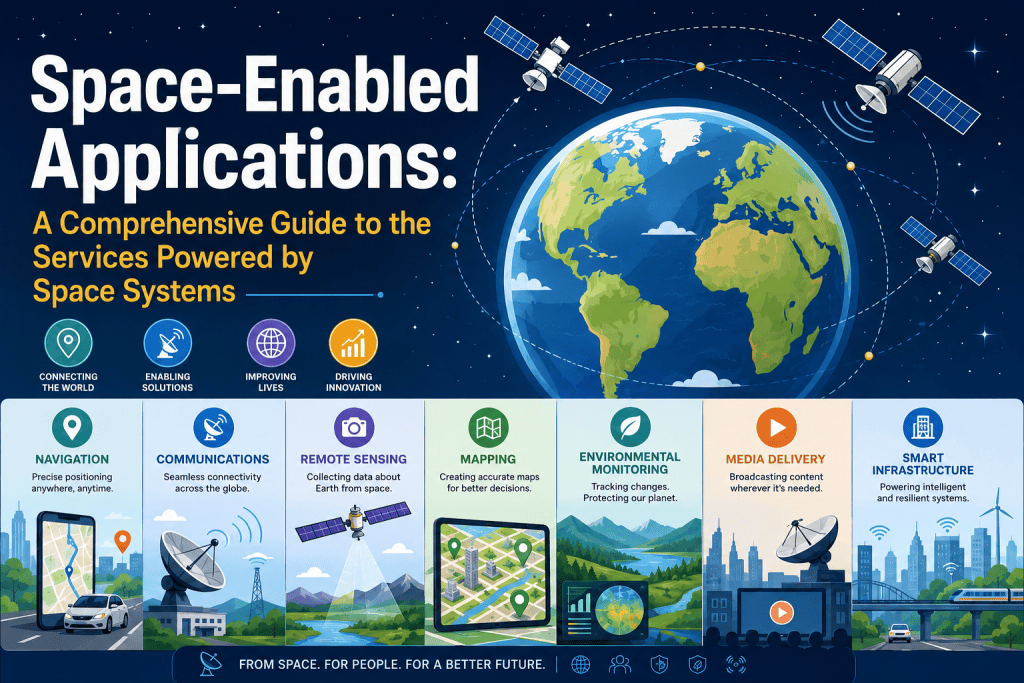
- Key Takeaways
- Space-Enabled Applications as Everyday Infrastructure
- Communications, Connectivity, and Data Relay
- Positioning, Navigation, and Timing in Commercial Life
- Earth Observation for Land, Oceans, Climate, and Cities
- Weather, Disaster Response, and Public Safety Applications
- Agriculture, Natural Resources, Energy, and Industrial Operations
- Transportation, Logistics, Finance, and Consumer Services
- Government, Defense and Security, Health, and Education
- Science, Exploration, Space Operations, and In-Space Services
- Space Economy Markets, Business Models, and User Adoption
- Limits, Risks, and Future Development of Space-Enabled Applications
- Summary
- Appendix: Useful Books Available on Amazon
- Appendix: Top Questions Answered in This Article
- Appendix: Glossary of Key Terms
- Appendix: Comprehensive Space-Enabled Applications List
- Space-Enabled Applications as Everyday Infrastructure
- Communications, Connectivity, and Data Relay
- Positioning, Navigation, and Timing in Commercial Life
- Earth Observation for Land, Oceans, Climate, and Cities
- Weather, Disaster Response, and Public Safety Applications
- Agriculture, Natural Resources, Energy, and Industrial Operations
- Transportation, Logistics, Finance, and Consumer Services
- Government, Defense and Security, Health, and Education
- Science, Exploration, Space Operations, and In-Space Services
- Space Economy Markets, Business Models, and User Adoption
- Limits, Risks, and Future Development of Space-Enabled Applications
Key Takeaways
- Space-enabled applications support communications, navigation, weather, finance, safety, and public services.
- Earth observation turns satellite data into practical decisions for land, oceans, climate, farms, and cities.
- The space economy reaches far beyond launch vehicles, satellites, and exploration missions.
Space-Enabled Applications as Everyday Infrastructure
The World Economic Forum and McKinsey estimated in 2024 that the global space economy could grow from $630 billion in 2023 to $1.8 trillion by 2035. That forecast includes direct space activity, such as launch vehicles, satellites, ground systems, and satellite services, as well as “reach” markets where satellite communications, positioning, navigation, timing, and Earth observation support revenue in other industries.
A simple definition helps set the boundary. A space-enabled application is a service, product, process, or decision system that depends on space infrastructure or space-derived information. The dependency may be obvious, as with satellite television, GPS navigation, or weather satellite imagery. It may also be hidden inside ordinary services, such as a banking transaction time-stamped by satellite timing, a container shipment tracked through satellite navigation, or an insurance model using satellite imagery to estimate flood exposure.
The phrase matters because it separates the application from the spacecraft. A communications satellite is a space asset. Satellite internet is an application. A Global Navigation Satellite System is infrastructure. Food delivery tracking, fleet dispatch, aircraft navigation, and power-grid synchronization are applications. An Earth observation satellite is a platform. Crop monitoring, methane detection, wildfire mapping, and coastal erosion tracking are applications. The commercial and social value often appears far from the launch site, the mission control room, or the satellite manufacturer.
Space-enabled applications are also broader than the space industry in the narrow sense. The Organisation for Economic Co-operation and Development describes the space economy as the activities and resources that create value through exploring, researching, understanding, managing, and using space. That framing includes the industrial base that builds rockets and satellites, but it also includes data services, ground systems, user equipment, analytics, software, insurance, procurement, regulation, and end-user markets.
Three enabling families dominate most application lists. Satellite communications move information where terrestrial networks are unavailable, damaged, overloaded, or too expensive to build. Positioning, navigation, and timing services provide location and synchronized time. Earth observation supplies images, measurements, and signals about the atmosphere, oceans, land, ice, cities, farms, forests, and infrastructure. Weather satellites overlap with Earth observation but deserve separate treatment because public safety, aviation, shipping, agriculture, and energy planning depend on regular weather data.
Space-enabled applications also differ in visibility. Consumer uses appear on phones, cars, watches, map apps, and television screens. Enterprise uses appear in logistics dashboards, mine planning systems, insurance risk models, precision agriculture platforms, airline operations centers, and maritime traffic systems. Government uses appear in disaster response rooms, public safety dispatch centers, environmental agencies, civil aviation authorities, military commands, land registries, and national statistics offices. Scientific uses appear in climate models, astronomical surveys, planetary missions, and public research data archives.
Some applications use a single space capability. A satellite phone call depends mostly on communications. Many high-value applications combine several capabilities. A disaster response system may combine satellite imagery, GPS-tagged field reports, emergency satellite communications, weather forecasting, and population vulnerability maps. A precision agriculture service may combine location data, Earth observation, soil information, weather forecasts, and machinery guidance. A maritime monitoring system may combine ship transponders, synthetic aperture radar, optical imagery, weather routing, and port scheduling.
Satellite communications, positioning, navigation, timing, and Earth observation are often called downstream space services because users receive data or connectivity from assets already in orbit. The downstream segment matters because it reaches far beyond the organizations that own satellites. A farmer using machine guidance, a shipping company tracking containers, a telecom provider synchronizing cell towers, and a city mapping heat exposure all sit inside the space-enabled economy without necessarily buying spacecraft or launch services.
The distinction between space-enabled and space-derived applications can be useful. Space-enabled applications need ongoing access to satellite services or space data. Space-derived applications may use technology originally developed for space but no longer depend on space infrastructure. Insulation materials, sensors, miniaturized electronics, and medical technologies can fall into the second category. This article focuses on applications that depend on active space systems, satellite data, ground networks, or space operations.
Many space-enabled applications became ordinary because the data became reliable, frequent, and affordable. GPS provides open positioning, navigation, and timing services to civilian users. Copernicus provides free access to European Earth observation data and services. NASA’s Applied Sciences Program supports use of Earth science data for decisions about environment, food, water, health, and safety. These public systems lowered barriers for private firms, public agencies, researchers, and nonprofit users.
Commercial systems now extend the application base. High-throughput satellite broadband supports ships, aircraft, remote communities, energy sites, and mobile users. Commercial Earth observation providers sell higher-resolution imagery, radar data, radio-frequency sensing, thermal imaging, greenhouse gas monitoring, and analytics. Space-based automatic identification system receivers track ships. Space-based automatic dependent surveillance-broadcast receivers track aircraft. Direct-to-device satellite services are moving satellite messaging and emergency connectivity into ordinary mobile devices.
The application list is still expanding because space systems increasingly work with terrestrial systems. 3GPP, the standards organization for cellular systems, describes non-terrestrial networks as network segments that use satellites or high-altitude platforms to relay or provide connectivity. Release 17 work brought satellite access into the 5G standards discussion for handheld and Internet of Things use cases, creating a path for more standardized satellite-cellular services.
Space-enabled applications do not remove the need for terrestrial infrastructure. They often complement it. Fiber networks carry most internet traffic. Aircraft and ships still need onboard equipment, terrestrial control systems, and human oversight. Weather forecasting relies on aircraft, buoys, radar, surface stations, models, and human forecasters, along with satellites. Earth observation data must pass through ground stations, cloud platforms, algorithms, domain experts, and user workflows before it becomes a decision.
The practical test is dependency. If a service stops working, loses accuracy, or becomes much less useful when satellite signals or space-derived data disappear, it qualifies as a space-enabled application. That test includes obvious services such as satellite broadband and GPS navigation. It also includes less visible services such as time synchronization for telecommunications, financial-market timing, power-grid control, crop insurance assessment, flood mapping, wildfire smoke tracking, and maritime surveillance.
Communications, Connectivity, and Data Relay
Satellite communications remain one of the clearest families of space-enabled applications because the link between the satellite and the service is visible. A user terminal sends or receives a signal through a spacecraft, and that spacecraft connects the user to another point on Earth or to another network. The application can be simple voice communication, broadband internet, television distribution, aircraft connectivity, shipboard internet, emergency messaging, or machine data transfer from a remote sensor.
Traditional satellite communications served broadcasting, government communications, maritime safety, aviation operations, and remote industrial sites. Geostationary satellites, which appear fixed in the sky from the ground, supported television distribution and broad regional coverage. Low Earth orbit systems added lower-latency broadband and more flexible coverage through large constellations. Medium Earth orbit systems serve specialized broadband and navigation-related roles. Each orbit creates different trade-offs in latency, coverage, spacecraft count, user equipment complexity, and service continuity.
The most familiar consumer-facing communications application is satellite television. Broadcast operators use satellites to distribute television channels to cable headends, direct-to-home dishes, and broadcast networks. Even where the end user receives content through cable or internet streaming, satellites may support contribution feeds, live news gathering, backup distribution, and remote event coverage. Broadcasting is one of the oldest large-scale space-enabled media applications, and it remains relevant in places where terrestrial distribution is limited or where one-to-many coverage has economic value.
Broadband internet is now the most visible growth area. Satellite broadband gives households, ships, aircraft, field teams, schools, clinics, and industrial sites access to internet service where fiber and cellular networks may be unavailable. Remote mining camps, offshore platforms, disaster response teams, scientific expeditions, and rural communities can use satellite links as a main connection or as a backup. The service depends on satellites, ground gateways, user terminals, spectrum rights, routing systems, and network management software.
Aviation connectivity turns aircraft into connected spaces. Passenger Wi-Fi is the visible feature, but operational uses matter as well. Airlines can use satellite links for aircraft health data, crew communications, weather updates, flight operations, and passenger services. Business aviation, cargo carriers, military aircraft, and emergency aircraft use satellite communications for routes where ground networks do not cover the flight path. In polar regions and oceanic airspace, satellite links have special value because terrestrial radio and cellular coverage are limited.
Maritime connectivity has a similar role at sea. Commercial ships use satellite communications for navigation support, crew welfare, cargo operations, port coordination, weather routing, engine monitoring, and regulatory reporting. Cruise ships rely on satellite bandwidth for passenger services and ship operations. Fishing vessels use satellite systems for safety, catch reporting, navigation, and market coordination. Offshore energy platforms and research vessels need communications for operations, safety, science, and logistics.
Emergency communications show why satellite systems matter even in highly connected countries. Floods, fires, hurricanes, earthquakes, conflict zones, cyber incidents, and power outages can damage terrestrial networks. Satellite links can restore connectivity for responders, hospitals, command centers, shelters, and mobile field units. NOAA satellite services support emergency managers through early threat detection, real-time tracking, and post-event mapping. Communications links complement that information flow by moving voice, data, images, alerts, and operational plans.
The Internet of Things creates a large class of small-data applications. Sensors in farms, pipelines, ships, railcars, power systems, wildlife tags, water stations, weather stations, and remote industrial equipment may need to send short messages from places with no terrestrial connectivity. Satellite IoT services can carry low-bandwidth data for asset status, location, temperature, vibration, pressure, flow rates, alarms, and environmental measurements. The commercial value often comes from preventing loss, reducing manual inspection, and improving resource allocation.
Direct-to-device satellite service extends the communications category into ordinary phones. Early services focused on emergency messaging and basic text. The longer-term direction is integration between satellite networks and cellular systems, though service quality, bandwidth, spectrum, device power, antenna design, and regulatory approvals limit what can be offered. Standardized non-terrestrial network work by 3GPP is significant because it gives device makers, network operators, chip companies, and satellite firms a shared technical path.
Satellite backhaul connects terrestrial networks to the internet or core network. A mobile operator may place a cellular tower in a rural area and use a satellite link for backhaul when fiber is unavailable. Community Wi-Fi providers can do the same. Backhaul is less visible to the public than satellite phones or user terminals, but it can be more scalable because many users share one connection point. Backhaul also supports temporary sites such as events, construction projects, remote work camps, and disaster response operations.
Data relay satellites serve space users rather than ground users. NASA and other operators use relay networks to move data between spacecraft and Earth when the spacecraft lacks a direct ground station link. Earth observation satellites, human spaceflight missions, launch vehicles, and future lunar systems benefit from relay capacity. The application is operational continuity: more contact time, faster data return, more flexible mission design, and less dependence on a single ground station pass.
Communications applications also carry regulatory and economic complexity. The International Telecommunication Union manages radio-frequency coordination procedures for space systems, earth stations, and radio astronomy stations through its space services work. Spectrum is finite, interference can cross borders, and satellite networks often need coordination with national administrations.
The application list in this category includes satellite broadband internet, rural internet, remote education, telemedicine connectivity, maritime internet, aviation internet, in-flight Wi-Fi, broadcast television, radio distribution, emergency communications, disaster recovery links, cellular backhaul, satellite IoT, remote industrial telemetry, scientific expedition communications, offshore platform connectivity, polar communications, military communications, diplomatic communications, live event transmission, news gathering, search-and-rescue communications, and space data relay.
Several business models sit behind these services. Operators may sell subscriptions to households, bandwidth to aircraft and ships, enterprise service packages to energy companies, wholesale capacity to telecom providers, managed services to governments, or terminals and airtime to field organizations. Some services rely on public procurement, particularly emergency communications and defense and security. Others depend on consumer adoption, airline passenger demand, shipping operations, or industrial automation.
Reliability requirements vary by application. A recreational satellite messaging service can tolerate delays and limited bandwidth. A ship safety service, aircraft operational link, military command channel, disaster response network, or remote medical connection needs higher assurance. Service providers must manage latency, coverage gaps, weather attenuation, jamming risk, cyber risk, ground station availability, equipment maintenance, power supply, and user training.
The most important communications trend is integration. Satellite systems increasingly connect with cellular networks, cloud platforms, cybersecurity systems, fleet management software, navigation tools, and Earth observation services. A remote mine might use satellite broadband, satellite IoT, GNSS tracking, weather data, and Earth observation in one operational system. A humanitarian organization might use satellite communications for field teams and satellite imagery for damage assessment. The value grows when connectivity becomes part of a broader information chain.
Positioning, Navigation, and Timing in Commercial Life
Positioning, navigation, and timing services are among the most widely used space-enabled applications because they sit inside phones, vehicles, aircraft, ships, farm machines, surveying instruments, financial networks, telecom systems, and power grids. GPS.gov describes the Global Positioning System as a U.S.-owned utility providing positioning, navigation, and timing services, and notes that the open nature of GPS has supported hundreds of applications affecting modern life.
The positioning part tells a receiver where it is. The navigation part helps a user or machine move from one place to another. The timing part supplies precise time that can synchronize networks and systems. Many people notice the first two through maps and directions. The timing function is less visible, yet it supports telecommunications, banking, financial markets, power-grid operations, broadcast networks, and data systems. GPS timing applications include communications networks, banking systems, financial markets, and power grids.
Satellite navigation is not limited to GPS. The broader category is Global Navigation Satellite Systems, or GNSS. It includes GPS, Europe’s Galileo, Russia’s GLONASS, China’s BeiDou, and regional augmentation systems. Devices often use signals from more than one constellation to improve availability and accuracy. The European Union Agency for the Space Programme describes its market work as covering both Earth observation and GNSS applications across consumer, business, government, industrial, nonprofit, and research users.
Consumer applications are the most familiar. Smartphone maps, pedestrian navigation, driving directions, ride-hailing, food delivery, fitness tracking, geotagged photos, find-my-device services, outdoor recreation apps, and smartwatch location depend on satellite positioning, often combined with cell towers, Wi-Fi, inertial sensors, and map databases. Location-based services became normal because GNSS receivers became cheap, small, and power-efficient enough to fit into mass-market devices.
Transportation and logistics depend heavily on GNSS. Trucking firms track vehicles, optimize routes, schedule deliveries, manage fuel use, document arrival times, and monitor driver safety. Package companies use location data to track shipments and refine last-mile delivery. Rail operators use location and timing data for asset tracking, signaling support, scheduling, and maintenance coordination. Ports use position data to coordinate containers, vehicles, cranes, ships, and yard operations.
Aviation uses satellite navigation for route planning, instrument procedures, flight tracking, approach guidance, and air traffic modernization. GPS.gov identifies GPS as important to U.S. aviation modernization and civil aviation efficiency. Aircraft operations also combine GNSS with inertial navigation, radar, radio navigation, surveillance systems, and air traffic control procedures.
Maritime users depend on GNSS for navigation, port approaches, vessel tracking, fishing operations, offshore energy work, dredging, hydrographic surveying, and search and rescue. Electronic chart systems and automatic identification systems rely on accurate position data. Large ships still need trained crews, radar, visual lookout, weather information, and local piloting, but satellite positioning supplies a common reference point for many maritime workflows.
Precision agriculture is a high-value application. GPS.gov describes precision farming uses such as farm planning, field mapping, soil sampling, tractor guidance, crop scouting, and variable-rate applications. Satellite positioning lets tractors and sprayers follow accurate paths, reduces overlap, lowers input waste, improves field records, and supports yield mapping.
Construction and mining use GNSS for machine control, surveying, site mapping, haul truck dispatch, drill positioning, grading, excavation, and safety management. Surveyors use GNSS receivers to map boundaries, elevation, construction layouts, roads, pipelines, power lines, and water infrastructure. The productivity gain comes from connecting physical work to digital design, schedule, and compliance systems.
Emergency services rely on satellite positioning in multiple ways. Dispatch centers use caller location, vehicle location, route planning, and incident mapping. Search-and-rescue teams use GNSS to locate missing persons, coordinate ground teams, guide aircraft, and mark hazards. Disaster response organizations map field reports and damage assessments using location-tagged data. The public safety value depends on accuracy, device availability, network connectivity, and good operational procedures.
Timing applications deserve more attention because they reveal how deeply space systems reach into ordinary infrastructure. Telecommunications networks require synchronized time to hand off calls, manage data packets, allocate spectrum, and coordinate base stations. Financial markets use precise time stamps for trades, audits, order sequencing, and regulatory records. Power grids use time synchronization to measure phase angles, coordinate protection systems, and manage wide-area monitoring.
The finance sector’s reliance on satellite timing shows that a space-enabled application may have no visual connection to space. A person using a bank card, trading platform, or payment network may never see a satellite map. The transaction may still rely on time synchronization ultimately derived from GNSS. The same principle applies to data centers, broadcast systems, cloud services, and some industrial control networks.
Location-based business models extend beyond navigation. Retailers and advertisers use geofencing to target offers or measure store visits. Insurance companies use vehicle location and driving patterns for usage-based insurance. Logistics companies use location history for delivery proof and dispute resolution. Governments use location data for road pricing, tolling, and congestion management. These applications raise privacy, cybersecurity, and consumer protection issues because location data can reveal personal behavior.
PNT services have limitations. Signals are weak when they reach Earth. They can be blocked indoors, degraded in urban canyons, reflected by buildings, disrupted by interference, or spoofed by false signals. Positioning, navigation, and timing technologies can be vulnerable to interference and unavailable indoors, underground, or underwater.
That vulnerability has created demand for resilience. Users may combine GNSS with inertial sensors, terrestrial radio systems, fiber timing, network timing, atomic clocks, map matching, radar, visual navigation, and local beacons. High-assurance users in aviation, defense, finance, energy, and telecom often require layered systems because a single satellite signal cannot carry the full burden alone.
The application list includes smartphone navigation, vehicle navigation, pedestrian navigation, fleet management, rail scheduling, aviation navigation, maritime navigation, drone navigation, agricultural guidance, construction equipment control, mining vehicle dispatch, surveying, land mapping, boundary mapping, emergency location, ambulance routing, fire dispatch, search and rescue, hiking navigation, boating navigation, fishing navigation, fitness tracking, geotagging, location-based advertising, geofencing, electronic tolling, stolen vehicle recovery, asset tracking, container tracking, aircraft tracking, ship tracking, telecom synchronization, financial transaction timing, power-grid synchronization, data center timing, scientific instrument timing, and legal time-stamping.
PNT has become a general-purpose input for the digital economy. It gives software a common answer to where and when. Many services can operate with degraded accuracy, but the cost, risk, or friction rises. A navigation app can switch to cell-tower location for a short period. A high-speed trading network, an aircraft approach, or a precision construction machine has much less tolerance for timing or positioning errors. The application value depends on matching the service to the required level of accuracy, integrity, continuity, and availability.
Earth Observation for Land, Oceans, Climate, and Cities
Earth observation turns satellites into measurement systems for the planet. Optical imagers collect reflected sunlight. Synthetic aperture radar sees through clouds and can operate at night. Thermal sensors measure heat. Hyperspectral instruments detect narrow bands of reflected energy that can reveal vegetation, minerals, water quality, and materials. Altimeters measure sea level and ice. Scatterometers estimate ocean winds. Atmospheric sensors measure gases, aerosols, clouds, and temperature profiles.
Copernicus services organize Earth observation around atmosphere, marine, land, climate change, emergency, and security domains. The program provides data and services free of charge to users, which has helped public agencies, researchers, companies, and nonprofit organizations build downstream applications.
Land applications include land cover mapping, land use mapping, forest monitoring, wetland mapping, soil moisture estimation, surface temperature mapping, urban growth tracking, snow monitoring, fire scar mapping, glacier monitoring, ground deformation analysis, construction progress monitoring, and protected area surveillance. These applications matter because land decisions are often slow, expensive, and politically sensitive. Satellite data gives users regular, comparable observations over large areas.
Agriculture is one of the largest Earth observation application areas. Satellite imagery can support crop type mapping, crop health monitoring, drought assessment, irrigation planning, yield forecasting, crop insurance, field boundary mapping, soil moisture estimation, and pest risk models. NASA’s Applied Sciences Program identifies food, water, health, safety, and environment as decision areas where NASA data helps institutions and individuals.
Forestry applications include timber inventory, illegal logging detection, forest health monitoring, fire risk mapping, reforestation verification, carbon estimation, habitat monitoring, and supply chain transparency. Radar data can help monitor forests through clouds, which is valuable in tropical regions. Optical imagery supports canopy assessment and land cover classification. Repeated imagery can show changes in road building, clearing, fires, and regrowth.
Water applications span rivers, lakes, reservoirs, snowpack, glaciers, wetlands, irrigation systems, floods, and drought. Satellite altimetry and imagery can track surface water extent, reservoir levels, flood spread, snow cover, and watershed conditions. NASA’s Earth Science Applications Guidebook describes use of Earth science information from satellites and other sources for decisions about water, land, agriculture, disasters, health, and more.
Ocean applications are equally broad. Satellites measure sea surface temperature, ocean color, sea level, ocean winds, waves, sea ice, oil spills, harmful algal blooms, coastal erosion, coral reef stress, chlorophyll, and marine pollution. Fisheries managers use ocean conditions, vessel tracking, and habitat models. Shipping companies use sea ice data, winds, waves, and currents for route planning. Coastal communities use satellite data for erosion, storm surge risk, and water quality.
Maritime domain awareness combines Earth observation with ship signals and other intelligence sources. Optical images can identify ships in clear conditions. Synthetic aperture radar can detect vessels at night or through clouds. Space-based automatic identification system receivers collect ship broadcasts. Analysts can compare ship broadcasts with imagery to detect dark vessels, suspicious behavior, illegal fishing, sanctions evasion, or unsafe activity. Copernicus Security supports border surveillance, maritime surveillance, and external action support within European Union policy needs.
Urban applications have expanded as satellite resolution, revisit rates, and analytics improve. Cities can use satellite data to map impervious surfaces, heat islands, vegetation, building expansion, construction progress, informal settlements, flood exposure, subsidence, air quality, and transportation corridors. Urban planners can compare growth patterns with zoning, transit, utilities, and environmental constraints. Satellite data cannot replace local surveys, but it can reveal patterns that local records miss or update too slowly.
Infrastructure monitoring uses imagery, radar interferometry, thermal data, and location services. Ground deformation monitoring can detect subsidence near tunnels, mines, pipelines, reservoirs, railways, ports, dams, and urban districts. Pipeline operators use satellite data to watch construction encroachment, ground movement, vegetation, leaks, and right-of-way conditions. Power utilities use satellite imagery to monitor vegetation near transmission corridors, storm damage, wildfire risk, and remote assets.
Climate applications depend heavily on long-term satellite records. Satellites track sea level, ice cover, glaciers, land surface temperature, vegetation, ocean heat indicators, atmospheric composition, aerosols, clouds, and greenhouse gases. The United Nations Office for Outer Space Affairs links space-derived data, information, services, and products to sustainable development and climate-related decision-making.
Greenhouse gas monitoring has become a commercial and policy application. Satellites can detect methane plumes from oil and gas facilities, coal mines, landfills, agriculture, and other sources. Carbon dioxide monitoring remains more technically demanding, but space-based systems contribute to atmospheric science and emissions analysis. The application has value for regulators, companies, investors, insurers, researchers, and climate policy institutions.
Biodiversity and conservation applications use satellite data to monitor habitats, wetlands, forest fragmentation, coastal ecosystems, protected areas, fire impacts, drought stress, and illegal activity. Earth observation cannot identify every species or ecological condition, but it supplies repeated, consistent measurement over space and time. Conservation groups combine it with field surveys, acoustic sensors, camera traps, local knowledge, and administrative records.
Disaster applications sit between Earth observation and emergency management. Satellites map flood extent, wildfire hotspots, smoke, hurricane clouds, earthquake damage, landslides, volcanoes, oil spills, and storm impacts. NASA’s Disasters Program develops tools and free resources that use Earth observations to show how natural hazards interact with vulnerability, exposure, and coping capacity.
Earth observation markets also include data platforms, analytics firms, cloud processing, artificial intelligence models, application programming interfaces, consulting, insurance analytics, and decision-support tools. The user rarely wants raw pixels. The user wants crop stress by field, flood extent by road, methane sources by facility, ship counts by port, construction progress by project, forest loss by concession, or subsidence risk by asset.
Limitations shape the application design. Optical imagery depends on daylight and cloud-free views. Radar data can be harder to interpret. High-resolution commercial imagery can be expensive or restricted. Revisit times may not match urgent operational needs. Automated analysis can create false positives. Regulatory limits may restrict access to the sharpest imagery. Users also need domain knowledge, ground validation, and workflow integration.
A complete list of Earth observation applications includes satellite imagery, radar imaging, thermal imaging, hyperspectral analysis, land cover mapping, land use mapping, urban expansion monitoring, building footprint mapping, infrastructure mapping, terrain analysis, change detection, nighttime lights analysis, settlement mapping, border region mapping, coastal mapping, river mapping, wetland mapping, forest mapping, desertification monitoring, soil moisture estimation, surface temperature mapping, snow and ice mapping, glacier monitoring, permafrost monitoring, landslide risk mapping, subsidence monitoring, earthquake damage mapping, volcano monitoring, flood mapping, fire scar mapping, mine-site monitoring, illegal dumping detection, environmental compliance monitoring, archaeology, heritage monitoring, protected area monitoring, crop monitoring, marine monitoring, climate services, and disaster response.
The highest-value applications often combine Earth observation with economic, social, and physical data. A crop forecast may combine satellite vegetation indices, weather data, soil maps, crop calendars, and market information. A flood risk tool may combine elevation models, rainfall, river gauges, land cover, building footprints, and insurance exposure. A city heat tool may combine surface temperature, tree cover, building density, income, age, and public health indicators. Satellites provide the recurring measurement layer, not the entire answer.
Weather, Disaster Response, and Public Safety Applications
Weather forecasting is one of the most mature space-enabled application families. Meteorological satellites observe cloud systems, water vapor, atmospheric temperature, sea surface conditions, snow, ice, smoke, dust, fire, and storm development. Geostationary satellites watch the same region frequently. Polar-orbiting satellites provide broader coverage and different instrument types. The data flows into forecasting models, warning systems, aviation products, marine forecasts, agriculture planning, and emergency management.
NOAA hurricane imagery supports monitoring and forecasting of hurricanes and tropical weather that threaten life and property. Hurricane specialists analyze satellite imagery along with other observations and computer models when making forecast decisions.
Daily weather applications include cloud monitoring, rainfall estimation, temperature analysis, storm tracking, snow and ice mapping, fog detection, wind estimation, and lightning support. The public sees these through weather apps, television forecasts, school closure decisions, road maintenance plans, agricultural decisions, airline operations, and energy demand forecasts. The satellite contribution can be invisible because the final forecast appears as a simple icon, warning polygon, or temperature chart.
Severe weather applications include hurricane tracking, tropical cyclone analysis, thunderstorm monitoring, atmospheric river tracking, winter storm monitoring, dust storm detection, volcanic ash tracking, wildfire smoke mapping, and flood risk analysis. These applications rely on frequent data and rapid distribution. Satellite observations do not eliminate uncertainty, but they help forecasters observe storm structure, movement, moisture, cloud-top temperatures, and environmental conditions over oceans and remote land areas.
Wildfire applications combine weather satellites, thermal detection, smoke tracking, vegetation condition, fuel moisture estimates, winds, and terrain. Satellites can identify hotspots, estimate fire growth, map smoke plumes, and assess burn scars after the event. Emergency managers can use this information for evacuation planning, air quality warnings, firefighting strategy, and recovery work. Satellite data is particularly valuable in remote regions where ground observations may be sparse.
Flood applications use rainfall estimates, storm tracking, river basin information, elevation models, radar imagery, optical imagery, and population exposure. During major floods, radar satellites can map water extent even through clouds. That capability helps emergency managers identify affected roads, settlements, farmland, and infrastructure. Humanitarian agencies use similar data to plan relief delivery and assess damage.
Disaster response applications extend beyond weather. Earthquakes, volcanoes, landslides, oil spills, industrial accidents, dam failures, and tsunamis can all require satellite data. Radar can detect ground deformation before or after some events. Optical imagery can show damaged buildings, blocked roads, landslides, and inundation. Thermal imagery can identify fires or heat anomalies. Communications satellites can help response teams communicate when local networks fail.
The United Nations Office for Outer Space Affairs states that space-based technologies support disaster prevention, preparedness, early warning, response, and reconstruction. That full-cycle view matters because satellites are useful before, during, and after an event. Risk maps can guide planning before disaster strikes. Weather and hazard monitoring can support warnings. Imagery and communications help response. Repeated observations support recovery and reconstruction.
Public safety applications also include search and rescue. Satellite positioning helps locate people, vehicles, aircraft, ships, and emergency beacons. Satellite communications help field teams exchange information in remote areas. Weather satellites guide search planning by showing storms, winds, sea state, visibility, and temperature conditions. Maritime and aviation distress systems depend on coordinated detection, location, communications, and response networks.
Health-related disaster applications include smoke exposure mapping, heat-health alerts, disease risk models, water contamination monitoring, and emergency logistics. NASA’s Applied Remote Sensing Training Program provides training across areas such as air quality, public health, agriculture, disasters, ecological conservation, water resource management, climate resilience, and wildland fires.
Food security applications are linked to disaster monitoring. Drought, floods, pests, crop failure, and conflict can affect food supplies. Satellite data can track vegetation health, rainfall anomalies, crop condition, grazing pressure, water availability, and market access disruption. Humanitarian organizations use these indicators to anticipate needs and direct resources. Accuracy improves when satellite data is combined with field reporting, local price data, and agricultural expertise.
Insurance applications use satellite data before and after disasters. Before a loss, insurers and reinsurers use imagery, hazard models, flood maps, wildfire risk, coastal exposure, building footprints, and climate indicators to price risk or manage portfolios. After a loss, they use imagery to estimate damage, validate claims, detect fraud, and plan adjuster deployment. Parametric insurance products can trigger payouts from measured conditions, such as rainfall, wind, or flood extent, where contract terms permit.
Energy applications depend on weather and disaster data. Utilities need storm forecasts, wildfire risk maps, solar irradiance forecasts, wind forecasts, ice loading warnings, heat demand forecasts, and damage maps. Offshore energy operators need wave, wind, storm, and sea ice information. Hydropower operators need snowpack, rainfall, and basin data. Satellite-enabled weather information affects generation planning, grid reliability, maintenance scheduling, and worker safety.
Aviation applications rely on weather satellites for storms, turbulence indicators, icing risk, volcanic ash, fog, hurricanes, and convective weather. Airlines, air traffic managers, airports, and pilots use satellite-supported forecasts to route flights, manage delays, protect passengers, and reduce fuel burn. Volcanic ash monitoring is particularly important because ash can damage aircraft engines and create large airspace disruptions.
Maritime safety applications include storm warnings, sea ice information, wave forecasts, winds, ocean temperature, fog, and route optimization. Ship operators use weather data to reduce risk, avoid severe conditions, protect cargo, manage fuel consumption, and plan port arrival. Fisheries use weather and ocean data to improve safety and operations. Coastal authorities use storm surge, wave, and sea level data for warnings and evacuation planning.
Weather and disaster applications also have governance implications. Public agencies often provide core warning services because the value includes lives protected, infrastructure damage reduced, and public trust. Commercial firms add specialized analytics, decision platforms, industry-specific products, and high-resolution datasets. The public-private mix differs by country, sector, and hazard type.
Limitations remain. Forecast models can disagree. Satellite instruments have outages, replacement cycles, calibration needs, and coverage limits. Some data streams depend on international cooperation. Budget changes, aging satellites, cybersecurity concerns, and procurement delays can affect continuity.
A complete application list in this family includes daily weather forecasting, storm forecasting, hurricane tracking, thunderstorm monitoring, flood forecasting, drought monitoring, heatwave monitoring, snowpack monitoring, wildfire detection, smoke tracking, air quality forecasting, dust storm monitoring, volcanic ash monitoring, cloud monitoring, rainfall estimation, sea surface wind monitoring, wave monitoring, sea ice monitoring, seasonal climate outlooks, El Niño and La Niña monitoring, aviation weather, marine weather, agricultural weather, energy forecasting, insurance risk modeling, disaster risk mapping, early warning, emergency mapping, damage assessment, reconstruction monitoring, public safety alerts, evacuation planning, humanitarian logistics, refugee camp mapping, and search-and-rescue support.
The public often treats forecasts as ordinary information. From an economic viewpoint, they are decision infrastructure. A road agency deciding when to salt highways, an airline rerouting aircraft, a farmer planning irrigation, a grid operator preparing for peak demand, a port delaying cargo operations, and an emergency manager issuing evacuation orders all depend on space-enabled weather and hazard information. The value appears in avoided losses, better scheduling, faster response, and safer operations.
Agriculture, Natural Resources, Energy, and Industrial Operations
Agriculture uses nearly every main space capability: positioning, Earth observation, communications, weather, and timing. The field may be rural and local, but the information system can be global. Satellite positioning guides tractors, sprayers, harvesters, and drones. Satellite imagery shows vegetation condition, water stress, crop type, soil moisture indicators, and field variability. Satellite weather data informs planting, spraying, irrigation, harvest timing, and risk management.
Precision agriculture is the most direct application. GPS-based tractor guidance reduces overlap and gaps in field operations. Variable-rate application systems can apply seed, fertilizer, lime, or crop protection products in different amounts across a field. Field mapping creates digital records for planning, compliance, insurance, and yield analysis. GPS.gov identifies farm planning, field mapping, soil sampling, tractor guidance, crop scouting, and variable-rate applications as GPS-based precision farming uses.
Satellite imagery adds a different view. Vegetation indices can show crop vigor. Thermal data may indicate water stress. Radar can observe some field conditions despite clouds. Repeated imagery can show emergence, growth, stress, damage, and harvest. These observations help agronomists and farmers prioritize scouting rather than replacing it. Field-level decisions still require local knowledge, soil information, equipment capacity, and crop economics.
Food security agencies use satellite data at larger scales. They monitor rainfall anomalies, vegetation condition, drought, flooding, crop calendars, pasture, and conflict-related access constraints. Governments and humanitarian organizations can identify regions at risk of crop failure or livestock stress. Satellite data improves coverage where field surveys are slow, dangerous, or expensive. Forecasts remain uncertain, particularly where conflict, trade restrictions, pests, and market shocks interact with environmental stress.
Livestock and rangeland applications include grazing condition monitoring, water source mapping, pasture productivity estimates, livestock tracking, drought planning, and insurance. Satellite imagery can show vegetation trends over large grazing areas. GNSS devices can track animals or herds in some settings. Remote communications can send data from collars, water pumps, gates, and weather stations. The value often comes from reducing labor and improving early warning.
Forestry applications include timber inventory support, harvest tracking, fire risk, illegal logging detection, forest road monitoring, pest damage, reforestation verification, carbon estimation, and biodiversity habitat assessment. Optical imagery helps classify land cover and tree canopy. Radar helps observe humid and cloudy regions. Thermal and weather data support fire monitoring. Earth observation gives regulators, companies, and conservation organizations a shared evidence base, though legal enforcement still requires field investigation and due process.
Mining uses satellite applications before, during, and after extraction. Exploration teams use remote sensing to identify geological features and surface mineral indicators. Mine operators use GNSS for surveying, machine control, vehicle dispatch, slope monitoring support, and safety zones. Radar interferometry can detect ground movement near pits, waste piles, and tailings dams. Imagery can track construction, expansion, reclamation, water impacts, and environmental compliance.
Energy is another large application field. Oil and gas operators use satellite communications for offshore platforms, pipelines, remote fields, and mobile crews. Earth observation helps monitor pipeline corridors, ground deformation, encroachment, spills, methane emissions, and storm risks. Methane detection has become a visible example because satellites can identify large emissions events from oil and gas operations, coal mines, landfills, and other sources.
Renewable energy applications include solar resource assessment, cloud monitoring, irradiance forecasting, wind resource assessment, wind forecasting, snow cover monitoring, hydropower basin monitoring, and storm risk. Solar and wind operators use weather and satellite data to forecast generation and schedule maintenance. Hydropower operators use snowpack, rainfall, reservoir, and watershed information. Grid planners use weather and climate data to understand demand, generation variability, and transmission risk.
Power grids also depend on timing. GNSS time synchronization supports grid monitoring and control systems. Wide-area measurement systems use synchronized sensors to observe grid conditions across regions. Timing errors can affect situational awareness and protection systems. Because GNSS signals can be disrupted, high-reliability grid operators may seek backup timing sources, monitoring, and resilience planning.
Water resource management uses satellite data for snowpack, rainfall, evapotranspiration, reservoir levels, river extent, groundwater-related land movement, irrigation demand, drought, and flood risk. Water agencies need this information for allocation, drought response, infrastructure management, agriculture planning, and environmental protection. Satellite data helps where ground networks are sparse or where basin-scale views are needed.
Industrial operations use satellite IoT and remote communications to monitor equipment, vehicles, tanks, pipelines, pumps, generators, and environmental sensors. A remote sensor may send small data packets through a satellite network when cellular coverage is absent. This supports predictive maintenance, safety alerts, production monitoring, environmental reporting, and asset utilization. The business case often comes from avoiding site visits, reducing downtime, or catching failures early.
Construction and infrastructure firms use GNSS and satellite imagery to manage projects. Machine control can guide earthmoving equipment. Survey crews use GNSS to collect accurate site data. Satellite imagery can document progress, track material stockpiles, monitor land disturbance, and verify site restoration. Large projects such as roads, railways, pipelines, ports, and energy facilities benefit from repeated overhead monitoring.
Environmental compliance is a cross-sector application. Regulators, investors, communities, and companies use satellite data to monitor land disturbance, deforestation, water impacts, dust, emissions, methane, flaring, illegal mining, tailings risk, and reclamation. Satellite data cannot automatically prove legal liability, but it can flag anomalies, guide inspections, and create time-stamped records.
Supply chain monitoring links space data to trade and market analysis. Analysts use satellite imagery to estimate crop production, oil storage, port activity, mine output, construction activity, and industrial traffic. Nighttime lights can indicate economic activity, power disruptions, or disaster impacts. Ship tracking can reveal trade flows, congestion, and rerouting. These applications support commodity markets, investors, logistics firms, insurers, and governments.
The application list for this section includes precision agriculture, crop health monitoring, crop type mapping, yield forecasting, irrigation planning, soil moisture monitoring, fertilizer planning, pest risk modeling, agricultural insurance, farm machinery guidance, pasture monitoring, food security monitoring, forestry inventory, illegal logging detection, mine planning, tailings monitoring, oil and gas field monitoring, pipeline monitoring, methane detection, solar forecasting, wind forecasting, hydropower monitoring, dam monitoring, reservoir monitoring, industrial IoT, remote equipment tracking, environmental compliance, and supply chain intelligence.
These applications reveal a common pattern. Space systems rarely make a decision alone. They supply observations, timing, connectivity, or location to a broader operational system. A farmer decides whether to irrigate. A utility decides whether to pre-position crews. A mining company decides whether to inspect a slope. A regulator decides whether to investigate a suspected illegal clearing. The satellite-enabled service improves the information available at the point of decision.
Transportation, Logistics, Finance, and Consumer Services
Transportation is one of the largest application categories because movement requires location, timing, communication, weather, and monitoring. Road vehicles, trains, aircraft, ships, containers, delivery drivers, warehouse yards, ports, airports, and logistics platforms all use space-enabled inputs. The user may see a moving icon on a screen. Behind that icon sits GNSS, maps, wireless communications, software, and sometimes satellite imagery or weather data.
Road transportation applications include turn-by-turn navigation, fleet management, route optimization, dispatch, estimated arrival times, traffic analysis, electronic tolling, road pricing, stolen vehicle recovery, usage-based insurance, hazardous cargo tracking, and emergency response. Many systems combine GNSS with cellular networks, map databases, onboard sensors, and dispatch software. Satellite positioning supplies the location reference that makes the service useful.
Freight logistics uses location data to reduce uncertainty. A container, truck, railcar, trailer, pallet, or high-value asset can be tracked through its journey. Some trackers use cellular networks most of the time and satellite links in remote areas. Cold-chain logistics adds temperature monitoring for food, pharmaceuticals, and sensitive materials. Location and sensor data create records for compliance, insurance, customer service, and disruption management.
Rail applications include asset tracking, scheduling support, maintenance planning, safety systems, construction surveying, and time synchronization. Trains follow fixed tracks, but rail networks still need precise time, location, and communications. GNSS can support positive train control functions in some systems when combined with track databases and other sensors. Satellite communications can help remote rail corridors with limited terrestrial coverage.
Aviation applications combine GNSS navigation, satellite communications, weather data, aircraft tracking, and operational data links. Commercial airlines use satellite-enabled services to manage routes, passenger connectivity, crew communications, and safety information. Cargo aviation uses the same systems for time-sensitive freight. General aviation uses satellite navigation, weather products, and emergency beacons. Airspace modernization depends on reliable positioning and communications, even though aircraft systems keep multiple layers of redundancy.
Maritime logistics depends on satellite navigation, ship tracking, weather routing, satellite communications, sea ice monitoring, port coordination, and cargo visibility. Automatic identification system messages can be collected by satellites, extending ship tracking beyond coastal receivers. Vessel operators use weather and ocean data to reduce risk and fuel use. Ports use vessel arrival predictions to schedule pilots, berths, tugs, cranes, labor, and inland transport.
Drone applications depend on positioning, communications, maps, and weather. Small drones often use GNSS for navigation, geofencing, mapping, agriculture, inspection, and emergency response. Larger uncrewed systems may need satellite communications for beyond-line-of-sight operations. Drone delivery, infrastructure inspection, maritime patrol, wildfire mapping, and disaster assessment all need reliable location and communications. Regulatory approval remains a major factor because airspace safety depends on more than the spacecraft signal.
Consumer services represent the broadest and least visible category. Weather apps, navigation apps, ride-hailing, delivery tracking, outdoor recreation apps, fitness watches, geotagged images, local search, travel planning, emergency satellite messaging, connected car services, and personal asset trackers all depend in part on space systems. Consumers often treat these as app features rather than space services.
Tourism and recreation applications include wilderness navigation, boating safety, skiing weather, adventure tourism communications, marine weather, satellite messaging, dark-sky planning, cruise connectivity, and remote lodge communications. Astrotourism also depends on satellite weather, light pollution mapping, remote access, navigation, and safety communications. Space imagery supplies educational and cultural content for museums, planetariums, media, and public outreach.
Finance uses space-enabled inputs in several ways. Precise timing supports transaction ordering, audit trails, and market infrastructure. Earth observation supports commodity analysis, insurance modeling, climate risk, property risk, and infrastructure monitoring. GNSS supports logistics finance through shipment tracking and asset security. Satellite data can also inform economic indicators by tracking nighttime lights, port activity, crop conditions, and energy infrastructure.
Insurance applications are expanding as satellite data becomes more frequent and easier to analyze. Property insurers use flood, wildfire, storm, roof condition, and exposure data. Agricultural insurers use crop condition, drought, hail, flood, and yield indicators. Marine insurers use ship tracking, weather, and route data. Reinsurers use catastrophe models fed by hazard and exposure datasets. Parametric insurance uses measured triggers, though contract design and data reliability matter.
Banking and payments rely on time synchronization and network resilience. GPS.gov identifies banking systems and financial markets as users of GPS time synchronization. Payment systems, trading platforms, and audit systems need accurate time records. The space dependency is hidden, but the operational value is high.
Retail applications include location-based advertising, store visit analytics, delivery tracking, inventory movement, site selection, and weather-driven demand forecasting. Retailers may use satellite-derived weather data to forecast demand for seasonal products. Site planners may use imagery, traffic data, and demographic information to evaluate new locations. Delivery firms use routing and location data to manage customer expectations.
Media and entertainment applications include satellite broadcasting, live news feeds, remote event coverage, weather visualization, sports event connectivity, documentary imagery, space imagery, and location-based augmented reality. The entertainment application may use space imagery as content rather than infrastructure. Live broadcasting from remote regions and ships uses satellite communications as operational infrastructure.
Legal and regulatory uses appear in time-stamped records, land administration, border management, environmental enforcement, and transportation compliance. Satellite images can document land changes, construction, vegetation clearing, flood extent, or infrastructure damage. GNSS records can support route compliance, delivery proof, worksite documentation, and chain-of-custody records. These uses require careful data governance because accuracy, authenticity, privacy, and admissibility can be contested.
The application list in this category includes road navigation, fleet routing, truck dispatch, rail scheduling, aviation routing, maritime routing, port logistics, airport operations, container tracking, package tracking, cold-chain tracking, supply chain visibility, last-mile delivery, transit arrival estimates, traffic monitoring, fuel optimization, drone delivery support, aircraft surveillance support, ship arrival prediction, smartphone maps, local search, location-based recommendations, delivery apps, ride-hailing apps, fitness apps, outdoor recreation apps, travel apps, geotagged social media, satellite emergency messaging, financial network timing, transaction time-stamping, crop insurance, flood insurance, maritime insurance, commodity forecasting, ESG monitoring, and carbon credit verification.
The economic value can be direct or indirect. A satellite broadband subscription creates direct space-sector revenue. A ride-hailing trip creates reach revenue because space services enable part of the transaction. A financial trade time-stamped by GNSS may create no direct satellite revenue for the satellite operator, but the transaction depends on space-based timing. This is why space-enabled applications are larger than direct sales of satellites, rockets, and imagery.
Risk management is now a major driver. Companies want to know where goods are, whether a port is congested, whether a supplier’s region has flooded, whether crops are stressed, whether an energy site is emitting methane, whether a road is closed, or whether a ship has deviated. Space-enabled applications give managers a broader, more current view of events that affect operations and capital.
Government, Defense and Security, Health, and Education
Government uses space-enabled applications because states must manage territory, infrastructure, resources, borders, disasters, public services, and security. Satellites help governments observe areas that are hard to reach, communicate across large regions, navigate safely, synchronize important systems, and provide public information. Many civilian public services depend on space systems without being branded as space programs.
Land administration uses satellite imagery, GNSS surveying, maps, and digital records. Governments use these tools for land registries, cadastral mapping, urban planning, tax assessment, infrastructure planning, agricultural subsidies, and environmental compliance. Satellite data can help identify land use changes, informal construction, illegal dumping, encroachment, deforestation, mining expansion, and settlement growth. Local legal records still matter because imagery alone cannot settle ownership or rights.
Border and maritime authorities use Earth observation, ship tracking, communications, and navigation data. Copernicus Security identifies border surveillance, maritime surveillance, and support to external and security actions among its application areas for European Union policy. These services can support awareness, planning, and response, but they work inside legal frameworks that govern privacy, sovereignty, asylum, customs, and law enforcement.
Defense and security applications include secure communications, positioning and timing, missile warning, space domain awareness, reconnaissance, maritime monitoring, logistics, weather, navigation, search and rescue, and treaty monitoring support. These applications are sensitive, and public descriptions often remain general. The same technology families used for civilian services can support military operations, which creates dual-use policy issues for export control, licensing, procurement, and commercial data access.
Space domain awareness focuses on objects and activity in orbit. Governments and commercial operators track satellites, spent rocket bodies, debris, conjunction risks, maneuvers, and reentries. The application protects satellites, supports collision avoidance, informs launch operations, and helps identify unusual activity. Space traffic coordination becomes more important as low Earth orbit fills with more spacecraft and debris fragments.
Public safety agencies use satellite communications, GNSS, Earth observation, and weather services. Police, fire, ambulance, civil protection, coast guard, emergency management, and search-and-rescue organizations use space-enabled tools for dispatch, situational awareness, route planning, damage mapping, and field communications. The tools must work under stress, with clear procedures and trained users. Data without operational discipline can slow response rather than improve it.
Health applications include telemedicine connectivity, disease risk mapping, air quality monitoring, heat exposure analysis, water quality monitoring, medical supply tracking, disaster health response, and hospital infrastructure planning. NASA’s Health and Air Quality Applications area encourages use of Earth observations in air quality management and public health.
Air quality applications combine satellite observations with ground monitors, emissions data, weather models, and public health records. Satellites can observe smoke, dust, aerosols, nitrogen dioxide, ozone-related indicators, and other atmospheric features. Public health agencies can use this information for advisories, exposure analysis, environmental justice work, and long-term planning. Local sensors remain important because satellites may not measure pollution at street level.
Heat-health applications use satellite-derived land surface temperature, vegetation cover, building density, demographic data, and health vulnerability indicators. Cities can identify hot neighborhoods, prioritize tree planting, plan cooling centers, and issue warnings. The application shows how space data can connect physical geography to social policy. Surface temperature does not equal air temperature, so interpretation must be careful.
Water and sanitation applications include mapping flood risk, water bodies, drought, algal blooms, wastewater impacts, and contamination indicators. Humanitarian organizations may use satellite imagery to map camps, roads, water access, and environmental hazards. Public health teams can combine remote sensing with field data to understand disease vectors, particularly where mosquitoes, standing water, heat, and land use interact.
Education applications include distance learning connectivity, educational broadcasting, access for remote schools, space imagery for science education, and teacher training resources using satellite data. Satellite internet can connect classrooms in places where terrestrial networks are limited. Earth observation data gives students real examples of weather, climate, agriculture, oceans, fires, and cities. The application is educational access and scientific literacy.
International development applications use space data for Sustainable Development Goals, infrastructure monitoring, agriculture, disaster resilience, water management, urban growth, environmental protection, and public health. UNOOSA links space-derived data, information, services, and products to sustainable development work through cooperation and capacity-building.
Justice and human rights applications can include evidence of burned villages, mass displacement, illegal resource extraction, environmental harm, border conditions, and damage to civilian infrastructure. These uses require caution. Satellite imagery can provide important evidence, but analysts need context, validation, chain of custody, and ethical safeguards. Misinterpretation can harm affected communities or distort public understanding.
Regulatory applications are increasing. Civil aviation regulators need satellite navigation and surveillance standards. Telecommunications regulators manage satellite spectrum and licensing. Environmental regulators use imagery for compliance. Financial regulators care about timing integrity and market records. Space regulators license launches, satellites, remote sensing, debris mitigation plans, and reentry risk. The application base grows alongside legal obligations.
Procurement shapes many government applications. A civil agency may buy satellite imagery subscriptions, analytics services, emergency communications terminals, GNSS receivers, data platforms, or cloud processing. Defense agencies may buy commercial satellite communications, commercial imagery, weather data, hosted payloads, launch services, and space tracking services. Public procurement can create stable demand but may also impose security, data rights, and domestic content requirements.
The application list includes national statistics support, census mapping, tax compliance mapping, land registry support, border management, environmental regulation, fisheries regulation, forestry regulation, agriculture policy, disaster policy, climate policy, infrastructure planning, transportation policy, national security planning, peacekeeping support, treaty monitoring support, secure government communications, military communications, military navigation, missile warning, space domain awareness, critical infrastructure monitoring, illegal mining detection, illegal logging detection, illegal fishing detection, emergency caller location, ambulance routing, telemedicine, disease risk mapping, public health logistics, remote education, and educational broadcasting.
Government applications often create public goods. Weather warnings, disaster maps, GNSS signals, open Earth observation data, and public research archives help many users at once. Private firms can build services on top of public infrastructure. That relationship creates a mixed economy where taxpayers fund core systems and companies build specialized applications. The balance differs by country and by application.
Science, Exploration, Space Operations, and In-Space Services
Space-enabled applications are not limited to Earth users. Space systems also enable science, exploration, and operations beyond Earth. Astronomy, planetary science, heliophysics, Earth science, microgravity research, space weather monitoring, lunar exploration, Mars missions, asteroid missions, deep-space communications, and human spaceflight all depend on space infrastructure, ground systems, and specialized data services.
Space science applications include observatories that study the universe from orbit or deep space. Space telescopes observe wavelengths blocked or distorted by Earth’s atmosphere. Planetary spacecraft study moons, planets, asteroids, comets, magnetic fields, atmospheres, surfaces, and interiors. Solar missions monitor the Sun and space weather. Earth science missions measure climate, weather, oceans, land, ice, and atmospheric composition.
NASA describes its work as including space exploration, scientific discovery, and aeronautics research, with Earth science, solar system science, and universe science among its public mission areas. The agency’s mission pages show how science applications depend on spacecraft, instruments, data archives, ground operations, and international partnerships.
Space weather applications deserve special attention because they connect solar activity to Earth infrastructure. Solar flares, coronal mass ejections, radiation storms, and geomagnetic storms can affect satellites, communications, aviation routes, GNSS accuracy, pipelines, and power grids. Space weather monitoring uses solar observatories, magnetometers, solar wind monitors, radiation sensors, and forecasting centers. The application is protection of infrastructure and operational planning.
Space operations applications include satellite command and control, ground station scheduling, orbit determination, telemetry processing, collision avoidance, maneuver planning, anomaly diagnosis, reentry prediction, and spectrum coordination. Every satellite service depends on these background operations. Consumers rarely see them, but a broadband constellation, weather satellite, navigation satellite, or Earth observation fleet needs continuous operations to remain useful.
Launch applications include range safety, weather monitoring, tracking, telemetry, flight termination systems, scheduling, payload processing, launch site operations, and regulatory licensing. Space-enabled services also support launch. Weather satellites and ground weather networks influence launch windows. GNSS can support flight tracking. Communications relay mission data. Space domain awareness helps avoid conflicts with orbital objects.
Satellite servicing and in-space logistics are emerging application families. On-orbit inspection, refueling, repair, life extension, relocation, debris removal, and component replacement can change how satellites are designed and financed. Operational examples remain limited compared with communications and Earth observation, but the application potential is significant for high-value spacecraft, government missions, and future cislunar infrastructure.
In-space manufacturing and research applications use the microgravity environment. The International Space Station has supported biological research, materials science, fluid physics, combustion studies, Earth observation, technology demonstrations, and commercial research. Future commercial stations may expand these services, but markets remain under development. The application is the use of space conditions as a research or production environment.
Human spaceflight applications include crew transport, space station operations, life support research, astronaut health, spacesuits, robotics, training, mission control, emergency return planning, and exploration systems. Some applications produce direct scientific results. Others develop operational knowledge for future missions. Human spaceflight also supports education, diplomacy, industrial capability, and national prestige, though those benefits are harder to measure than data services.
Lunar applications are under active development. They include lunar communications, lunar navigation, surface power planning, resource prospecting, landing site mapping, terrain hazard detection, relay satellites, lunar timekeeping, cislunar space monitoring, and surface operations support. These applications serve government exploration first, with commercial markets emerging through contracts, payload delivery, communications services, and future infrastructure.
Mars and deep-space applications require communications, navigation, science data processing, mission planning, entry-descent-landing analysis, surface operations, relay orbiters, and planetary protection compliance. Deep-space missions operate under long signal delays and limited bandwidth. Applications must be designed around autonomy, power limits, radiation, thermal conditions, and mission lifetime.
Astronomy applications also reach the public through data archives and educational products. Space telescope images, exoplanet discoveries, asteroid surveys, solar observations, and planetary mission results support science education, media, museums, planetariums, and public engagement. The public-facing image is only the final layer of a complex chain that includes instruments, calibration, data pipelines, peer review, archives, and interpretation.
Planetary defense is a science and public safety application. Surveys discover and track near-Earth objects. Orbit calculations estimate future close approaches. Radar, optical telescopes, and space missions improve knowledge of size, shape, rotation, and composition. The application connects astronomy, civil protection, international coordination, mission planning, and public communication.
Debris monitoring and collision avoidance are space safety applications. Satellites can be damaged or destroyed by debris impacts. Operators use tracking data, conjunction assessments, and maneuver planning to reduce risk. As spacecraft numbers rise, coordination systems, data sharing, standards, and disposal practices become more important. This is an operational application with economic, safety, and regulatory consequences.
The application list includes astronomy, planetary science, solar physics, Earth science, atmospheric science, ocean science, climate science, space weather forecasting, microgravity research, astrobiology, lunar exploration support, Mars exploration support, asteroid observation, comet observation, exoplanet discovery, deep-space communications, space telescope operations, scientific data relay, technology demonstrations, biological experiments in orbit, materials research in microgravity, satellite operations, spacecraft tracking, launch tracking, collision avoidance, debris monitoring, reentry prediction, satellite anomaly diagnosis, ground station scheduling, on-orbit servicing, satellite refueling, satellite inspection, satellite life extension, lunar navigation, lunar communications, and cislunar monitoring.
Science and operations applications often produce knowledge rather than immediate commercial revenue. That does not make them separate from the space economy. Instrument suppliers, launch providers, ground stations, software developers, data centers, universities, research institutes, contractors, insurers, and workforce pipelines all participate. Scientific missions also generate technologies, datasets, and expertise that later support commercial and government services.
Space Economy Markets, Business Models, and User Adoption
Space-enabled applications create economic value through several pathways. Some generate direct revenue for satellite operators. Others generate revenue for downstream service firms. Many create indirect value by reducing risk, saving time, improving logistics, avoiding damage, or supporting public services. The World Economic Forum and McKinsey’s 2024 framing separates backbone applications, tied more directly to space hardware and services, from reach applications, where space capabilities help other industries generate revenue.
The backbone side includes satellites, launch vehicles, ground systems, satellite manufacturing, launch operations, communications services, broadcast services, Earth observation data, positioning services, user terminals, ground hardware, and support services. The reach side includes industries such as transportation, agriculture, insurance, energy, finance, consumer services, weather-sensitive businesses, and government operations that use space capabilities inside broader products and workflows.
This distinction helps explain why the list of space-enabled applications is so long. A satellite operator may sell bandwidth to an airline. The airline sells passenger Wi-Fi and improves operational communications. A GNSS constellation provides open signals. A delivery company uses those signals to manage drivers and customer updates. A public Earth observation program releases data. A company builds crop analytics on top of it. Revenue and value appear at several points.
Business models include subscriptions, data licenses, usage fees, managed services, analytics platforms, hardware sales, bundled connectivity, government contracts, procurement frameworks, insurance products, performance-based services, and public funding. A satellite broadband service may sell monthly subscriptions. An imagery company may sell data access or analytic products. A GNSS receiver firm may sell hardware. A climate-risk firm may sell reports and models built partly on satellite data.
Government demand remains a major market driver. Weather systems, navigation systems, defense communications, disaster response, science missions, and open Earth observation programs often depend on public funding. Governments also buy commercial services when speed, innovation, coverage, or cost make procurement attractive. Commercial remote sensing and satellite communications have become particularly relevant to defense and security users, humanitarian organizations, and civil agencies.
Regulation affects application growth. Remote sensing rules may limit resolution, latency, customer access, or national security-sensitive data. Telecommunications rules govern spectrum, landing rights, orbital filings, and interference. Aviation and maritime authorities set safety requirements. Privacy laws affect location data, imagery analytics, and consumer tracking. Environmental rules affect debris mitigation, launch impacts, spectrum sharing, and reentry planning.
Insurance is both a user and an enabler. Space-enabled insurance applications use data to assess risk and verify losses. Space industry insurance covers launch, satellites, in-orbit operations, and liability. As more services depend on space infrastructure, outages, interference, cyberattacks, solar storms, and collisions can create broader economic exposure. Insurance models must account for both asset risk and service-dependency risk.
Finance supports application growth through venture capital, private equity, project finance, public grants, export credit, defense procurement, and strategic investment by telecom, aerospace, data, and cloud companies. Market data firms such as Space Capital track investment flows across space infrastructure, distribution, and applications, showing that capital markets often view space as a software, data, communications, and infrastructure sector rather than only as launch and spacecraft manufacturing.
User adoption depends less on the satellite than on the workflow. A farmer does not buy crop analytics because a satellite exists. The farmer buys it if it helps manage inputs, yields, risk, labor, compliance, or insurance. A city does not use heat mapping because imagery is available. It uses the product if it improves planning, grants, health alerts, or infrastructure choices. A shipping company does not need raw vessel data. It needs better schedules, lower fuel cost, fewer delays, and lower risk.
Trust and validation are adoption barriers. Users need confidence that satellite-derived products are accurate enough for the decision. A flood map, crop forecast, methane alert, ship detection, or construction progress report can produce costly errors if interpreted poorly. Vendors must explain accuracy, uncertainty, data gaps, update frequency, validation method, and appropriate use. Overstated claims can slow adoption by creating disappointment or legal risk.
Data access and usability are also barriers. Satellite datasets can be large, technical, and hard to process. Cloud platforms, application programming interfaces, preprocessed products, dashboards, and no-code tools have improved access. Training programs also matter. NASA’s Applied Remote Sensing Training Program offers training across areas such as air quality, public health, agriculture, disasters, conservation, water resources, climate resilience, and wildland fires.
Pricing must fit the user. High-resolution imagery and specialized analytics may be affordable for defense agencies, energy firms, insurers, and large commodity traders, but too expensive for small municipalities or small farms. Open data programs such as Copernicus and Landsat lower barriers, but users still need skills, computing, software, and local context. The market includes both premium data and lower-cost services built on public data.
Standards support scale. GNSS receivers rely on signal standards. Satellite communications depend on radio regulations, terminal certifications, network standards, and interconnection rules. Earth observation products benefit from metadata standards, calibration, interoperability, data formats, and quality measures. Cellular-satellite convergence depends on standards such as 3GPP non-terrestrial network work. Standards reduce custom integration costs and help applications move from bespoke projects to repeatable services.
Workforce needs extend beyond aerospace engineers. The application layer needs data scientists, agronomists, meteorologists, oceanographers, urban planners, insurance analysts, emergency managers, cybersecurity specialists, spectrum experts, software engineers, product managers, user-experience designers, policy analysts, lawyers, and sales teams. Space-enabled markets grow when domain experts can translate satellite capabilities into sector-specific decisions.
Supply chains matter as well. User terminals, chips, antennas, ground stations, cloud infrastructure, launch services, optical components, radar payloads, propulsion, solar arrays, batteries, and software all affect service availability and cost. A satellite application can fail commercially if terminals are too expensive, installation is hard, data latency is high, ground station capacity is limited, or customer support is weak.
Cybersecurity cuts across every category. Satellite services depend on ground systems, user devices, cloud processing, software updates, network operations, and data distribution. Attacks can target control systems, user terminals, data integrity, timing signals, or customer platforms. Location spoofing, satellite jamming, data tampering, and account compromise can disrupt services. High-assurance users need security architecture, monitoring, redundancy, and response procedures.
Application maturity varies by sector. Weather forecasting, GNSS navigation, satellite television, and maritime satellite communications are mature. Satellite IoT, methane monitoring, direct-to-device messaging, commercial space domain awareness, in-orbit servicing, and some climate-risk applications are newer. Maturity affects reliability, pricing, regulation, user trust, and procurement options.
A space-enabled application succeeds when five conditions align: the space capability works, the data or connection reaches the user, the product fits the decision, the economics make sense, and the legal or organizational environment permits adoption. Failure at any point can weaken the service. A technically impressive satellite can support a poor application if the product does not solve a real user problem.
Limits, Risks, and Future Development of Space-Enabled Applications
Space-enabled applications are powerful, but they are not magic. They depend on physical signals, orbiting hardware, ground networks, processing systems, regulatory permissions, funding, skilled users, and trust. They can fail because of cloud cover, signal interference, cyber incidents, budget gaps, old satellites, launch delays, bad models, weak validation, poor user training, or unrealistic business assumptions.
Signal vulnerability is one of the most important limits for positioning and communications. GNSS signals arrive at Earth with low power and can be disrupted by jamming, spoofing, indoor blockage, terrain, buildings, or equipment failures. Satellite communications can be affected by rain fade, congestion, antenna blockage, interference, damaged ground gateways, and cyberattacks. High-reliability users need redundancy rather than dependence on a single signal path.
Earth observation has measurement limits. A satellite may not see the desired location at the right time. Clouds can block optical sensors. Radar may detect objects but require expert interpretation. Thermal data may have coarse resolution. High-resolution images may be restricted, expensive, or delayed. Automated models can misclassify fields, ships, buildings, fires, floods, or emissions. Validation with field data remains important.
Weather and disaster services face uncertainty. Satellites observe conditions, but forecasts still depend on models, data assimilation, ground observations, physics, computing, and expert judgment. A hurricane forecast improves with better satellite data, yet track, intensity, rainfall, and storm surge still carry uncertainty. Public communication must express risk clearly without overstating precision.
Data governance creates policy risks. Location data can expose personal movement. High-resolution imagery can reveal sensitive sites. Maritime tracking can affect commercial confidentiality and security. Disaster imagery can show vulnerable populations. Health and air quality maps can influence property values and public trust. Governments and companies need rules for consent, access, retention, anonymization, security, and accountability.
Defense and security demand creates dual-use tension. Earth observation, satellite communications, navigation, and analytics can support civilian services and military operations. Commercial providers may face decisions about customer access, conflict-zone data, export controls, sanctions, and national security restrictions. Governments may seek priority access in emergencies or conflicts. The same capability that helps disaster response may also support surveillance or targeting.
Space sustainability affects all applications. More satellites increase service capacity, but they also increase the need for responsible orbital behavior. Collision avoidance, debris mitigation, disposal plans, spectrum coordination, brightness management, and conjunction data sharing affect long-term service reliability. Space-enabled applications depend on usable orbital environments, not just successful individual satellites.
Climate and space weather risks also matter. Solar storms can disrupt satellites, GNSS accuracy, communications, aviation, and power grids. Atmospheric drag during geomagnetic storms can change satellite orbits, particularly in low Earth orbit. Extreme weather can damage ground stations and user infrastructure. Climate change can increase demand for space-enabled monitoring while also stressing the terrestrial systems that deliver services.
Economic concentration is another issue. Some application markets depend on a small number of satellite operators, data providers, launch providers, cloud platforms, chip suppliers, or government systems. Concentration can improve scale but create dependency. Users may need exit plans, interoperability, backup suppliers, and clear data rights.
The future application base will likely grow through integration rather than isolated breakthroughs. Satellite communications will connect with cellular networks. Earth observation will connect with artificial intelligence, cloud computing, and digital twins. GNSS will combine with alternative timing and positioning systems. Weather data will connect with industry-specific decision tools. Space domain awareness will connect with satellite fleet automation and traffic coordination.
Direct-to-device services may bring satellite connectivity to more phones, watches, vehicles, and sensors. The early value is emergency messaging and remote coverage. More advanced services will depend on spectrum, standards, constellation capacity, device power, antennas, and business agreements with mobile operators. The consumer experience will need to be simple because most users do not want to understand orbital geometry or network handoffs.
Commercial Earth observation will become more specialized. Higher revisit rates, radar constellations, thermal imaging, hyperspectral data, radio-frequency mapping, greenhouse gas monitoring, and analytics will serve distinct markets. Users will buy answers rather than data: field stress, ship detection, emissions alerts, roof damage, flood depth, road access, reservoir change, or construction progress. The firms that win adoption will likely combine good data with domain-specific products.
Climate applications will keep expanding because governments, insurers, lenders, investors, companies, and communities need risk information. Satellite data will support emissions monitoring, adaptation planning, water management, coastal planning, heat mapping, agricultural resilience, biodiversity assessment, and infrastructure risk. Forecasts must remain restrained because climate data is complex and uncertainties vary by region, timescale, and application.
In-space services may alter satellite design. If refueling, repair, upgrade, inspection, and relocation become more common, satellites may be built with standardized interfaces, access points, modular components, refueling ports, grapple fixtures, and software architectures that support servicing. This could extend asset life, reduce debris, and create new business models. The market remains less mature than communications or navigation, but the direction is significant.
Lunar and cislunar applications may create a new service layer. Communications relay, navigation, timekeeping, terrain mapping, landing support, space weather alerts, power coordination, resource prospecting, and logistics tracking could support exploration missions. Demand will depend heavily on government programs, international partnerships, commercial delivery contracts, and the pace of lunar surface activity.
A practical taxonomy helps keep the subject organized. Space-enabled applications can be grouped by enabling capability, end-user sector, decision type, data type, economic model, or maturity level. A navigation app, crop insurance product, wildfire map, satellite phone, direct-to-device alert, methane monitoring system, and lunar communications relay all belong in the same broad category because each depends on space infrastructure. Their users, risks, business models, and technical requirements differ sharply.
The most complete application list includes communications and connectivity; positioning, navigation, and timing; weather and environmental forecasting; Earth observation and mapping; agriculture and food systems; oceans and fisheries; climate and sustainability; disaster management; transportation and logistics; energy and utilities; finance and insurance; public safety and defense and security; health and education; urban planning and infrastructure; natural resources and industry; consumer services; tourism and culture; science and research; space operations; and government policy.
Space-enabled applications will keep spreading because they solve a basic information problem. People need to know where things are, when events happened, what changed, what risk is forming, how to communicate, and how to act over large distances. Satellites are not the only way to answer those questions, but they offer reach, repeatability, timing, and perspective that terrestrial systems alone cannot match.
Summary
Space-enabled applications now sit inside ordinary life and institutional operations. They help phones navigate, ships route, aircraft connect, farms plan, cities map heat, insurers estimate losses, banks synchronize transactions, utilities manage grids, emergency teams respond, and scientists monitor Earth and space. The public often sees the app, dashboard, warning, map, or service rather than the satellite.
The value of space-enabled applications comes from connection, location, timing, observation, and reach. Satellite communications move information through places where terrestrial networks are weak or unavailable. GNSS tells users where and when. Earth observation records physical change on land, at sea, in the atmosphere, and across built environments. Weather satellites support forecasts and warnings. Space operations keep the infrastructure functioning.
The space economy is larger than the hardware placed in orbit. It includes the downstream companies, public agencies, data platforms, analysts, standards, regulations, insurers, users, and workflows that convert satellite capability into practical value. A satellite does not create value by existing. Value appears when a user makes a better decision, reduces a loss, reaches a remote customer, improves safety, or builds a service that could not operate as well without space systems.
Future growth will likely come from ordinary adoption rather than dramatic visibility. More devices will connect when terrestrial networks fail or disappear. More industries will use satellite data without describing themselves as space users. More public services will depend on space-derived evidence. More resilience planning will treat space systems as essential infrastructure that needs backups, security, and governance.
Appendix: Useful Books Available on Amazon
- The Space Economy
- The Case for Space
- Space 2.0
- Space Economy: The New Frontier for Development
- The Cosmos Economy
- To Infinity
Appendix: Top Questions Answered in This Article
What Are Space-Enabled Applications?
Space-enabled applications are services, products, or decisions that depend on satellites, space data, satellite communications, navigation signals, timing signals, Earth observation, or space operations. Examples include GPS navigation, satellite broadband, weather forecasting, disaster mapping, crop monitoring, maritime tracking, and financial time synchronization.
Why Are Space-Enabled Applications Part of the Space Economy?
They are part of the space economy because they convert space infrastructure into economic or public value. The value may appear in satellite service revenue, data analytics, safer transport, improved logistics, better risk management, or public services such as weather warnings and disaster response.
Which Space-Enabled Application Is Most Common in Daily Life?
Satellite navigation is one of the most common daily applications. Phones, vehicles, delivery services, ride-hailing apps, fitness watches, emergency dispatch systems, and logistics platforms use GNSS signals to determine location, support routing, and add time-stamped records to services.
How Do Satellites Support Weather Forecasting?
Weather satellites observe clouds, storms, moisture, temperature patterns, ocean conditions, smoke, dust, snow, and ice. Forecasters combine satellite data with ground observations, aircraft data, radar, buoys, and computer models to produce warnings, forecasts, and public safety products.
How Does Earth Observation Differ From Satellite Communications?
Earth observation measures the planet through images and sensor data. Satellite communications move information between users, networks, aircraft, ships, ground stations, and remote sites. One observes physical conditions; the other carries voice, video, internet traffic, telemetry, or operational data.
Why Does Finance Depend on Space Systems?
Finance depends on precise timing for transaction records, trading systems, audit trails, and network synchronization. GNSS signals provide time references used by financial markets and banking networks. Satellite data also supports insurance, commodity analysis, climate risk, and infrastructure monitoring.
How Do Space-Enabled Applications Help Agriculture?
Agriculture uses GNSS for tractor guidance and field mapping, Earth observation for crop health monitoring, weather satellites for planning, and satellite communications for remote sensors. These tools support irrigation, fertilizer planning, crop insurance, yield forecasting, and food security monitoring.
What Are the Main Risks of Space-Enabled Applications?
The main risks include signal disruption, cyberattacks, satellite outages, data errors, cloud cover, model uncertainty, privacy concerns, regulatory limits, orbital debris, and overdependence on a small number of systems. High-reliability users often need backup systems and validation.
How Are Space-Enabled Applications Used in Disaster Response?
Disaster teams use satellite imagery for flood, fire, storm, earthquake, and landslide mapping. They use satellite communications when terrestrial networks fail. They use GNSS to locate teams, route emergency vehicles, tag field reports, and coordinate recovery operations.
Will Space-Enabled Applications Keep Expanding?
Space-enabled applications are likely to keep expanding as satellites connect with cellular networks, cloud platforms, artificial intelligence, public data programs, and sector-specific software. Growth will depend on reliability, cost, regulation, user trust, cybersecurity, and clear value for end users.
Appendix: Glossary of Key Terms
Space-Enabled Application
A service, product, or decision process that depends on space infrastructure or space-derived information. Examples include satellite internet, GPS navigation, weather forecasting, crop monitoring, disaster mapping, maritime tracking, and precise time synchronization for financial or telecommunications networks.
Satellite Communications
The use of satellites to transmit voice, data, video, internet traffic, telemetry, or emergency messages between users and networks. Satellite communications serve remote communities, aircraft, ships, field teams, broadcasters, governments, and industries operating outside reliable terrestrial coverage.
Global Navigation Satellite System
A constellation of satellites that provides positioning, navigation, and timing signals to receivers on or near Earth. GPS, Galileo, GLONASS, and BeiDou are examples. Users apply these signals in phones, vehicles, aircraft, ships, machines, networks, and timing systems.
Positioning, Navigation, and Timing
A service family that provides location, movement guidance, and precise time. The positioning function answers where a receiver is. Navigation supports movement. Timing synchronizes networks, financial systems, power grids, telecommunications systems, and scientific instruments.
Earth Observation
The collection of information about Earth using satellites and other remote sensing systems. Earth observation supports land monitoring, ocean analysis, climate science, agriculture, forestry, disaster response, urban planning, environmental protection, and security-related applications.
Synthetic Aperture Radar
A radar imaging method that can observe Earth at night and through many cloud conditions. It is used for flood mapping, ship detection, ground deformation monitoring, forest analysis, sea ice monitoring, and infrastructure assessment.
Remote Sensing
The measurement of objects, surfaces, or atmospheric conditions from a distance. In the space context, remote sensing often means satellite instruments collecting optical, radar, thermal, atmospheric, or other data about Earth or other planetary bodies.
Non-Terrestrial Network
A communications network segment that uses satellites or high-altitude platforms as part of a broader network. Non-terrestrial networks are relevant to satellite-cellular integration, remote connectivity, Internet of Things services, and future direct-to-device communications.
Satellite Internet of Things
A connectivity model where remote sensors or machines send small amounts of data through satellites. Common uses include agriculture sensors, pipeline monitors, asset trackers, wildlife tags, weather stations, railcars, ships, and industrial equipment in remote areas.
Space Domain Awareness
The monitoring of objects and activity in orbit. It includes tracking satellites, debris, maneuvers, conjunction risks, launches, and reentries. Operators and governments use it to reduce collision risk and support space safety.
Geostationary Orbit
An orbit about 35,786 kilometers above Earth’s equator where a satellite appears to remain fixed over one longitude. It is widely used for communications, broadcasting, and weather satellites that need continuous coverage of a region.
Low Earth Orbit
An orbital region relatively close to Earth, often used for Earth observation, human spaceflight, and many broadband constellations. Low Earth orbit can offer lower latency for communications but usually requires many satellites for continuous coverage.
Space Weather
Conditions caused by solar activity that can affect satellites, communications, navigation, aviation, pipelines, and power grids. Solar flares, radiation storms, and geomagnetic storms are major space weather concerns for infrastructure operators.
Methane Detection
The identification and measurement of methane emissions using satellites, aircraft, ground sensors, or other tools. Satellite methane monitoring can help detect large emissions from oil and gas operations, coal mines, landfills, agriculture, and other sources.
Downstream Space Services
Services that use satellite data, communications, navigation, timing, or other space-derived capabilities for end users. Examples include weather products, crop analytics, navigation apps, maritime tracking, insurance models, and disaster response maps.
Appendix: Comprehensive Space-Enabled Applications List
Space-Enabled Applications as Everyday Infrastructure
- Satellite broadband internet
- Satellite television distribution
- Satellite radio distribution
- Satellite-enabled mobile connectivity
- Satellite emergency messaging
- Direct-to-device satellite messaging
- Direct-to-phone satellite alerts
- Satellite Internet of Things connectivity
- Positioning, navigation, and timing services
- Smartphone location services
- Digital mapping services
- Weather forecasting
- Climate monitoring
- Earth observation data services
- Disaster warning systems
- Disaster response mapping
- Search-and-rescue support
- Precision agriculture services
- Maritime tracking
- Aircraft tracking
- Fleet tracking
- Asset tracking
- Package tracking
- Container tracking
- Power-grid timing
- Telecommunications timing
- Financial transaction timing
- Broadcast network timing
- Remote education connectivity
- Telemedicine connectivity
- Remote work connectivity
- Remote community connectivity
- Rural internet access
- Aviation connectivity
- Maritime connectivity
- Offshore energy communications
- Mining-site communications
- Scientific expedition communications
- Remote sensor data collection
- Environmental monitoring
- Public safety alerts
- National security monitoring
- Government service delivery in remote areas
- Global time synchronization
- Satellite data archives
- Open Earth observation data platforms
- Commercial geospatial analytics platforms
- Space-derived risk analytics
- Space-enabled infrastructure monitoring
- Satellite-supported logistics platforms
- Remote industrial automation
- Space-enabled insurance products
- Space-enabled public policy planning
- Satellite-supported humanitarian operations
- Space-enabled development aid monitoring
- Satellite-enabled scientific research
- Space-enabled education and public outreach
- Space-enabled climate adaptation planning
- Space-enabled supply chain monitoring
- Space-enabled emergency management systems
- Space-enabled navigation for autonomous systems
- Space-enabled digital twins of cities, farms, ports, and infrastructure
- Space-enabled monitoring of large geographic regions
- Satellite-supported situational awareness for public and private organizations
- Space-enabled data fusion platforms combining imagery, weather, location, and communications
- Space-enabled time-stamping for legal, commercial, and operational records
Communications, Connectivity, and Data Relay
- Satellite broadband internet
- Rural broadband connectivity
- Remote-area broadband connectivity
- Community internet access
- Maritime internet service
- Aviation internet service
- In-flight passenger Wi-Fi
- Crew communications for aircraft
- Airline operational communications
- Shipboard crew welfare connectivity
- Cruise ship connectivity
- Offshore platform connectivity
- Remote mine connectivity
- Remote oilfield connectivity
- Remote construction-site connectivity
- Polar-region communications
- Arctic expedition communications
- Antarctic station communications
- Remote science camp communications
- Emergency communications
- Disaster recovery communications
- Backup communications for government agencies
- Backup communications for hospitals
- Backup communications for utilities
- Backup communications for financial institutions
- Backup communications for telecom networks
- Cellular backhaul
- Rural cellular backhaul
- Temporary cellular backhaul for events
- Emergency cellular backhaul
- 5G non-terrestrial network support
- Future 6G non-terrestrial network support
- Satellite direct-to-device messaging
- Satellite direct-to-phone messaging
- Satellite emergency SOS services
- Satellite-enabled emergency alerts
- Satellite Internet of Things data links
- Machine-to-machine communications
- Remote sensor communications
- Remote equipment telemetry
- Pipeline sensor telemetry
- Weather station telemetry
- Ocean buoy telemetry
- Wildlife tracking telemetry
- Railcar telemetry
- Container telemetry
- Smart agriculture sensor communications
- Smart utility sensor communications
- Remote water system monitoring
- Remote power system monitoring
- Broadcast television distribution
- Direct-to-home satellite television
- Cable headend television distribution
- Radio broadcasting distribution
- Satellite news gathering
- Live broadcasting from remote locations
- Sports broadcasting from remote venues
- Disaster-zone media transmission
- Event broadcasting from ships
- Event broadcasting from aircraft
- Government field communications
- Diplomatic communications
- Military communications
- Humanitarian field communications
- Peacekeeping mission communications
- Border post communications
- Coast guard communications
- Search-and-rescue communications
- Aviation safety communications
- Maritime safety communications
- Connected vehicle communications in remote areas
- Smart grid communications support
- Remote industrial control links
- Supervisory control and data acquisition backup links
- Mining automation communications
- Forestry-site communications
- Offshore wind farm communications
- Remote renewable energy site communications
- Satellite-based corporate network backup
- Satellite-based cloud access for remote sites
- Remote video monitoring links
- Remote drone command links
- Beyond-line-of-sight uncrewed aircraft communications
- Telemedicine video links
- Distance education video links
- Remote court or administrative hearing connectivity
- Field research data transmission
- Spacecraft communications relay
- Low Earth orbit data relay
- Lunar communications relay
- Cislunar communications relay
- Deep-space communications relay
- Launch vehicle telemetry relay
- Human spaceflight communications
- Space station communications
- Satellite command and control links
- Emergency command links for spacecraft
- Payload data downlink
- Ground station network services
- Optical communications relay
- Laser communications between satellites
- Inter-satellite links for broadband constellations
- Inter-satellite routing
- Satellite network management
- Satellite cybersecurity monitoring
- Communications service assurance for remote customers
Positioning, Navigation, and Timing in Commercial Life
- Smartphone navigation
- Vehicle navigation
- Pedestrian navigation
- Public transit navigation
- Ride-hailing location services
- Food delivery tracking
- Grocery delivery tracking
- Package delivery tracking
- Courier dispatch
- Fleet management
- Truck routing
- Long-haul freight tracking
- Hazardous materials route tracking
- School bus tracking
- Taxi dispatch
- Emergency vehicle dispatch
- Rail navigation support
- Rail timing synchronization
- Rail asset tracking
- Rail maintenance positioning
- Aviation navigation
- Aircraft approach support
- Aircraft route optimization
- Aircraft surveillance support
- Maritime navigation
- Port approach navigation
- Inland waterway navigation
- Fishing vessel navigation
- Yacht navigation
- Ferry navigation
- Ice navigation support
- Drone navigation
- Drone geofencing
- Drone delivery support
- Drone mapping flight control
- Autonomous vehicle navigation support
- Driver-assistance system location support
- Agricultural machinery guidance
- Tractor auto-steering
- Sprayer path guidance
- Harvester route guidance
- Field boundary mapping
- Construction equipment guidance
- Earthmoving machine control
- Road grading control
- Bridge construction alignment
- Tunnel construction alignment
- Pipeline route mapping
- Utility corridor mapping
- Mining vehicle guidance
- Mine haul truck dispatch
- Mine surveying
- Quarry surveying
- Land surveying
- Topographic surveying
- Cadastral surveying
- Boundary mapping
- Road construction alignment
- Rail construction alignment
- Port construction alignment
- Wind farm construction positioning
- Solar farm construction positioning
- Offshore platform positioning
- Offshore wind installation positioning
- Dredging guidance
- Hydrographic surveying
- Emergency caller location
- Ambulance dispatch routing
- Fire service dispatch routing
- Police dispatch routing
- Search and rescue
- Wilderness rescue
- Mountain rescue
- Marine rescue
- Aircraft emergency locator support
- Personal locator beacon support
- Outdoor recreation navigation
- Hiking navigation
- Boating navigation
- Fishing navigation
- Hunting navigation
- Snowmobile navigation
- Fitness tracking
- Wearable device tracking
- Sports performance tracking
- Geotagging photos
- Geotagging field reports
- Location-based advertising
- Location-based retail analytics
- Geofencing
- Workforce check-in systems
- Electronic tolling
- Road pricing
- Congestion pricing
- Parking management
- Usage-based insurance
- Stolen vehicle recovery
- Asset tracking
- Livestock tracking
- Pet tracking
- Container tracking
- Railcar tracking
- Trailer tracking
- Heavy equipment tracking
- Rental equipment tracking
- Aircraft tracking
- Ship tracking
- Precision time synchronization
- Telecommunications timing
- Cellular network synchronization
- 5G network timing
- Broadcast network timing
- Financial transaction timing
- Stock exchange timing
- Banking network timing
- Payment network timing
- Data center synchronization
- Cloud infrastructure timing
- Power grid synchronization
- Phasor measurement unit timing
- Scientific instrument timing
- Seismic network timing
- Legal time-stamping
- Commercial record time-stamping
- Digital evidence time-stamping
- Cybersecurity log synchronization
- Network event correlation
- Time synchronization for industrial automation
- Timing support for smart grids
- Timing support for public safety networks
- Timing support for emergency alert systems
- Timing support for satellite networks
- Timing support for launch operations
- Timing support for spacecraft tracking
- Timing support for distributed sensor networks
- Backup timing architecture planning
- Resilient positioning service design
- Alternative navigation system integration
- Anti-spoofing monitoring
- Jamming detection support
- Navigation integrity monitoring
Earth Observation for Land, Oceans, Climate, and Cities
- Satellite imagery
- Optical imaging
- Radar imaging
- Synthetic aperture radar imaging
- Thermal imaging
- Hyperspectral imaging
- Multispectral imaging
- Nighttime lights monitoring
- Radio-frequency sensing
- Land cover mapping
- Land use mapping
- Urban expansion monitoring
- Building footprint mapping
- Road network mapping
- Infrastructure mapping
- Topographic mapping
- Digital elevation models
- Terrain analysis
- Change detection
- Settlement mapping
- Informal settlement mapping
- Border region mapping
- Coastal mapping
- Shoreline change monitoring
- River mapping
- Wetland mapping
- Forest mapping
- Grassland mapping
- Desertification monitoring
- Soil moisture monitoring
- Surface temperature mapping
- Snow mapping
- Sea ice mapping
- Glacier monitoring
- Ice sheet monitoring
- Permafrost monitoring
- Landslide risk mapping
- Subsidence monitoring
- Ground deformation monitoring
- Earthquake damage mapping
- Volcano monitoring
- Lava flow mapping
- Tsunami impact mapping
- Flood extent mapping
- Fire scar mapping
- Burn severity mapping
- Drought impact mapping
- Mine-site monitoring
- Quarry monitoring
- Tailings facility monitoring
- Illegal dumping detection
- Environmental compliance monitoring
- Construction progress monitoring
- Large infrastructure progress tracking
- Road construction monitoring
- Rail construction monitoring
- Pipeline construction monitoring
- Port construction monitoring
- Airport construction monitoring
- Archaeological site detection
- Cultural heritage monitoring
- Protected area monitoring
- National park monitoring
- Wildlife habitat monitoring
- Biodiversity monitoring
- Forest carbon estimation
- Blue carbon monitoring
- Reforestation monitoring
- Afforestation monitoring
- Mangrove monitoring
- Coral reef monitoring
- Ocean color monitoring
- Chlorophyll monitoring
- Harmful algal bloom detection
- Marine heatwave monitoring
- Sea surface temperature mapping
- Sea level monitoring
- Ocean wind monitoring
- Wave monitoring
- Oil spill detection
- Marine pollution monitoring
- Plastic pollution monitoring support
- Illegal fishing detection
- Ship detection
- Port traffic monitoring
- Anchorage monitoring
- Offshore platform monitoring
- Offshore wind site monitoring
- Coastal erosion monitoring
- Aquaculture site monitoring
- Fisheries habitat monitoring
- Atmospheric composition monitoring
- Aerosol monitoring
- Dust monitoring
- Smoke monitoring
- Volcanic ash monitoring
- Methane leak detection
- Carbon dioxide monitoring
- Nitrogen dioxide monitoring
- Air quality mapping
- Urban heat island mapping
- Green space monitoring
- Tree canopy mapping
- Impervious surface mapping
- Stormwater planning support
- Floodplain mapping
- Housing development monitoring
- Slum and informal settlement mapping
- Property change detection
- Tax assessment support
- Zoning compliance monitoring
- Public works planning
- Utility corridor monitoring
- Dam deformation monitoring
- Bridge deformation monitoring
- Airport runway monitoring
- Rail corridor monitoring
- Road condition monitoring support
- Building damage assessment
- Roof condition assessment support
- Insurance exposure mapping
- Mortgage risk mapping
- Climate risk mapping
- Supply chain site monitoring
- Commodity production estimation
- Economic activity estimation through nighttime lights
- Humanitarian displacement mapping
- Refugee camp mapping
- Camp growth monitoring
- Cross-border movement monitoring support
- Conflict damage assessment
- External action monitoring
- Treaty monitoring support
- Land degradation monitoring
- Desertification tracking
- Water body monitoring
- Reservoir level monitoring
- Lake extent monitoring
- River flow proxy monitoring
- Snowpack monitoring
- Irrigation monitoring
- Evapotranspiration estimation
- Crop type mapping
- Crop health monitoring
- Crop yield forecasting
- Agricultural damage assessment
- Pest and disease risk mapping
- Pasture condition monitoring
- Livestock grazing pressure monitoring
Weather, Disaster Response, and Public Safety Applications
- Daily weather forecasting
- Severe storm forecasting
- Hurricane tracking
- Tropical cyclone monitoring
- Tornado-supporting weather analysis
- Thunderstorm monitoring
- Atmospheric river tracking
- Flood forecasting
- Flash flood warning support
- River flood monitoring
- Coastal flood monitoring
- Drought monitoring
- Heatwave monitoring
- Cold wave monitoring
- Snowpack monitoring
- Snowstorm monitoring
- Ice storm monitoring
- Freezing rain monitoring
- Fog monitoring
- Cloud monitoring
- Rainfall estimation
- Precipitation nowcasting support
- Lightning monitoring support
- Solar radiation monitoring
- Wildfire weather monitoring
- Fire hotspot detection
- Fire perimeter mapping
- Smoke plume tracking
- Smoke exposure mapping
- Air quality forecasting
- Dust storm monitoring
- Volcanic ash monitoring
- Aviation ash advisory support
- Ocean temperature monitoring
- Sea surface wind monitoring
- Wave monitoring
- Sea ice monitoring
- Iceberg tracking
- Arctic weather monitoring
- Antarctic weather monitoring
- Seasonal climate outlooks
- Climate trend monitoring
- El Niño monitoring
- La Niña monitoring
- Monsoon monitoring
- Weather data for aviation
- Weather data for shipping
- Weather data for agriculture
- Weather data for energy forecasting
- Weather data for insurance
- Weather data for disaster planning
- Aviation turbulence support
- Aviation icing support
- Airport operations weather support
- Marine weather routing
- Offshore platform weather support
- Renewable energy forecasting
- Solar power forecasting
- Wind power forecasting
- Hydropower planning support
- Heating demand forecasting
- Cooling demand forecasting
- Disaster risk mapping
- Early warning support
- Disaster preparedness
- Emergency mapping
- Flood response mapping
- Wildfire response mapping
- Hurricane impact mapping
- Storm surge mapping
- Earthquake damage mapping
- Landslide monitoring
- Volcano eruption monitoring
- Tsunami impact assessment
- Drought response planning
- Humanitarian logistics
- Refugee camp mapping
- Population displacement mapping
- Damage assessment
- Insurance loss estimation
- Infrastructure damage assessment
- Emergency communications
- Search-and-rescue support
- Recovery planning
- Reconstruction monitoring
- Public safety alerts
- Evacuation route planning support
- Emergency shelter planning support
- Road closure mapping
- Bridge outage mapping
- Power outage assessment support
- Communications outage assessment support
- Hospital access mapping
- Disaster debris mapping
- Hazardous spill monitoring
- Oil spill response support
- Industrial accident mapping
- Dam failure impact mapping
- Food security early warning
- Water security monitoring
- Public health emergency mapping
- Heat-health warning support
- Disease vector habitat monitoring
- Smoke-related health warning support
- Emergency field team tracking
- Emergency supply delivery tracking
- Emergency aviation planning
- Coast guard response support
- Civil protection mapping
- Security planning for major public events
- Crowd movement monitoring support from imagery
- Critical facility exposure mapping
- School closure decision support
- Road maintenance planning
- Winter road treatment planning
- Disaster training and simulation support using satellite scenarios
Agriculture, Natural Resources, Energy, and Industrial Operations
- Precision agriculture
- Crop health monitoring
- Crop type mapping
- Crop yield forecasting
- Irrigation planning
- Soil moisture monitoring
- Fertilizer planning support
- Variable-rate fertilizer application support
- Variable-rate seeding support
- Variable-rate crop protection support
- Pest risk monitoring
- Disease risk monitoring
- Drought impact assessment
- Farm boundary mapping
- Field productivity mapping
- Field scouting prioritization
- Crop emergence monitoring
- Harvest timing support
- Farm logistics routing
- Agricultural machinery guidance
- Tractor auto-steering
- Sprayer guidance
- Harvester guidance
- Livestock grazing monitoring
- Pasture condition monitoring
- Rangeland monitoring
- Livestock tracking
- Water trough monitoring
- Food security monitoring
- Agricultural insurance
- Crop damage assessment
- Commodity supply forecasting
- Vineyard monitoring
- Orchard monitoring
- Rice paddy monitoring
- Greenhouse gas monitoring from agriculture
- Agricultural water-use monitoring
- Illegal land clearing detection
- Forestry inventory
- Timber harvest monitoring
- Illegal logging detection
- Forest health monitoring
- Forest pest damage monitoring
- Fire risk monitoring
- Fire recovery monitoring
- Reforestation verification
- Forest carbon estimation
- Biodiversity habitat monitoring
- Water resource monitoring
- River basin monitoring
- Reservoir monitoring
- Snowpack monitoring
- Groundwater-related subsidence monitoring
- Irrigation district monitoring
- Wetland water monitoring
- Mineral exploration support
- Mine planning
- Mine safety mapping
- Open-pit mine monitoring
- Underground mine surface impact monitoring
- Mine haul truck dispatch
- Mine surveying
- Tailings dam monitoring
- Tailings pond monitoring
- Quarry monitoring
- Reclamation monitoring
- Illegal mining detection
- Oil and gas exploration support
- Oilfield monitoring
- Gas field monitoring
- Pipeline route planning
- Pipeline corridor monitoring
- Pipeline leak indicator monitoring
- Pipeline encroachment monitoring
- Offshore platform monitoring
- Methane leak detection
- Gas flaring monitoring
- Oil spill detection
- Refinery area monitoring
- Remote worker communications
- Remote facility communications
- Industrial IoT connectivity
- Remote equipment tracking
- Remote equipment telemetry
- Predictive maintenance support
- Industrial site monitoring
- Environmental compliance monitoring
- Emissions monitoring
- Dust monitoring near industrial sites
- Waste pond monitoring
- Construction material stockpile monitoring
- Commodity production estimates
- Supply chain monitoring
- Solar farm site selection
- Solar farm performance monitoring
- Solar power forecasting
- Wind farm site selection
- Wind power forecasting
- Offshore wind site assessment
- Offshore wind farm monitoring
- Hydropower basin monitoring
- Hydropower water resource monitoring
- Dam monitoring
- Reservoir level monitoring
- Transmission line monitoring
- Vegetation monitoring near power lines
- Power-grid timing
- Grid synchronization
- Utility outage response
- Energy infrastructure risk mapping
- Nuclear facility environmental monitoring
- Smart meter backhaul in remote regions
- Remote microgrid communications
- Battery storage site monitoring
- Carbon capture site monitoring support
- Carbon storage monitoring support
- Hydrogen infrastructure site monitoring support
- Industrial safety zone mapping
- Worker location tracking in remote sites
- Remote inspection planning
- Uncrewed aircraft inspection support
- Supply route planning for remote industrial operations
- Rail and road access monitoring for resource sites
Transportation, Logistics, Finance, and Consumer Services
- Road navigation
- Fleet routing
- Truck dispatch
- Freight tracking
- Trailer tracking
- Container tracking
- Railcar tracking
- Cold-chain tracking
- Package delivery tracking
- Last-mile delivery tracking
- Delivery route optimization
- Food delivery tracking
- Grocery delivery tracking
- Warehouse yard management
- Port logistics
- Airport operations
- Rail scheduling
- Maritime routing
- Aviation routing
- Inland waterway routing
- Transit arrival estimates
- Public transit tracking
- Traffic monitoring
- Road congestion analysis
- Accident response routing
- Fuel-use optimization
- Eco-routing support
- Toll collection support
- Road pricing support
- Parking management
- Navigation safety alerts
- Autonomous mobility support
- Connected vehicle services
- Driver-assistance location support
- Drone delivery support
- Drone fleet tracking
- Rail asset monitoring
- Aircraft surveillance support
- Ship arrival time prediction
- Berth planning support
- Crane scheduling support
- Cargo transfer monitoring
- Supply chain visibility
- Supply chain risk monitoring
- Shipment condition monitoring
- High-value asset tracking
- Rental equipment tracking
- Stolen vehicle recovery
- Smartphone maps
- Local search
- Location-based recommendations
- Delivery apps
- Ride-hailing apps
- Taxi apps
- Fitness apps
- Outdoor recreation apps
- Weather apps
- Travel apps
- Navigation apps
- Geotagged social media
- Augmented reality location services
- Find-my-device services
- Pet tracking
- Personal safety alerts
- Satellite emergency messaging
- Satellite-enabled mobile connectivity
- Vehicle infotainment navigation
- Smartwatch positioning
- Sports performance tracking
- Boating apps
- Fishing apps
- Skiing apps
- Hiking apps
- Camping apps
- Adventure travel safety services
- Cruise ship passenger connectivity
- Airline passenger connectivity
- Remote lodge connectivity
- Aviation travel connectivity
- Financial network timing
- Stock exchange synchronization
- Transaction time-stamping
- Banking network timing
- Payment network timing
- Audit trail synchronization
- Cybersecurity log synchronization
- Risk modeling
- Climate risk assessment
- Catastrophe insurance modeling
- Crop insurance
- Parametric insurance
- Flood insurance analysis
- Wildfire insurance analysis
- Maritime insurance support
- Aviation insurance support
- Supply chain risk monitoring
- Commodity forecasting
- Agricultural market intelligence
- Energy market forecasting
- Mortgage risk assessment
- Property risk assessment
- Infrastructure investment monitoring
- Environmental, social, and governance verification support
- Carbon credit monitoring
- Reinsurance loss estimation
- Retail site selection
- Store visit analytics
- Weather-driven retail demand forecasting
- Advertising geofencing
- Tourism route planning
- Dark-sky tourism planning
- Museum and science education content
- Space imagery for media
- Planetarium programming support
- Space-themed entertainment data products
- Live media broadcasting from remote locations
- Remote sports event broadcasting
- Cruise operations monitoring
- Wilderness rescue support
- Marine recreation navigation
- Mountain rescue support
Government, Defense and Security, Health, and Education
- National statistics support
- Census mapping support
- Population distribution mapping
- Tax compliance mapping support
- Land registry support
- Cadastral mapping
- Property boundary support
- Border management
- Border monitoring
- Coast guard surveillance support
- Maritime domain awareness
- Illegal fishing detection
- Smuggling route awareness
- Fisheries regulation support
- Forestry regulation support
- Illegal logging detection
- Illegal mining detection
- Environmental regulation support
- Land use regulation support
- Zoning compliance support
- Agriculture policy support
- Disaster policy support
- Climate policy support
- Infrastructure planning
- Transportation policy support
- Urban policy support
- Public works planning
- Development aid monitoring
- International treaty monitoring
- Public procurement planning
- Economic activity estimation
- Nighttime lights economic analysis
- Supply chain resilience planning
- Government continuity communications
- Secure government communications
- Emergency government communications
- Diplomatic communications
- Civil protection mapping
- Security planning for major events
- Search and rescue
- Disaster response
- Emergency communications
- Public safety dispatch
- Emergency caller location
- Ambulance routing
- Fire service routing
- Police routing
- Critical infrastructure monitoring
- Power infrastructure monitoring
- Water infrastructure monitoring
- Transportation infrastructure monitoring
- Port security monitoring
- Airport security support
- Dam safety monitoring
- Military communications
- Military navigation
- Military timing
- Military weather support
- Military logistics tracking
- Military satellite communications
- Missile launch warning
- Space domain awareness
- Satellite tracking
- Debris tracking
- Reentry prediction
- Peacekeeping mission support
- Treaty monitoring support
- Humanitarian evacuation support
- Conflict damage assessment
- Sanctions monitoring support
- Maritime sanctions monitoring support
- Cyber-resilience timing backup planning
- Jamming detection support
- Spoofing detection support
- Secure positioning support
- Intelligence, surveillance, and reconnaissance support
- Telemedicine
- Remote clinics connectivity
- Remote hospital connectivity
- Medical supply tracking
- Vaccine cold-chain tracking
- Disaster health response mapping
- Public health logistics
- Disease risk mapping
- Vector habitat mapping
- Mosquito habitat monitoring
- Air pollution exposure mapping
- Smoke exposure mapping
- Dust exposure mapping
- Heat-health warning support
- Urban heat vulnerability mapping
- Water quality monitoring
- Sanitation risk mapping
- Accessibility mapping
- Social vulnerability mapping
- Humanitarian health planning
- Refugee camp health planning
- Food security health risk monitoring
- Environmental health surveillance
- Hospital access mapping during disasters
- Remote education connectivity
- Distance learning
- Educational broadcasting
- Remote school internet access
- Satellite-based classroom connectivity
- Science education with satellite imagery
- Earth science curriculum support
- Weather education support
- Space science education support
- Planetarium education support
- University research data access
- Field course communications
- Remote training for disaster managers
- Remote sensing training for public agencies
- Public outreach using space imagery
- Citizen science data collection support
- Indigenous community connectivity support
- Rural public service delivery
- Mobile government service connectivity
- Digital inclusion programs using satellite links
Science, Exploration, Space Operations, and In-Space Services
- Astronomy
- Space telescope observations
- Exoplanet discovery
- Galaxy surveys
- Star formation studies
- Cosmic microwave background observations
- Planetary science
- Lunar science
- Mars science
- Asteroid observation
- Comet observation
- Solar physics
- Heliophysics
- Space weather research
- Earth science
- Atmospheric science
- Ocean science
- Climate science
- Cryosphere science
- Geodesy
- Gravity field mapping
- Magnetic field mapping
- Microgravity research
- Biological experiments in orbit
- Materials research in microgravity
- Fluid physics research
- Combustion research
- Human physiology research in space
- Space medicine research
- Astrobiology research
- Technology demonstration missions
- Small satellite technology demonstrations
- CubeSat research missions
- Hosted payload missions
- Scientific data relay
- Deep-space communications
- Deep-space navigation support
- Planetary mission communications relay
- Mars relay communications
- Lunar communications relay
- Lunar navigation support
- Lunar surface communications
- Lunar terrain mapping
- Lunar landing site assessment
- Lunar resource prospecting support
- Lunar timekeeping support
- Cislunar space monitoring
- Cislunar communications support
- Cislunar navigation support
- Human spaceflight operations
- Space station operations
- Crew communications
- Crew health monitoring
- Spacesuit operations support
- Robotic arm operations support
- Cargo vehicle tracking
- Crew vehicle tracking
- Launch tracking
- Launch range safety support
- Launch weather support
- Launch telemetry
- Payload processing support
- Satellite operations
- Spacecraft command and control
- Spacecraft telemetry processing
- Spacecraft health monitoring
- Satellite anomaly diagnosis
- Ground station scheduling
- Mission control communications
- Orbit determination
- Maneuver planning
- Collision avoidance
- Conjunction assessment
- Debris monitoring
- Space traffic coordination
- Reentry prediction
- Radiation environment monitoring
- Space weather alerts for spacecraft
- Satellite fleet management
- Satellite network management
- Payload tasking
- Data downlink planning
- Ground segment operations
- Mission planning
- Mission simulation
- Spacecraft autonomy testing
- On-orbit servicing support
- Satellite inspection
- Satellite refueling support
- Satellite repair support
- Satellite upgrade support
- Satellite life-extension services
- Satellite relocation services
- Debris removal support
- End-of-life disposal planning
- In-orbit manufacturing research
- In-space assembly support
- In-space logistics planning
- Space tug operations
- Orbital transfer services
- Commercial space station services
- Private astronaut mission support
- Commercial research in orbit
- Pharmaceutical research in microgravity
- Fiber and materials experiments in microgravity
- Additive manufacturing experiments in orbit
- Planetary defense observations
- Near-Earth object tracking
- Asteroid impact risk assessment
- Space situational awareness data services
- Space object cataloging
- Satellite brightness monitoring
- Radio astronomy interference coordination
- Space environmental monitoring
- Planetary protection compliance support
- Sample return mission tracking
- Deep-space mission operations
- Robotic surface operations support
- Rover navigation support
- Rover science planning
- Entry, descent, and landing analysis support
Space Economy Markets, Business Models, and User Adoption
- Satellite broadband subscriptions
- Managed satellite communications services
- Satellite television service packages
- Satellite radio service packages
- Aviation connectivity service packages
- Maritime connectivity service packages
- Enterprise backup communications services
- Government communications contracts
- Defense communications contracts
- Cellular backhaul services
- Satellite IoT subscriptions
- Remote sensor data subscriptions
- User terminal sales
- Antenna sales
- Ground station services
- Ground segment as a service
- Cloud-based satellite data platforms
- Imagery data licensing
- Synthetic aperture radar data licensing
- Thermal imagery data licensing
- Hyperspectral imagery data licensing
- Radio-frequency geolocation data services
- Vessel tracking data services
- Aircraft tracking data services
- Weather data products
- Climate data products
- Disaster analytics products
- Agricultural analytics services
- Forestry analytics services
- Mining analytics services
- Energy analytics services
- Insurance analytics services
- Maritime analytics services
- Urban analytics services
- Infrastructure monitoring services
- Methane monitoring services
- Carbon monitoring services
- ESG monitoring services
- Supply chain intelligence services
- Commodity intelligence services
- Geospatial software platforms
- Application programming interface data access
- Data fusion platforms
- Digital twin data feeds
- Decision-support dashboards
- Risk scoring products
- Site selection products
- Compliance monitoring products
- Environmental monitoring products
- Remote sensing consulting
- Geospatial consulting
- Space-enabled insurance products
- Parametric insurance products
- Crop insurance data services
- Catastrophe risk modeling services
- Reinsurance analytics
- Financial market timing services
- Timing resilience consulting
- PNT resilience planning
- GNSS receiver sales
- Precision agriculture equipment sales
- Surveying equipment sales
- Construction machine-control systems
- Maritime navigation equipment
- Aviation navigation equipment
- Emergency beacon sales
- Personal satellite communicator sales
- Satellite-enabled smartphone services
- Connected vehicle service packages
- Location-based advertising services
- Fleet management subscriptions
- Supply chain visibility subscriptions
- Logistics optimization software
- Port optimization services
- Aircraft operational connectivity services
- Weather routing services
- Public safety data contracts
- Disaster response data contracts
- Humanitarian mapping services
- Development aid monitoring contracts
- Defense and security geospatial services
- Border monitoring service contracts
- Maritime surveillance services
- Space domain awareness services
- Collision avoidance services
- Satellite operations outsourcing
- Mission operations services
- Launch tracking services
- On-orbit servicing contracts
- Satellite life-extension services
- Satellite inspection services
- Satellite refueling service contracts
- Commercial space station services
- Commercial microgravity research services
- In-space manufacturing service models
- Lunar communications service models
- Lunar navigation service models
- Cislunar monitoring service models
- Government open-data programs
- Public-private Earth observation partnerships
- Hosted payload business models
- Anchor-customer procurement models
- Subscription analytics platforms
- Usage-based satellite services
- Performance-based service contracts
- Procurement frameworks for satellite data
- Data reseller services
- Value-added reseller services
- Cloud marketplace data products
- Training services for remote sensing users
- Workforce development services
- Compliance and licensing advisory services
- Spectrum coordination services
- Export control advisory services
- Cybersecurity services for satellite users
- Service assurance monitoring
- User adoption consulting
- Vertical-market product development
- Domain-specific satellite data integration
- Space-enabled software for agriculture
- Space-enabled software for insurance
- Space-enabled software for energy
- Space-enabled software for maritime operations
- Space-enabled software for urban planning
- Space-enabled software for disaster management
- Space-enabled software for defense and security
Limits, Risks, and Future Development of Space-Enabled Applications
- GNSS jamming detection
- GNSS spoofing detection
- GNSS interference mapping
- Backup positioning systems
- Backup navigation systems
- Backup timing systems
- Timing resilience planning
- PNT assurance services
- Signal integrity monitoring
- Satellite communications interference monitoring
- Rain fade mitigation planning
- Network congestion management
- Satellite network redundancy planning
- Multi-orbit communications integration
- Multi-constellation navigation receivers
- Hybrid terrestrial-satellite connectivity
- Direct-to-device service expansion
- Satellite-cellular roaming support
- Non-terrestrial network integration
- Internet of Things coverage expansion
- Remote sensor miniaturization
- Lower-cost satellite terminals
- Portable emergency terminals
- Consumer satellite messaging devices
- Connected vehicle satellite backup links
- Aviation satellite connectivity improvements
- Maritime broadband expansion
- Polar communications improvements
- Optical satellite communications
- Inter-satellite link routing
- Space laser communications
- Cloud-native satellite operations
- Automated satellite tasking
- Automated imagery analysis
- Artificial intelligence-assisted geospatial analytics
- Near-real-time Earth observation services
- Higher-revisit imaging services
- Higher-resolution commercial imagery services
- Wider use of radar imagery
- Wider use of thermal imagery
- Wider use of hyperspectral imagery
- Greenhouse gas monitoring expansion
- Methane detection service growth
- Carbon dioxide monitoring improvements
- Climate adaptation analytics
- Urban climate risk analytics
- Infrastructure climate risk analytics
- Biodiversity monitoring expansion
- Natural capital monitoring
- Carbon market monitoring
- Carbon credit verification support
- Water security monitoring expansion
- Food security early warning improvements
- Crop insurance data improvements
- Disaster response automation
- Rapid damage assessment
- Real-time flood mapping improvements
- Wildfire smoke exposure analytics
- Heat-health risk platforms
- Public health geospatial analytics
- Humanitarian data protection workflows
- Privacy-preserving location services
- Responsible imagery governance
- Sensitive-site data handling
- Conflict-zone data access policies
- Defense and commercial data coordination
- Export control compliance support
- Remote sensing licensing compliance
- Spectrum sharing systems
- Radio-frequency interference coordination
- Orbital debris mitigation
- Collision avoidance automation
- Space traffic coordination
- Space sustainability monitoring
- End-of-life disposal monitoring
- Satellite brightness mitigation support
- Reentry risk monitoring
- Space weather resilience planning
- Solar storm operational alerts
- Radiation risk monitoring
- Cybersecurity for satellite networks
- Cybersecurity for ground stations
- Cybersecurity for user terminals
- Data integrity verification
- Geospatial model validation
- Ground-truth data collection
- Accuracy assessment services
- Uncertainty reporting tools
- Bias detection in geospatial analytics
- Legal admissibility support for satellite evidence
- Chain-of-custody systems for imagery
- Data provenance tracking
- Interoperability standards adoption
- Open-data platform expansion
- Cloud processing improvements
- Edge processing for satellite terminals
- Onboard satellite data processing
- Small satellite constellation growth
- Hosted payload growth
- Commercial weather data growth
- Commercial space domain awareness growth
- On-orbit inspection services
- On-orbit servicing services
- Satellite refueling markets
- Satellite repair markets
- Satellite upgrade markets
- Debris removal markets
- In-space logistics markets
- Space tug services
- Commercial space station markets
- Microgravity research markets
- In-space manufacturing markets
- Lunar communications services
- Lunar navigation services
- Lunar timing services
- Lunar surface mapping services
- Cislunar monitoring services
- Cislunar logistics support
- Deep-space relay services
- Planetary defense monitoring
- Near-Earth object survey expansion
- Resilient space architecture design
- User training for satellite data interpretation
- Public procurement modernization for satellite services
- Insurance products for satellite-dependent services
- Business continuity planning for satellite outages
- Dependency mapping for space-enabled infrastructure
- Service-level assurance for space-enabled applications
- Multi-source data fusion for important operations
- Human oversight for automated satellite analytics
- Ethical review of surveillance applications
- Long-term archive preservation for Earth observation data