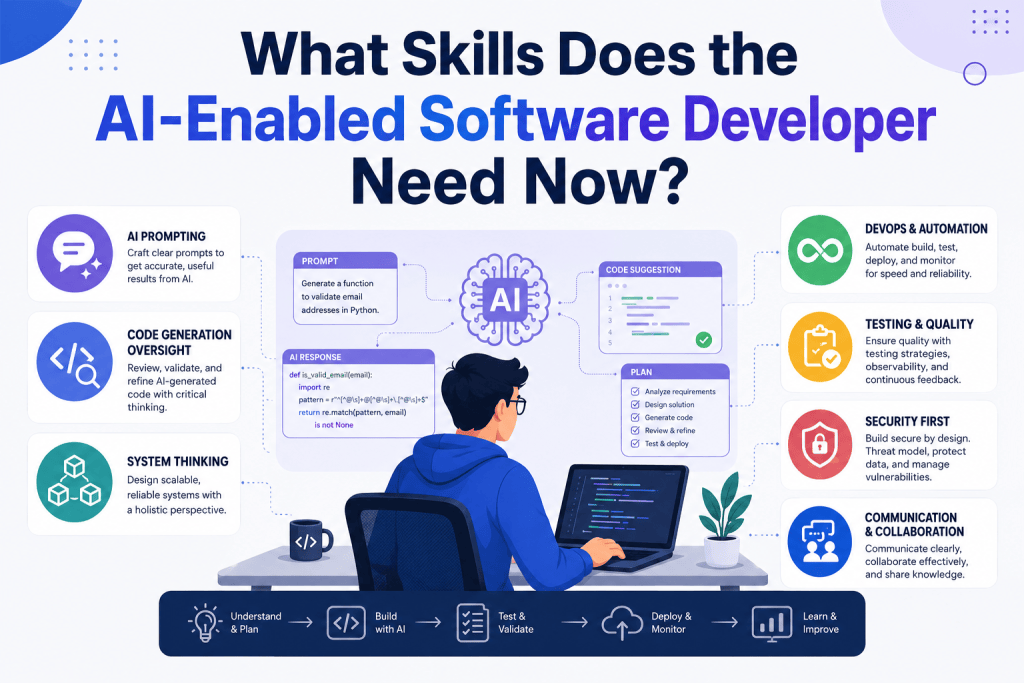
- Key Takeaways
- AI-Enabled Software Developer Skills Are Moving Beyond Code Production
- Prompting Is Becoming Specification Work
- Code Review Becomes More Valuable as Code Gets Cheaper
- Coding Agents Require Workflow Orchestration
- Security and Privacy Skills Move Into Daily Development
- Software Architects Need Model, Data, and Evaluation Literacy
- Product and Domain Knowledge Gain More Career Value
- Career Paths Split Between Builders, Reviewers, Orchestrators, and Governors
- New Skills Do Not Replace Software Fundamentals
- Team Skills Matter as Much as Individual Skills
- Summary
- Appendix: Useful Books Available on Amazon
- Appendix: Top Questions Answered in This Article
- Appendix: Glossary of Key Terms
Key Takeaways
- AI-enabled developers need stronger review, testing, security, and architecture skills.
- Prompting is becoming specification work, not a replacement for engineering judgment.
- Coding agents raise demand for orchestration, governance, and product understanding.
AI-Enabled Software Developer Skills Are Moving Beyond Code Production
The 2025 Stack Overflow Developer Survey reported that 84% of respondents were using or planning to use artificial intelligence tools in their development process, with 51% of professional developers using them daily. That data point marks a practical shift in software work. Artificial intelligence is no longer a side tool for experiments, documentation drafts, or occasional code completion. It is becoming part of the daily workflow for software developers, software engineers, software architects, site reliability engineers, platform engineers, data engineers, security engineers, product engineers, and technical managers.
The new skill set does not make traditional engineering knowledge obsolete. It makes weak engineering harder to hide. An AI-enabled software developer still needs to understand data structures, interfaces, networks, testing, deployment, observability, access control, and software maintenance. The difference is that more code can now be produced faster, by people and by tools. Faster production raises the cost of poor review, unclear requirements, weak architecture, and careless deployment.
That is why AI-enabled software developer skills now sit on top of conventional software engineering rather than beside it. A developer who can ask an AI coding assistant to generate a function still needs to know whether the function fits the system, exposes private data, creates a race condition, ignores an edge case, duplicates existing logic, or makes future maintenance harder. A software architect who delegates refactoring work to a coding agent still needs to judge coupling, data ownership, latency, failure modes, regulatory exposure, and long-term operability.
The strongest engineers in this new setting are not passive users of AI tools. They are directors of technical work. They describe intent clearly, constrain the problem, provide context, review outputs, test behavior, control risk, and connect software changes to customer and business needs. That means the job shifts from typing code as the dominant activity to shaping reliable outcomes through code, tests, prompts, architecture, documentation, tooling, and feedback loops.
This table summarizes how the skill profile is changing.
| Skill Area | Older Emphasis | AI-Enabled Emphasis |
|---|---|---|
| Code Writing | Manual implementation speed | Directing, reviewing, and integrating generated changes |
| Requirements | User stories and tickets | Precise prompts, constraints, examples, and acceptance tests |
| Testing | Unit and integration coverage | Behavioral verification of human and AI-written code |
| Security | Secure coding and dependency control | Prompt injection, data leakage, tool permissions, and agent boundaries |
| Architecture | Components, services, and interfaces | Model choice, retrieval, evaluation, guardrails, and operational control |
The shift also changes junior and senior work. Junior developers may become productive sooner because AI tools can explain code, generate examples, and help them move across unfamiliar languages. Senior developers may face heavier review and design responsibilities because generated code can increase the volume of pull requests, experiments, and proposed changes. Research on AI-assisted programming has already raised caution that apparent productivity gains can move maintenance burden toward experienced maintainers when review quality and ownership practices lag behind adoption.
A mature AI-enabled engineering team needs people who can slow down at the right moments. Speed matters, but unexamined speed can fill a backlog with fragile code. The new skill profile rewards engineers who can decide when AI assistance is useful, when it should be constrained, and when direct human design is safer.
Prompting Is Becoming Specification Work
Prompting is often described as a new communication skill, but in professional software development it is better understood as specification work. A good coding prompt resembles a small technical brief. It names the goal, identifies the relevant files, states constraints, explains edge cases, defines acceptance criteria, and tells the tool what not to change. The more autonomous the tool becomes, the more the prompt must resemble a work order that another developer could follow.
This is a major difference between casual AI use and professional AI-enabled software engineering. A casual user may ask a chatbot to create a script. A professional developer needs to keep the change inside repository conventions, security requirements, user experience rules, error-handling patterns, logging standards, and deployment constraints. The prompt is not a magic phrase. It is a compressed form of engineering intent.
Good prompt work starts with context selection. Coding assistants and agents perform better when they receive the right project files, architecture notes, test outputs, error logs, API contracts, and examples. They perform worse when they receive too little context, stale context, or irrelevant context. This makes context engineering a core skill. Engineers need to know what information the tool needs, what information it should not see, and how much context will create confusion rather than clarity.
Prompting also requires negative constraints. A developer may need to say that the tool must not change public APIs, must not add a new dependency, must not alter database migrations, must not weaken authentication, and must not rewrite unrelated files. Those instructions help convert a broad request into a bounded engineering task.
AI-enabled developers also need to split work well. A large request such as “modernize the billing service” gives an agent too much room to make risky choices. A stronger request breaks the work into inspection, plan, small patch, test, and review stages. This mirrors established engineering practice. The novelty is that a machine can now perform some of those steps, but the human still decides the shape of the assignment.
The same skill applies to architects. A software architect can use AI to compare designs, draft migration plans, or inspect code paths, but the architect must provide decision criteria. A model cannot infer the organization’s tolerance for downtime, vendor lock-in, audit complexity, cost variance, or operational staffing unless those constraints are stated. Architecture prompts need to include service boundaries, latency budgets, data sensitivity, failure recovery needs, and known organizational constraints.
A useful prompt is also testable. It should connect the requested output to tests, examples, or acceptance criteria. If the goal is to fix a bug, the prompt should describe the observed behavior, expected behavior, reproduction steps, and likely files. If the goal is to add a feature, the prompt should state what success looks like from the user’s point of view and what behavior must remain unchanged.
Prompting, in this sense, is not a soft skill separated from engineering. It is requirements engineering, task design, and risk control expressed in language that a coding assistant can act on.
Code Review Becomes More Valuable as Code Gets Cheaper
AI coding tools reduce the cost of producing code. They do not reduce the cost of knowing whether the code is correct. That difference is central to the future of software work.
The DORA State of AI-Assisted Software Development research frames AI as an amplifier of existing organizational strengths and weaknesses. Strong engineering systems can gain from AI because they have tests, review habits, deployment controls, incident learning, and clear ownership. Weak systems can generate more code without creating more reliable software. The tool magnifies the surrounding engineering system.
That means review skills become more valuable. AI-generated code can look polished, use familiar naming patterns, and produce passing examples, but still misunderstand a hidden assumption. Reviewers need to inspect logic, data flow, permissions, error handling, concurrency, performance, and consistency with existing patterns. They also need to identify overly broad changes where the tool solved more than the assigned problem.
AI can help with review, but it cannot own accountability. A coding assistant can summarize diffs, propose tests, look for security defects, or explain a failure. The human reviewer still needs to decide whether the change should merge. That responsibility belongs to the team and the organization, not the model.
Testing also needs to become more disciplined. Generated unit tests can be shallow, overly tailored to the implementation, or focused on the simplest path. AI-enabled developers need to recognize tests that confirm a trivial outcome without protecting behavior. They need to ask for boundary tests, failure tests, authorization tests, migration tests, and regression tests. They should expect the tool to draft tests, then inspect whether those tests would fail for the defect being prevented.
Observability skills become part of review. A change that passes tests may still be risky in production if it lacks metrics, logs, tracing, alert thresholds, or rollback design. Developers who use AI to move faster need to pair that speed with better evidence from real systems. This includes knowing which metrics show user impact, which logs expose sensitive information, and which alerts create noise.
Experienced developers also need to train themselves to distrust surface fluency. AI systems can produce explanations that sound confident even when they miss repository-specific facts. Reviewers should check claims against actual code, test output, documentation, and runtime behavior. A strong AI-enabled engineer treats the model’s explanation as a hypothesis, not as proof.
This creates a new technical craft: reviewing machine-generated work without becoming a bottleneck. Teams need review patterns that scale. Small changes, clear ownership, automated checks, and well-scoped agent tasks help. Large AI-generated pull requests with vague goals and scattered edits create the opposite effect. The future belongs to teams that can make review faster by making work smaller, not by lowering standards.
Coding Agents Require Workflow Orchestration
A coding assistant suggests code inside a developer’s editor. A coding agent can inspect a repository, edit files, run commands, create pull requests, and perform multi-step tasks. That move from assistance to agency changes the developer’s skill profile.
GitHub’s Copilot, OpenAI’s Codex work, Anthropic’s Claude Code, Google’s Gemini Code Assist, and Cursor’s AI coding agent all point toward workflows where engineers delegate bounded tasks to systems that can operate across files and tools. The human developer becomes a planner, reviewer, integrator, and risk manager.
This requires orchestration skill. Developers need to design the path from request to merged change. A well-orchestrated task might start with repository inspection, then a written plan, then a small patch, then generated tests, then test execution, then a reviewer summary. A weak workflow jumps from broad instruction to large patch without inspection or feedback.
Agent orchestration includes tool permission design. If an agent can run shell commands, access secrets, call services, modify infrastructure, or browse internal documents, the risk profile changes. Engineers must understand least privilege, sandboxing, approval gates, audit logs, and isolation. An agent that can write code is useful. An agent that can write code and deploy it without adequate controls can create production risk.
Another new skill is agent task sizing. Some tasks suit agents well: updating repetitive patterns, adding simple tests, explaining unfamiliar code, drafting migration notes, summarizing pull requests, generating documentation, or fixing localized defects with clear reproduction steps. Other tasks still demand direct human design: deciding product behavior under ambiguity, changing security boundaries, redesigning data ownership, altering public contracts, or making irreversible infrastructure changes.
Developers also need multi-agent judgment. Some environments now allow separate agents to plan, code, test, review, or search documentation. More agents do not automatically create better outcomes. They can produce conflicting plans, duplicated work, or false agreement. The human engineer needs to decide which agent handles which task, what evidence counts, and when to stop iteration.
The same applies to software architects and technical leads. AI agents may draft design options, but architecture remains a responsibility system. Architects need to evaluate trade-offs, not just compare diagrams. A model can suggest a queue, cache, or microservice. The architect needs to assess ownership, data consistency, operational staffing, legal exposure, user impact, and future change costs.
Workflow orchestration also connects to organization design. The DORA ROI of AI-assisted Software Development material emphasizes measuring AI adoption through delivery and business outcomes rather than tool enthusiasm alone. Teams need to track whether AI use improves cycle time, quality, incident rates, developer satisfaction, maintenance cost, and customer outcomes. Without measurement, organizations may mistake activity for value.
The best AI-enabled developers will know how to run agents as controlled collaborators. They will delegate small, inspectable tasks, demand evidence, use automation checks, and keep humans accountable for final decisions.
Security and Privacy Skills Move Into Daily Development
AI changes the software security problem in two ways. It changes how software is written, and it creates new kinds of software that include models, prompts, retrieval systems, embeddings, and tool calls. Both changes expand the security skills expected from developers.
The OWASP Top 10 for Large Language Model Applications identifies risks such as prompt injection, insecure output handling, sensitive information disclosure, supply-chain exposure, excessive agency, and vector or embedding weaknesses. These are no longer specialist concerns limited to AI research teams. Any developer building AI features into products needs to understand them.
Prompt injection is an example. A model-powered application may receive user text, webpage content, documents, emails, support tickets, code comments, or third-party data. That content can include hidden instructions that try to override the system’s intended behavior. A developer who builds an AI agent that reads external content and takes actions must design boundaries between untrusted input and trusted instructions. Traditional input validation still matters, but it is not enough by itself.
Sensitive data handling also becomes more complex. Developers need to know which prompts, logs, embeddings, traces, model outputs, and evaluation datasets may contain customer data, confidential code, credentials, legal records, or personal information. The skill is not just “avoid pasting secrets into a chatbot.” It is designing systems where sensitive information flows through approved tools, with retention rules, access controls, redaction, and auditability.
AI-generated code can also introduce conventional vulnerabilities. A model may suggest an outdated library, skip authorization checks, mishandle tokens, create unsafe deserialization, or ignore rate limits. Developers need secure coding knowledge, dependency management, software composition analysis, and threat modeling. AI does not remove these requirements; it increases the volume of code that must meet them.
Privacy and compliance skills are becoming part of engineering practice because AI systems often cross legal and organizational boundaries. The European Union AI Act uses a risk-based framework for AI developers and deployers, and the NIST AI Risk Management Framework provides a widely used structure for identifying and managing AI risks. Software engineers do not need to become lawyers, but they do need to understand how design choices affect documentation, risk classification, monitoring, human oversight, and data governance.
Security work also extends to coding agents themselves. If an agent can read repositories, call internal APIs, modify files, or generate pull requests, teams need rules for credentials, branch permissions, dependency updates, and approval workflows. The agent’s identity, permissions, and actions should be traceable. Otherwise, organizations may struggle to know who changed what, why it changed, and what evidence supported the change.
AI-enabled engineers need to learn secure defaults for model-backed systems. They should validate outputs before execution, separate trusted instructions from untrusted content, limit tool permissions, avoid automatic execution of model-generated commands, review generated dependencies, and monitor for abnormal behavior. They should also know when a use case is too risky for autonomous action.
Security skills used to appear late in many software workflows. AI pushes them earlier. The safest teams will build threat modeling, evaluation, access control, and incident learning into the normal development cycle.
Software Architects Need Model, Data, and Evaluation Literacy
Software architecture used to center mostly on components, interfaces, data stores, networks, deployment patterns, and organizational ownership. Those topics remain important. AI adds model behavior, retrieval design, evaluation systems, safety controls, prompt versioning, context windows, cost management, and data governance.
A software architect working with AI-enabled systems needs model literacy. This does not mean every architect must train foundation models. It means architects need to understand the differences among hosted commercial models, open-weight models, small local models, domain-tuned models, and task-specific systems. New Space Economy’s discussion of open source AI software is useful in this setting because enterprise buyers face trade-offs among control, operating burden, portability, cost, and vendor dependence.
Architects also need workload literacy. AI is not one workload. Training, inference, retrieval-augmented generation, code generation, multimodal processing, agent workflows, edge inference, and monitoring all stress systems differently. New Space Economy’s AI workload analysis separates those workload types in a way that helps engineering teams think about latency, cost, data location, security, and infrastructure fit.
Retrieval-augmented generation, often shortened to RAG, is another required concept. RAG systems connect models to external knowledge sources such as documents, databases, code repositories, or product manuals. Developers and architects need to understand indexing, chunking, embeddings, permissions, freshness, source attribution, and evaluation. A RAG system can fail because the model is weak, but it can also fail because the retrieval layer returns stale or unauthorized material.
Evaluation literacy may become the most overlooked skill. AI features cannot rely only on unit tests. They need task-based evaluations, regression datasets, adversarial tests, human review samples, and production feedback. An architect should ask how the team knows the system is improving, whether it fails safely, which users are affected by errors, and how model changes are tested before release.
Cost architecture also changes. Model calls can create variable operating expenses that grow with user adoption, retries, context length, and tool calls. A feature that looks inexpensive during a prototype may become costly at scale. Engineers need to understand token costs, caching, batching, model routing, small-model substitution, and when ordinary deterministic code is better than an AI call.
The AI value chain frames this as a chain that converts infrastructure, data, software, and trust into output. For software architects, that framing matters because the application layer depends on choices made far below it: chips, clouds, data centers, networking, model providers, data pipelines, monitoring systems, and compliance controls.
Architectural decision records become more valuable in AI-enabled systems. Teams should document why a model was selected, what data it can access, what actions it can take, what evaluation thresholds apply, and what rollback options exist. Documentation is not bureaucracy when behavior depends on probabilistic systems and external providers. It is the memory of the system.
Product and Domain Knowledge Gain More Career Value
AI tools can write code faster than most people can type. They cannot decide what should be built without human goals, constraints, and judgment. This raises the value of product knowledge and domain knowledge.
A developer who deeply understands the customer problem can give an AI assistant better instructions. That developer can identify when the generated solution solves the wrong problem, overbuilds a feature, ignores a workflow, or creates support burden. Product understanding turns AI from a code generator into a tool for delivering useful software.
Domain knowledge matters in regulated, safety-sensitive, financial, medical, defense, space, education, and public-sector systems. A model may produce plausible code, but it does not know the organization’s legal commitments, procurement rules, data classifications, union constraints, audit expectations, or customer trust boundaries unless those constraints are supplied and enforced. The developer with domain knowledge can detect failures that a syntax checker cannot.
This is why AI may increase the value of engineers who can move between technical and business conversations. They can talk to users, translate needs into specifications, test assumptions, and guide AI tools toward work that matters. They can also reject work that creates activity without value.
The AI supply chain shows why this broader judgment matters. AI-enabled software depends on many external layers, including chips, cloud services, model providers, data pipelines, open-source packages, orchestration tools, and monitoring systems. A developer who understands only the code in one repository may miss upstream and downstream risks.
Product judgment also changes backlog management. When AI reduces the effort needed to prototype, teams may generate more ideas than they can responsibly maintain. Product engineers need to ask whether a feature deserves to exist, whether it should be automated, whether users can trust it, and whether the support organization can handle failures. The ability to say no becomes more valuable when the cost of saying yes appears lower.
Domain knowledge helps with evaluation design. A generic test may check whether the model returns a well-formed answer. A domain-aware test checks whether the answer follows business rules, avoids restricted advice, respects terminology, and produces a result that fits the user’s real workflow. This is where subject-matter experts, product managers, and software engineers need tighter collaboration.
AI-enabled developers also need communication skill. They must explain model behavior to stakeholders without exaggerating certainty. They need to describe risks, trade-offs, and unknowns in language that product, legal, security, and executive teams can use. Strong writing becomes part of engineering because prompts, design records, review summaries, incident reports, and user-facing explanations all shape system quality.
The developer who combines coding skill with product judgment will stand out. The architect who combines systems thinking with domain knowledge will stand out even more.
Career Paths Split Between Builders, Reviewers, Orchestrators, and Governors
AI-enabled software work will not produce one new job profile. It will create several overlapping paths. Some developers will specialize in using AI tools to build faster. Others will specialize in review, quality, architecture, security, evaluation, developer platforms, or governance. Many senior people will need parts of all those skills.
Builder-oriented developers will use AI assistants to create features, tests, scripts, documentation, migrations, and internal tools. Their strength will be clear task design, fast feedback, and strong integration with existing systems. They will need enough architecture and testing knowledge to avoid flooding teams with low-quality work.
Reviewer-oriented engineers will become more important as code volume grows. They will inspect AI-generated changes, design review checklists, improve automated gates, and protect maintainability. Their value will come from judgment, pattern recognition, and the ability to distinguish useful speed from hidden debt.
Orchestrators will design workflows for agents. They will set up repositories, permissions, task templates, continuous integration rules, evaluation gates, and developer experience tooling. Platform engineers may take much of this work because AI adoption depends on repeatable infrastructure. The Software Engineering Body of Knowledge already places software architecture, software security, and software engineering operations inside the professional knowledge base, which fits the direction of AI-enabled development.
Governance-oriented engineers will connect AI use to policy, compliance, audits, and risk management. This path will matter in enterprises and regulated sectors. These engineers will define approved tools, data-handling rules, logging practices, model evaluation thresholds, documentation needs, and incident procedures. They will need enough technical skill to make governance practical rather than symbolic.
Software architects will need to operate across all four paths. They will guide model choice, design service boundaries, set data-access patterns, and decide where human approval is required. They will also need to reason about vendor dependence, portability, cost, and exit strategies. New Space Economy’s analysis of AI market structure helps explain why teams cannot treat all AI services as interchangeable.
Managers and technical leads will need a different skill mix. They must evaluate productivity claims, set responsible adoption policies, train teams, and avoid measuring AI success only through lines of code or number of pull requests. They should ask whether lead time, escaped defects, incident rates, developer satisfaction, onboarding speed, and customer outcomes improve after AI adoption.
This table organizes the job profiles that are likely to matter most.
| Job Profile | Main Work | New Skill Need | Risk To Manage |
|---|---|---|---|
| AI-Enabled Developer | Feature delivery | Prompting, testing, review | Overproduced weak code |
| AI Code Reviewer | Quality control | Diff analysis, security, maintainability | False confidence |
| Agent Orchestrator | Workflow design | Permissions, task design, gates | Unsafe autonomy |
| AI Software Architect | System design | Model, data, and evaluation literacy | Fragile designs |
| AI Governance Engineer | Controls and evidence | Risk mapping, audits, documentation | Policy without practice |
These paths will overlap inside smaller organizations. A developer in a startup may need to prompt, code, test, review, secure, deploy, and document AI-enabled features. A developer in a large enterprise may specialize in one layer. In either setting, the same principle applies: the scarce skill is not typing code. The scarce skill is converting AI-assisted work into dependable software.
New Skills Do Not Replace Software Fundamentals
The strongest argument for learning software fundamentals is stronger in the AI era than it was before. AI tools can fill gaps in syntax, library usage, boilerplate, and examples. They cannot replace the engineer’s need to understand correctness, complexity, state, data ownership, failure, testing, and maintenance.
A developer who lacks fundamentals may accept generated code because it looks convincing. A developer with fundamentals can inspect the code and ask better questions. Does the algorithm scale? Does it handle null values? Does it retry safely? Does it expose secrets? Does it create a deadlock? Does it break compatibility? Does it make future changes easier or harder?
The same applies to architecture. A model can suggest a distributed architecture, but distributed systems remain difficult because of latency, partial failure, duplicated state, ordering, consistency, observability, and human ownership. AI may produce a diagram faster. It does not remove the engineering trade-offs.
Database knowledge remains central. AI-generated code often touches data models, migrations, queries, indexing, caching, and retention. Poor data choices can lock in defects for years. Developers need to understand transactions, schema design, access patterns, data quality, and privacy constraints.
Networking knowledge remains relevant because AI systems often call external services, stream responses, use APIs, connect to vector stores, and operate across cloud systems. Timeout handling, retries, circuit breakers, rate limits, authentication, and service-level objectives still matter.
Operating knowledge remains relevant because production systems fail in ways that development environments hide. AI-enabled developers need to understand deployment pipelines, rollback, feature flags, configuration, logs, metrics, traces, alerts, incident response, and capacity planning. The Measuring AI in the U.S. Economy discussion on AI’s place in productivity and labor inputs points to a broader measurement problem: activity is easier to count than real value.
Fundamentals also help engineers choose when not to use AI. A deterministic rule, a simple query, or a conventional service may be cheaper, safer, faster, and easier to explain than a model call. AI-enabled skill includes restraint. The right architecture may use AI in one narrow step and ordinary software everywhere else.
Education and training need to reflect that balance. Developers should learn to use AI tools early, but not as a substitute for understanding. Training should include reading unfamiliar code, debugging, writing tests, threat modeling, reviewing generated code, and explaining design choices. It should also teach how to verify model output against authoritative documentation rather than accepting plausible statements.
This is good news for serious developers. The profession is not being reduced to prompt typing. It is being pushed toward higher standards of specification, review, architecture, security, product judgment, and operational care.
Team Skills Matter as Much as Individual Skills
AI adoption often starts with individuals. A developer installs an assistant, uses it for a script, then starts using it for tests, documentation, and small features. Enterprise adoption soon becomes a team and organization problem.
Teams need shared rules. Which tools are approved? Which repositories can be indexed? Which data can leave the organization? Which tasks can agents perform? Which generated outputs require human review? Which logs are retained? Which model providers can be used for regulated work? Without shared rules, teams drift into shadow AI use, where individuals adopt tools without security, privacy, or procurement visibility.
Teams also need shared prompt and workflow patterns. A good team will not leave every developer to invent their own AI habits. It will create task templates for bug fixes, test creation, documentation, refactoring, code review, dependency updates, and incident analysis. These templates reduce risk and help junior staff learn from senior practice.
Knowledge management becomes a stronger engineering concern. AI tools perform better when documentation, architecture records, coding standards, runbooks, and test examples are current. Poor documentation hurts people and models. Teams that keep project knowledge organized will get better AI results than teams that rely on tribal knowledge.
AI adoption also changes mentoring. Junior developers may use tools to move faster, but they still need feedback on judgment. Senior developers should review not only the code, but the prompt, the task framing, and the validation plan. Mentoring should teach how to ask better questions, identify risk, and build evidence.
Managerial skills change as well. Managers need to avoid simplistic productivity metrics. Lines of code, number of commits, and number of pull requests can rise even when quality falls. Better measures include lead time, deployment frequency, change failure rate, recovery time, escaped defects, maintenance load, customer value, and developer experience. The DORA research program remains relevant because it connects delivery practices to performance rather than raw activity.
Team boundaries may need adjustment. Platform teams may provide approved AI tooling, secure agent environments, context connectors, evaluation harnesses, and reusable guardrails. Product teams may own domain-specific evaluations and user feedback. Security teams may define threat models and approval gates. Legal and compliance groups may define rules for data handling and model use. None of this works well if AI adoption stays an individual productivity experiment.
Organizations also need training that treats AI as a work system. A one-hour tool demo is not enough. Developers need practice with real repositories, real defects, real tests, and real security constraints. Architects need design review scenarios. Managers need measurement guidance. Security teams need model-specific threat exercises.
The future AI-enabled software team will look less like a room full of faster typists and more like a coordinated engineering organization with stronger feedback, clearer ownership, and better controls.
Summary
AI-enabled software development is changing the value of software skill, but it is not eliminating the need for software engineers. It is shifting the center of work from manual code production toward specification, orchestration, review, testing, security, architecture, product judgment, and governance.
The new AI-enabled software developer needs to know how to frame a task, choose context, constrain an agent, inspect generated code, design tests, detect security risks, and explain trade-offs. The new software engineer needs to combine coding fluency with system thinking. The new software architect needs model, data, retrieval, evaluation, and cost literacy. Platform engineers need to create safe environments for agentic work. Technical leads and managers need to measure outcomes rather than activity.
The job market will reward people who can turn AI assistance into reliable systems. That means the most valuable developers will not be those who simply use the most tools. They will be those who can apply the right tool to the right task, with enough discipline to protect quality, privacy, security, maintainability, and user trust.
AI can produce more code. The human skill that matters is knowing what should exist, how it should behave, how it should fail, how it should be tested, and when it should not be built at all.
Appendix: Useful Books Available on Amazon
- AI Engineering
- Accelerate
- Software Architecture: The Hard Parts
- Team Topologies
- Designing Data-Intensive Applications
- The Staff Engineer’s Path
- Building Machine Learning Powered Applications
Appendix: Top Questions Answered in This Article
What Is an AI-Enabled Software Developer?
An AI-enabled software developer is a developer who uses AI tools as part of normal engineering work. The work may include code generation, debugging, test creation, documentation, repository analysis, and agent-based task execution. The developer still owns correctness, security, maintainability, and user value.
Will AI Coding Tools Replace Software Developers?
AI coding tools will replace some routine coding tasks, but they do not remove the need for engineering judgment. Software still needs requirements, architecture, testing, review, deployment, operations, security, and product decisions. Teams that rely on AI output without human accountability can create quality and maintenance problems.
What Skill Matters Most for Developers Using AI?
Review skill may matter most because AI can produce code faster than teams can safely approve it. Developers need to inspect logic, edge cases, security, performance, and consistency with existing architecture. The ability to verify generated work is more valuable than the ability to generate more output.
Is Prompt Engineering Still a Useful Skill for Software Engineers?
Prompt engineering is useful when treated as specification work. Strong prompts define goals, context, constraints, acceptance criteria, and files that should or should not change. Weak prompts create broad tasks that invite accidental rewrites, incomplete fixes, and hidden risk.
What Should Software Architects Learn About AI?
Software architects should learn model selection, retrieval design, evaluation methods, cost controls, data governance, and agent permission design. They should also understand when ordinary deterministic software is better than an AI feature. Architecture decisions now include model behavior and data access, not just services and databases.
How Does AI Change Code Review?
AI increases the amount of code that teams can produce, which makes code review more valuable. Reviewers need to check generated code for correctness, security, maintainability, and fit with existing patterns. They also need to prevent large, unclear AI-generated pull requests from overwhelming maintainers.
What Security Skills Do AI-Enabled Developers Need?
AI-enabled developers need to understand prompt injection, sensitive data exposure, insecure output handling, dependency risk, agent permissions, and secure coding practices. They also need to design logging, access control, and approval gates for systems where AI can read data or take action.
Are Junior Developers Helped or Hurt by AI Coding Tools?
Junior developers can benefit from explanations, examples, scaffolding, and faster experimentation. The risk is that they may accept generated code without understanding it. Mentoring should focus on reading code, testing, debugging, and explaining why a solution is safe and maintainable.
What Should Engineering Managers Measure After AI Adoption?
Engineering managers should measure lead time, change failure rate, recovery time, defect escape rate, developer experience, customer outcomes, and maintenance load. Raw code volume is a weak measure because AI can increase output without improving reliability or value.
What Is the Best Career Strategy for Software Engineers in the AI Era?
The best strategy is to strengthen fundamentals and add AI workflow skills. Developers should learn prompting, agent orchestration, test design, code review, security, product thinking, and architecture. People who can connect AI-assisted work to dependable software outcomes will remain valuable.
Appendix: Glossary of Key Terms
Agentic AI
Agentic AI describes systems that can plan steps, use tools, inspect files, run commands, and work toward a goal with less step-by-step human direction. In software development, coding agents may edit repositories, create pull requests, run tests, or summarize changes.
AI-Enabled Software Developer
An AI-enabled software developer is a developer who uses AI systems during normal software work. The work can include writing code, reviewing code, debugging, writing tests, drafting documentation, analyzing repositories, or coordinating coding agents inside approved workflows.
Context Engineering
Context engineering is the practice of giving an AI system the right information for a task. In software work, that may include relevant files, documentation, test output, logs, architecture decisions, examples, and constraints, with sensitive or irrelevant material excluded.
Evaluation Harness
An evaluation harness is a repeatable test system for AI behavior. It can include prompts, expected outputs, grading rules, human review samples, regression cases, and adversarial tests that show whether an AI feature performs well enough to release.
Prompt Injection
Prompt injection is an attack or failure mode where untrusted input changes how a large language model behaves. It can occur when a model reads user text, webpages, documents, or other content that contains hidden or manipulative instructions.
Retrieval-Augmented Generation
Retrieval-augmented generation connects a model to external information sources before it answers or acts. Software teams use it to bring product documents, code repositories, policies, or support records into model workflows, subject to access controls and freshness rules.
Software Architecture
Software architecture describes the high-level structure of a software system, including components, interfaces, data flows, deployment choices, and quality requirements. In AI-enabled systems, architecture also includes model choice, context design, evaluation, and operational controls.
Vector Store
A vector store is a database designed to search information by mathematical representations of meaning. AI applications often use vector stores to retrieve relevant documents, code snippets, or support records for retrieval-augmented generation.