
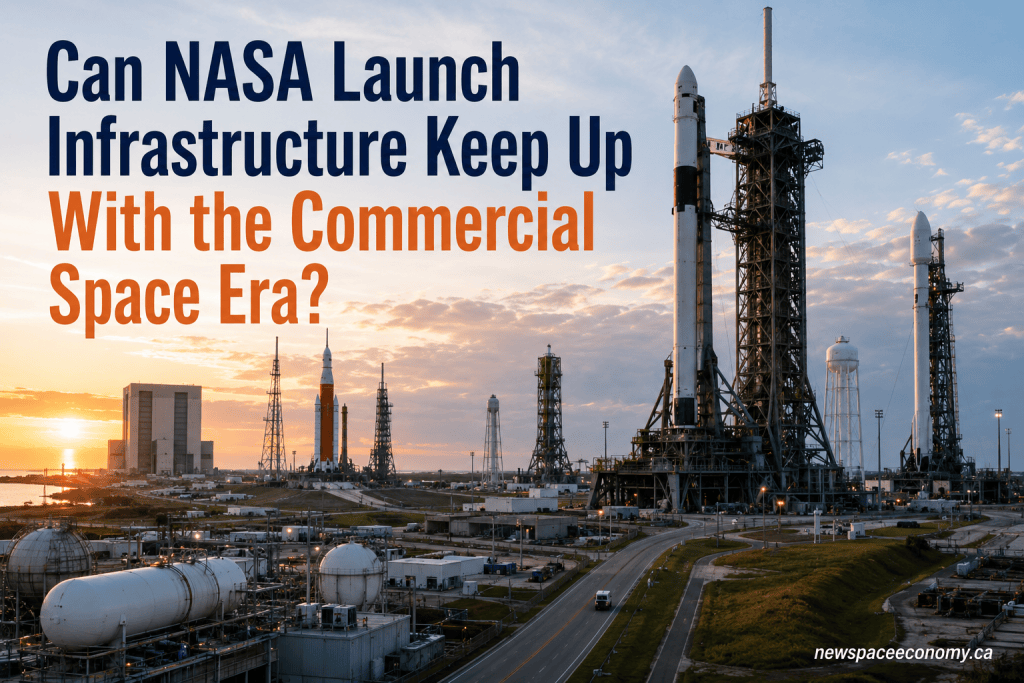
- Key Takeaways
- NASA Launch Infrastructure Has Become a Capacity Test
- Kennedy’s Shared Systems Carry Most of the Risk
- Wallops Shows How Smaller Spaceports Face Different Pressure
- Commercial Growth Has Outrun the Funding Model
- Launch Pads Are Strategic Infrastructure, Not Real Estate
- Coverage Turned a Budget Audit Into a Spaceport Warning
- What Fixing the Bottleneck Would Require
- Summary
- Appendix: Useful Books Available on Amazon
- Appendix: Top Questions Answered in This Article
- Appendix: Glossary of Key Terms
Key Takeaways
- Kennedy and Wallops could approach launch capacity by 2028 to 2029.
- Commercial missions now drive much of the wear on shared NASA systems.
- Funding law, cost recovery, and pad scarcity shape the next launch bottleneck.
NASA Launch Infrastructure Has Become a Capacity Test
On June 22, 2026, the NASA Office of Inspector General released a 52-page audit warning that NASA launch infrastructure at Kennedy Space Center in Florida and Wallops Flight Facility in Virginia is aged, capacity-constrained, and increasingly exposed to commercial launch demand. The headline finding is simple enough to understand, yet hard to solve: the United States is asking Apollo-era and Shuttle-era ground systems to support a launch market that now runs closer to transportation infrastructure than expeditionary exploration.
The audit found that NASA-supported launches from Kennedy and Cape Canaveral Space Force Station increased from 31 in 2020 to 109 in 2025, a 252% increase. NASA projects that figure could reach 268 annual launches by 2030. At Wallops, NASA-supported launches grew from 3 in 2020 to 17 in 2025, a 467% increase, with projections reaching 44 annual launches by 2030. Those figures include commercial, Department of Defense, and NASA missions, but the demand profile has shifted sharply toward commercial activity.
The NASA OIG summary framed the issue as a capacity and maintenance problem, not a narrow launch-pad problem. Pads matter, but Kennedy’s deeper challenge sits in shared utilities, gases, transportation routes, and aging electrical systems that support users at Kennedy and Cape Canaveral Space Force Station. The audit noted that both Kennedy and Wallops could operate near capacity in the 2028 to 2029 time frame if current projections hold.
That warning fits a broader space economy pattern. Launch demand is no longer driven mainly by rare national missions. It now reflects constellation deployment, cargo transportation, crew services, science missions, defense missions, commercial lunar systems, reusable launch vehicles, and high-cadence test programs. New Space Economy’s analysis of U.S. spaceport capacity anticipated the same bottleneck: demand for launch access can grow faster than the physical and regulatory capacity of launch sites.
Kennedy and Wallops also sit in different parts of the launch market. Kennedy Space Center remains closely tied to crewed exploration, heavy-lift vehicles, Artemis, commercial crew, and large national security launches. Wallops Flight Facility supports sounding rockets, uncrewed missions, commercial small and medium launch activity, range services, and the Mid-Atlantic Regional Spaceport. The audit treats both as NASA-owned launch infrastructure, but the operational problems differ.
The near-capacity warning has economic implications beyond NASA. Commercial operators rely on federal launch infrastructure even when their vehicles fly from leased or partner-operated pads. SpaceX, Blue Origin, Rocket Lab, Firefly Aerospace, Northrop Grumman, United Launch Alliance, and other operators need roads, bridges, utilities, range systems, gas distribution, processing facilities, emergency services, environmental reviews, and operational coordination. A launch pad cannot function as an isolated concrete slab. It depends on the surrounding network.
The audit also arrived at a moment when public commentary on launch bottlenecks has moved from abstract concern to direct operational risk. SpacePolicyOnline emphasized the funding structure behind the problem, including NASA’s limited ability to receive capital contributions from commercial users. Payload focused on the rising launch cadence and the stress that Kennedy faces as launches climb toward projected 2030 levels.
The OIG report makes NASA launch infrastructure a test of national space policy. The United States has encouraged commercial use of public space assets for decades. That strategy helped build a stronger launch market. The hard question now is whether the public infrastructure, legal authorities, and cost recovery methods can keep pace with the market they helped create.
The table below organizes several headline figures from the audit and their space economy meaning.
| Audit Signal | Figure | Meaning |
|---|---|---|
| Kennedy Growth | 31 launches in 2020 to 109 in 2025 | Commercial cadence is reshaping federal launch operations |
| Kennedy Projection | 268 annual launches by 2030 | Shared systems could face high operating strain |
| Wallops Growth | 3 launches in 2020 to 17 in 2025 | Small and medium launch demand is rising |
| Wallops Projection | 44 annual launches by 2030 | Range efficiency and expansion studies matter |
| Kennedy Upgrade Need | At least $1 billion | The $250 million allocation is a down payment |
| Road Traffic | About 19,000 added truck trips yearly | Heavy transport is now a launch constraint |
Kennedy’s Shared Systems Carry Most of the Risk
Kennedy’s best-known assets are Launch Complex 39A and Launch Complex 39B, but the OIG report gives more attention to systems that receive less public attention. Electrical distribution, gaseous nitrogen, gaseous helium, roads, bridges, substations, duct banks, and shared transportation corridors support launches from Kennedy and Cape Canaveral Space Force Station. Those systems do not attract the same attention as rockets, yet they can decide whether rockets move, fuel, test, count down, and launch.
The audit describes Kennedy’s Launch Complex 39 electrical distribution system as aged and degraded. The C-5 Substation feeds electrical power through transformers, underground duct banks, and medium-voltage feeders. Portions of the duct banks date to the 1960s and use Orangeburg pipe, a wood-fiber and coal-tar material with a 50-year useful life. NASA found portions of that duct-bank system collapsed. If a feeder fails where ducts have collapsed, NASA or SpaceX could lose redundancy and face a workaround that takes weeks or months.
Electrical reliability matters because launch operations need power during vehicle processing, propellant loading, communications, monitoring, countdown operations, and safety operations. The OIG report did not describe this as a cosmetic maintenance problem. It described a launch-support system whose failure could delay missions for extended periods. The implication is uncomfortable: a high-value mission stack can be ready, the weather can cooperate, the range can be available, and the launch can still be blocked by aging shared infrastructure.
Gas supply and distribution add another constraint. Kennedy’s Converter Compressor Facility converts liquid helium into high-pressure gaseous helium and supports delivery of gaseous nitrogen and helium to pads. Those gases serve safety, pressurization, purging, and launch-processing functions. The OIG found that existing capacity is insufficient to support multiple users at the same time. That means high launch cadence creates scheduling competition in support systems before it creates visible pad conflict.
Transportation creates a third pressure point. Kennedy’s roads and bridges were largely built during the Apollo period and were not designed for the volume, weight, and frequency of today’s heavy transport operations. The audit says launch-rate growth could generate about 19,000 additional annual truck trips to move flight hardware, propellants, and related materials. It also identifies bridge and roadway repair needs that could cost more than $200 million over 10 years.
The Banana River Bridge illustrates the problem. NASA owns and maintains the bridge, but some capacity needs are driven by commercial users moving larger vehicles and hardware. Kennedy officials told the OIG that the bridge’s grade and width make it unsuitable for some present and future heavy transport needs. Without replacement, oversized transports may need a 20-mile detour, which could create launch impacts.
New Space Economy’s examination of launch supply-chain weak points helps explain why these support systems matter. Launch vehicles can be built in factories, but launch pads and their supporting systems are fixed assets tied to coastlines, environmental constraints, safety corridors, and transport links. Infrastructure failure can stop activity even when the rocket supply chain remains healthy.
The audit’s Kennedy findings also intersect with the rise of reusable and super heavy-lift systems. SpaceX Starship is designed as a fully reusable super heavy-lift vehicle. Blue Origin New Glenn is a heavy-lift vehicle that places large loads into low Earth orbit and high-energy orbits. Vehicles of this class bring larger mass flows, higher propellant demand, larger ground safety zones, and added transport requirements. The ground site must scale with the vehicle, or the vehicle’s promise becomes harder to turn into routine service.
The infrastructure pressure at Kennedy is not caused by one company. SpaceX dominates recent launch counts, but the broader picture includes Artemis, commercial crew, national security payloads, Blue Origin, United Launch Alliance, Starlink, Starship development, lunar landing systems, and cargo activity. Kennedy has become a shared operating platform for civil, military, and commercial space. Shared platforms need shared investment models.
Wallops Shows How Smaller Spaceports Face Different Pressure
Wallops presents a more complicated picture than a simple aging-infrastructure narrative. The facility dates to 1945, and its island setting exposes it to coastal and environmental constraints. Yet the OIG found that Wallops does not face the same common-use infrastructure problems as Kennedy because recent upgrades have improved electrical and bridge capacity. Wallops has already completed $8 million in electrical distribution upgrades on Wallops Island, and construction began in 2025 on a new causeway bridge expected to support larger launch vehicles.
That does not mean Wallops has excess slack. NASA projects launches from Wallops rising from 17 in 2025 to 44 in 2030. Wallops officials told the OIG that the facility could support up to 32 launches and 128 Launch Equivalent Days annually, reaching launch capacity by 2028 absent further efficiency gains. A Launch Equivalent Day is an operational measure that counts launches, scrubs, rehearsals, static firings, and other events that consume spaceport support capacity.
The facility’s role differs from Kennedy’s. Wallops supports uncrewed missions, sounding rockets, orbital launches, suborbital research, defense activity, commercial launches, and range services. The Wallops Island Launch Site includes multiple pads, blockhouses, assembly buildings, processing facilities, and support infrastructure. Its partners include the Virginia Spaceport Authority, the U.S. Navy, the National Oceanic and Atmospheric Administration, and the Federal Aviation Administration.
The Mid-Atlantic Regional Spaceport, located at Wallops, gives Virginia a commercial launch role tied directly to a federal range. New Space Economy’s analysis of commercial spaceport models describes this type of public-private structure as a way to combine government infrastructure with state economic development and commercial launch services. The model can work, but it still depends on NASA range capacity, local infrastructure, environmental approvals, and steady coordination among partners.
Rocket Lab’s Neutron program shows how Wallops is moving into heavier commercial activity. Rocket Lab says Launch Complex 3 at the Mid-Atlantic Regional Spaceport is the dedicated launch site for Neutron, located within NASA’s Wallops Flight Facility and adjacent to the company’s existing U.S. Electron site. Firefly Aerospace also has plans connected to Wallops activity, with its Alpha launch vehicle serving the small-launch market from U.S. launch sites.
The audit says Wallops may need above-ground pipelines in the future if launch activity increases enough to require continuous gas flow to orbital launch pads. Road repairs may also become more frequent as launch traffic rises. The facility is pursuing upgrades to reduce turnaround time, and NASA expects the Wallops Island Southern Expansion Environmental Assessment to examine the effect of increasing annual launches.
New Space Economy’s coverage of Wallops and coastal launch infrastructure adds another dimension. Wallops sits on a barrier-island environment exposed to Atlantic coastal forces. That location gives launch safety advantages over water, but it also creates resilience and maintenance questions. Spaceports often need shoreline access, restricted airspace, safety corridors, and open downrange areas. Those same features can place them in sensitive and exposed locations.
Wallops may be better positioned than Kennedy in specific infrastructure categories, but its capacity path remains dependent on launch mix. A small sounding rocket, a hypersonic test, a medium-class orbital vehicle, and a reusable medium launcher do not consume the same support footprint. Annual launch counts alone can hide that difference. Launch Equivalent Days are useful because they count operational load, not only liftoff events.
Commercial Growth Has Outrun the Funding Model
NASA’s commercialization strategy has worked well enough to create a new funding problem. The agency made launch infrastructure and services available to commercial users through Space Act Agreements, Commercial Space Launch Act agreements, and Enhanced Use Leases. Those agreements helped bring private investment into public launch sites. They also allowed companies to use infrastructure that might otherwise have been underused after the Space Shuttle era. The result is a busier, more commercially relevant spaceport system.
The audit found that about 70% of launches supported by NASA since 2020 were commercial missions. That figure changes the policy question. Commercial launch is no longer a fringe use of NASA launch infrastructure. It is one of the main sources of demand and wear on shared systems. Commercial partners can maintain leased pads under agreements, but they cannot easily pay for large shared infrastructure upgrades when statutory barriers prevent NASA from accepting capital contributions directly.
The OIG identified three interlocking financial problems. NASA’s construction and maintenance budgets have declined after adjusting for inflation. Statutory barriers prevent NASA from receiving money directly from commercial partners for shared capital infrastructure in many cases. Cost recovery practices have not collected enough money to maintain or upgrade shared launch infrastructure at the scale now required.
The budget numbers are stark. Over five years, the budgets NASA uses to fund construction projects and maintenance on launch-related infrastructure decreased between 11% and 47% after inflation. NASA’s Office of Strategic Infrastructure told the OIG that the agency’s infrastructure renewal rate is over 260 years, despite a NASA goal to renew infrastructure every 66 years. That means facilities stay in service for periods far beyond intended recapitalization cycles.
Deferred maintenance adds another layer. NASA’s deferred maintenance gap has grown to almost $4.7 billion, with Kennedy accounting for nearly $1 billion. Shared launch infrastructure often depends on the Infrastructure and Technical Capabilities budget. The OIG report says the fiscal year 2026 budget for that account was about $135 million below the estimated cost for basic sustainment, and the deficit rises to $400 million when larger repairs are included.
The 2025 H.R.1 reconciliation law provided $250 million for Kennedy infrastructure improvements. NASA officials told the OIG that at least $125 million of those funds may go to electrical power distribution upgrades. That is meaningful, but the OIG report states that Kennedy would need at least $1 billion to fully upgrade its launch infrastructure. A down payment can start work, but it cannot complete a full recapitalization program.
SpacePolicyOnline’s coverage of the audit focused on the legal structure behind the funding gap. The analysis noted that the Department of Defense received authority more than a decade ago to accept commercial contributions for infrastructure investment, and it discussed legislative efforts to give NASA similar authority. That distinction matters because NASA’s launch infrastructure now supports civil, commercial, and defense activity, yet its funding authorities do not fully match the mixed-use reality.
Cost recovery also affects the issue. NASA charges direct and indirect costs under reimbursable Space Act Agreements, but indirect rates may not cover the maintenance and recapitalization needs of common-use infrastructure. Wallops applies an additional indirect rate of 9.5% of direct costs for operational support and maintenance of facilities. Kennedy does not apply a comparable Other Approved Indirect Rate for common-use launch infrastructure. The OIG recommended that Kennedy assess whether it can charge such a rate for launch services and dedicate it to shared maintenance and upgrades.
Launch Pads Are Strategic Infrastructure, Not Real Estate
Launch pads sit at the center of public attention, but they are only one part of a strategic infrastructure system. A spaceport combines land, water access, restricted airspace, road access, bridge capacity, electrical distribution, commodities, emergency services, environmental permissions, range safety, telemetry, industrial suppliers, workforce, and political authority. That mix makes launch infrastructure hard to replace and hard to scale quickly.
At Kennedy, available locations for new heavy and super heavy-lift pads are limited. The OIG report says Blue Origin officials approached Kennedy to explore options for added pad capacity because Space Launch Complex 36 alone may not provide enough capacity and resiliency for long-term New Glenn plans. Kennedy identified a potential location north of Launch Complex 39A and Launch Complex 39B, but that area includes protected wetlands and would require lengthy federal and local review processes.
The scarcity of suitable launch sites helps explain why aging infrastructure becomes a national concern. Rockets must launch over safe downrange areas. Heavy and super heavy-lift vehicles require large safety buffers, high-capacity propellant systems, flame deflection, sound suppression, lightning protection, transport corridors, and specialized ground equipment. Even when land exists, environmental, safety, and operational reviews can take years.
This is why New Space Economy’s guide to North American spaceports and its review of FAA-licensed spaceports are relevant to the audit. The United States has multiple spaceports, but only a smaller group can support orbital launch at high cadence, and fewer still can support heavy-lift or crew-related operations. Capacity is not interchangeable across sites.
The Artemis campaign gives the infrastructure issue a civil-space dimension. NASA’s Artemis program depends on the Space Launch System, Orion, ground systems, commercial human landing systems, spacesuits, and lunar surface systems. Launch Complex 39B supports NASA’s Space Launch System. Launch Complex 39A supports SpaceX’s Falcon and Dragon operations, and SpaceX has been building Starship infrastructure there. A bottleneck in shared systems can affect NASA missions and commercial missions at the same time.
Defense demand adds another layer. The Department of Defense and national security space users depend on launch availability for payloads that may require secure scheduling, rapid response, and assured access. Commercial constellations also compete for launch slots, and high-cadence operations from one user can consume shared ground capacity. The OIG report makes clear that Kennedy’s support systems serve Kennedy and nearby Cape Canaveral Space Force Station, so pressure at one location can affect a broader Florida launch corridor.
The audit also shows why pad-specific investments do not solve every problem. SpaceX can invest in Launch Complex 39A. Blue Origin can invest in Space Launch Complex 36. Rocket Lab can invest at Wallops. Commercial pad investment helps, but common-use infrastructure remains NASA-owned or NASA-managed in many areas. A commercial operator may fund its pad and still depend on a NASA bridge, NASA road, NASA gas system, or NASA electrical corridor.
The space economy increasingly treats launch as a logistics market. That framing is useful, but incomplete. Launch logistics depends on public infrastructure that was not built under a modern airport or seaport-style investment model. Many spaceports evolved from federal research ranges or Cold War military sites. Commercial use can grow quickly because companies can build vehicles and lease pads, but shared ground systems require slower public budgeting, permitting, construction, and legal authority.
Coverage Turned a Budget Audit Into a Spaceport Warning
The public coverage of the OIG report quickly moved beyond a routine oversight story. NASA OIG’s own release stressed that Kennedy and Wallops are decades old, that launch cadence has increased sharply due to commercial activity, and that both sites could approach operational capacity by 2028 to 2029. That official framing gave the story a national launch-capacity angle rather than a narrow facilities-management angle.
SpacePolicyOnline treated the report as a policy and funding story. Its coverage pointed to the mismatch between commercial use and NASA’s ability to accept private contributions for capital infrastructure. It also explained why Congress matters: NASA may need legislative authority similar to authority available to the Department of Defense. That framing highlights a policy gap. The commercial launch market can create demand, but only Congress can change some of NASA’s funding authorities.
Payload focused on launch cadence and operational strain. Its headline that NASA’s launch infrastructure is nearing capacity captures the most accessible part of the story: launches are rising, and the underlying spaceport systems may not keep pace. That business-and-policy framing fits the broader commercial space discussion because capacity can affect customers, insurers, schedules, national security missions, and lunar program milestones.
NASA Watch and other space-focused outlets amplified the OIG report by repeating the audit’s core findings and recommendations. That matters because oversight reports can disappear into government-document archives unless specialist media translate them into operational language. Coverage gave the audit a wider audience among space companies, investors, policy staff, and spaceport observers.
New Space Economy’s related coverage provides a wider frame for the same issue. The article on space industry economic centers describes Florida and Virginia as parts of a larger U.S. space industrial geography. The article on reusable launch vehicles explains why reusability changes expectations for launch cadence. The article on global spaceports places U.S. spaceports inside a competitive international infrastructure race.
The coverage also reduces the risk of misreading the audit as a complaint about commercial space. The OIG report does not argue that commercialization failed. It argues that NASA’s shared infrastructure, budgets, legal authorities, and cost recovery practices have not caught up with commercialization. That distinction is important. Commercial launch demand is creating value, but the public infrastructure layer still needs a financing model that reflects use.
Media commentary also helps expose a hidden assumption in space-market forecasts. Analysts often treat launch cadence as a function of rocket production, payload demand, and launch price. The OIG report adds shared ground infrastructure to that list. A reusable rocket that can fly often still needs pad access, gas supply, electrical systems, roads, bridges, range support, regulatory approval, and recovery time after scrubs or static tests. Launch cadence is not only a rocket metric.
The audit also makes spaceport capacity relevant to climate and resilience planning. Coastal spaceports face storm exposure, salt corrosion, humidity, wetlands constraints, sea-level pressure, and road vulnerability. New Space Economy’s coverage of America’s launch infrastructure connects launch capacity with climate exposure, suggesting that future upgrades need to treat resilience as part of capacity rather than a separate facilities issue.
What Fixing the Bottleneck Would Require
NASA’s OIG made three recommendations, all directed to Kennedy Space Center. The Kennedy Center Director should study the effects of heavy vehicle traffic tied to sustained launch-related transport activity, prioritize H.R.1 funds for common-use infrastructure at Kennedy, and assess whether Kennedy can charge an Other Approved Indirect Rate on reimbursable agreements for launch services dedicated to shared infrastructure maintenance and upgrades. NASA management concurred with the recommendations.
Those recommendations are narrow by design, but they point to a broader fix. Kennedy needs a prioritized investment plan for electrical distribution, gas supply, roadways, and bridges. Wallops needs efficiency upgrades, careful expansion planning, and continued investment in transportation and commodity systems as launch rates rise. NASA as an agency needs legal and financial tools that allow commercial partners to contribute to shared infrastructure in proportion to their use and benefit.
A better model would treat shared launch infrastructure as a utility-like platform. Users could still operate dedicated pads, but common systems would need transparent cost recovery, long-term capital planning, and a way to fund projects whose benefits cross agency, defense, and commercial boundaries. This is familiar in airports, seaports, energy systems, and rail corridors. Spaceports are now moving toward that category, but the law has not fully followed.
The audit also suggests that launch-capacity planning should rely on more than annual launch counts. Kennedy’s use of Launch Equivalent Days is valuable because scrubs, wet dress rehearsals, static fire tests, and other events consume support capacity. A spaceport supporting 100 clean launches is not in the same operating condition as a spaceport supporting 100 launches plus dozens of scrubs, tests, and rehearsals. Launch Equivalent Days show the hidden workload.
Another requirement is mission segmentation. Not every launch belongs at Kennedy. Not every launch belongs at Wallops. Some small and medium missions can use alternative sites, and some mission classes could benefit from distributed launch geography. Yet high-inclination, polar, crewed, heavy-lift, lunar, and national security missions each carry specific site constraints. Policymakers need to match mission classes to suitable spaceports rather than assume that launch demand can spread evenly.
The table below summarizes the main infrastructure categories and their practical effects.
| Infrastructure Area | Pressure | Practical Effect |
|---|---|---|
| Electrical Power | Aged duct banks and transformers | Launch delays from loss of redundancy |
| Gas Supply | Multiple users need nitrogen and helium | Scheduling conflicts before launch day |
| Roads And Bridges | Heavy transport and added truck trips | Detours, wear, and mission schedule risk |
| Pad Availability | Heavy-lift sites are scarce | New pads require time and approvals |
| Cost Recovery | Shared systems lack dedicated revenue | Commercial demand can exceed public funds |
A capacity fix would also need data transparency. Launch forecasts should state assumptions about vehicle type, test cadence, scrubs, pad turnaround, environmental limits, range support, ground commodities, bridge capacity, and transportation windows. Without those details, an annual launch projection can look precise but hide the sources of strain.
The commercial space sector has spent years proving that rockets can fly more often. NASA’s launch infrastructure audit asks whether the ground can support that new rhythm. The answer is not automatic. It depends on whether the United States treats spaceports as long-lived national infrastructure rather than leftover facilities from earlier programs.
Summary
NASA’s launch infrastructure audit turns a facilities issue into a space economy issue. Kennedy and Wallops are no longer simply NASA launch sites supporting occasional government missions. They are shared national assets serving civil exploration, defense, commercial cargo, crew transportation, constellation deployment, lunar systems, small-launch activity, and technology development.
The audit’s strongest warning is that launch demand can outrun infrastructure even when rockets improve. Kennedy’s electrical systems, gas distribution, roads, bridges, and limited heavy-lift pad options show how shared support systems can become bottlenecks. Wallops shows a different version of the same challenge: recent upgrades have helped, but projected launch growth still requires efficiency gains, environmental review, and long-term planning.
The funding model is the hardest part. Commercial missions represent about 70% of NASA-supported launches since 2020, yet NASA faces statutory barriers that limit direct capital contributions from commercial partners. Declining construction and maintenance budgets compound the problem. The $250 million for Kennedy infrastructure helps, but NASA estimates at least $1 billion is needed for a full Kennedy upgrade.
The space economy often celebrates launch cadence, reusability, and private investment. The OIG report adds a less glamorous requirement: power cables, gas lines, bridges, roads, substations, and rules for who pays. Launch frequency depends on those systems as much as it depends on rocket engines. If Congress, NASA, and commercial partners align investment with use, Kennedy and Wallops can remain national launch assets for a higher-cadence era. If that alignment lags, the next launch bottleneck may be on the ground.
Appendix: Useful Books Available on Amazon
- The Right Stuff
- Failure Is Not an Option
- Apollo: The Race to the Moon
- Digital Apollo
- The Space Barons
- The Space Economy
Appendix: Top Questions Answered in This Article
What Did The NASA OIG Report Say About NASA Launch Infrastructure?
The NASA OIG report said Kennedy and Wallops are aged, capacity-constrained, and under rising pressure from commercial, defense, and NASA missions. It found that launch rates rose sharply between 2020 and 2025 and could push both sites near capacity by 2028 to 2029 if projections hold.
Why Is Kennedy Space Center Under So Much Pressure?
Kennedy supports NASA missions, commercial crew, SpaceX Falcon operations, Starship development, Blue Origin activity nearby, and launches from adjacent Cape Canaveral Space Force Station. Its shared systems include electrical power, gases, roads, bridges, and transportation corridors. Those systems were often designed for lower cadence and lighter operating patterns.
Why Do Roads And Bridges Matter For Rocket Launches?
Large rockets and launch hardware must move between processing areas, integration facilities, storage sites, and launch pads. Heavy transport can stress old bridges and roadways. If a route cannot support a load, operators may need detours, added coordination, or schedule changes that affect mission timing.
What Is A Launch Equivalent Day?
A Launch Equivalent Day is a planning measure that counts operational events that use spaceport capacity. It includes launches, scrubs, rehearsals, static firings, and similar events. The measure matters because a spaceport can be busy even on days when no rocket leaves the pad.
How Is Wallops Different From Kennedy?
Wallops supports uncrewed missions, sounding rockets, small and medium launch activity, commercial launch operations, and range services. Recent upgrades have improved its electrical and bridge infrastructure. Its challenge is rising launch volume, operational efficiency, coastal exposure, and planning for future medium-class vehicles.
Why Can’t Commercial Partners Simply Pay NASA For Shared Upgrades?
NASA faces statutory barriers that limit its ability to accept direct capital infrastructure contributions from commercial partners. The audit says those limits matter because commercial launches now account for most NASA-supported launches since 2020. Congress may need to modify NASA’s authorities for large shared investments.
How Much Money Does Kennedy Need For Infrastructure Upgrades?
NASA officials estimated that Kennedy would need at least $1 billion to fully upgrade its launch infrastructure. The 2025 reconciliation law provided $250 million for Kennedy infrastructure, which the audit treats as an important down payment rather than a complete solution.
What Commercial Companies Are Most Relevant To The Audit?
SpaceX, Blue Origin, Rocket Lab, Firefly Aerospace, Northrop Grumman, and United Launch Alliance all appear in the broader infrastructure discussion. Their missions, pads, vehicles, and growth plans place different demands on Kennedy, Wallops, Cape Canaveral, and shared NASA support systems.
Does The Audit Mean Commercial Space Is Hurting NASA?
The audit does not argue that commercial space is bad for NASA. It shows that commercial demand has grown faster than parts of NASA’s infrastructure, funding authorities, and cost recovery practices. The core issue is how to finance shared systems that now serve public and private missions.
What Is The Main Policy Question Raised By The Audit?
The main policy question is whether NASA can modernize shared launch infrastructure quickly enough for higher launch cadence. That requires funding, legal authority, cost recovery, environmental review, and prioritization. The answer will affect Artemis, defense launch, commercial constellations, and future spaceport resilience.
Appendix: Glossary of Key Terms
NASA Launch Infrastructure
NASA launch infrastructure refers to launch pads, utilities, gas systems, roads, bridges, processing areas, transportation routes, range-support systems, and related ground assets used to prepare and launch rockets. In the audit, the term mainly refers to Kennedy Space Center and Wallops Flight Facility.
Common-Use Infrastructure
Common-use infrastructure means shared systems used by more than one mission, program, agency, or commercial partner. At Kennedy, examples include electrical distribution, gas supply, roadways, bridges, and other systems that support launches from Kennedy and nearby Cape Canaveral Space Force Station.
Launch Equivalent Day
A Launch Equivalent Day is a planning measure that counts operational workload rather than liftoffs alone. Launches, scrubs, wet dress rehearsals, static firings, and other support-heavy events can all consume spaceport capacity and create scheduling pressure.
Construction of Facilities
Construction of Facilities is a NASA budget category used for design, construction, repair, and demolition of agency facilities and infrastructure. The OIG report says lower construction funding has made it harder for NASA to renew launch infrastructure on a healthy schedule.
Commercial Space Launch Act Agreement
A Commercial Space Launch Act Agreement is a legal agreement that lets private or state entities use certain U.S. launch or reentry property and services. NASA has used this authority for commercial space activity, but the audit says agreement choices can affect cost recovery.
Enhanced Use Lease
An Enhanced Use Lease lets NASA lease real property and receive cash or in-kind consideration. The audit describes how shifting certain launch-site arrangements to this type of lease can allow proceeds to support infrastructure investment.
Other Approved Indirect Rate
An Other Approved Indirect Rate is an added indirect cost rate NASA policy allows in certain reimbursable agreements. Wallops uses such a rate for operational support and maintenance. The OIG recommended that Kennedy assess using one for common-use launch infrastructure.
Gaseous Nitrogen And Gaseous Helium
Gaseous nitrogen and gaseous helium support launch processing, pressurization, purging, and safety operations. The audit found that Kennedy’s gas supply and distribution infrastructure can struggle to support multiple users at once as launch cadence rises.
