- Key Takeaways
- AI Weather Forecasting Versus NWP Weather Forecasting in July 2026
- Why NWP Remains the Operational Backbone
- Where AI Weather Models Have Pulled Ahead
- Where AI Forecasting Still Depends on NWP
- The Observation Problem Favors Space-Based Data
- Forecast Skill Depends on the Decision Being Made
- Commercial Weather Services Will Use Both Approaches
- What Forecasters Should Trust in 2026
- Summary
- Appendix: Useful Books Available on Amazon
- Appendix: Top Questions Answered in This Article
- Appendix: Glossary of Key Terms
Key Takeaways
- AI systems now compete with top medium-range models but still depend on physics-based analyses.
- NWP still anchors data assimilation, public warnings, and high-resolution physical consistency.
- The near-term winner is hybrid forecasting, not a clean replacement of one method by another.
AI Weather Forecasting Versus NWP Weather Forecasting in July 2026
On May 12, 2026, the European Centre for Medium-Range Weather Forecasts placed upgraded versions of its physics-based Integrated Forecasting System and its Artificial Intelligence Forecasting System into operation on the same day. That single operational decision says more about AI weather forecasting versus NWP weather forecasting than any simple claim that artificial intelligence has “beaten” traditional weather models.
Artificial intelligence (AI) weather forecasting uses statistical learning from past atmospheric states to predict future states. Numerical weather prediction (NWP) solves mathematical equations that represent fluid motion, thermodynamics, radiation, clouds, land, ocean, sea ice, and other physical processes. Both start from an estimate of the current atmosphere. Both depend on observations from satellites, aircraft, weather balloons, ships, buoys, radars, and surface stations. Both produce guidance that human forecasters must interpret before issuing public forecasts and warnings.
The difference is method. NWP tries to simulate the atmosphere by applying physics step by step on a grid. AI systems learn patterns from historical datasets, then generate forecasts by applying those learned relationships to a current initial state. That makes AI forecasts fast, cheap to run after training, and increasingly skilled at medium-range prediction. It also means many leading AI systems inherit strengths and weaknesses from the NWP analyses or reanalyses used to train or initialize them.
The contest in 2026 is less about replacement than division of labor. ECMWF’s AIFS, Google DeepMind’s WeatherNext 2, Microsoft’s Aurora, Huawei’s Pangu-Weather, and Google DeepMind’s GenCast have changed expectations for speed and skill. ECMWF’s Integrated Forecasting System, NOAA’s Global Forecast System, national weather services, and global observing networks still provide the operational backbone.
Satellite infrastructure sits under both approaches. A New Space Economy analysis of satellite weather services places commercial weather data inside a larger government-led market where data quality, latency, and model impact matter more than sensor counts. That framing matters because neither AI nor NWP works without observations. Better models make headlines; better observing systems keep the models grounded.
Why NWP Remains the Operational Backbone
NWP begins with the current state of the atmosphere and Earth surface. That starting point is not a simple collection of raw measurements. It is an analysis, built through data assimilation, the process of blending observations with a short-range forecast and error estimates. ECMWF describes data assimilation as the way its forecasts estimate initial conditions from meteorological observations. NOAA describes NWP data as model output based on current observations assimilated into a framework that predicts temperature, precipitation, and many other meteorological elements.
That machinery gives NWP an operational depth that many AI models still lack. NWP systems ingest fresh observations during every cycle. They handle many physical variables across the atmosphere, land, ocean, and sea ice. They produce fields that forecasters, emergency managers, aviation operators, energy utilities, and military users already understand. NWP also supports specialized products such as severe storm guidance, air quality forecasts, hydrology, marine forecasts, and climate reanalysis.
Physics-based models also offer a direct way to represent processes that may be rare in the training record. A heat wave, atmospheric river, tropical cyclone, polar outbreak, or flash-flood setup may combine ingredients in ways that past data only partly captures. NWP can still struggle with those events, but its structure lets scientists improve the representation of convection, radiation, ocean coupling, and land-surface exchange when a specific bias appears. ECMWF’s 2026 IFS Cycle 50r1 targeted better physical realism in convection, ocean and sea ice processes, land-surface interactions, and stratospheric dynamics.
The price is computation. NWP requires high-performance computing, long development cycles, complex codebases, and expensive operational infrastructure. Finer grids and larger ensembles improve detail and uncertainty estimates, but they require more computing power. That cost pressure partly explains why AI models attracted so much attention. After training, an AI model can often generate a global medium-range forecast in minutes or less.
Yet operational weather forecasting is not a contest judged only by speed. A forecast system has to run reliably every cycle, survive data outages, handle strange initial conditions, produce trusted uncertainty information, and generate variables needed by downstream services. It must support warnings, not just headline skill scores. That standard keeps NWP central even as AI systems improve.
The observation layer is also a space infrastructure story. New Space Economy’s article on terrestrial services reliant on satellites describes modern weather forecasting as dependent on satellite data. Weather satellites do not replace surface stations or balloons, but they provide global coverage over oceans, polar regions, and less-instrumented land areas. That global coverage remains important for both NWP analyses and AI weather models.
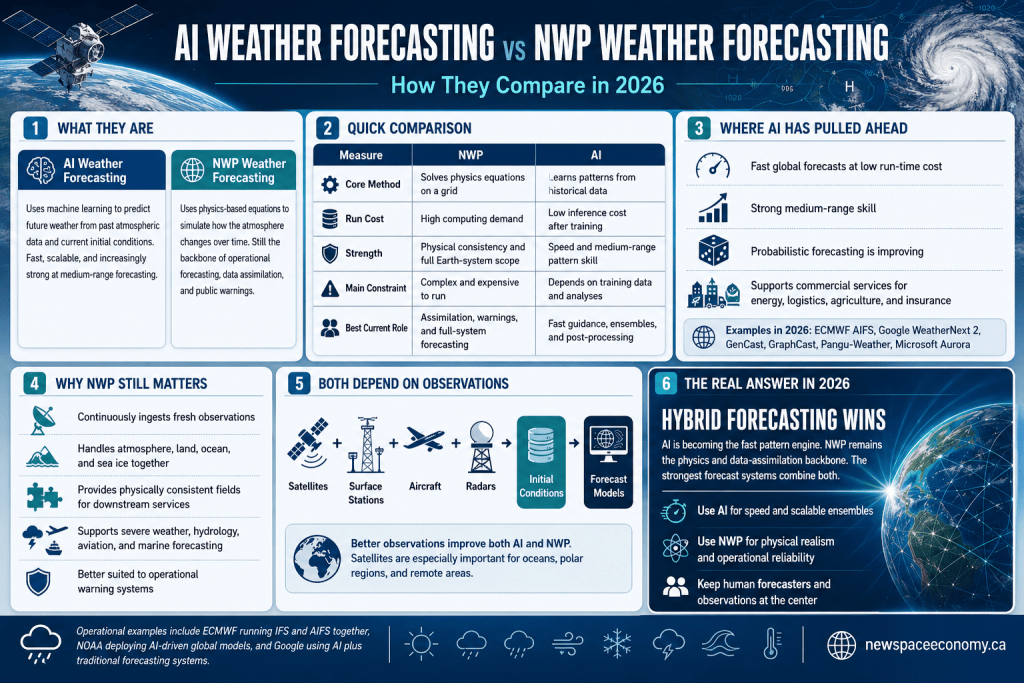
The table below summarizes the main differences between NWP and AI weather forecasting.
| Measure | NWP Forecasting | AI Forecasting |
|---|---|---|
| Core Method | Solves physics equations on a grid | Learns patterns from historical atmospheric data |
| Run Cost | High operational computing demand | Low inference cost after training |
| Strength | Physical consistency and full Earth-system scope | Speed and medium-range pattern skill |
| Main Constraint | Computing cost and model complexity | Dependence on training data and analyses |
Where AI Weather Models Have Pulled Ahead
AI weather models gained credibility because they did more than generate plausible maps. They matched or exceeded leading operational systems on many standard verification targets, often at far lower computing cost. In 2023, Google DeepMind’s GraphCast predicted hundreds of variables up to 10 days ahead at 0.25-degree resolution and reported stronger performance than ECMWF’s deterministic high-resolution forecast on many evaluated targets. Huawei’s Pangu-Weather showed that a three-dimensional neural network could produce fast medium-range forecasts and tropical cyclone track guidance.
GenCast moved the discussion from single-outcome forecasts to uncertainty. Published in Nature in 2025, GenCast generated probabilistic 15-day global forecasts at 12-hour steps and 0.25-degree resolution for more than 80 variables. The central point was not just speed. Weather decisions depend on uncertainty. Emergency managers, grid operators, insurers, farmers, and airlines need to know the range of possible outcomes, not a single line on a map.
By late 2025, Google announced WeatherNext 2 as a higher-resolution and more efficient global AI forecasting model. Google’s developer materials describe WeatherNext as a family of AI weather models for probabilistic prediction, faster inference, and higher temporal resolution. Google Maps Platform’s Weather API says it uses both AI weather models and traditional forecasting systems for current conditions and forecasts.
ECMWF’s operational adoption gave AI forecasting another kind of legitimacy. AIFS Single became fully operational in February 2025, and ECMWF upgraded AIFS Single and AIFS Ensemble in May 2026. The AIFS ENS v2 model card describes a 51-member 15-day global forecast run four times per day. That is a strong signal from an institution known for physics-based forecasting discipline.
AI systems have also opened new commercial channels. Faster forecast generation lowers the cost of large ensembles, high-frequency reruns, custom sector products, and API-delivered services. Energy traders can test wind and solar scenarios. Logistics firms can assess disruption risk. Agriculture users can compare temperature and precipitation outcomes. Insurance firms can price weather-related exposure. The same market logic appears in New Space Economy’s coverage of satellite data answers as a service, where buyers pay for decision-ready outputs rather than raw imagery.
Speed also changes experimentation. Research teams can run many sensitivity tests quickly, compare ensembles, and test different initial conditions without reserving a national supercomputer for each experiment. A low-cost forecast model does not automatically create a better public warning, but it does expand the number of scenarios that can be examined.
Where AI Forecasting Still Depends on NWP
Many leading AI weather systems were trained on ERA5 or other reanalysis datasets. A reanalysis is not raw history. It is a reconstruction created by combining past observations with a forecast model and data assimilation system. In practice, many AI models learned from an atmosphere already shaped by NWP methods. They may outperform the model that produced the training data on some targets, but they do not escape the observing and analysis system that made the training archive possible.
Initialization creates the same dependency. A real-time AI forecast still needs a current atmospheric state. If that state comes from an NWP analysis, the AI model inherits the quality, biases, timing, and missing data of that analysis. Direct-observation AI forecasting is an active research path. ECMWF’s 2026 preprint on AIFS-DOP described a system trained from gridded observations rather than NWP reanalysis or model data, with competitive medium-range scores in a test period. That research matters because it points toward AI systems that depend less on physics-model analyses. As of July 13, 2026, it remains a research advance rather than a full replacement for operational global data assimilation.
Physical consistency remains another concern. Weather maps can look plausible yet violate balances among pressure, temperature, wind, moisture, and mass. Operational users care about these details because downstream models may depend on conservation, vertical structure, and interactions among variables. A wind energy user may need hub-height wind distributions. A flood forecaster may need rainfall timing and soil moisture. Aviation users may need turbulence, icing, and convective hazards. A forecast that wins broad-average skill scores can still miss the variable that matters for a specific decision.
Extreme events pose a harder test. Rare combinations of atmospheric ingredients, changing climate conditions, and local geography may sit outside the densest part of the training record. AI models can still forecast extremes well if their training data captures enough relevant physics statistically. GenCast and GraphCast both reported skill in extreme-event tasks. The concern is not that AI cannot handle extremes. The concern is that forecasters need reliable uncertainty, physical diagnostics, and failure awareness when stakes are high.
AI models also depend on the observing system indirectly. If satellite, balloon, radar, aircraft, buoy, or surface-station data degrade, NWP analyses degrade, and AI initial conditions can degrade with them. WMO’s OSCAR resource tracks observing requirements, satellites, instruments, and space-based capabilities for weather, water, and climate applications. New Space Economy’s explanation of OSCAR connects observing metadata to forecasting quality and investment choices. AI does not remove that dependency. It makes the value of good observations easier to convert into fast forecasts.
The most realistic technical direction is hybrid. AI can correct biases, emulate expensive physics, generate ensembles, post-process NWP output, fill gaps, downscale forecasts, and identify risk patterns. NWP can supply initial states, maintain physical discipline, assimilate new observations, and handle Earth-system coupling. The strongest systems will likely combine both.
The Observation Problem Favors Space-Based Data
Weather forecasting is often described as a software problem, but it begins as a measurement problem. The atmosphere is too large, deep, wet, fast-moving, and unevenly observed for any model to work from local measurements alone. Satellites provide global coverage that ground networks cannot match. Geostationary satellites watch large regions continuously. Polar-orbiting satellites scan the whole planet with instruments that measure temperature, moisture, clouds, sea surface temperature, winds, precipitation-related signals, and many other variables.
New Space Economy’s history of Earth observation technology begins with TIROS-1, launched on April 1, 1960. Weather forecasting was one of the earliest practical uses of satellites because cloud patterns, storms, and circulation features could be seen from orbit. The technology moved from pictures toward global data infrastructure. That shift matters for both NWP and AI.
NWP uses satellite observations through data assimilation. Satellite radiances are complex because instruments measure radiation affected by temperature, humidity, clouds, surface properties, and viewing geometry. Translating those measurements into model updates requires observation operators, bias correction, quality control, and error estimates. AI may speed parts of that workflow, but it has to respect the physics and uncertainty of the measurement chain.
AI forecasting also benefits from satellite-rich reanalysis datasets. The reason modern AI models can learn global atmospheric patterns is that decades of observations have been organized into consistent training records. Without satellites, the historical record would be far weaker over oceans, polar regions, and many parts of the Southern Hemisphere. This is why the space economy cannot be separated from the AI weather story. Better sensors, lower latency, improved calibration, and stable data access all affect forecast quality.
Commercial satellite operators add another layer. Radio occultation data, microwave sounders, hyperspectral instruments, and radar systems can supplement public missions. New Space Economy’s discussion of current and planned satellite applications places commercial weather data inside a category where procurement, latency, and model impact shape value. The strongest commercial case is not simply “more data.” It is data that improves decisions enough to justify purchase.
AI may strengthen that business case because faster models can test the impact of new observations more often. If a commercial dataset improves cyclone track forecasts, wind forecasts, or precipitation risk at useful lead times, AI systems can help quantify that value quickly. NWP impact studies remain important, but AI can lower the cost of parallel evaluation and sector-specific testing.
The table below organizes the observation layer behind AI and NWP weather forecasting.
| Input | Use in Forecasting | Why It Matters |
|---|---|---|
| Satellites | Global temperature, moisture, cloud, ocean, and wind data | Fills ocean, polar, and remote-region gaps |
| Surface Stations | Temperature, pressure, wind, and precipitation checks | Anchors forecasts near people and infrastructure |
| Aircraft | Upper-air wind and temperature reports | Improves aviation and jet-stream guidance |
| Radars | Short-range precipitation and storm structure | Supports warnings and nowcasting |
Forecast Skill Depends on the Decision Being Made
A model can be better on an average global score and worse for a local decision. That is one reason forecasters rarely trust a single model blindly. Temperature at 850 hPa, 500 hPa height, tropical cyclone track, two-meter temperature, wind gusts, freezing rain, convective rainfall, and fire-weather indices all behave differently. A model that performs well at large-scale mid-tropospheric patterns may still struggle with local precipitation.
AI weather forecasting has shown strong medium-range skill because large-scale atmospheric flow contains learnable patterns. Jet streams, pressure systems, Rossby waves, tropical cyclone tracks, and broad temperature anomalies are well suited to global pattern recognition. For many medium-range applications, AI models now provide guidance that forecasters and businesses cannot ignore.
NWP remains strong when detailed physical processes matter. Convective thunderstorms, local terrain effects, boundary-layer mixing, fog, freezing rain, snow banding, and coastal wind shifts depend on fine-scale physics. Some AI systems can learn statistical relationships for these variables, but operational trust requires repeated proof across seasons, regions, and event types.
Resolution is part of the answer but not the whole answer. A model can output data on a fine grid without truly resolving the physics implied by that grid. NWP faces the same issue. Fine grid spacing does not automatically create accurate thunderstorms or rainfall. Parameterization, data assimilation, surface data, and boundary conditions matter. AI models face another version of the problem: a high-resolution output may still reflect training data limitations.
Uncertainty is a second measure. A deterministic forecast says what one model run expects. An ensemble forecast shows many plausible futures. For high-impact weather, the spread, tails, and clustering of ensemble outcomes often matter more than the average. GenCast, AIFS ENS, and WeatherNext 2 show that probabilistic AI forecasting is becoming practical, not just a research curiosity.
Communication is a third measure. The public does not consume model fields. People receive warnings, maps, icons, timing estimates, and confidence statements. Human meteorologists translate guidance into messages that account for local vulnerability, geography, infrastructure, and known model biases. AI may help generate guidance faster, but public trust depends on how the forecast becomes advice.
For commercial users, the best model depends on the loss function. An energy company may care about wind power ramp events. An airline may care about turbulence and convective rerouting. An insurer may care about rainfall return periods. A farmer may care about frost timing. A logistics operator may care about road closures. Forecast verification has to match the decision.
New Space Economy’s discussion of top issues in Earth observation emphasizes trust, access, validation, and workflow fit. The same logic applies to weather forecasting. AI model skill is valuable only when it survives operational validation and connects to a decision workflow.
Commercial Weather Services Will Use Both Approaches
The business impact of AI weather forecasting will not come from replacing every national weather model. It will come from turning forecast guidance into faster, cheaper, more customized services. That shift is already visible in consumer weather apps, logistics tools, energy platforms, insurance analytics, and agricultural services.
Google’s WeatherNext 2 has been positioned for both consumer products and enterprise use. ECMWF’s AIFS output supports public data access and professional forecasting workflows. NOAA’s December 2025 announcement of AI-driven global weather models placed AI inside operational public forecasting, not outside it. Microsoft’s Aurora 1.5, announced in July 2026, extended an open Earth-system foundation model with more weather variables.
Commercial weather firms can use AI to generate many forecast scenarios quickly, blend public and private data, and tailor output to sector needs. They can also use NWP for physical consistency and regulatory trust. The commercial winner will not necessarily be the provider with the cleverest neural network. It may be the provider with the best workflow integration, data rights, reliability, validation, and customer-specific loss metrics.
Satellite companies could benefit if AI forecasting increases demand for low-latency and specialized observations. A data buyer wants proof that a satellite dataset improves a model output that affects a business decision. AI models can make that testing less expensive, but commercial datasets still have to meet calibration, continuity, coverage, and licensing requirements. New Space Economy’s guide to satellite sensors shows how sensor type shapes applications, including weather monitoring.
Public agencies face a different challenge. They need fair access, transparent standards, auditability, international data sharing, and resilient operations. A private AI forecast can fail quietly for one customer. A public warning system cannot. That difference means national meteorological services will adopt AI carefully, with parallel operations, independent verification, and human oversight.
The financial story also has limits. Lower inference cost does not make global forecasting free. Training large models, maintaining data pipelines, validating forecasts, buying observations, operating satellites, and supporting users all carry costs. AI shifts the cost structure rather than eliminating it.
The more realistic commercial pattern is layered. Public NWP and AI systems provide baseline global guidance. Private firms add data, post-processing, localization, user interfaces, risk metrics, and industry-specific alerts. Satellite operators supply observations. Cloud providers supply computing and APIs. Human forecasters remain part of high-stakes interpretation.
What Forecasters Should Trust in 2026
Forecasters should trust evidence, not model branding. An AI model that performs well on global medium-range scores deserves attention. A physics-based model that performs better for a local hazard deserves attention. A blended forecast that has been verified for the exact application may deserve more trust than either system alone.
In operational practice, trust grows through repeated performance across independent cases. A model trained on past data must prove itself on future weather. It must handle missing observations, unusual circulation patterns, changing climate baselines, seasonal transitions, sensor outages, and regional extremes. It must also produce usable fields on schedule.
AI weather forecasting has already earned a place in the forecast suite. The 2026 question is no longer whether AI can produce skillful global forecasts. It can. The question is how far AI can move into data assimilation, local hazards, coupled Earth-system prediction, climate-sensitive extremes, and public warning operations without losing reliability or interpretability.
NWP has not lost its scientific value. It remains the main framework for physical process development, coupled prediction, observation impact studies, and forecast diagnostics. Improvements to NWP can also improve AI systems when NWP analyses remain part of the training and initialization pipeline. That relationship makes the competition circular. Better NWP can create better AI training data. Better AI can identify NWP biases, emulate expensive components, and support larger ensembles.
The hybrid future is already visible. ECMWF operates IFS and AIFS together. NOAA has placed AI models inside its forecast guidance environment. Google’s Weather API uses both AI and traditional systems. Research teams are testing AI data assimilation, AI correction of physics models, AI emulators for observation operators, and coupled atmosphere-ocean AI models.
Risk management should follow four rules. Use AI where verified skill and speed improve decisions. Use NWP where physical consistency, variable completeness, and operational reliability are required. Use ensembles rather than single runs for high-impact weather. Keep observations, human meteorology, and transparent validation at the center.
AI weather forecasting versus NWP weather forecasting is the wrong frame if it implies one method must eliminate the other. The better frame is operational allocation. AI is becoming the fast pattern engine. NWP remains the physics engine and assimilation backbone. The forecast systems that matter most in 2026 are the ones that combine both without pretending either method is magic.
Summary
AI weather forecasting reached operational maturity faster than many forecasters expected. ECMWF’s AIFS, NOAA’s AI-driven global models, Google’s WeatherNext 2, Google DeepMind’s GenCast, Microsoft’s Aurora, Huawei’s Pangu-Weather, and GraphCast show that machine learning can produce skillful medium-range forecasts with far lower run-time cost than traditional NWP.
NWP remains essential because weather forecasting is more than pattern prediction. It requires fresh observations, data assimilation, physical consistency, coupled Earth-system modeling, variable completeness, public accountability, and human interpretation. AI systems often depend on NWP analyses or reanalyses, even when their forecasts outperform older physics-based baselines on many scores.
The most useful answer in 2026 is practical rather than ideological. AI will take more forecasting work because it is fast, scalable, and increasingly accurate. NWP will remain central because the atmosphere is a physical system, not a pattern archive. Weather services, satellite operators, cloud platforms, and commercial forecast firms will compete on how well they combine the two.
Appendix: Useful Books Available on Amazon
- Atmospheric Modeling, Data Assimilation and Predictability
- Fundamentals of Numerical Weather Prediction
- Numerical Weather and Climate Prediction
- The Weather Machine
- Weather Prediction by Numerical Process
Appendix: Top Questions Answered in This Article
What Is AI Weather Forecasting?
AI weather forecasting uses machine learning to predict future weather from past atmospheric data and current initial conditions. Many systems learn from reanalysis datasets that blend observations with NWP models. After training, they can generate global forecasts quickly, often with lower run-time computing cost than physics-based models.
What Is NWP Weather Forecasting?
Numerical weather prediction uses mathematical equations to simulate how the atmosphere changes over time. It starts with an analyzed estimate of the current atmosphere, then runs physics-based calculations on a grid. Modern NWP also couples atmosphere, land, ocean, and sea ice components for many operational forecasts.
Has AI Weather Forecasting Beaten NWP?
AI has beaten some leading NWP baselines on many medium-range verification tests, but that does not mean it has replaced NWP. Operational forecasting needs reliability, physical consistency, data assimilation, hazard-specific guidance, and human interpretation. AI now competes strongly with NWP and increasingly works beside it.
Why Does AI Forecasting Still Need NWP?
Many leading AI models train on reanalysis data produced by NWP-based data assimilation systems. Real-time AI forecasts also often start from NWP analyses. That means AI can improve forecast speed and skill, but it may still inherit NWP strengths, biases, and data dependencies.
Why Are Satellites Important for Both Forecasting Methods?
Satellites provide global observations over oceans, polar regions, and remote land areas where surface data are limited. NWP uses satellite data through data assimilation. AI models benefit from satellite-rich historical datasets and current atmospheric analyses. Better satellite data can improve both model families.
What Makes AI Forecasting Commercially Attractive?
AI models can generate forecasts and ensembles at low run-time cost after training. That supports customized services for energy, logistics, agriculture, insurance, and consumer apps. Commercial value still depends on validation, data rights, reliability, and integration into real decision workflows.
What Are the Main Limits of AI Weather Forecasting?
AI models can depend on training data, inherited analysis biases, and incomplete physical constraints. They may perform well on broad scores yet struggle with specific local hazards. Operational trust requires independent verification, uncertainty testing, and proof across many regions and seasons.
What Are the Main Limits of NWP Weather Forecasting?
NWP requires expensive computing, complex code, and long development cycles. Higher resolution and larger ensembles increase cost. NWP also contains physical approximations and known biases, which agencies address through model upgrades, better observations, and improved data assimilation.
Will Human Forecasters Still Be Needed?
Human forecasters remain needed because public forecasts require judgment, local knowledge, risk communication, and awareness of model behavior. AI can improve guidance speed and scenario generation. Forecasters still decide how model output becomes warnings, confidence statements, and practical advice.
What Is the Best Forecasting Approach in 2026?
The best approach is hybrid. AI contributes fast global pattern prediction and low-cost ensembles. NWP contributes physical consistency, data assimilation, and operational depth. Forecast centers that combine both methods carefully are better positioned than those treating the issue as a winner-take-all contest.
Appendix: Glossary of Key Terms
Artificial Intelligence
Artificial intelligence refers to computer systems that perform tasks associated with pattern recognition, prediction, language processing, decision support, or automated analysis. In weather forecasting, AI usually means machine learning models trained on large atmospheric datasets to predict future weather states.
Numerical Weather Prediction
Numerical weather prediction is the use of mathematical equations and computer models to forecast future weather. It represents the atmosphere on a grid and calculates how temperature, wind, pressure, moisture, and other variables change over time.
Data Assimilation
Data assimilation blends observations with a short-range model forecast to estimate the current state of the atmosphere. It accounts for measurement error, model error, and timing differences so a forecast model can start from a balanced initial condition.
Reanalysis
Reanalysis is a historical reconstruction of the atmosphere created by applying a consistent data assimilation system to past observations. AI weather models often use reanalysis datasets for training because they provide long, global, structured records of atmospheric conditions.
Ensemble Forecast
An ensemble forecast uses many model runs to estimate a range of possible future weather outcomes. Ensembles help forecasters assess uncertainty, identify low-probability high-impact events, and avoid relying on a single deterministic forecast.
AIFS
The Artificial Intelligence Forecasting System is ECMWF’s operational data-driven forecast system. It uses machine learning to produce weather forecasts and now runs beside ECMWF’s physics-based Integrated Forecasting System as part of the center’s operational forecast suite.
Integrated Forecasting System
The Integrated Forecasting System is ECMWF’s physics-based Earth-system forecasting model. It combines atmosphere, ocean, land, sea ice, waves, data assimilation, and ensemble methods to provide global forecast guidance used by weather services and professional users.
GraphCast
GraphCast is a Google DeepMind machine learning weather model introduced in peer-reviewed research in 2023. It predicts many atmospheric variables up to 10 days ahead and helped demonstrate that AI models could compete with leading medium-range forecast systems.
GenCast
GenCast is a Google DeepMind probabilistic weather model designed to generate ensembles of possible future weather states. It advanced the AI forecasting discussion because it addressed uncertainty, a central issue for warnings, energy planning, and risk management.
WeatherNext 2
WeatherNext 2 is Google’s advanced AI weather forecasting model family announced in 2025. It supports faster and higher-resolution probabilistic forecasts and has been connected to Google products and developer platforms for consumer and enterprise applications.