
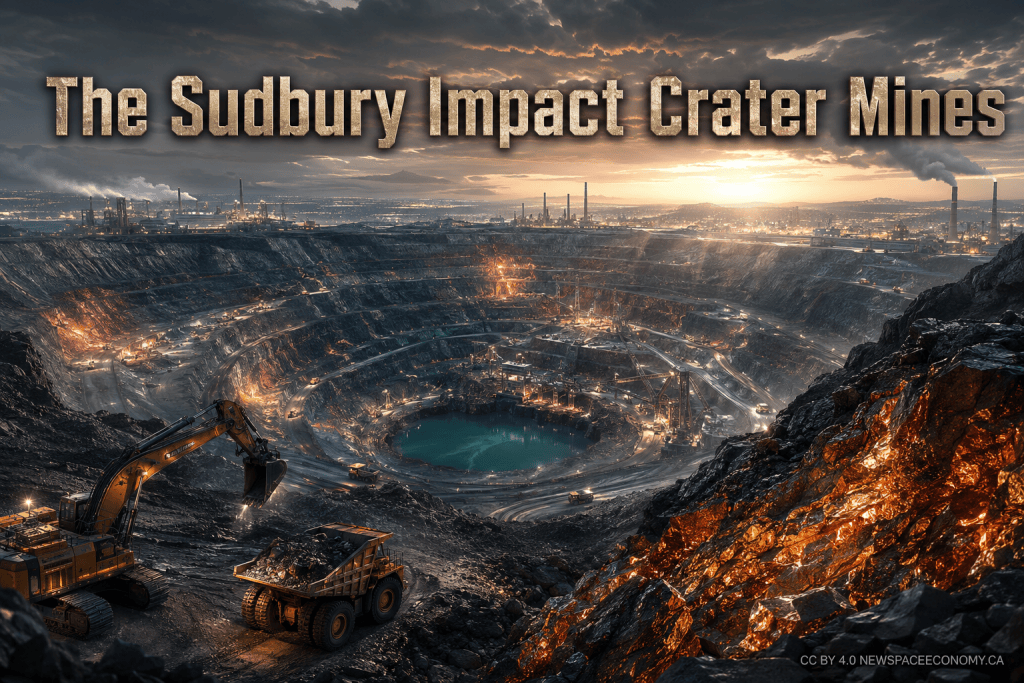
- Key Takeaways
- A Collision Large Enough to Melt the Crust
- How the Impact Concentrated Nickel and Copper
- How the Sudbury Impact Crater Mines Follow the Basin
- Operating Mines and Projects as of July 15, 2026
- Metals from Sudbury and Their Industrial Uses
- A Mining Legacy of Damage and Recovery
- Sudbury as a Bridge Between Earth and Planetary Science
- Summary
- Appendix: Useful Books Available on Amazon
- Appendix: Top Questions Answered in This Article
- Appendix: Glossary of Key Terms
Key Takeaways
- A 1.85-billion-year-old impact produced the melt system that concentrated Sudbury’s ores.
- Vale operates five underground mines and the Stobie open pit in the Sudbury mining district.
- Sudbury connects mining history, environmental repair, underground science, and planetary geology.
A Collision Large Enough to Melt the Crust
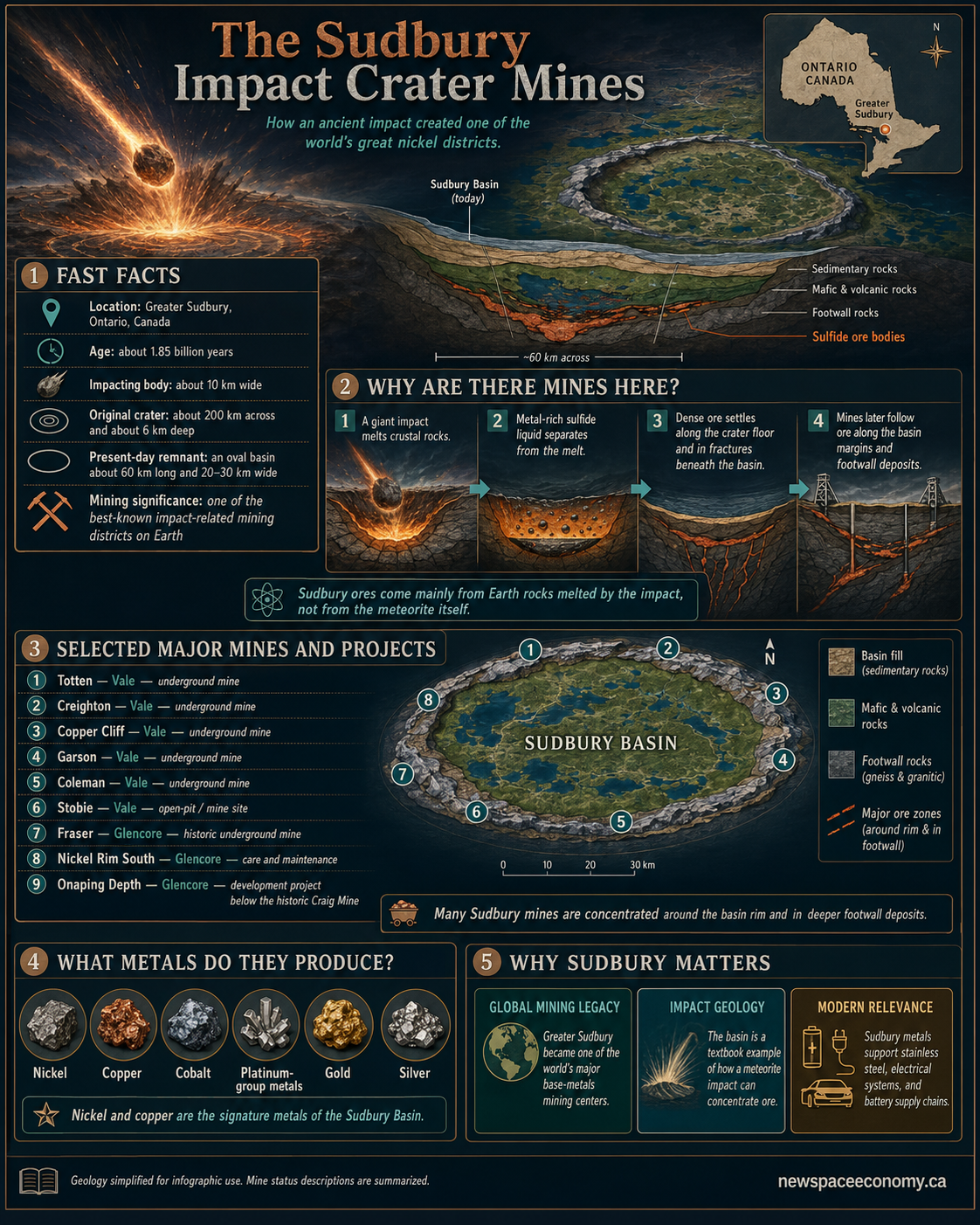
About 1.85 billion years ago, an extraterrestrial object estimated at roughly 10 kilometers, or 6 miles, in diameter struck the region that is now Greater Sudbury, Ontario. The collision excavated an original crater commonly estimated at about 200 kilometers across and approximately 6 kilometers deep. It also melted an immense volume of Earth’s crust, producing a sheet of molten rock several kilometers thick beneath impact debris. The Sudbury impact crater mines owe their existence to the geological processes that unfolded inside this temporary sea of molten material.
The Ontario Geological Survey’s Sudbury GeoTours describe an impact powerful enough to melt, vaporize, shatter, and eject immense quantities of rock. Impact debris later fell back into the crater, and the molten material beneath it cooled over a long period. The resulting sequence of igneous rocks, breccias, sedimentary units, fractures, and mineral deposits forms the geological foundation of the modern mining district.
The original crater no longer appears as a clean circular depression. Continental deformation squeezed the structure, erosion removed much of its upper portion, and sediment accumulated within it. The surviving geological structure forms an oval approximately 60 kilometers long and 20 to 30 kilometers wide. Greater Sudbury occupies the southern portion of this deeply altered remnant rather than the center of a recognizable bowl.
The impactor is often described as a meteorite or asteroid in public accounts, although the precise nature of the object remains less certain than the impact itself. NASA’s examination of the Sudbury structure notes that interpretations have included both an asteroid and a comet. Geological proof of an impact comes from shocked minerals, shattered rock, impact breccias, melt rocks, shatter cones, and structural deformation spread across the district.
The visible basin represents only one portion of a much larger region affected by extreme pressure and heat. The impact altered rocks far beyond the present oval and produced structures that later controlled the movement and accumulation of metal-bearing liquids. Its effects extended downward into the crust as well as outward from the point of collision.
Sudbury belongs among Earth’s oldest and largest confirmed impact structures. Its age, ore deposits, extensive rock exposure, and long mining record distinguish it from sites that are younger, buried, or economically less significant. New Space Economy’s reviews of Canada’s asteroid craters, the largest terrestrial impact structures, and impact crater classification place Sudbury within the wider record of collisions that have reshaped Earth and other rocky worlds.
How the Impact Concentrated Nickel and Copper
The impactor did not simply deposit a mass of valuable metal that miners later extracted. Sudbury’s ores came mainly from Earth’s crust. The collision supplied enough energy to fracture, heat, and melt existing terrestrial rocks. Metals that had been scattered in low concentrations through those rocks entered the impact-generated melt and became concentrated through physical and chemical separation.
The Ontario geological guide to the Sudbury crater explains that metal-rich liquid separated from the melted crust and moved downward because it was denser than the surrounding material. Nickel, copper, cobalt, gold, silver, and platinum-group elements became concentrated in sulfide-rich liquids rather than remaining evenly distributed through the silicate melt.
The process can be compared with two liquids that resist mixing, although the chemistry inside the Sudbury melt system was much more complex. A dense liquid rich in iron and sulfur separated from the lighter silicate material. Nickel, copper, and several valuable trace metals had a strong chemical preference for the sulfide liquid.
Gravity pulled the dense material downward. It collected along irregularities near the bottom and margins of the melt sheet, entered fractures, and moved through broken rock beneath and beside the crater. The crater floor was not a smooth basin. It contained depressions, shattered zones, breccias, faults, and channels that could trap or redirect the metal-bearing liquid.
Later geological activity deformed the structure and moved some mineralized material through the surrounding rock. The result was not one continuous ring of ore. Sudbury contains numerous deposits with different shapes, grades, depths, mineral combinations, and relationships to the central igneous complex.
Geologists commonly describe several broad deposit settings. Contact deposits occur close to the boundary between the Sudbury Igneous Complex and older footwall rocks. Footwall deposits lie below that contact and may occupy fractures or breccia zones. Offset deposits occur along mineralized dikes extending away from the principal complex. Other deposits formed within Sudbury breccias and altered country rock.
The Western University Impact Earth initiative identifies Sudbury as a leading example of an economic mineral system associated with an impact melt sheet, dikes, and later fluid activity. This combination helps explain why mines appear around the basin rim, beneath the principal contact, and along structures extending beyond the obvious oval.
The basic geological sequence can be summarized as impact, crustal melting, sulfide separation, metal collection, migration into structural traps, cooling, and later deformation. Each phase changed where the metals accumulated and how miners could eventually reach them.
The table summarizes the relationship between the impact process and the resulting ore deposits.
| Stage | Geological Process | Mining Result |
|---|---|---|
| Impact | Crust fractures and melts | A vast impact melt sheet forms |
| Separation | Dense sulfide liquid separates | Nickel, copper, and related metals concentrate |
| Migration | Ore liquid enters fractures and depressions | Contact, footwall, and offset deposits develop |
| Cooling | Minerals crystallize from the liquids | Mineable sulfide ore bodies remain |
Sudbury demonstrates why the economic value of an impact site cannot be estimated by calculating the metal content of the impactor. The valuable deposits resulted from large-scale processing of terrestrial material. This distinction also matters when comparing Sudbury with speculative asteroid mining assessments, which concern extracting material from an object itself rather than mining Earth rocks altered by an ancient collision.
How the Sudbury Impact Crater Mines Follow the Basin
A map of Sudbury’s mines often resembles a broken necklace around an oval. That pattern reflects geology rather than convenient surface access. Many deposits formed near the lower edge of the Sudbury Igneous Complex, where dense sulfide liquids could accumulate against older footwall rocks. Others occur beneath the main contact or along offset structures extending away from the basin.
Early prospectors recognized that copper-nickel mineralization appeared repeatedly near the outer edge of the igneous rocks. Modern exploration uses drilling, seismic data, electromagnetic surveys, gravity measurements, geological mapping, and three-dimensional deposit models to search for extensions at greater depths. A target may sit thousands of meters below the surface or beyond workings created decades earlier.
Mining development accelerated after copper-nickel ore was identified during construction of the Canadian Pacific Railway in the 1880s. The discovery encouraged further prospecting and the establishment of mines around the basin. Within several decades, Sudbury had become Canada’s leading nickel-producing district and an internationally recognized source of nickel and copper.
The Vale Sudbury Complex traces more than 140 years of mining activity in the district. Over that period, the region supplied metals for steelmaking, electrical equipment, transportation, industrial machinery, military production, consumer goods, and energy infrastructure.
Most surviving deposits require underground mining because the ore extends steeply downward or lies beneath substantial rock cover. Shafts, ramps, hoists, ventilation systems, underground crushers, rail systems, and extensive tunnel networks connect working areas with surface facilities. Deep operations must manage heat, groundwater, rock stress, seismic activity, ventilation, emergency access, communications, and the movement of workers and ore.
Vale’s 2026 Sudbury technical disclosure describes underground production from Coleman, Creighton, Copper Cliff, Garson, and Totten, together with open-pit mining at Stobie. Creighton has working levels extending more than 2,500 meters, or approximately 8,300 feet, below the surface.
The mines do not operate as isolated extraction points. Ore moves through concentrators, smelters, refineries, transportation systems, maintenance facilities, analytical laboratories, and specialized supply companies. Vale’s Sudbury system includes underground mines, the Stobie open pit, the Clarabelle Mill, the Copper Cliff Smelter, and refining operations.
Glencore’s Sudbury Integrated Nickel Operations include exploration properties, mine sites, the Strathcona Mill, and the Sudbury Smelter. These assets allow material from different deposits and external sources to move through an established regional processing system.
This concentration of geology, infrastructure, labor, engineering knowledge, and processing capacity has allowed mining to continue after many early deposits were exhausted. New discoveries may use existing shafts, mills, power systems, and transportation connections when geological and commercial conditions permit.
Brownfield exploration, meaning exploration near established operations, remains central to Sudbury’s future. Vale’s 2026 exploration outlook includes drilling around operating mines and identified deposits. Existing infrastructure may lower development barriers, but it cannot make an uneconomic or technically unsuitable deposit viable by itself.
Operating Mines and Projects as of July 15, 2026
Vale Base Metals identifies five operating underground mines in its Sudbury portfolio: Coleman, Creighton, Copper Cliff, Garson, and Totten. The company also includes the Stobie open pit among the operations supporting its declared Sudbury mineral reserves.
The current operating portfolio is confirmed in Vale’s 2026 asset handbook, its Sudbury technical disclosure, and its current mineral-reserve information. These properties supply polymetallic sulfide ore containing different proportions of nickel, copper, cobalt, gold, silver, platinum, and palladium.
Glencore’s operating picture has changed as older deposits reached depletion. Nickel Rim South entered care and maintenance in July 2024 after producing more than 18.3 million tonnes during almost 15 years of operation. Glencore’s mining and milling information continues to identify Nickel Rim South as a care-and-maintenance property and describes the nearby Nickel Rim South Extension as a resource under study.
Fraser Mine entered a shutdown and closure transition during 2025. Glencore had previously identified 2024 as the anticipated end of its mine life, and the operator began the formal shutdown process in October 2025. Final ore production was expected in December 2025. The site remains part of the company’s broader Sudbury property and infrastructure portfolio during closure activities.
Glencore continues to identify Craig Mine Onaping Depth as a development-stage project beneath the historic Craig Mine. The project is designed to access a deep nickel-copper resource through existing and expanded infrastructure. Its development reflects a broader shift toward deeper deposits as shallower and older Sudbury ore bodies reach depletion.
The table summarizes the named operations and projects featured in the infographic. Mine status can change through production decisions, rehabilitation work, study results, permitting, safety conditions, commodity prices, capital availability, or revised reserve estimates.
| Operation | Operator | July 15, 2026 Status |
|---|---|---|
| Totten | Vale Base Metals | Operating underground mine |
| Creighton | Vale Base Metals | Operating underground mine |
| Copper Cliff | Vale Base Metals | Operating underground mine |
| Garson | Vale Base Metals | Operating underground mine |
| Coleman | Vale Base Metals | Operating underground mine |
| Stobie | Vale Base Metals | Operating open pit |
| Nickel Rim South | Glencore | Care and maintenance |
| Fraser | Glencore | Shutdown and closure transition |
| Onaping Depth | Glencore | Development project |
Vale and Glencore agreed in December 2025 to evaluate a potential brownfield copper development involving adjacent deposits near Nickel Rim South. The joint evaluation agreement proposes using and deepening Glencore’s existing shaft infrastructure to access deposits controlled by both companies.
The preliminary concept estimates production of approximately 880,000 tonnes of copper over 21 years, together with nickel, cobalt, gold, platinum-group metals, and other minerals. Vale estimated the project’s capital cost at approximately US$1.6 billion to US$2 billion. Detailed engineering, consultation, and permitting work were scheduled during 2026, with a possible final investment decision in the first half of 2027. These figures describe a proposed project rather than an approved operating mine.
Vale’s 2026 exploration program also includes extensive drilling across its Ontario portfolio. Exploration results can extend known mineralized zones and improve geological confidence, but they do not guarantee development. Grade, geometry, metallurgy, rock conditions, capital cost, safety, permitting, market prices, and access all influence whether a mineral resource becomes a producing mine.
Metals from Sudbury and Their Industrial Uses
Nickel and copper remain Sudbury’s signature products, yet its polymetallic ores contain several other commercially recoverable metals. Vale lists nickel, copper, cobalt, platinum-group metals, gold, and silver among the products associated with its Sudbury operations.
The geological processes that concentrated sulfides brought together elements with different industrial uses and market behavior. The value of a Sudbury deposit may depend on several metals rather than a single commodity. Revenue from secondary metals can improve the economics of an ore body developed mainly for nickel or copper.
Nickel’s largest industrial use is stainless steel. Natural Resources Canada’s nickel data show that stainless steel accounted for 64% of global nickel use in 2024. Nickel improves corrosion resistance, strength, heat tolerance, and performance in demanding environments.
Nickel also appears in specialty alloys, plating, catalysts, electronics, and several rechargeable battery chemistries. Sudbury nickel can enter markets far removed from the mine, including food-processing equipment, transportation systems, energy facilities, chemical plants, and aerospace components.
Copper carries electrical current efficiently and is widely used in wiring, motors, transformers, construction, industrial machinery, electric vehicles, renewable-energy systems, and power networks. Canadian copper statistics show how copper connects mining with manufacturing, construction, electrical infrastructure, and international trade.
Electrification can raise copper demand because generators, transmission systems, charging equipment, vehicles, data centers, and industrial controls all require conductive material. Sudbury’s copper production gains added value from the district’s existing concentration, smelting, refining, and transportation infrastructure.
Cobalt may be recovered as a secondary product rather than the central economic target of a mine. Its uses include superalloys, cemented carbides, magnets, catalysts, tools, and battery materials. Natural Resources Canada’s review of clean-energy mineral applications reports that battery technology represented 42% of cobalt demand in the data examined, with aerospace superalloys accounting for another significant share.
Market interest in cobalt can change with battery chemistry, recycling, supply security, technology choices, and commodity prices. Recovering it from polymetallic Sudbury ores can provide an additional Canadian source without requiring a mine developed solely for cobalt.
Platinum-group metals include platinum, palladium, rhodium, ruthenium, iridium, and osmium. Sudbury ores can contain several of these elements, although concentrations and recovery differ by deposit. Applications include vehicle-emission catalysts, chemical processing, electronics, jewelry, medical devices, hydrogen-related equipment, and high-temperature industrial systems.
Natural Resources Canada reported that Canadian platinum-group-metal production reached approximately 746,000 troy ounces in 2024, with about three-quarters originating from Ontario mines. Much of this output is linked to nickel-copper sulfide operations rather than mines developed exclusively for platinum-group metals.
Gold and silver add value to Sudbury’s ore streams and may improve the economics of deposits primarily developed for nickel and copper. Their recovery demonstrates the value of examining the full mineral composition of an ore body. A change in metal prices, recovery technology, processing efficiency, or operating cost can alter how a deposit is valued.
Sudbury provides a useful terrestrial contrast with proposals for an asteroid resource economy. Both subjects involve nickel, iron, cobalt, platinum-group metals, resource concentration, processing, transportation, and uncertain economics.
Sudbury benefits from established roads, electricity, communities, skilled labor, legal systems, processing plants, emergency services, customers, and more than a century of geological knowledge. A space-mining venture would need to create or obtain comparable capabilities far from Earth and operate them with limited opportunities for maintenance or human intervention.
A Mining Legacy of Damage and Recovery
Sudbury’s mineral wealth produced jobs, infrastructure, technical knowledge, export revenue, and industrial growth. Mining and smelting also caused severe environmental damage. Early roasting methods burned ore on large wood piles to remove sulfur before smelting. Logging supplied fuel, sulfur dioxide damaged vegetation, metal-bearing particles contaminated soils, and erosion exposed darkened rock across extensive areas.
The Ontario GeoTour of Copper Cliff documents the relationship between mining, smelting, air emissions, industrial infrastructure, and the physical appearance of the region. The combined effects of sulfur emissions, logging, fire, acidic soils, erosion, and metal contamination shaped Sudbury’s public image for decades.
Barren hills were sometimes compared with the Moon. That analogy could obscure the industrial causes of the local condition. The ancient impact did not produce the blackened, treeless terrain familiar from twentieth-century photographs. Mining practices, smelting emissions, fuel consumption, soil chemistry, and vegetation loss produced much of that appearance.
Greater Sudbury’s Regreening Program began in 1978 after research showed that applying crushed limestone could reduce soil acidity and help grasses, shrubs, and trees become established. The municipal Regreening Program reports that more than 3,500 hectares have been limed and grassed and more than 10 million trees have been planted.
Regreening also involved watershed repair, erosion control, soil treatment, ecological monitoring, community participation, industrial emission reductions, and long-term management. The program developed into one of the most recognized examples of ecological rehabilitation in a heavily industrialized mining region.
Recovery does not erase the district’s environmental liabilities. Closed mines, waste-rock areas, tailings, contaminated soils, altered water systems, inactive infrastructure, and future closure obligations require continued management. Regreening statistics document measurable progress without establishing that every affected area has returned to its preindustrial condition.
Present-day mining operations face environmental assessment, permitting, emissions controls, water management, tailings requirements, closure planning, workplace regulation, and consultation obligations. New projects must address their environmental and social effects before construction and continue managing them during operation and after closure.
The Greater Sudbury region also lies within the traditional territories of Indigenous peoples and within the area covered by the Robinson-Huron Treaty of 1850. Mining decisions can affect Indigenous rights and interests connected with land, water, harvesting, employment, business agreements, environmental stewardship, and cultural use.
Sudbury’s environmental record carries two lessons that should remain connected. Large mining and processing systems can impose damage that lasts for generations. Coordinated action involving regulation, industrial upgrades, scientific research, municipal programs, workers, residents, and long-term funding can produce substantial repair.
Sudbury as a Bridge Between Earth and Planetary Science
Sudbury operates as a mining district and as a natural laboratory for impact science. Researchers can examine melt rocks, breccias, shatter cones, shocked minerals, dikes, faults, ore deposits, erosion, and post-impact deformation within one region.
Those features help scientists interpret impact structures on the Moon, Mars, Mercury, and other rocky bodies where direct fieldwork remains limited. The Ontario Geological Survey’s Sudbury research documents how field mapping, geochemistry, geophysics, and structural geology contribute to understanding the ancient collision.
Earth removes or disguises impact evidence through erosion, sedimentation, tectonic movement, vegetation, water, and human activity. The Moon preserves craters for much longer because it lacks rivers, oceans, active plate tectonics, and a substantial atmosphere.
Sudbury shows how a very old structure can survive in fragments rather than as a complete crater. New Space Economy’s examinations of the Sudbury Basin’s cosmic history, its identity as a cosmic scar on the Canadian Shield, and Earth’s prominent impact structures connect field geology with planetary observations.
The relationship also works in the opposite direction. Study of lunar craters helped geologists recognize impact structures on Earth and distinguish them from volcanic or tectonic features. Remote sensing, gravity measurements, magnetic surveys, spectroscopy, crater morphology, and sample analysis developed for planetary science can inform terrestrial geological investigation.
Sudbury gives researchers a location where interpretations can be tested against rocks that can be touched, drilled, mapped, dated, and chemically analyzed. The district exposes deeper sections of an impact structure that might remain hidden beneath younger craters.
The region’s underground infrastructure supports another branch of science. SNOLAB lies approximately 2 kilometers, or 1.2 miles, underground within Vale’s operating Creighton Mine. The depth and surrounding Canadian Shield rock greatly reduce interference from cosmic rays.
This low-background environment allows sensitive experiments in neutrino physics, dark-matter searches, quantum research, life sciences, and other fields. A mine developed to extract impact-related ore now provides access to conditions used to study particles arriving from the Sun, space, and distant astrophysical events.
Sudbury also adds realism to debates about extracting resources beyond Earth. The district shows that identifying metal is only an early step. Economic extraction depends on ore concentration, deposit geometry, geotechnical conditions, access, energy, water, processing, waste management, safety, transportation, financing, regulation, workers, and customers.
These terrestrial requirements complicate claims that an asteroid’s theoretical metal content establishes its commercial value. A credible space-mining proposal must explain how resources would be located, characterized, extracted, processed, transported, sold, and regulated. The presence of valuable elements does not establish that they can be recovered at a profit.
Legal and ethical questions would become more pronounced beyond Earth. Sudbury operates within Canadian mining, environmental, labor, taxation, treaty, and property systems. Proposed lunar or asteroid mining must operate within an incomplete international framework governing resource rights, state responsibility, environmental protection, benefit sharing, and supervision of private companies.
New Space Economy’s examination of space resource property rights explains why geology alone cannot create a functioning resource industry. Sudbury’s history indicates that institutions, infrastructure, environmental controls, and social agreements matter alongside ore grade and technology.
Summary
The Sudbury impact crater mines exist because an ancient collision reorganized the chemistry and structure of Earth’s crust. The impact melted enormous volumes of rock, allowed dense sulfide liquids to separate, concentrated nickel and copper with other metals, and directed mineralized material into contacts, fractures, footwall zones, and offset structures.
Later deformation and erosion changed the original crater into the oval geological structure visible through mapping and rock exposure. The modern basin represents an altered remnant of a much larger impact system rather than an intact crater.
Mining followed the ore rather than the visible shape of the basin. More than a century of exploration and development created deep mines, processing plants, smelters, refineries, transportation systems, service companies, and a skilled workforce.
As of July 15, 2026, Vale’s operating portfolio includes five underground mines and the Stobie open pit. Glencore’s Sudbury portfolio is shifting from depleted operations toward Onaping Depth, mine-site closure work, and the evaluation of additional resources near Nickel Rim South.
The metals produced in Sudbury enter stainless steel, electrical equipment, batteries, aerospace alloys, industrial catalysts, medical technologies, transportation systems, and precious-metal markets. Their economic usefulness does not remove the environmental costs associated with historic roasting, smelting, soil contamination, vegetation loss, and mine waste.
Sudbury’s regreening demonstrates that damaged industrial regions can recover substantially through sustained scientific, municipal, industrial, and community work. Its underground infrastructure supports research at SNOLAB, and its exposed impact rocks help scientists interpret craters on other worlds.
Few places connect cosmic collision, mineral formation, industrial mining, environmental repair, and fundamental physics so directly.
Appendix: Useful Books Available on Amazon
- Nickel Sulfide Ores and Impact Melts
- The Geology and Ore Deposits of the Sudbury Structure
- The Geology of Ore Deposits
- Exploration and Mining Geology
- Impact Cratering: Processes and Products
- Ore Deposit Geology
Appendix: Top Questions Answered in This Article
Was Sudbury’s Nickel Delivered by the Meteorite?
Most of Sudbury’s mineable nickel and copper came from terrestrial rocks rather than directly from the impactor. The collision melted a vast volume of Earth’s crust. Metal-rich sulfide liquid separated from that melt, collected in depressions and fractures, and later crystallized into ore deposits.
How Old Is the Sudbury Impact Structure?
The impact occurred about 1.85 billion years ago during the Paleoproterozoic Era. Scientific dating commonly places the event near 1.849 billion years ago, with small differences depending on the dating method, rock sample, and source.
How Large Was the Original Crater?
Ontario geological guides commonly describe the original crater as approximately 200 kilometers across and about 6 kilometers deep. Erosion and tectonic deformation destroyed or altered much of the original structure, leaving a smaller oval remnant.
Why Are Many Sudbury Mines Located Around the Basin Rim?
Dense sulfide liquids collected near the lower margins of the impact melt and entered fractures in surrounding footwall rocks. These processes created contact, footwall, breccia-hosted, and offset deposits around or beyond the present basin.
Which Vale Mines Operate in Sudbury?
Vale identifies Coleman, Creighton, Copper Cliff, Garson, and Totten as operating underground mines as of July 15, 2026. The company also includes the Stobie open pit in its Sudbury operations and mineral-reserve disclosures.
What Happened to Nickel Rim South Mine?
Glencore placed Nickel Rim South into care and maintenance in July 2024 after almost 15 years of production. The site remains relevant because nearby deposits and existing infrastructure may support future development concepts.
What Happened to Fraser Mine?
Glencore began shutting down Fraser Mine in 2025 as its ore body approached depletion. Final ore production was expected in December 2025, and the property entered a closure and transition phase.
What Is the Onaping Depth Project?
Onaping Depth is a deep nickel-copper resource located beneath the historic Craig Mine. Glencore describes it as a development-stage project that would use expanded underground infrastructure to supply future ore to its Sudbury processing facilities.
Which Metals Are Produced from Sudbury Ores?
Sudbury operations produce nickel, copper, cobalt, gold, silver, and platinum-group metals. The quantity and economic contribution of each metal differ among deposits, ore types, processing routes, and market conditions.
Has Sudbury Recovered from Historic Environmental Damage?
Greater Sudbury has achieved extensive regreening and emission reductions, including treatment of more than 3,500 hectares and the planting of more than 10 million trees. Environmental liabilities remain, so recovery should be viewed as substantial progress rather than complete restoration.
Appendix: Glossary of Key Terms
Impact Structure
The geological remains of a collision between an extraterrestrial object and a planetary surface. An impact structure may include a crater, shocked rocks, breccias, melt rocks, faults, dikes, and subsurface deformation even when erosion has removed the original crater shape.
Sudbury Igneous Complex
The large body of rock formed when impact-generated melt cooled and crystallized inside the Sudbury structure. Its contact with older surrounding rocks contains or lies near many of the district’s nickel-copper sulfide deposits.
Impact Melt
Rock melted by the heat and pressure generated during a high-speed collision. At Sudbury, the impact produced an enormous melt sheet from terrestrial crust rather than material derived mainly from the impactor.
Sulfide Liquid
A molten material rich in sulfur, iron, and metals that separated from the larger silicate melt. Nickel, copper, cobalt, and platinum-group elements became concentrated in this denser liquid.
Contact Deposit
An ore body located near the boundary between the Sudbury Igneous Complex and older surrounding rocks. Dense sulfide liquid could accumulate along depressions, channels, and irregularities at this boundary.
Footwall Deposit
A deposit located beneath or outside the lower contact of an igneous body. Sudbury footwall deposits can occupy fractures, breccias, veins, and altered zones within older country rock.
Offset Deposit
A mineral deposit associated with a dike or channel extending away from the main Sudbury Igneous Complex. These structures transported impact melt and metal-bearing sulfide material into surrounding rocks.
Care and Maintenance
A temporary non-producing status in which a mine is secured, inspected, ventilated, pumped, or otherwise maintained. The designation preserves some possibility of later access without establishing that production will resume.
Polymetallic Ore
Ore containing more than one metal with potential economic value. Sudbury ores may produce nickel and copper together with cobalt, gold, silver, platinum, palladium, and other platinum-group metals.
Brownfield Exploration
Exploration conducted near established mines, deposits, or processing infrastructure. It seeks extensions or new mineralized zones that may benefit from existing shafts, roads, electrical systems, mills, geological records, and technical personnel.
