- Key Takeaways
- Alien Communication Begins With the Limits of Human Assumption
- A Dictionary of Biological Signaling Channels
- Electromagnetic Communication From Radio to Laser Light
- Communication Through Matter, Artifacts, and Engineered Environments
- Mental, Neural, and Consciousness-Based Possibilities
- Mathematical, Symbolic, and Machine Languages
- Environmental and Planetary Communication Systems
- Social, Ritual, and Collective Communication
- Exotic Physical Channels and Their Limits
- Detection, Translation, and Misinterpretation
- Summary
- Appendix: Useful Books Available on Amazon
- Appendix: Top Questions Answered in This Article
- Appendix: Glossary of Key Terms
Key Takeaways
- Alien communication may rely on senses and media humans do not naturally detect.
- Earth’s animals show that intelligence can use sound, color, motion, chemicals, and electricity.
- SETI searches detect signals more easily than meanings, motives, or shared concepts.
Alien Communication Begins With the Limits of Human Assumption
The Search for Extraterrestrial Intelligence still has no confirmed detection of a message from another civilization, so any dictionary of alien communication must begin as a disciplined map of possibilities rather than a list of established facts. Communication among extraterrestrial intelligence could resemble radio engineering, animal display, distributed computing, dreamlike shared cognition, or a form of signaling that has no obvious human equivalent.
The safest starting point is Earth. Humans use speech, writing, mathematics, images, gesture, facial expression, music, touch, digital networks, satellite links, and machine protocols. Other species use scent trails, mating dances, warning colors, drumming, clicks, song, posture, electrical pulses, vibration, thermal cues, and coordinated motion. A civilization elsewhere could build on any comparable channel, depending on its biology, environment, technology, social organization, and sensory world.
That is why the most useful question is not whether aliens would speak. Speech is only one local solution to a broader problem: how one mind changes the behavior or knowledge of another. New Space Economy has covered this point in its discussion of animal communication and extraterrestrial intelligence, where the human difficulty of understanding animals becomes a warning about cosmic interpretation. Detection is not translation. Translation is not understanding. Understanding is not trust.
A hypothetical alien species might communicate through channels that map poorly onto human categories. A color change could function as grammar. A chemical plume could act as a public record. A synchronized migration could operate like a civic vote. A magnetic-field pattern could encode social status, location, and memory. A machine civilization could communicate through error-correcting packets traveling between orbital relays, with no sound, gesture, or face involved.
The science of technosignatures gives the technological side of this problem a search framework. NASA describes technosignatures as potentially detectable signs of advanced technology, separate from biosignatures that point to life in a broader biological sense. That distinction matters because communication can leave traces even when the communicators remain unseen. A narrowband radio signal, a laser pulse, a heat pattern, or a megastructure-like energy imbalance might reveal technology before it reveals language.
A dictionary of possible alien communication must separate three layers. A medium is the physical carrier: sound, light, chemicals, plasma, radio waves, electric fields, particles, gravity, or matter itself. A signal is the structured change placed into that medium: rhythm, frequency, color, pulse width, motion, sequence, shape, delay, or intensity. A language is the shared system that turns those signals into meaning for a community.
Most speculation fails by skipping from medium to meaning. A repeating radio pulse may prove engineering. It may not say hello. A geometric object placed on an asteroid may prove intent. It may not reveal whether the builder is friendly, extinct, automated, or indifferent. A telepathic field, if such a thing existed, might still contain ambiguity, deception, metaphor, and error.
This article treats extraterrestrial communication as a structured dictionary of plausible channels. Some entries extend from known biology. Some extend from known physics and engineering. Some remain speculative because they require abilities not observed in Earth life or human technology. That distinction keeps imagination useful without turning speculation into claimed fact.
The search problem also has a publication and policy dimension. New Space Economy’s work on government handling of extraterrestrial intelligence disclosure shows why communication is never only scientific. A confirmed signal would trigger questions about verification, authority, public release, response policy, security, religion, law, markets, and international coordination. Even alien-to-alien communication, if detected by humans, would become part of human governance.
A Dictionary of Biological Signaling Channels
Biological communication begins with bodies. If extraterrestrial intelligence arose through biological life, its early communication systems would likely draw on the same broad constraints that shape life on Earth: energy cost, distance, noise, predators, mating, group coordination, kin recognition, territory, threat, and memory. The result could be a communication system that feels strange to humans but remains grounded in survival.
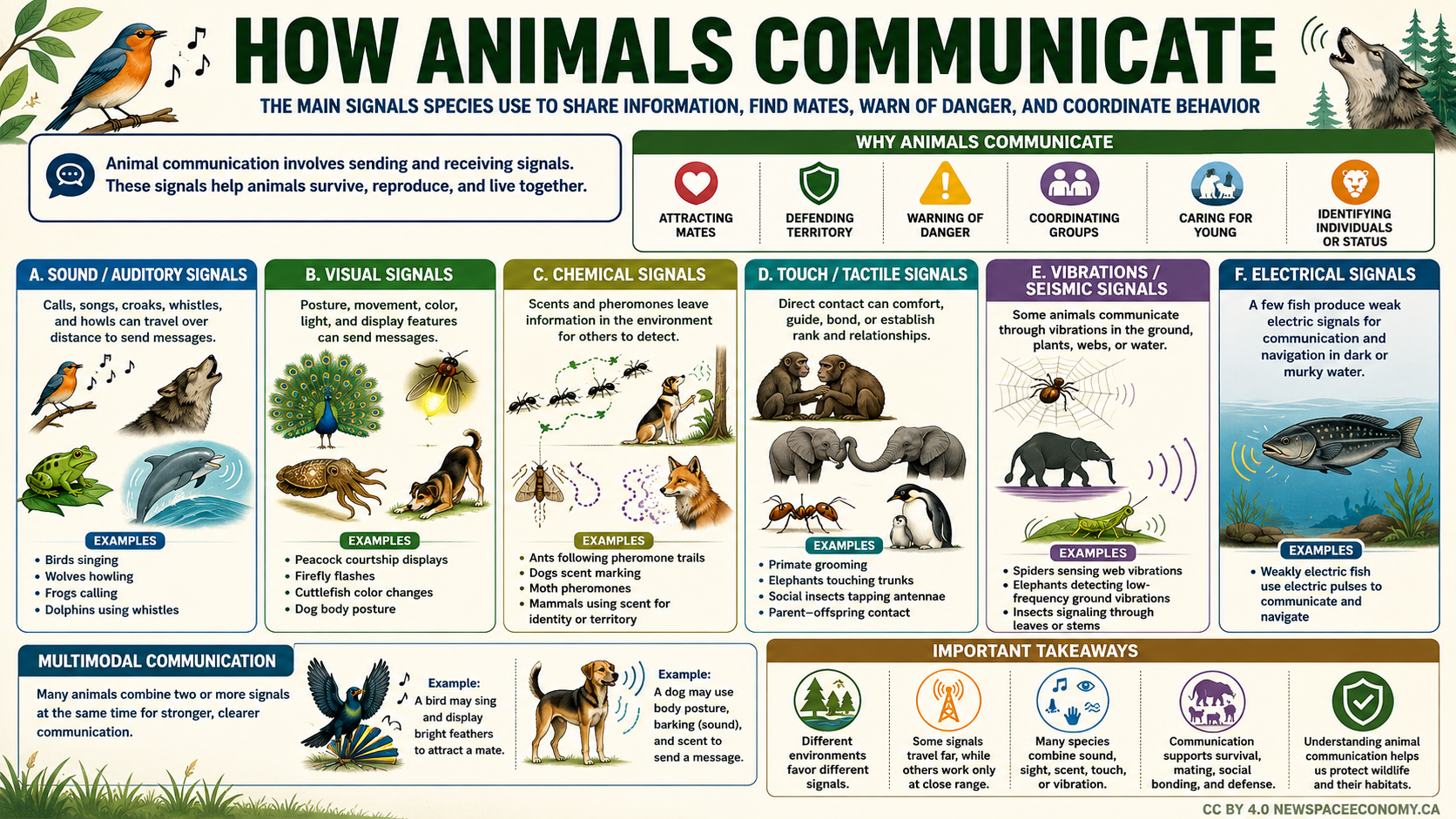
Sound is an obvious entry because it travels through air, water, and solids. On Earth, NOAA Fisheries describes dolphins and porpoises as using squeaks, buzzes, whistles, clicks, and surface slaps. A marine extraterrestrial species living beneath ice or in a global ocean could build complex culture around sound because radio waves do not travel well through seawater. Long-distance low-frequency calls might carry identity, maps, migration instructions, warnings, or ceremonial sequences across vast ocean basins.
Vibration is a related but distinct channel. A creature living in soil, ice, rock, vegetation, or dense fluid might communicate through tremors rather than airborne sound. Earth insects and spiders already use substrate vibrations. An alien civilization descended from burrowers could develop architecture that acts as an instrument: floors, roots, mineral lattices, or artificial membranes carrying civic messages through the ground. Their public announcements might be felt as patterned pressure underfoot.
Color is another powerful biological channel. On Earth, animals use color for warning, camouflage, courtship, identity, and status. A visually dominant alien species could make color grammars far richer than human speech. Skin, feathers, scales, gels, membranes, crystal plates, or engineered surface cells might shift hue, saturation, brightness, polarization, and pattern. A sentence could appear as a moving mosaic across the body.
Motion can become grammar when a species has strong visual perception and bodies designed for display. Courtship dances, threat postures, and social gestures on Earth offer simple analogues. Alien motion-language might use limb angle, body rotation, group choreography, eye orientation, shadow placement, or synchronized flight. A species that evolved in low gravity could use three-dimensional movement with a precision that land animals rarely need.
Chemical signaling may be older and more persistent than sound or vision. Pheromones, as described by American Scientist, are chemical signals exchanged within a species. Alien chemical language could be slow, spatial, and archival. A scent mark might persist for days, seasons, or centuries. A city might smell like a library, with chemical layers encoding ownership, law, history, danger, and invitation.
Touch may dominate communication in dark, crowded, or fluid environments. Tentacles, cilia, antennae, tendrils, root networks, or soft distributed bodies could exchange pressure codes. A tactile language could be private, low-energy, and hard to intercept. It could also support a social order built on physical proximity rather than public broadcast. A species with dense nerve endings across the body might read touch with the clarity humans associate with speech.
Electrical communication is known on Earth. Weakly electric fish produce electric fields for sensing and social interaction, and research published through NIH’s PubMed Central describes how electric fish can use weak fields to communicate with mates and rivals. A water-dwelling extraterrestrial species could expand that channel into a high-bandwidth civic system. Underwater cities might pulse with electric signatures that mark identity, intent, navigation, and social rules.
Magnetic signaling is more speculative as a rich language, but not absurd as a sensory possibility. Some Earth animals appear sensitive to magnetic fields for orientation. An alien species with precise magnetoreception might exchange information through field modulation, mineral structures, or moving conductive fluids. A magnetically active moon or ocean planet could produce natural background patterns that a species learns to imitate, then engineer.
Bioluminescence offers another route. In dark oceans, caves, thick atmospheres, or nightside regions of tidally locked planets, light production could serve as speech. An alien might flash, glow, ripple, dim, or project shapes. Bioluminescent communication could combine color, timing, spatial pattern, and social display. It would be visible at a distance but vulnerable to interception by predators or rivals, which might lead to encrypted flash codes.
Thermal signaling could matter for species that perceive heat with great precision. Earth pit vipers sense infrared radiation, and human technology can image heat. An alien species might use controlled warmth as an emotional, social, or linguistic channel. A warm pulse across a limb might mean approach. A patterned heat trace on a wall might preserve a message. A city’s thermal rhythm could communicate status to distant observers.
Body form itself can communicate. Horns, crests, scars, growth rings, shell pattern, limb count, posture, or artificial ornament can transmit identity, rank, role, age, and history. A slow-growing species might carry autobiographical structure in the body. A social alien could read another’s life record from pattern, surface chemistry, or engineered implants.
The biological dictionary below organizes plausible channels by medium, speed, and human detectability.
| Channel | Likely Strength | Human Detection Problem |
|---|---|---|
| Sound | Strong in air, water, ice, and solids | Meaning depends on context and behavior |
| Color | High bandwidth for visual species | Human eyes may miss polarization or ultraviolet data |
| Chemical Signals | Persistent and useful in complex terrain | Slow signals may look like environmental chemistry |
| Electric Fields | Useful in conductive environments | Requires sensors near the source |
| Touch | Private, precise, and low energy | Remote observers may never detect it |
A biological channel can become technological. Humans turned voice into telephony and radio. A color-speaking species could turn body pattern into optical coding. A chemical species could build atmospheric messaging towers. An electrical species could build conductive networks before inventing radio. An ocean species might reach space late because fire and metallurgy are difficult underwater, but it might achieve rich science through acoustics, pressure engineering, chemistry, and bioelectric control.
This matters for the space economy because detection tools reflect human bias. Radio telescopes, optical observatories, infrared surveys, planetary probes, and sample-return missions each favor certain signatures. New Space Economy’s article on how humans search for extraterrestrial life links this to a broader search architecture, from habitable worlds to technosignatures. A civilization can be communicative and still nearly invisible if its primary channels do not leak into space.
Electromagnetic Communication From Radio to Laser Light
Electromagnetic communication remains the most searched category because it travels through space at light speed, can cross interstellar distances, and can be detected without physical contact. Humans already use radio, microwave, infrared, visible light, fiber optics, radar, and laser communications. An extraterrestrial intelligence with comparable physics could do the same, though its chosen frequencies and signal forms might differ sharply from human expectations.
Radio sits at the center of historical SETI because narrowband radio signals can stand out against many natural sources. Nature produces radio emissions, but extremely narrow, stable, structured signals can suggest engineering. That is why many SETI searches look for narrowband patterns, pulses, frequency drift, and repetition. New Space Economy’s article on the SETI paradox frames the core problem: listening only works if someone transmits in a way the listener can detect.
A radio-using alien society might not broadcast messages intentionally toward young civilizations. Its detectable signals could be leakage from radar, navigation, power transmission, weather control, space traffic management, or planetary defense. Earth’s own powerful radar transmissions would be easier to detect across interstellar distance than ordinary television leakage. That suggests a practical rule: detection may favor infrastructure over conversation.
Microwave signaling could support planetary and interplanetary networks. A civilization with satellites, habitats, mining stations, and probes might build microwave links for communication and power management. Such links could look like brief bursts, narrow beams, or repeating maintenance signals. A distant observer might detect geometry before meaning: a planet, moons, and orbital stations exchanging timed emissions.
Laser communication would offer high data rates, narrow beams, and reduced spread compared with many radio broadcasts. NASA’s Deep Space Optical Communications experiment demonstrated optical communications beyond the Earth-Moon system during the Psyche mission. That human milestone matters because it shows why advanced civilizations might prefer tight optical beams for high-value data. The drawback is detectability. A laser aimed elsewhere is easy to miss.
Infrared communication could emerge from species adapted to heat sensing or from machine systems operating in dust, darkness, or planetary atmospheres. Infrared beams may pass through some environments better than visible light. An alien city could use infrared for local communication, navigation, or machine coordination. Humans might confuse such emissions with waste heat unless the timing, modulation, or geometry looks artificial.
Ultraviolet communication could be useful in thin atmospheres or for species whose vision extends beyond human color range. Many Earth animals perceive ultraviolet patterns. A civilization with ultraviolet-sensitive biology might make ultraviolet writing, displays, and signaling systems. Space-based sensors could detect unusual ultraviolet modulation from spacecraft or orbital platforms.
X-ray and gamma-ray communication would be dangerous and technically demanding, but advanced machines might use high-energy photons for narrow, penetrating signals. Such channels could cross dusty regions or operate near high-energy astrophysical environments. The energy cost and biological risk would make them unlikely for ordinary social communication, but they could serve specialized beacons, defense warnings, or machine-to-machine links in extreme settings.
Polarization adds another entry. Light waves can carry information in their polarization orientation. Some Earth animals detect polarization, and human technology uses polarization in optics and communications. An alien species might encode identity, direction, or emotional state in polarized light. Humans could miss the message if sensors record brightness but not polarization.
Frequency hopping, spread spectrum, and encryption complicate detection. Advanced societies may avoid simple beacons because simple beacons waste energy, invite interception, or fail privacy tests. Their communications may resemble noise unless the receiver knows the code. A galaxy could contain many signals that are technically detectable but practically unreadable.
A signal dictionary also needs to treat beacons separately from conversation. A beacon is designed to be found. Conversation is designed to serve participants. A beacon might use prime numbers, hydrogen-line symbolism, repeated geometry, or broad sky coverage. A conversation might use tight beams, compression, and encryption. SETI has a better chance with beacons than ordinary alien internet traffic.
This distinction connects to the Fermi Paradox. Silence may not mean absence. It may mean private channels, short transmission windows, weak leakage, incompatible timing, low incentives to broadcast, or communication systems that do not radiate much energy into space. A mature civilization might grow quieter as it grows more efficient.
Communication Through Matter, Artifacts, and Engineered Environments
Communication does not require a wave moving through space. A civilization can communicate by arranging matter. Humans use books, monuments, maps, fossils, spacecraft plaques, barcodes, machine parts, architecture, and data storage media. Alien communication through matter may outlast speech, radio, and even biological bodies.
Artifacts are the most durable entry in this dictionary. A manufactured object placed on a moon, asteroid, comet, or stable orbit could function as a message. Its material composition, symmetry, isotopic pattern, machining precision, internal structure, and location could show intent. New Space Economy’s article on whether a lunar artifact could prove extraterrestrial intelligence makes this point in a space-economy context. A confirmed artifact would convert exploration into preservation, verification, and international site management.
A message could be encoded in geometry. The sender might arrange objects in prime-number sequences, nested solids, star maps, orbital resonances, or mathematical constants. Geometry has appeal because it can cross biology. A triangle does not require human culture. Yet geometry still does not guarantee shared interpretation. The receiver must infer which features are intentional and which are structural.
Matter-based communication could also use isotopes. A civilization might alter isotope ratios in a rock, ice sheet, ring system, or planetary atmosphere. Some ratios would be hard to explain naturally. If arranged in layers, patterns, or repeated ratios, they could serve as a slow record. This kind of message might be designed for geological time rather than conversation.
Synthetic molecules could carry information. Human DNA stores biological information; human laboratories can store digital data in molecules. Alien biology or technology might encode messages in polymers, crystals, proteins, mineral defects, or artificial cells. A message capsule could contain molecular libraries readable by chemistry rather than radio astronomy.
Architecture can communicate with inhabitants and observers. City layout, transport networks, orbital mirrors, energy collectors, and large-scale land art could encode social organization or intentional display. A distant telescope may detect only an artificial light curve, but a close probe might find roads, symbols, repeating modules, or alignment with astronomical events.
Planetary engineering could serve as communication. A civilization might alter albedo, atmosphere, night-side lighting, vegetation pattern, or orbital debris distribution. Some technosignature discussions include megastructures and waste heat because large energy use may leave signatures detectable across distance. Yet a planet can be engineered for local needs without any intent to message outsiders.
Machines may communicate through maintenance patterns. A probe left in the Solar System could broadcast rarely, open panels, change orbit, flash reflectors, emit heat, or release marker particles. Such actions might form a message through behavior, not language. The difficult task would be distinguishing message, malfunction, autonomy, and environmental response.
Biological artifacts may blur life and message. A civilization could seed engineered organisms as carriers of encoded memory. The organisms might replicate, adapt, and preserve fragments of the sender’s information. This idea raises hard ethical and scientific issues. A living message could mutate. It could also disturb local biospheres. Any claimed biological artifact would need careful chain-of-custody science, not public excitement alone.
Matter-based messages may be attractive for civilizations that think on long time scales. Radio signals pass and fade. Laser beams miss. Artifacts wait. A species expecting million-year gaps between readers might place message objects in stable environments: lunar lava tubes, Trojan asteroids, outer-planet moons, deep ice, or interstellar objects.
The strongest material message would combine redundancy. Shape, material, isotopes, internal code, location, and active signal could all point toward the same conclusion. Redundancy would matter because future readers may lack the sender’s assumptions. Humans face this problem when designing long-term nuclear-waste warning markers. Alien senders would face it at much larger scales.
Mental, Neural, and Consciousness-Based Possibilities
Mental communication is the most culturally familiar and scientifically uncertain category. Many stories imagine telepathy, shared dreams, group minds, psychic fields, or direct transfer of thought. No verified human evidence establishes telepathy as a physical communication channel. For extraterrestrial intelligence, mental communication belongs in the speculative part of the dictionary unless tied to a plausible mechanism such as electromagnetic neural interfaces, chemical coupling, sound-based entrainment, or engineered brain-to-brain systems.
A biological group mind could still exist without magic. Colonial organisms on Earth show that a single living system can distribute function across many bodies or cells. Social insects show how individual agents can create collective behavior through local rules. A highly social alien species might share cognition through constant sensory exchange, pheromonal state, touch networks, electrical coupling, or environmental memory. The result could look mental from the outside even if the mechanism is physical.
Brain-to-brain technology offers a more plausible path. A civilization could invent neural implants that encode perception, memory, intent, or emotion into signals. Those signals could move by radio, optical fiber, ultrasonic links, conductive touch, or chemical interfaces. Members of that society might experience communication as direct thought, though the underlying system would remain technological.
Dream communication is another speculative entry. A species with synchronized sleep cycles and strong social neurobiology might exchange information during sleep through touch, scent, low-frequency sound, or electromagnetic stimulation. That could create a culture where major decisions occur through shared dream states. Humans might mistake such communication for ritual if they saw only the external behavior.
Emotion channels may precede symbolic language. An alien species could transmit fear, attraction, trust, anger, curiosity, pain, or social belonging through hormones, field patterns, skin states, or neural synchronization. Such communication might be rich but hard to translate into sentences. A society could be highly intelligent without separating feeling from information in the human manner.
Memory sharing would transform culture. If individuals can transfer memories directly, education, law, art, and history may operate differently. A witness could share experience instead of giving testimony. A child could receive ancestral navigation memories. A scientist could transmit failed experiments as felt events. Accuracy would still be a problem because memory can distort, compress, and merge.
A collective intelligence could use individuals as temporary nodes. Messages might not pass between stable persons. Instead, they might pass through a group state that forms when many bodies connect. The communicating unit would be the assembly. Humans studying such a species might struggle because the individual organism would not contain the full language.
Machine intelligence expands the mental category. A digital civilization could duplicate minds, merge processes, fork identities, and synchronize memory. Communication may become less like talking and more like state alignment. Two machine minds might exchange models, run simulations of each other, compare compressed world-states, and resolve differences through computation.
Quantum consciousness should be treated with caution. Quantum physics is real, and quantum communication is an active field, but quantum entanglement does not provide a simple faster-than-light messaging system. Claims about alien telepathy through entanglement need evidence and a mechanism. A careful dictionary can list quantum-assisted communication as speculative engineering, not mystical certainty.
A more grounded possibility is ultra-high-bandwidth sensory sharing. An alien species with many sensory channels could exchange internal states in dense streams. To humans, that might appear like telepathy because there would be little visible action. The real signals could be micro-color changes, skin voltage, pressure waves, pheromone pulses, or implant transmissions.
Mental communication also raises social risks. Privacy may mean little in a species that evolved with shared states. Deception might be hard, or it might take forms humans cannot recognize. Individual rights, legal responsibility, consent, memory ownership, and identity would all look different. A message from such a species could carry assumptions that humans would misread at the deepest level.
Mathematical, Symbolic, and Machine Languages
Mathematics is often proposed as a bridge because many mathematical relations are not local cultural inventions. Prime numbers, ratios, geometry, periodicity, and physical constants could help identify intelligence. Yet mathematics is a detection aid more than a full language. A sequence of primes can say, “this is artificial.” It does not say who sent it, what they value, or what they want.
Symbolic communication requires shared reference. Humans can draw a hydrogen atom or encode a pulsar map because they assume another scientific civilization might recognize physics. That assumption may work better for technology than for culture. The laws of physics are shared. The meanings attached to family, obligation, humor, beauty, grief, law, trade, or danger are not.
A mathematical message could begin with counting, then build toward operations, geometry, chemistry, astronomy, and biology. Human attempts at interstellar messaging have often used this ladder. Daniel Oberhaus’s Extraterrestrial Languages examines this history through philosophy, linguistics, mathematics, and science. The recurring hope is that structure can bootstrap meaning.
Machine languages may be more common than biological languages in detectable space. Spacefaring civilizations need automation, probes, navigation systems, error correction, compression, encryption, and timing standards. Much of their traffic may be machine-to-machine. Humans might detect packets, handshakes, synchronization tones, routing beacons, or maintenance signals long before encountering poetry.
A digital civilization may treat language as model exchange. Instead of sending words, it may send simulations, causal graphs, compression dictionaries, training data, or executable environments. A message could contain a miniature world rather than a text. The receiver would have to run, inspect, and safely isolate it, much like handling unknown software.
Compression creates a problem for detection. Highly compressed information can resemble noise. Encryption worsens the problem. A secure alien network could fill space with signals that reveal bandwidth, direction, and timing but hide meaning. Humans may identify technology through metadata: repetition, alignment, source motion, spectral purity, or unnatural scheduling.
Error correction could offer clues. Messages across interstellar distances face noise, dispersion, interference, and time delay. A designed signal may include redundancy, checksums, repeated blocks, framing sequences, or training patterns. SETI algorithms often search for such structure. Yet the absence of simple structure does not prove absence of intelligence.
Mathematical aesthetics might differ. Humans often expect elegance: primes, Fibonacci patterns, circles, and constants. Aliens may prefer optimization patterns tied to their world: turbulence, chemistry, orbital mechanics, biological rhythms, or computational constraints. Their “obvious” greeting may be obscure to humans.
A symbol dictionary may include icons, topological forms, knots, rhythm trees, color maps, molecule chains, or orbital patterns. It may also include absence. Silence, delay, omission, blank intervals, and withheld response can carry meaning in human societies. An alien communication system may treat timing gaps as grammatical units. Interstellar delay makes this more likely, since time itself becomes part of message structure.
Machine translation after contact would require data. A single message is rarely enough. The strongest path to meaning would come from repeated signals tied to observable behavior: a probe changes direction after a pulse; a beacon shifts when a planet rotates; a message repeats during stellar events. Meaning comes from correlation between signal and world.
New Space Economy’s treatment of first contact within the Solar System emphasizes this gap between detection and meaning. A local artifact or probe could provide more context than a distant radio burst because humans could observe behavior, environment, materials, and possible response patterns. Close contact improves data but raises security, scientific, and governance problems.
Environmental and Planetary Communication Systems
Some communication may be environmental rather than individual. A civilization could use the planet itself as part of its signaling system. Atmosphere, ocean, ice, magnetosphere, clouds, biota, orbital debris, surface reflectivity, and heat flow could all carry information if the sender can shape them with precision.
Atmospheric communication might use controlled aerosols, trace gases, cloud patterns, or engineered auroras. A species with strong atmospheric science could write in its sky. Seasonal patterns might encode calendars, political states, warnings, or religious events. From Earth, unusual atmospheric chemistry might appear as a biosignature, technosignature, or geophysical anomaly depending on context.
Ocean communication could use waves, currents, salinity gradients, pressure pulses, plankton blooms, or bioluminescent fields. A world with a global ocean might develop civilization without fire, metal smelting, or radio at the surface. Its communication could be rich inside the ocean but nearly invisible from space. If the ocean sits beneath ice, detection becomes harder.
Ice communication could exploit sound, stress fractures, light scattering, embedded crystals, or thermal pulses. A species living under ice might use the shell as a resonator. Messages could move for long distances through the ice, as coded cracking or vibration. Human probes might interpret such signals as geology unless patterns repeat with unnatural timing.
Magnetospheric communication would require advanced control over charged particles and fields. A civilization around a magnetic planet might create auroral patterns or field disturbances visible from space. The signal would be large and energy-intensive, so it might serve ceremony, warning, navigation, or interplanetary marking rather than casual conversation.
Orbital communication could use satellites, reflectors, mirrors, occulting screens, or artificial transits. A civilization might arrange objects so that distant observers see repeated dimming, glints, or spectral changes. Unlike radio, orbital communication can be passive after construction. The message sits in motion and repeats through celestial mechanics.
Ecological communication could use living systems. A planet-spanning biological network might alter color, reflectivity, smell, heat, or electrical state in response to social inputs. Forests, reefs, microbial mats, or artificial biofilms could function as public displays. Such communication could be slow but visible at planetary scale.
Geological communication is stranger but possible for long-lived beings. A civilization could carve plates, move rocks, seed crystals, or build mineral strata. This would be slow communication for future readers, not ordinary dialogue. Its natural analogue is the fossil record, which communicates without intent. A technological species might design a fossil record with intent.
Environmental communication would produce ambiguous evidence. Planetary processes can mimic pattern. Weather creates shapes. Geology creates repetition. Biology creates structure without technology. A reliable claim would need multiple lines of evidence: unnatural periodicity, artificial materials, synchronized signals, improbable geometry, or direct association with other artifacts.
This category matters because humans increasingly search exoplanets through remote sensing. Space telescopes may detect atmospheres, reflected light, thermal emission, and orbital patterns before they detect messages. A communication system built into a planet may appear in data as an anomaly. The interpretation could stay uncertain for years.
Social, Ritual, and Collective Communication
Communication is more than signal transfer. It also organizes society. Human language carries law, myth, memory, trade, identity, humor, kinship, hierarchy, science, and art. Alien communication would do the same in alien forms. A dictionary that lists media but omits social function remains incomplete.
Ritual communication may be central for long-lived or group-oriented species. Repeated displays, migrations, synchronized pulses, chemical releases, song cycles, or orbital alignments could preserve shared identity. The signal’s purpose may be less about new information than social bonding. Humans might misread such displays as navigation, mating, or malfunction if they lack cultural context.
Status communication could be embedded in body pattern, signal frequency, permitted colors, scent mixtures, network privileges, orbit access, or memory rights. A society that shares mental states may mark status through openness or filtering. A machine society might mark status through processing priority, copy rights, or access to protected models.
Legal communication may appear as environmental markers. Instead of written law, an alien society could encode permissions in architecture, field patterns, chemical boundaries, or machine-readable tags. An outsider might cross a boundary without knowing that a message was present. This is one reason contact protocols would need patience.
Economic communication may not use money in a human form. A species could signal obligation through stored energy, nutrient flows, attention credits, computation cycles, reproductive permission, or access to shared memory. A spacefaring civilization might encode trade through docking rights, orbital slots, spectrum allocation, and energy exchange.
Artistic communication could be difficult to recognize. Humans identify art through context, craft, repetition, and cultural framing. Alien art might be a scent, a temperature gradient, a gravitational choreography, a controlled storm, a silence pattern, or a simulated mind-state. The line between art, engineering, ritual, and language may not exist in the same place.
Education would reveal much about communication if humans could observe it. Young members learning signal systems would produce repetition, correction, play, and simplified forms. Animal communication studies often depend on context because meaning appears through behavior. The same principle would apply to alien societies.
Conflict communication may include warnings, deception, camouflage, spoofing, jamming, silence, mimicry, and false beacons. Human military and cybersecurity experience shows that intelligent communication systems develop adversarial forms. Alien systems would likely include authentication and trust controls if deception exists in their world.
Diplomatic communication between alien societies could be slower and more formal than human speech. Interstellar delay may favor treaties encoded in artifacts, shared ephemerides, autonomous agents, or long-cycle beacons. A reply might take decades or centuries. Civilizations may communicate more through stable protocols than conversation.
New Space Economy’s work on controversial theories about extraterrestrial intelligence is relevant because many ideas about alien communication mix science, speculation, culture, and belief. A strong dictionary marks uncertainty and avoids turning cultural preference into evidence.
Exotic Physical Channels and Their Limits
A serious dictionary should include exotic physical channels, but it must label them carefully. Neutrinos, gravitational waves, plasma structures, quantum links, and stellar engineering may all appear in discussions of advanced communication. Some are physically real but inefficient. Some are plausible only for machines far beyond human capability. Some are popular in fiction but lack a demonstrated communication mechanism.
Neutrino communication is attractive in theory because neutrinos pass through matter with little interaction. That same property makes them hard to generate and detect. A neutrino message could pass through planets, stars, and dust, but the infrastructure would be enormous by human standards. Such a system might serve specialized links between dense environments, hidden bases, or deep interiors, not ordinary public communication.
Gravitational-wave communication would be even more demanding. The LIGO Scientific Collaboration describes gravitational waves as ripples that travel at light speed and carry information about their sources. Natural gravitational waves come from massive accelerating bodies such as merging black holes or neutron stars. Engineering a controlled gravitational-wave transmitter would require energies and masses far beyond known human technology.
Plasma communication could matter near stars, magnetospheres, or engineered fusion systems. Charged particles can form waves, filaments, and structures. A civilization comfortable with stellar environments might modulate plasma for local signaling, propulsion coordination, or industrial control. Remote detection would be difficult because stars and magnetospheres are noisy.
Stellar communication imagines a civilization using its star as a signal source. It might modulate starlight through orbiting structures, energy collectors, lasers, or controlled transits. Such signals could be visible across interstellar distance if large enough. The difficulty is separating intentional modulation from planets, dust, starspots, and natural variability.
Black-hole communication appears in some advanced speculation. A civilization might use black holes as energy sources, clocks, gravitational anchors, or extreme computing sites. Signals near black holes would face distortion, time dilation, and hard engineering constraints. A black-hole communication system would be a sign of technological capability far beyond current human practice.
Quantum communication is real in human laboratories and networks, but quantum entanglement does not give a simple shortcut around light-speed limits. Advanced civilizations might use quantum methods for security, synchronization, sensing, or distributed computation. A cautious dictionary should not treat quantum language as instant telepathy.
Dark matter or dark energy communication belongs at the far speculative edge. Humans do not know how to manipulate dark matter or dark energy for information transfer. A civilization that could do so would be operating beyond known engineering. Such a channel could be undetectable to current instruments, but that statement says more about human ignorance than alien practice.
Artificial particle beams could carry information through charged particles, neutral atoms, antimatter, or dust streams. These systems would be slower, more massive, and more detectable than photons, but they could deliver physical samples. A matter beam can carry both message and material. It can also be dangerous.
Time-based communication may exploit predictability rather than exotic physics. A civilization could encode meaning in the timing of events: when a beacon turns on, when an object transits a star, when a pulse arrives relative to a pulsar, or when a probe wakes. Timing is a universal resource because astronomy supplies clocks.
The exotic dictionary is valuable because it prevents radio-only thinking. It is also dangerous because it can turn absence of evidence into limitless speculation. A careful approach ranks channels by known physics, detectability, energy cost, and plausible motivation. Radio and optical signals remain high-value search targets because they are physically efficient and already used by humans. Gravitational waves and neutrinos remain conceptually interesting but costly.
Detection, Translation, and Misinterpretation
Humanity’s central problem is not a shortage of possible communication channels. The problem is separating signal from noise, technology from nature, message from artifact, and meaning from projection. A galaxy full of alien communication could remain hard to understand if the channels are narrow, private, compressed, encrypted, slow, local, or tied to senses humans lack.
Detection is the easiest layer. A telescope, probe, spectrometer, antenna, seismometer, chemical sensor, magnetometer, or camera can record anomalies. A signal becomes more interesting when it repeats, carries structure, tracks an object, resists natural explanation, or appears in more than one instrument. Even then, instrument error, human interference, satellites, aircraft, software faults, and natural events must be ruled out.
Translation needs context. A message with no shared referents is hard to parse. Animal communication research shows why. Humans can record whale song, dolphin whistles, bird calls, pheromone trails, and electric fish pulses, yet meaning often depends on behavior, social setting, environment, identity, and timing. New Space Economy’s article on human attempts to communicate with animals makes that analogy directly relevant to extraterrestrial contact.
Misinterpretation can come from human expectation. Humans may look for greetings, warnings, maps, numbers, or faces because those are familiar. An alien signal may encode maintenance data, ritual order, legal status, machine synchronization, ecological state, or a joke. Human receivers may impose narrative where none exists.
False positives are a permanent risk. The Breakthrough Listen candidate signal known as BLC1, detected toward Proxima Centauri, attracted attention because it had features broadly consistent with a possible technosignature, but later analysis attributed it to local interference. That case is useful because it shows how disciplined skepticism protects SETI from wishful interpretation.
A signal’s medium can bias interpretation. Radio feels technological to humans. Chemicals feel biological. Geometry feels intentional. Motion feels behavioral. These associations may fail. A biological species could produce radio-like electric structures. A machine could use chemical signaling. A natural process could create geometry. An artifact could be accidental debris from a machine culture with no message intent.
Translation may require interaction. If a sender responds to a change in receiver behavior, meaning can emerge through experiment. This is how humans learn to communicate with animals and machines. Yet interaction with extraterrestrial intelligence raises safety and governance concerns. Replying to a signal is not just a scientific act. It is a political act with planetary consequences.
The International Academy of Astronautics and SETI communities have long discussed post-detection issues, but no single global authority controls Earth’s response. New Space Economy’s coverage of Earth’s reaction to extraterrestrial intelligence captures the institutional problem. Reliable data would matter more than speed. Verification, transparency, and restraint would shape public trust.
Machine learning may help detect patterns, but it cannot supply meaning by itself. A model can cluster signals, identify anomalies, compare patterns, and simulate possible grammar. It can also overfit noise. Alien communication would need interdisciplinary interpretation across astronomy, linguistics, biology, computer science, anthropology, physics, chemistry, law, and security.
A responsible dictionary ends with humility. Humans may detect a channel that no human language can describe cleanly. A signal may be real and still unreadable. A message may be readable and still misleading. A civilization may be communicative and still silent to us. The next step is not to choose one favorite channel. It is to widen the search without loosening standards of proof.
Summary
Extraterrestrial intelligence could communicate through sound, vibration, color, motion, chemicals, touch, electricity, magnetism, bioluminescence, thermal pattern, radio, laser light, particles, artifacts, orbital structures, planetary engineering, neural links, machine protocols, or collective behavior. Some channels are grounded in Earth biology. Some are grounded in human engineering. Others remain speculative because they require abilities humans have not demonstrated.
The most plausible alien communication systems would reflect environment before philosophy. Ocean species may favor acoustics, pressure, chemistry, and electricity. Visual species may build color and motion grammars. Machine civilizations may use compressed, encrypted model exchange. Long-lived societies may prefer artifacts and orbital markers. Planet-scale societies may communicate through environmental state.
The hardest part for humans would be meaning. SETI can search for structure, repetition, and technosignatures, but a detected signal does not automatically reveal language. Earth’s animals already show that communication can be obvious in form and difficult in meaning. A careful approach treats every channel as a hypothesis, every anomaly as provisional, and every claimed message as a testable problem rather than a story waiting to be believed.
Appendix: Useful Books Available on Amazon
- Contact
- The Eerie Silence
- Extraterrestrial Languages
- The Zoologist’s Guide to the Galaxy
- The Cosmic Zoo
Appendix: Top Questions Answered in This Article
Could Extraterrestrial Intelligence Communicate Through Telepathy?
Telepathy has no verified scientific basis in human research, so it should be treated as speculative. A more plausible version would involve biological or technological brain-to-brain links, such as neural implants, electromagnetic interfaces, chemical coupling, or shared machine networks. Such communication might feel direct to its users without requiring a supernatural mechanism.
Why Does SETI Focus So Much on Radio Signals?
Radio signals can cross interstellar distances, can be detected by large antennas, and can stand out when they are narrow, structured, and stable. SETI does not assume every alien civilization uses radio for ordinary life. Radio remains attractive because it is physically efficient, searchable, and already used by human technology.
Could Aliens Communicate With Color Instead of Speech?
A visually oriented alien species could use color as a rich language. Color signals might include hue, brightness, pattern, polarization, timing, and movement. Humans might miss much of that language if it occurs outside visible light or uses visual dimensions that human eyes do not naturally detect.
Could Chemicals Serve as an Alien Language?
Chemical communication could support identity, territory, memory, warning, law, or social bonding. It would likely be slower than speech but more persistent. On an alien world, chemical layers in air, water, soil, or biological surfaces could function like signs, records, and social messages.
Could an Alien Civilization Communicate Through Artifacts?
Artifacts may be among the most durable communication methods. A constructed object on a moon, asteroid, or stable orbit could wait for future discovery. Its material, structure, geometry, isotopic pattern, and placement could signal intelligence even if its message remained difficult to translate.
Would Alien Machines Communicate Differently From Biological Beings?
Machine intelligence may communicate by exchanging models, memory states, software updates, compressed data, or simulations. Such signals might resemble noise if compressed or encrypted. Humans could detect timing, source motion, or network structure before understanding content.
Could Gravitational Waves Be Used for Communication?
Gravitational waves are physically real, but engineering them as a communication channel would require extreme energy and mass control by current human standards. They remain an exotic possibility for very advanced systems. Radio, optical, and material signaling remain more plausible for near-term SETI searches.
Why Would Aliens Hide or Encrypt Their Communications?
Privacy, security, efficiency, and ordinary engineering could all lead to narrow, compressed, or encrypted communication. A civilization does not need to be secretive to be hard to detect. Efficient networks often reduce leakage, and mature systems may use tight beams rather than broad broadcasts.
Could Humans Translate a Single Alien Message?
A single message might prove intelligence if it contains strong structure, but translation would be difficult without context. Meaning improves when signals repeat, connect to observable behavior, or include self-describing patterns. Interaction, redundancy, and shared physical references would improve the odds of understanding.
Could Alien Communication Already Exist Without Human Detection?
Yes. Communication could be local, weak, narrow, encrypted, slow, biological, chemical, electrical, or aimed elsewhere. It could also occur in media humans rarely search. Absence of detection does not prove absence of communicative intelligence, but it does require caution before making claims.
Appendix: Glossary of Key Terms
Bioluminescence
Bioluminescence is light produced by living organisms through chemical reactions. On Earth, it appears in many marine organisms, fungi, and insects. In an alien communication system, controlled flashes, colors, timing, and spatial patterns could carry identity, warning, courtship, or social information.
Biosignature
A biosignature is evidence that may indicate life, such as atmospheric chemistry, surface pigments, minerals, organic molecules, or biological structures. Biosignatures do not necessarily imply intelligence. A planet may show life signs without showing technology, language, or civilization.
Electrocommunication
Electrocommunication is information exchange through electric fields or pulses. Weakly electric fish on Earth provide a biological example. In an alien ocean or conductive environment, electrical signaling could develop into a complex language or technological network.
Extraterrestrial Intelligence
Extraterrestrial intelligence means intelligent life originating beyond Earth. It could be biological, machine-based, collective, post-biological, or something harder to classify. The term does not assume confirmed contact, known motives, humanoid bodies, or human-like language.
Fermi Paradox
The Fermi Paradox describes the tension between the vast number of potential life-bearing worlds and the lack of confirmed evidence for extraterrestrial civilizations. Communication choices, detectability limits, short signal windows, and non-radio channels are possible parts of the explanation.
Machine-To-Machine Communication
Machine-to-machine communication is data exchange between automated systems without direct biological conversation. In an alien civilization, most detectable traffic may come from probes, satellites, factories, networks, or navigation systems rather than living speakers.
Pheromone
A pheromone is a chemical signal used between members of the same species. Pheromones can carry information about mating, territory, alarm, trails, or social state. Alien chemical languages could expand this principle into persistent environmental messaging.
Technosignature
A technosignature is evidence that may indicate technology. Examples can include unusual radio signals, laser pulses, waste heat, artificial atmospheric chemicals, engineered objects, or orbital structures. A technosignature may prove technology before revealing any readable message.
SETI
SETI means the Search for Extraterrestrial Intelligence. It includes scientific efforts to detect signs of intelligent life beyond Earth, often through radio, optical, infrared, and other technosignature searches. SETI looks for evidence, not folklore or assumption.
Signal
A signal is a structured change in a medium that can carry information. Signals can use sound, light, chemicals, motion, heat, electric fields, radio waves, or matter. A signal becomes language only when a community shares rules for meaning.