- How the Russia US Escalation Timeline Entered Its Present Phase
- Russia US Escalation Timeline at a Glance
- Detailed Timeline of the Escalation
- August 11, 2026: Ukraine Publicly Warns of Russian Mobilization Preparations
- August 24, 2026: Russia Expands Government Control Over Infrastructure Protection
- August 24, 2026: Reports Reveal Mobilization Readiness Exercises
- August 25, 2026: CIA Director John Ratcliffe Makes an Unannounced Moscow Visit
- August 25, 2026: E-6B Mercury Flights Fuel Nuclear Speculation
- August 26, 2026: Moscow Confirms Ratcliffe Met Russian Intelligence Officials
- August 26, 2026: NATO’s Arctic Sentry Activity Becomes More Visible
- August 27, 2026: Reporting Says Ratcliffe Warned Russia Against Attacking NATO
- August 27, 2026: Russia Threatens British Military Targets Beyond Ukraine
- August 27, 2026: Russia Launches a Large Missile and Drone Attack Across Ukraine
- Patterns Driving the Escalation
- Turning Points That Changed the Meaning of the Crisis
- Russia US Escalation Status as of August 27, 2026
- What Could Change the Russia US Escalation Timeline Next
- Summary
How the Russia US Escalation Timeline Entered Its Present Phase
On August 24, 2026, Russian President Vladimir Putin signed Decree No. 604, giving the Russian government expanded authority to place privately controlled infrastructure under temporary state management when authorities judge security, restoration, or protection measures inadequate. The order covers sectors including energy, transportation, communications, industry, utilities, and nuclear facilities. Moscow presented the measure as a response to growing threats against Russian infrastructure, including drone attacks.
That administrative action coincided with reporting that Russian military authorities had rehearsed procedures for another possible mobilization. The Wall Street Journal reported exercises intended to test whether the Russian military and regional authorities could house, feed, equip, arm, and process a large influx of personnel if the Kremlin ordered another call-up. One area linked to these preparations was Kaliningrad, Russia’s heavily militarized exclave between Poland and Lithuania. No public Russian decree initiating another mass mobilization had appeared by August 27.
Those developments might have remained another episode in the long Russia-Ukraine war had CIA Director John Ratcliffe not made an unannounced trip to Moscow on August 25. Reuters confirmed Ratcliffe’s visit and subsequent Russian statements confirmed that he met Russian intelligence officials. The trip marked the highest-profile publicly known CIA visit to Moscow since William Burns traveled there in November 2021 before Russia’s full-scale invasion of Ukraine. The Kremlin later confirmed that President Putin did not personally attend Ratcliffe’s meeting but received a briefing afterward.
At roughly the same time, civilian flight trackers drew attention to several U.S. Navy E-6B Mercury aircraft operating over the United States. Because the E-6B supports American nuclear command, control, and communications, its appearance generated speculation that Washington might have changed its nuclear posture. Public evidence available through August 27 does not establish such a change.
The U.S. Navy describes the E-6B as a survivable airborne communications relay and strategic command post connecting national command authorities with elements of the nuclear force. Its missions include Take Charge and Move Out, commonly called TACAMO, and Looking Glass. The aircraft can support communications with ballistic-missile submarines and the airborne launch-control system associated with land-based intercontinental ballistic missiles. The Navy maintains operational squadrons and training infrastructure for these missions, meaning flight activity is inherent to sustaining readiness.
New Space Economy examined the aircraft activity and the Ratcliffe mission as a combined escalation-management problem in its coverage of the CIA Moscow visit and E-6B flights. The episode also fits a broader pattern in which military communications, satellite networks, intelligence collection, cyber operations, and conventional forces increasingly overlap. Related New Space Economy coverage of the military space warfare market examines how commercial and government space infrastructure has become intertwined with defense operations.
By August 27, the Russia US escalation timeline had developed into a combination of conventional warfare, military preparedness, intelligence diplomacy, NATO deterrence messaging, Russian mobilization planning, and increasingly direct threats involving NATO members. None of the verified information available by that date demonstrates that Russia or the United States had begun preparing for nuclear war. The record does show that both sides were paying greater attention to scenarios in which the war in Ukraine could spill into a direct Russia-NATO confrontation.
Russia US Escalation Timeline at a Glance
The chronology below separates confirmed events from reported assessments and future possibilities.
| Date Or Period | Milestone | Significance |
|---|---|---|
| August 11 | Ukraine Warns of Russian Mobilization Plans | Kyiv says Moscow may seek hundreds of thousands of additional personnel after September elections. |
| August 24 | Putin Signs Decree No. 604 | Russia expands state powers over infrastructure security and wartime resilience. |
| August 24 | Mobilization Exercises Reported | Exercises test Russia’s ability to absorb large numbers of recruits. |
| August 25 | Ratcliffe Travels to Moscow | CIA director opens a rare intelligence channel with Moscow. |
| August 25 | E-6B Activity Draws Attention | Nuclear-command aircraft flights fuel speculation but prove no alert change. |
| August 26 | Kremlin Confirms Intelligence Talks | Putin receives a briefing after Ratcliffe meets Russian intelligence officials. |
| August 26 | Operation Atlantic City Begins | U.S., British, and Norwegian forces train on Jan Mayen under Arctic Sentry. |
| August 27 | CIA Warning Details Emerge | Reporting says Ratcliffe warned Russia against attacking NATO members. |
| August 27 | Russia Expands Its Threat Toward Britain | Moscow says British military assets could face retaliation beyond Ukraine. |
| August 27 | Large Russian Strike Hits Ukraine | Missiles and drones strike Kyiv and other Ukrainian cities. |
Detailed Timeline of the Escalation
August 11, 2026: Ukraine Publicly Warns of Russian Mobilization Preparations
Ukrainian President Volodymyr Zelenskyy said on August 11 that Moscow appeared to be preparing another mobilization campaign after Russia’s September parliamentary elections. Reuters reported that Zelenskyy linked the possible call-up to the period following the elections, and Ukrainian officials said they had reviewed information they believed indicated preparations for hundreds of thousands of additional personnel.
The claim originated with the Ukrainian government and requires that qualification. Moscow had not announced such an operation, and Russian officials had not issued another compulsory mass-mobilization decree as of August 27.
Related information from the Foreign Intelligence Service of Ukraine said Russia’s 2026 contract-recruitment program sought 409,000 personnel. As of early July, the service estimated that approximately 195,000 had been recruited against a planned figure of 204,500 at that stage of the year. Those numbers concern contract recruitment rather than a new compulsory mobilization and should not be treated as interchangeable.
Mobilization matters beyond the raw personnel count. A Russian decision to call up hundreds of thousands of additional people could support replacement of battlefield losses, creation of new formations, reinforcement of reserves, or preparation for a longer war. Its strategic meaning would depend heavily on where those troops trained and deployed.
Personnel intended primarily for eastern and southern Ukraine would point toward continuation or expansion of the existing war. Large new formations oriented toward Belarus, Kaliningrad, the Baltic frontier, or Russia’s northwestern military districts would carry a different implication for NATO.
August 24, 2026: Russia Expands Government Control Over Infrastructure Protection
Putin signed Decree No. 604 on August 24. The Kremlin described the measure as addressing the security of Russian infrastructure. The order allows temporary state management when authorities decide that responsible owners or operators have failed to provide adequate protection or restoration.
The measure followed repeated Ukrainian drone attacks against Russian energy, industrial, transportation, and military-support facilities. Administrative preparation of this type can be understood as part of Russia’s adaptation to a prolonged war in which infrastructure deep inside the country is increasingly exposed to attack.
The decree is not equivalent to national martial law or mass mobilization. It does give the government another instrument for bringing economically important assets under centralized management during periods of disruption. That makes it part of the broader preparedness picture rather than evidence of a specific planned offensive.
August 24, 2026: Reports Reveal Mobilization Readiness Exercises
The Wall Street Journal reported that Russian authorities had conducted exercises intended to determine how regional institutions and military commands would handle a new mobilization. The reported activities involved practical logistics such as accommodating, supplying, equipping, and processing recruits. Kaliningrad appeared among the locations associated with the exercises.
Kaliningrad draws attention because of geography. The Russian territory sits between Lithuania and Poland, both NATO members, and hosts substantial Russian military infrastructure. A mobilization rehearsal there has more alliance relevance than a comparable administrative exercise deep inside Russia.
Rehearsal does not establish intent. Governments maintain contingency plans that are never executed. The stronger conclusion is that Moscow appears interested in preserving the ability to generate manpower more quickly if the Kremlin makes that political decision.
August 25, 2026: CIA Director John Ratcliffe Makes an Unannounced Moscow Visit
Ratcliffe’s trip changed the character of the episode. Reuters confirmed that the CIA director traveled to Moscow for meetings with Russian officials on August 25. Public reporting placed him aboard a U.S. military aircraft that traveled through Latvia before continuing to Russia.
CIA chiefs can serve as direct channels between governments during periods when ordinary diplomacy is strained. William Burns performed that function in November 2021, when Washington sought to communicate directly with Moscow as U.S. intelligence detected preparations preceding Russia’s February 2022 invasion.
The historical comparison does not mean the two missions had identical purposes. It does explain why Ratcliffe’s travel attracted close scrutiny. Sending the head of the CIA to Moscow indicated that Washington considered the discussion sensitive enough to require a senior intelligence channel.
New Space Economy’s analysis of Ratcliffe’s Moscow trip placed the visit in the context of nuclear communications, military attribution, Ukrainian strikes, and the danger that Moscow could regard some forms of Western assistance as direct participation in the conflict.
August 25, 2026: E-6B Mercury Flights Fuel Nuclear Speculation
Civilian tracking of several E-6B Mercury aircraft produced some of the most dramatic public discussion surrounding the episode. The aircraft are associated with U.S. nuclear command and communications, which explains the attention.
Their mission is more specific than the nickname “doomsday plane” suggests. The Naval Air Systems Command describes the E-6B as a communications relay and strategic airborne command post providing survivable Nuclear Command, Control, and Communications for the president, secretary of defense, and U.S. Strategic Command.
Its TACAMO mission links national authorities with ballistic-missile submarines. The Looking Glass mission includes an airborne launch-control capability for U.S. land-based intercontinental ballistic missiles. The U.S. Navy fact file also identifies forward operating locations and the fleet’s long-established command-and-control mission.
That role makes unusual E-6B activity relevant to escalation monitoring. It does not turn every flight into evidence of impending nuclear operations. The fleet requires operational sorties, crew training, maintenance movements, communications testing, and readiness activity.
No public U.S. announcement identified an increase in nuclear alert status connected to the August 25 flights. No corresponding publicly verified pattern of strategic bomber dispersal, emergency continuity-of-government measures, or extraordinary nuclear-force generation had emerged by August 27.
Space infrastructure forms part of the same strategic communications environment. New Space Economy’s examination of satellite-enabled military doctrine describes how satellite communications, positioning services, surveillance, and terrestrial command networks increasingly interact during high-intensity military operations.
August 26, 2026: Moscow Confirms Ratcliffe Met Russian Intelligence Officials
The Kremlin confirmed that Ratcliffe held talks with Russian intelligence counterparts. Reuters reported that Ratcliffe did not meet Putin, although Putin received a briefing about the discussions. Kremlin spokesman Dmitry Peskov described intelligence-service contacts between the countries as useful despite severely strained bilateral relations.
President Donald Trump publicly described the visit as “semi-routine” and linked it broadly to attempts to end the war in Ukraine. He rejected speculation that the mission concerned a NATO test or Iran sanctions.
The difference between public messaging and later reporting became significant on August 27. Washington’s effort to minimize the visit reduced immediate public alarm, yet subsequent accounts indicated that Ratcliffe had carried a more specific deterrence message.
The intelligence channel also provides an avenue for escalation management. Direct contact gives Washington and Moscow a means to clarify intentions, communicate boundaries, and reduce the chance that ambiguous military activity gets interpreted in the most dangerous possible way.
On August 27, Russian Foreign Intelligence Service Director Sergei Naryshkin confirmed that he met Ratcliffe, describing the encounter as a working-level meeting. Neither government publicly disclosed its complete agenda.
August 26, 2026: NATO’s Arctic Sentry Activity Becomes More Visible
Norwegian, British, and U.S. forces began Operation Atlantic City on and around Jan Mayen on August 26. The exercise runs through September 4 under NATO’s Arctic Sentry enhanced vigilance activity. The Norwegian Armed Forces said similar allied training had occurred in the area during the preceding year.
U.S. Marine Corps Forces Europe and Africa described the activity as integrating multinational sensors, command-and-control nodes, and precision fires. Jan Mayen is Norwegian territory approximately 1,000 kilometers from mainland Norway and occupies a strategically useful position in the Norwegian Sea.
Its timing overlaps the Russia-US episode, but available evidence argues against treating Atlantic City as an emergency deployment caused by Ratcliffe’s Moscow visit. Norwegian authorities announced the training on August 21, four days before Ratcliffe traveled to Moscow, and said allied forces conducted comparable activity around Jan Mayen the previous year.
The operation still matters because the High North contains Russian submarine bases, naval facilities, long-range aviation infrastructure, missile systems, and access routes into the North Atlantic. Planned exercises there form part of NATO’s continuing deterrence and readiness posture.
August 27, 2026: Reporting Says Ratcliffe Warned Russia Against Attacking NATO
The Wall Street Journal reported on August 27 that Ratcliffe’s mission involved warning Russian officials against an attack on NATO members. According to that account, U.S. intelligence assessments examined scenarios in which Russia might try to test alliance cohesion with actions ranging from cyberattacks to limited territorial incursions, with the Baltic region receiving particular attention.
This reporting materially changed the public interpretation of the trip. A general discussion about Ukraine would have represented crisis diplomacy of a more familiar kind. A specific warning against attacking NATO indicates that U.S. officials considered the underlying intelligence sufficiently concerning to justify direct communication at the CIA director level.
The account remains sourced to U.S. officials rather than a public CIA statement. Neither the CIA nor Russian officials had publicly confirmed the reported NATO warning by the morning of August 27. The distinction matters because the existence of the meeting is confirmed, but some details of its purpose remain reported rather than officially acknowledged.
The intelligence described publicly does not establish that Putin has decided to attack NATO. Intelligence assessments can examine capabilities, preparations, incentives, and plausible scenarios without concluding that a final political decision exists.
Washington’s reported response appears preventive. A private warning delivered before an adversary acts can remove uncertainty about how the other side might respond and reduce the chance that Moscow could believe a limited operation would fracture the alliance rather than produce collective action.
August 27, 2026: Russia Threatens British Military Targets Beyond Ukraine
Russian Foreign Ministry spokeswoman Maria Zakharova said Russia could retaliate against British military facilities and equipment inside Ukraine and potentially beyond Ukraine in response to Ukrainian strikes on Russian territory using British weapons. Reuters reported the warning on August 27.
The statement came amid tensions over Ukraine’s use of British-supplied Storm Shadow cruise missiles and British military assistance. Moscow has argued for years that Western targeting support, intelligence, weapons, and technical assistance make NATO countries participants in attacks against Russia. Western governments reject Russia’s broader characterization and maintain that Ukraine has the right to defend itself against Russian aggression.
The geographic wording matters. A threat against British personnel or equipment inside Ukraine remains connected to the established war zone, even though an attack could still escalate the conflict. A deliberate Russian attack against a British military facility on NATO territory would enter a different category because the United Kingdom is protected by NATO’s collective-defense arrangements.
Russia did not announce that such a strike had been ordered. Zakharova’s statement remains a warning tied to future British and Ukrainian actions. It nevertheless narrows the rhetorical distance between the Ukraine conflict and direct Russia-NATO military confrontation.
August 27, 2026: Russia Launches a Large Missile and Drone Attack Across Ukraine
Russian forces launched a large combined strike against Ukraine during the night of August 26 into August 27. Reuters reported attacks involving missiles and 258 drones, with damage reported in Kyiv, Odesa, Poltava, Kryvyi Rih, Zaporizhzhia, and other areas.
The targets included energy, industrial, port, warehouse, and other infrastructure. Ukrainian authorities reported casualties and substantial damage. The operation demonstrated Russia’s continuing ability to assemble large mixed strike packages combining ballistic missiles, cruise missiles, and unmanned aircraft.
Moldovan authorities also reported Russian drones entering Moldovan airspace during the attack. Moldova is not a NATO member, so such an incursion does not create an Article 5 situation. It does demonstrate how long-range strike operations can produce cross-border effects beyond Ukraine.
The attack did not create direct Russia-NATO combat. It did increase the possibility of miscalculation because missile and drone operations near alliance territory can create navigation errors, debris impacts, air-defense responses, or disputes over attribution.
New Space Economy has examined how the Ukraine conflict increasingly depends on satellites and military doctrine. Long-range operations depend on combinations of navigation, communications, surveillance, electronic warfare, ground intelligence, and targeting systems. That technological interdependence complicates political attribution when weapons supplied by one country are operated by another.
Patterns Driving the Escalation
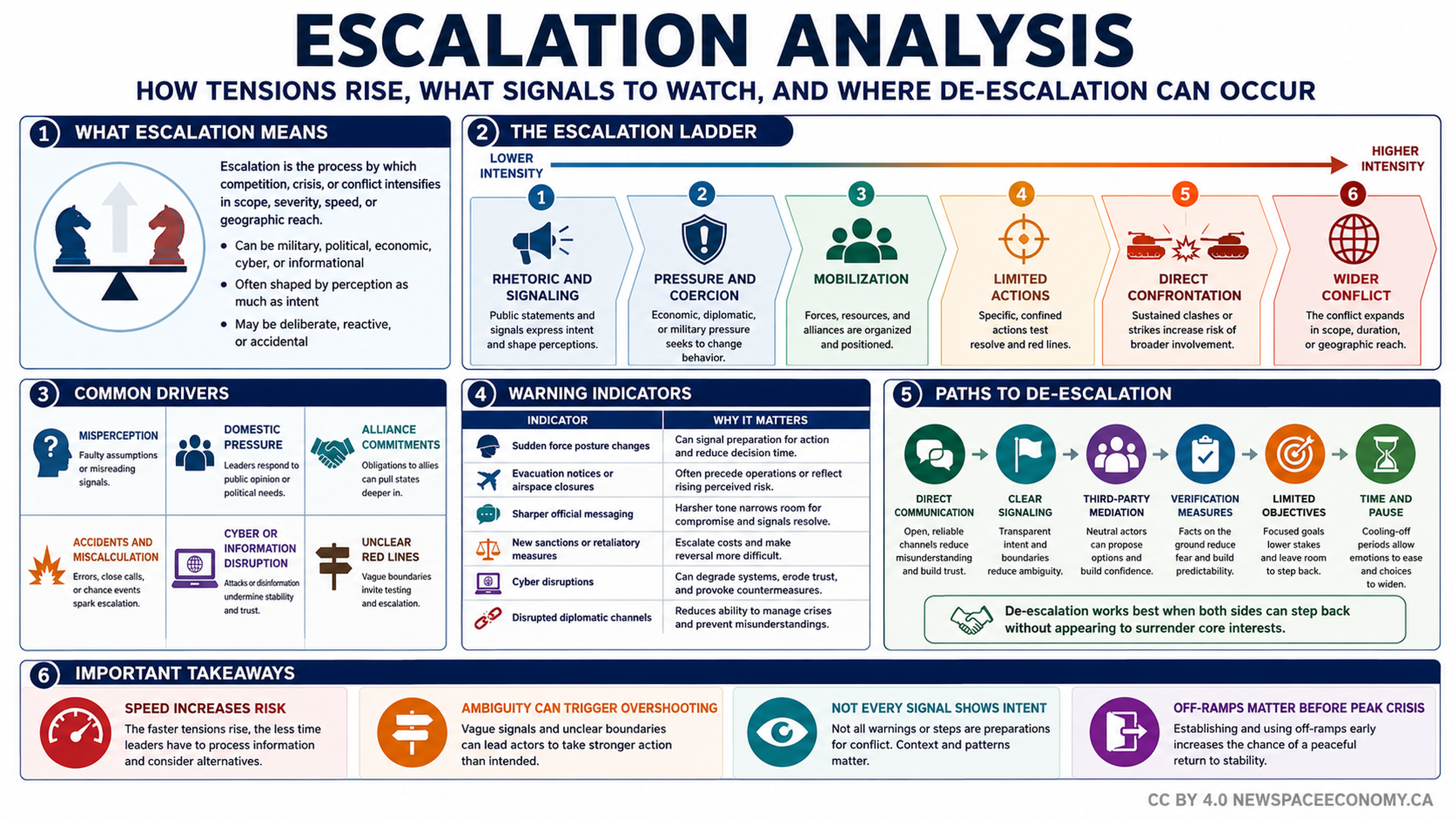
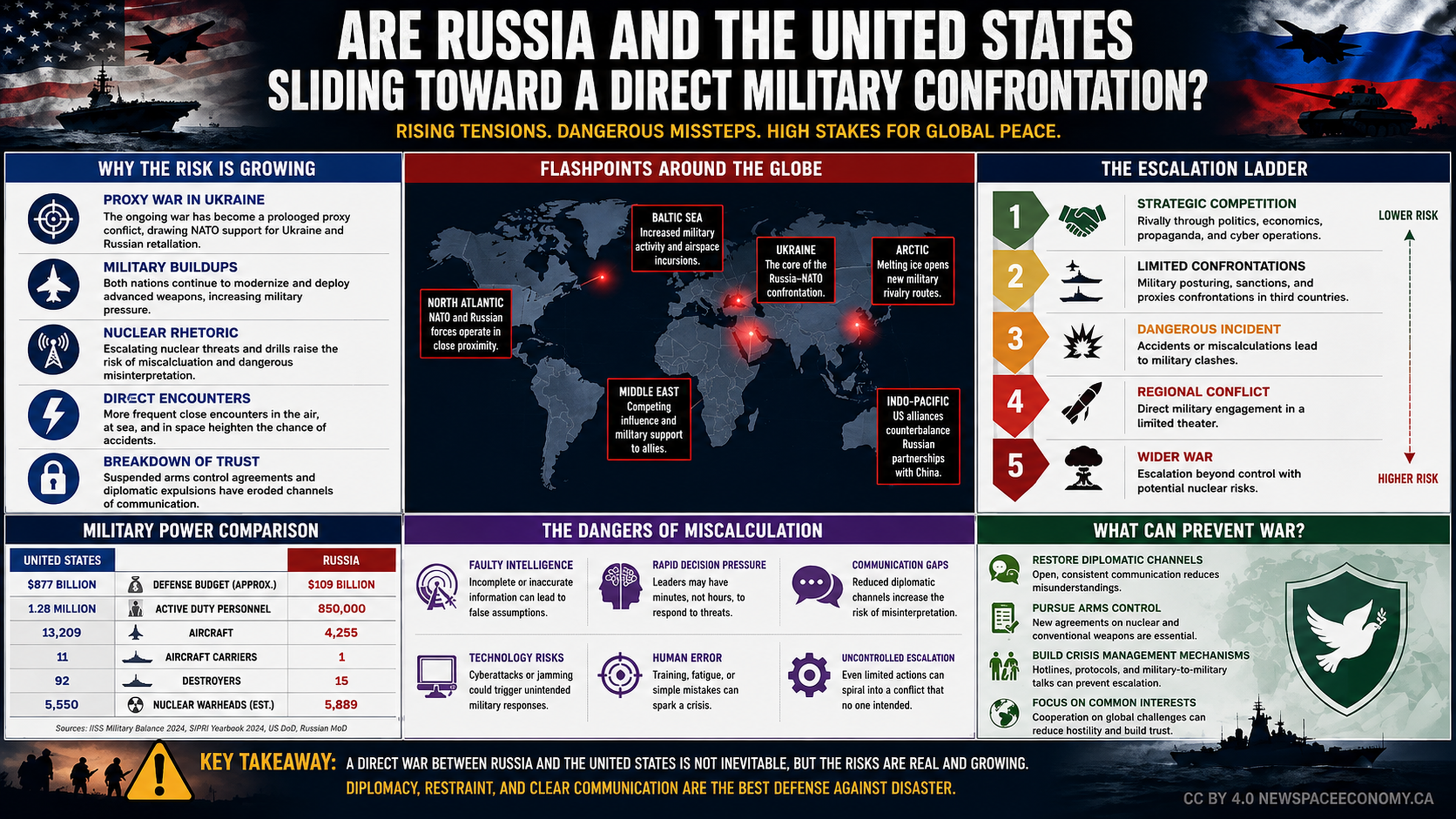
The Russia US escalation timeline does not describe one continuous march toward nuclear war. Several overlapping processes are occurring, and separating them produces a more accurate picture.
Conventional escalation is the most visible process. Ukraine continues attacking targets inside Russia with drones and long-range weapons. Russia continues large missile and drone attacks against Ukrainian cities, industrial facilities, ports, and military-support infrastructure. Each side is trying to impose greater costs without accepting the other’s political conditions.
A manpower process is developing beside it. Russian authorities are testing mobilization mechanisms and maintaining plans that could support another large call-up. Ukraine says Moscow may seek hundreds of thousands of additional troops after the September elections. Moscow had not issued another mass mobilization order by August 27. Both conditions can coexist: preparations can exist without a decision to execute them.
A NATO process is also underway. Reporting indicates that Washington worries Russia might test alliance cohesion through cyber operations, coercion, sabotage, airspace incidents, or a limited territorial action. The reported Ratcliffe warning appears designed to tell Moscow that such an operation could encounter a collective response rather than political hesitation.
NATO’s own policy leaves room for responses to attacks that do not resemble a conventional invasion. Its official explanation of Article 5 collective defense states that significant cyberattacks and other hybrid attacks can, depending on circumstances, be considered armed attacks for collective-defense purposes.
At the same time, NATO forces continue planned readiness activity. Operation Atlantic City demonstrates alliance interest in operating effectively in the Arctic. Pentagon and NATO officials are also discussing broader European defense policy. NATO announced that Secretary General Mark Rutte would meet Elbridge Colby at NATO headquarters in Brussels on August 27, with Colby also scheduled to participate in a meeting of the North Atlantic Council.
Nuclear deterrence forms another layer, but the public evidence differs from the conventional picture. The presence of E-6B aircraft shows that the United States maintains survivable airborne nuclear communications. That has been true for decades. No verified public information available by the morning of August 27 demonstrated an emergency transition in U.S. nuclear posture connected to this episode.
Russia has also used nuclear rhetoric repeatedly during the Ukraine war. Nuclear discussion becomes more consequential when accompanied by observable military preparation, such as unusual movements associated with warhead storage, changes in nuclear-capable force deployment, abnormal command activity, or unmistakable leadership measures. Public reporting associated with the late-August episode had not established such a pattern.
Turning Points That Changed the Meaning of the Crisis
Ratcliffe’s Moscow visit is the clearest political turning point. Before August 25, Russian mobilization preparations and infrastructure-security measures could be interpreted primarily through the Ukraine war. The arrival of the CIA director introduced evidence that Washington believed the situation warranted direct intelligence-level communication.
The disclosure of the reported NATO warning changed its meaning again. Publicly, Trump minimized the trip. Subsequent Wall Street Journal reporting said Ratcliffe warned against attacks on NATO countries. The account suggests Washington sought to communicate a boundary without escalating publicly through presidential threats or military announcements.
Russia’s August 27 warning toward British military targets marks another turning point. Moscow has long described Western military assistance as participation in the war, but explicitly raising the possibility of retaliation against British military assets outside Ukraine moves the language closer to NATO territory.
The mobilization issue could become a larger turning point if Moscow activates the preparations now being reported. Ukraine has warned that Russia may seek several hundred thousand additional personnel, and separate Western reporting has described exercises testing Russia’s capacity to absorb new recruits. Neither establishes that Putin has issued an order.
The location of any new formations would then become as important as their size. Deployment toward Ukrainian fronts would suggest reinforcement of the existing conflict. Persistent movement toward the Baltic region, Belarus, Kaliningrad, or northern NATO approaches would carry greater alliance implications.
Russia US Escalation Status as of August 27, 2026
The Russia US escalation timeline has reached an elevated conventional and political state without crossing the threshold into verified direct Russia-NATO combat.
Russia is attacking Ukraine at scale. Ukraine continues conducting long-range operations against Russian territory. Moscow is strengthening infrastructure-control mechanisms and appears to be maintaining the ability to conduct another mobilization. Washington has used an unusually senior intelligence channel to communicate directly with Moscow. NATO continues military preparedness activity in the Arctic and consultations over European defense policy.
Russia’s August 27 threat involving British military targets deserves close monitoring because it directly concerns the assets of a nuclear-armed NATO member. The wording still leaves substantial distance between threat and execution. No verified Russian strike against a British military facility on NATO territory had occurred by the morning of August 27.
The Ratcliffe mission points toward both danger and restraint. It indicates that U.S. officials saw enough concern to justify direct contact. It also demonstrates that Washington and Moscow retain a communication mechanism capable of carrying sensitive messages privately.
The E-6B episode requires similar restraint in interpretation. The aircraft are among the most sensitive components of U.S. nuclear command and communications, but their mission requires regular flying, crew training, maintenance, and readiness operations. Public tracking data alone cannot establish why an individual sortie occurred.
More persuasive evidence of a U.S. nuclear posture change would require a broader pattern. That could include extraordinary strategic bomber movements, unusual continuity-of-government activity, sustained abnormal airborne command-post operations, official strategic-force announcements, or other corroborating measures. No such publicly verified combination had emerged by August 27.
Russia’s nuclear posture requires the same evidence standard. Statements about tactical nuclear weapons matter politically, yet rhetoric and operational preparation are different categories. The public record associated with this episode does not show confirmed movement toward nuclear employment.
Space-based military infrastructure would become highly relevant if the confrontation widened. Satellite communications, missile warning, navigation, reconnaissance, and intelligence systems support both nuclear deterrence and conventional warfare. New Space Economy’s examination of Russian activity near European satellites illustrates why a wider confrontation could extend beyond air, land, sea, and cyber operations.
What Could Change the Russia US Escalation Timeline Next
A formal Russian mobilization order would materially alter the assessment. The number of personnel, geographic distribution, training locations, unit assignments, and deployment destinations would help determine whether Moscow was primarily replacing Ukraine losses or creating forces for broader contingencies.
A Russian kinetic strike against NATO territory would create a much larger change. Such an event would force alliance governments to determine whether consultations and collective military responses were appropriate. Attribution, scale, intent, casualties, and the target would shape that decision. NATO’s Article 5 policy makes clear that collective-defense determinations depend on the nature and circumstances of an armed attack.
A cyberattack could present a more ambiguous case. NATO states that significant cyberattacks and hybrid attacks can, depending on their effects, be considered armed attacks. Moscow could perceive ambiguity as useful because cyber operations create room for denial and disputes over responsibility.
Repeated Russian drone or missile incursions into NATO airspace would increase danger even without deliberate attack. Air-defense forces would face decisions about interception, pursuit, engagement rules, and debris risk. A single incident might be contained diplomatically. A recurring pattern would be harder to dismiss as accidental.
Changes in strategic nuclear posture would constitute another threshold. For the United States, sustained abnormal E-6B or E-4B activity combined with bomber dispersal or other strategic measures would carry greater weight than isolated aircraft movements. For Russia, unusual activity involving nuclear-capable forces, command networks, warhead-support infrastructure, or leadership-protection measures would require closer scrutiny.
The September Russian parliamentary elections form another date to watch because Ukrainian officials have linked possible mobilization decisions to the period after voting. That prediction remains an assessment rather than a known Kremlin timetable. If no mobilization follows, the intelligence may have reflected contingency planning rather than approved policy.
Operation Atlantic City is scheduled to continue through September 4. Its preplanned nature limits its value as evidence of sudden escalation, but an unscheduled enlargement beyond the announced activity would require separate assessment.
The strongest stabilizing factor remains communication. Intelligence contacts, military deconfliction mechanisms, diplomatic exchanges, and leader-level messaging cannot prevent every conflict, but they can reduce misunderstandings that might otherwise transform conventional military operations into an alliance confrontation.
Summary
The late-August Russia US escalation timeline began with Russian domestic preparedness measures and reports of mobilization planning, then changed sharply when CIA Director John Ratcliffe traveled to Moscow on August 25. Subsequent reporting indicates that he warned Russian officials against attacking NATO members, placing alliance deterrence near the center of the episode.
Multiple U.S. E-6B Mercury flights attracted attention because those aircraft support nuclear command, control, and communications. Their activity belongs in escalation monitoring, but official Navy information establishes that these aircraft maintain continuing command-and-communications missions. Public evidence does not establish that the United States changed its nuclear alert level because of the August 25 events.
Russia intensified conventional attacks against Ukraine and issued a direct warning that British military targets could face retaliation inside or potentially outside Ukraine. That language raises concern because the United Kingdom is a NATO member and nuclear power. Moscow had not announced an order to attack British territory as of August 27.
Russian mobilization preparations form another unresolved branch of the timeline. Ukrainian officials say Moscow may seek hundreds of thousands of additional troops after September elections, and separate reporting describes exercises testing Russia’s capacity to absorb new recruits. No new mass mobilization decree had been publicly confirmed by August 27.
NATO’s Arctic training and Brussels consultations show continuing alliance preparedness, but the most visible Arctic activity identified during this period was planned before Ratcliffe’s Moscow trip rather than assembled as an emergency response.
The assessment as of August 27, 2026 is that the confrontation has entered a more dangerous period of conventional escalation, deterrence messaging, mobilization preparation, and direct intelligence communication. The available evidence does not support describing the situation as an imminent U.S.-Russia nuclear confrontation.
That assessment could change quickly if Russia begins mass mobilization, directs newly generated forces toward NATO borders, conducts a deliberate strike against alliance territory, or shows observable changes in nuclear-force posture. Comparable U.S. or NATO strategic-force changes would carry similar weight. Until such evidence appears, the record supports describing the episode as an elevated escalation-management crisis centered on Ukraine and NATO deterrence rather than the opening phase of a confirmed direct U.S.-Russia war.