- Key Takeaways
- August 24 to August 31
- Europe Places a Major IRIS² Satellite Manufacturing Order
- ESA Commits €543.6 Million to Three Launcher Challengers
- SpaceX Proposes a $100 Billion Louisiana Launch Campus
- NASA Launches the Roman Space Telescope
- Ariane 6 Demonstrates Geostationary Capability
- Pentagon Audit Identifies Barriers to Commercial Space Data
- FCC Examines Spectrum for High-Frequency Launch Operations
- Europe Completes EGNOS V3 Ground-Network Contracting
- NASA Expands the Deep Space Network
- White House Creates a U.S. Space Academy Commission
- Ursa Major Signs a $2.3 Billion Public-Market Agreement
- Astrum Space Proposes a $1 Billion Combination
- What the Week Reveals About the Space Economy
- Developments to Watch
Published August 31, 2026
Key Takeaways
- Europe’s space-sovereignty agenda moved into industrial execution through major IRIS² and launcher contracts, alongside new meteorological and navigation infrastructure.
- The proposed $100 billion Starbase Louisiana project illustrates how launch expansion is becoming an energy, land, transportation, workforce, regulatory, and environmental issue, not simply a rocket-development story.
- Commercial capital remains available for strategically important space businesses, but the Ursa Major and Astrum transactions still face closing, execution, and market risks.
August 24 to August 31
Europe moved several sovereign space programs from planning into procurement, the United States advanced launch infrastructure and regulatory initiatives, and two space companies turned to proposed public-market transactions to finance expansion.
The most consequential developments between August 24 and August 31 involved secure satellite communications, European launch autonomy, a proposed Louisiana spaceport, scientific and meteorological infrastructure, commercial space-data procurement, launch spectrum, navigation services, workforce policy, and space-sector capital formation.
Not every announcement represents an accomplished result. Some are signed contracts or verified operational milestones; others remain proposed investments, regulatory consultations, or transactions that have not closed. Those distinctions are central to understanding what changed.
Europe Places a Major IRIS² Satellite Manufacturing Order
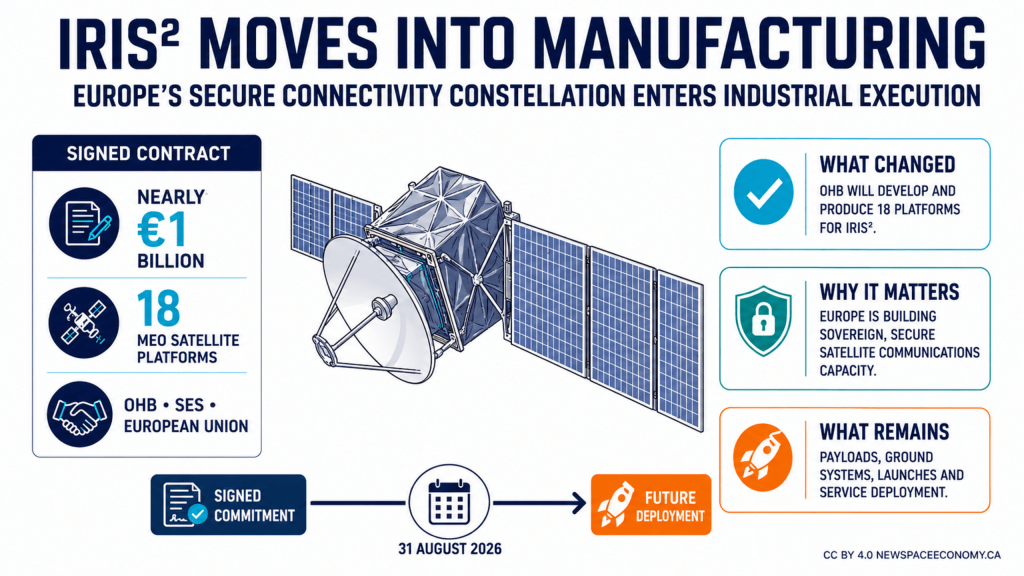
Europe’s planned sovereign communications constellation moved from institutional preparation toward physical production on August 31 when OHB announced a contract worth nearly €1 billion.
Under the agreement, OHB will develop and manufacture 18 medium-Earth-orbit satellite platforms for SES as part of the European Union’s Infrastructure for Resilience, Interconnectivity and Security by Satellite program, better known as IRIS².
The award is a major industrial contract following the start of the program’s implementation phase. The expanded IRIS² architecture is planned to contain 348 satellites, including 18 in medium Earth orbit and 330 in low Earth orbit, together with an extensive ground segment and a portfolio of government and commercial services.
The program is intended to provide secure communications for European governments, public institutions, businesses, and potentially underserved communities. It is also designed to reduce European dependence on communications systems controlled by non-European companies or governments.
The economic importance extends well beyond the 18 spacecraft. Each satellite platform supports supply chains involving electronics, propulsion, structures, software, testing, cybersecurity, ground equipment, launch services, and operations. Subsequent awards will determine how widely the program’s industrial benefits are distributed across Europe.
For policymakers, IRIS² is becoming a test of whether Europe can convert its sovereignty goals into a competitive and operational communications service. For industry, it represents a long-term procurement opportunity that could shape the European satellite-manufacturing base for more than a decade.
The contract is binding, but it does not mean IRIS² is operational. Payload production, low-Earth-orbit elements, ground infrastructure, launches, system integration, and service deployment remain future activities. Cost, schedule, and performance risks will become clearer as those procurements advance.
ESA Commits €543.6 Million to Three Launcher Challengers
The European Space Agency signed the first European Launcher Challenge contracts on August 27, committing a combined €543.6 million to three privately developed launch systems:
- €197.8 million for Germany’s Isar Aerospace
- €186.9 million for Germany’s Rocket Factory Augsburg
- €158.9 million for Spain’s PLD Space
A separate award involving France’s MaiaSpace remained in the contracting process as of August 31, 2026.
The contracts are milestone-based. Participating companies must demonstrate technical and business progress before funds are released. Under the latest ESA contract announcement, the challengers must initially achieve an orbital launch by 2028 before advancing into later program activities.
This approach marks an important change in European launcher policy. Europe has historically concentrated institutional support around a small number of major programs, principally Ariane and Vega. The European Launcher Challenge instead supports competition among several privately managed providers.
The policy reflects a broader shift toward governments purchasing capabilities from competing companies rather than funding a single national or institutional system from beginning to end.
The potential benefit is a more diverse and resilient launch market. European governments and companies could gain additional options for placing small and medium-sized satellites into orbit without relying on non-European providers.
The risk is that Europe could spread public support across several companies without generating enough launch demand to sustain all of them. Each challenger must still demonstrate reliable flight performance, recurring production, regulatory compliance, responsive operations, and financially viable pricing.
The contracts therefore represent industrial progress, but not yet demonstrated sovereign launch capacity. The next important evidence will be successful orbital flights followed by repeat missions.
SpaceX Proposes a $100 Billion Louisiana Launch Campus
SpaceX and Louisiana officials announced plans on August 25 for a new launch and industrial complex in Vermilion Parish that could become the company’s largest spaceport.
According to Louisiana Economic Development’s Starbase Louisiana announcement, the proposed campus would occupy approximately 125,000 acres near Pecan Island. At full development, it could include five launch complexes with two pads each, propellant production, power generation, vehicle-processing facilities, employee housing, and associated industrial infrastructure.
The state describes the project as a potential $100 billion investment. Construction is expected to begin in 2027, with the first launch targeted for as early as 2029.
SpaceX expects the development to create 3,000 direct jobs over ten years, with an average annual salary of $92,600. Louisiana Economic Development estimates that another 8,100 indirect jobs could result. These figures are projections associated with the proposed full development rather than verified employment already created.
The proposal is notable because it treats launch capacity as an integrated industrial system rather than an isolated launchpad. Operating Starship at very high frequency would require large quantities of propellant, electrical power, water, transportation capacity, communications, maintenance services, and specialized labor.
Louisiana’s Gulf Coast industrial base may offer relevant capabilities in energy, chemicals, marine logistics, fabrication, and large-scale construction. SpaceX could potentially draw on suppliers and workers with experience supporting the oil, gas, petrochemical, and offshore sectors.
The location would also give SpaceX another major operating base beyond its existing sites in Texas, Florida, and California. Geographic diversification could increase launch capacity and reduce dependence on individual ranges, although weather, coastal vulnerability, environmental constraints, and compatible flight trajectories will influence the site’s practical value.
Louisiana says its incentives are conditional on capital investment, job creation, and a $25 million charitable contribution. SpaceX has also entered into a payment-in-lieu-of-taxes agreement under which local payments are expected to exceed $820 million over 25 years.
The $100 billion figure should nevertheless be treated as a long-term projection rather than money already deployed. The project still requires environmental review, construction approvals, infrastructure development, federal launch licensing, and substantial capital spending.
The most revealing near-term indicators will be land transactions, environmental filings, utility agreements, site preparation, procurement notices, and documented construction expenditures.
NASA Launches the Roman Space Telescope
NASA successfully launched the Nancy Grace Roman Space Telescope on August 30 aboard a SpaceX Falcon Heavy from Launch Complex 39A at Kennedy Space Center.
The spacecraft separated from the launch vehicle, established communications, and began an approximately three-month journey toward an orbit around the second Sun-Earth Lagrange point, about 1 million miles, or 1.6 million kilometers, from Earth.
The Roman Space Telescope has an estimated lifecycle cost of approximately $4.3 billion. It is designed to investigate dark energy, dark matter, the large-scale structure of the universe, exoplanets, and a broad range of astrophysical phenomena.
Roman’s wide-field instrument will observe an area of sky at least 100 times larger than the Hubble Space Telescope can capture in a comparable image. This capability will allow Roman to conduct large infrared surveys much faster than observatories with narrower fields of view.
That makes Roman more than a single scientific mission. It is a public data platform whose observations could support thousands of research projects that were not specifically defined when the spacecraft was designed.
Large astronomical archives can also create opportunities for advanced computing, artificial intelligence, data visualization, cloud services, and automated discovery. Universities, national laboratories, software developers, and commercial analytics companies may build tools around the mission’s data.
The August 30 launch was a verified success, but it was only the first major operational step. Roman must reach its intended orbit, deploy and stabilize its systems, commission its instruments, and demonstrate that it can achieve the required measurement accuracy.
The next important milestones will include trajectory corrections, arrival at L2, instrument checkout, first-light images, and the release of early scientific data.
Ariane 6 Demonstrates Geostationary Capability
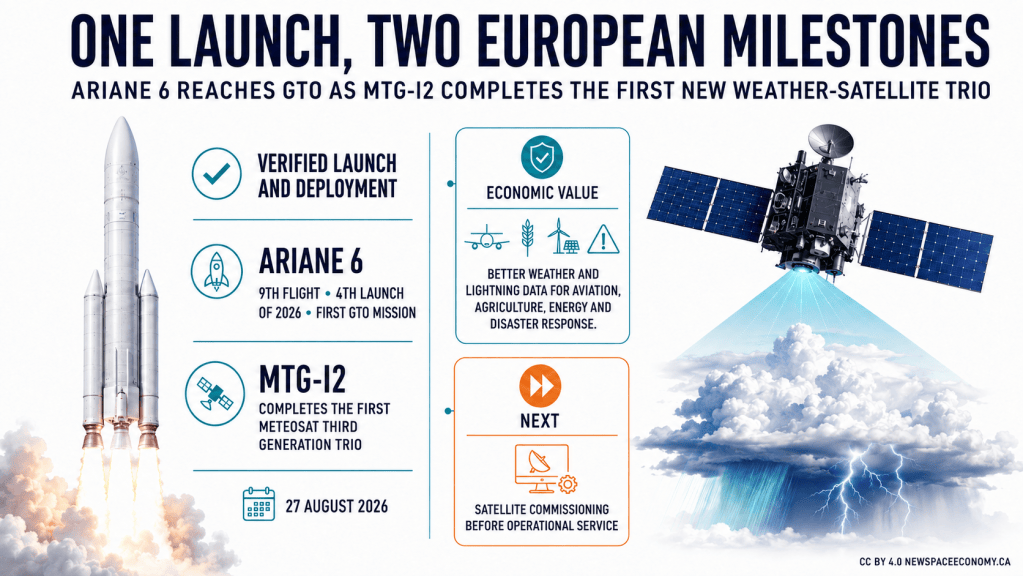
Arianespace successfully launched the MTG-I2 meteorological satellite on August 27, marking Ariane 6’s first mission to geostationary transfer orbit.
The mission was Ariane 6’s ninth flight and its fourth launch of 2026. Successful delivery to geostationary transfer orbit is commercially important because many large communications, weather, and government satellites operate in geostationary orbit.
Ariane 6 must be able to serve this market if it is to replace Ariane 5 as Europe’s principal heavy launcher and compete for institutional and commercial missions.
The payload was equally significant. MTG-I2 completes the first Meteosat Third Generation satellite family, reinforcing Europe’s next-generation weather-observation infrastructure.
The MTG system is intended to provide more frequent and detailed observations of Europe, Africa, and surrounding waters. Its capabilities include rapid imagery and lightning detection that can improve monitoring of severe storms and fast-changing atmospheric conditions.
Weather satellites produce economic value across many sectors. Airlines use forecasts and storm observations for routing. Farmers depend on weather information for planting, irrigation, and harvesting. Energy companies use it to anticipate demand and renewable-power generation. Governments and emergency agencies use it to prepare for floods, wildfires, heat waves, and severe storms.
Insurance companies, logistics providers, maritime operators, telecommunications companies, and financial markets also incorporate weather data into risk models and operational decisions.
The launch and spacecraft separation were successful. MTG-I2 must still complete orbit-raising, testing, and commissioning before it can provide operational services.
Pentagon Audit Identifies Barriers to Commercial Space Data
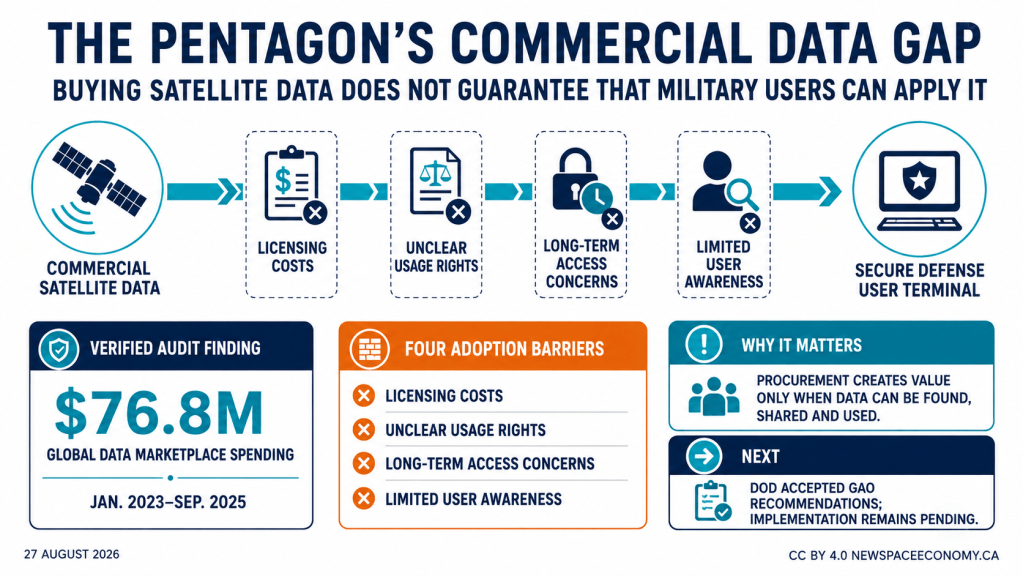
A new U.S. Government Accountability Office review of commercial space-data procurement found that the Department of Defense is not consistently using commercial space data and services it has already purchased.
The report, released August 27, identified several obstacles, including licensing costs, perceived usage restrictions, concerns about long-term access, and limited awareness among potential military users.
The Space Force’s Joint Commercial Operations Cell spent $76.8 million on data and services through its Global Data Marketplace between January 2023 and September 2025. Yet purchasing access did not automatically produce widespread operational adoption.
This distinction matters throughout the space economy. Governments increasingly describe themselves as customers of commercial satellite communications, Earth observation, space-domain awareness, weather, navigation, and analytics. However, a contract does not guarantee that personnel can find, share, combine, or legally use the resulting information.
Licensing can be particularly complicated. A commercial provider may restrict redistribution, storage, modification, or use by partner organizations. Those restrictions can become more consequential during international operations involving military services, intelligence agencies, allies, contractors, and civilian authorities.
Users may also hesitate to build operational processes around a commercial service if they are uncertain whether funding or access will continue.
GAO recommended that the Secretary of the Air Force ensure the Space Force improves awareness of a cross-government commercial-data working group and informs users how to access and use services government organizations have purchased. The Department of Defense agreed with the recommendation.
This is an audit finding rather than a completed procurement reform. Its significance will depend on whether the department subsequently simplifies licenses, educates users, establishes common access systems, and makes commercial data a routine part of operational planning.
FCC Examines Spectrum for High-Frequency Launch Operations

The Federal Communications Commission opened a consultation on August 25 concerning the radio spectrum required for commercial launches, reentries, recovery operations, and related activities in orbit.
Rockets and spacecraft rely on radio links for telemetry, tracking, command, flight safety, and status information. Launch operators must coordinate those links with federal agencies and other spectrum users to prevent interference.
The FCC’s public notice asks whether operators need access to additional frequency bands, stronger primary or co-primary operating rights, and improved coordination procedures.
This can appear to be a narrow technical matter, but spectrum is an important component of launch infrastructure. A launch vehicle cannot operate safely without reliable communications, regardless of how many rockets or launchpads are available.
The United States conducts approximately 200 launch-related activities annually. The National Space Transportation Policy issued on August 20, 2026 directs U.S. space-transportation ranges to develop the capacity to support more than 1,000 launches and reentries annually by 2030.
Reaching that level would require regulatory systems capable of processing far more operations without creating unacceptable interference or administrative delays. Spectrum coordination must also account for growing federal, scientific, aviation, maritime, satellite, and terrestrial communications demand.
The FCC has not adopted new rules. Comments are due September 14, 2026, followed by reply comments on September 24. Filings from launch providers and other spectrum users should offer evidence about where the most immediate communications bottlenecks exist.
Europe Completes EGNOS V3 Ground-Network Contracting
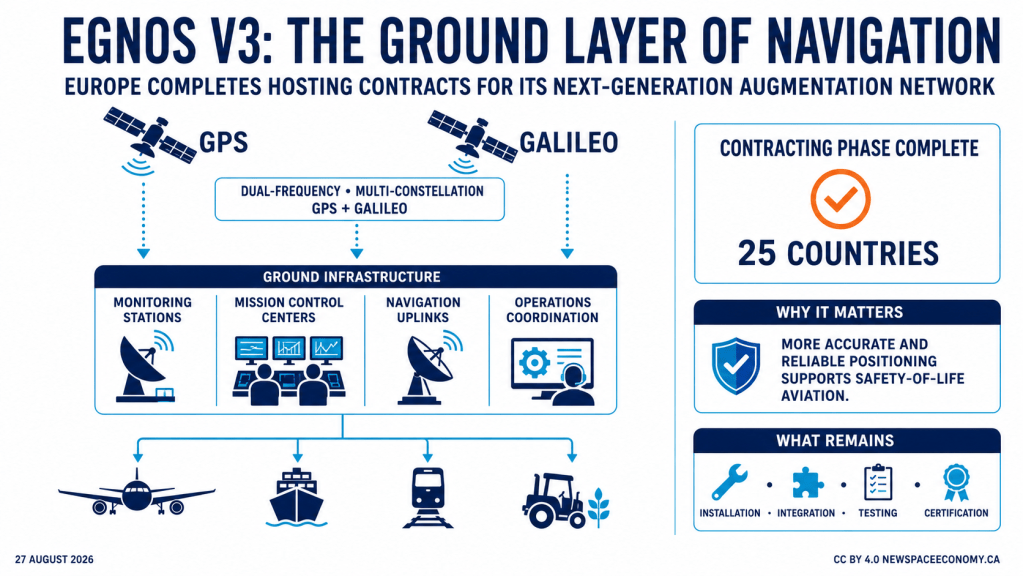
The European Union Agency for the Space Programme announced on August 27 that it had signed the final hosting agreement for the EGNOS V3 ground network.
The agreement completes the contracting phase for infrastructure distributed across 25 countries. The network includes ranging and integrity monitoring stations, mission-control centers, navigation land Earth stations, and operations-coordination centers.
The EGNOS V3 infrastructure program is intended to improve the accuracy, reliability, integrity, and resilience of satellite-navigation services. Its safety-of-life services are particularly important to aviation, where pilots and air-traffic systems need timely warnings if positioning information becomes unreliable.
EGNOS V3 is being developed to support dual-frequency, multi-constellation operations using GPS and Galileo signals. This should make the service more resilient and improve positioning performance.
The program illustrates how heavily satellite services depend on terrestrial infrastructure. Satellites may generate or relay navigation signals, but ground stations must monitor their accuracy, calculate corrections, manage system integrity, and send updated information back into the network.
The hosting agreements are now in place, but the enhanced services are not yet operational. Installation, integration, testing, certification, and operational transition remain necessary.
NASA Expands the Deep Space Network
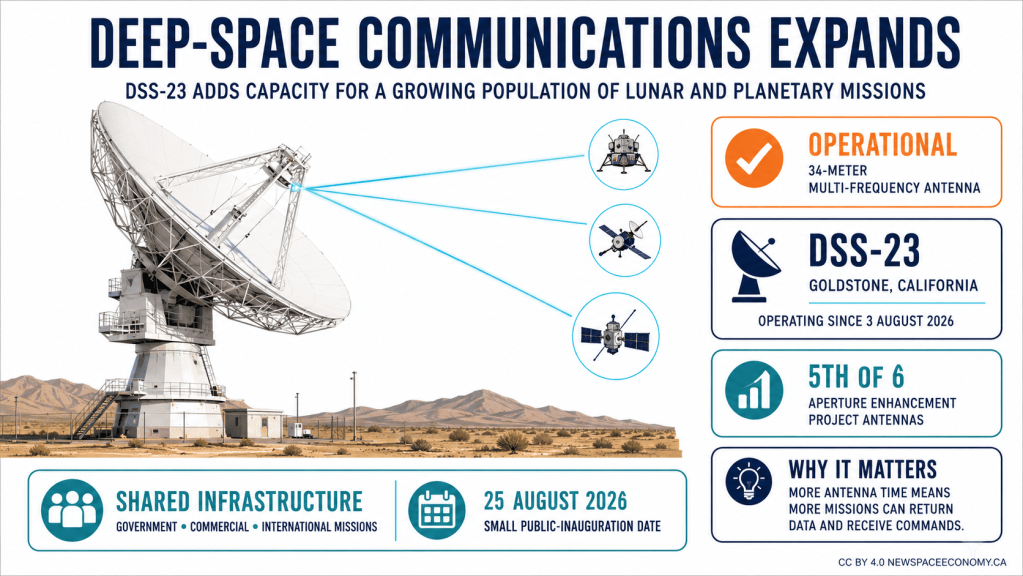
NASA publicly inaugurated a new 34-meter antenna at the Goldstone Deep Space Communications Complex on August 25.
Known as Deep Space Station 23, or DSS-23, the multi-frequency antenna began operations on August 3 after testing conducted between May and July. It initially tracked the Chandra X-ray Observatory and has since communicated with missions including Mars Reconnaissance Orbiter, Psyche, Juno, and Voyager 1.
The new DSS-23 antenna is part of NASA’s effort to expand and modernize the Deep Space Network, which provides communications and navigation services for spacecraft traveling to the Moon, Mars, the outer planets, and other distant destinations.
As the number of lunar and planetary missions grows, communications time becomes a constrained resource. Spacecraft must compete for access to antennas capable of receiving extremely weak signals over immense distances.
The expansion has economic implications for commercial lunar landers, privately developed spacecraft, international missions, and future infrastructure around the Moon. Even independently financed missions may ultimately depend on government or commercial ground networks to transmit commands and return valuable data.
DSS-23 is the fifth of six antennas planned under NASA’s Aperture Enhancement Project and the fifth antenna operating at Goldstone. NASA expects the sixth enhancement-project antenna, DSS-33 in Canberra, Australia, to enter service in 2029.
DSS-23’s operational entry provides additional communications capacity. The larger question is whether government and commercial networks can expand quickly enough to support the number of lunar and deep-space missions being proposed.
White House Creates a U.S. Space Academy Commission
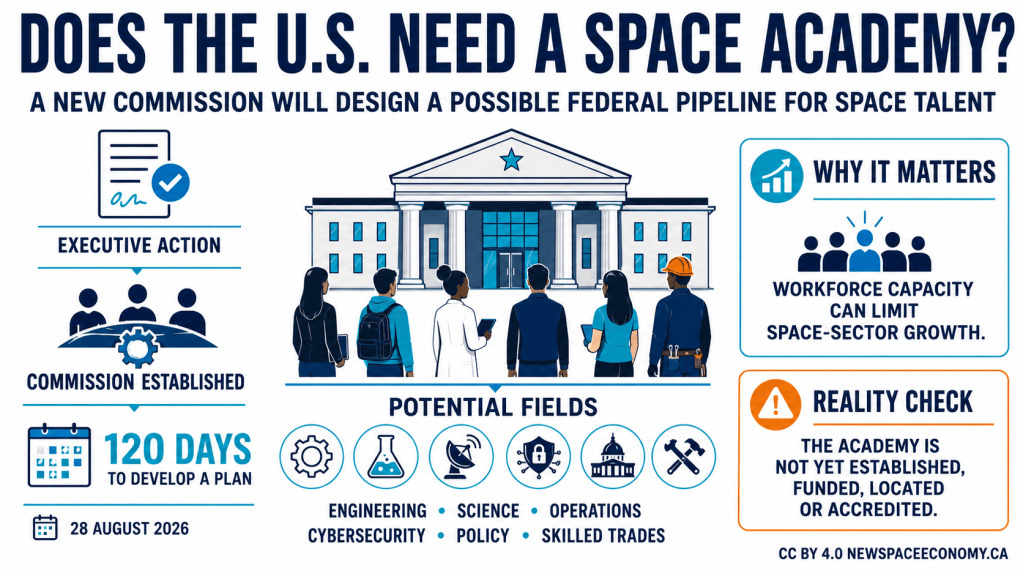
A White House executive order establishing the Presidential Commission on the United States Space Academy was issued on August 28.
The commission is tasked with developing a plan for a proposed NASA-led federal academy that could provide technical education, leadership development, experiential training, and pathways into public service.
The commission has 120 days from the date of the order to recommend a governance framework, accreditation arrangements, curriculum, applicant requirements, service obligations, location-selection process, legislative actions, and implementation strategy.
The order reflects concern that workforce availability could constrain U.S. space ambitions. The industry needs engineers and scientists, but it also requires technicians, machinists, software specialists, cybersecurity professionals, construction workers, regulators, acquisition personnel, and mission operators.
A dedicated academy could create a more direct pipeline into federal space programs. It could also offer students a route into public service comparable to institutions supporting military careers.
However, the proposal raises questions about duplication. Universities, military academies, community colleges, technical schools, NASA programs, and company-run training initiatives already educate space-sector workers.
The commission exists, but the academy does not. No campus has been selected, no operating budget has been approved, and no accreditation framework has been established. Congressional authorization and appropriations may be required before significant parts of the proposal can be implemented.
Ursa Major Signs a $2.3 Billion Public-Market Agreement
Propulsion and defense manufacturer Ursa Major announced on August 25 that it had signed a definitive agreement to combine with Bleichroeder Acquisition Corp. III, a special-purpose acquisition company.
The proposed Ursa Major transaction reflects a pre-transaction equity valuation of approximately $1.6 billion and a post-transaction equity valuation of approximately $2.3 billion. It is supported by at least $350 million in private-investment commitments and is expected to close during the first quarter of 2027.
Ursa Major develops solid rocket motors, liquid propulsion systems, hypersonic technologies, missile systems, and space-mobility capabilities. The company says transaction proceeds will support manufacturing expansion, working capital, and product development.
The proposed combination is important because propulsion capacity has become a constraint across civil, commercial, and defense markets. Demand for launch vehicles, missiles, interceptors, maneuverable spacecraft, and hypersonic systems has increased faster than some industrial suppliers can expand.
Manufacturing propulsion systems at scale requires factories, specialized materials, testing infrastructure, qualified workers, safety systems, and long-term supply agreements. Those requirements consume substantial capital before companies can generate recurring production revenue.
The transaction therefore tests whether public markets are willing to finance industrial expansion in strategically important but capital-intensive parts of the space and defense economy.
A definitive agreement has been signed, but the transaction is not complete. It remains subject to shareholder approval, regulatory requirements, closing conditions, and possible investor redemptions. The final amount of usable capital may differ from the headline figures. The associated SEC filing confirms that the agreement remains a pending transaction.
Astrum Space Proposes a $1 Billion Combination
Singapore-based Astrum Space announced a proposed business combination with Black Spade Acquisition III on August 27.
The Astrum transaction filing values the company at approximately $1 billion and contemplates listing the combined company on the New York Stock Exchange.
Astrum is developing NEASTAR-1, a geostationary satellite intended to support wholesale satellite-to-device broadcasting and data distribution in Asia-Pacific markets. The company says it holds 25 megahertz of contiguous L-band spectrum between 1467 and 1492 megahertz, together with spectrum and orbital resources associated with the 105-degree-east geostationary position.
According to the filed transaction announcement, NEASTAR-1 is being manufactured by SWISSto12, while launch and orbital-delivery services have been contracted with Impulse Space for a planned launch between late 2028 and the first quarter of 2029.
The wholesale approach is significant because satellite-to-device connectivity is often presented as a service controlled directly by a satellite operator. Astrum instead aims to supply infrastructure through existing telecommunications companies with established customers, billing systems, spectrum rights, and regulatory relationships.
Asia-Pacific includes island states, remote communities, extensive maritime regions, and large areas where terrestrial coverage is difficult or uneconomic. That creates a potentially significant market for emergency messaging, basic communications, logistics, maritime services, disaster response, and rural connectivity.
The transaction should not be confused with an operational NEASTAR-1 network or completed financing. Astrum must still complete the satellite, launch and commission it, obtain spectrum and market-access authorizations, integrate with mobile operators, and demonstrate reliable connections with compatible consumer devices.
The business combination is expected to close by the end of 2026, subject to shareholder and regulatory approvals and customary closing conditions. Redemptions by Black Spade shareholders could reduce the cash available to the combined company.
What the Week Reveals About the Space Economy
The week’s developments show that sovereign space capability is increasingly being constructed through overlapping layers of infrastructure.
IRIS² represents secure communications infrastructure. The European Launcher Challenge addresses access to orbit. MTG-I2 strengthens environmental intelligence. EGNOS V3 supports positioning and aviation. NASA’s new deep-space antenna expands communications capacity. The FCC proceeding addresses the spectrum needed to operate increasingly busy launch systems.
These developments are connected. Satellites require launch services, spectrum, ground stations, data platforms, skilled personnel, financing, and reliable customers. Weakness in any one layer can limit the economic value of the others.
The week also highlights the difference between large numbers and accomplished results.
The IRIS² and European Launcher Challenge contracts have been signed, but the resulting systems must still be built. Roman and MTG-I2 reached space, but they require commissioning. DSS-23 is already operational. The FCC has begun a consultation but has not changed its rules. The Space Academy is a planning initiative rather than an existing institution. Starbase Louisiana is a proposed development whose $100 billion figure depends on years of approvals and investment. Ursa Major and Astrum have signed transaction agreements, but neither transaction has closed.
For readers, investors, policymakers, and industry participants, this distinction is the most useful way to evaluate the week: identify what is contractually committed, what is operating, what remains conditional, and what evidence should appear next.
Developments to Watch
- IRIS² follow-on awards: Payload, low-Earth-orbit, ground-segment, launch, cybersecurity, and service contracts will determine which companies and countries capture the program’s economic value.
- MaiaSpace’s launcher contract: ESA reported on August 27 that the remaining contracting process was close to completion.
- Starbase Louisiana execution: Environmental filings, utility agreements, permits, land records, and documented construction spending will indicate whether the proposed campus is moving into development.
- Roman commissioning: Trajectory corrections, instrument activation, first light, and initial data releases will test the observatory’s performance.
- FCC spectrum filings: Industry submissions due in September should identify the communications constraints most likely to affect high-frequency launch and reentry operations.
- Commercial-data reforms at the Department of Defense: Changes to licensing, training, access systems, and procurement practices would show whether the department is acting on GAO’s findings.
- Public-market transaction conditions: SEC filings, shareholder votes, redemptions, and regulatory approvals will determine whether the Ursa Major and Astrum transactions close with the capital anticipated in their announcements.