- Key Takeaways
- What Does the Scientific Literature Say About the Asteroid Threat to Earth?
- How Do Asteroid Size and Structure Shape the Threat?
- How Frequently Do Asteroid Impacts Occur?
- Why Detection and Characterization Determine the Available Response
- How Are Impact Probabilities Calculated and Communicated?
- What Does Planetary Defense Include Before an Impact Threat Is Confirmed?
- What Did DART Prove About Asteroid Deflection?
- Which Mitigation Methods Are Supported by the Literature?
- Why Do Governance and Law Matter to Planetary Defense?
- What Do Recent Cases Teach About the Asteroid Threat to Earth?
- What Evidence Supports a Practical Planetary-Defense Strategy?
- What Remains Unresolved as of August 2026?
- Summary
Key Takeaways
- Impact severity depends on an asteroid’s size, structure, speed, orbit, and warning time.
- Better observations can convert uncertain impact alerts into precise and manageable risk estimates.
- DART proved kinetic deflection, but characterization, governance, and emergency planning remain incomplete.
What Does the Scientific Literature Say About the Asteroid Threat to Earth?
On 15 February 2013, an asteroid estimated at roughly 20 meters across exploded over Chelyabinsk, Russia. The airburst injured approximately 1,600 people, damaged thousands of buildings, and released energy comparable to hundreds of kilotons of TNT. The event caused no crater and did not threaten human civilization, yet it demonstrated how an object too small to produce a global catastrophe could still create a large regional emergency. The detailed scientific account published by the Chelyabinsk Airburst Consortium remains one of the most useful modern studies of an asteroid encounter with Earth.
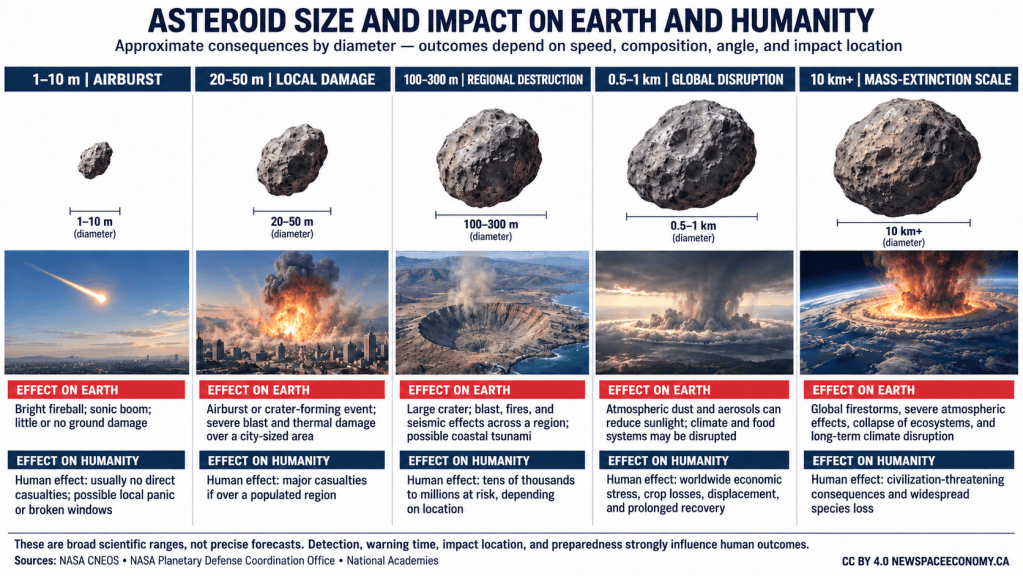
The scientific literature treats the asteroid threat to Earth as a spectrum rather than a single danger. Objects only a few meters across usually burn up or fragment in the atmosphere. Objects around 10 to 30 meters across may produce damaging airbursts. Bodies tens to hundreds of meters in diameter may destroy cities or regions. Objects approaching one kilometer or more can inject enough dust and vapor into the atmosphere to disrupt climate, agriculture, and human systems over large areas. An object near 10 kilometers across can produce mass-extinction consequences, as shown by the geological record surrounding the Chicxulub impact.
The risk is unusual because it combines low annual probability with potentially severe consequences and a degree of technological preventability. Earthquakes, volcanic eruptions, pandemics, and storms cannot be stopped by changing the path of the hazard before it reaches a populated area. A threatening asteroid, by contrast, may be diverted if it is discovered early enough and if its physical properties are understood well enough to support a reliable mission.
The literature also warns against treating preventability as proof of preparedness. Humanity has demonstrated one deflection technique on an asteroid, yet no country has carried out an operational response to a confirmed impact threat. Most planetary-defense systems remain dedicated to finding objects, improving orbit estimates, measuring physical properties, developing mission concepts, and coordinating international decisions.
The National Academies’ assessment of hazardous asteroids provides a useful foundation for interpreting the research. It connects four questions that are often discussed separately:
- How many hazardous objects exist?
- How many have been found?
- What would an impact do?
- Could a mission prevent or reduce the damage?
The answers depend on object size, composition, orbit, approach direction, impact speed, impact angle, warning time, and the location of any encounter with Earth. A dark, porous asteroid approaching from near the Sun may be harder to detect than a brighter object of the same size. A loosely bound rubble pile may respond differently to a kinetic impact than a compact metallic body. An ocean impact may produce different damage from a land impact, and a warning received 20 years before an encounter creates options unavailable 20 days before it.
A literature review must also distinguish hazard from risk. Hazard refers to the capacity of an object or event to cause harm. Risk combines that capacity with the probability of occurrence, the location of the event, the number of people and assets exposed, and the vulnerability of those exposed systems. A large asteroid with no plausible impact in the next several centuries may represent a serious hazard but a low near-term risk. A smaller object with a measurable probability of striking a populated area within a decade may deserve immediate attention even though its effects would remain regional.
Scientific publications, government strategies, mission reports, and international policy documents converge on one conclusion: planetary defense is a continuous decision process. It begins with surveillance and ends, if necessary, with deflection, disruption, evacuation, sheltering, infrastructure protection, recovery, and public communication. The literature does not support a single universal defense method. It supports a layered capability that improves knowledge before committing to action.
How Do Asteroid Size and Structure Shape the Threat?
Asteroid size is the most visible measure of danger, but it is only a starting point. Impact energy depends on mass and speed. Mass depends on volume and density. Volume depends on size and shape. The same estimated diameter can represent very different energies if one object is a porous carbon-rich rubble pile and another is a dense metallic body.
The basic relationship is expressed through kinetic energy, which increases with mass and with the square of velocity. A faster object can deliver far more energy than a slower object of equal mass. The atmosphere reduces the energy of small, fragile objects through fragmentation and drag, yet larger bodies retain enough momentum to reach lower altitudes or the surface.
The 2019 National Academies study explains why physical characterization matters. Visible-light observations often estimate an asteroid’s size from brightness. That method depends on albedo, or the fraction of sunlight reflected by the surface. A dark asteroid may appear smaller than a bright asteroid of the same diameter. Thermal-infrared observations provide better size estimates because emitted heat depends less strongly on surface reflectivity.
Density introduces another uncertainty. A solid iron-rich object can carry much more mass than a porous body of the same diameter. The National Academies review identified a possible density range of roughly 1 to 8 grams per cubic centimeter across plausible materials and structures. That range can produce a large difference in estimated impact energy. Remote observations can narrow the uncertainty through spectral classification, thermal measurements, radar, rotation studies, and observations of binary systems, yet direct mass measurements remain uncommon.
Asteroid structure also affects mitigation. A compact monolithic object may transmit an impact shock differently from a rubble pile held together by weak gravity. DART struck Dimorphos, a small moonlet in the Didymos binary system, and produced a substantial change in its orbit. The result demonstrated that ejecta, or material thrown away from the asteroid by the collision, can amplify the momentum transferred by the spacecraft. That amplification may differ for another object with a different surface, internal structure, spin state, or impact geometry.
The geological record provides the scale of possible outcomes. The 1980 Science paper by Luis and Walter Alvarez and their colleagues connected an extraterrestrial impact with the end-Cretaceous extinction. Later geological work identified the Chicxulub crater beneath the Yucatán Peninsula and strengthened the association between the impact and the disappearance of non-avian dinosaurs. The scientific discussion continues to examine the relative contribution of the impact and Deccan volcanism, yet the evidence for a large impact at the extinction boundary remains strong.
A global extinction event is not required for an asteroid to create severe human consequences. The 1908 Tunguska airburst flattened forests across a large area of Siberia, although it occurred over a sparsely populated region. The 2013 Chelyabinsk event caused injuries largely through broken glass and shock effects rather than direct impact. A similar object over a dense urban area could produce a much greater human toll.
The literature on impact effects has expanded beyond simple crater-size calculations. Researchers model:
- Atmospheric breakup and airburst altitude.
- Thermal radiation and shock-wave propagation.
- Ground motion and ejecta.
- Ocean impacts and coastal flooding.
- Fires, infrastructure failure, and transportation disruption.
- Population exposure and evacuation requirements.
- Cascading effects on communications, power, health care, food distribution, and government services.
A review by Titus and colleagues on asteroid impacts and cascading hazards compares asteroid effects with familiar natural disasters. Such comparisons help emergency planners use existing knowledge about hurricanes, explosions, wildfires, earthquakes, and tsunamis. They also show where the analogy fails. An asteroid impact can produce several hazard mechanisms in a short interval and may occur with limited warning in a region that has no recent experience of a comparable event.
The expected damage changes sharply with size, as shown in the following summary.
| Approximate Size | Likely Physical Effect | Typical Planning Concern |
|---|---|---|
| 1–10 meters | Atmospheric fragmentation or small meteorite fall | Local observation and public information |
| 10–30 meters | Potential damaging airburst | Regional warning and emergency response |
| 30–140 meters | Severe local or regional destruction | Deflection, evacuation, and infrastructure protection |
| 140 meters–1 kilometer | Large regional or multi-region effects | International mission planning |
| Above 1 kilometer | Potential global climate and food-system disruption | Civilization-scale preparedness |
These size bands are approximate. The boundary between local, regional, and global effects depends on velocity, density, impact angle, geology, geography, and population distribution. A 100-meter object that explodes high in the atmosphere may create a different pattern of damage from a dense iron object that reaches the ground. An ocean impact can create damaging waves, yet the wave hazard depends strongly on impact location, water depth, coastline shape, and the distribution of energy.
The literature also distinguishes between immediate and delayed effects. Immediate effects may include flash heating, blast pressure, ground shock, crater formation, and tsunami generation. Delayed effects can include fires, crop losses, atmospheric dust, changes in sunlight, infrastructure failure, disease risk, migration, economic disruption, and political instability. The largest objects could create conditions that extend far beyond the impact region.
Such uncertainty does not weaken the case for planetary defense. It changes the type of information required before action. A defense mission needs a reliable estimate of size, mass, shape, spin, composition, orbit, impact probability, and possible impact location. Emergency managers need a separate estimate of expected damage and the population requiring protection. The two forms of analysis must be connected without being treated as the same problem.
How Frequently Do Asteroid Impacts Occur?
Impact frequency is one of the most debated areas in the literature because the observation record is incomplete. Large objects are easier to detect and remain visible for longer periods. Small objects are more numerous, faint, and often approach from directions where sunlight interferes with ground-based observations. Estimates of their population depend on survey data, statistical correction, atmospheric records, infrasound, meteor observations, crater counts, and models of the near-Earth object population.
The 1994 analysis by Chapman and Morrison helped place the asteroid threat in a broader risk framework. It examined the frequency of large impacts and their potential effects on human civilization. Later surveys revised population estimates and improved knowledge of the orbital distribution, yet the basic conclusion remained: large impacts are infrequent on a human time scale, but their consequences are sufficiently severe to justify long-term monitoring and preparation.
The population is strongly size-dependent. Small objects are common, and large objects are rare. A survey that finds most kilometer-scale asteroids may still miss a large fraction of objects capable of destroying a city or producing a regional disaster. That distinction matters because a high completion percentage for large objects does not represent a complete defense against smaller impactors.
The Granvik et al. population model provided a debiased description of near-Earth objects by correcting observed data for survey selection effects. The model considered orbital elements and absolute magnitude, then estimated the underlying population that surveys could not see directly. Later work, including updated NEOMOD models, continued to revise the estimated distribution of objects by size and orbit.
These population models support several observations:
- The known population is biased toward objects that are bright, near Earth, and favorably positioned for observation.
- Objects approaching from the direction of the Sun are harder to detect with ordinary visible-light surveys.
- Low-albedo objects may be larger than their apparent brightness suggests.
- A close approach can improve an orbit estimate but may also be the first time a small object becomes visible.
- Objects can be lost after discovery if the observation arc is too short or follow-up observations are unavailable.
The annual impact rate also depends on how “impact” is defined. A small meteoroid entering the atmosphere is common. A Chelyabinsk-scale airburst is rare but may occur on a century-scale interval. A Tunguska-scale event is less frequent, although estimates remain uncertain. A kilometer-scale impact is much less common, yet its consequences are much broader.
The NASA Asteroid Threat Assessment Project publication list illustrates how researchers now address the problem. It includes population models, atmospheric breakup studies, impact-energy calculations, regional damage estimates, evacuation modeling, deflection analysis, planetary-defense exercises, and machine-learning methods for local damage prediction. No single paper can answer the complete risk question because each paper addresses a different part of the chain from discovery to consequence.
Lorien Wheeler and Donovan Mathias developed probabilistic models for sub-300-meter impacts and Tunguska-scale events. Their work shows why estimates should be expressed as probability distributions rather than single fixed numbers. Object diameter, density, entry angle, speed, fragmentation strength, and atmospheric response all contain uncertainty. The result is a set of possible outcomes rather than one exact prediction.
The 2017 probabilistic asteroid impact risk model examined impacts below 300 meters and incorporated uncertainty in object properties and impact effects. The 2019 study of Tunguska-scale impacts examined how different assumptions about population size and physical properties affect the estimated frequency of damaging airbursts. These studies do not indicate that every small object poses a civilization-level danger. They show that small and medium objects deserve their own detection and response strategies.
The Chelyabinsk event changed the empirical basis of the discussion. Before 2013, much knowledge about small impactors came from models and historical records. Chelyabinsk produced extensive video, infrasound, seismic, satellite, meteorological, and geological data. The event demonstrated that a body can cause widespread damage without creating a surface crater and without being detected in advance by a dedicated asteroid survey.
That outcome exposed a gap between population estimates and practical warning. A small object may be too faint to detect until it is close to Earth. Even if a telescope detects it, an intercept mission may be impossible because there is too little time. For these objects, civil defense and public warning may matter more than deflection.
The risk from a larger object is different. A body 140 meters across or larger may be detectable years before a potential encounter if its orbit and brightness permit sufficient observations. The United States has used 140 meters as an important survey threshold because objects in this size class can create severe regional destruction. The 2023 national preparedness strategy estimated that more than 230,000 objects 50 meters or larger may exist and that fewer than 8% had been detected at the time of that assessment. Such estimates illustrate why survey completeness remains an active policy concern.
The figures should be read as model outputs rather than a census. Population models change as surveys improve, and detection rates may differ by orbit, surface reflectivity, and observation geometry. A lower estimate does not prove that the danger has disappeared. A higher estimate does not mean a large impact is imminent. Both results can indicate that the observation system needs broader coverage.
The literature also cautions against inferring a rising impact rate from a rising discovery rate. More discoveries may reflect better telescopes, more automated processing, improved data sharing, and longer observation arcs. A growing catalog can indicate improved knowledge rather than a growing population. Public reporting often treats a new object as a newly created threat, but the object existed before its discovery.
At the same time, discovery records can reveal blind spots. A sequence of objects found only after close approach may indicate that surveys are missing particular approach geometries or size classes. Research on objects such as 2023 NT1 has examined how a near-Earth asteroid can pass close to Earth before discovery. The 2023 NT1 study explored short-warning mitigation options and showed that a late discovery can sharply narrow the available choices.
Impact frequency is also shaped by the distinction between asteroids and comets. Long-period comets may arrive from distant regions of the Solar System on high-speed orbits and can have shorter warning times. Their surfaces may be volatile-rich and structurally weak, making characterization and mitigation more difficult. Most planetary-defense survey programs focus on near-Earth asteroids because they are more numerous in the relevant catalog and often remain observable across repeated apparitions, yet comet hazards cannot be excluded.
The strongest interpretation of the frequency literature is measured rather than alarmist. Large impacts are rare, small damaging airbursts are more frequent, and the population of medium-sized objects remains incompletely known. The uncertainty is a reason to improve observations and response plans, not a reason to treat every low-probability alert as an impending disaster.
Why Detection and Characterization Determine the Available Response
Detection is the gateway to every other planetary-defense action. An object cannot be characterized, tracked, deflected, or used in an evacuation decision until an observing system finds it. The literature treats discovery as more than the appearance of a moving point of light. A useful discovery must lead to enough observations to establish an orbit and determine whether the object may intersect Earth’s path.
The discovery process typically begins with repeated images of the same region of sky. Software identifies moving points, compares them with known objects, and sends candidate observations to the Minor Planet Center. The Minor Planet Center collects astrometric observations and distributes designations and orbital information for minor planets and comets. The Center for Near-Earth Object Studies then uses available data to calculate precise orbits and evaluate possible Earth encounters.
An initial orbit can be highly uncertain. The object may be observed for only a few minutes or hours, and the available measurements may cover a short portion of its path around the Sun. A small error in position or velocity can grow into a large uncertainty decades later. Follow-up observations extend the arc, reduce uncertainty, and may remove a potential impact from consideration.
The orbit problem is shaped by geometry. An asteroid visible in the night sky may become hidden in solar glare after it moves away from Earth. Objects approaching from near the Sun can remain difficult to detect until shortly before a close encounter. Objects leading or trailing Earth in its orbit can also occupy regions that ordinary ground surveys observe less effectively.
Visible-light surveys remain essential because they can cover large areas of sky and detect many objects. Thermal-infrared surveys add information that visible systems cannot provide as efficiently. Infrared measurements estimate emitted heat and can reveal dark objects that reflect little sunlight. They can also improve the size estimate, reducing uncertainty in mass and impact energy.
NASA’s NEO Surveyor mission is designed for this purpose. NASA describes it as the first space telescope built specifically to find large numbers of potentially hazardous asteroids and comets. The mission is planned for launch no earlier than September 2027 as of the agency’s current mission information. Its infrared instruments are intended to detect dark objects and bodies approaching from near the Sun, where ground-based optical surveys face limitations.
The Vera C. Rubin Observatory adds a different capability. Its large mirror, wide field of view, sensitive camera, and automated data system are designed to survey large areas repeatedly. Rubin will contribute to the discovery of moving objects and provide observations useful for orbit refinement. It will not eliminate the need for specialized planetary-defense systems because survey depth, cadence, weather, sunlight, processing, and follow-up capacity all affect the result.
The literature treats survey design as a problem of complementarity. A new telescope should cover regions, wavelengths, cadences, and object properties that existing systems handle poorly. Building a deeper visible-light telescope that repeats the same observational biases may improve the catalog without closing the largest gaps. Infrared space observations, wide-field optical surveys, radar, targeted spectroscopy, and archival image searches each contribute different information.
Characterization begins after discovery but often overlaps with survey work. Useful measurements include:
- Diameter and albedo.
- Thermal inertia and surface temperature.
- Rotation period and spin-axis orientation.
- Shape and binary companions.
- Surface composition and mineralogy.
- Bulk density and internal structure.
- Strength, porosity, and fragmentation behavior.
- Nongravitational forces such as the Yarkovsky effect.
The Yarkovsky effect is a small change in an asteroid’s orbit caused by the uneven emission of heat from its surface. Over long periods, the effect can shift an asteroid’s position enough to influence a future close approach or impact calculation. It is difficult to estimate without information about spin, surface properties, thermal behavior, and shape.
Radar can provide highly accurate position measurements and, for close objects, shape information. Radar observations can identify binary companions, surface features, rotation states, and dimensions. They are limited by distance, observing geometry, instrument availability, and the temporary nature of close approaches. Radar cannot replace optical and infrared surveys, but it can substantially improve knowledge of selected objects.
The Apophis observing campaigns illustrate the value of coordinated characterization. Apophis was once considered a significant impact concern because of its size and close approaches. Improved optical and radar observations removed the previously identified Earth-impact possibilities for the foreseeable future. The object remains scientifically useful because its 2029 close approach will allow detailed observation of how a large near-Earth asteroid responds to Earth’s gravity.
NASA’s NEOWISE observations of Apophis showed how thermal data can improve physical estimates. The NEOWISE Apophis study estimated the object’s effective diameter, albedo, and thermal properties during a mock planetary-defense exercise. The study concluded that Apophis would likely produce regional rather than global damage if it struck Earth, a distinction that matters for mission planning and public communication.
Asteroid 2024 YR4 provides a more recent example of how characterization can change the assessment. The object was discovered in December 2024 and briefly attracted attention because early orbit solutions produced a measurable possibility of an Earth impact in 2032. Additional observations reduced the Earth-impact probability to effectively zero. Later James Webb Space Telescope observations improved the understanding of its size and ruled out a potential lunar impact in 2032.
The 2026 JWST study of 2024 YR4 identified a growing challenge for planetary defense: small objects may be discovered by new surveys but become too faint for ordinary ground-based follow-up before their orbits are sufficiently constrained. Space telescopes can observe some of these objects during periods when ground systems cannot. This creates a demand for rapid allocation of space-based observing time when an object has a meaningful uncertainty in its future position.
Characterization also determines which mitigation method is plausible. A kinetic impactor requires a navigable target and an estimate of the object’s position, size, and surface behavior. A gravity tractor requires long-duration proximity operations and precise control of the spacecraft relative to the object. A nuclear standoff option requires estimates of mass, geometry, composition, and fragmentation behavior. A disruption mission requires modeling the resulting fragments and their future paths.
A poorly characterized object may create two types of danger. The mission may fail to change its path sufficiently, or the intervention may produce fragments that remain on dangerous courses. An inaccurate estimate of the impact point can also lead to ineffective evacuation planning. The literature repeatedly returns to the same point: observation quality is part of mitigation capability.
How Are Impact Probabilities Calculated and Communicated?
Impact probability is not a permanent property of an asteroid. It is a calculation based on the available observations, an orbit model, physical assumptions, and a defined time interval. As new observations arrive, the range of possible future positions narrows or shifts. A probability may rise before falling as the orbit becomes better known.
The process can be illustrated through a simple example. Suppose an asteroid is observed during one night and its future position in 10 years is uncertain across a broad region of space. Earth occupies a small portion of that possible region. The calculated impact probability may be low, yet nonzero. Additional observations can move the uncertainty region so that it intersects Earth more directly, causing the probability to rise. More observations may then show that the asteroid will pass safely, causing the probability to fall toward zero.
This pattern can be difficult to communicate because a rising probability may look like worsening danger even when it reflects improved knowledge. The asteroid has not changed course in response to the calculation. The calculation has changed because the range of possible orbits has changed.
NASA’s Center for Near-Earth Object Studies uses the Sentry system to monitor potential future impacts. The Sentry monitoring system reports estimated impact probabilities, possible dates, estimated size, impact energy, and ratings under the Torino and Palermo scales. ESA’s Near-Earth Object Coordination Centre operates comparable monitoring and risk-analysis capabilities for Europe.
The Torino Scale is intended for public communication. It combines estimated probability and impact energy into an integer scale from 0 to 10. A zero indicates no unusual level of danger relative to the background impact risk. Higher values indicate more unusual combinations of probability and consequence. The Torino Scale explanation from CNEOS makes clear that the scale does not express the full technical detail needed for mission analysis.
The Palermo Technical Impact Hazard Scale is used by specialists. It compares the calculated risk from a particular object with the background risk from the overall population of objects. A negative value generally indicates that the assessed risk is below the background level. Values above zero are uncommon and deserve closer technical attention. The Palermo value should not be read as a public danger score without understanding the calculation and time horizon.
Size estimates can also mislead. CNEOS notes that an asteroid’s diameter is often inferred from absolute magnitude using an assumed albedo. When actual albedo data are unavailable, the estimated diameter may be uncertain by a factor of two. Impact energy can have an uncertainty of roughly a factor of three or more because mass depends on size, density, and shape.
The literature recommends separating several linked quantities:
- Probability that an object will impact Earth.
- Probability that an impact will occur during a specified interval.
- Estimated impact location or corridor.
- Estimated energy released.
- Expected physical effects.
- Population and infrastructure exposure.
- Probability that a mitigation mission will succeed.
- Residual risk after mitigation.
A 1% impact probability for a small airburst is not equivalent to a 1% impact probability for a kilometer-scale object. The numerical probability is the same, but the expected consequences differ substantially. A 1% chance of a large regional disaster may justify sustained observation and mission planning. A much smaller probability of a civilization-scale impact may also merit action because the consequence is so extensive. Public communication must explain both probability and consequence.
Impact corridors introduce another complication. An object’s future path may intersect Earth along a long geographic band because the exact encounter position remains uncertain. That corridor does not mean that every location along it faces an equal probability of impact. It represents a collection of possible solutions, often weighted by their probability. As observations improve, the corridor can contract, shift, or disappear.
Physical modeling adds another layer. A predicted impact point does not automatically reveal the affected area. The damage radius depends on energy, entry angle, altitude of breakup, surface geology, wind, terrain, building quality, population density, and the response of infrastructure. An ocean impact requires analysis of waves and coastal exposure. An airburst requires atmospheric modeling and blast calculations.
The 2024 Acta Astronautica risk-assessment study examines how impact threat scenarios can be modeled for planetary-defense exercises. Related NASA studies examine how additional characterization data change the inferred physical properties and impact risk of a hypothetical object. Such work helps planners determine which observations offer the greatest reduction in uncertainty.
The most useful observation is not always the one that produces the largest amount of data. An observation may be valuable because it distinguishes between two possible mission choices, removes an impact date from consideration, improves the estimate of object mass, or determines whether a spacecraft can reach the target. This is an information-value problem. The best observation can change the decision rather than simply improve a number.
The 2024 YR4 episode demonstrated how public discussion can become distorted when early probabilities are treated as final predictions. Initial reports emphasized the measurable chance of impact. Later reports emphasized the near-zero result. Both were valid at their respective stages of observation, yet many public accounts treated the change as a contradiction rather than a normal feature of orbit determination.
Clear communication should explain:
- When the object was discovered.
- How long the observation arc is.
- Which future dates are being assessed.
- How uncertain the size estimate remains.
- Whether the probability is rising, falling, or stable.
- What observations are planned.
- What action threshold would trigger international coordination.
- Whether the object is a scientific concern, a civil-defense concern, or a mission-planning concern.
A low probability does not mean zero risk, and a nonzero probability does not mean an impact is expected. Probability statements require time limits and assumptions. Any public warning should distinguish between a monitoring alert, an international notification threshold, a mission-planning threshold, and a civil-emergency declaration.
What Does Planetary Defense Include Before an Impact Threat Is Confirmed?
Planetary defense begins long before a spacecraft is launched toward a threatening asteroid. It includes surveys, orbit calculation, physical characterization, data sharing, warning systems, mission design, technology development, emergency exercises, public communication, legal planning, and international coordination.
NASA established its Planetary Defense Coordination Office in 2016. The office manages the agency’s Near-Earth Object Observations Program and coordinates planetary-defense missions. NASA’s Planetary Defense Strategy and Action Plan describes a program that combines detection, risk assessment, technology development, mission planning, emergency preparedness, and international cooperation.
The United States national strategy identifies four broad operational functions:
- Find and track objects that could pose an impact hazard.
- Characterize their orbit and physical properties.
- Warn authorities and provide estimates of timing and effects.
- Deflect or disrupt an object, or reduce harm through civil response.
The sequence resembles a decision cycle. Observations provide information. Analysis turns information into an estimate. Authorities decide whether to continue monitoring, request additional observations, begin mission planning, issue a public notice, or prepare an emergency response. Any action generates new information that updates the assessment.
International coordination began to develop through the United Nations system. The International Asteroid Warning Network, known as IAWN, connects observatories and institutions that share observations and information about near-Earth objects. The IAWN page maintained by the United Nations Office for Outer Space Affairs identifies the network as an international collaboration with more than 60 official signatories as of the current information available.
The Space Mission Planning Advisory Group, known as SMPAG, supports discussions about possible space missions when an object may require mitigation. Its members include space agencies and related institutions. SMPAG develops reference mission concepts and considers launch opportunities, spacecraft capability, deflection methods, and international participation. It does not function as a world government and does not possess independent authority to order a mission.
ESA’s Planetary Defence Office contributes through observations, orbit analysis, impact monitoring, and mission development. The Near-Earth Object Coordination Centre serves as a data and analysis hub for European and international observations. Its systems evaluate orbits, maintain risk information, support follow-up observations, and contribute to warning services.
Government responsibilities extend beyond civil space agencies. The U.S. Department of Energy’s National Nuclear Security Administration has expertise relevant to asteroid modeling, nuclear effects, radiation transport, and emergency planning. The National Nuclear Security Administration’s planetary-defense program describes its role in supporting detection, characterization, simulation, mitigation studies, and coordination with NASA.
Emergency management agencies also have responsibilities. A deflection mission may reduce the chance of impact but cannot guarantee that all consequences will disappear. The object could remain on a different impact path, produce fragments, or create a warning period too short for a mission. Evacuation and shelter planning may remain necessary even after a successful deflection attempt.
NASA and the Federal Emergency Management Agency have conducted asteroid-impact exercises to explore communication, decision-making, emergency management, and international coordination. The NASA-FEMA planning exercise showed that planetary defense must connect space science with local and national emergency systems. A technically correct orbit estimate has limited practical value if authorities cannot translate it into evacuation zones, shelter guidance, transportation plans, medical capacity, and public messages.
The literature on response planning emphasizes that damage may extend beyond the predicted impact point. Blast waves can shatter windows at long distances. Fires may spread after an airburst or surface impact. Roads, bridges, airports, hospitals, power networks, water systems, and communications may fail in connected ways. A response plan must account for people who cannot evacuate independently, hospitals that cannot easily relocate patients, prisons, schools, industrial facilities, and communities with limited transport access.
The planetary-defense field also depends on data infrastructure. Survey images, observation records, orbit solutions, radar data, thermal measurements, impact models, and mission simulations must move between institutions. Open data practices help independent researchers examine risk calculations and identify useful archival observations. Data quality controls matter because a small astrometric error can influence future predictions.
The commercial space sector has a supporting role. Launch providers, spacecraft manufacturers, optical and infrared instrument companies, communications firms, software providers, ground-station operators, and data-processing companies may contribute to planetary-defense missions. Their participation does not turn planetary defense into a normal commercial market because missions are rare, public benefits are shared, and governments carry the financial and political responsibility for response. It does create industrial capabilities that can support other civil, scientific, and security missions.
New Space Economy’s overview of planetary defense places detection, deflection, international coordination, DART, Hera, and NEO Surveyor within a single space-sector context. Its review of planetary-defense technologies also connects telescopes, tracking systems, spacecraft, and mitigation techniques. These internal discussions are useful for publication continuity, yet technical claims about mission status and measured performance require official and academic sources.
Planetary defense also has a public-information function. A sudden warning about a possible impact could trigger fear, financial disruption, false claims, hoarding, political conflict, or unsafe travel. A warning system must be designed to provide accurate updates without creating an impression that a low-probability estimate is a confirmed prediction.
The field therefore contains two linked forms of preparedness. Technical preparedness concerns finding, measuring, modeling, and deflecting objects. Institutional preparedness concerns who decides, who communicates, who pays, who accepts legal responsibility, who protects vulnerable populations, and who coordinates with other countries. A mission can succeed technically and still create a governance failure if the decision process is unclear.
What Did DART Prove About Asteroid Deflection?
NASA’s Double Asteroid Redirection Test, known as DART, changed planetary defense from a mainly theoretical engineering field into one with a direct flight demonstration. The mission launched in November 2021 and collided with Dimorphos on 26 September 2022. Dimorphos was not on a collision course with Earth. The test used a safe target to measure whether a spacecraft could change the orbital motion of an asteroid moonlet.
The result was measured through observations of the Didymos binary system. The orbital period of Dimorphos around Didymos decreased by approximately 33 minutes. The Nature paper by Thomas and colleagues reported the measured period change as 33.0 plus or minus 1.0 minutes at the stated confidence level.
The period change exceeded what would have been expected from direct transfer of the spacecraft’s momentum alone. Material excavated from Dimorphos was thrown into space, and the recoil from that ejecta added momentum in the opposite direction. The effect is described by a momentum-enhancement factor known as beta. The Nature study by Cheng and colleagues estimated beta between 2.2 and 4.9 for the modeled density range of Dimorphos, with a central estimate near 3.6 under a particular density assumption.
The result is important for two reasons. It demonstrated that a kinetic impactor can change an asteroid’s motion, and it showed that asteroid surface and structural properties influence the result. The spacecraft did not simply deliver a fixed amount of momentum to a rigid ball. It struck a complex body, generated an ejecta plume, and produced a response shaped by material behavior.
DART did not demonstrate that any threatening asteroid can be deflected. It used a carefully selected target, a known orbit, a planned intercept, and an object small enough for the mission architecture. The target’s orbit around Didymos made the change measurable from Earth. A solitary asteroid on a heliocentric orbit would require a different measurement strategy, and the desired change would be expressed as a future miss distance rather than a change in a short binary period.
The test also left important questions unresolved. Scientists needed better measurements of the impact crater, the mass of Dimorphos, its internal structure, the distribution of ejecta, and the long-term evolution of the system. The European Space Agency’s Hera mission is intended to provide those measurements.
ESA launched Hera on 7 October 2024. The mission is scheduled to reach the Didymos system in November 2026. The ESA Hera mission page describes the spacecraft as a detailed post-impact survey mission. Hera carries instruments to measure the target bodies, study the impact site, examine the binary system, and support autonomous operations near a small body. Two CubeSats, Milani and Juventas, add additional measurement capabilities.
Hera’s findings matter beyond DART because a planetary-defense technique must be repeatable. A single successful test proves that a method can work under one set of conditions. A mature method requires models that can predict performance for other objects. Mission designers need to know how much momentum a spacecraft can transfer, how ejecta changes that transfer, how a porous target responds, how a spinning object reacts, and whether the impact creates dangerous fragments.
The scientific literature now treats DART as a calibration point. Researchers can compare pre-impact predictions with measured results, update impact models, and improve the design of future missions. The test also informs the relationship between reconnaissance and mitigation. A spacecraft sent to deflect an object may need to carry instruments capable of measuring the target before impact. A separate reconnaissance mission may improve the mission result but consume time and launch capacity.
New Space Economy’s discussion of the DART and Hera missions places the demonstration within the wider development of planetary-defense methods. The article’s broader point is that deflection capability depends on warning time, object properties, mission design, and international coordination. Those variables appear repeatedly in the academic literature.
DART also illustrates the difference between demonstration and deployment. A demonstration mission answers a technical question under controlled conditions. An operational planetary-defense mission would involve a real object, uncertain physical properties, political authority, legal responsibility, possible consequences for different regions, and a public decision about acceptable risk.
The mission did not test a nuclear explosive device, a gravity tractor, an ion-beam system, laser ablation, or fragmentation under emergency conditions. It tested a kinetic impactor against a small binary asteroid. Other methods remain supported by laboratory work, simulation, mission studies, and engineering analysis rather than flight demonstration.
DART’s success has changed the policy discussion in a useful way. Governments can now point to a measured deflection result rather than a purely conceptual proposal. At the same time, the result does not justify a claim that Earth has a complete defense. Planetary defense has moved from “could this work?” toward “for which objects, with what warning, and under what decision process would this work?”
Which Mitigation Methods Are Supported by the Literature?
The literature identifies several mitigation methods, each suited to different combinations of size, composition, warning time, orbit, and mission access. No single method is effective across every threat scenario.
The principal approaches include kinetic impact, gravity tractors, nuclear standoff explosions, nuclear disruption, ion-beam deflection, laser ablation, and fragmentation concepts. Some have received extensive study but no flight demonstration. Others remain at an early research stage. The relevant question is not which method sounds most powerful. It is which method can produce a reliable change in the object’s future position with an acceptable level of residual risk.
A kinetic impactor collides with an asteroid at high speed. The spacecraft transfers momentum to the target, and ejecta may increase the total momentum change. DART provided direct evidence that this process can work. Kinetic impact is most attractive when the object is discovered years before a possible impact and when its size and structure are within the capability of available launch vehicles and spacecraft.
A small change in velocity can produce a large change in future position if applied early enough. The asteroid continues to orbit the Sun after the impact, and the small difference accumulates over many years. A late impact requires a much larger velocity change because there is less time for the altered path to separate from the original one.
A gravity tractor uses the mutual gravitational attraction between a spacecraft and an asteroid. The spacecraft hovers near the object and gradually pulls it away from its original path. The method avoids physical contact and provides continuous control, yet it requires long operating periods, precise navigation, stable proximity operations, and sufficient time. It is likely to be more useful for selected objects discovered well before a potential impact than for a short-warning emergency.
An ion-beam deflection system directs a stream of charged particles at the asteroid. The particle flow transfers momentum over time. The method can operate without striking the asteroid, but it requires power, precise pointing, long duration, and a spacecraft capable of maintaining position near an irregular and rotating body.
Laser ablation heats part of the surface until material vaporizes and escapes. The escaping material creates a small thrust that changes the object’s motion. Concept studies such as Directed Energy Missions for Planetary Defense examine how a laser system could use the asteroid’s own material as reaction mass. These ideas remain theoretical and require significant advances in power generation, beam control, thermal management, and deep-space operations.
Nuclear methods can deliver much more energy than conventional spacecraft impacts, particularly for large objects or short-warning cases. A nuclear standoff explosion could heat and vaporize part of an asteroid’s surface, generating a strong recoil effect. A nuclear disruption option could fragment an object into pieces, yet fragmentation does not automatically remove danger. The resulting fragments must be shown to miss Earth, burn up, spread sufficiently, or produce less harmful effects than the original object.
NASA and national laboratories have studied nuclear options because an unusually large object or a short warning period may leave few alternatives. The European Space Agency review of nuclear mitigation concepts examines technical and policy trade-offs. The subject also raises legal, diplomatic, safety, and security questions because a launch involving a nuclear device could be misunderstood or contested.
NASA’s work on the hypothetical 2025 Planetary Defense Conference scenario examined mission options for reconnaissance, deflection, and disruption. The 2026 NASA analysis considered multiple methods under uncertainty. The study illustrates a practical trend in the literature: mission planning increasingly treats flexibility as an important design requirement.
The mission architecture may need to change as new information arrives. An initial mission might launch to observe the object. A follow-up spacecraft might deflect it. A later mission might verify the change. If the object’s size or composition differs from the initial estimate, the response may require a different spacecraft, multiple impactors, a nuclear option, or civil protection.
Fragmentation concepts receive attention because they may address short-warning threats. The proposed Pulverize It approach, studied through NASA’s Innovative Advanced Concepts program, models the use of high-speed penetrators to break an asteroid into smaller pieces. Supporters argue that a sufficiently dispersed fragment cloud could reduce ground damage. Other researchers emphasize the need to validate assumptions about fragment size, energy deposition, atmospheric breakup, and the distribution of residual risk.
A 2023 study of asteroid 2023 NT1 examined an object discovered shortly after a close approach. The authors modeled short-warning disruption scenarios and argued that fragmentation might reduce the damage from an otherwise dangerous object. Such papers represent an area of active research rather than a deployed defense capability. Their simulations depend on assumptions about internal structure, interception accuracy, timing, and fragment behavior.
The most useful comparison among methods is shown below.
| Method | Strength | Limitation | Evidence Status |
|---|---|---|---|
| Kinetic impactor | Direct flight demonstration | Needs warning time and target knowledge | Demonstrated on Dimorphos |
| Gravity tractor | Precise, non-contact control | Requires long operating time | Simulation and mission studies |
| Nuclear standoff | High energy delivery | Legal, security, and fragmentation concerns | Modeling and laboratory studies |
| Ion beam | Gradual controlled force | Power and proximity requirements | Concept studies |
| Fragmentation | Potential short-warning option | Residual fragment risk | Simulation and laboratory studies |
The 2024 review by Cheng and colleagues surveys detection, characterization, deflection, and mitigation technologies. It identifies the central engineering problem: the method must be matched to the object and the warning interval. A kinetic impactor may be suitable for a modest object discovered decades in advance. The same method may be insufficient for a large object found shortly before impact. A nuclear option may provide greater energy, yet it carries a different set of technical, legal, and political risks.
The literature also supports mission combinations. A reconnaissance spacecraft can reduce uncertainty before a deflection attempt. Multiple kinetic impactors can increase the total momentum delivered. A deflection attempt can be followed by an observing mission to measure the changed orbit. Civil protection can remain active even if a space mission succeeds because residual uncertainty may persist.
The concept of “success” must be defined carefully. A mission might succeed by changing the impact date, moving the impact point away from a populated area, reducing the energy delivered to Earth, dispersing fragments, or removing the object from an impact corridor. A small orbital change that prevents an impact may be highly successful even if the asteroid remains near Earth. A large orbital change that moves the risk toward another country may create a political and ethical problem.
Planetary defense technology is therefore best understood as a portfolio. The portfolio requires proven methods, promising concepts, laboratory studies, modeling tools, reconnaissance capability, launch capacity, communication systems, and decision protocols. DART strengthened one part of that portfolio. It did not eliminate the need for the others.
Why Do Governance and Law Matter to Planetary Defense?
A confirmed asteroid threat would create a problem that science and engineering alone cannot resolve. A mission may protect Earth as a whole but alter the probability of impact across different regions. A deflection attempt may be launched by one country and affect the security of many others. A nuclear-capable mission may be interpreted through existing military assumptions. The decision to act may require rapid coordination among states that do not share the same interests or trust.
IAWN and SMPAG provide valuable coordination structures, yet neither body has authority to command a mission or decide which country should bear the risk. They support information exchange, observation, analysis, and mission planning. The final decision would involve national governments, international institutions, space agencies, military and civil authorities, launch providers, emergency agencies, and public communication systems.
The legal literature examines several unresolved issues. The Outer Space Treaty establishes principles for peaceful use, state responsibility, and international cooperation, but it was not written specifically for asteroid deflection. The Liability Convention addresses damage caused by space objects, yet applying it to a failed planetary-defense mission could raise difficult questions. A deflection spacecraft might be properly launched and operated but still move fragments toward another country. Determining responsibility could be difficult if the mission reduced global risk but increased local risk.
Nuclear methods raise another set of legal questions. An explosive device placed in space could raise concerns under treaties governing nuclear explosions, weapons in outer space, and the peaceful use of nuclear technology. A planetary-defense mission would require transparent communication, inspection arrangements, and confidence-building measures to avoid being mistaken for an offensive system.
The Harvard International Law Journal discussion of planetary defense describes the legal and policy questions that arise if an asteroid is found on a collision course with Earth. The issues include consent, liability, decision authority, international cooperation, and the relationship between national action and global consequences.
Scientific studies also address the moral distribution of risk. If a deflection mission shifts the possible impact corridor, who decides whether the risk is acceptable? If the alternative is a likely impact in one region, can authorities redirect the object toward an ocean or a less populated area? If an object has a small probability of impact but a very large possible consequence, how much public money should be spent on reconnaissance or mission preparation?
These questions do not have simple technical answers. They require agreed procedures developed before a real emergency. A government that waits until an object has a high impact probability may find that other governments lack time to review the mission, approve a launch, inspect the spacecraft, or prepare their populations.
The public-information problem is equally important. An early alert can be technically justified even if the probability later falls to zero. Officials must explain that an impact probability is a changing estimate and that additional observations are expected. They must also prevent false certainty. Calling an object a “planet killer” or “city killer” may attract attention, but such labels can distort the relationship between size, probability, location, and consequence.
The literature on public perception suggests that asteroid impacts are often viewed as distant or unlikely threats. A 2024 study on public opinion and planetary defense examined how people rank hypothetical hazards and how expectations about asteroid impacts influence public attitudes. Low public concern can make long-term funding harder to maintain. Sudden public alarm can create pressure for rushed action during a temporary increase in estimated probability.
International cooperation also has a financial dimension. Survey systems provide benefits to all countries, including countries that do not operate major telescopes. Deflection capability is expensive and may be used only rarely. The costs are concentrated among governments and agencies, but the benefits are shared across borders. This creates a collective-action problem.
A sustainable program requires funding for observations, data systems, mission studies, laboratory research, exercises, and emergency planning. It also requires trained personnel who can maintain orbital-analysis systems and respond during a rare event. A program that depends on a small number of specialists may be vulnerable to retirement, budget interruption, institutional change, or loss of technical knowledge.
Space law also intersects with national-security policy. Tracking and deflection technologies can resemble military surveillance and missile-defense systems. Radar, launch vehicles, high-speed interceptors, nuclear modeling, autonomous navigation, and spacecraft control have dual-use characteristics. A planetary-defense mission must be transparent enough to build trust without disclosing information that governments classify for security reasons.
The problem becomes harder if a non-state organization proposes to launch a mission. International law generally assigns responsibility for national activities in outer space to states, including activities by private entities. A commercial company could develop spacecraft or provide launch services, yet a government would still need to authorize and supervise the activity.
Planetary defense also raises questions about the Moon and near-Earth infrastructure. An asteroid impact on the Moon could eject material into space, affect spacecraft, or create hazards for future lunar activity. The 2024 YR4 case briefly raised interest in a possible lunar impact before later observations ruled it out. As more satellites and spacecraft operate in cislunar space, the scope of planetary defense may expand beyond direct threats to Earth’s surface.
Legal and governance planning should address at least six decision points:
- Who declares that an object requires international response?
- Which institution publishes the authoritative risk estimate?
- Who approves a reconnaissance or deflection mission?
- How are affected states consulted?
- Who carries responsibility if a mission fails or shifts risk?
- How are evacuation, recovery, and financial assistance coordinated?
The literature does not support a single institutional model. Some proposals favor stronger authority within existing United Nations structures. Others favor agreements among space agencies. Some emphasize national preparedness and voluntary cooperation. The most practical near-term approach may combine public technical standards, transparent data sharing, established notification thresholds, pre-agreed mission protocols, and exercises involving governments and emergency agencies.
Governance does not replace engineering. It determines whether engineering can be used in time. A spacecraft that is technically capable but cannot be authorized, launched, or accepted by affected states provides little protection.
What Do Recent Cases Teach About the Asteroid Threat to Earth?
Recent cases show how planetary defense works under uncertainty. They also demonstrate that the most important outcome is often improved knowledge rather than a dramatic mission.
Apophis became a prominent example of changing risk estimates. Early observations produced concern about future impacts. Extended tracking and radar measurements refined the orbit and removed the previously identified impact possibilities. The case showed the value of long observation arcs and the danger of treating early calculations as permanent.
Asteroid 2024 YR4 produced a more recent test of international monitoring. Discovered in December 2024, it briefly reached a level of public attention associated with a measurable possibility of impact in 2032. As more observations became available, the probability changed. The Earth threat was removed, and later JWST observations ruled out a proposed lunar impact.
The NASA 2024 YR4 page records the progression from monitoring to improved assessment. The case illustrates the value of rapid coordination between survey teams, orbit analysts, ground observatories, space telescopes, and public-information offices.
The most important lesson from 2024 YR4 is methodological. A short observation arc can support an alert, yet it cannot support a final statement about the object’s future. Risk values may rise as the uncertainty region intersects Earth and then fall after further measurements separate the orbit from Earth’s position. The public must be prepared for that movement.
The case also exposed a new observational regime. Small asteroids may be discovered by powerful surveys, yet the same objects can quickly become too faint for ordinary ground-based follow-up. The 2026 JWST study of 2024 YR4 reported observations at a brightness beyond the practical ground-based limit and reduced uncertainty in the future lunar encounter. This suggests that future planetary defense will need access to space-based observatories when small objects become difficult to recover from Earth.
The 2013 Chelyabinsk event teaches a different lesson. The object was not detected before atmospheric entry, and no deflection mission was possible. The damage came from an airburst, broken windows, shock effects, and injuries in a populated region. The event demonstrated that planetary defense cannot be limited to large asteroids that can be found decades ahead of time.
Chelyabinsk also showed the value of atmospheric and civil-response data. The event was recorded by cameras, satellites, seismic stations, infrasound systems, eyewitnesses, and geological surveys. Researchers used those records to estimate size, energy, entry angle, fragmentation, and damage distribution. The data improved models of small impactors and helped refine estimates of future airburst risk.
Tunguska remains a historical case with incomplete evidence. The 1908 event flattened forests over a large area, yet the absence of a clear crater led to long discussions about whether the object was an asteroid, comet fragment, or another body. Modeling studies show that several combinations of size, strength, speed, entry angle, and composition can reproduce parts of the observed damage. The case demonstrates how incomplete evidence produces a range of plausible explanations rather than one precise reconstruction.
Apophis provides an opportunity for future observation. Its close approach in April 2029 will bring it within roughly 31,600 kilometers of Earth’s surface according to U.S. government planning documents. The object is not expected to impact Earth during that encounter. Its passage can support measurements of spin, surface behavior, tidal effects, and orbit changes caused by Earth’s gravity.
ESA has considered a mission called Ramses to study Apophis during the close approach. As of August 2026, the mission’s status and funding should be distinguished from the completed facts of the 2029 encounter and earlier observations. A proposed or studied mission is not the same as an approved operational response.
The case of Bennu adds a long-term risk perspective. Bennu is a well-characterized near-Earth asteroid studied by NASA’s OSIRIS-REx mission. Its orbit has been measured with high precision, and its possible future impact probabilities have been calculated over long periods. The object demonstrates how improved characterization can make a small probability more scientifically meaningful because the uncertainty in size, shape, and nongravitational forces is reduced.
Bennu also shows why planetary defense produces scientific benefits. A spacecraft mission can measure an asteroid’s surface, interior clues, rotation, thermal behavior, and response to sunlight. Those data improve knowledge of the object itself and help calibrate models for other near-Earth asteroids.
The 2023 NT1 case illustrates the danger of late discovery. The object passed relatively close to Earth before astronomers identified it. Its estimated size and potential damage were uncertain, yet the case showed that some objects may become visible only after the most useful interception opportunity has passed. Such objects require survey improvements, rapid orbit calculation, civil-warning procedures, and short-warning mitigation studies.
Planetary-defense exercises provide another form of evidence. A hypothetical object can be tracked through a staged sequence of discovery, observation, characterization, risk escalation, mission planning, and response. These exercises expose institutional delays that cannot be measured through telescope data alone. They reveal who has authority, which information is missing, how long procurement takes, and whether public messages remain consistent.
The 2025 Planetary Defense Conference exercise and related NASA analysis examined a hypothetical impact scenario with uncertain physical parameters and multiple mission options. The NASA Asteroid Threat Assessment Project list identifies studies of mission choices, information value, impact risk, evacuation planning, and characterization. Such research helps convert planetary defense from a collection of technologies into a coordinated response system.
These cases produce a consistent pattern:
- Large objects can often be tracked long before a possible impact if surveys find them early.
- Small objects can create serious local damage with little warning.
- Initial impact probabilities may change substantially as observations improve.
- Physical characterization can change the predicted energy and mission choice.
- Deflection methods require early action and accurate target information.
- Civil response remains necessary for late discoveries and residual risk.
- International procedures must exist before a real emergency.
The cases also show why media labels can mislead. “Planet killer” describes a possible consequence of a very large object but says little about probability. “City killer” may describe a rough damage scale for a medium-sized object but does not identify where or when it might strike. Technical communication should use size, energy, probability, warning time, and geographic uncertainty together.
What Evidence Supports a Practical Planetary-Defense Strategy?
The literature supports a layered strategy built around early detection, high-quality characterization, flexible mission planning, civil preparedness, and international coordination.
The strongest near-term investment is expanded observation. A mitigation mission cannot respond to an unknown object. Detection also provides the warning time that makes modest deflection possible. Ground optical surveys, space infrared telescopes, radar, archival searches, and follow-up networks should be treated as complementary systems.
NEO Surveyor addresses several limitations of visible-light surveys. Its infrared instruments are intended to detect dark objects and bodies near the Sun’s apparent direction. Rubin Observatory will improve the discovery of faint moving objects across large parts of the sky. Catalina, Pan-STARRS, ATLAS, and other facilities continue to contribute observations. The Minor Planet Center and CNEOS provide the data and orbit-analysis infrastructure needed to turn individual observations into a usable catalog.
Observation programs should measure success through more than the number of discoveries. Relevant metrics include:
- Fraction of the population detected by size and orbit.
- Time between discovery and impact for objects later found to be hazardous.
- Fraction of discoveries receiving adequate follow-up.
- Accuracy of diameter and mass estimates.
- Access to radar and infrared characterization.
- Ability to observe objects approaching from the Sun.
- Speed of public and international notification.
- Capacity to recover lost objects.
- Availability of mission designs for realistic threat cases.
The second layer is physical characterization. A catalog containing approximate orbits but poor estimates of size, density, composition, and spin cannot support reliable mitigation. The 2019 National Academies report recommends combining visible, infrared, radar, photometric, and spectroscopic observations. Spacecraft reconnaissance becomes important for objects that could require deflection.
The third layer is mission readiness. Governments should maintain mission concepts that can be adapted to different warning times and object sizes. That does not mean building a fleet of unused spacecraft for every possible scenario. It means developing tested designs, launch options, navigation systems, communications plans, and decision procedures that can be activated without starting from zero.
A mission-readiness program might include:
- Reference kinetic-impact designs.
- Reconnaissance spacecraft concepts.
- Rapid trajectory and launch-window studies.
- Multiple-launch planning.
- Nuclear-option studies under strict legal and security controls.
- Fragmentation and disruption modeling.
- Post-intervention observation plans.
- Ground-response coordination.
- International notification and consultation procedures.
The fourth layer is modeling and simulation. Models must connect orbital mechanics with impact effects and human exposure. They should express uncertainty clearly and allow decision-makers to compare options. A model that provides a precise-looking impact point without conveying the uncertainty can create false confidence.
The fifth layer is civil preparedness. A city or region may receive a warning for an object too small, too fast, or too late for deflection. Evacuation, shelter, medical response, infrastructure protection, traffic management, public messaging, and recovery plans can reduce harm. The NASA study on evacuation and shelter plans applies lessons from hurricanes and nuclear explosions to asteroid scenarios.
Civil preparedness should also recognize the special characteristics of asteroid events. A predicted impact zone may be large because of uncertainty. An airburst may damage a broad corridor rather than a single crater area. An ocean impact may threaten coastlines without producing the same effects as a land impact. The warning period may be measured in days or hours, and authorities may need to act before the exact location is known.
The sixth layer is international governance. IAWN can support common notification procedures and data exchange. SMPAG can support mission studies and agency coordination. National governments can establish decision authorities and emergency responsibilities. International exercises can test whether these structures operate under pressure.
A practical strategy should also protect against overreaction. The goal is not to launch a mission for every object with a nonzero probability. Most listed objects have very low risk values that fall below the background level. The aim is to identify which combinations of probability, consequence, warning time, and uncertainty justify increased observation or mission planning.
Risk thresholds should be defined by function. A survey threshold may trigger additional observations. A notification threshold may require communication with international partners. A mission-planning threshold may justify spacecraft studies. An action threshold may require a formal decision to launch. A civil-protection threshold may require evacuation or shelter preparation. These thresholds need not be identical.
The strategy should also preserve scientific independence. A government may want reassuring language during an uncertain alert, yet risk analysis must remain transparent and technically defensible. Public trust depends on explaining how estimates change. Overstating danger can damage trust when the probability falls. Understating danger can create severe consequences if the threat persists.
The commercial sector can support this program through contracts for instruments, spacecraft, launch, communications, ground systems, data processing, modeling, and emergency information services. The market remains unusual because demand is driven by public protection rather than frequent commercial missions. Government procurement and research grants will continue to shape the field.
The New Space Economy article on NASA’s planetary-defense strategy connects agency planning with the wider development of observation and mitigation capabilities. Such internal coverage can help place technical programs within the space economy, yet official documents remain the preferred basis for current mission status and policy claims.
The seventh layer is sustained research. Several questions remain open:
- How do rubble-pile asteroids respond to impacts?
- How accurately can density be estimated from remote observations?
- How should fragmentation be modeled under uncertain internal structure?
- How can small objects be recovered after they become too faint for ground telescopes?
- How should impact effects be estimated for ocean encounters?
- What warning systems can support small, short-warning events?
- How can governments share information without creating security disputes?
- What decision process should authorize a deflection mission?
- How should the mission account for residual risk and possible geographic shifts?
A useful strategy does not treat the asteroid threat as a single engineering problem. It treats it as a chain of linked information and decisions. A failure at any point can reduce the value of the entire system. An undiscovered asteroid cannot be deflected. A poorly characterized asteroid may receive the wrong intervention. A successful mission without post-impact observation may leave the outcome uncertain. A clear risk estimate without emergency planning may not protect people on the ground.
The evidence supports gradual capability growth rather than a single dramatic project. Survey systems, data centers, characterization instruments, mission studies, exercises, and governance arrangements reinforce one another. Funding one layer without maintaining the others produces an incomplete defense.
What Remains Unresolved as of August 2026?
As of August 2026, planetary defense has moved beyond its purely conceptual stage, yet its operational capability remains limited. DART demonstrated kinetic impact on Dimorphos. Hera is traveling toward the Didymos system to examine the result. NEO Surveyor is under development for launch no earlier than September 2027. Rubin Observatory is expected to expand optical survey capability. NASA, ESA, IAWN, SMPAG, CNEOS, the Minor Planet Center, national laboratories, universities, and private contractors contribute to the wider system.
Several unresolved issues remain.
The detection gap is still important. Large objects are better cataloged than smaller objects, but objects tens of meters across can still cause severe local damage. The population estimate for objects above 50 meters remains uncertain, and the least visible approach geometries remain difficult to cover from the ground.
The follow-up gap may grow as new surveys discover smaller and fainter objects. A telescope can identify a candidate without providing enough observations to calculate a reliable future orbit. Space-based infrared observations and space telescopes such as JWST can help in selected cases, yet access to those facilities is limited.
The characterization gap remains substantial. Diameter, density, internal structure, surface strength, spin, and composition are uncertain for many objects. The uncertainty affects both impact modeling and mitigation design. DART reduced uncertainty about one type of kinetic impact, yet Dimorphos was a single target with a specific structure.
The mission gap is also unresolved. Humanity has no standing operational deflection spacecraft waiting for a confirmed threat. A future mission would require a launch vehicle, spacecraft, navigation system, mission team, observation campaign, funding, approvals, and international coordination. The time needed to assemble those elements may exceed the available warning period for some objects.
The nuclear-option gap combines technical, legal, and political uncertainty. Studies indicate that nuclear methods could offer more energy for large or short-warning threats. They also raise concerns about fragmentation, launch safety, treaty interpretation, international trust, and control of nuclear materials. A formal decision framework does not yet exist for every possible case.
The comet gap remains open. Many planetary-defense studies focus on asteroids because their orbits can be tracked across repeated close approaches. A long-period comet may arrive at high speed and provide less warning. Its volatile content and physical structure can make deflection more difficult. No flight demonstration has tested a comet mitigation method.
The civil-defense gap is uneven. Some governments conduct exercises and maintain emergency systems. Others have limited capacity to issue warnings, move populations, protect infrastructure, or provide medical care after a large airburst or impact. A planetary-defense strategy that focuses only on spacecraft leaves those differences unresolved.
The governance gap may be the most difficult. IAWN and SMPAG provide valuable international coordination, yet the world still lacks a universally accepted process for authorizing a deflection mission, distributing responsibility, handling liability, resolving disagreement, and communicating a decision to affected populations.
The measurement gap affects public trust. Impact probabilities can change sharply, but public communication often presents each new value as a definitive statement. The 2024 YR4 case showed that the public needs an explanation of uncertainty, observation arcs, physical-property estimates, and risk scales. Better communication is part of technical readiness.
The funding gap is persistent because the threat is intermittent. Planetary defense competes with missions that produce regular scientific results, commercial revenue, or visible national benefits. The absence of a recent large impact can weaken political support, even though the absence of an impact partly reflects the rarity of the events and the success of existing observation systems.
The literature also leaves room for disagreement about the proper balance between asteroid defense and other risks. Some researchers emphasize the low annual probability of large impacts. Others emphasize the severity, preventability, and long warning time associated with many threats. Both positions can be scientifically reasonable when they refer to different size ranges, time horizons, or risk measures.
A sound policy should avoid two errors. The first is treating every object as an emergency. The second is treating low annual probability as a reason to defer capability development. The evidence supports continuous investment at a level proportionate to the consequence, uncertainty, and time required to build the necessary systems.
The next several years may provide valuable data. Hera should improve understanding of DART’s impact on Dimorphos. NEO Surveyor should improve infrared discovery and size estimation after launch. Rubin Observatory should expand optical detection and follow-up. Apophis provides a close-approach opportunity in 2029. Planetary-defense exercises will test institutional coordination. Studies of 2024 YR4 and other small objects will clarify the role of space-based follow-up.
The results will not remove all risk. They should improve the ability to identify which risks can be reduced through observation, which require a mission, which require civil protection, and which remain beyond practical control.
Summary
The scientific literature supports a measured assessment of the asteroid threat to Earth. Large impacts are rare, yet the geological record shows that they can alter the climate and biological history of the planet. Smaller objects are more frequent and can produce severe regional damage through airbursts, surface impacts, and associated shock effects. The 2013 Chelyabinsk event demonstrated that an object too small for a global catastrophe can still injure thousands of people and damage a large urban area.
Risk calculations depend on incomplete knowledge. Discovery surveys favor objects that are bright, nearby, and observable from Earth. Small, dark, fast-moving objects and bodies approaching from near the Sun remain difficult to detect. Orbit estimates improve through repeated observations, radar, infrared measurements, archival searches, and spacecraft reconnaissance. Physical characterization matters because size, density, composition, shape, spin, and internal structure influence both impact effects and mission design.
Planetary defense includes more than asteroid deflection. It includes detection, orbit analysis, characterization, impact prediction, warning, international coordination, mitigation, evacuation, sheltering, infrastructure protection, public communication, and recovery. A deflection mission cannot replace civil preparedness because some objects will be discovered too late for interception.
DART provided a direct demonstration that a spacecraft can change an asteroid’s motion. The measured 33-minute reduction in Dimorphos’s orbital period and the enhanced momentum produced by ejecta strengthened the scientific case for kinetic impact. The result does not show that every asteroid can be diverted. Hera’s investigation of the impact site and internal structure will help determine how well the result applies to other objects.
Other methods remain under study. Gravity tractors offer gradual and precise control but require long warning periods. Ion-beam and laser concepts remain experimental. Nuclear methods could address large or short-warning threats but introduce technical, legal, security, and diplomatic risks. Fragmentation concepts may help in selected circumstances, yet residual fragment behavior requires careful modeling and validation.
The research base supports a layered strategy. Governments should improve survey completeness, infrared coverage, follow-up capacity, characterization, mission planning, impact modeling, civil-defense exercises, and international decision procedures. The strongest protection comes from finding objects early enough to create choices. Early knowledge allows a small deflection to accumulate over time, provides more opportunities for characterization, and gives authorities time to coordinate.
As of August 2026, humanity possesses useful components of planetary defense but does not possess a complete operational shield. The practical objective is to connect those components into a system that can detect a threat, describe its uncertainty, select an appropriate response, authorize action, measure the result, and protect people if prevention fails.