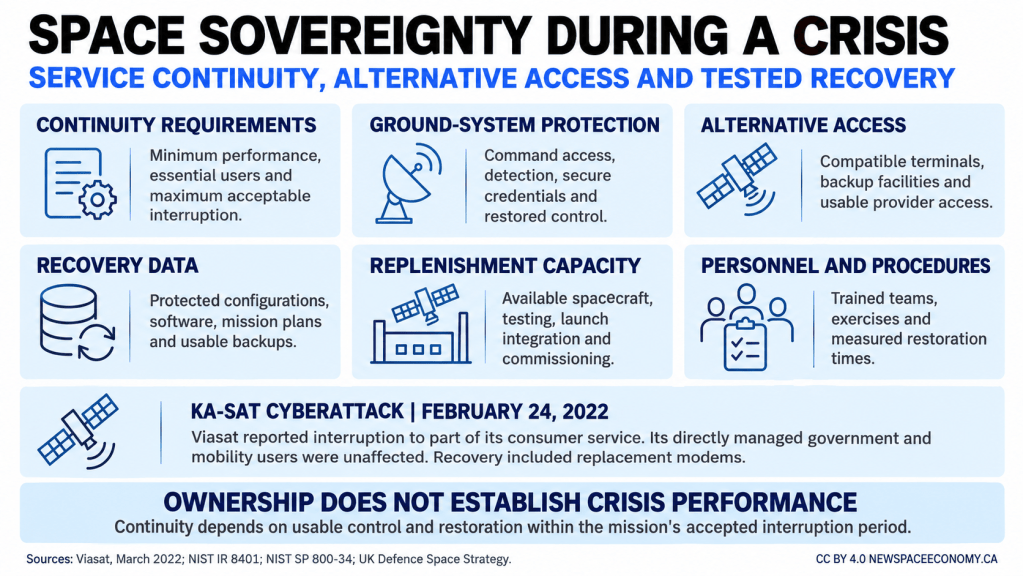
On February 24, 2022, a cyberattack interrupted part of Viasat’s KA-SAT consumer satellite broadband service. The company’s incident account reported affected customers in Ukraine and other European countries. It also stated that its directly managed government and mobility users on KA-SAT were unaffected. The incident demonstrates why assessments of space sovereignty must examine the specific service, network partition, and recovery arrangements involved.
A country can possess spacecraft and still lose access to the service they support. Ground equipment, user terminals, software, telecommunications connections, and operating personnel all contribute to delivery. Maintaining space sovereignty during a crisis requires evidence that essential functions can continue, or that they can be restored within an acceptable period. National ownership does not supply that evidence by itself.
The starting point is a defined continuity requirement. Government communications, military observation, weather information, and positioning can tolerate different levels of interruption. Authorities need to identify the minimum acceptable performance, affected users, geographic coverage, and maximum outage. A crisis assessment then tests the complete service against those requirements. Counting surviving satellites without measuring service delivery can produce an incomplete result.
The KA-SAT incident also illustrates the distinction between an orbital asset and access through a network. Viasat reported no evidence that the satellite itself had been impaired or compromised. Recovery included replacement modems for customers whose equipment could not be restored efficiently through updates. That operational account shows that terminal availability and distribution arrangements can determine restoration even when spacecraft replacement is unnecessary.
Cybersecurity must cover the facilities that command and manage space systems. The NIST satellite ground-segment report, published in December 2022, applies its cybersecurity framework to satellite command and control. Protecting these functions involves the ground environment and its connections. A sovereignty assessment consequently needs to examine who controls privileged access, how unauthorized activity is detected, and how legitimate control can be restored.
Radio interference creates a different problem. Jamming disrupts reception through interfering signals; spoofing presents deceptive signals that can produce incorrect information. Alternative communications paths, suitable receivers, and operational procedures can reduce particular exposures, but their effectiveness depends on the service and threat. A backup that uses the same vulnerable connection may provide less independence than its separate ownership suggests.
Physical disruption can affect control facilities, gateways, power, and terrestrial telecommunications. A backup site contributes only if it has the equipment, connectivity, personnel, and authorization needed to operate the service. Geographic separation can reduce exposure to a local incident, but both sites may still depend on one network provider or software platform. Identifying shared dependencies is necessary to establish the actual degree of redundancy.
Alternative services must be integrated before they are needed. Terminals may require different equipment, credentials, network settings, or operating procedures to use another provider. Observation data may arrive in a format that national processing systems cannot immediately handle. Compatibility assessments and exercises can reveal these problems. A contract for additional capacity and a demonstrated ability to use that capacity are separate forms of evidence.
The UK’s Defence Space Strategy provides a policy example of combining ownership, collaboration, and access. Partnerships can distribute costs and provide additional capacity. Their crisis value depends on agreed responsibilities and available resources. National requirements can compete with a partner’s domestic needs or other customers’ demands, making access conditions and priority arrangements relevant to continuity.
Commercial agreements also need an operational assessment. Reserved capacity, restoration obligations, technical support, data access, and termination arrangements can support continuity, subject to the applicable contract. However, an agreement cannot produce unavailable equipment or prevent every physical disruption. Authorities need evidence about the provider’s facilities and recovery capability, together with a plan for conditions in which contractual remedies would arrive too late.
Data recovery introduces another requirement. Operators may need configuration records, mission plans, software, authentication information, and analytical archives to restore a disrupted service. Protected backups need to be usable by authorized personnel in the recovery environment. Restoring compromised configurations without resolving their weaknesses can recreate the original problem. Technical recovery must be accompanied by confirmation that the restored system can perform its required function.
The NIST contingency-planning guidance connects information-system recovery with broader emergency planning and system life cycles. For space services, that relationship supports testing recovery procedures, defining responsibilities, and maintaining plans as systems change. Exercises should establish which functions were restored and how long restoration took. A written plan without evidence of execution leaves the required continuity unresolved.
Loss of a spacecraft can create a longer recovery process. Replenishment may require available hardware, testing, launch integration, a suitable vehicle, and commissioning after deployment. Launch capacity alone does not establish recovery time. Neither does a spare spacecraft that lacks a compatible launch opportunity. Production and deployment arrangements must be assessed together against the duration of interruption that authorities can accept.
Workforce availability affects every response. Staff who can operate the normal system may need additional training for backup facilities or emergency procedures. Engineers must also be able to diagnose problems and verify changes. Related coverage of national control explains why technical knowledge and operational arrangements contribute to usable autonomy. Dependency on one external support team can remain consequential even when equipment is nationally owned.
Assessment scenarios need to distinguish an isolated outage from a prolonged regional disruption. A provider may restore one failed gateway using spare capacity elsewhere, yet have fewer options when several facilities or customers are affected together. Reporting the tested conditions prevents a successful limited exercise from being treated as proof of performance under a different crisis.
Sustained readiness requires spending on exercises, support, spares, software maintenance, and replacement plans. Some services may need national infrastructure; others may achieve acceptable continuity through several providers or allied arrangements. The appropriate choice follows from tested performance and the consequences of interruption. Space sovereignty during a crisis is demonstrated when national authorities retain usable decision-making authority and can maintain or restore the required service within the period established for that mission.
Useful Books Available on Amazon