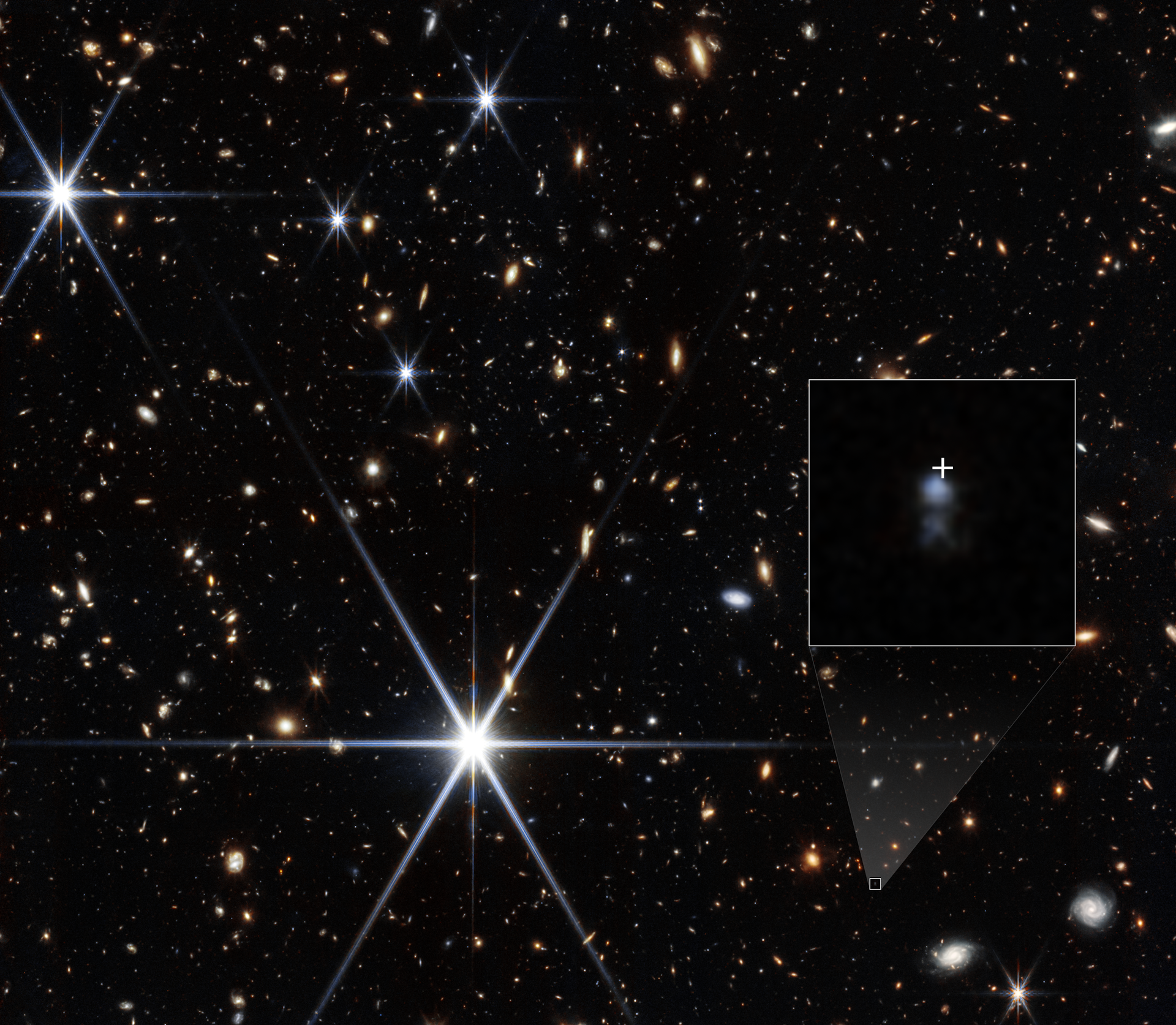
More than 10 billion years ago, something in a distant galaxy gave off an incredibly bright burst of radio waves which lasted just a few milliseconds.
In new research published today in Science, our team tracked it back to its origin in a small galaxy filled with many young stars, when the universe was only one-fifth of its current age.
Fast radio bursts like this one are a mystery scientists have been trying to unravel for almost 20 years since they were first discovered. Our discovery is the most distant such burst whose host galaxy has yet been identified.
Finding a radio signal from 10 billion years ago
We detected the burst, dubbed FRB 20240304B, with the MeerKAT radio telescope in South Africa, using a system called MeerTRAP which is designed to catch fast-changing transient radio signals from space in real time.
The different frequencies of the radio burst arrived at slightly different times. We call this effect “dispersion”, and it happens because the signal has travelled through a lot of electrically charged material in space on its journey to Earth.
By measuring the amount of dispersion, we can tell how much of this material the signal has passed through – which in turn lets us calculate how far the signal has travelled and how far away from us it was created.
The FRB 20240304B burst showed a large amount of dispersion, which suggested it was probably coming from a great distance. We were also able to pinpoint its position on the sky.
But when we looked at that position with large ground-based telescopes like the Keck Telescopes, we couldn’t see a host galaxy. The galaxy was simply too faint.
So we turned to the James Webb Space Telescope (JWST). The space telescope’s infrared camera revealed a tiny galaxy very close to the position of the fast radio burst.
We then broke down light from the galaxy into the spectrum of different frequencies that made it up. We know what part of this spectrum “should” look like, and seeing how those frequencies have changed lets us calculate how fast the galaxy is moving away from us due to the expansion of the universe – which in turn lets us figure out how old it is.
These calculations confirmed that we were looking at a galaxy 10.6 billion years ago.

A surprisingly small galaxy
The host galaxy itself was another surprise.
It contains only about 10 million times the mass of our Sun, which is a tiny fraction of the mass of our own Milky Way galaxy. The host galaxy appears to be a young galaxy still forming many stars, with a very low amount of metal content, and very different from many of the larger galaxies in which most other fast radio bursts have been found.

This is consistent with one theory about the source of at least some fast radio bursts – that they are produced by young, highly magnetised neutron stars called magnetars.
At the same time, fast radio bursts come in different shapes and sizes, we don’t think all of them necessarily have the same kind of origin.
However, observations like ours give us another piece of the puzzle. By studying the host galaxies and the environments of fast radio bursts across cosmic time, we can start to understand which types of galaxies and stellar environments produce them.
A cosmic flashlight
The most exciting thing about this discovery may not be the distance itself.
As the radio signal made its way to Earth, it picked up the imprint of everything it passed through, bearing a record of the magnetic fields, changes in the space environment, and turbulence that it encountered. This makes it a gold mine of information about the cosmos that is otherwise difficult to access.
This includes how electrons are distributed through the cosmic web, as well as information on magnetic fields that pervade the universe. As the signal encounters magnetic fields along the way they subtly twist the orientation of its radio waves. By measuring this twist, we learn about the magnetic field complexities across many billions of light years.
FRB 20240304B does more than tell us about one distant galaxy. It gives us a new data point for studying how electrically charged matter has been distributed through the universe over cosmic time, and also how magnetised the cosmos is.
Why this matters
Our discovery has shown for the first time that fast radio bursts were being produced all the way back to around 3 billion years after the Big Bang, during the period when the universe was most actively forming stars and galaxies. This lets us probe electrically charged matter across about 80% of cosmic history.
Finding fast radio bursts at such large distances is difficult because of the combination of detecting increasingly faint bursts and identifying galaxies that are themselves extremely faint.
The next step is to find many more.
With larger samples of distant fast radio bursts, we can use these brief flashes as cosmic signposts, revealing how matter is spread through the universe, how galaxies grow, and how the space between them changes over time.
Authors
Themiya Nanayakkara, Senior Lecturer in Astrophysics, University of Sydney
Manisha Caleb, Senior Lecturer in Astrophysics, University of Sydney
Disclosure statement
Manisha Caleb acknowledges support of an Australian Research Council Discovery Early Career Research Award (project number DE220100819) funded by the Australian government. Parts of this research were conducted by the Australian Research Council Centre of Excellence for Gravitational Wave Discovery (OzGrav), project number CE230100016.
Themiya Nanayakkara does not work for, consult, own shares in or receive funding from any company or organization that would benefit from this article, and has disclosed no relevant affiliations beyond their academic appointment.
Originally published by The Conversation. Read the original article.