
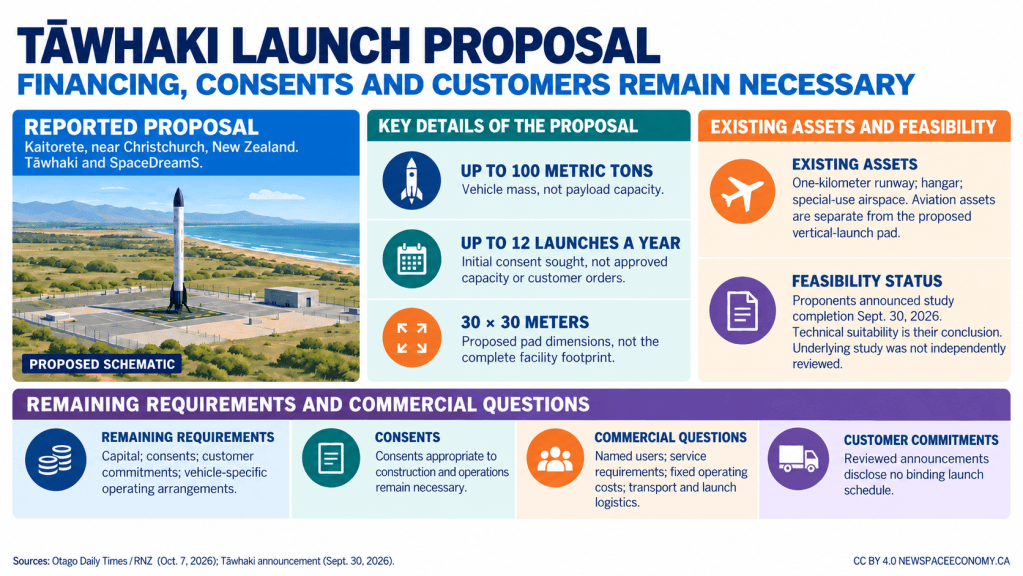
Reporting published on October 7, 2026, describes a proposed Tāwhaki spaceport near Christchurch New Zealand, intended to accommodate rockets weighing up to 100 metric tons. The Otago Daily Times article, carrying reporting by RNZ’s Phil Pennington, identifies an initial consent sought for up to 12 launches annually and a 30-by-30-meter launchpad. These are proposal parameters, not approved operating capacity.
Tāwhaki and France’s SpaceDreamS still need capital, consents, and customers for the planned vertical-launch facility at Kaitorete. The distinction between a favorable study and an operating spaceport is particularly relevant here. Existing aviation facilities support activity at the aerospace center, but they do not establish that the proposed rocket pad has been built, approved, or placed in service.
Tāwhaki’s September 30 announcement says a joint feasibility study found the site technically and operationally suitable for vertical launch. That conclusion comes from the project proponents. The underlying study was not directly available for review, so its assumptions, detailed analyses, and treatment of alternative designs cannot be independently assessed from the announcement alone.
The operator identifies an existing one-kilometer sealed runway, a hangar, and special-use airspace supporting advanced aviation activity. These assets can inform development planning. A runway supports a different operating environment from a vertical rocket launchpad. Their presence does not remove the need to assess the proposed launch vehicle, its ground equipment, and the consequences of its flight.
The reported 100-metric-ton limit refers to vehicle mass, not payload capacity. A rocket’s total mass includes its structure, engines, propellant, and payload. It cannot be used to infer the amount of equipment that a vehicle could deliver to orbit. The achievable payload also depends on the vehicle design and mission. Confusing these measures would substantially misstate the proposal.
The proposed 12 launches per year describe the initial consent being sought. They do not establish customer orders, a production schedule, or an achieved launch rate. Even an approved annual allowance would be different from actual use. A business assessment needs to connect permitted activity with named operators that have suitable vehicles and reasons to select the site.
New Zealand’s space regulatory regime distinguishes launch, facility, and payload authorizations. Its framework considers safety, international obligations, and national interests. These categories matter because a facility’s development and a particular mission do not present identical questions. An agreement between developers cannot replace the government decisions required for the intended activity.
The separate authorization categories also affect how responsibilities are assigned among a site owner, launch operator, and payload customer. Each party needs to establish which decisions apply to its activities. One favorable facility decision cannot be assumed to authorize every subsequent customer mission. The proposed operating model needs to identify the actor responsible for each requirement.
Local development consents are another matter from the space authorization framework. The project proponents’ statement that capital and consents remain necessary identifies unresolved work. It does not establish which approvals will be granted or when. A publication should describe completed decisions using the relevant authority’s record and retain proposed status for decisions still being sought.
The 30-by-30-meter pad gives a defined physical parameter, but it is not a complete description of the facility. Launch operations also require arrangements for preparing vehicles, managing hazardous activities, controlling access, and coordinating the mission. The final combination depends on the vehicles and services supported. A small pad footprint cannot be equated with the full area affected by construction or operations.
Environmental evaluation would also need to consider the actual operation rather than a general description of cleaner propellants. Different fuels have different handling, storage, and combustion characteristics. Claims about lower emissions need a defined comparison and evidence. A statement of environmental objectives does not establish the measured consequences of a facility that has not operated.
The operator’s announcement identifies Māori partners and the Crown in Tāwhaki’s ownership arrangements and connects aerospace development with care for the land. That institutional context is relevant to the project’s objectives. It does not allow commercial, environmental, and cultural outcomes to be assumed in advance. Each needs evidence appropriate to the outcome being assessed.
SpaceDreamS presents the project as part of wider international access to launch infrastructure. Location can affect the missions a site can support, but geographic suitability alone does not establish a competitive service. Vehicle availability, scheduling, transport logistics, prices, and permitted trajectories also affect customer decisions. A site’s commercial case must explain these relationships for specific intended users.
New Space Economy’s background on spaceport financial planning describes the difference between upfront facilities and continuing operating costs. The distinction applies before the first launch as well as afterward. Financing a pad does not automatically finance the staffing, maintenance, safety processes, and customer support needed between missions.
A phased investment decision can reduce uncertainty if each stage produces information useful to the next. A feasibility study can identify questions for design and consultation. A customer agreement can define required services. An approval can establish conditions under which operations may occur. None of these documents should be presented as evidence that the other stages have already been completed.
The available announcements disclose no complete construction budget, committed financing package, or binding customer launch schedule. The absence of those disclosures does not prove that the project cannot proceed. It limits what can be concluded about its timing and commercial prospects. Additional evidence would need to identify the commitments and their conditions.
Tāwhaki’s proposal now has a more specific intended scale, which allows subsequent decisions to be examined against defined parameters. The unresolved work is to translate that proposal into financed facilities, accepted operating arrangements, and contracted use. A vertical-launch spaceport becomes an operational asset when those requirements are satisfied, rather than when a feasibility conclusion or a proposed annual launch allowance is announced.
Useful Books Available on Amazon
