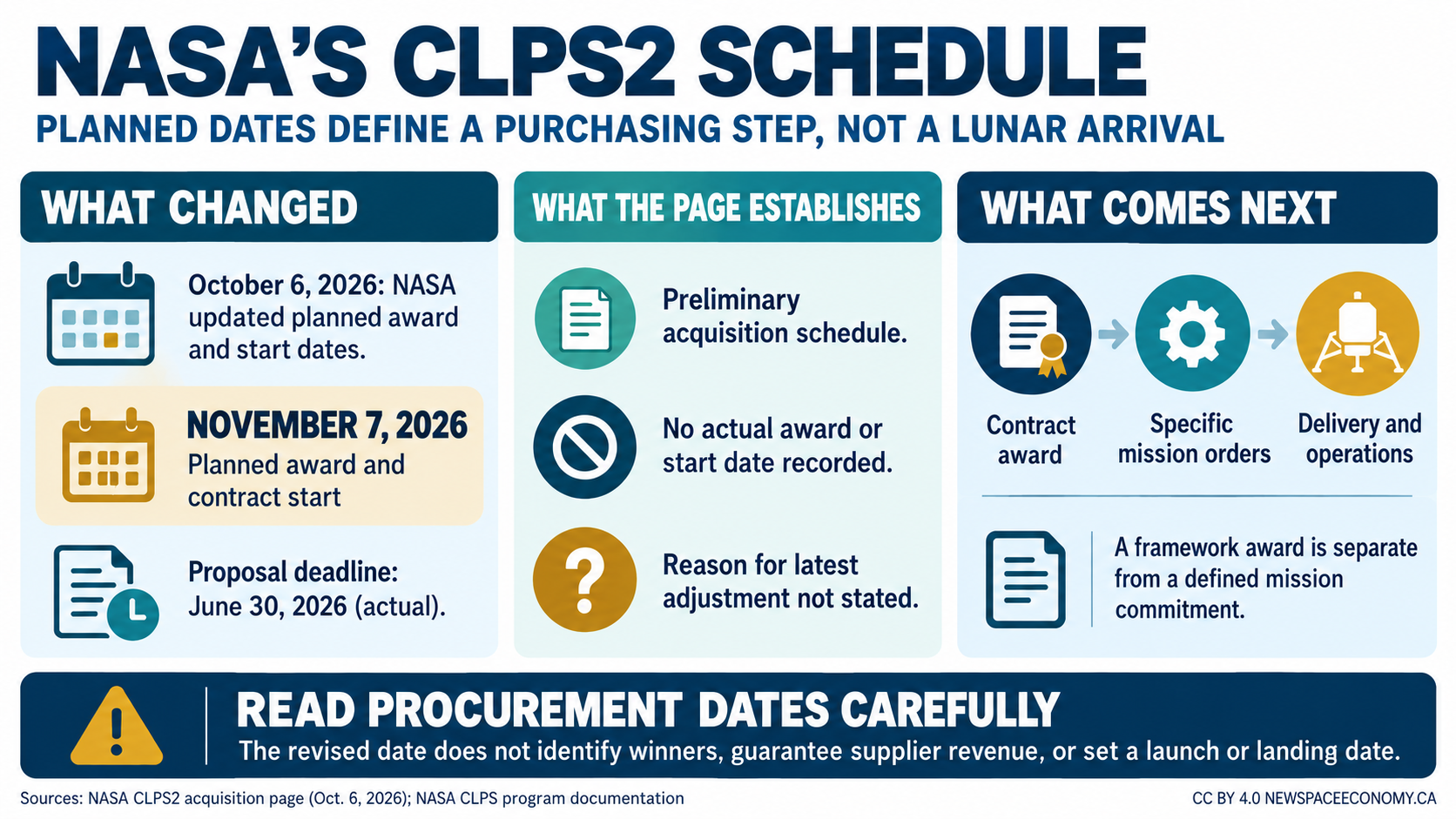
NASA revised its CLPS2 acquisition schedule on October 6, 2026, placing both the planned contract award and contract start on November 7, 2026. The change concerns Commercial Lunar Payload Services, the agency’s mechanism for purchasing commercial transportation for lunar science and technology. For companies and payload teams, the date identifies a procurement milestone to watch. It does not announce a contractor selection, a launch, or a lunar landing.
The distinction matters because commercial lunar delivery involves several separate commitments. Establishing a contracting arrangement creates a route for buying services. Ordering a particular mission defines the work NASA wants performed. Completing that mission requires hardware, launch, navigation, landing, and payload operations. Treating the first step as proof of the last would overstate what the October update establishes.
The CLPS2 acquisition page labels its milestone list a preliminary schedule. It records June 30, 2026, as the actual proposal deadline, but leaves actual award and start dates blank. Its change log also records planned-award updates on September 14 and September 22. The October entry supplies no explanation for the latest adjustment. Without an earlier verified schedule, the size of the latest movement cannot be established from the current page alone.
That limited disclosure still has practical value. A dated change log allows readers to distinguish an updated procurement expectation from an unchanged website. It also establishes which information NASA has chosen to make public. The absence of an actual award entry supports a narrow conclusion: this page does not document a completed award. It cannot establish whether every internal evaluation step has finished or identify the reason for the revised target.
NASA’s CLPS program description explains the broader purchasing model. Commercial providers handle end-to-end delivery activities, including payload integration, launch, landing, and mission operations. The existing contracting framework is an indefinite-delivery, indefinite-quantity arrangement, meaning the framework supports orders whose specific work is defined separately. Its stated combined maximum is $2.6 billion through November 2028. That ceiling belongs to the existing framework; the October schedule revision does not establish a new CLPS2 value.
A contract ceiling also differs from revenue already earned. It describes an upper boundary for purchases under an arrangement, rather than money guaranteed to an individual supplier. Readers evaluating a lunar company need to distinguish eligibility to compete, an awarded order, funding committed to that order, and payments associated with performance. Those distinctions help prevent a procurement announcement from being converted into an unsupported sales forecast.
The scientific purpose provides another reason to separate the stages. NASA’s lunar science explanation describes buying capabilities such as delivery, mobility, and survival through the lunar night instead of developing every spacecraft directly. Transportation is a means of obtaining measurements or demonstrating technology. A contracting milestone becomes scientifically meaningful when it connects to a defined investigation and a credible delivery plan, with suitable operating conditions at the destination.
For a payload team, the relevant planning questions extend beyond the name of a selected provider. Instruments must fit the available mass, power, communications, and operating constraints of a mission. Their value may depend on where they land and how long they operate. A revised award target may inform planning, but it does not answer those questions. Teams need the applicable solicitation, order, and interface requirements before treating a delivery opportunity as sufficiently defined.
The procurement calendar is also separate from a mission manifest. Readers should look for an identified payload, destination, and delivery obligation before assigning a lunar arrival date. An anticipated contract start provides no basis for calculating when an instrument will begin collecting data.
Commercial implications extend to the suppliers behind the lander. New Space Economy’s coverage of the CLPS supplier market explains how delivery providers draw on integration, communications, power, and mission services. A new procurement can create opportunities along that chain. The October revision does not name subcontractors or disclose purchases from them. Any estimate of downstream business would require evidence beyond the milestone calendar.
Past oversight gives useful context for evaluating future promises. In its June 2024 CLPS audit, NASA’s Office of Inspector General reported $208.2 million in initiative cost increases and average delays of at least 14 months per task order. The audit examined earlier work, with important financial comparisons dated February 2024. Those findings describe that historical portfolio, rather than the performance of contracts that might be awarded under CLPS2.
The inspector general identified pressures arising from ambitious schedules, changing NASA requirements, and vendor development and supply problems. That history suggests a useful test for the next procurement: whether delivery expectations, technical maturity, and government responsibilities fit together. It does not prove that the same problems will recur. A revised administrative date, by itself, supplies no evidence that a future lander has encountered a technical failure.
For NASA, purchasing an outcome still requires deciding what evidence is sufficient to accept the service. More government involvement can improve visibility into risk, but requirements and oversight can also affect the provider’s workload and cost. The commercial model depends on making those responsibilities understandable before performance begins. The relevant issue is how the contract allocates decisions and obligations, rather than whether a schedule uses the word commercial.
For industry observers, the next meaningful evidence will come from award documentation and specific mission commitments. Those records can identify selected organizations, contractual scope, and the terms under which services will be ordered. Later performance records can show whether delivery promises become operational results. Each answers a different question, and each deserves its own date rather than being folded into one announcement.
NASA’s revised CLPS2 schedule gives the lunar delivery sector a new preliminary procurement target. Its significance lies in the expected timing of a purchasing decision, with the reasons for the adjustment undisclosed. The development becomes a stronger indicator of commercial opportunity when an award defines who can provide services and subsequent orders establish what NASA will actually buy.
Useful Books Available on Amazon