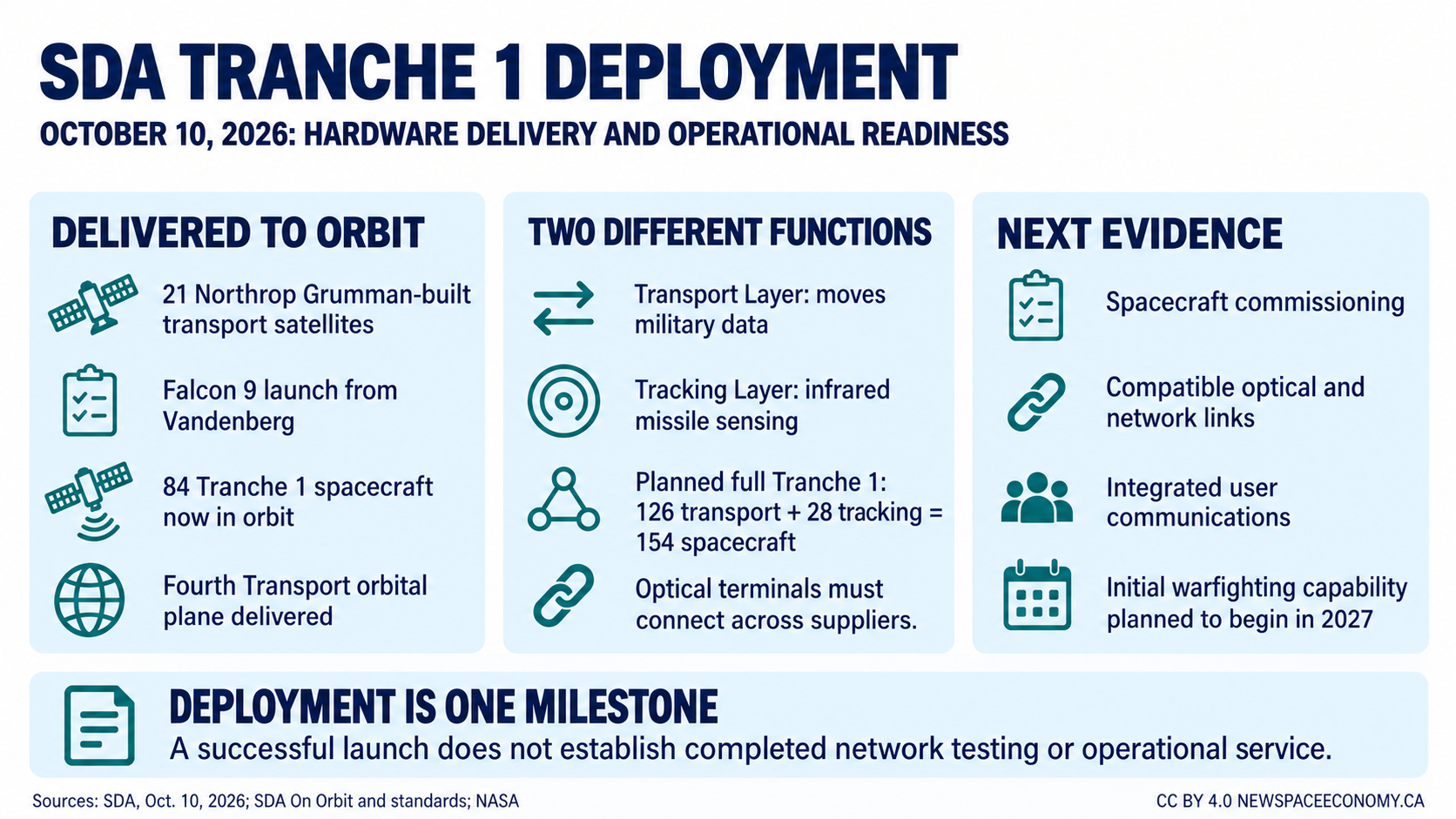
The Space Development Agency added 21 Northrop Grumman-built satellites to its Tranche 1 network on October 10, 2026. A SpaceX Falcon 9 delivered them from Vandenberg Space Force Base in California, bringing the announced Tranche 1 orbital total to 84. The launch supplies more of the hardware intended to carry military data between sensors, command systems, and deployed users.
The immediate achievement is delivery to orbit. SDA’s launch announcement places the beginning of Tranche 1’s initial warfighting capability in 2027. Establishing communications, checking spacecraft systems, and demonstrating network performance remain distinct from a successful launch. The practical question is how these additional spacecraft contribute to a working communications service.
Tranche 1 is an increment of the Proliferated Warfighter Space Architecture, the agency’s layered satellite system. “Proliferated” describes an approach that distributes functions across many spacecraft. “Tranche” identifies a planned delivery increment. The October mission delivered the fourth Tranche 1 Transport orbital plane, meaning a group of spacecraft sharing an orbital orientation. The initial October 5 attempt had stopped before liftoff when Falcon 9’s automated systems halted the countdown.
The distinction between transport and tracking explains what these satellites contribute. According to SDA’s Tranche 1 configuration, Transport spacecraft carry communications equipment, including Link 16 tactical data links. Tracking spacecraft carry infrared sensors for missile warning and tracking. Transport satellites move information; they should not automatically be described as missile-detection satellites merely because the larger architecture supports missile defense.
The planned full Tranche 1 constellation comprises 154 operational spacecraft: 126 for transport and 28 for tracking. Those totals describe the intended completed system, rather than the number already providing service. They also show why one successful deployment cannot establish completion of the architecture. Different spacecraft types perform different jobs, and the combined system requires connections between them and its users.
SDA’s procurement history shows that integration was part of the original requirement. In February 2022, the agency announced approximately $1.8 billion in Transport Layer agreements with York Space Systems, Lockheed Martin Space, and Northrop Grumman Strategic Space Systems. Each supplier was assigned two orbital planes. The stated objective was an interconnected communications network, with suppliers responsible for demonstrating effectiveness as well as building spacecraft.
The original announcement anticipated readiness for launch by September 2024. That historical date should remain separate from the October 2026 delivery and the current 2027 capability objective. A procurement schedule records an expectation at a particular time; a launch records completed hardware delivery. Comparing them establishes that the program’s timing changed, but does not by itself identify the causes or assign responsibility for each change.
Optical communications provide one of the main technical connections within the architecture. These systems encode information onto laser light and direct it toward another terminal. NASA’s optical communications overview explains that narrow beams can support high data rates, but require accurate pointing. The benefit comes from carrying more information through a link, rather than making light travel faster.
Pointing requirements matter because a terminal must direct its beam toward a moving receiver. A functioning transmitter and receiver are necessary, but their ability to establish and maintain a connection determines whether data actually passes between spacecraft. This makes network testing different from checking whether individual satellites respond to commands. A collection of healthy spacecraft is only one prerequisite for a usable service.
Interoperability adds another requirement. SDA publishes optical and networking standards to define how equipment from different suppliers connects to the architecture. The optical standard addresses terminal compatibility; the NEBULA networking standard addresses the network through which data moves. Their separate roles reflect the difference between establishing a physical connection and managing the information carried over it.
For the industrial base, that approach creates both opportunities and obligations. A supplier that builds compatible equipment can participate in a system containing other manufacturers’ spacecraft. Government buyers can also seek competing proposals without designing every increment around one supplier’s proprietary interfaces. These are potential benefits of standardization, not evidence that every combination of equipment has already passed operational testing.
The demand extends beyond complete satellites. Optical terminals, processors, software, ground equipment, test facilities, and launch integration all contribute to the delivered service. New Space Economy’s examination of SDA’s laser-link integration risks describes why production schedules and demonstrations must be assessed together. Producing hardware repeatedly can support deployment, but unresolved interfaces can affect several spacecraft or delivery increments.
Postlaunch commissioning supplies another category of evidence. NASA’s small-satellite commissioning guidance identifies early needs such as establishing communications, maintaining power, and recovering from unexpected conditions after deployment. Those are general spacecraft requirements, not a report of problems with this Northrop Grumman batch. They explain why a launch announcement cannot substitute for subsequent information about spacecraft health and readiness.
Network acceptance must then connect hardware performance to military requirements. Relevant evidence includes whether users can exchange data through the intended interfaces, whether links remain available under specified conditions, and whether the system meets its required timing. These are evaluation questions derived from the architecture’s stated purpose. Public reporting of a satellite count does not answer them.
The same distinction applies to resilience. Distributing communications among more spacecraft may provide alternative routes, but the usefulness of those alternatives depends on compatible terminals, network control, and available ground connections. A larger orbital inventory is an input to that design. That requires evidence about the network as a whole, including its supporting systems. The operational outcome is continued delivery of the required service when part of the system becomes unavailable.
The October launch increases the hardware available for that work. Its significance will become more measurable as SDA reports commissioning results, integrated communications demonstrations, and acceptance of operational capability. Until then, 84 spacecraft in orbit documents deployment progress; the ability to deliver dependable military data service remains the next result to establish.
Useful Books Available on Amazon