
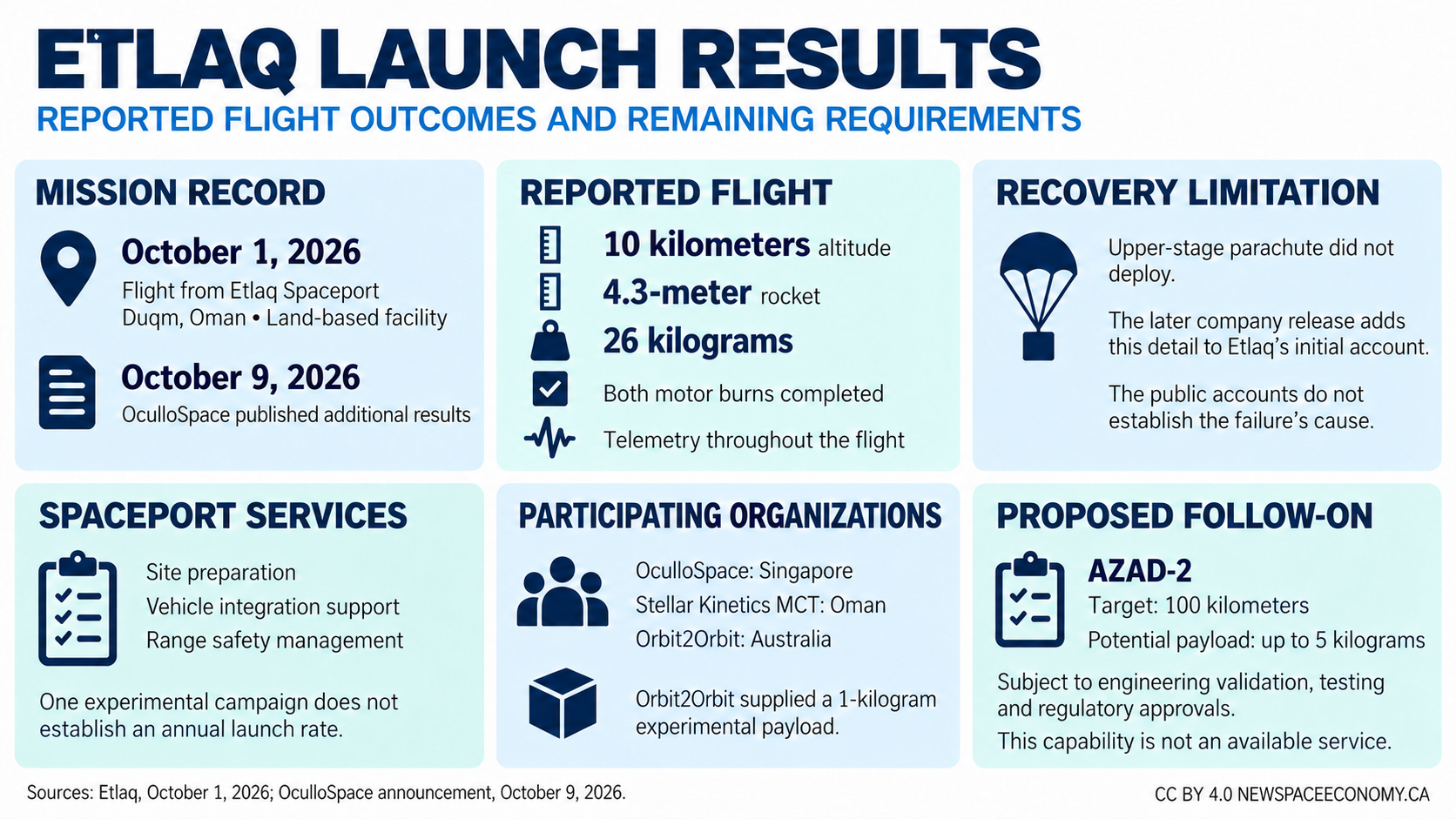
OculloSpace reported on October 9, 2026, that its AZAD experimental rocket reached an altitude of 10 kilometers during an October 1 flight from Etlaq Spaceport in Oman. The two-stage vehicle, named The Dreamer, completed both motor burns and transmitted telemetry throughout the flight, according to the company. Its upper-stage parachute did not deploy, making recovery performance a limitation alongside the reported propulsion and data results.
The flight demonstrates use of Etlaq Spaceport for an international experimental launch campaign. It does not demonstrate orbital launch capability or a flight to the commonly used 100-kilometer boundary of space. The commercial significance concerns the work required to host, integrate, and operate the test, together with the evidence available to support later missions.
OculloSpace’s October 9 announcement identifies the mission as Karman X1. The rocket measured 4.3 meters and weighed 26 kilograms. Singapore-based OculloSpace led the program, and Oman-based Stellar Kinetics MCT served as an engineering, manufacturing, and launch partner. Australia’s Orbit2Orbit supplied a 1-kilogram experimental payload, and Singapore’s WWG Engineering contributed coated material samples.
Etlaq’s own mission account, dated October 1, describes the campaign as part of its Genesis Program. The spaceport says its teams prepared the site, supported vehicle integration, and managed range safety. These are identifiable services provided to the mission, distinct from ownership of the rocket or responsibility for the payload’s scientific objectives.
The division of work matters when assessing a spaceport business. A launch site can support a vehicle developed elsewhere by providing operating procedures, infrastructure, and personnel. A vehicle developer remains responsible for meeting the conditions needed to fly its system. A payload organization has another task: specifying what must be measured or demonstrated. Completing a campaign requires those responsibilities to work together.
The two published accounts emphasize different aspects of the outcome. Etlaq describes a stable ascent and an upper stage that came down in the ocean. OculloSpace’s later release explicitly reports that the upper-stage parachute did not deploy. These statements should be read together. An ocean impact within the intended operating area does not establish that a planned recovery system performed correctly.
The company also attributes to Stellar Kinetics an assessment that most mission objectives were achieved. The public announcement does not provide a complete objective-by-objective test report or an independent assessment. The reported result supports specific claims about the flight, but it leaves the cause of the parachute failure and the required corrective work unresolved.
The timing of the announcements is relevant to that assessment. The October 9 release describes a flight already reported by the spaceport on October 1; it is additional information about the same mission, rather than evidence of another launch. Counting the announcements as separate flights would overstate utilization. Combining their details produces a more precise operational record, including both the completed burns and the recovery-system problem. Future reports would be more useful if they distinguished planned objectives, recorded results, and remaining investigations in the same account.
Recovery can have consequences beyond retrieving the rocket. NASA’s sounding rocket overview explains that recovering payloads can allow instruments and supporting systems to be used over multiple missions. It also describes sounding rockets as platforms for brief scientific flights that do not enter orbit. Depending on the experiment, transmitted data and recovered hardware can provide different kinds of evidence, so successful telemetry alone need not satisfy every mission requirement.
NASA’s experience provides context for the value of short flights without establishing equivalence to Karman X1. Its scientific sounding rockets can place instruments in regions difficult to study with satellites and test equipment before more expensive missions. The intended environment remains decisive. A payload tested during a 10-kilometer flight has not automatically been qualified for the thermal, vacuum, or duration requirements of an orbital mission.
Etlaq’s published site description points to an ocean downrange area and proximity to Duqm’s port, airport, and free zone. Those features can support transport and launch planning. They should not be treated as proof that every advertised launch class is already supported by completed facilities, approved operations, and qualified vehicles. The campaign evidence establishes the services used for this particular test.
The spaceport’s role can also be evaluated through repeated work. A second customer must be able to understand the applicable conditions, bring hardware to the site, complete integration, and obtain the necessary support. Experience from one mission can inform later procedures, but repeatability needs evidence from subsequent operations. An announcement that a test occurred cannot establish an annual launch rate or a dependable commercial schedule.
New Space Economy’s earlier examination of Etlaq’s commercial launch prospects distinguishes operational experience from sustained customer demand. That distinction remains relevant after the additional flight details. OculloSpace describes its rocket program as self-funded, but the announcement does not disclose the spaceport’s revenue, the campaign price, or contracts for a series of future launches.
Payload participation provides evidence of organizations willing to take part in a test. It does not establish the terms of their involvement or prove that a repeatable service is profitable. A commercial assessment would require information about what customers purchase, how often they return, and the resources needed to deliver each campaign. Those figures are not supplied in the public mission accounts.
OculloSpace proposes a follow-on vehicle, AZAD-2, targeting 100 kilometers and potentially carrying up to five kilograms of research payload. The company makes that capacity subject to engineering validation, testing, and regulatory approvals. These are future objectives. The first flight’s results can inform development, but the proposed increase in altitude and payload cannot be treated as an available service.
The practical next evidence is a documented response to the recovery failure, further flight results, and clearer terms for future payload missions. Etlaq has hosted a multinational team and supported an experimental launch. Establishing a broader commercial capability requires that operating experience to produce repeatable performance, defined customer services, and evidence that each proposed mission can meet its own requirements.
Useful Books Available on Amazon
