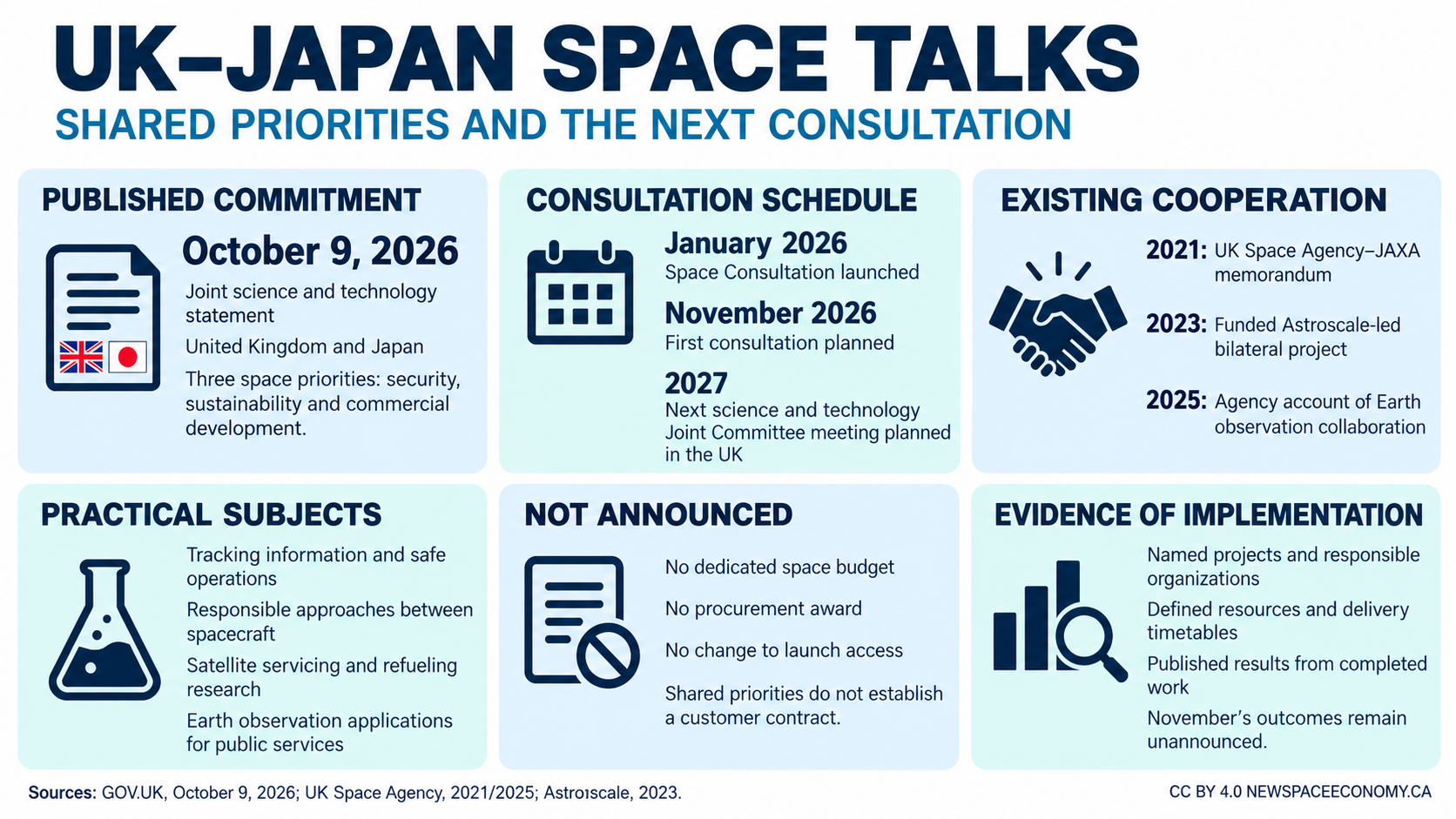
The United Kingdom and Japan identified space security, space sustainability, and commercial development as shared priorities in a joint statement published on October 9, 2026. Its accompanying fact sheet places those subjects within the UK–Japan Space Consultation, a mechanism launched in January 2026. The first consultation is scheduled for November, giving the statement a specific next step without establishing the decisions that meeting will produce.
For space companies and research organizations, the distinction between a diplomatic agenda and an operating program is consequential. The joint statement and fact sheet announce no dedicated space budget, procurement award, or change to launch access. They identify areas for cooperation and a forum through which officials can pursue them. Commercial opportunities would require subsequent decisions with clearer terms, responsibilities, and resources.
The statement followed the 13th meeting of the bilateral science and technology Joint Committee in Tokyo. Space appears among 15 areas in the fact sheet, alongside other scientific and technological subjects. The governments also plan to hold the next Joint Committee meeting in the UK in 2027. These arrangements provide opportunities to assess progress, but the existence of a meeting schedule does not demonstrate that a proposed project has been funded.
The relationship predates the current consultation. On June 25, 2021, the UK Space Agency and the Japan Aerospace Exploration Agency, known as JAXA, signed a renewed memorandum of cooperation. The agency described work involving research and development, exploration, and safe and sustainable space activity. The October 2026 statement is better understood within that continuing relationship than as the beginning of cooperation between previously separate national programs.
The 2021 announcement also recorded an implementing arrangement between JAXA and the UK’s Defence Science and Technology Laboratory for research on space situational awareness. That term refers to understanding objects and activity in space. Such information can support decisions about satellite operations and safety. The earlier arrangement provides an example of a defined activity beneath a broader diplomatic commitment, without establishing what new security work November’s consultation will approve.
Sustainability has similarly produced specific bilateral work. In August 2023, Astroscale announced a grant from the UK Space Agency’s International Bilateral Fund. The project involved Astroscale’s UK and Japanese businesses, Orbit Fab, and CGI. Its stated subjects included responsible behavior during close approaches between spacecraft, the use of tracking information to support those operations, and refueling in low Earth orbit.
Close approaches illustrate why technical development and policy discussions overlap. A servicing spacecraft must approach another object closely enough to inspect, repair, refuel, or remove it. Reliable information about the intended activity can help other operators interpret what is happening. Operational rules, data exchange, and the physical capability to perform a service address connected problems, although agreement on one does not automatically resolve the others.
The 2023 grant announcement proposed using JAXA’s ADRAS-J debris-inspection mission as a case study for responsible operating practices. That was the project’s stated plan at the time. It should not be converted into a claim that the October 2026 consultation has already adopted those practices as binding rules. The example instead shows how a bilateral program can bring companies, mission evidence, and policy questions into the same defined research activity.
Cooperation also concerns services delivered on Earth. A November 2025 agency account described UK Space Agency and JAXA collaboration through the Committee on Earth Observation Satellites. The account emphasized coordinating observations and connecting satellite information to users. It cited exchanges about public-service applications, including the UK’s Unlocking Space for Government program and Japanese examples involving carbon-credit programs.
Those activities identify a different route to commercial value from building additional spacecraft. Public bodies need data that can support a particular decision, and suppliers need to understand that decision before designing a service. Cooperation on applications can clarify demand and technical requirements. It still requires evidence that a service works for the intended user, and an arrangement for paying for continued delivery.
National institutions retain separate responsibilities throughout these partnerships. A science agency, a regulator, a defense organization, and a funding body do not exercise interchangeable powers. New Space Economy’s explanation of space governance structures provides background on those distinctions. For companies, identifying the responsible organization is necessary before treating a general statement of cooperation as a route to a license, research grant, or customer contract.
A joint project also needs a usable division of responsibility. Partners may contribute instruments, software, observations, testing facilities, or funding, and those contributions need not be identical. The practical question is whether their combined work meets a defined objective. Clear ownership of results and an agreed way to evaluate progress make a project more assessable than an open-ended expression of interest. These implementation details are the information needed to judge any additional work announced through the consultation.
The three priorities in the new fact sheet can overlap commercially. Satellite operators benefit from reliable operating conditions, and servicing companies need confidence that their activities can be understood and authorized. Research partnerships can help establish technical evidence. However, the published priorities do not specify which companies would qualify for support, how any competitive selection would work, or whether either government would buy a resulting service.
Concrete follow-up would make the consultation easier to evaluate. A named project, an identified implementing organization, a funding amount, or a published timetable would permit an assessment of delivery. A procurement notice would establish a different level of commitment from a statement that officials intend to explore cooperation. These are distinctions in the available evidence, rather than predictions that the consultation will produce any particular outcome.
As of October 10, 2026, the documented commitment is to pursue shared space priorities through an established bilateral consultation, with its first meeting scheduled for November. Existing agency agreements and funded collaborative work provide relevant experience. The unresolved issue is which additional activities will receive defined responsibilities and resources, allowing the next phase of cooperation to be assessed through completed work rather than the breadth of its stated interests.
Useful Books Available on Amazon