
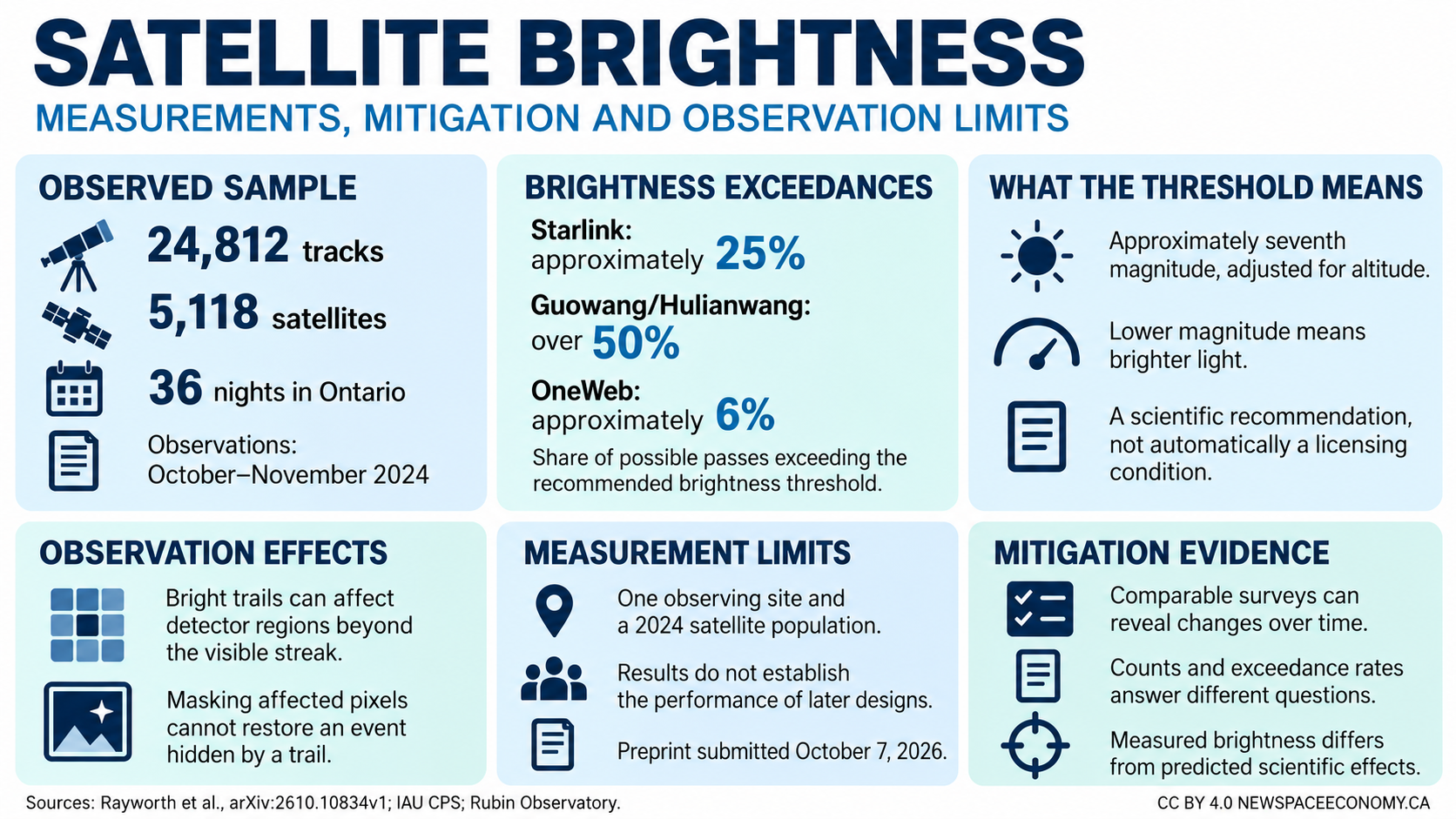
A satellite brightness study submitted to arXiv on October 7, 2026, reports observations of 5,118 satellites from Elginfield Observatory in Ontario. Researchers recorded 24,812 tracks during a 36-night campaign in October and November 2024. The measurements offer a way to evaluate how often satellite passes exceeded an astronomical brightness recommendation, rather than relying entirely on predictions about spacecraft designs.
The practical issue is the effect of reflected sunlight on astronomical observations. A communications satellite can provide its intended service and still leave a bright trail in a telescope exposure. Evaluating that interference requires information about brightness, orbital geometry, observation time, and the instrument receiving the light. The new research provides measurements of one observed population, with limits that matter when applying its findings to other locations or later satellite generations.
The research paper comes from Jack Rayworth, Denis Vida, and colleagues affiliated with Western University, the University of Oxford, and Defence Research and Development Canada. As of October 10, the repository identifies the submission as version one and states that it is under revision with Nature Astronomy. That description does not establish acceptance or publication by the journal. Its findings remain those of the authors of a publicly available preprint.
Six cameras collected the observations at a single northern-latitude site. Counting tracks and counting spacecraft answer different questions: one satellite can produce more than one recorded track. The study’s comparison also uses geometrically possible passes as its denominator. Its reported percentages should not be interpreted as the percentage of satellites in a constellation that permanently meet or fail a brightness standard.
Starlink exceeded the recommended threshold on approximately 25% of possible passes in the analysis. The corresponding figure exceeded 50% for the Guowang/Hulianwang group. OneWeb’s detailed results put its exceedance rate at approximately 6%. Those differences are relevant to mitigation, but they do not isolate the effect of any single design feature. Orbit height, spacecraft orientation, reflective surfaces, and viewing conditions all influence what an observer measures.
Astronomical magnitude describes apparent brightness using a scale on which a lower number means a brighter object. The threshold discussed in the paper is approximately seventh magnitude, adjusted for altitude. This is a scientific recommendation associated with the International Astronomical Union’s Centre for the Protection of the Dark and Quiet Sky from Satellite Constellation Interference. Exceeding it means appearing brighter than the recommended level. It does not, by itself, establish a violation of a licensing condition.
The IAU’s technical recommendations address more than surface color. They connect constellation design, operating practices, information sharing, and public tools for astronomers. This combination reflects the nature of the problem: operators control spacecraft design and orientation, but observatories need sufficiently accurate information to anticipate when objects will cross an exposure. A mitigation program can require changes on both sides.
A darkened satellite can still appear in a sensitive image. The objective of reducing brightness is to limit the severity of interference, rather than promise that every spacecraft becomes undetectable. New Space Economy’s background on constellation interference explains why commercial orbital infrastructure and astronomical instruments can compete for usable observing conditions even when they perform different services. Optical interference also differs from radio interference, which involves a separate set of emissions and receiver constraints.
Rubin Observatory’s assessment of satellite impacts explains that sufficiently bright trails can affect larger detector regions than the visible streak alone. Its processing software identifies affected pixels and flags potential contamination. Removing compromised measurements from a combined image can protect the reliability of the remaining data, but it does not restore an unobserved astronomical event behind a trail.
The distinction matters for short-lived events and moving objects. An observation at a particular moment cannot always be replaced with an equivalent exposure later. Repeated observations can help some research programs, but an interrupted measurement may still reduce the information available about a transient source. The economic consequence is best described as a potential loss of scientific use from existing infrastructure, rather than an assumed monetary loss that the study has not measured.
Observation timing changes exposure to the problem. Satellites can remain illuminated after the ground beneath them enters darkness, making twilight an important observing period for this research. The authors estimate that roughly one in three 30-second twilight exposures at Rubin could contain a trail under their modeled conditions. That is a prediction derived from their measurements, not a reported count of contaminated Rubin images.
A trail frequency is also not a direct measure of lost science. One affected exposure may retain useful information over most of its area, and different scientific analyses tolerate different kinds of contamination. Brightness, the location of the trail, detector behavior, and the processing method influence the result. A defensible impact assessment needs to connect observed interference to the particular measurement that an observatory is trying to make.
Absolute counts and percentages also serve different decisions. A large constellation can create many bright crossings even when its exceedance percentage is lower than that of a smaller group. An observatory concerned with scheduling needs the expected total traffic through its field. An operator assessing a design change needs a comparison that accounts for exposure opportunities. Reporting both avoids treating the largest raw count as proof of the brightest individual spacecraft, or a favorable percentage as proof of negligible combined interference.
The campaign’s dates impose another boundary. Observations from October and November 2024 cannot establish the performance of every spacecraft launched afterward. A company may alter its hardware, operational procedures, or orbital distribution. Comparing successive surveys with consistent methods would help distinguish a real improvement from a change in the mix of satellites being observed.
The study supports a narrower and useful conclusion: constellation brightness can be measured systematically, and outcomes differ across observed populations. Operators and observatories can use that evidence to evaluate mitigation against a stated threshold. Establishing whether newer deployments perform better requires further observations with clear denominators, comparable conditions, and reporting that separates measured brightness from predicted consequences for scientific work.
Useful Books Available on Amazon
