As an Amazon Associate we earn from qualifying purchases.

- Key Takeaways
- Why Is Blue Origin Developing New Glenn 9×4?
- How Much More Can New Glenn 9×4 Carry?
- How Will Thirteen Rocket Engines Work Together?
- Why Does the Larger 8.7-Meter Fairing Matter?
- How Would Reusability Affect New Glenn 9×4 Launch Costs?
- Which Commercial, Government, and Lunar Missions Could Benefit?
- What Does NASA’s September 2026 Contract Decision Actually Establish?
- What Have New Glenn’s First Three Flights and 2026 Setbacks Demonstrated?
- How Are Launch Infrastructure and Regulatory Requirements Changing?
- Where Could New Glenn 9×4 Fit in the Competitive Launch Market?
- Summary
- Appendix: Useful Books Available on Amazon
- Appendix: Top Questions Answered in This Article
- Appendix: Glossary of Key Terms
Key Takeaways
- New Glenn 9×4 is designed to carry 70 metric tons to low Earth orbit using a reusable nine-engine booster.
- NASA added the unflown rocket to its launch-services contract in September 2026 without awarding a mission.
- Its commercial success will depend on flight reliability, launch infrastructure, reusability, and customer demand.
Why Is Blue Origin Developing New Glenn 9×4?
On September 29, 2026, NASA added Blue Origin’s New Glenn 9×4 to its NASA Launch Services II contracting framework. The decision makes the planned super-heavy launch vehicle eligible for consideration in future NASA launch procurements, marking an important commercial development for a rocket that has yet to complete its first flight.
New Glenn 9×4 is the larger member of Blue Origin’s developing orbital launch vehicle family. Its designation describes the propulsion configuration: nine BE-4 engines on the reusable first stage and four BE-3U engines on the second stage. The existing New Glenn 7×2 uses seven first-stage engines and two upper-stage engines.
Blue Origin introduced the expanded configuration on November 20, 2025, one week after the original New Glenn completed its second flight and successfully recovered its first-stage booster. The larger design incorporates additional propulsion, increased payload capacity, a wider protective enclosure for spacecraft, and modifications intended to support more demanding missions.
The company is developing the 9×4 alongside the original 7×2 rather than replacing the smaller configuration. This distinction reflects differences in customer requirements. A launch vehicle capable of carrying exceptionally heavy spacecraft may be economically unnecessary for missions involving modest payloads, even if both rockets share substantial engineering and manufacturing infrastructure.
Blue Origin identifies commercial satellite constellations, national security missions, lunar transportation, and deep-space exploration as potential markets for the larger rocket. Each involves different requirements for payload mass, spacecraft dimensions, orbital destination, integration, and launch scheduling.
The 9×4 represents a planned expansion of launch capacity rather than a demonstrated replacement for existing launch services.
The development also builds on the longer New Glenn program. The rocket reached orbit for the first time in January 2025, achieved a successful booster landing in November 2025, and demonstrated booster reuse in April 2026. However, subsequent technical problems illustrated the difference between demonstrating selected capabilities and establishing reliable, routine commercial operations.
The earlier development and initial operational experience are examined in New Space Economy’s coverage of New Glenn’s entry into the market.
For Blue Origin, the principal question is whether larger payload capacity can attract enough commercial and government business to justify the additional engineering, launch infrastructure, and operating costs.
How Much More Can New Glenn 9×4 Carry?
The published New Glenn 9×4 specifications describe a rocket nearly 400 feet (approximately 122 meters) tall, considerably larger than the existing New Glenn 7×2, which stands more than 320 feet (98 meters) tall.
Its advertised low Earth orbit payload capacity is 70 metric tons, compared with 45 metric tons for the existing configuration. This represents an increase of approximately 56% based on the published figures.
Low Earth orbit generally refers to orbits extending from a few hundred kilometers above Earth to altitudes below approximately 2,000 kilometers. These orbits accommodate communications satellites, Earth observation spacecraft, research platforms, and other orbital infrastructure.
The figures below summarize the principal differences between the configurations. They describe the manufacturer’s published designs rather than demonstrated 9×4 flight performance.
| Specification | New Glenn 7×2 | New Glenn 9×4 |
|---|---|---|
| First-Stage Engines | 7 BE-4 engines | 9 BE-4 engines |
| Upper-Stage Engines | 2 BE-3U engines | 4 BE-3U engines |
| Fairing Diameter | 7 m (23 ft) | 8.7 m (28.5 ft) |
| Low Earth Orbit Capacity | 45 metric tons | 70 metric tons |
| Height | More than 320 ft (98 m) | Nearly 400 ft (122 m) |
The larger configuration’s performance is particularly significant beyond low Earth orbit.
Blue Origin advertises the ability to carry 14 metric tons directly to geostationary orbit and 20 metric tons onto a trans-lunar injection trajectory. Its November 2025 announcement described these capabilities as exceeding those rounded figures.
A geostationary orbit is approximately 35,786 kilometers (22,236 miles) above Earth’s equator. Satellites in this orbit remain above approximately the same point on Earth’s surface, making the orbit suitable for many communications and weather-monitoring applications.
Delivering a spacecraft directly to geostationary orbit differs from placing it into a geostationary transfer orbit, which requires subsequent propulsion maneuvers to reach the operational destination. Direct delivery can reduce the amount of propulsion equipment and fuel that a satellite must carry for orbit insertion.
Trans-lunar injection is a propulsion maneuver that sends a spacecraft from Earth orbit toward the Moon. Payload mass delivered onto this trajectory should not be confused with mass that can ultimately land on the lunar surface.
These distinctions matter because payload capacity is not a single universal measurement. A vehicle capable of carrying 70 metric tons to low Earth orbit cannot necessarily deliver the same mass to a much more distant destination.
The implications of increasing rocket performance and introducing new configurations are explored in New Space Economy’s examination of how New Glenn is evolving.
How Will Thirteen Rocket Engines Work Together?
New Glenn 9×4 uses two distinct propulsion systems, each intended for a different phase of flight.
Its reusable first stage will contain nine BE-4 engines. These burn liquid oxygen and liquefied natural gas, which consists primarily of methane. The first stage provides the substantial thrust required to lift the vehicle from the launch pad and accelerate it through the lower atmosphere.

Source: Blue Origin
According to Blue Origin’s engine specifications, each BE-4 produces up to approximately 640,000 pounds-force (2,846 kilonewtons) of thrust under its stated operating conditions.
The BE-4 employs an oxygen-rich staged combustion cycle. In simplified terms, the engine uses a high-pressure combustion process to power its machinery before sending the resulting gases into the main combustion chamber. This design supports high operating pressure and substantial thrust but requires demanding materials, valves, and control systems.
The BE-4 also powers the first stage of United Launch Alliance’s Vulcan rocket, providing Blue Origin with another application for the engine beyond its own launch vehicle.
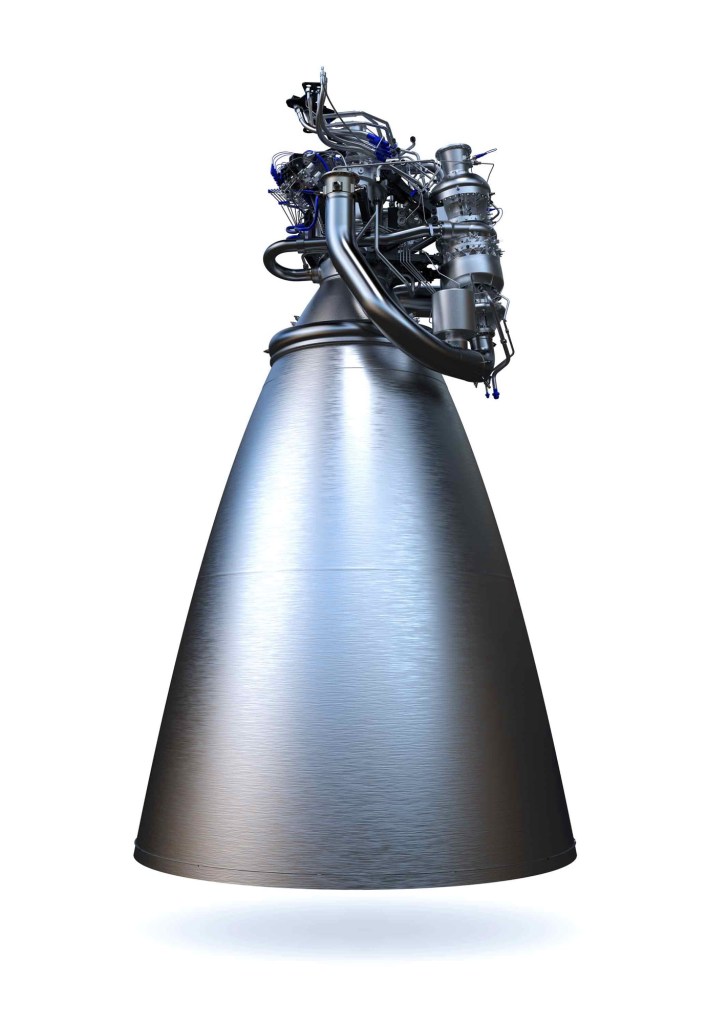
After the first stage separates, New Glenn’s second stage uses four BE-3U engines burning liquid oxygen and liquid hydrogen.
Source: Blue Origin
Hydrogen-powered rocket engines are particularly valuable for upper stages because their exhaust can deliver high efficiency. This helps spacecraft reach demanding orbital and interplanetary destinations, although storing extremely cold liquid hydrogen introduces additional design and operational requirements.
Blue Origin states that the four BE-3U engines will collectively generate more than 800,000 pounds-force (approximately 3,558 kilonewtons) of thrust.
The BE-3U is restartable, allowing an upper stage to perform additional burns after an initial coast period. This capability supports missions involving orbit adjustments, deployment into higher-energy trajectories, and precise delivery to customer-defined destinations.
Expanding from seven to nine first-stage engines and from two to four upper-stage engines also increases the number of components that must operate correctly.
Engine control, propellant distribution, thermal management, vibration, structural loading, and flight software must accommodate the expanded configuration. Performance demonstrated by an individual engine does not automatically establish the performance of an integrated stage.
The company must also verify how the enlarged stages respond to changing fuel loads, acceleration, and aerodynamic forces during flight.
In July 2026, NASA announced support for New Glenn second-stage testing at its Stennis Space Center in Mississippi. The agreement includes preparations for using the historic B-2 test stand, previously used for major NASA rocket-stage testing.
That agreement supports New Glenn propulsion development, but it should not be interpreted as confirmation that the four-engine 9×4 upper stage has completed qualification testing.
The distinction between individual engine performance, stage testing, and completed orbital missions remains important when evaluating the larger rocket’s readiness.
Why Does the Larger 8.7-Meter Fairing Matter?

Rocket performance depends on the dimensions of a spacecraft as well as its mass.
The payload fairing is the protective structure surrounding a satellite or other cargo during the early stages of launch. It protects the payload from atmospheric forces, heating, and environmental exposure until the rocket reaches conditions where the fairing can be discarded.
New Glenn 7×2 has a 7-meter-diameter fairing, already substantially wider than the approximately 5-meter fairings used on many established orbital launch vehicles.
New Glenn 9×4 expands that diameter to 8.7 meters, approximately 28.5 feet.
Blue Origin reports a fairing volume of approximately 29,000 cubic feet (821 cubic meters), nearly 70% greater than the volume of the 7×2 configuration.
A larger enclosure can accommodate spacecraft that would otherwise require complicated folding mechanisms, divided structures, or multiple launches.
Communications satellites with large antennas, substantial solar arrays, or unusual structural dimensions may benefit from additional packaging room. The same applies to certain scientific observatories, orbital servicing equipment, space-station components, and lunar transportation hardware.
For satellite constellations, the fairing also provides room for larger deployment structures that hold multiple spacecraft during launch.
However, additional space inside a fairing does not automatically translate into more delivered satellites. The total usable payload depends on spacecraft mass, deployment-system mass, mechanical interfaces, separation requirements, electrical connections, and mission-specific safety constraints.
The fairing itself must withstand substantial aerodynamic loading during ascent. Its separation system must also operate reliably without damaging the payload or interfering with the rocket.
Larger fairings can create additional manufacturing, transportation, and handling requirements. Existing ground facilities may require modification to accommodate the increased diameter and height.
The combination of greater lift capacity and greater internal volume is more commercially meaningful than either specification alone.
A customer purchasing a launch service needs a rocket that can accommodate the spacecraft’s complete physical configuration and deliver it to the required destination.
The 9×4’s wider fairing expands the range of designs that could be considered, but each actual mission will still require payload integration and engineering verification.
How Would Reusability Affect New Glenn 9×4 Launch Costs?
Blue Origin designed New Glenn around recovering and reusing its first-stage booster.
The company states that the reusable 9×4 first stage is designed for a minimum of 25 missions. This is a design objective rather than a demonstrated service life.
The economic principle is that recovering a costly rocket stage allows its manufacturing expense to be distributed over multiple launches instead of charging the entire stage cost to one mission.
A reusable booster still requires substantial expenditure on fuel, inspections, maintenance, recovery operations, replacement parts, and ground infrastructure. The upper stage and other expendable hardware also contribute to mission cost.
The benefit depends on how frequently a recovered stage can be flown again and how much work is required between flights.
Blue Origin demonstrated an important part of this approach on November 13, 2025, when New Glenn’s second mission delivered NASA’s ESCAPADE spacecraft into the intended initial orbit and landed its booster on the recovery vessel Jacklyn.
That booster subsequently flew again on April 19, 2026, and completed another landing. The reuse demonstrated that a New Glenn first stage could survive recovery, refurbishment, relaunch, and a second landing.
The same April mission also suffered an upper-stage failure, emphasizing that successful booster recovery does not guarantee successful payload delivery.
New Space Economy previously examined the significance of New Glenn’s first successful booster landing.
For the 9×4, Blue Origin must establish whether the enlarged booster can achieve comparable recovery and refurbishment performance.
The company has also announced plans for improved thermal protection, more efficient manufacturing, lower-cost tank structures, and reusable payload fairings as part of its broader New Glenn development program.
These improvements could support lower recurring costs, but their eventual financial effect cannot be determined from technical announcements alone.
Blue Origin has not published a verified, standardized commercial launch price for New Glenn 9×4 that would permit a dependable comparison with its competitors.
Even a low advertised cost per kilogram can misrepresent the expense to customers when a mission uses only part of the rocket’s available capacity.
For example, a satellite weighing 10 metric tons does not automatically become cheaper to launch simply because a vehicle has a 70-metric-ton capacity. The customer must consider the actual mission price, delivery requirements, scheduling, and opportunities to share the launch with other payloads.
Broader evidence about launch economics is discussed in New Space Economy’s analysis of how space launch costs are changing.
The 9×4’s economic performance will ultimately depend on actual operating expenses, launch frequency, successful booster reuse, and the portion of each mission’s available capacity that customers purchase.
Which Commercial, Government, and Lunar Missions Could Benefit?
The immediate commercial argument for New Glenn 9×4 involves satellites that are too large, too heavy, or too numerous for less capable launch vehicles to transport efficiently.
Large communications constellations provide one possible market.
Amazon’s satellite internet system, now called Amazon Leo and previously known as Project Kuiper, requires repeated launches to deploy and replenish a substantial constellation in low Earth orbit.
In a 2026 deployment update, Amazon reported that it had secured 24 firm New Glenn launches and expected the rocket’s initial satellite missions to carry 48 spacecraft using the existing 7-meter fairing.
Those commitments demonstrate commercial demand for New Glenn launch services, but they do not establish a specific contractual commitment to use the 9×4 variant.
Additional mass capacity and a wider fairing could eventually support larger satellite batches. The feasibility would depend on the spacecraft, their deployment system, and the economics of each launch.
Large individual satellites represent another potential market. Spacecraft designed for direct-to-device communications, substantial radar systems, or complex scientific instruments can require considerable launch mass and physical volume.
The larger rocket could permit designers to reconsider compromises made to accommodate smaller launch vehicles. However, any reduction in spacecraft complexity must be weighed against the expense of the larger launch service.
Government demand also extends beyond conventional communications satellites.
National security spacecraft may have demanding requirements for orbit, structural dimensions, payload security, and schedule assurance. New Glenn 9×4 could provide additional capacity for such missions, provided it satisfies the relevant government requirements.
The lunar market introduces a different set of needs.
Blue Origin is developing its Blue Moon lunar landing systems to support cargo transportation and NASA’s Artemis human exploration program.
A launch vehicle capable of placing 20 metric tons onto a trans-lunar trajectory could support substantial cargo or spacecraft transportation toward the Moon. Nevertheless, this capability does not establish the mass that a particular lunar lander can deliver to the surface.
Lunar landing requires additional propulsion, navigation, guidance, power, and thermal-control systems.
Likewise, development of New Glenn 9×4 does not mean that every Blue Moon mission will use it. Specific mission architectures and launch assignments must be established separately.
The larger rocket could also support scientific missions heading beyond the Moon. Certain planetary spacecraft require substantial propulsion capability to escape Earth orbit, particularly when they must carry large instruments or additional maneuvering fuel.
Commercial orbital infrastructure presents a longer-term market.
Large space-station modules, servicing spacecraft, propellant depots, and industrial equipment could benefit from the ability to place heavier and wider structures into orbit.
These applications remain dependent on customer programs, financing, spacecraft development, and sustained operational demand.
The 9×4 addresses several potential market segments, but its advertised capabilities should not be interpreted as evidence that all these markets have already contracted for launches.
What Does NASA’s September 2026 Contract Decision Actually Establish?
NASA’s September 29, 2026, announcement provides an identifiable institutional development for New Glenn 9×4.
The agency added the vehicle to the NASA Launch Services II contract, commonly abbreviated NLS II, through a provision allowing additional launch services to enter the contracting arrangement.
NLS II is a multiple-award, indefinite-delivery/indefinite-quantity contracting structure. It permits NASA to select eligible launch services for future missions without creating a completely new overarching contract for every procurement.
The current contracting arrangement has an ordering period extending through June 2030 and an overall performance period extending through December 2032.
The on-ramp provision allows new providers to seek participation and existing providers to introduce vehicles not already included in their NLS II arrangements.
Adding New Glenn 9×4 means NASA can consider the service under this framework.
It does not mean NASA has purchased a particular launch, assigned a spacecraft, or confirmed a maiden-flight date.
The distinction matters because contracting eligibility and operational readiness are different milestones.
NASA’s Launch Services Program Office, based at Kennedy Space Center in Florida, manages these contracts. The framework can support missions across the agency’s human spaceflight, science, research, and technology activities.
The contracts also permit NASA to provide launch services for certain other government agencies, including the National Oceanic and Atmospheric Administration.
Participation in this contracting framework should not be confused with human-rating certification or authorization to carry astronauts aboard New Glenn.
Separately, the U.S. Space Force selected Blue Origin in April 2025 as one of three providers for the National Security Space Launch Phase 3 Lane 2 program.
That procurement serves a different government market, and Blue Origin’s selection should not be represented as an assignment of a mission to New Glenn 9×4.
Government launch customers assess more than advertised payload capacity. Mission assurance, engineering evidence, reliability, orbital precision, integration procedures, and launch-site readiness can influence procurement decisions.
For the planned 9×4, NASA’s inclusion is commercially relevant because it opens an established procurement pathway. Demonstrating the performance required to satisfy future customers remains a separate undertaking.
What Have New Glenn’s First Three Flights and 2026 Setbacks Demonstrated?
New Glenn’s flight history provides essential context for evaluating the 9×4 program.
The first New Glenn mission launched on January 16, 2025, successfully reaching orbit. The mission demonstrated the primary orbital capabilities of the original rocket, but its first-stage booster was lost during the attempted recovery.
The second mission launched on November 13, 2025, carrying NASA’s twin Escape and Plasma Acceleration and Dynamics Explorers spacecraft, known as ESCAPADE.
Blue Origin confirmed successful spacecraft deployment and booster landing. The recovery marked an important achievement for the company’s reusable orbital launch system.
On April 19, 2026, New Glenn completed its third launch, carrying AST SpaceMobile’s BlueBird 7 communications satellite.
The previously recovered first-stage booster flew a second time and successfully returned to the ocean recovery platform.
However, the upper stage did not deliver BlueBird 7 to its intended orbit. The spacecraft was left at an altitude too low to sustain its planned operations.
The Federal Aviation Administration subsequently required a mishap investigation.
On May 22, 2026, the FAA announced the investigation’s closure. The regulator reported that a cryogenic leak had frozen a hydraulic line, resulting in a thrust anomaly during the second-stage engine burn.
Blue Origin identified nine corrective actions. The FAA stated that the vehicle could return to flight provided the corrective actions were implemented and other licensing requirements were satisfied.
A separate setback occurred on May 28, 2026, during a ground hotfire test of another New Glenn vehicle at Launch Complex 36.
The incident severely damaged launch infrastructure and disrupted Blue Origin’s planned launch operations.
In an August 5 technical update, Blue Origin reported that investigators had traced the anomaly to the main oxygen valve of one BE-4 engine. Hardware recovery and inspections supported that finding.
The company described modifications to the valve and further testing intended to address the identified failure mechanism.
The April flight anomaly and May ground-test event involved different circumstances and should not be treated as one failure.
They demonstrate that reusable booster technology, upper-stage performance, ground infrastructure, and engine reliability must all function as an integrated launch system.
Blue Origin announced a goal of returning the 7×2 configuration to flight before the end of 2026. That was a company target, not confirmation of a completed return flight.
Importantly, Blue Origin also stated that it would not bypass the 7×2 configuration and move directly to the larger 9×4.
The developing 9×4 has not completed an orbital flight. Its projected capabilities remain engineering objectives requiring integration, qualification, launch testing, and operational demonstration.
How Are Launch Infrastructure and Regulatory Requirements Changing?
New Glenn 9×4 requires infrastructure capable of handling its greater height, propulsion configuration, payload enclosure, and associated launch operations.
On August 12, 2026, Blue Origin announced construction of Launch Complex 36B at Cape Canaveral Space Force Station in Florida.
The company designated LC-36B for New Glenn 9×4 and LC-36A for the existing 7×2 configuration.
This separation is intended to support both launch vehicles and provide additional operational capacity.
The infrastructure program also includes a Vertical Integration Facility for the larger rocket and a Payload Processing Facility intended to serve both New Glenn configurations and national security launch providers.
Payload processing is an important part of launch operations. Satellites and other spacecraft must be inspected, fueled where applicable, configured, and prepared for integration under controlled environmental and safety conditions.
The new launch facilities are intended to accommodate these activities and reduce operational conflicts between different customer missions.
Blue Origin has also announced changes to the method used to assemble and position New Glenn.
Following the May 2026 ground-test anomaly, the company described a hybrid horizontal and vertical integration approach.
Under this plan, rocket stages are joined horizontally inside the integration facility. The assembled vehicle is then moved to the launch pad and raised vertically using a crane. The payload is integrated after the vehicle has been erected.
The approach replaces the previous reliance on a transporter-erector that combined transportation and erection functions.
Blue Origin stated that it had already been developing a similar operational method for the 9×4 program before the May incident.
Using related procedures across both launch pads could simplify training, maintenance, and operational planning. The actual effects on turnaround times and launch frequency will depend on experience after implementation.
Regulatory approvals also constrain the number and type of missions that can be conducted.
According to the FAA’s New Glenn project information, Blue Origin’s existing vehicle operator license authorizes up to 12 New Glenn launches annually at Space Launch Complex 36.
The FAA has also published a draft environmental assessment concerning a proposed increase in launch activity at LC-36A.
A public meeting on that assessment was scheduled for October 22, 2026. A proposed increase should not be treated as an approved expansion of the launch license.
The assessment concerns the existing launch-site operations and does not, by itself, establish that every requirement for the planned 9×4 facilities has been satisfied.
Additional launch capacity will require the necessary technical, safety, environmental, range, and operational approvals.
Constructing two launch pads creates the physical possibility of more launch opportunities. It does not automatically guarantee that Blue Origin can conduct launches at the desired frequency.
Where Could New Glenn 9×4 Fit in the Competitive Launch Market?
New Glenn 9×4 enters a market in which payload capacity, flight frequency, mission reliability, and delivered cost determine much of a launch provider’s competitive position.
SpaceX has an established record operating reusable orbital rockets, including Falcon 9 and Falcon Heavy. Its Starship development program is pursuing substantially greater transportation capacity, with its ultimate commercial performance dependent on successful testing and operational maturation.
United Launch Alliance’s Vulcan Centaur serves commercial and government customers with different mission requirements. Europe’s Ariane 6 and other national launch systems also contribute to the international market.
New Glenn 9×4 would expand the number of commercially developed vehicles offering substantial heavy-lift or super-heavy-lift capability.
Its published 70-metric-ton low Earth orbit capacity exceeds the approximately 63.8-metric-ton maximum low Earth orbit payload rating SpaceX has published for an expendable Falcon Heavy configuration.
That comparison concerns advertised maximum performance, not equivalent operational conditions, customer pricing, recovery assumptions, or demonstrated reliability.
The launch market does not necessarily favor the vehicle with the largest maximum payload.
A satellite operator may prioritize a proven delivery record, a particular orbital destination, a fixed deployment schedule, or the ability to launch from more than one geographical location.
Government organizations may also consider assured access to space, national industrial capacity, supply-chain resilience, and independent launch alternatives.
The significance of these competitive dimensions is explored in New Space Economy’s New Glenn competitive landscape analysis and its comparison of New Glenn and Vulcan Centaur.
Other prospective heavy-lift launch providers face comparable questions about development costs, customer acquisition, and sustainable operations, as illustrated in the publication’s comparison of New Glenn and Nova.
The larger New Glenn could become attractive to customers seeking spacecraft designs that exceed conventional launch limits.
Its ability to conduct direct missions to high-energy destinations could also reduce the spacecraft propulsion burden for certain customers.
However, an expanded rocket requires a suitable market.
If payload demand does not support frequent launches, a large rocket’s manufacturing and operating costs may be distributed over relatively few missions. Conversely, a high launch rate can improve the use of infrastructure and reusable hardware, provided maintenance and production can support that frequency.
The availability of smaller launch vehicles also gives customers alternatives when they do not need super-heavy capacity.
Blue Origin’s strategy of retaining both New Glenn configurations addresses this problem by offering different payload capabilities within a related vehicle family.
NASA’s September 2026 contracting decision, the construction of LC-36B, and the company’s existing commercial launch commitments indicate meaningful institutional and commercial support for the broader New Glenn program.
They do not establish the eventual profitability, reliability, or launch rate of the larger configuration.
The important milestones for New Glenn 9×4 will include completion of its flight hardware, qualification of the four-engine upper stage, readiness of its dedicated launch infrastructure, a successful inaugural mission, demonstrated booster recovery, and subsequent customer deliveries.
Until those milestones are achieved, New Glenn 9×4 should be evaluated as a substantial planned expansion of orbital launch capability rather than an established commercial service.
Summary
Blue Origin’s New Glenn 9×4 is designed to extend the capabilities of its existing reusable orbital launch system through additional engines, a larger structure, and greater payload capacity.
The advertised specifications include 70 metric tons to low Earth orbit, 14 metric tons directly to geostationary orbit, and 20 metric tons toward the Moon. Its 8.7-meter fairing could accommodate spacecraft and deployment structures exceeding the dimensions supported by many existing launch vehicles.
NASA’s decision to include the 9×4 in its launch-services contracting framework provides a procurement opportunity, and Blue Origin’s construction of LC-36B establishes a dedicated infrastructure development program.
These developments must be considered alongside the company’s 2026 technical setbacks, the unflown status of the larger configuration, and the absence of demonstrated 9×4 operating costs.
Its eventual influence on the space economy will depend on whether the company can translate announced technical capabilities into reliable, competitively priced launch services that meet identifiable customer requirements.
Appendix: Useful Books Available on Amazon
- The Space Economy: Capitalize on the Greatest Business Opportunity of Our Lifetime
- The Space Barons: Elon Musk, Jeff Bezos, and the Quest to Colonize the Cosmos
- Rocket Dreams: Musk, Bezos, and the Inside Story of the New, Trillion-Dollar Space Race
- Rocket Billionaires: Elon Musk, Jeff Bezos, and the New Space Race
- When the Heavens Went on Sale: The Misfits and Geniuses Racing to Put Space Within Reach
- Reentry: SpaceX, Elon Musk, and the Reusable Rockets that Launched a Second Space Age
- Liftoff: Elon Musk and the Desperate Early Days That Launched SpaceX
Appendix: Top Questions Answered in This Article
What Is Blue Origin’s New Glenn 9×4?
New Glenn 9×4 is a planned super-heavy orbital launch vehicle developed by Blue Origin. It is an enlarged version of the company’s existing New Glenn rocket, incorporating nine first-stage engines and four second-stage engines. The vehicle is designed to transport larger spacecraft and heavier payloads to Earth orbit and destinations beyond Earth.
How Much Can New Glenn 9×4 Carry to Orbit?
Blue Origin advertises a payload capacity of 70 metric tons to low Earth orbit. The company also publishes capabilities of 14 metric tons directly to geostationary orbit and 20 metric tons onto a trans-lunar trajectory. These figures describe different mission destinations and should not be treated as interchangeable performance measurements.
How Does New Glenn 9×4 Differ From New Glenn 7×2?
The 9×4 incorporates two additional first-stage engines and two additional upper-stage engines. It also has a wider payload fairing, increased height, and substantially greater advertised payload capacity. The 7×2 is the existing flight-tested configuration, whereas the 9×4 remains under development and has not completed its inaugural orbital mission.
Has New Glenn 9×4 Completed a Launch?
No completed orbital launch of New Glenn 9×4 was established as of October 9, 2026. Blue Origin’s three New Glenn launches through that date used the original seven-engine booster and two-engine upper-stage configuration. The company’s larger rocket requires further development, qualification, launch infrastructure, and flight testing before its performance can be demonstrated.
Why Does New Glenn 9×4 Use Two Different Rocket Engines?
The BE-4 engines on the first stage provide the substantial thrust needed for liftoff and early ascent. The BE-3U engines on the second stage use liquid hydrogen and liquid oxygen to provide efficient propulsion in space. This combination supports the separate requirements of atmospheric ascent and high-energy orbital missions.
Will the New Glenn 9×4 Booster Be Reusable?
Blue Origin designed the larger rocket’s first stage for a minimum of 25 missions. The existing New Glenn program has demonstrated booster recovery and reuse, but that experience does not establish the operational lifetime of the enlarged booster. Actual reusability will depend on successful testing, inspection, refurbishment, and repeated flights of the 9×4 hardware.
Has NASA Awarded New Glenn 9×4 a Launch Mission?
NASA added the 9×4 service to its NASA Launch Services II contracting framework on September 29, 2026. This allows the service to be considered for future procurements. The announcement did not identify a specific spacecraft assigned to the rocket or constitute an order for a particular mission.
Could New Glenn 9×4 Launch Missions to the Moon?
The rocket’s advertised trans-lunar injection capability makes it potentially suitable for transporting substantial spacecraft and cargo toward the Moon. Blue Origin is also developing lunar landing systems for NASA’s Artemis program. However, the ability to reach a lunar trajectory does not establish how much cargo a particular lander can deliver to the surface.
What Is the Purpose of Launch Complex 36B?
Launch Complex 36B is being developed at Cape Canaveral Space Force Station to support New Glenn 9×4. Blue Origin has also announced additional vehicle integration and payload processing infrastructure. The new facilities are intended to accommodate the larger rocket and support operations alongside the existing New Glenn 7×2 launch site.
When Will New Glenn 9×4 Become Operational?
An independently confirmed inaugural launch date and operational service date were not established as of October 9, 2026. Blue Origin has announced the vehicle’s design, NASA contracting eligibility, and construction of supporting launch facilities. Operational service depends on completing development, securing the necessary approvals, and demonstrating successful flights.
Appendix: Glossary of Key Terms
Super-Heavy Launch Vehicle
A rocket designed to carry exceptionally large payload masses into space. Launch vehicle classification systems differ, but super-heavy generally describes rockets with low Earth orbit payload capacities of at least 50 metric tons. The classification concerns intended payload capability rather than operational reliability or commercial success.
Low Earth Orbit
An orbit around Earth at relatively low altitude, generally below approximately 2,000 kilometers. Low Earth orbit accommodates communications satellites, scientific spacecraft, Earth observation systems, and space stations. Satellites in these orbits travel around Earth much faster than the planet rotates, often completing an orbit in roughly 90 to 120 minutes.
Payload Fairing
The protective enclosure surrounding a spacecraft during the early stages of a rocket launch. It shields the spacecraft from atmospheric pressure, heating, and aerodynamic forces. The fairing is typically separated after the rocket reaches conditions where this protection is no longer necessary.
Geostationary Orbit
A circular orbit approximately 35,786 kilometers above Earth’s equator in which a satellite completes one revolution in the same time Earth takes to rotate. This allows the satellite to remain approximately fixed over one geographical location, which is useful for communications and weather observation.
Trans-Lunar Injection
A rocket propulsion maneuver that places a spacecraft onto a trajectory departing Earth orbit toward the Moon. It provides the energy needed to begin the journey but does not include the subsequent maneuvers required to enter lunar orbit or descend to the surface.
Staged Combustion
A rocket engine operating cycle in which propellants pass through a preliminary combustion process to drive engine machinery before entering the main combustion chamber. The design can provide efficient, high-pressure operation, but its high temperatures, pressure requirements, and mechanical complexity create demanding engineering conditions.
Booster Reusability
The ability to recover a rocket’s first stage and prepare it for additional flights. Reusability can reduce recurring hardware expenditure, provided recovery and refurbishment costs remain manageable. Its economic value depends on the number of successful flights, maintenance requirements, operational availability, and the overall launch rate.
Hotfire Test
A ground test in which a rocket engine or integrated propulsion system operates with its propellants ignited. Hotfire tests are used to evaluate performance, engine controls, propellant delivery, structural behavior, and system integration. The test may involve individual engines, complete rocket stages, or assembled vehicles.
Launch Cadence
The frequency with which a launch provider conducts missions over a specified period. Launch cadence depends on rocket availability, payload readiness, regulatory permissions, maintenance, launch infrastructure, personnel, and customer demand. A high advertised launch capacity does not necessarily indicate that an operator can achieve a high launch frequency.