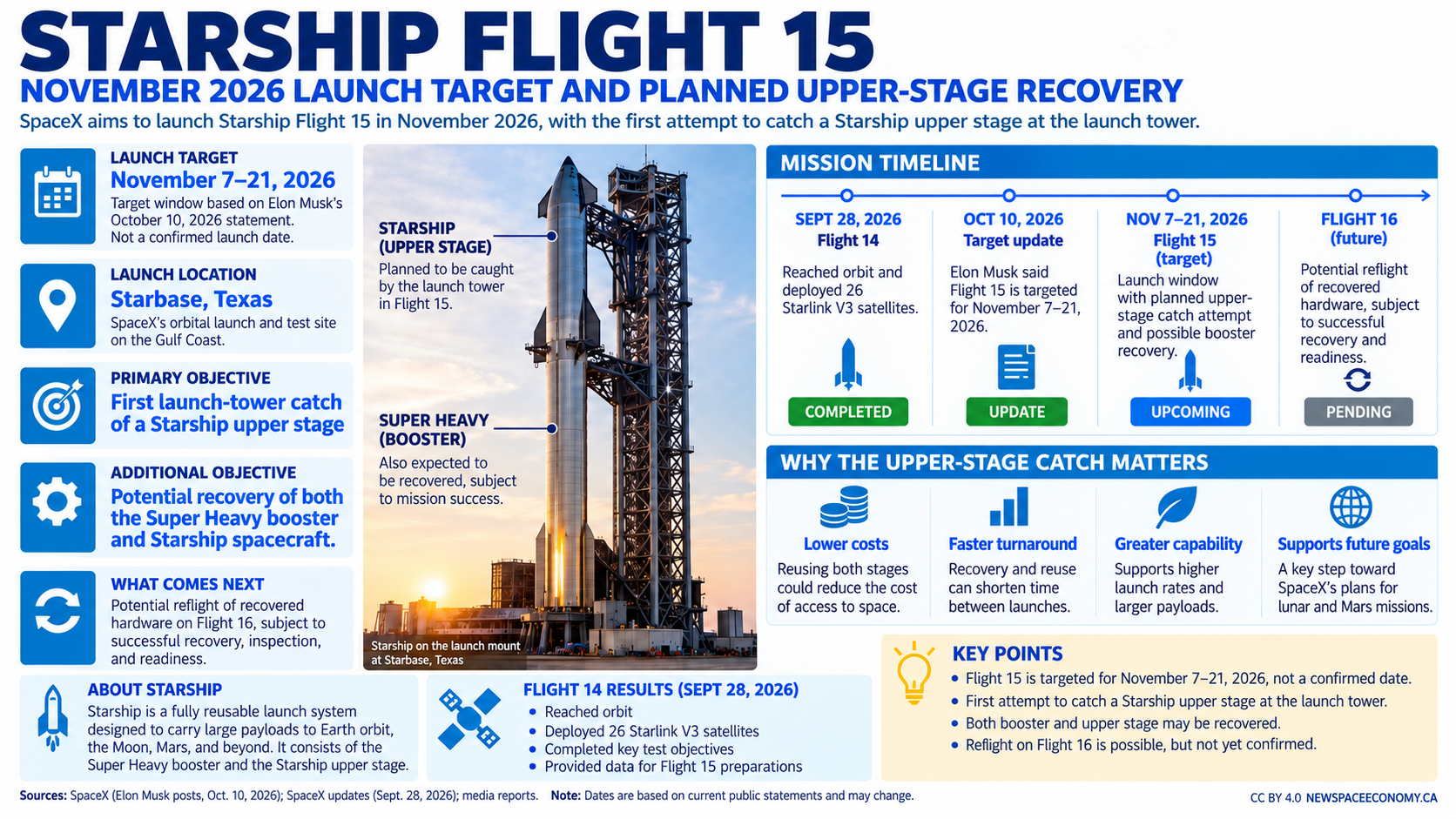
SpaceX is aiming to conduct Starship Flight 15 in November 2026 and attempt to recover its upper-stage spacecraft with the mechanical arms of a launch tower. On October 10, chief executive Elon Musk said the mission was hopefully four to six weeks away during an interview at the X Takeover event in Austin, Texas. That interval corresponds approximately to November 7 through November 21. It is a forecast, not a confirmed launch window. Musk also said SpaceX intends to attempt tower recovery of both the Super Heavy booster and the Starship upper stage.
The announcement narrows the near-term schedule after earlier airspace coordination material had indicated a provisional no-earlier-than date of October 19. Subsequent planning information circulated on October 8 placed the tentative date at November 8. Those planning references do not constitute a launch commitment from SpaceX or authorization for a particular flight. The October 10 statement supports November as the intended month, but it does not establish that November 8 will be the launch date. Testing, airspace arrangements, technical readiness, and regulatory requirements can all affect the eventual window.
Flight 15 follows Starship’s first successful orbital mission on September 28. According to SpaceX’s Flight 14 report, the rocket launched from Starbase, Texas, reached Earth orbit, and deployed 26 Starlink V3 satellites. That was Starship’s first delivery of an operational satellite payload into orbit. SpaceX also demonstrated an orbital insertion burn and a later deorbit maneuver. The company shortened the spacecraft’s orbital flight after one of its six upper-stage Raptor engines shut down prematurely during ascent. The remaining engines compensated for the lost thrust, and controllers authorized the spacecraft to enter orbit after assessing its systems.
Neither stage from Flight 14 was recovered for reuse. The Super Heavy booster completed a return sequence and splashed down in the Gulf, while the Starship upper stage reentered and descended to a designated Pacific Ocean area. SpaceX’s official mission listing records the vehicle as expended. The orbital and satellite-delivery results established capabilities that had not been demonstrated on the previous integrated flights, but they did not establish that the entire rocket could be recovered and flown again. New Space Economy’s account of the September mission explains the flight results and the unresolved engine issue.
Flight 15’s intended recovery sequence presents a different engineering test. Starship consists of the Super Heavy first-stage booster and the upper-stage spacecraft, which carries the payload. SpaceX has previously used launch-tower arms to catch Super Heavy boosters following selected test flights. The upper stage has not been caught by those arms. To recover the spacecraft, SpaceX must manage its return from space, control heating and aerodynamic forces during atmospheric entry, slow its descent with engine burns, and position the vehicle accurately for the tower arms to support its weight.
The upper stage faces requirements that differ from those of the booster. It travels at orbital speed during its mission, then must lose energy as it passes through the atmosphere. Heat-shield tiles protect vulnerable surfaces, and movable flaps help control the vehicle’s orientation. After slowing to lower speeds, its Raptor engines must restart for the final descent and landing maneuver. The tower and spacecraft also require suitable structural interfaces and control accuracy. Demonstrating these elements independently does not guarantee a successful integrated catch.
SpaceX’s Block 3, also called Version 3, design includes changes intended to support recovery and repeated operation. These include modifications to the spacecraft’s catching interfaces and changes to propulsion and onboard systems. The hardware configuration has advanced during 2026 flight testing, but the company has not yet demonstrated recovery and reflight of a Starship upper stage. New Space Economy’s review of Starship version families explains the differences between the earlier vehicle designs and Block 3.
Musk has described Flight 15 as an opportunity to test a complete return of both stages. During a September interview with SpaceX president Gwynne Shotwell, he said SpaceX would attempt to catch the ship on Flight 15 if Flight 14 went well. In the October 10 conversation, he reiterated the intended attempt and suggested that the booster and ship recovered from Flight 15 could potentially fly again on Flight 16. This second objective is contingent on successful recoveries, inspections, and any necessary repairs. It is not a confirmed vehicle assignment or a demonstrated refurbishment process.
Recovery and reflight are separate milestones. Catching a returning vehicle shows that the guidance, propulsion, structures, and ground equipment can complete one recovery. Reusing that same hardware on a subsequent mission requires engineers to assess engine condition, inspect the heat shield and structure, service components, and certify the vehicle for another launch. The duration and cost of those steps determine whether recovery produces a meaningful operational improvement. A single successful catch would provide evidence about the recovery method, but it would not establish routine, rapid reuse.
Starship’s reusability objectives affect more than the launch schedule. The system is intended to deploy larger batches of Starlink satellites and eventually support cargo, propellant-transfer, and human exploration missions. SpaceX’s plans for NASA’s lunar program depend on additional capabilities, particularly transferring propellant between spacecraft in orbit. Flight 15’s announced catch objective does not itself demonstrate orbital refueling or lunar-landing readiness. Each capability requires its own testing and evidence, and the timing of those additional milestones remains separate from the next launch date.
As of October 11, 2026, Starship remains a developmental orbital launch system. Flight 14 demonstrated that it could reach orbit and deploy satellites, while the next proposed step concerns recovering hardware intended for another flight. November is the publicly reported target period, not a final launch window. Flight 15 provides a more substantial measure of progress toward full reusability if SpaceX safely executes the planned return and can subsequently inspect and prepare the recovered stages for another mission.
Useful Books Available on Amazon
- Reentry: SpaceX, Elon Musk, and the Reusable Rockets that Launched a Second Space Age
- Liftoff: Elon Musk and the Desperate Early Days That Launched SpaceX
- The Space Barons: Elon Musk, Jeff Bezos, and the Quest to Colonize the Cosmos
- When the Heavens Went on Sale: The Misfits and Geniuses Racing to Put Space Within Reach
- Space to Grow: Unlocking the Final Economic Frontier