
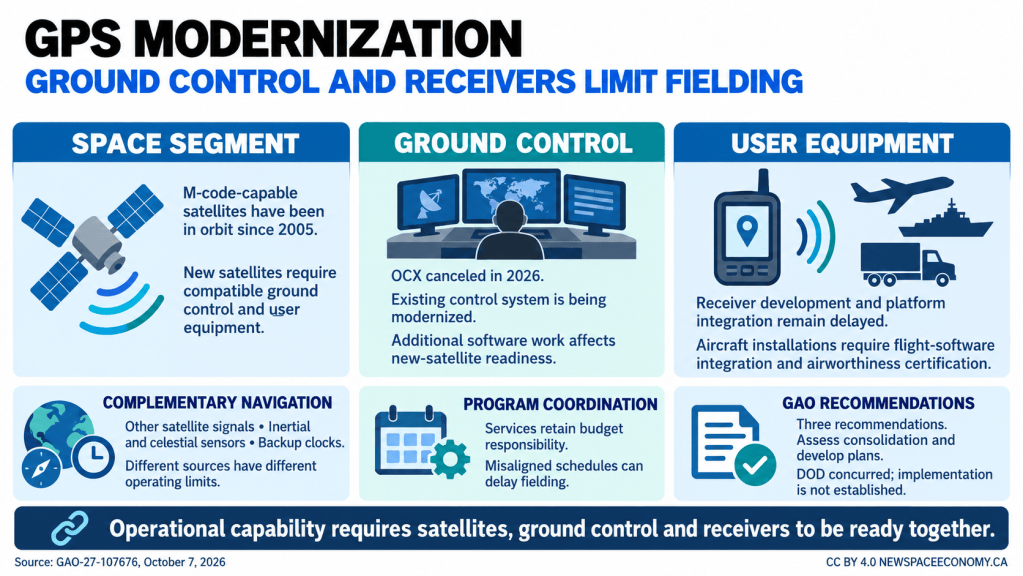
The U.S. Government Accountability Office reported on October 7, 2026, that GPS modernization continues to face delays in ground control, receiver development, and integration across military equipment. Its latest navigation audit examines a system whose performance depends on satellites, control facilities, and receivers working together. Improvements in orbit cannot provide their intended benefits when the equipment needed to command satellites or interpret their signals remains incomplete.
The findings matter beyond satellite manufacturing. Navigation programs purchase software, electronics, integration services, ground infrastructure, and testing alongside spacecraft. GAO identifies problems connecting these purchases to usable military capabilities. The report also examines complementary positioning, navigation, and timing technologies, commonly called PNT, intended to maintain useful information when GPS becomes unavailable or unreliable.
GPS satellites broadcast information about their positions and time. Receivers use those transmissions to calculate location and support navigation and synchronization. Ground facilities monitor and control the constellation. These responsibilities create separate development programs, but their operational results remain interdependent. A spacecraft can carry an improved navigation payload without every intended user possessing compatible equipment.
Military modernization includes M-code, an encrypted signal designed to resist interference more effectively than earlier military GPS signals. GAO reports that satellites capable of broadcasting M-code have been in orbit since 2005. Widespread use requires suitable ground control and receiving equipment, followed by integration into specific aircraft, ships, vehicles, and other platforms. New Space Economy’s earlier GPS modernization coverage provides context for this continuing mismatch between available satellite technology and fielded equipment.
The ground segment has undergone a change in direction. According to GAO, the Department of Defense canceled the Next Generation Operational Control System, known as OCX, in 2026 after continuing technical problems. The Space Force is instead modernizing its existing Operational Control Segment. This requires additional software work to support the newer GPS IIIF satellites, whose planned operations had depended on OCX.
The change creates a scheduling problem rather than an immediate conclusion that existing GPS service has stopped. GAO identifies risks to the launch, checkout, and operation of new satellites. Satellite delivery and operational availability are different milestones: a completed spacecraft still needs launch services, compatible control software, testing, and acceptance before it can provide its intended service.
The full GAO report states that, as of September 2026, the first GPS IIIF satellite delivery was projected for July 2027. That date is a program forecast, not a completed delivery. The audit records progress in component qualification and satellite testing, but those achievements do not independently resolve ground-system readiness. Assessing modernization requires comparing the schedules of connected programs rather than treating each milestone separately.
Receiver integration presents another set of constraints. Aircraft equipment must work with flight software and satisfy airworthiness requirements. A navigation receiver that performs adequately in isolation does not automatically meet the requirements of every aircraft installation. GAO reports software, funding, and integration difficulties across aviation receiver programs, explaining why developing a receiver card is only part of the work.
The Navy is pursuing an interim approach that incorporates M-code capability into existing aviation receivers. Using established interfaces may reduce the work associated with introducing an entirely new receiver architecture. The approach still requires engineering changes and certification. GAO also reports progress fielding M-code-capable equipment in some Army applications, showing that modernization proceeds at different rates across platforms.
Complementary PNT adds options when GPS is disrupted. GAO groups these efforts into satellite-based alternatives, navigation methods that do not depend on satellites, and backup timing. The categories address different requirements. A system that preserves accurate time may support synchronization without independently determining position, and an alternative navigation sensor may have operating constraints absent from a radio receiver.
Low Earth orbit satellites are one potential source of additional navigation signals. Their shorter distance from users can support stronger received signals, but radio-based alternatives can still face interference. The Army’s Alternative Navigation system combines a commercial satellite constellation with an Army-developed ground segment. GAO reports that it reached initial operational capability in late 2024; completing its ground-monitoring network remains part of the broader fielding effort.
Other approaches use inertial sensors, celestial observations, or clocks that preserve timing after an external reference is lost. Their limitations differ. GAO notes that clouds can obstruct the Navy’s automated celestial-navigation observations. Combining sources can reduce dependence on one input, but integration still requires receivers, software, testing, and arrangements for incorporating future upgrades.
Management responsibilities complicate this technical work. The PNT Oversight Council can assess programs and make budget recommendations, but the military services retain responsibility for their budgets. A shared objective does not ensure that receiver development, platform installation, and supporting infrastructure receive funding on compatible schedules. GAO identifies this fragmentation as a barrier to timely delivery.
Some consolidation has occurred. Transfers into the Air Force’s M-code Aviation Receiver Joint Program Office were completed in May 2026, according to the audit. The consolidated efforts became subject to additional cost, technical-risk, and progress reviews. GAO recommends that each military department assess where further consolidation would improve alignment and develop appropriate plans. DOD concurred with the report’s three recommendations; concurrence does not establish that implementation is complete.
For suppliers, the findings indicate why a technology demonstration and an operational procurement opportunity require different assessments. An available navigation signal still needs funded integration into customer equipment. A receiver contract can depend on software maturity, certification, production readiness, and platform schedules. These dependencies affect when technical progress becomes deployable capability.
GAO conducted the audit from July 2024 through October 2026 using program documentation and interviews. Its findings describe implementation risks rather than predict commercial market size. The practical test for GPS modernization remains whether satellites, control systems, receivers, and platform installations become ready on compatible schedules. Progress in any single component cannot establish that the complete capability is available.
Useful Books Available on Amazon
