
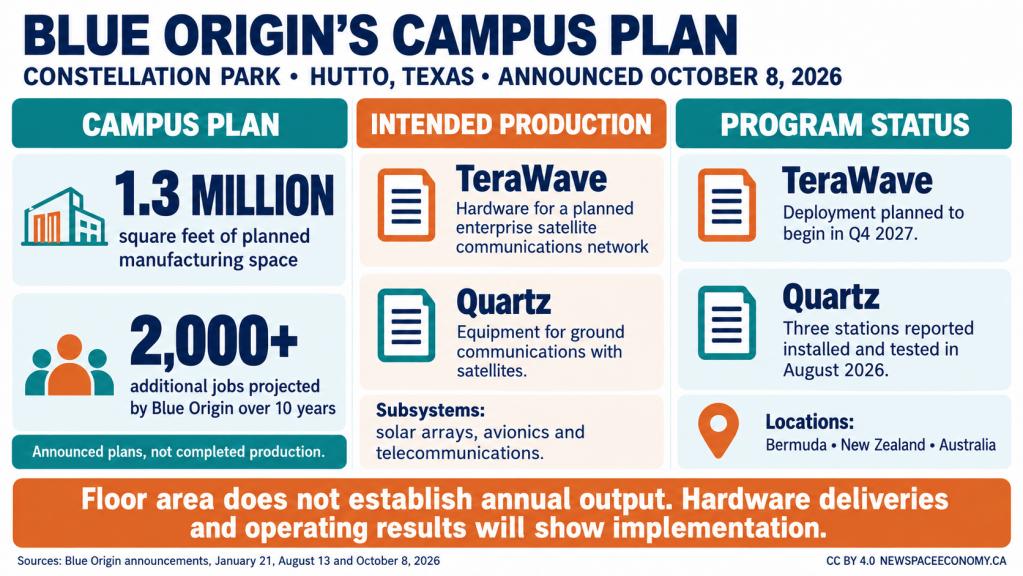
Blue Origin announced Constellation Park on October 8, 2026, describing a planned 1.3-million-square-foot manufacturing campus in Hutto, Texas. The company expects the development to support satellite communications equipment and related components. It projects more than 2,000 additional manufacturing and associated jobs over 10 years, a forecast rather than an existing workforce.
The campus would support three connected activities: manufacturing for the TeraWave communications network, production for the Quartz ground communications network, and satellite subsystems. Together, these activities show how Blue Origin intends to supply more of the equipment needed to operate communications services. The announcement establishes a proposed production location and scope. It does not establish completed buildings, annual satellite output, or customer revenue.
TeraWave supplies the clearest explanation for the proposed manufacturing requirement. In its January 2026 announcement, Blue Origin described a planned network of 5,408 satellites distributed between low and medium Earth orbit. Satellites in those regions would communicate through optical links, which transmit information using light. The company said deployment would begin in the fourth quarter of 2027. That date remains a planned start of deployment, not a date for completion of the entire network.
Blue Origin describes TeraWave’s intended customers as enterprises, data centers, and government organizations. Its proposed service includes connections between locations and access to the internet. The commercial objective is high-capacity communications for organizations whose requirements extend beyond ordinary residential broadband. Selling that service would require working satellites, ground equipment, network management, and customers willing to purchase the resulting capacity.
The company’s advertised speeds also require qualification. Blue Origin specifies connections of up to 144 gigabits per second through the low-orbit portion and up to six terabits per second through optical links involving the medium-orbit portion. These are design claims for different parts of the proposed architecture. They should not be read as measured speeds available to every customer, or as evidence that the planned network already operates.
Quartz serves a different communications function. In its August 2026 rollout announcement, Blue Origin reported that three ground stations had been installed and tested in Bermuda, New Zealand, and Australia. It described an initial configuration using 3.7-meter antennas and a further rollout across nine sites by the end of 2026. The reported installations and the planned expansion are separate stages.
A ground station provides the connection between an orbiting satellite and equipment on Earth. Operators use such connections to send commands, receive information about spacecraft condition, and retrieve mission data. Quartz’s initial antennas support specified radio-frequency bands for low Earth orbit operations. Those facilities should not be equated with the complete TeraWave customer network simply because both programs appear in the campus announcement.
The distinction affects the manufacturing business. A factory making satellites produces equipment that must survive launch and function in orbit. Production for a ground network supplies equipment installed at terrestrial sites, where operators can generally access it for maintenance. Both require testing and reliable communications performance, but their operating environments and servicing arrangements differ. Combining them within one campus does not eliminate those different requirements.
Satellite subsystems provide another connection between the programs. Blue Origin identifies solar arrays, avionics, and telecommunications equipment among the intended manufacturing activities. Solar arrays supply electrical power, and avionics provide onboard electronic control. Producing these components within the company could give it more direct control over interfaces and delivery schedules. Whether that arrangement reduces cost would depend on production volume, quality, and the expense of maintaining internal facilities.
New Space Economy’s discussion of Blue Origin’s business portfolio places communications alongside the company’s launch and other space activities. For Constellation Park, the relevant implication is a potential relationship between equipment production and service provision. Manufacturing satellites can support the supply of communications capacity, but manufacturing activity and customer demand remain different measures of business performance.
The announced floor area is a measure of physical scale, not production capacity. Annual output would depend on how much space is assigned to assembly, component production, testing, and storage. It would also depend on staffing, equipment availability, and the time each unit spends under inspection. The October announcement supplies no annual satellite production rate, so the campus area cannot support a reliable estimate of satellites delivered per year.
The employment projection has similar limits. A 10-year hiring forecast does not establish the number of workers needed when a facility opens or the pace of recruitment in each year. For local training organizations and potential suppliers, the useful next information would include hiring schedules and defined purchasing requirements. Treating all projected jobs as current employment would overstate the economic activity established by the announcement.
Supplier opportunities would also depend on decisions that a campus announcement does not settle. Companies considering equipment orders or expanded production would need specifications, procurement schedules, and contractual commitments. Blue Origin’s decision to make some subsystems internally does not identify every component it will purchase externally. An announced manufacturing location gives potential suppliers a reason to investigate demand, but it does not itself constitute an order.
Construction and production would be followed by further technical and commercial tests. Completed hardware must meet its requirements before delivery, and a communications operator must connect that equipment into a functioning service. For TeraWave, customer contracts and demonstrated network performance would provide evidence that manufacturing investment supports a viable offering. Building size alone cannot establish service reliability, pricing competitiveness, or the level of capacity customers will purchase.
Constellation Park gives Blue Origin’s satellite plans a more specific industrial basis. Its practical significance will become clearer through documented construction progress, commissioned production equipment, and accepted hardware deliveries. The business case then depends on the programs that use that hardware: TeraWave must progress toward deployed communications service, and Quartz must expand its operating infrastructure. The announcement identifies the intended production activities; subsequent deliveries and service results will establish how much of that plan has been implemented.
Useful Books Available on Amazon
