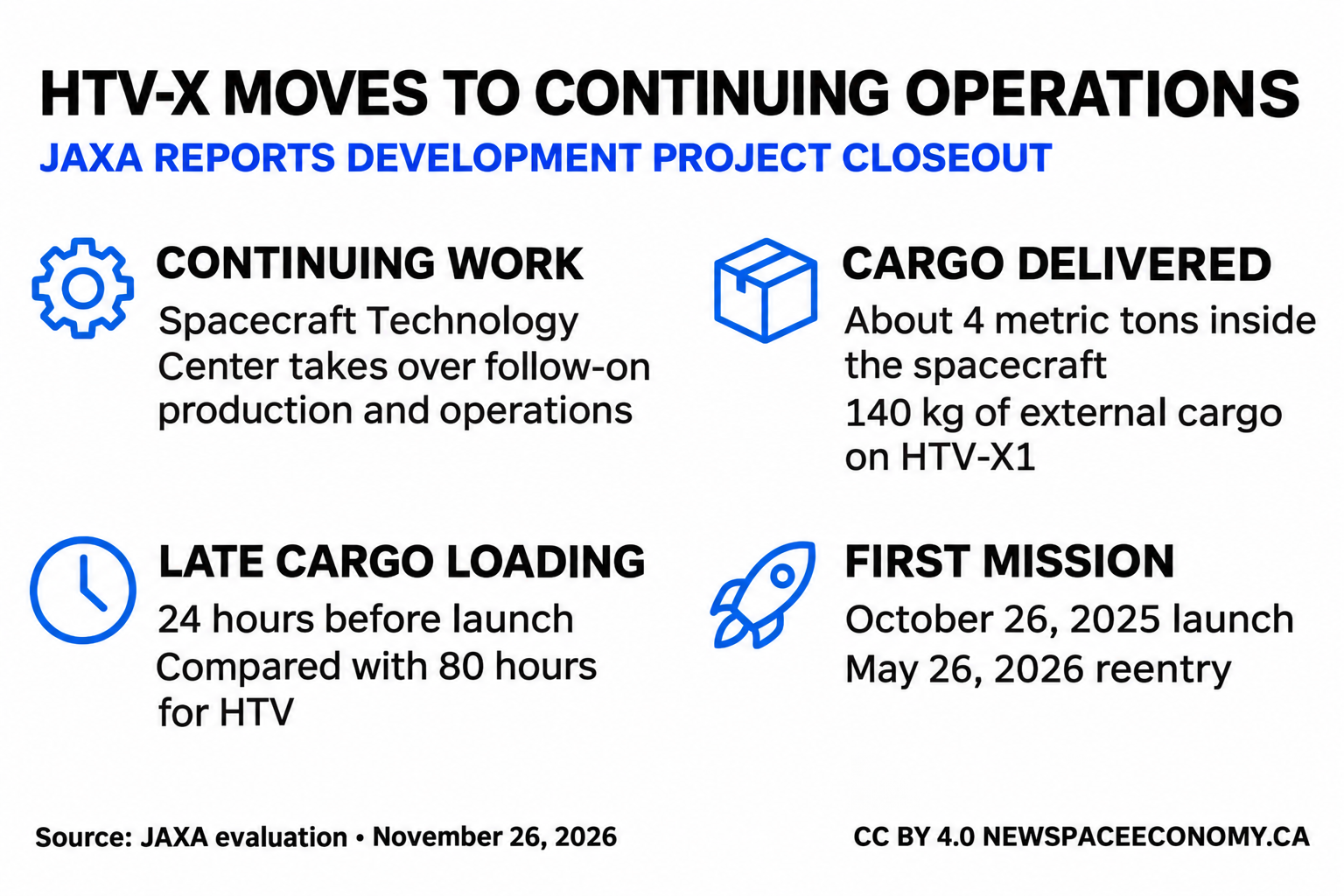
The Japan Aerospace Exploration Agency reported on November 26, 2026, that HTV-X cargo spacecraft work is moving from its development project into a permanent organization responsible for subsequent production and operations. JAXA’s project closeout evaluation says the agency approved that transition on September 1 following the first spacecraft’s completed mission.
The Spacecraft Technology Center will continue work on follow-on vehicles. The development project began in October 2017 with a scope covering three spacecraft. JAXA changed the closeout point to the end of HTV-X1 after the first mission established the basis for meeting the project’s success criteria and major development work previously anticipated for the second and third vehicles was no longer necessary.
The International Space Station’s extension through 2030 also changed the workload. JAXA says vehicles four through six were added following coordination with NASA, creating a continuing production and operations responsibility. The second and third spacecraft are being transferred to the Spacecraft Technology Center as part of that organizational change.
HTV-X1 launched on an H3 rocket from Tanegashima Space Center on October 26, 2025. Four days later, astronaut Kimiya Yui captured it using the station’s robotic arm, after which ground controllers attached it to the orbital laboratory. The spacecraft delivered approximately four metric tons of pressurized cargo and 140 kilograms of external cargo.
Pressurized cargo travels inside a compartment accessible to station astronauts. External cargo remains outside that compartment and can include equipment intended for use in the space environment. These two arrangements allow a supply mission to carry both crew provisions and hardware for station operations and research.
HTV-X1 left the station on March 7, 2026, and continued with about two and a half months of technology demonstrations. The evaluation records atmospheric reentry on May 26. The spacecraft disposed of approximately 2.4 metric tons of station waste during that final phase.
The new vehicle also changes how payload owners prepare shipments. The evaluation lists cargo capacity at 5.82 metric tons, compared with four metric tons for the earlier HTV, and a 60% increase in cargo volume. Selected late-access cargo can be loaded 24 hours before launch, compared with 80 hours for the predecessor.
JAXA’s cargo service description explains the purpose of those changes. Later loading accommodates fresh food and time-sensitive experiment samples. Electrical power supplied to cargo allows equipment such as freezers to keep samples cold during transportation. The external cargo arrangement also makes use of the space available inside the rocket’s protective fairing.
After leaving the station, HTV-X can serve as an independent experimental platform. On the first mission, the H-SSOD experiment deployed the small satellite Ten-Koh 2, Mt. FUJI tested lightweight deployable panels, and DELIGHT conducted an experiment related to estimating spacecraft attitude and motion.
JAXA lists up to one and a half years as the design capability for the technology-demonstration phase. HTV-X1’s actual demonstration period was about two and a half months. The additional propellant and spacecraft resources support experiments after the main cargo delivery has finished.
The permanent organization also provides a base for follow-on applications. Japan’s post-ISS service planning connects cargo transportation and orbital research with future commercial stations. The closeout report identifies planned automatic-docking demonstrations, NASA small-debris observation work and a Japanese Ministry of Defense infrared-sensor demonstration among future uses of the platform.
JAXA’s stated next step is to continue manufacturing and operating subsequent HTV-X spacecraft through the Spacecraft Technology Center, maintaining Japan’s supply contribution to the station.