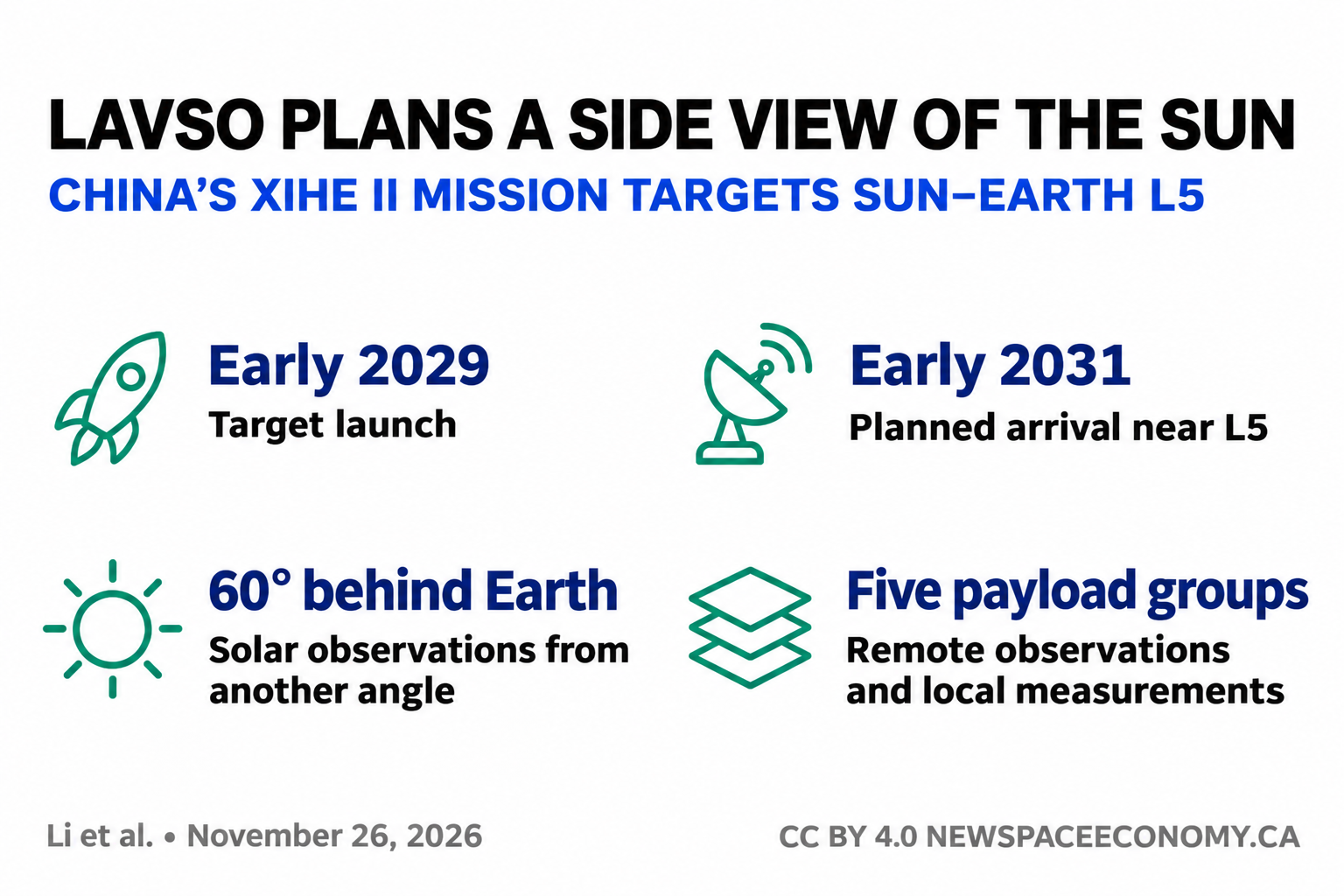
China’s planned LAgrange-V Solar Observatory, or LAVSO, is described in a mission paper published November 26, 2026, in Space Science Reviews. Chuan Li and colleagues report an early 2029 launch target for the spacecraft, also known as Xihe II.
According to the mission description, the China National Space Administration approved LAVSO in December 2025. The spacecraft would travel to the Sun–Earth L5 region, trailing Earth by 60 degrees around the Sun. Its five scientific payload groups combine remote solar observations with measurements of the local space environment.
The planned research examines the evolution of magnetic fields in solar active regions and the movement of eruptions through interplanetary space. The paper describes a transfer of about 790 days and arrival near L5 in early 2031. Observations could begin during the journey.
A Different View of Earth-Directed Eruptions
The geometry of L5 gives a spacecraft a sideways view of the space between the Sun and Earth. Observations from near Earth look along a different line. Combining the two perspectives helps reconstruct an eruption’s motion and shape, much as viewing an object from separate positions supplies information about its depth.
The European Space Agency explains this observing approach in its description of Vigil’s instruments. Its own planned L5 mission would view solar regions before they rotate toward Earth and follow coronal mass ejections as they move through space.
A coronal mass ejection carries solar plasma and magnetic field into interplanetary space. A coronagraph blocks the bright solar disk so that much fainter material around the Sun can be observed. A heliospheric imager watches a wider region farther from the Sun, extending the observational record as an eruption travels outward.
Direct measurements and images supply different kinds of information. An image records light arriving from a region at a distance. A particle detector samples material reaching the spacecraft, and a magnetometer measures the field at its position. Those measurements can be combined with observations from other locations and physical models.
Observations Feed Forecasting Services
Solar activity affects systems well beyond solar research. Space weather can disturb communications and satellite navigation, expose spacecraft to energetic particles, and affect electrical infrastructure on Earth. Tracking the direction and speed of an eruption provides information relevant to the timing of those disturbances.
New Space Economy’s coverage of NOAA’s space weather testimony describes how observations enter forecasting services. In written testimony dated November 19, National Weather Service Director Kenneth Graham discussed measurements from space and ground instruments, model evaluation, and the transition from research into operational use.
That testimony also describes NOAA’s cooperation with ESA’s Vigil mission to obtain L5 observations. The observing system combines locations: spacecraft near the Sun–Earth line sample one view, and an L5 spacecraft supplies another. Data delivery and processing connect those measurements to forecasters and users.
For LAVSO, the mission paper specifies that calibrated high-level scientific data would be made available to the research community through Nanjing University’s Solar Science Data Center.