
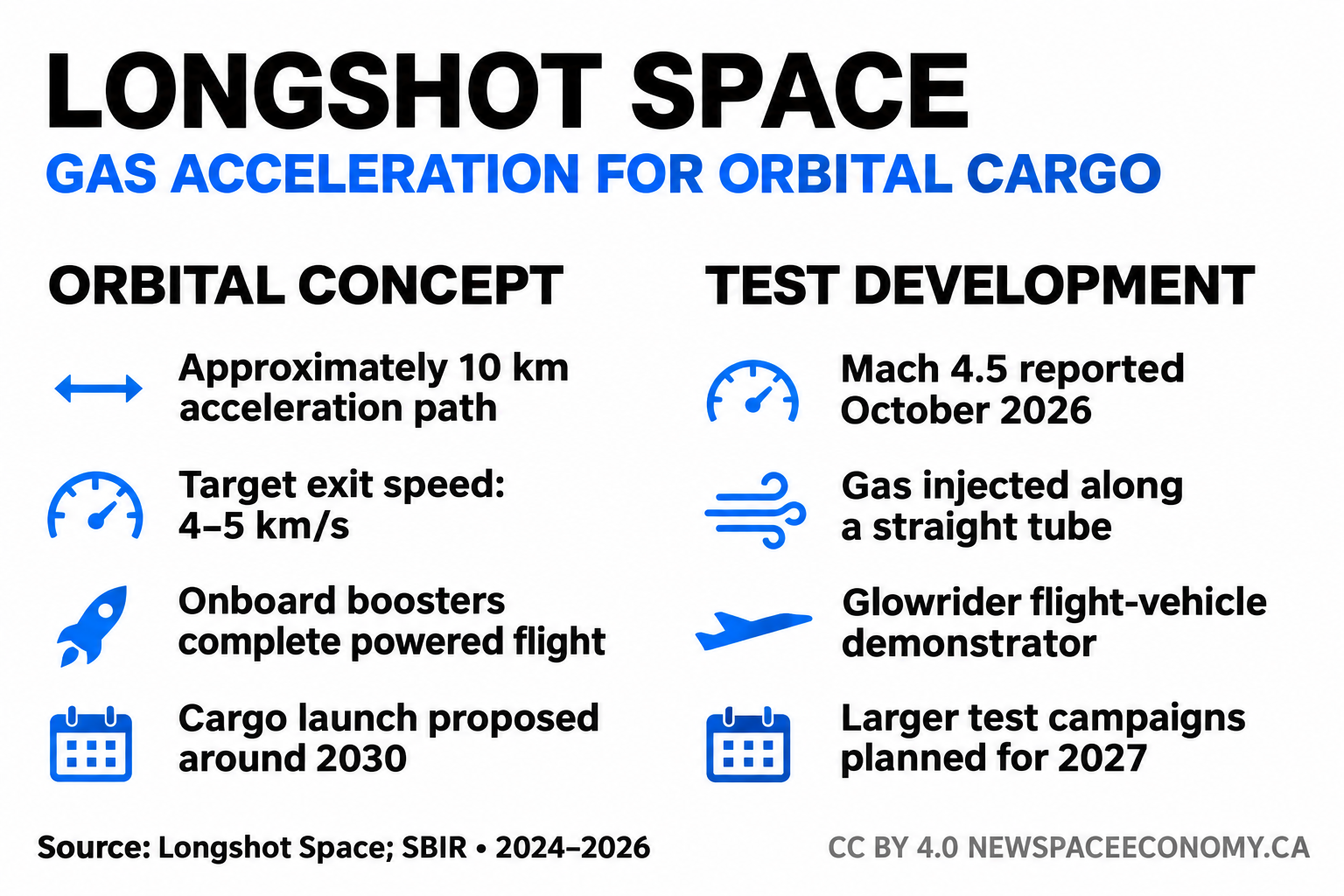
Longshot Space is developing a ground-based gas accelerator for hypersonic testing and eventual orbital cargo launch. The company reported a Mach 4.5 test result as of October 14, 2026. Its orbital concept combines a long accelerator tube with a departing vehicle that carries propulsion for the later portion of flight. The ground machinery would remain available for repeated launches.
The company’s development program proceeds through increasingly large test installations. Its first commercial focus is high-speed testing for defense and aerospace customers. Orbital transportation is the longer-term application of the same acceleration approach, with satellites and other cargo as the intended payloads. Longshot’s proposed launch system uses a straight acceleration path and compressed gas to impart speed before the flight vehicle leaves the ground installation.
Company Origins and Leadership
Longshot’s company history begins with Mike Grace building an accelerator in a San Jose garage in 2020. Development moved aboard a vessel, Maritol, in 2021 and later to Oakland. Grace is co-founder and chief executive. His background includes service as a U.S. Army combat engineer and research at NASA’s Ames Research Center.
Co-founder Nathan “Nato” Saichek serves as chief technology officer. He previously led integration of Astra’s Rocket 3.3. Chief of staff Lauren Liddell worked as project scientist for NASA’s BioSentinel deep-space biology mission, and chief operating officer Brendan Conaway joined the business in 2021. The team combines launch-vehicle integration, research, manufacturing, and operating experience.
Longshot’s early Oakland installation had a six-inch diameter and a length of 60 feet. The company associates that hardware with a Mach 4.2 result and more than 100 shots. Its later development work includes side-injection testing and Glowrider, a hypersonic glide-vehicle demonstrator. The headquarters moved to Alameda Point, the former naval air station, in 2026.
Funding and the Alameda Facilities
A June 23, 2026 investment announcement reported $5 million from South Park Commons, bringing Longshot’s total funding to $20 million. The stated uses included continued accelerator development and construction of a test installation designed to accelerate 100-kilogram payloads beyond Mach 5. The release described expansion of the company’s engineering and manufacturing facilities, including a hangar and test range.
The same announcement identified the company’s larger prototype by its nickname, “minigun.” It also reported that Mark Bigham, formerly Raytheon’s chief innovation officer, had joined to lead government sales and strategic relationships. Those activities connect Longshot’s hardware development to customers seeking access to high-speed flight testing. The financing supports that intermediate test business as part of the company’s broader launch program.
The physical use of Alameda Point is documented in a city staff report presented in October 2026. It described Longshot occupying Suite 200 of Building 29 under a short-term administrative license and proposed a 37-month lease. The proposed premises included approximately 9,200 square feet indoors and 7,400 square feet of adjacent yard.
Building 29 contains a long, narrow reinforced-concrete corridor originally designed for naval gun testing. City staff described that geometry as suitable for Longshot’s scaled accelerator prototype. The report also recorded an administrative use permit issued on March 16, 2026. The site gives the company a location for hardware installation and testing within an existing industrial building, alongside the wider Alameda operation.
The Multi-Injection Accelerator
The accelerator supplies a sequence of gas injections as the vehicle travels along a tube. This distributes the acceleration along the path. In its technical explanation of the investment, South Park Commons describes side injection against a tapered portion of the moving vehicle. The arrangement uses the geometry of that surface to transfer momentum from the incoming gas to forward motion.
The investor’s account identifies the injection sequence and its timing as central to the approach. It connects the smaller prototype to a much longer proposed installation through repetition and scaling of the accelerator hardware. The propulsion equipment is built into the ground structure, and the departing vehicle receives energy as it passes through that structure. This is the physical division between launcher and payload vehicle in Longshot’s design.
Longshot’s public orbital concept describes an approximately 10-kilometer acceleration path, an exit-speed goal of four to five kilometers per second, and onboard boosters for the remaining acceleration. It estimates roughly 250 times Earth’s gravity during the ground acceleration phase. The company identifies around 2030 as its desired period for reaching space. These figures describe its proposed cargo system.
A 2024 Air Force award abstract provides a separate description of demonstrated and planned hardware. It reports an earlier system using three gas injections along a 75-foot accelerator to propel a 500-gram projectile to Mach 2.5. The project then proposed scaling toward 100 kilograms at Mach 5 or 20 kilograms at Mach 7, using repeated injection modules and steel pipeline material.
The proposed test configuration accommodated payloads up to 30 inches in diameter. Its flight path extended approximately one kilometer parallel to the ground before termination in a berm. The award record described the planned installation as a testbed for government and commercial customers, with an initial objective of one launch per week. The project received $1,899,188 through a 2024 Phase II award associated with the Tactical Funding Increase program.
Glowrider and the Orbital Flight Vehicle
Longshot introduced Glowrider as a demonstrator for its hypersonic glide vehicle. This is the airborne element of the development program, paired with the accelerator that remains on the ground. The company presented the vehicle in connection with its longer-term space-launch work and a target of making payload account for 50% of the launched system’s mass.
The demonstrator gives the company a flight-vehicle development activity alongside the tube, gas supply, and injection hardware. Its role is to investigate the vehicle portion of a system in which a ground installation provides the initial acceleration. Longshot’s orbital architecture then combines that departure from the accelerator with onboard propulsion for the later flight phase.
Ground-assisted launch is one of the alternative launch approaches being developed for satellites. The common feature is moving some initial acceleration into equipment outside the departing rocket. Longshot’s particular implementation uses gas injection along a straight tube. Its orbital proposal treats the ground accelerator and powered flight vehicle as parts of a single transportation system.
Air Force Research and Testing Work
Government research funding appears early in the company’s development. A 2021 Air Force award provided $749,984 for a multi-injection hypersonic accelerator under a Direct to Phase II Small Business Innovation Research contract. The award period ran from August 5, 2021, to May 9, 2022. Its subject was rapid, lower-cost testing of hypersonic technology.
A further full-scale thruster research award recorded $74,971 for a Phase I project running from November 2022 to February 2023. The project linked development of an accelerator for hundreds of kilograms to applications in hypersonic testing, missile defense, and space launch. Together with the later scaling contract, these records show a progression from early research to a larger test-system proposal.
In July 2026, Longshot announced selection for the AEDC Velocity Alliance. The Arnold Engineering Development Complex established the consortium with the Air Force Test Center to support engineering and construction work on test infrastructure. Membership placed Longshot among qualified companies able to compete for projects within that modernization effort.
Longshot described its contribution as kinetic accelerators for low-altitude free-flight testing of full-scale systems. That application uses the accelerator to release test articles into the atmosphere, where they can be observed under flight conditions. The company connected its Alameda facility to the design, assembly, and testing work supporting those activities. The alliance provides a government procurement route for test infrastructure associated with the same technology being developed for future launch.
The Announced Test Campaigns
Longshot’s published test campaign schedule identifies Desert Thunder for fall 2026, using six-inch and 29-inch hardware. It places hydrogen testing at Barstow, California. The subsequent Big Iron campaign is planned for spring 2027 around a 29-inch-diameter accelerator 2,000 feet long, using cold hydrogen.
The company lists a Mach 5 to Mach 7 target with payloads of 20 to 100 kilograms for April and May 2027. Hot Iron, scheduled for summer 2027, would use the same stated diameter and length for hot-hydrogen and combustion testing. Longshot sets a daily firing objective for this larger system. These campaigns develop the ground acceleration equipment and flight-test operations that underpin its announced progression toward orbital cargo launch.
