
Beyond Gravity manufactures satellite panels, central structures, cylinders, and struts. Its product range includes aluminum and carbon-fiber composite constructions, showing how a spacecraft’s load-bearing structure can be purchased from a specialist supplier rather than manufactured entirely by the company assembling the satellite.
The structure connects equipment to the launch interface and maintains the physical relationships needed in orbit. It carries batteries, computers, tanks, instruments, and other hardware through launch, then supports their operation after release. Its geometry affects how the satellite is assembled, cooled, pointed, and serviced on the ground.
New Space Economy’s guide to satellite components places structural support among the bus functions. Structure manufacturers supply the physical framework through which those functions become one spacecraft.
Carrying Loads Through the Spacecraft
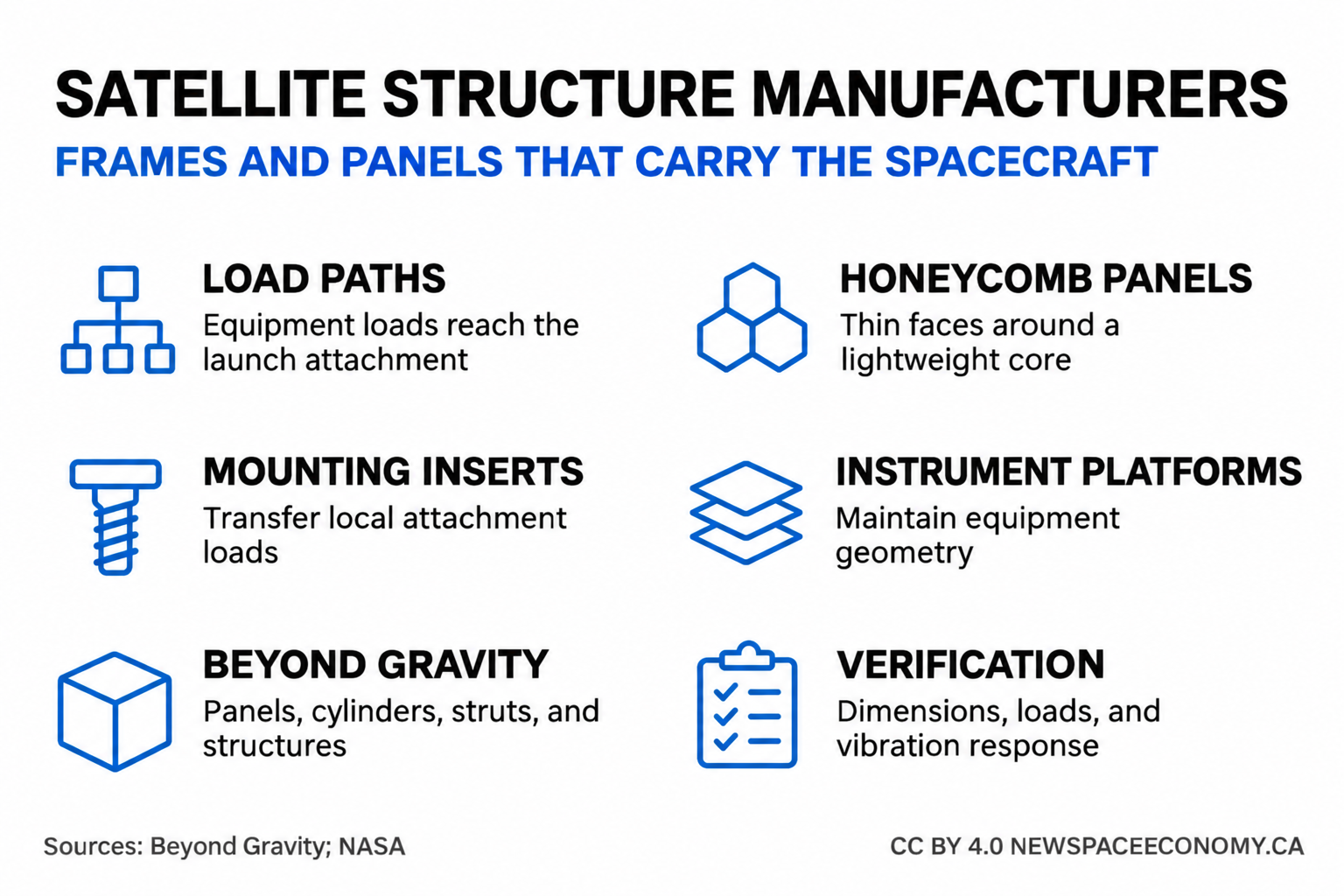
Launch acceleration produces forces throughout the satellite. Each equipment mounting transfers its load into a panel, bracket, or central support. Those local paths join the main structure and reach the attachment to the launch vehicle.
A structure can be organized around a central cylinder, a box of connected panels, or a frame. The arrangement follows the equipment layout and launch attachment. A heavy propellant tank mounted close to a central support creates a different load path from an instrument positioned on an outer deck.
Stiffness and strength describe different properties. Strength concerns the loads a structure can withstand without unacceptable damage. Stiffness concerns how much it deforms under load. A strong structure can still bend enough to affect equipment alignment or interact with launch vibrations.
The manufacturer works with dimensions, material properties, joints, and assembly methods together. The finished geometry establishes how forces pass through the spacecraft, including the points where separate structural parts meet.
Why Honeycomb Panels Are Common
A sandwich panel places thin outer faces around a lightweight core. Separating the faces increases their effectiveness in resisting bending without filling the entire panel thickness with solid material.
Honeycomb cores use many small cells to support the faces. The faces and core have different mechanical roles, and the bond between them transfers loads. Panel design includes that bond as well as the material used on each side.
Beyond Gravity’s structural products include honeycomb panels with aluminum or carbon-fiber-reinforced face sheets. The company also supplies instrument platforms and central structural elements, allowing a satellite builder to purchase individual parts or larger assemblies.
Equipment cannot always be bolted directly through a thin face sheet and hollow core. Local inserts provide attachment points and distribute concentrated loads into the surrounding panel. Their position and installation become part of the panel’s manufacturing definition.
Holding an Instrument in Place
An optical instrument depends on the relationship between its own reference surfaces and the spacecraft’s pointing sensors. A mounting structure establishes that relationship. Dimensional measurements taken during assembly connect the physical hardware to the spacecraft coordinate system used in software.
Temperature changes can alter dimensions. Different materials expand by different amounts, and a temperature gradient can bend a structure even when its average temperature remains acceptable. Instrument platforms are designed around the alignment behavior relevant to their payloads.
NASA’s discussion of spacecraft structural materials identifies density, thermal expansion, stiffness, and strength as material-selection factors. It also distinguishes metallic materials from composites whose properties can depend strongly on direction.
The structural supplier’s work can include material selection, analysis, manufacturing, and testing. Those activities establish the panel or frame as a specified spacecraft part with measured dimensions and a documented assembly process.
Interfaces Define the Delivered Product
A structural interface includes more than the outside dimensions of a frame. It specifies mounting-hole locations, reference surfaces, fasteners, permitted loads, and the space reserved for equipment and access.
Electrical equipment also needs cable routes and connector access. A unit that fits inside the spacecraft may still require room to install its harness or remove ground-test connections. Structural layout is coordinated with those assembly activities.
Thermal interfaces create another connection. Electronics mounted to a panel can conduct heat through their mounting surfaces. The panel may carry that heat toward another part of the thermal system, depending on the spacecraft design.
These interfaces make the structure part of several engineering disciplines at once. Its manufacturer delivers a controlled physical arrangement that supports mechanical loads and the installation of the satellite’s other systems.
Manufacturing Repeated Structures
A one-off scientific spacecraft and a satellite constellation can use similar structural principles but different production arrangements. Repeated spacecraft allow fixtures, machining programs, inspection routines, and assembly sequences to be reused.
Beyond Gravity describes industrialized panel production and an automated process for installing its potted inserts. The manufacturing approach addresses repeated attachment features that occur across many spacecraft panels.
Build-to-print work follows a customer’s detailed design. Build-to-specification work assigns the supplier more responsibility for developing a structure that meets defined performance and interface criteria. These contracting arrangements place the design boundary in different locations.
Both produce hardware whose identity is recorded through drawings, material records, and inspection results. Configuration control connects each delivered part to the design and manufacturing instructions used to make it.
Testing the Mechanical Assembly
Structural verification combines analysis with physical tests appropriate to the design. Static tests apply defined loads. Vibration tests examine response to oscillating input. Measurements of structural behavior help relate the physical article to the mathematical model.
Testing a panel alone establishes a different level of information from testing a complete spacecraft. Once equipment is installed, its mass and attachment stiffness change the assembled response. The satellite manufacturer incorporates the structural supplier’s information into the integrated vehicle assessment.
The completed structure arrives with its mounting features, reference surfaces, and verified configuration. Those features become the locations where the satellite builder installs the equipment that generates power, communicates, maneuvers, and performs the mission.
Useful Books Available on Amazon
