

- Key Takeaways
- Interstellar Distance Turns Conversation Into Timekeeping
- Finding a Signal Is Harder Than Hearing a Sound
- Radio and Laser Messages Must Fight Noise
- Shared Meaning Cannot Be Assumed
- Alien Senses and Minds May Break Human Categories
- Verification Must Come Before Interpretation
- Governance Must Decide Who Speaks for Earth
- Better Searches Can Raise the Odds
- Message Design Needs Science, Art, and Restraint
- Contact Would Challenge Human Institutions Before Alien Translation
- Summary
- Appendix: Useful Books Available on Amazon
- Appendix: Top Questions Answered in This Article
- Appendix: Glossary of Key Terms
Key Takeaways
- Distance, noise, timing, and meaning make alien communication harder than simple detection.
- A real signal would need verification before translation, reply planning, or public claims.
- Better instruments, shared protocols, and careful message design can improve the odds.
Interstellar Distance Turns Conversation Into Timekeeping
On June 4, 2026, the NASA Exoplanet Archive listed 6,298 confirmed planets outside the Solar System, a number that keeps expanding the possible search space for life beyond Earth. That count does not mean an extraterrestrial intelligence is nearby, detectable, or able to communicate. It does mean that communication with extraterrestrial intelligence now sits inside a real astronomical setting rather than a purely speculative one: thousands of confirmed planetary systems, billions of stars in the Milky Way, and many possible signal paths that cross immense distances.
The most immediate barrier is time. Light travels at about 300,000 kilometers per second, but interstellar space makes even that speed feel slow. A signal from a star 10 light-years away takes 10 years to reach Earth. A reply would take 10 more years to arrive there. That would make even the closest plausible two-way conversation a decades-long exchange. A signal from a civilization 1,000 light-years away would create a dialogue measured in millennia, not news cycles, elections, careers, or institutional budgets.
That delay changes the meaning of communication. Human conversation assumes feedback. Speakers correct themselves, clarify confusion, and respond to facial expression, tone, silence, and disagreement. Interstellar exchange would remove nearly all of that. A message would need to carry context, structure, error correction, and interpretation aids inside itself because the sender may never learn whether the receiver understood it. The Voyager Golden Record reflects this problem in physical form. Launched in 1977 aboard both Voyager spacecraft, it carries sounds, images, and instructions intended for an unknown finder, but no one expects a practical reply within human timescales.
Distance also weakens signals. A radio transmission spreads as it travels unless it is tightly focused. A laser can narrow the beam, but then the sender must point accurately across light-years and account for the motion of stars, planets, and receivers. A message can miss Earth even if it was meant for Earth. A receiver can miss a message by observing the wrong frequency, the wrong patch of sky, or the wrong hour.
The New Space Economy review of SETI questions frames the issue correctly: the search is not just a matter of listening harder. Researchers have to decide what kind of signal counts as artificial, what technologies may be used by civilizations unlike ours, and whether intentional messaging should be attempted at all. Communication starts with detection, but detection starts with assumptions.
Time also creates a civilization problem. A society that sends a message may change beyond recognition before a reply arrives. The original sender may no longer exist. Its language may shift. Its political system may collapse. Its scientific ideas may advance. The receiver might be interpreting a message from a lost culture rather than a living partner. Earth would face the same issue in reverse. Signals from humanity now include radar, broadcast leakage, deep-space mission traffic, planetary radar, and intentional symbolic artifacts. A distant civilization might detect traces of an earlier technological Earth, not the society that eventually receives its reply.
Overcoming the time barrier does not mean making light travel faster. It means designing communication for delay. Messages would need to be self-contained, redundant, and layered. A simple opening sequence could establish number systems, units, physical constants, and message structure. Later sections could add chemistry, astronomy, biology, culture, and questions. A reply strategy would need political patience because no government, company, or research team could own a conversation that unfolds over centuries.
Interstellar distance turns communication into a form of archive design. The sender must assume that the receiver is absent, delayed, unfamiliar, skeptical, and unable to ask immediate questions. That makes the problem less like a telephone call and more like creating a scientific library for someone who has never seen a human, heard a human language, or shared a human planet.
Finding a Signal Is Harder Than Hearing a Sound
The Search for Extraterrestrial Intelligence, known as SETI, began from a simple insight: technology may leave detectable traces. A narrowband radio signal, a brief optical pulse, an unusual waste-heat pattern, or a persistent artificial beacon could stand out from natural astrophysical sources. Yet the phrase “listen for aliens” hides the real difficulty. A telescope does not hear a voice. It records energy, frequency, direction, time, polarization, modulation, drift, and noise. Researchers must then separate instrument effects, human interference, satellites, aircraft, natural radio sources, and statistical accidents from anything that might deserve follow-up.
The classic SETI target has been a narrowband radio signal because natural astrophysical emitters usually produce broader emission. The SETI Institute continues to treat the search for technology beyond Earth as a scientific effort based on observation, signal analysis, and repeatability. A candidate signal must appear again, point back to a fixed celestial source, shift in ways consistent with motion, and survive checks by independent observatories. A one-time burst may be interesting, but interest is not confirmation.
The history of SETI contains many lessons in caution. The 1977 Wow! signal remains culturally famous because it was strong, narrowband, and strange, but it was never detected again. Without repeatability, scientists cannot move from anomaly to discovery. That standard may feel frustrating, but it protects the field from false claims. A claim of extraterrestrial communication would affect science, religion, politics, security, markets, and public trust. Weak evidence would do more harm than silence.
Radio frequency interference creates one of the largest practical barriers. Earth is full of transmitters. Satellites, phones, aircraft, radars, navigation systems, internet infrastructure, and consumer electronics all produce emissions. Some signals bounce, leak, or appear in unexpected places. A telescope can record a pattern that looks astronomical because the interference entered through a side lobe, reflected off nearby infrastructure, or passed through equipment in a misleading way. Radio astronomy has long depended on protected environments, and the International Telecommunication Union has published work on radio quiet zones because observatories need protection from human-made signals.
The problem is getting harder as orbit and Earth orbit communications grow denser. The International Astronomical Union Centre works on the protection of dark and quiet skies from satellite constellation interference. This matters for SETI because a false positive can consume large amounts of telescope time, public attention, and institutional credibility. It also matters because a true signal might hide inside rising background noise.
Search strategy matters as much as sensitivity. A receiver must choose where to look, when to look, which frequency to examine, how narrow or broad the search should be, and what kind of modulation to expect. The Breakthrough Listen program expanded SETI data collection with major radio and optical facilities, but even large projects sample only a tiny fraction of the possible search space. A civilization might transmit at a frequency humanity ignores. It might send rare pulses rather than continuous beacons. It might target another star. It might use neutrinos, gravitational waves, or technologies humanity cannot yet detect.
The New Space Economy technosignature guide explains why the field has widened beyond traditional radio signals. Technosignatures can include signs of technology rather than direct messages. That broader category helps researchers avoid one narrow assumption: that extraterrestrial civilizations would communicate in the same way humanity did during its early radio age. It also makes the interpretation problem harder. A signal intended as communication differs from a byproduct of technology, but both might appear as anomalies in data.
Overcoming the detection barrier requires patience and layered confirmation. Candidate signals should trigger automatic checks against databases of human transmitters, satellites, aircraft, and known astronomical sources. Independent observatories should observe the same target. Open data can help outside teams test claims. Machine learning may help find patterns in large datasets, but algorithms need transparent validation because a black-box classification cannot carry a discovery claim by itself.
A true signal may be faint, rare, and ambiguous. The practical goal is not to expect a perfect message. It is to build a detection system that can notice something strange, resist excitement, test alternatives, and keep enough data to let future researchers repeat the work.
Radio and Laser Messages Must Fight Noise
Radio and laser communication both look attractive because humans already use electromagnetic signals for long-distance transmission. That familiarity can mislead. Interstellar communication would push ordinary engineering into an extreme environment. A message has to cross years of space, survive dispersion and background noise, and still look artificial after it arrives at a receiver that does not know the sender’s language, timing, equipment, or purpose.
Radio signals can travel through dust and gas better than visible light in many conditions. They can also be detected with large antennas, and astronomers understand radio instrumentation well. That is why radio SETI has received so much attention since the work of Frank Drake and later projects at observatories such as Green Bank and Arecibo. Yet radio is crowded. Natural sources such as pulsars, masers, and active galaxies produce real astrophysical signals. Human transmitters add local noise. Satellites add moving interference. A narrowband signal can look promising, then collapse under follow-up because it came from Earth.
Laser communication offers a different path. A powerful, tightly pointed laser could produce a brief optical flash that outshines a star for a moment at the receiver. The SETI Institute LaserSETI program uses optical instruments to search for brief laser-like events across large areas of sky. Optical SETI expands the search beyond radio assumptions and suits the possibility that an advanced civilization may prefer highly directed beams over broad broadcasts.
Yet lasers create their own constraints. The beam must point with great precision. The sender has to know where Earth will be when the signal arrives, not where Earth was when the signal left. A receiver must be watching the right star at the right time, with a detector fast enough to capture brief pulses. Clouds, daylight, weather, atmospheric turbulence, and telescope scheduling all affect ground-based optical searches. Space telescopes could avoid some of those problems, but telescope time is scarce and mission priorities rarely center on SETI alone.
Message structure becomes another engineering problem. A simple beacon can say, in effect, that technology exists. A richer message must carry information. The 1974 Arecibo Message used binary structure to encode numbers, chemistry, DNA, human form, the Solar System, and the transmitting instrument. It was symbolic, brief, and powerful as a demonstration. It was not a practical opening to a real exchange because it targeted the globular cluster Messier 13, and any reply would take thousands of years.
Binary coding may feel universal because mathematics seems less culture-bound than spoken language. Yet even mathematics needs framing. A sequence of prime numbers may suggest intelligence, but it does not teach vocabulary. A grid of bits may encode an image, but the receiver has to infer dimensions, orientation, ordering, scale, and intended grouping. If the receiver has no eyes, no visual culture, or no reason to treat two-dimensional arrays as pictures, the message may fail despite clever design.
The New Space Economy METI analysis distinguishes passive search from Messaging Extraterrestrial Intelligence, often called METI. Listening and transmitting involve different risk profiles. Listening can be done quietly. Transmitting makes a claim about who gets to represent Earth, what information should be shared, and whether active outreach is acceptable without broad consent.
Overcoming the physics and noise challenge will require message designs that accept uncertainty. Repetition helps. Multiple frequencies help. Multiple encoding methods help. A message could combine prime number sequences, physical constants, atomic transitions, star maps, and simple images. It could repeat its own decoding rules many times. It could send a short beacon for detection and a longer message for interpretation. It could avoid depending on any single sensory channel by encoding the same idea in several formal systems.
Humanity also needs receiving discipline. A detected signal should not be translated too quickly for public consumption. A pattern may look like a message because people are skilled at finding meaning. Researchers would need to separate signal detection, decoding, semantic interpretation, and social meaning into different stages. A mathematical sequence is not a greeting. A map is not consent. A detectable signal is not proof of friendly intent.
Radio and laser systems offer plausible paths, but they do not remove the deeper problem. The medium may carry information across space. It cannot guarantee that the receiving mind will share the assumptions needed to understand it.
Shared Meaning Cannot Be Assumed
Human communication depends on shared biology, shared environments, shared social experience, and shared bodies. Even when people do not share a language, they often share enough context to infer pointing, hunger, danger, trade, family, territory, tools, and ritual. Extraterrestrial communication strips away most of that context. A civilization that arose under a different sky, gravity, atmosphere, ocean chemistry, or sensory system may divide reality into categories that do not match human categories.
Mathematics often appears to solve this problem. Numbers, ratios, geometry, and physical constants should not depend on culture in the same way as metaphors or myths. A hydrogen spectral line, the speed of light, and the structure of atoms can provide reference points. Yet mathematics alone may not carry purpose. A sequence can show intelligence, but it may not show whether the sender is warning, greeting, teaching, testing, advertising, praying, or marking territory.
The NASA technosignatures workshop report treated technosignature science as a field that must connect astrophysics, instrumentation, target selection, and interpretation. That same lesson applies to communication. A signal is not a sentence until a receiver can assign structure and meaning. The receiver must know where a symbol starts, where it ends, how symbols combine, and which references sit outside the message.
Human attempts at interstellar messaging reveal the difficulty. The Pioneer plaque used human figures, a spacecraft outline, a pulsar map, and hydrogen transition symbolism. It assumed that an extraterrestrial finder could understand line drawings, relative scale, and spatial mapping. The Voyager record went further by including sounds, greetings, music, images, and playback instructions. NASA’s Golden Record contents page points to the careful curation behind the project. Yet the record still depends on assumptions about image reconstruction, symbolic interpretation, and what aspects of humanity are worth presenting.
Earth itself shows how hard cross-species communication can be. Humans share a planet with dolphins, elephants, corvids, octopuses, primates, whales, and many social species, yet communication across species remains limited. The New Space Economy animal analogy makes that comparison useful without treating animals as aliens. If humans struggle to interpret intelligence shaped by Earth’s own biosphere, then intelligence shaped by another biosphere could be much harder.
Meaning also depends on embodiment. A species with no hands may not think about tools in human terms. A species living in darkness may treat images as secondary or irrelevant. A machine intelligence may not have birth, hunger, sleep, family, childhood, pain, or death in the biological sense. A distributed intelligence spread across many habitats may not experience individuality as humans do. A civilization that communicates through chemical gradients, magnetic fields, pressure patterns, or engineered organisms might find human-style symbolic messages primitive or opaque.
A practical solution is to build messages from increasingly complex layers. The initial layer should establish counting and ordering. The next layer can define units using physical constants. Later layers can introduce chemistry, planetary data, stellar position, and biological information. Cultural content should arrive only after the message has built enough decoding scaffolding. A message that begins with music, art, or political ideals may be meaningful to humans but undecodable to another intelligence.
Redundancy matters because translation will involve error. A receiver might misunderstand a symbol but infer its meaning from repeated patterns. If the same idea appears through numbers, diagrams, spectra, and contextual relationships, the chance of partial understanding improves. Human children learn language through repetition, shared attention, correction, and context. Interstellar messages lack correction, so they must overbuild context from the start.
Humility may be the strongest design principle. Humanity should expect any outgoing message to be incomplete and any incoming message to be partly misunderstood. The goal should be staged intelligibility rather than perfect translation. A shared physics can open a door, but it cannot supply culture, intention, or trust on its own.
Alien Senses and Minds May Break Human Categories
The hardest communication problem may not be language. It may be cognition. Humans tend to imagine extraterrestrial intelligence as a mind that wants to speak, solve problems, exchange knowledge, and ask recognizable questions. That assumption reflects human social life and human science. Another intelligence may have different priorities, different time perception, and different thresholds for what counts as communication.
A species living for thousands of years may treat a century-long reply as prompt. A short-lived species may rely on memory systems that outlast individuals. A machine civilization may copy itself, pause itself, or distribute itself across physical substrates. A communal organism may not separate sender and receiver in human terms. A civilization inside an ocean world may develop acoustics, chemistry, or pressure signaling long before astronomy, and it may never build radio telescopes unless it reaches the surface or sends instruments above an ice shell.
This creates the like-detection problem. Civilizations may be better at detecting technologies that resemble their own. Human radio SETI favors signals that make sense to a radio-using species. Optical SETI favors directed light. Searches for waste heat favor civilizations that use large amounts of energy in ways visible to infrared astronomy. The New Space Economy like-detection essay explores that bias: detection may work best between civilizations with partly similar technologies, senses, and search habits.
Even if two civilizations overlap technologically, they may differ in communication motives. Humans often assume a detectable extraterrestrial intelligence would either want contact or want concealment. More options exist. A civilization might transmit for calibration, navigation, art, religion, engineering, education, deterrence, scientific measurement, or reasons humans lack words for. A signal may not be addressed to Earth. It may be a byproduct of activity elsewhere. It may be a message to another civilization that Earth happens to intercept.
Time perception also shapes content. Human messages often present snapshots: anatomy, chemistry, location, music, greetings, spacecraft diagrams. A long-lived sender might prefer dynamic archives, self-updating beacons, or repeated teaching sequences. A machine sender might value compression, formal proofs, and executable descriptions. A biological sender might value environmental context, origin history, and survival needs. None of those categories can be assumed.
Culture adds another barrier. Human societies disagree about what should represent Earth. Some would emphasize science. Others would include art, religion, law, history, environmental warnings, human rights, conflict, disease, inequality, or moral aspiration. An extraterrestrial receiver might draw conclusions from omissions as much as inclusions. A message that hides war may look deceptive if other evidence reveals it. A message that includes war may look threatening if context fails.
Communication may also be asymmetrical. Humanity might detect a signal from a civilization far more capable than Earth, or from one at a similar level, or from one that no longer exists. Each case changes interpretation. A message from a more advanced civilization could be too dense or too compressed. A message from a similar civilization may contain familiar limitations. A message from an extinct civilization may be an archaeological object rather than a conversation.
The way forward is to separate intelligence from humanness. Message designers should not ask only what humans want to say. They should ask what kinds of structure could survive alien cognition. Repetition, physical grounding, mathematical ordering, and multiple representations can help. So can tests with humans from different cultures, disciplines, ages, and languages. If a message cannot be interpreted across human differences, it has little chance across interstellar ones.
Researchers should also search for signals that do not look like greetings. Technosignature science already moves in that direction by treating technology as something that might be detected through energy use, chemistry, artifacts, or environmental modification. Communication may begin with recognizing that another mind may not be trying to communicate with humanity at all.
Verification Must Come Before Interpretation
A real candidate signal would create immediate pressure to explain it. Scientists would want more data. Governments would want briefings. Newsrooms would want headlines. Markets might react. Religious and cultural organizations would issue statements. Social media would amplify claims before verification finished. That pressure makes the detection process as much a public trust problem as a technical one.
The Declaration of Principles adopted by the International Academy of Astronautics in 1989 remains the best-known post-detection framework. It encourages verification, consultation, public disclosure after confirmation, and no response before appropriate international consultation. It is a declaration rather than binding law, but it gives researchers a disciplined path for the initial hours and days after a possible detection.
Verification has to start with the mundane. Did the telescope work correctly? Did local equipment create the signal? Did a satellite pass through the beam? Did software introduce an artifact? Did a human transmitter leak into the observing band? Did another observatory see the same thing? Did the signal repeat? Does it track a celestial source? Does it show Doppler drift consistent with relative motion? Each question can strip away excitement, but each protects the claim.
The New Space Economy post-detection article reflects the practical value of process. A detection claim would not succeed because a signal feels strange. It would need a chain of evidence that specialists outside the discovering team can inspect. Public trust would depend on openness, but openness without quality control could spread confusion.
Interpretation should come later. A verified artificial signal would still not guarantee that the content is understood. Researchers may identify repetition, modulation, or structure without decoding meaning. The signal might be a beacon with no message content. It might be encrypted or compressed. It might be too fragmentary. It might be old. It might carry mathematics that takes years to parse. The public should be prepared for a long gap between confirmation of artificiality and any meaningful translation.
False positives deserve special attention. SETI has to work under a high burden of proof because extraordinary claims can damage science if mishandled. A premature announcement followed by retraction would feed conspiracy theories and weaken future trust. Yet excessive secrecy could create its own suspicion. The better balance is rapid disclosure of verified facts, clear labeling of uncertainty, and release of data when doing so does not compromise follow-up observations.
International coordination adds complexity. A signal may be detected by a university team, a national observatory, a private foundation, a military sensor, or a commercial system. Each has different disclosure habits and legal constraints. Some countries may treat the event as scientific. Others may treat it as strategic. If a signal contains usable information, even harmless-looking information, governments may worry about security, social stability, or technological advantage.
The Outer Space Treaty does not provide a detailed alien communication procedure. It does establish ideas that matter: peaceful use, international responsibility for national activities, due regard for other states, and consultation when activities may cause harmful interference. Those principles could inform governance for intentional replies, high-power transmissions, or use of national facilities.
Overcoming the verification challenge requires prearranged workflows. Observatories should maintain candidate signal protocols, contact lists, independent confirmation plans, and public communication templates. Governments should discuss how scientific verification differs from policy response. International bodies should decide where consultation would occur if a credible signal appears. The public should be taught that uncertainty is not concealment; it is how science avoids error.
The strongest post-detection posture is slow confidence. Detection should be fast. Claims should be careful. Interpretation should be patient. Reply decisions should be broader than the group that made the discovery.
Governance Must Decide Who Speaks for Earth
A message sent from Earth could represent all humanity in the mind of a receiver even if it came from one laboratory, one country, one company, one wealthy donor, or one small group of enthusiasts. That mismatch is the central governance problem of Messaging Extraterrestrial Intelligence. A sender may have the technical ability to transmit, but technical ability does not settle political legitimacy.
Humanity has no world government, no agreed planetary spokesperson, and no binding legal procedure for approving intentional interstellar messages. The United Nations Committee on the Peaceful Uses of Outer Space, known as COPUOS, provides a forum for space law and international cooperation, but it does not operate as an executive authority over all transmissions from Earth. National regulators control spectrum and facilities within their jurisdictions, but messages can also come from private groups using powerful antennas.
The governance issue is not only risk. It is representation. What languages should be included? Which scientific facts are safe to share? Should messages include human biology, planetary location, culture, ethics, history, or conflict? Should they ask questions or simply announce existence? Should they invite reply? Should they disclose vulnerability? No answer can satisfy everyone because Earth contains different governments, religions, cultures, scientific traditions, and risk tolerances.
Some METI advocates argue that Earth has already revealed itself through atmospheric signatures, radio leakage, radar, city lights, and the chemical effects of industrial activity. From that view, intentional messages do not create a new category of risk. Critics answer that detectability and active targeting differ. A planet may leak traces unintentionally, but a powerful directed message could make detection easier for a receiver looking in the right direction.
The New Space Economy first-contact survey treats contact as a scenario space rather than a single event. That framing helps governance because the response to a faint technosignature differs from the response to a direct message, a nearby probe, or a signal with apparent instructions. A uniform rule would fail across such cases.
The reply question is more difficult than the detection question. A confirmed signal might contain no request. It might ask for a reply. It might include a suggested protocol. It might look like a beacon sent to many stars. Responding could take decades to matter, but the decision itself would have immediate political significance on Earth. A reply sent by one state might be rejected by others. A reply delayed for consultation might frustrate scientists. A reply shaped by security agencies might lack cultural legitimacy.
A credible governance model would need several layers. Scientific bodies would verify the signal and characterize its technical features. International legal forums would address consultation and peaceful-use questions. Cultural, ethical, linguistic, and religious communities would contribute to message content debates. National governments would control facilities and spectrum. Public transparency would help prevent mistrust.
No process will be perfect. The goal should be legitimacy good enough to avoid a narrow, secretive, or reckless decision. A reply to extraterrestrial intelligence would be one of the few acts that could plausibly be interpreted as an act by Earth, not only by one institution. That makes openness and broad consultation more than symbolism. They are part of the message itself.
Better Searches Can Raise the Odds
Better communication starts with better search. Before humans can answer a message, they must detect one with confidence. Since 2015, larger datasets, improved computing, optical searches, archival analysis, and exoplanet catalogs have widened the search space. The field remains small compared with mainstream astronomy, but it has become more technically diverse.
The Breakthrough Listen data systems show how modern SETI depends on data scale. Radio telescopes can generate enormous datasets that require storage, filtering, signal processing, and public archives. Machine learning can help search for outliers, classify interference, and scan old data for patterns missed by earlier methods. Yet machine learning should support, not replace, physical interpretation. A model can find unusual patterns, but scientists still need to know whether those patterns come from sky, hardware, software, or Earth.
New observatories will improve adjacent sciences that matter for extraterrestrial communication. NASA’s Roman Space Telescope is slated to launch on August 30, 2026, and conducts major work in exoplanets and astrophysics. NASA’s Habitable Worlds Observatory remains a future flagship concept designed to search for signs of life on planets orbiting other stars. Biosignature searches differ from SETI, but both benefit from better target lists, better stellar characterization, and better understanding of planetary environments.
A richer exoplanet census can sharpen SETI targeting. Stars with potentially habitable planets, favorable geometry, or known planetary systems may deserve focused observations. The restricted Earth Transit Zone, where an outside observer could see Earth cross the Sun, offers one example of a geometry-based target set. A civilization using similar transit methods might notice Earth’s atmosphere and later decide to transmit toward the Solar System.
Searches also need more channels. Radio remains valuable, but optical pulses, infrared excess, unusual atmospheric chemistry, artificial night-side illumination, megastructure-like transits, waste heat, and solar-system artifacts all deserve structured attention. No single method can cover the full possibility space. The New Space Economy science overview describes how searches can include intentional transmissions and unintentional technological leakage.
The best near-term improvement may be commensal observing. A telescope can collect SETI-relevant data during observations designed for other science, reducing cost and increasing sky coverage. Archival searches can revisit data from past surveys with new algorithms. Open data can let independent teams test results. Standard formats can reduce duplication. Public archives also help train new researchers without requiring immediate access to scarce telescope time.
Better searches need better interference control. Radio quiet zones, spectrum coordination, satellite coordination, observatory shielding, and improved databases of human transmitters all help prevent false positives. The rise of satellite megaconstellations creates pressure on optical and radio astronomy, and the same pressure affects SETI. A civilization’s faint signal will be easier to miss if Earth surrounds itself with poorly characterized noise.
International participation matters. A candidate signal detected from one hemisphere should be checked from another if geometry permits. Optical detections should be compared with radio follow-up. Radio candidates should be checked across facilities with different hardware. A global scientific network can reduce parochial error and build trust.
Overcoming the search challenge does not require assuming aliens are common. It requires treating the question as testable. Each null result narrows a small part of the search space. Each improved method makes the next null result more informative. Progress may look slow because the cosmic haystack is vast, but better maps, better instruments, and better protocols make the work less blind.
Message Design Needs Science, Art, and Restraint
Outgoing messages must do two jobs at once. They must attract attention as artificial signals, and they must carry enough structure to support interpretation. Those jobs can conflict. A short beacon can be easy to detect but say little. A rich message can say more but be harder to decode. A message heavy with human culture may inspire humans yet confuse a receiver. A message reduced to mathematics may be intelligible but emotionally thin, if the receiver has anything comparable to emotion.
The strongest message design begins with a preamble. A sequence of prime numbers or repeated mathematical patterns can mark artificial origin. After that, the message can introduce binary notation, ordering rules, units, and physical constants. Hydrogen’s spectral properties have often appeared in message concepts because hydrogen is abundant and physically well-defined. A message can then build toward larger units: atoms, molecules, planetary data, stellar position, time intervals, and biological chemistry.
Images need caution. Humans treat pictures as natural, but pictures are conventions. A two-dimensional image requires assumptions about scanning order, pixel shape, orientation, scale, and perspective. A receiver that senses its environment differently may not treat a flat image as representation. The solution is not to abandon images. It is to teach image decoding inside the message before using images for complex content.
Music, greetings, and cultural material create a different issue. They may be valuable because they show that human civilization is more than measurement. Yet without shared hearing, rhythm, emotion, or social context, music may not communicate what humans intend. Greetings in natural languages may show diversity, but a receiver may not distinguish them from other sound patterns. Cultural content should be included only after a formal foundation has been built.
The Extraterrestrial Languages tradition of thinking about alien communication has wrestled with this problem for decades: language cannot be separated from bodies, histories, and worlds. Formal systems can reduce ambiguity, but they cannot remove it. A message that says too much too soon may become noise. A message that says too little may never become conversation.
Testing can improve message design. Draft messages should be tested on human groups that did not help create them. Teams from different languages, disciplines, and cultures can attempt to decode messages from scratch. Children, mathematicians, artists, linguists, engineers, anthropologists, and biologists may notice different ambiguities. If no human group can decode a message without coaching, the design is not ready for interstellar use.
Restraint should shape content. A message need not include every fact humanity knows. A compact, repeatable, staged message may be better than a vast archive. Location data should be debated carefully. Biological details should be debated carefully. Claims about humanity’s values should match observable behavior, or the message may become self-contradictory. The sender should avoid threats, triumphalism, and political slogans. A civilization that can cross interstellar distance with information may not be impressed by noise disguised as confidence.
A good message would likely be modular. Module one proves artificiality. Module two teaches the code. Module three establishes physics and units. Module four describes Earth’s astronomical setting. Module five describes life and chemistry. Module six introduces human culture with strong context. Module seven asks limited questions and offers a reply method. Repetition across modules would improve error recovery.
Message design also has to accept that no message can control its interpretation. A receiver may treat Earth’s message as science, art, spam, threat, archaeology, or curiosity. The sender can reduce confusion, but cannot dictate meaning. That limit argues for humility. Humanity should design messages that are accurate, calm, and transparent about uncertainty.
Contact Would Challenge Human Institutions Before Alien Translation
A confirmed extraterrestrial signal would test human institutions before anyone translated the message. Scientific teams would need to protect data quality. Governments would need to avoid turning uncertainty into strategic panic. News organizations would need to report without overstating meaning. Schools, museums, religious organizations, and civic institutions would need educational material. The public would need a way to distinguish confirmed facts from speculation.
The New Space Economy contact response article captures the broad social spread of such an event. Contact would not remain inside astronomy. It would become a cultural fact. Even a faint confirmed beacon with no decoded message would change how many people understand humanity’s place in the universe.
The initial institutional failure mode would be overclaiming. A signal could be artificial without being a message. It could be a message without being decoded. It could be decoded in structure but not in meaning. It could be old, automated, or unrelated to Earth. Public officials and commentators may compress those distinctions into a simpler story because simple stories travel faster. Scientific teams would need to repeat careful language until it becomes familiar.
Another failure mode would be secrecy. Some information may require temporary coordination before release, but a broad discovery claim cannot remain credible if handled as a closed process. Public datasets, independent confirmation, and transparent uncertainty would reduce rumor. A discovery that belongs to all humanity should not appear to be owned by one government or one private institution.
Education would matter. People should learn before a detection that SETI is a search for evidence, not a catalog of beliefs. They should understand why false positives happen, why repeat observations matter, and why no reply should be rushed. The New Space Economy article on post-detection policy gives publishers and educators a useful starting point for explaining that sequence.
Religious and philosophical reactions would differ. Some traditions may absorb extraterrestrial intelligence into existing cosmologies. Others may debate theological status, moral standing, or the meaning of human uniqueness. Secular philosophies would face questions about ethics, personhood, and knowledge across species. None of these responses should be dismissed as distractions. Communication with extraterrestrial intelligence would be a scientific event and a human event.
Markets and security institutions may also react. Companies connected to communications, aerospace, computing, and defense may see speculation. Governments may ask whether any information in a signal has technological value. Researchers would need to guard against premature claims that a message contains energy secrets, propulsion methods, or dangerous knowledge. A signal that cannot yet be interpreted should not become a platform for commercial hype.
Overcoming institutional strain requires planning before detection. Scientific organizations can publish response playbooks. International forums can stage exercises. Media organizations can prepare style guides for candidate signals, confirmed signals, decoded content, and false positives. Education systems can teach the difference between life, intelligence, technology, technosignature, and communication. Public trust will depend on vocabulary as much as evidence.
Humanity may not get a clean scenario. The initial evidence could be partial. Confirmation could take months. Governments could disagree. Different teams could interpret data differently. That is why social preparation matters. A real signal would be hard enough to understand without human institutions adding avoidable confusion.
Summary
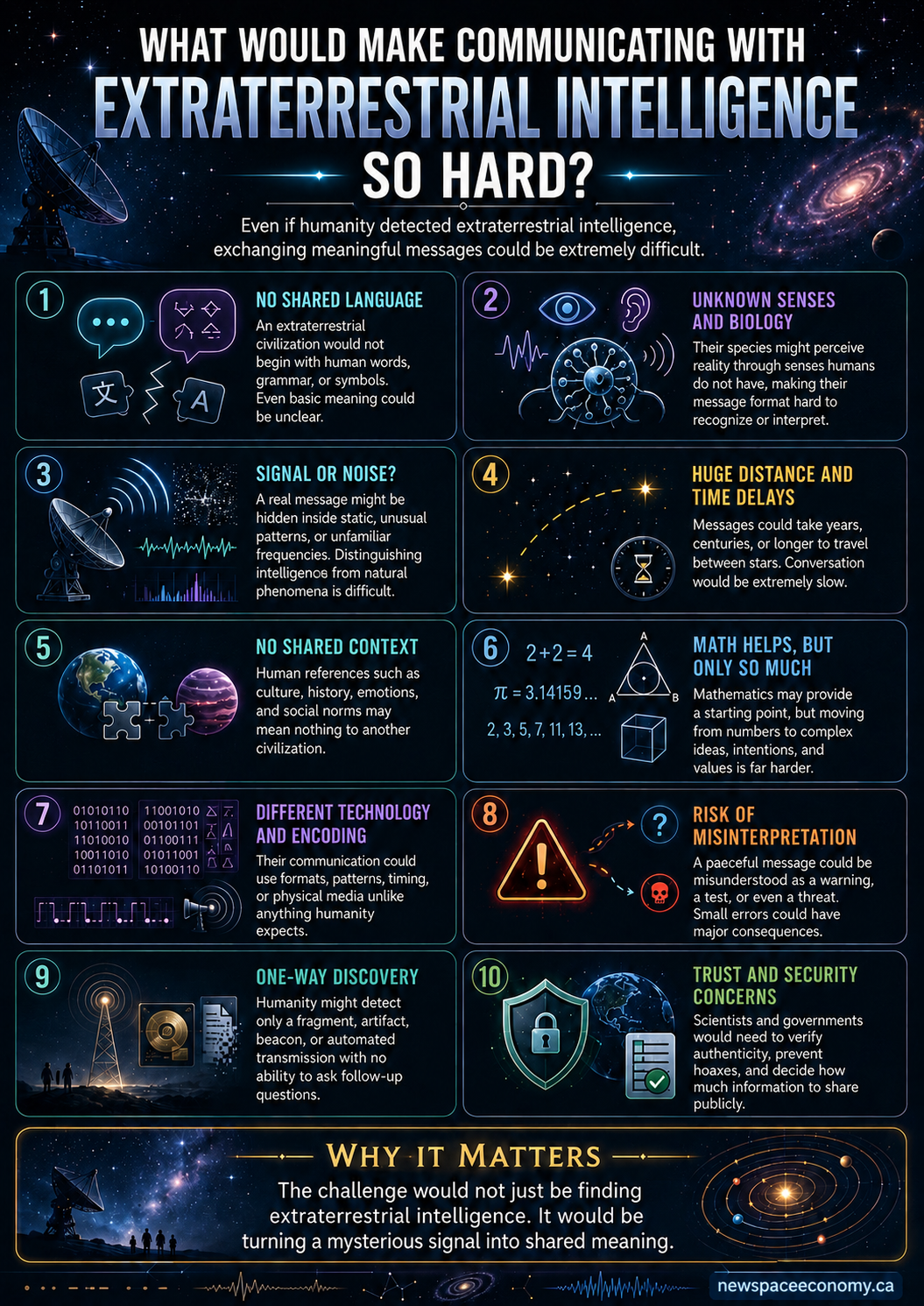
Communication with extraterrestrial intelligence would be difficult because every layer of the problem removes an assumption that ordinary human communication relies on. Distance removes quick feedback. Noise threatens detection. Different technologies widen the search space. Alien senses and cognition may weaken human categories. Verification must precede interpretation. Governance must decide who can send a reply. Public institutions must handle uncertainty without panic, secrecy, or exaggeration.
The path forward is practical rather than dramatic. Better searches can improve detection. Better archives can preserve data. Better protocols can reduce false positives. Better message design can increase the chance of partial understanding. Broader consultation can give outgoing messages more legitimacy. Stronger education can prepare the public for uncertainty.
A signal from extraterrestrial intelligence might not arrive as a greeting. It might appear as a pattern, a leak, a beacon, a relic, or a clue that takes years to interpret. The best human response would be careful enough to protect evidence and open enough to earn trust. The real test may be whether humanity can act with patience before it knows whether anyone is waiting for an answer.
Appendix: Useful Books Available on Amazon
- Extraterrestrial Languages
- Communication with Extraterrestrial Intelligence
- Civilizations Beyond Earth
- SETI 2020
- The Contact Paradox
- The Eerie Silence
Appendix: Top Questions Answered in This Article
Why Is Communicating With Extraterrestrial Intelligence So Difficult?
The difficulty comes from distance, timing, noise, verification, and meaning. A signal may take years or centuries to cross space, then arrive without shared language or cultural context. Even after detection, researchers would need to prove that the signal is artificial before trying to interpret it.
Would Mathematics Be a Universal Language?
Mathematics is one of the strongest starting points because numbers and physical relationships should not depend on human culture. It still cannot carry all meaning by itself. A receiver must infer the code, structure, units, purpose, and context before mathematics can become communication.
Why Is SETI Focused on Radio Signals?
Radio signals can travel across interstellar distances and can stand out when they are narrowband or structured. Human radio astronomy also has mature instruments and data methods. Radio is not the only option, so optical SETI, infrared searches, and broader technosignature studies now matter as well.
What Is the Difference Between SETI and METI?
SETI usually means searching for evidence of extraterrestrial technology or intelligence. METI means intentionally sending messages to possible extraterrestrial receivers. Listening raises fewer governance questions than transmitting because a deliberate message may be interpreted as speaking for Earth.
Could an Alien Message Be Impossible to Decode?
Yes. A message could be compressed, incomplete, symbolic, sensory-specific, or built around concepts humans do not share. Even a clearly artificial signal might never become fully understandable. Partial decoding may be more realistic than perfect translation.
Who Would Announce a Confirmed Signal?
A credible announcement would likely involve the discovering team, independent observatories, scientific organizations, and international consultation. The strongest approach would release verified facts, describe uncertainty, and make data available where possible. No single institution would have enough legitimacy to frame the event alone.
Should Humanity Reply to a Signal?
A reply should not be automatic. It would require scientific verification, legal review, international consultation, and public discussion. The decision would depend on what was detected, whether it was addressed to Earth, what it seemed to request, and what risks or duties governments and civil society recognized.
Could Alien Communication Use Something Other Than Radio?
Yes. Possible channels include lasers, infrared signals, artifacts, atmospheric technosignatures, or communication methods humans have not yet developed. A civilization’s preferred channel may reflect its environment, biology, technology, and goals rather than human expectations.
Why Do False Positives Matter So Much?
False positives can damage scientific credibility and public trust. Radio interference, software errors, satellites, and natural sources can create strange patterns. SETI claims need repeat observations and independent confirmation because a mistaken alien-contact claim would be difficult to undo.
How Can Humanity Improve Its Chances?
Humanity can improve the odds by expanding search methods, protecting observatories from interference, sharing data, testing message designs, and building post-detection protocols. Better instruments help, but patient verification and careful governance are just as necessary.
Appendix: Glossary of Key Terms
Arecibo Message
The Arecibo Message was a binary-coded radio transmission sent in 1974 from the Arecibo Observatory. It encoded basic information about numbers, chemistry, DNA, human form, the Solar System, and the transmitting telescope as a demonstration of human communication capability.
Breakthrough Listen
Breakthrough Listen is a large-scale SETI initiative that uses major radio and optical observatories to search for possible technosignatures. Its work includes large datasets, public archives, and signal-processing methods designed to distinguish candidate signals from interference.
Exoplanet
An exoplanet is a planet orbiting a star outside the Solar System. Exoplanet discoveries help SETI researchers identify possible target systems, study planetary environments, and think more carefully about where detectable life or technology might exist.
LaserSETI
LaserSETI is a SETI Institute optical search program that looks for brief laser-like flashes from the sky. It expands the search beyond radio signals and tests whether extraterrestrial technology might use directed light for communication or signaling.
METI
Messaging Extraterrestrial Intelligence, or METI, means intentionally transmitting messages toward possible extraterrestrial civilizations. METI raises technical questions about message design and political questions about whether any group has authority to speak for Earth.
Post-Detection Protocol
A post-detection protocol is a set of recommended steps for handling a possible extraterrestrial signal. These steps usually include verification, independent confirmation, consultation, public disclosure after confirmation, and caution before any reply is sent.
Radio Frequency Interference
Radio frequency interference is unwanted human-made or natural radio energy that can contaminate observations. It can come from satellites, aircraft, phones, radars, electronics, or local equipment, and it can make false SETI candidates look convincing.
SETI
The Search for Extraterrestrial Intelligence, or SETI, is the scientific effort to detect evidence of technology or communication beyond Earth. SETI includes radio searches, optical searches, data analysis, target selection, and technosignature research.
Technosignature
A technosignature is observable evidence that may indicate technology beyond Earth. Examples could include artificial radio signals, laser pulses, unusual waste heat, atmospheric industrial chemicals, engineered structures, or other anomalies requiring careful verification.
Voyager Golden Record
The Voyager Golden Record is a physical record carried by both Voyager spacecraft, launched in 1977. It contains sounds, images, greetings, and instructions intended as a time capsule for any future intelligence that might encounter the spacecraft.
