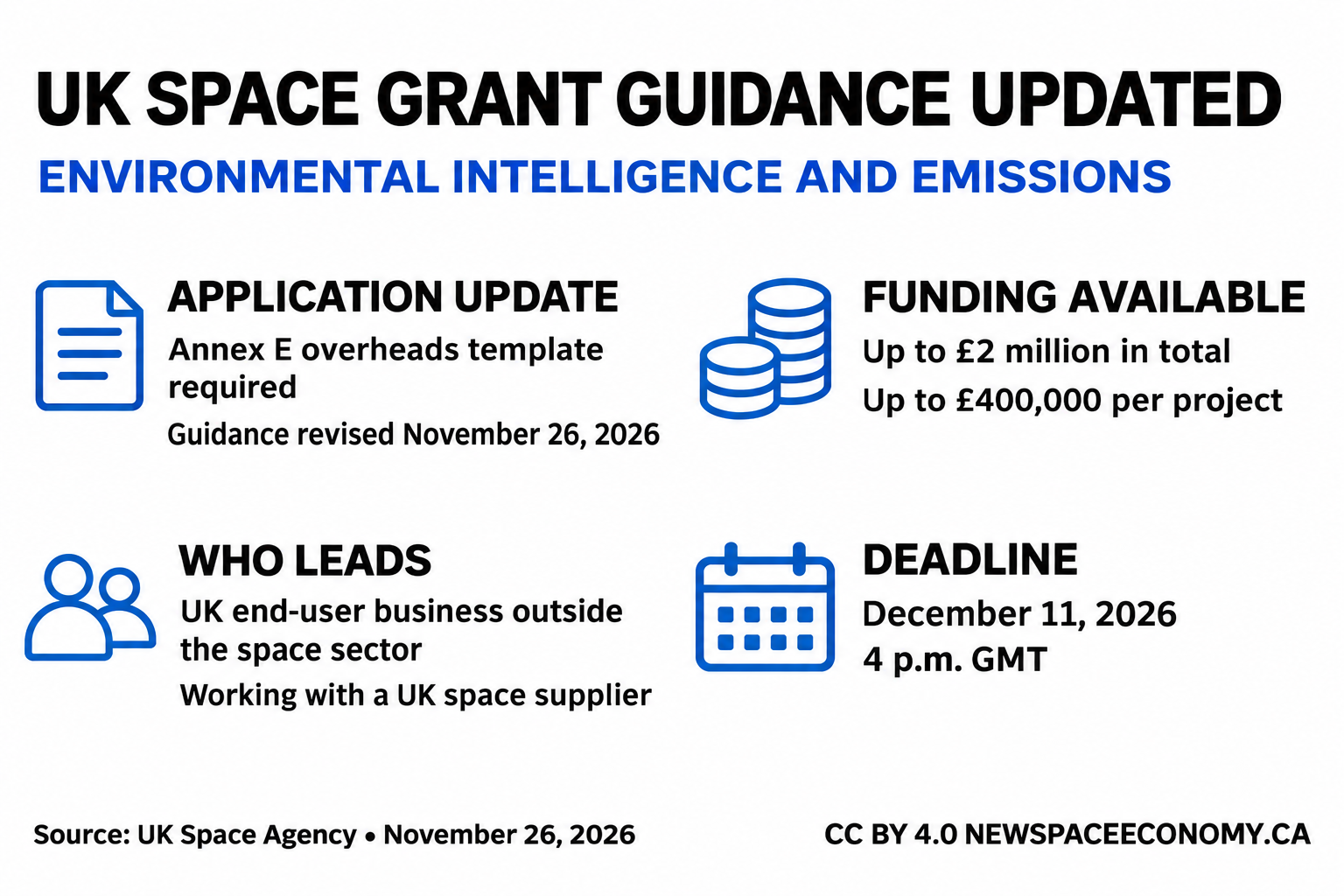
The UK Space Agency updated its environmental intelligence and emissions grant guidance on November 26, 2026, adding application material and clarifying how businesses can qualify for funding. Applicants must include an overheads template alongside their proposal before the December 11 deadline.
The official publication record identifies the November 26 revision to the competition first published on October 19. The call offers up to £2 million in total grant funding, with up to £400,000 for an individual project. The new material develops the application requirements for that existing competition.
The revised grant guidance includes Annex E, the overheads template, in the required submission documents. Other application material covers proposed milestones, a project cost breakdown and a national security questionnaire. Applicants must also supply details of previous grants for subsidy-control purposes when applicable.
Applications are submitted through the government’s Flexigrant portal by the lead business on behalf of its consortium. The deadline is 4 p.m. GMT on December 11, 2026. The agency says late submissions will not be accepted.
The funding is directed at businesses adopting space-derived services for environmental decisions. A UK end-user business outside the space sector must lead a consortium with a UK space supplier. Relevant integrators can join to combine satellite information with other datasets, software or business systems.
The updated questions and answers distinguish those roles by the work an organization performs. An end user has the operating problem and will use the resulting service in its business. A space supplier can provide satellite data, satellite services or satellite-derived insights. An integrator combines those capabilities with other components to produce a usable service or decision-support tool.
That structure places the intended customer inside the funded project. For a satellite supplier, the demonstration is connected to an identified business use. The application must explain the economic benefits for the UK end user and the contribution to the UK space supplier’s development and growth.
The guidance also clarifies how technology readiness is assessed. The proposed solution must begin at technology readiness level five or higher and reach at least level seven during the funded period. The requirement applies to the overall solution being developed and demonstrated, rather than separately to every consortium member’s contribution.
The two challenge areas cover environmental intelligence and emissions monitoring. The first includes climate resilience, nature recovery and natural-capital assessment. The second concerns measuring, reporting and verifying emissions. Eligible projects can use Earth observation, satellite communications, or positioning, navigation and timing services, with at least one space-based capability incorporated into the solution.
Those capabilities contribute in different ways. Earth-observation satellites collect measurements of environmental conditions over large areas. Satellite communications can carry information from remote or distributed assets. Positioning and timing services associate measurements and activities with locations and times. The guidance permits complementary technologies such as artificial intelligence and machine learning within the proposed service.
New Space Economy’s coverage of the original call described its business-led structure when applications opened. The revised guidance now gives applicants more detail about the required financial documents, the roles of participating organizations and the maturity of the combined solution.
Overseas field testing can form part of a project when it is relevant to demonstrating the service. The guidance says the project must still be led by a UK-based end-user business and show benefits to that business and its UK space supplier. Proposed overseas activities and costs remain subject to the call’s eligibility rules.
Projects can last up to nine months. The agency expects successful teams to be ready to start by mid-January 2027 and aim to finish by September 30, 2027. The first milestone is expected by March 31 and should represent at least 25% of the requested grant value, with justification required for a different allocation.
The guidance incorporates responses to questions raised around the November 3 applicant webinar. The recording and application annexes are available through the official publication page, ahead of the December 11 submission deadline.