
- Key Takeaways
- From an Advertising Engine to a Half-Trillion-Dollar Artificial Intelligence Platform
- Why Google Search Growth Slowed Even as Queries Hit a Five-Year High
- Google Cloud Doubles in Size as Enterprise Artificial Intelligence Scales
- Custom Silicon and Full-Stack Economics Redefine Google's Cost Structure
- Consumer Subscriptions and YouTube Build Direct Recurring Revenue
- The Capital Expenditure Surge and the Return of Negative Free Cash Flow
- Agentic Commerce, Autonomous Vehicles, and Alphabet's Long-Term Bets
- Competitive Pressures and the Structural Tradeoffs Ahead
- Summary
Key Takeaways
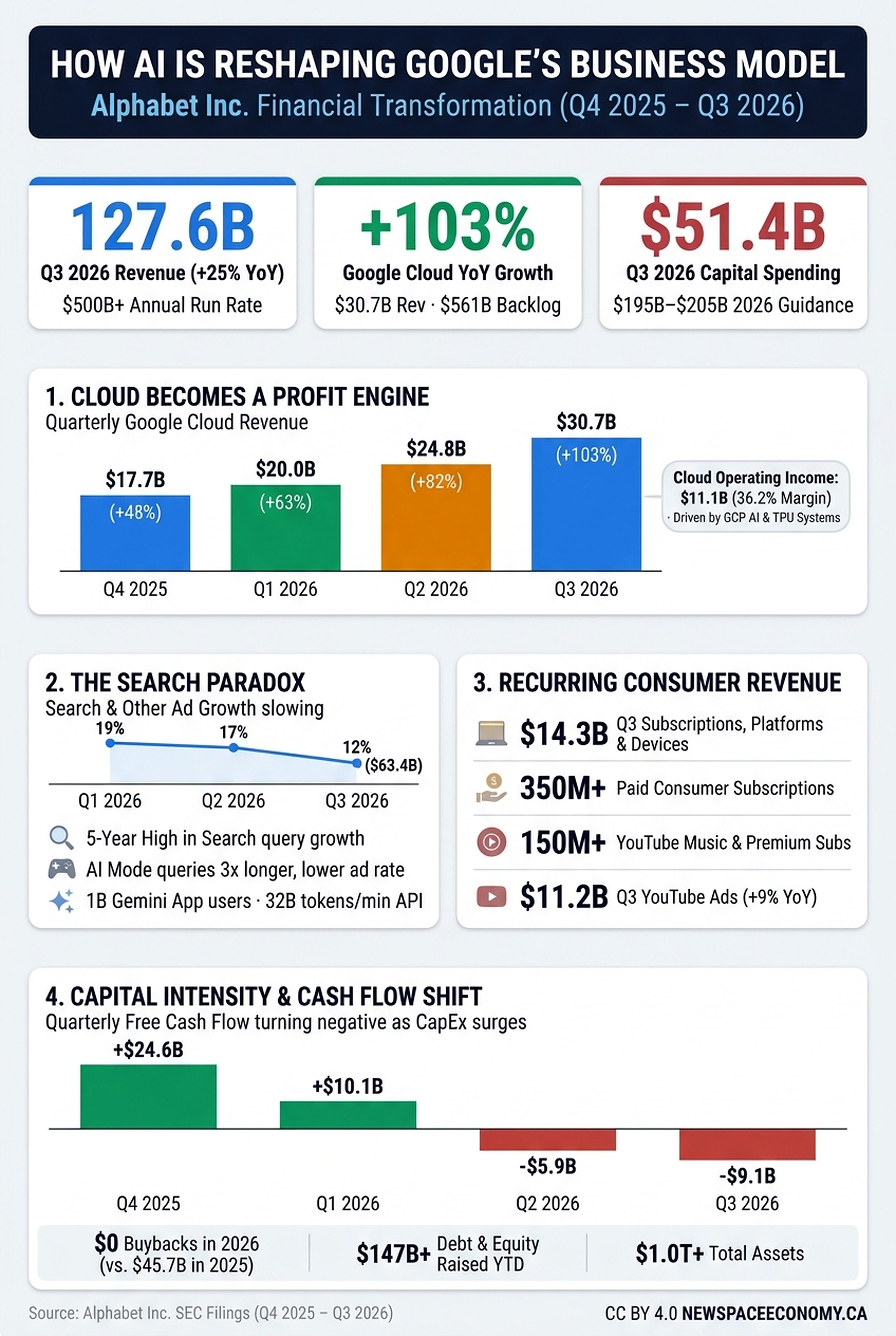
- Alphabet reached a $500 billion annual revenue run rate in Q3 2026 as Google Cloud grew 103% year over year.
- Search query growth hit a five-year high, yet lower AI Mode monetization slowed Search ad growth to 12%.
- Quarterly capital spending reached $51.4 billion in Q3 2026, turning quarterly free cash flow negative.
From an Advertising Engine to a Half-Trillion-Dollar Artificial Intelligence Platform
On October 28, 2026, Alphabet Inc. reported third-quarter revenue of $127.6 billion, an increase of 25% from the same period in 2025, pushing the parent company of Google past a half-trillion-dollar annual revenue run rate for the first time in its history. That milestone in Alphabet’s third-quarter 2026 filing marks a deeper transformation than simple top-line expansion. For more than two decades, Google operated one of the most capital-efficient advertising engines in corporate history, turning free web queries into high-margin clicks with relatively modest physical infrastructure compared with industrial peers. Over the four quarters from late 2025 through September 30, 2026, artificial intelligence (AI) altered nearly every financial pillar of that model, changing where revenue originates, how search queries convert into advertising dollars, how much physical capital the company must deploy, and how Alphabet finances its balance sheet.
The pace of that shift becomes visible when comparing Alphabet’s full-year 2025 baseline against its 2026 quarterly trajectory. In Alphabet’s fourth-quarter 2025 release, full-year 2025 revenue crossed $402.8 billion, up 15% from 2024, with consolidated operating income of $129.0 billion and a 32% operating margin. At the end of 2025, Google Services still generated 84.2% of quarterly revenue, and Google Cloud accounted for 15.5%. Nine months later, in the third quarter of 2026, Google Cloud had expanded to 24.1% of consolidated revenue and 27.4% of consolidated operating income before corporate eliminations, nearly doubling its share of Alphabet’s business in less than one year.
Earlier analysis of how AI reshapes Google’s business framed the transition primarily as an existential defense of search advertising against conversational chatbots. The 2026 financial statements reveal a more complex commercial reality. Search advertising has not collapsed, and consolidated operating income rose 30% year over year in each of the first three quarters of 2026. At the same time, the financial profile of Alphabet has become far more capital-intensive. Total assets climbed from $595.3 billion at the end of 2025 to more than $1.0 trillion by September 30, 2026, driven by surging investments in data centers, specialized computing hardware, and enterprise cloud infrastructure.
The table below tracks Alphabet’s consolidated financial progression across four consecutive quarters, highlighting the simultaneous acceleration in revenue and capital intensity from late 2025 through the third quarter of 2026.
| Financial Metric | Q4 2025 | Q1 2026 | Q2 2026 | Q3 2026 |
|---|---|---|---|---|
| Total Revenue | $113.8B (+18%) | $109.9B (+22%) | $119.8B (+24%) | $127.6B (+25%) |
| Operating Income | $35.9B (31.6%) | $39.7B (36.1%) | $40.8B (34.0%) | $40.6B (31.8%) |
| Search and Other | $63.1B (+17%) | $60.4B (+19%) | $63.3B (+17%) | $63.4B (+12%) |
| Google Cloud | $17.7B (+48%) | $20.0B (+63%) | $24.8B (+82%) | $30.7B (+103%) |
| Capital Expenditure | $27.9B | $35.7B | $44.9B | $51.4B |
These quarterly figures establish a clear structural pattern. Consolidated revenue growth accelerated in every period, rising from 18% in the fourth quarter of 2025 to 22% in the first quarter of 2026, 24% in the second quarter, and 25% in the third quarter. Yet the composition of that growth shifted decisively away from pure advertising toward enterprise cloud services, custom computing hardware, and recurring consumer subscriptions. Understanding how AI is reshaping Google requires examining both sides of that ledger: the friction emerging inside core search advertising and the explosive expansion occurring across cloud infrastructure.
Why Google Search Growth Slowed Even as Queries Hit a Five-Year High
Google Search remains the financial bedrock of Alphabet, generating $63.35 billion in the third quarter of 2026, or roughly half of consolidated revenue. On the surface, AI has energized user engagement across the platform. In Sundar Pichai’s third-quarter 2026 remarks, Alphabet’s chief executive officer reported that year-over-year Search query growth reached its fastest pace in five years, including gains in commercial queries. Users are asking fundamentally different questions through AI Overviews and AI Mode, the conversational search interface Google is merging with traditional web results. Queries in AI Mode average three times the length of traditional keyword searches, one in five AI Mode searches globally incorporates voice, images, or documents, and visual searches have surpassed 50 billion per month.
Despite that surge in usage, Search revenue growth decelerated for two consecutive quarters during 2026. After expanding 19% year over year to $60.4 billion in Alphabet’s first-quarter 2026 results and 17% to $63.27 billion in the second-quarter 2026 release, Google Search and other revenue grew 12% in the third quarter to $63.35 billion, virtually flat sequentially. During Alphabet’s third-quarter earnings call, senior vice president and chief business officer Philipp Schindler identified three factors behind the slowdown: foreign exchange movements, shifts in retail and media advertising budgets, and lower ad monetization in AI Mode.
Schindler’s acknowledgment marked a watershed moment for investors evaluating Google’s core business model. As reported in Search Engine Land’s earnings coverage, Schindler stated that strong growth in AI Mode queries affected revenue growth because AI Mode currently monetizes at a lower rate than traditional search results. For decades, Google’s pay-per-click auction thrived on concise commercial queries that mapped cleanly onto keyword bids and sponsored links. Conversational, multi-step prompts in AI Mode often sit earlier in the consumer decision process, where users research options rather than immediately clicking a merchant link. Alphabet did not disclose the exact revenue gap per query between classic Search and AI Mode, leaving open the question of how quickly new ad formats can close the difference.
Google management has framed this lag as a deliberate sequencing choice rather than a permanent structural ceiling. Pichai compared the transition to Google’s shift from desktop to mobile search more than a decade ago, noting that the company prioritizes building user engagement first and scaling monetization second. To narrow the gap, Google announced on October 28, 2026, that it was expanding ads in AI Mode to 10 additional international markets, including Canada and Australia, and introducing ads within follow-up questions in the United States. Existing Search, Shopping, and Performance Max campaigns became eligible by default. Schindler also noted that click-through rates for sponsored product listings in AI Mode were already similar to organic product listings in U.S. testing, and that Gemini models helped advertisers generate more than 1.5 billion campaign assets during the third quarter, more than seven times the prior-year volume.
Meanwhile, Google Network advertising, which places ads on third-party publisher websites, illustrates the slower side of the legacy model. Network revenue edged up just 1% year over year to $7.46 billion in the third quarter of 2026, following slight declines in the first and second quarters. Traffic acquisition costs (TAC), the revenue-sharing payments Google makes to distribution partners and device makers to keep its search engine as the default option, rose 10% year over year to $16.37 billion in the third quarter. As conversational answers absorb queries that once sent users to external websites, Google must balance advertiser return on investment, distribution partner economics, and publisher sustainability across the open web.
Google Cloud Doubles in Size as Enterprise Artificial Intelligence Scales
If Search demonstrates the monetization friction of the AI transition, Google Cloud demonstrates its commercial payoff. In the third quarter of 2026, Google Cloud revenue surged 103% year over year to $30.71 billion, accelerating from 48% growth in the fourth quarter of 2025, 63% in the first quarter of 2026, and 82% in the second quarter. Operating income in the segment more than tripled from $3.59 billion in the third quarter of 2025 to $11.12 billion a year later, expanding the segment’s operating margin from 23.7% to 36.2%. Within one year, Google Cloud evolved from a secondary growth division into a major profit engine rivaling the profitability profile of traditional enterprise software.
The drivers behind that expansion span infrastructure, models, applications, and hardware. Alphabet attributed third-quarter cloud performance to Google Cloud Platform (GCP) enterprise AI infrastructure, enterprise AI solutions, core cloud services, and a newly prominent revenue line: direct sales of Tensor Processing Unit (TPU) systems. In its official segment disclosures, Alphabet explicitly noted that Google Cloud generates services revenue from consumption-based fees and subscriptions for GCP and Google Workspace, and product revenue primarily from selling TPU systems. On the third-quarter earnings call, Google Cloud chief executive Thomas Kurian explained that a TPU system combines custom silicon, compute, storage, networking, and software for training and inference, turning Google’s internal hardware engineering into an external commercial product line.
Customer demand is also visible in contracted future business. Google Cloud backlog, representing binding multi-year customer commitments not yet recognized as revenue, climbed from $240 billion at the end of 2025 to more than $460 billion in the first quarter of 2026 and reached $561 billion in the third quarter. Management indicated that Alphabet expects to recognize slightly more than 55% of that backlog over the next 24 months. Adoption extends deep into large corporations: in the second quarter of 2026, Pichai reported that nearly 90% of Fortune 100 companies were using Gemini Enterprise. Direct customer usage of Google’s first-party model application programming interfaces (APIs), the software interfaces developers use to send prompts and receive model outputs, climbed from more than 10 billion tokens per minute in late 2025 to 16 billion in the first quarter of 2026, 22 billion in the second quarter, and nearly 32 billion tokens per minute in the third quarter.
The table below compares Alphabet’s segment revenue and operating income between the third quarter of 2025 and the third quarter of 2026, illustrating how rapidly Google Cloud has altered the company’s earnings mix.
| Business Segment | Q3 2025 Revenue | Q3 2026 Revenue | Q3 2026 Operating Income |
|---|---|---|---|
| Google Services | $87.05B | $96.30B (+11%) | $39.16B (+17%) |
| Google Cloud | $15.16B | $30.71B (+103%) | $11.12B (+209%) |
| Other Bets | $0.34B | $0.37B (+8%) | -$2.05B |
| Alphabet-Level Activities | Not applicable | Not applicable | -$7.66B |
| Hedging and Total | $102.35B | $127.58B (+25%) | $40.58B (+30%) |
Enterprise AI adoption also pulls adjacent cloud products into customer bills. Kurian noted that organizations building AI agents on Gemini simultaneously purchase compute for task execution, storage for agent memory, databases for contextual retrieval, and cybersecurity tools to protect automated workflows. As examined in New Space Economy’s taxonomy of AI markets, enterprise AI revenue rarely sits inside a single isolated line item; it flows across compute, databases, security, and productivity suites. At the same time, rapid adoption introduces operational complexity for software buyers. Research from Google Cloud’s own DevOps Research and Assessment program, analyzed in New Space Economy’s report on maintaining AI-generated software, found that higher organizational AI coding adoption can inflate batch sizes and reduce delivery stability unless human verification capacity scales alongside code generation. For Google Cloud, helping enterprises govern and verify AI workloads has become part of the commercial value proposition.
Custom Silicon and Full-Stack Economics Redefine Google’s Cost Structure
A defining feature of Alphabet’s 2026 financial results is the degree to which vertical integration shapes both revenue and operating costs. Unlike pure software companies that rent computing capacity or rely entirely on external chipmakers, Google controls its own custom accelerators, data-center networking, cloud software, frontier models, and consumer distribution. The centerpiece of that hardware stack is the Tensor Processing Unit, an application-specific integrated circuit Google began using internally in 2015 and has iterated through eight generations. In April 2026, Google introduced its eighth-generation TPU architecture split into two specialized designs: the TPU 8t for large-scale model pre-training and the TPU 8i for high-speed inference, AI agents, and long-context reasoning.
Owning custom silicon changes Google’s unit economics relative to competitors that depend exclusively on graphics processing units (GPUs) from NVIDIA. As New Space Economy noted in its analysis of NVIDIA’s dominance in AI chips, NVIDIA retains overwhelming share in high-end accelerated computing, forcing hyperscalers to absorb steep hardware costs when scaling model clusters. Google still purchases third-party GPUs for cloud customers that prefer NVIDIA’s software ecosystem, and chief financial officer Anat Ashkenazi cautioned that bringing third-party computing capacity online in the fourth quarter of 2026 would create near-term Cloud margin headwinds. However, running internal Search, YouTube, and Gemini workloads on custom TPUs allows Google to optimize models, compilers, liquid-cooled server racks, and networking together, lowering the cost per generated token as volume scales into the tens of billions per minute.
That full-stack approach is tightly linked to Google DeepMind, the research division responsible for the Gemini model family. In October 2026, Google launched Gemini 4 Argon and announced Gemini 4 Carbon, its most capable frontier model for complex reasoning, multimodal understanding, and cybersecurity defense. Inside Google itself, engineering teams across Chrome, Ads, and Search adopted Argon to accelerate internal software development, shipping 35% more code with 30% fewer errors in the weeks following its release. Internal productivity gains of that scale help offset the rising headcount and research costs needed to stay at the frontier.
Those research costs are substantial and clearly visible in Alphabet’s income statement. Research and development (R&D) expenses jumped 36% year over year to $20.64 billion in the third quarter of 2026, bringing nine-month R&D spending to $55.89 billion compared with $42.52 billion in the same period of 2025. Alphabet’s workforce expanded to 204,757 employees as of September 30, 2026, up from 190,167 one year earlier, reflecting aggressive hiring of AI researchers and technical infrastructure engineers. In segment reporting, Alphabet-level activities, which primarily capture shared AI research and general model development costs not allocated to individual divisions, recorded an operating loss of $7.66 billion in the third quarter, up 71% from $4.47 billion a year earlier.
Even Google’s experimental hardware research illustrates how seriously the company treats long-term compute constraints. On October 30, 2026, Google reported that its Project Suncatcher orbital prototype had generated and returned an AI response using a TPU operating in low Earth orbit after launching aboard a SpaceX mission earlier that month. Although orbital computing remains an early research program rather than a near-term commercial revenue stream, the experiment underscores how energy, thermal management, and physical compute supply have moved to the center of Alphabet’s strategic planning.
Consumer Subscriptions and YouTube Build Direct Recurring Revenue
Alongside enterprise cloud growth, AI has accelerated Alphabet’s push to build direct financial relationships with consumers. Historically, most Google users never paid the company directly; their attention was monetized through advertising. In 2026, consumer subscriptions have become a lasting third pillar inside Google Services. Revenue in the Google subscriptions, platforms, and devices category rose 11% year over year to $14.29 billion in the third quarter of 2026, following 19% growth in the first quarter and 15% growth in the second quarter.
By the end of the first quarter of 2026, Alphabet surpassed 350 million paid consumer subscriptions across Google One, YouTube Premium, YouTube Music, and YouTube TV, up from more than 325 million at the end of 2025. By the third quarter, YouTube Music and Premium alone exceeded 150 million global subscribers, including trials. Google One AI plans, which bundle cloud storage with access to frontier Gemini models and advanced features across Gmail, Docs, and Search, have become a primary growth catalyst for direct consumer billing.
The distribution funnel feeding those subscriptions has expanded at historic speed. Pichai announced in the third-quarter 2026 release that the standalone Gemini app reached one billion users, up from 750 million monthly active users in the fourth quarter of 2025 and 950 million in the second quarter of 2026, making it the fastest-growing product in Google’s history. Reaching one billion users narrows the consumer reach gap with OpenAI’s ChatGPT and gives Alphabet a massive installed base for tiered subscriptions, device integration on Android, and future commerce features.
YouTube continues to anchor Alphabet’s dual advertising and subscription strategy. Having surpassed $60 billion in combined annual advertising and subscription revenue in 2025, YouTube generated $11.21 billion in advertising revenue in the third quarter of 2026, up 9% year over year, after growing 11% in the first quarter and 13% in the second quarter during strong FIFA World Cup 2026 viewership. Management highlighted continued strength in living-room television viewing, where YouTube remained the top streaming platform in the United States by watch time. AI tools are reshaping both sides of YouTube’s marketplace: creators use generative tools for dubbing, editing, and custom feeds, and more than 1.3 million channels participate globally in YouTube Shopping, linking video recommendations directly to retail transactions.
This shift toward subscriptions and commerce reduces Alphabet’s exclusive reliance on keyword auctions. Subscription revenue is recurring, less volatile during advertising downturns, and directly tied to user demand for higher-capability AI models. Yet it also alters margin dynamics: serving frontier AI models to hundreds of millions of free and paid consumer users requires continuous inference capacity, making hardware efficiency and tiered pricing essential to long-term profitability.
The Capital Expenditure Surge and the Return of Negative Free Cash Flow
No metric in Alphabet’s 2026 financial statements illustrates the transformation of Google’s business model more starkly than capital expenditure (CapEx), the cash spent on long-lived physical assets such as land, data-center buildings, servers, and networking gear. For the full year 2024, Alphabet spent $52.54 billion on purchases of property and equipment. In full-year 2025, that figure rose to $91.45 billion. In the first nine months of 2026 alone, Alphabet spent $131.95 billion on property and equipment, including $35.67 billion in the first quarter, $44.92 billion in the second quarter, and $51.36 billion in the third quarter. Management reaffirmed full-year 2026 CapEx guidance of $195 billion to $205 billion and signaled that spending would rise further in 2027.
That spending pace pushed Alphabet’s quarterly free cash flow, defined by the company as operating cash flow minus capital expenditures, into negative territory for two consecutive quarters. In the second quarter of 2026, operating cash flow of $39.07 billion fell short of $44.92 billion in CapEx, producing negative $5.86 billion in free cash flow. In the third quarter, operating cash flow of $42.29 billion lagged $51.36 billion in CapEx, resulting in negative $9.07 billion in free cash flow. Trailing twelve-month free cash flow compressed from $73.27 billion at the end of 2025 to $19.75 billion by September 30, 2026.
The table below details Alphabet’s operating cash flow, capital expenditure, and resulting free cash flow across the four quarters ended September 30, 2026.
| Fiscal Quarter | Operating Cash Flow | Capital Expenditure | Free Cash Flow |
|---|---|---|---|
| Q4 2025 | $52.40B | $27.85B | $24.55B |
| Q1 2026 | $45.79B | $35.67B | $10.12B |
| Q2 2026 | $39.07B | $44.92B | -$5.86B |
| Q3 2026 | $42.29B | $51.36B | -$9.07B |
As New Space Economy explained in its assessment of whether the AI bubble has burst, negative free cash flow alongside $40.6 billion in quarterly operating income does not indicate an operating collapse. Rather, it reflects the accounting timing gap between upfront cash outflows for physical infrastructure and the multi-year recognition of depreciation, the accounting process that spreads an asset’s cost over its estimated useful life. Depreciation of property and equipment climbed to $8.37 billion in the third quarter of 2026, up 49% from $5.61 billion a year earlier, and management warned that depreciation and data-center operating expenses will continue rising as newly built facilities enter service. Inventory on Alphabet’s balance sheet also jumped from $2.44 billion at the end of 2025 to $13.31 billion by September 30, 2026, reflecting hardware and TPU system builds ahead of customer delivery.
To fund this infrastructure expansion, Alphabet executed a dramatic shift in corporate finance during 2026. For years, the company returned tens of billions of dollars annually through share buybacks, repurchasing $62.22 billion of stock in 2024 and $45.71 billion in 2025. Across the first nine months of 2026, Alphabet repurchased zero shares of stock. Instead, the company became a major issuer of both debt and equity. During the first three quarters of 2026, Alphabet raised $85.22 billion in net proceeds from debt issuance, $42.87 billion from common stock issuance including its at-the-market equity program, and $19.06 billion from mandatory convertible preferred stock. Long-term debt expanded from $46.55 billion at the end of 2025 to $125.10 billion by September 30, 2026, and Alphabet simultaneously fortified its liquidity, ending the third quarter with $265.10 billion in cash, cash equivalents, and marketable securities.
That balance-sheet transformation echoes historical infrastructure buildouts examined in New Space Economy’s comparison of the dot-com and AI cycles. Building hyperscale data centers requires land, grid interconnections, power generation contracts, and cooling systems years before full utilization is achieved. Alphabet’s shift from an asset-light share-repurchasing giant to a capital-raising infrastructure builder is the clearest financial proof that AI has permanently altered the company’s economic blueprint.
Agentic Commerce, Autonomous Vehicles, and Alphabet’s Long-Term Bets
Beyond current advertising and cloud revenue, Alphabet’s 2026 disclosures point toward a next-stage business model centered on AI agents, autonomous systems, and scientific discovery. On the third-quarter earnings call, Pichai described agentic experiences as a unifying layer that will extend across Search, the Gemini app, Chrome, Android, and Google Workspace. Rather than merely answering informational queries, AI agents can book reservations, complete forms, schedule appointments, and execute multi-step purchases on behalf of users and businesses. Alphabet deployed these capabilities first in Gemini Enterprise, where security and governance requirements are strict, before expanding them into consumer Search and the Gemini app.
If agentic workflows achieve broad consumer adoption, Google’s monetization model could gradually shift from charging for clicks to facilitating verified transactions, subscriptions, and enterprise automation. Supporting that evolution requires models capable of reasoning across physical and digital environments. In October 2026, Alphabet introduced Genie 4, an interactive world model with real-time audio designed as a training environment for robotics and autonomous agents.
Alphabet’s Other Bets segment illustrates how AI progress intersects with capital-intensive frontier ventures. In the third quarter of 2026, Other Bets generated $372 million in revenue and posted an operating loss of $2.05 billion, compared with a $1.43 billion loss a year earlier. The flagship business within Other Bets is Waymo, Alphabet’s autonomous driving subsidiary. By October 2026, Waymo had surpassed 300 million fully autonomous miles driven and operated public ride-hailing service across 15 major U.S. cities, including recent openings in San Antonio, San Diego, and Tampa, with planned international expansions into Canada, Germany, Singapore, and Spain. Earlier in 2026, Waymo announced a $16.0 billion investment round predominantly funded by Alphabet. Meanwhile, Isomorphic Labs, Alphabet’s drug-discovery venture, began applying Gemini 4 Argon to pharmaceutical design research, and Google’s quantum computing team demonstrated magic state cultivation for the first time.
Alphabet’s income statement in 2026 also revealed how non-operating technology investments can create sharp swings in reported net income. Under accounting rules, unrealized gains and losses on equity securities flow directly through Other Income and Expense. In the second quarter of 2026, Alphabet recorded a $99.03 billion net gain on equity securities, lifting quarterly net income available to common stockholders to $112.11 billion. One quarter later, in the third quarter of 2026, an $8.66 billion net loss on equity securities, largely linked to an unrealized markdown on Alphabet’s SpaceX investment, swung Other Income and Expense to negative $8.22 billion and pulled quarterly net income down to $26.17 billion, or $2.12 per diluted share, even though consolidated operating income climbed 30% to $40.58 billion. Separating core operating performance from equity-portfolio volatility has become essential when reading Alphabet’s bottom line.
Competitive Pressures and the Structural Tradeoffs Ahead
Alphabet’s 2026 financial results demonstrate undeniable commercial momentum, yet they also expose structural tradeoffs across the broader layered AI commercial ecosystem. As New Space Economy documented in its analysis of AI market share in 2026, no single vendor controls every layer of the stack. NVIDIA leads accelerated computing hardware, Amazon Web Services leads overall cloud infrastructure share, Microsoft holds deep enterprise software distribution through Microsoft 365 and GitHub, OpenAI commands strong consumer brand habit with ChatGPT, and Anthropic has captured substantial enterprise model spending in coding and knowledge work. Google’s distinct advantage lies in vertical integration across Search, Android, YouTube, Workspace, Google Cloud, Gemini, and custom TPUs.
Maintaining that integrated position requires managing three ongoing pressures revealed in the 2026 financials. First, Search monetization must adapt without alienating users, advertisers, or publishers. Alphabet’s third-quarter admission that AI Mode monetizes below classic Search triggered immediate investor scrutiny because Google Services still generates nearly four-fifths of Alphabet’s segment operating profit. Closing that monetization gap through shopping integrations, follow-up query ads, and agentic commerce will determine whether Search remains a reliable cash engine to finance the rest of Alphabet’s ambitions.
Second, Alphabet must prove that its $195 billion to $205 billion 2026 capital expenditure program, along with higher planned spending in 2027, earns attractive long-term returns after depreciation, electricity, and hardware replacement cycles. Because AI accelerators can become economically obsolete before their accounting useful lives expire, capital discipline matters as much as revenue growth. Google Cloud’s $561 billion backlog provides unusual revenue visibility, yet third-party compute costs and rising depreciation will test whether Cloud can sustain operating margins near 36%.
Third, regulatory and ecosystem friction remains a persistent financial variable. Alphabet’s third-quarter 2026 operating cash flow reflected large regulatory cash outflows alongside ongoing antitrust and copyright pressures worldwide. At the same time, publishers whose referral traffic declines when AI answers satisfy user queries face shrinking incentives to produce original web content, forcing Google to refine how attribution, licensing, and outbound links function inside AI-driven search.
Summary
Alphabet’s 2025 and 2026 financial results show that artificial intelligence has neither broken Google’s core business nor left its historic business model intact. Instead, AI has reorganized Alphabet into a far larger, more diversified, and substantially more capital-intensive enterprise. Revenue has accelerated to a half-trillion-dollar annual run rate, powered by a Google Cloud division that doubled in size to $30.71 billion in quarterly revenue and tripled its operating profit to $11.12 billion, backed by a $561 billion customer backlog and commercial sales of custom TPU systems. Consumer subscriptions and the one-billion-user Gemini app have added recurring direct revenue alongside YouTube’s streaming leadership.
That expansion has come with visible financial tradeoffs. Search advertising remains highly profitable, yet its growth slowed to 12% in the third quarter of 2026 as users shifted toward longer, multimodal AI Mode queries that currently monetize below traditional keyword links. Simultaneously, building the physical compute backbone for frontier AI pushed quarterly capital spending to $51.36 billion, turned quarterly free cash flow negative, halted share buybacks, and led Alphabet to raise more than $147 billion through debt and equity offerings in nine months. Google’s future financial performance now depends on how effectively it converts its unmatched full-stack infrastructure and $561 billion cloud backlog into lasting free cash flow as AI search monetization matures.
