
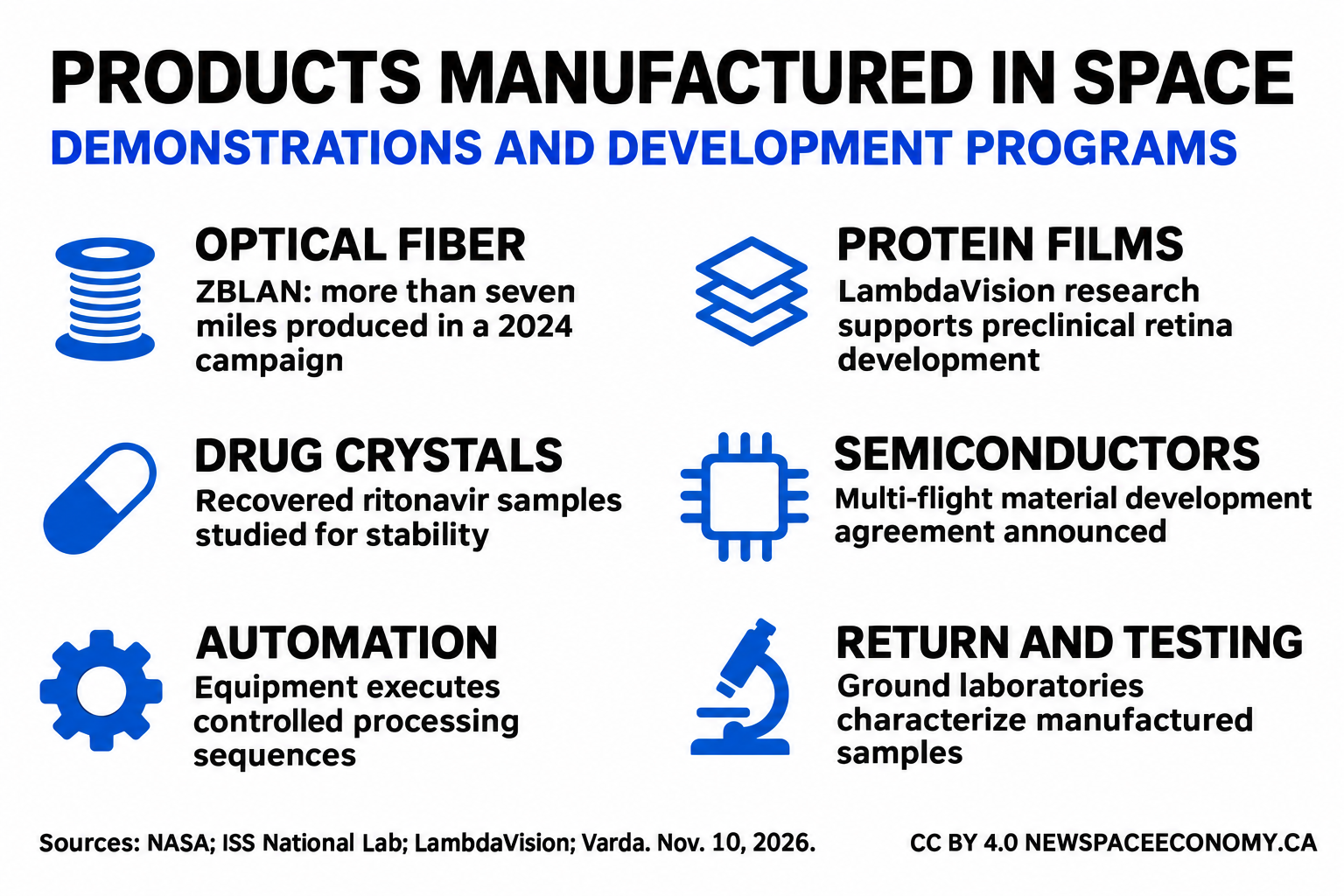
A manufacturing system on the International Space Station produced more than seven miles of optical fiber during a month of operations in 2024. The experiment used a fluoride glass called ZBLAN, whose processing behavior changes in microgravity. It is one of several documented programs connecting manufacturing in space with specialized products used on Earth.
The commercial connection is a material property: how much light a fiber transmits, how uniformly a protein film forms, or which crystalline form a pharmaceutical process produces. Space supplies a processing environment. The product’s value comes from the function it performs after manufacture and, for terrestrial applications, after its return to Earth.
The Manufacturing Step Is the Source of Value
Microgravity reduces settling and buoyancy-driven fluid motion within a material. Those changes can affect how crystals form, how substances mix, and how thin layers assemble. A manufacturer uses the environment for a specific production step and evaluates the resulting material against the properties relevant to its application.
The ISS National Laboratory describes In-Space Production Applications as an applied development program for products and processes with potential economic uses. Its work connects prior research with demonstrations of production against defined performance standards. The program’s subject is the manufactured output and the process used to make it.
A finished component can incorporate material processed in orbit alongside parts made on Earth. The orbital operation may produce a fiber, a crystal, or a thin film. Subsequent inspection, packaging, assembly, and distribution can occur in terrestrial facilities. This divides the production chain according to what each environment contributes to the final product.
That division also defines the customer relationship. A specialist material producer can sell to a component manufacturer, and a component manufacturer can supply a larger system. The orbital platform operator may provide processing capacity to the material producer. The buyer of the finished system need not purchase a spaceflight directly.
Optical Fiber Connects Processing With Transmission
NASA’s 2024 station achievements report records the Flawless Space Fibers-1 production campaign. Between mid-February and mid-March, the system produced more than seven miles of fiber. One draw exceeded half a mile, demonstrating that the equipment could produce long continuous lengths in orbit.
ZBLAN is a fluoride glass containing zirconium, barium, lanthanum, aluminum, and sodium compounds. Optical fiber carries light through a narrow glass structure. The material’s composition and internal quality affect how much of the signal is retained as it travels. Manufacturers connect those optical properties with communications, sensing, and other light-based applications.
NASA’s fiber-production explanation describes how unwanted crystals in ground-drawn ZBLAN can scatter light and make the fiber brittle. Microgravity changes the growth and transport processes during drawing and cooling. The flight investigations use those conditions to produce fiber and then examine its properties after return.
The commercial unit is usable fiber with specified optical and physical characteristics. Production length determines how much material is available for testing or incorporation into a device. Transmission measurements establish how it performs. These are separate attributes of the same manufactured output, connecting the production process with the customer’s intended application.
A 2024 National Science Foundation award to Flawless Photonics identifies automated ZBLAN manufacturing for terrestrial and orbital use. The project description connects the material with free-space mid-wave infrared optical links. This provides a specific application beyond a general claim that space-made glass has commercial value.
Protein Thin Films Are a Different Product
LambdaVision is developing an artificial retina composed of layers of a light-activated protein and a polymer. The company uses microgravity research to examine and improve its layer-by-layer manufacturing process. Its product development connects a biological material with the consistency and optical behavior of a manufactured thin film.
The ISS National Laboratory’s June 2026 report describes nine LambdaVision investigations on the station. Working with Space Tango, the company developed an automated production system inside CubeLab hardware. The report attributes improved uniformity, optical performance, and reproducibility to films produced in the microgravity experiments.
The orbital process builds up successive layers. Uniform deposition matters because the finished film’s function depends on the arrangement and behavior of its constituent material. The production equipment controls the sequence in which layers are applied, and examination of the output measures the result. The commercial product under development is the implant, with orbital processing contributing to its manufacture.
LambdaVision’s September 2026 mission announcement identifies the company as preclinical and describes plans for work on Helogen’s autonomous platform. It reports production of 200-layer protein films during the station program. The announced autonomous experiment focuses on characterizing the protein in orbit and developing quality-control information.
That planned work links process development with inspection. A manufacturer needs a record of what was produced and how the material behaves. An onboard measurement can contribute to that record during processing, and returned samples can support further analysis on Earth. Both forms of information belong to the production chain associated with the material.
Pharmaceutical Processing Produces Defined Crystal Forms
A pharmaceutical compound can form different crystal structures, known as polymorphs. The molecule remains the same, but its arrangement within the solid changes. Those arrangements can have different physical properties, making crystallization a defined part of pharmaceutical process development. Orbital processing supplies another environment in which researchers can produce and examine such forms.
Varda and its collaborators reported ritonavir processing and recovery in an April 2026 study. The work examined Form III produced in orbit and control samples that traveled to space and back. Comparison with reference material supported the reported physical and chemical stability of the tested samples.
The result connects several manufacturing activities: processing a material, preserving it during the mission, recovering it, and characterizing it in a laboratory. The orbital production step is one part of that chain. A customer receives material whose properties can be examined alongside a documented record of how it was made and handled.
New Space Economy’s earlier coverage of the ritonavir experiment describes the original processing demonstration. The later study provides an additional published account of the returned samples. Together, the work illustrates a manufacturing pathway centered on a specific compound and crystal form.
Pharmaceutical development can derive value from a small quantity of material because the immediate task is to characterize a form or process. The output can support a formulation investigation, a comparison with ground production, or another development experiment. The commercial service can consequently be a processing campaign that produces research material before any larger manufacturing operation is contemplated.
Semiconductor Materials Extend the Product Set
United Semiconductors and Varda announced a multi-flight development agreement in 2025 for semiconductor materials produced in orbit. The ISS National Laboratory described the collaboration as combining United’s crystal-growth expertise with Varda’s autonomous processing and recovery capabilities. The agreement assigns complementary roles to a material specialist and a spacecraft operator.
Semiconductor performance is connected to material structure and composition. Producing a crystal or film is an upstream step in a longer device-manufacturing process. An orbital investigation can focus on that material stage, with the resulting samples examined and processed further on Earth. The product is defined by the material and its intended electronic function.
Redwire’s Manufacturing of Semiconductors and Thin-film Integrated Coating facility addresses another part of the field. The ISS National Laboratory’s facility description identifies an autonomous system for producing semiconductor and metallic films. It includes a replaceable vacuum chamber, gas supplies, power systems, and a serviceable computer.
The equipment deposits material onto a substrate through controlled processing. The substrate provides the surface on which the film forms. Thickness and uniformity are among the properties relevant to how the resulting layer behaves. The facility turns those manufacturing operations into an experiment that can be performed within the station environment.
Material Value and Mission Cost Meet in the Production Chain
The economic relationship is between the value of the delivered output and the resources used to produce it. An orbital campaign includes equipment preparation, transportation, operations, and any return and ground processing. A material’s selling unit can be a length of fiber, a film, or a processed batch. That unit connects the mission activity to a commercial product.
Mass alone does not describe the production workload. A compact sample can require a long controlled-temperature process, and an automated facility can use electrical power and communications throughout its operation. A returned product also occupies recovery capacity and passes through inspection. The commercial offering allocates these resources to the processing campaign.
Production yield connects the material entering a process with the output available for its intended use. A campaign’s record can distinguish the quantity processed from the quantity meeting the product specification. For fiber, that specification includes optical and physical characteristics. For a film or crystal, it includes properties appropriate to the application. This is ordinary manufacturing accounting applied to an orbital process.
The operator and the material company can occupy different positions in that accounting. The operator sells processing and logistics services; the material company incorporates those services into its production activity. Their revenues arise from different transactions. The end customer pays for the material or device function, and the manufacturing chain distributes that payment among its suppliers.
Automation Organizes Repeated Production
Automated equipment executes a defined sequence without requiring a person to perform every processing step. A fiber system draws and collects material; a crystallization system controls the conditions around samples; a film system applies successive layers. Flight operations provide the supporting environment and monitor the equipment’s condition.
A repeat campaign can use the same equipment design with new feedstock or samples. Changes to the recipe can be made through the operating procedure, and changes to the hardware can be incorporated between flights or through serviceable components. The production record connects each batch with its particular inputs and settings.
The programs documented through 2026 concentrate on these identifiable outputs. Flawless Photonics has demonstrated long fiber draws, LambdaVision has produced layered protein films in microgravity research, and Varda has recovered processed pharmaceutical crystals. United Semiconductors’ multi-flight agreement adds a material-development program organized around repeated autonomous processing and return.
As an Amazon Associate we earn from qualifying purchases.
Useful Books Available on Amazon
