
Key Takeaways
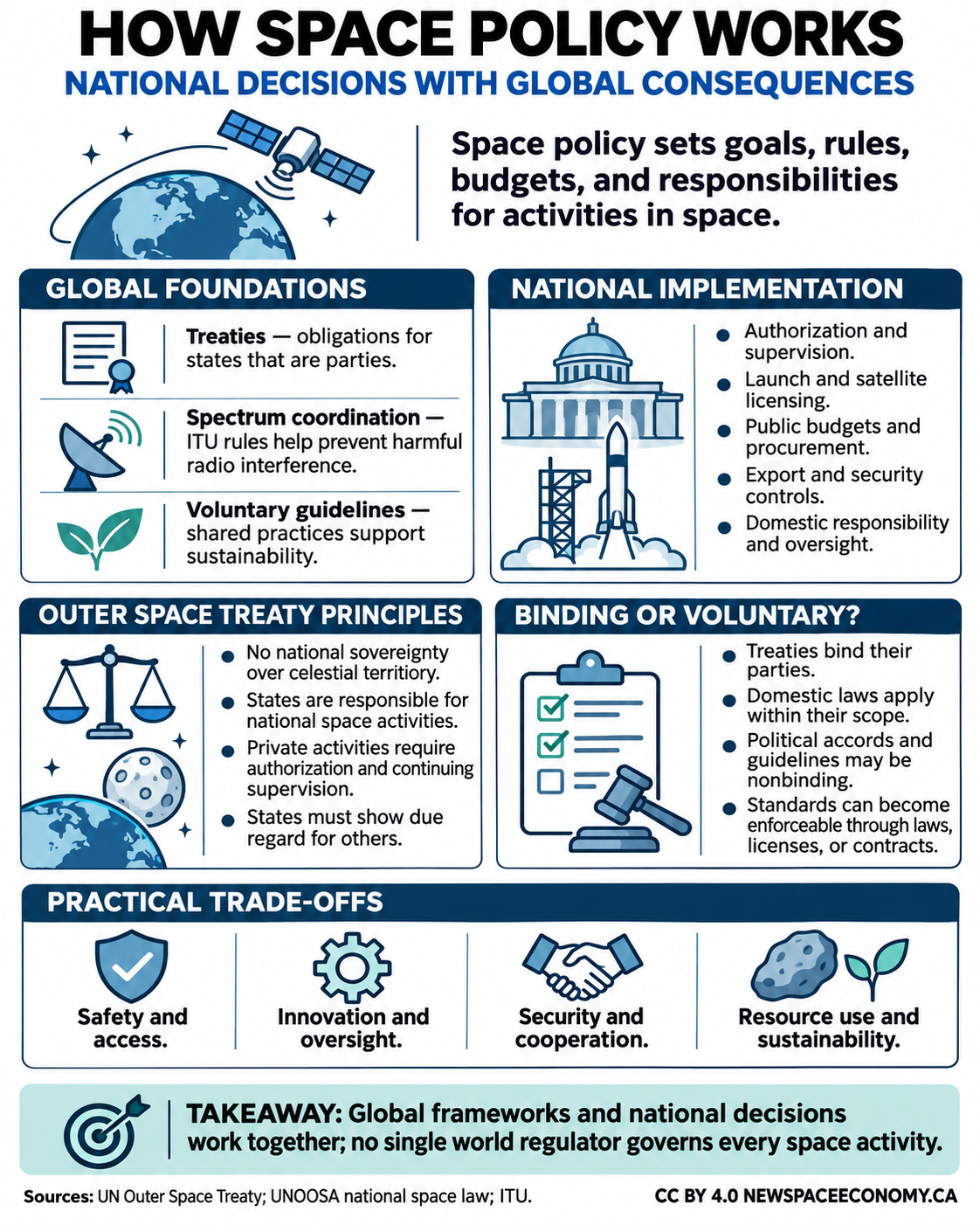
- Space policy links global treaties, national laws, budgets, and technical standards across civil and defense uses.
- Global governance relies on five UN treaties, ITU spectrum rules, and voluntary accords rather than one world regulator.
- National governments enforce treaty duties through domestic launch licenses, spectrum filings, and commercial oversight.
Defining Space Policy and Its Strategic Scope
In 2024, the global space economy reached $613 billion according to the Space Foundation’s The Space Report 2025 Q2, with commercial revenue generating nearly four-fifths of total activity. Behind that figure sits a complex architecture of laws, executive directives, public budgets, procurement frameworks, technical standards, and diplomatic agreements known collectively as space policy. Space policy determines who can launch a rocket, which radio frequencies a satellite may transmit on, how governments buy orbital services from private companies, and what rules apply when spacecraft operate near one another in orbit or on the Moon.
At its simplest, space policy translates national and collective priorities into actionable rules for outer space. Those priorities span four overlapping domains: civil science and exploration, commercial industry and economic growth, national security and defense, and international diplomacy. Because orbital infrastructure underpins global banking timestamps, aviation navigation, weather forecasting, maritime tracking, precision agriculture, and broadband connectivity, space policy reaches far beyond rockets and satellites. It shapes horizontal supply chains, ground-station networks, insurance underwriting, capital formation, export controls, workforce pipelines, and downstream data services across nearly every modern industry.
Understanding how these rules fit together requires looking at two interacting tiers. At the global level, sovereign nations negotiate binding treaties, coordinate shared orbital and spectrum resources, and establish voluntary norms of responsible behavior. At the national level, governments translate those international commitments into domestic statutes, regulatory agencies, licensing procedures, and public funding strategies. Neither tier functions in isolation. International agreements establish broad legal boundaries, and national institutions supply the enforcement mechanisms that make those boundaries workable for government missions and private enterprises alike.
This layered structure explains why governance of the space economy operates differently from domestic aviation or maritime transport. No single supranational authority issues spacecraft operating permits or polices orbital lanes. Instead, authority flows through a distributed network of United Nations committees, specialized technical agencies, regional blocs, national regulators, and industry standards bodies. Each layer addresses a distinct slice of risk, from preventing weapons of mass destruction in orbit to coordinating radio signals and limiting orbital debris.
The United Nations Treaties and Global Space Governance
Modern global space policy rests on five binding international treaties negotiated during the Cold War through the United Nations space committee, formally the Committee on the Peaceful Uses of Outer Space (COPUOS), and administered with the support of the United Nations Office for Outer Space Affairs (UNOOSA). Established by the UN General Assembly in 1959, COPUOS serves as the primary multilateral forum where member states debate space law, scientific cooperation, and orbital sustainability by consensus.
The foundational instrument in this global framework of space law is the 1967 Outer Space Treaty, formally titled the Treaty on Principles Governing the Activities of States in the Exploration and Use of Outer Space, including the Moon and Other Celestial Bodies. Opened for signature in January 1967 and entering into force in October 1967, the treaty binds every major spacefaring nation and is tracked annually in the UNOOSA treaty status compendium updated as of January 1, 2026.
By October 2025, ratification records listed 118 states parties to the Outer Space Treaty alongside 20 additional signatories that had not yet completed domestic ratification. That broad adherence gives the treaty unmatched legal reach across civil, commercial, and military space activities.
Several core principles in the Outer Space Treaty define the outer limits of all subsequent national and global space policy. Article I declares that outer space is free for exploration and use by all states on a basis of equality and shall be carried out for the benefit of all countries. Article II prohibits national appropriation of outer space, the Moon, or other celestial bodies by claim of sovereignty, use, occupation, or any other means. Article IV forbids placing nuclear weapons or other weapons of mass destruction in orbit or on celestial bodies and restricts the Moon and other celestial bodies exclusively to peaceful purposes.
Equally important for the commercial space sector are Articles VI, VII, VIII, and IX. Article VI makes states internationally responsible for national space activities whether carried out by governmental agencies or non-governmental entities, requiring authorization and continuing supervision by the appropriate state. Article VII establishes international liability for damage caused by space objects. Article VIII specifies that the state registering a space object retains jurisdiction and control over that object and its personnel, preserving ownership of launched hardware regardless of where it travels. Article IX obliges states to conduct activities with due regard for the corresponding interests of other states and to avoid harmful contamination of space and celestial bodies.
Four subsequent UN treaties elaborated on those core principles. The 1968 Rescue Agreement detailed duties to assist astronauts in distress and return recovered spacecraft. The 1972 Liability Convention established absolute liability for launching states when a space object causes damage on Earth’s surface or to aircraft in flight, alongside fault-based liability for damage in space. The 1976 Registration Convention created a central United Nations register of launched space objects. The 1979 Moon Agreement, which entered into force in 1984, sought to govern lunar resources as the common heritage of humankind, but it attracted limited ratification and was not joined by the United States, China, or Russia.
The table below summarizes the five United Nations space treaties, their entry into force, and the legal responsibilities they assign to participating states.
| Treaty | Entry Into Force | Core Governance Scope |
|---|---|---|
| Outer Space Treaty | 1967 | Bans sovereignty claims and orbital WMD, establishes state supervision |
| Rescue Agreement | 1968 | Mandates assistance to distressed astronauts and return of space objects |
| Liability Convention | 1972 | Sets absolute surface liability and fault-based orbital liability for states |
| Registration Convention | 1976 | Requires launching states to record space objects in UN registry |
| Moon Agreement | 1984 | Calls for international regime over lunar resources; limited state ratification |
Since 1979, geopolitical divergence and consensus voting rules inside COPUOS have prevented the adoption of a sixth binding UN space treaty. Global space policy has consequently shifted toward non-binding resolutions, technical guidelines, bilateral agreements, and multilateral political commitments that interpret and operationalize the original 1967 framework for a far more crowded, commercially active orbital environment.
Spectrum Allocation, Orbital Slots, and Technical Standards
No satellite can deliver communications, navigation signals, or Earth observation data without radio-frequency spectrum and a coordinated orbital path. At the global level, those finite physical resources are managed by the International Telecommunication Union (ITU), a specialized United Nations agency whose Radiocommunication Sector oversees global spectrum allocation and satellite coordination. Within the ITU, the Space Services Department processes filings and maintains the Master International Frequency Register, recording frequency assignments for satellite networks, earth stations, and radio astronomy facilities.
The ITU Radio Regulations carry treaty-level force for member states and are periodically revised at World Radiocommunication Conferences, with the 2024 Radio Regulations governing current international coordination. These rules establish a clear division between national authorization and international recognition, as explained in analyses of how ITU Radio Regulations connect frequencies. Private satellite operators cannot submit filings directly to the ITU. Instead, an operator must work through its national notifying administration, such as the Federal Communications Commission in the United States or Ofcom in the United Kingdom, which files on the operator’s behalf and coordinates with other countries to prevent harmful radio interference.
A common misconception equates an ITU orbital filing with property ownership in space. In reality, satellite spectrum rights grant regulatory protection against harmful interference under specified technical conditions, but they never convey territorial ownership of an orbital slot or shell. That distinction preserves consistency with Article II of the Outer Space Treaty. To discourage speculative paper filings that hoard radio spectrum without launching hardware, the ITU enforces bringing-into-use deadlines and staged deployment milestones for non-geostationary satellite constellations. If an operator fails to deploy required spacecraft on schedule, its international priority narrows or lapses.
Alongside ITU treaty rules, technical standards bodies shape day-to-day space operations. Organizations such as the International Organization for Standardization and the Consultative Committee for Space Data Systems publish engineering specifications covering spacecraft interfaces, telemetry protocols, cybersecurity, and debris mitigation. At the international level, these specifications are voluntary. Yet as examinations of how space governance develops through standards illustrate, a voluntary standard becomes legally enforceable the moment a national regulator incorporates it into a launch or satellite license, or a government agency writes it into a procurement contract.
How National Space Policies Translate Global Rules Into Law
Because international space treaties bind sovereign states rather than private corporations, Article VI of the Outer Space Treaty creates the legal engine behind national space policy. Every state whose citizens, companies, or launch sites conduct space activities must maintain domestic laws and institutions capable of authorizing missions, monitoring ongoing operations, and managing potential liability claims. UNOOSA tracks this growing body of domestic statutes in its National Space Law Database, reflecting dozens of countries that have enacted dedicated space legislation or licensing regimes.
National space policies vary widely in institutional design depending on each country’s industrial base, security posture, and constitutional structure. Some nations divide regulatory authority across several specialized agencies, whereas others concentrate promotion and authorization inside a single window. Examining how major spacefaring jurisdictions organize their global and national governance frameworks demonstrates how domestic policy choices directly affect commercial speed, investment attraction, and strategic autonomy.
United States Regulatory and Commercial Framework
The United States operates the world’s largest commercial and government space ecosystem through a distributed regulatory model guided by executive directives from the White House and statutory authority from Congress. The Office of Space Commerce inside the Department of Commerce coordinates commercial space policy and regulates private Earth remote sensing systems under the National Oceanic and Atmospheric Administration (NOAA). Launch and reentry safety licensing sits with the Federal Aviation Administration (FAA) Office of Commercial Space Transportation, and spectrum licensing and orbital debris rules for commercial satellites are enforced by the Federal Communications Commission (FCC). National civil exploration is led by NASA, and military space operations fall under the U.S. Space Force and U.S. Space Command.
Regulatory modernization accelerated sharply during 2025 and 2026 to keep pace with high-cadence commercial launches and mega-constellations. According to SpacePolicyOnline’s policy tracker, Executive Order 14355 in August 2025 directed reforms to commercial space competition and launch rules, Executive Order 14369 in December 2025 set broader space policy priorities, and on August 20, 2026, the White House issued a new National Space Transportation Policy under National Security Presidential Memorandum-17, the first full update since 2013. In parallel, as documented in an October 2026 regulatory analysis by Holland & Knight, the FCC adopted a Part 100 licensing overhaul in July 2026 to replace its legacy Part 25 rules, and on October 6, 2026, the FAA proposed five new rulemakings to streamline Part 450 launch licensing alongside proposals for novel commercial activity certification at the Office of Space Commerce.
European Union Space Act and Regional Governance
Europe governs space through a dual architecture combining the intergovernmental European Space Agency (ESA), which develops launch vehicles, science missions, and exploration hardware for its member states, with the European Union, which funds and operates flagship infrastructure such as Galileo navigation and Copernicus Earth observation. Historically, commercial space licensing in Europe remained fragmented across individual national space acts in countries such as France, the United Kingdom, Austria, and Finland, creating compliance friction for operators serving the European single market.
To address that fragmentation and strengthen resilience against cyber and orbital threats, the European Commission formally proposed the EU Space Act on June 25, 2025. Structured as a draft EU regulation that would apply directly across member states once adopted, the proposal establishes common pillars for orbital safety, cybersecurity resilience, and environmental lifecycle sustainability, covering both European and non-European operators providing space services inside the Union. Legislative negotiations progressed through 2026, with the Irish Presidency of the Council of the European Union releasing an updated compromise text on October 29, 2026, as tracked in a November 2026 Office of Space Commerce briefing.
China, India, Japan, Canada, and Regional Agencies
Other major and emerging spacefaring nations have adopted distinct institutional strategies tailored to their economic and geopolitical goals. China coordinates civil space policy through the China National Space Administration (CNSA), outlining multi-year objectives in periodic white papers such as China’s Space Program: A 2021 Perspective. Long dominated by state-owned aerospace conglomerates under close civil-military coordination, China has increasingly opened launch and satellite sectors to private capital, issuing a 2025-2027 commercial spaceflight action plan to scale regulatory oversight, launch infrastructure, and safety standards for commercial operators.
India overhauled its domestic architecture with the Indian Space Policy 2023, shifting the Indian Space Research Organisation (ISRO) toward advanced research and deep-space missions and enabling private non-governmental entities to conduct end-to-end space activities. Under this framework, the Indian National Space Promotion and Authorisation Centre (IN-SPACe) acts as an autonomous single-window regulator and promoter, issuing detailed norms and procedures for private authorizations, as examined in a June 2026 Stiftung Wissenschaft und Politik study.
Japan anchors its national framework in the 2008 Basic Space Law and updates priorities through the Cabinet Office’s Basic Plan on Space Policy, aligning JAXA’s civil exploration with commercial competitiveness and national security resilience. Canada guides its domestic sector through the Canadian Space Agency and Space Strategy for Canada, balancing international exploration commitments such as lunar robotics with domestic regulatory oversight for remote sensing and telecommunications detailed in analyses of Canada’s space governance ecosystem.
At the continental level, the African Union inaugurated the African Space Agency (AfSA) on April 20, 2025 in Cairo, Egypt, creating a regional body designed to coordinate Earth observation, satellite communications, capacity building, and regulatory harmonization across African member states. Regional agencies like AfSA allow developing space nations to pool technical expertise and negotiate shared infrastructure without duplicating expensive national agencies.
The table below compares the institutional architectures and primary policy instruments of six major national and regional jurisdictions.
| Jurisdiction | Primary Civil Agency | Commercial Regulator | Core Policy Instrument |
|---|---|---|---|
| United States | NASA | FAA, FCC, and NOAA | National Space Policy and NSPM-17 |
| European Union | ESA and EUSPA | National authorities; proposed EU rules | Draft EU Space Act (2025) |
| China | CNSA | CNSA and SASTIND | Space White Papers and Action Plans |
| India | ISRO | IN-SPACe | Indian Space Policy 2023 |
| Japan | JAXA | Cabinet Office NSPS | Basic Plan on Space Policy |
| Canada | Canadian Space Agency | ISED, Global Affairs, Transport Canada | Space Strategy for Canada |
Commercial Markets, Procurement, and Space Resource Rights
National space policy does more than restrict unsafe behavior; it actively shapes industrial markets through procurement, financing, trade rules, and property-rights frameworks. Over the past two decades, major space agencies have shifted away from owning every launch vehicle and spacecraft toward acting as anchor customers for commercial services. Instead of funding traditional cost-plus development contracts where the government assumes all technical and financial risk, agencies increasingly rely on firm-fixed-price service contracts for cargo resupply, astronaut transport, lunar payload delivery, and Earth observation data. NASA’s October 2026 commercial destination solicitation exemplifies how government procurement shapes commercial stations, structuring development, certification, and recurring orbital services so private operators can serve both public and commercial customers after the International Space Station retires around 2030.
Alongside procurement, national policies manage commercial liability, export controls, and human spaceflight jurisdiction. Under the Liability Convention, launching states remain internationally liable for third-party damage caused by private launches from their territory. Domestic laws require commercial launch providers to carry mandatory third-party liability insurance up to a calculated maximum probable loss, with governments frequently sharing catastrophic risk above that ceiling to keep launch markets insurable. Export control regimes regulate cross-border transfers of dual-use propulsion, sensors, and radiation-hardened electronics, directly influencing global supply chains and international joint ventures. For private and governmental crewed flights, national statutes and international mission agreements also determine how space law governs people aboard spacecraft, linking astronaut nationality, state of registry, and employer liability.
One of the most actively debated frontiers in national and global space policy concerns commercial extraction of space resources, such as lunar water ice or asteroid minerals. Because the Outer Space Treaty bans national appropriation of celestial bodies without explicitly defining commercial mining, four nations have enacted domestic laws recognizing private ownership over extracted resources. The United States led with the Commercial Space Launch Competitiveness Act of 2015, followed by Luxembourg in 2017, the United Arab Emirates in 2019, and Japan’s 2021 Space Resources Act.
These national statutes draw a careful boundary between territory and extracted material, reflecting how space law separates lunar territory from deployed hardware and recovered resources. Under this interpretation, a company cannot own a plot of lunar ground, but once it extracts water or regolith under national license and international supervision, it may possess, use, transport, and sell that material. Other countries argue that resource extraction requires a multilateral framework rather than unilateral national laws, prompting ongoing deliberations inside the UN COPUOS Working Group on Legal Aspects of Space Resource Activities to establish shared international principles.
Orbital Sustainability, Space Debris, and Traffic Coordination
Rapid growth in satellite deployments has made orbital sustainability a central pillar of both national regulation and global diplomacy. According to the ESA Space Environment Report 2026 and related tracking catalogs, tens of thousands of trackable objects larger than 10 centimeters orbit Earth, accompanied by an estimated 130 million fragments larger than one millimeter that travel at velocities capable of disabling operational spacecraft. Low Earth orbit now hosts thousands of active communications and imaging satellites, making collision avoidance and end-of-life disposal essential to preserving reliable access to space.
Global policy on orbital debris evolved first through technical consensus among national space agencies. The Inter-Agency Space Debris Coordination Committee (IADC) drafted technical mitigation standards that formed the basis for the UN COPUOS Space Debris Mitigation Guidelines and continued to inform updates such as the 2026 IADC debris status report submitted to COPUOS. In 2019, the UN General Assembly adopted 21 voluntary Long-Term Sustainability Guidelines covering regulatory supervision, conjunction data sharing, space weather, and capacity building.
At an operational level, UN space debris mitigation guidelines target four phases of a spacecraft’s lifecycle: limiting routine debris released during normal deployment, preventing accidental in-orbit breakups by passivating residual fuel and batteries, avoiding intentional destruction or collisions, and removing retired satellites from congested orbital zones. In low Earth orbit, regulators have steadily tightened post-mission disposal timelines from the historical 25-year benchmark down toward five-year requirements in jurisdictions such as the United States, whereas geostationary satellites must reserve propellant to boost into graveyard orbits above the active belt.
European and international partners have pushed even stricter voluntary benchmarks. Facilitated by ESA beginning in 2023, the community-driven Zero Debris Charter sets measurable technical targets aimed at achieving debris-neutral missions by 2030, growing to over 210 signatories across 34 countries, including 21 national governments, by January 2026. Complementing debris rules, governments are investing in civil space traffic coordination systems to share tracking catalogs and collision warnings with commercial operators. Because no global air-traffic-style authority can order a foreign satellite to maneuver, space traffic coordination depends on interoperable data standards, transparent ephemeris sharing, and consistent right-of-way practices developed across national civil agencies and industry coalitions.
National Security, Dual-Use Systems, and Space Diplomacy
Outer space has been intertwined with national security since the launch of the first artificial satellites, and modern commercial growth has deepened that connection. Almost all space technologies are dual-use: commercial satellite broadband connects both rural households and military units, high-resolution optical and radar imagery supports both agricultural insurance and defense intelligence, and orbital servicing spacecraft designed to refuel or repair satellites share technical capabilities with rendezvous and proximity operations that raise security concerns. National space policies must balance commercial openness with defense resilience, supply-chain security, and protection of space-based services for civilian populations.
At the global diplomatic level, states have pursued parallel tracks to reduce miscalculation and prevent conflict in orbit. On December 7, 2022, the UN General Assembly adopted Resolution 77/41 calling on all nations to commit against conducting destructive direct-ascent anti-satellite missile tests, which create long-lived orbital debris clouds endangering civilian and military satellites alike. By early 2026, 38 countries had joined the national moratorium pledge, including the United States, Canada, Japan, France, Germany, and the United Kingdom, though Russia, China, and India had not signed on. To bridge competing diplomatic proposals between binding arms-control treaties and voluntary behavioral norms, the UN General Assembly consolidated prior tracks into a single Open-Ended Working Group on the Prevention of an Arms Race in Outer Space (PAROS), mandated to convene from 2025 through 2028, as analyzed in SIPRI’s space escalation research.
Space diplomacy also operates through multilateral exploration coalitions that pair technical partnerships with governance principles. Co-led by NASA and the U.S. Department of State, the Artemis Accords launched on October 13, 2020 with eight founding nations and grew to 77 signatories by October 2026. Grounded in the Outer Space Treaty, the Artemis Accords principles establish non-binding political commitments on peaceful exploration, transparency, interoperability, emergency assistance, space heritage, orbital debris, and temporary safety zones intended to prevent harmful interference during lunar operations. Detailed assessments of how the Artemis Accords translate shared principles show how diplomatic pledges flow down into bilateral agency agreements and commercial mission contracts.
In parallel, China and Russia announced the International Lunar Research Station (ILRS) in 2021, building a separate coalition of national agencies and research institutions toward a sustained lunar base in the 2030s, as compared in the Secure World Foundation’s lunar cooperation overview. Rather than forming airtight ideological blocs, these initiatives show emerging diplomatic fluidity: several countries, including Thailand, have engaged with both frameworks to advance national scientific and industrial objectives.
Balancing Sovereignty, Interoperability, and Future Governance
Viewed together, national and global space policy form a multi-layered governance ecosystem rather than a single pyramid of command. Binding UN treaties establish baseline legal obligations among states, ITU Radio Regulations coordinate electromagnetic spectrum and orbital access, non-binding political accords and UN guidelines cultivate shared behavioral norms, national legislation enforces licensing and liability over private operators, and technical standards allow hardware and tracking networks from different countries to work together safely.
The table below maps these five governance layers, their legal character, and representative instruments in active use as of November 2026.
| Instrument Type | Legal Character | Representative Example |
|---|---|---|
| Multilateral Treaties | Binding international law for ratifying states | 1967 Outer Space Treaty and ITU Radio Regulations |
| National Statutes | Binding domestic law over national operators | FAA Part 450 rules and Japan Space Resources Act |
| Regional Regulations | Binding supranational rules across member states | Proposed European Union Space Act |
| Political Accords | Non-binding diplomatic commitments among partners | Artemis Accords and UN ASAT test resolution |
| Technical Standards | Voluntary unless adopted into licenses or contracts | IADC debris guidelines and Zero Debris Charter |
Several structural tensions will define how this system evolves through the late 2020s and 2030s. First, national governments face a constant trade-off between regulatory speed and orbital safety. Countries seeking to attract commercial launch sites, satellite manufacturers, and orbital servicing startups have strong incentives to streamline licensing timelines, as seen in U.S. regulatory reforms and India’s single-window model. If national standards diverge too sharply, operators may gravitate toward lenient jurisdictions, raising the risk of regulatory arbitrage and weaker debris compliance.
Second, equitable access remains a persistent concern for emerging spacefaring nations. Developing countries increasingly rely on satellite broadband, climate monitoring, and disaster response data, yet late entrants face congested low Earth orbit shells and scarce radio-frequency spectrum already claimed by established operators. Regional institutions such as the African Space Agency and capacity-building programs at UNOOSA aim to strengthen technical expertise and give newer space actors a stronger voice in ITU conferences and UN COPUOS negotiations.
Third, commercial expansion beyond Earth orbit will test rules written for an earlier era. In-orbit manufacturing, active debris removal, satellite refueling, private orbital stations, and sustained lunar surface operations introduce operational questions that domestic licensing frameworks did not originally anticipate. Governments are responding by drafting novel mission authorization processes, updating environmental and safety review rules, and negotiating interoperable standards for cislunar navigation, communications, and collision avoidance.
Summary
Space policy operates simultaneously as an instrument of national strategy and a framework for global stewardship. On a global basis, five United Nations treaties, ITU Radio Regulations, multilateral sustainability guidelines, and diplomatic accords establish shared legal boundaries that prohibit territorial sovereignty in space, coordinate radio spectrum, and promote peaceful use. On a national basis, sovereign states fulfill their international duty of supervision by enacting domestic space laws, licensing launches and satellites, shaping commercial markets through procurement, and safeguarding dual-use infrastructure.
As commercial space activity expands into large satellite constellations, private orbital stations, and lunar surface operations, the effectiveness of space policy depends on how smoothly these national and global layers align. Clear domestic licensing, interoperable technical standards, credible orbital debris enforcement, and inclusive multilateral diplomacy remain the practical foundations for keeping outer space safe, predictable, and accessible to established and emerging nations alike.
