
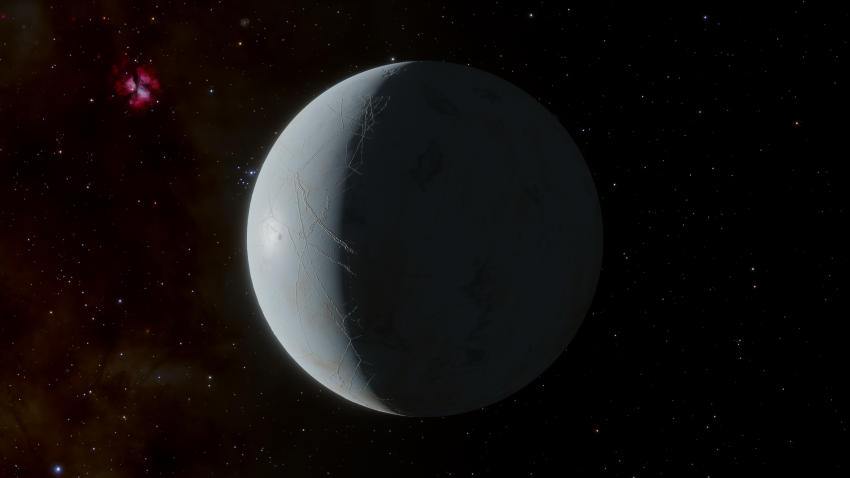
The longstanding hypothesis that “Planet Nine” exists in the far reaches of the solar system beyond the orbit of Neptune has torn apart the scientific community. This is based on formation and evolution models of the solar system beyond 50 astronomical units (AU), which is considered the outer edge of the main Kuiper Belt, potentially revealing the existing of a large planetary object. For context, the planet Neptune and the dwarf planet Pluto orbiting at 30 and 39.5 AU, respectively.
Now, a recent study published in the Monthly Notices of the Royal Astronomical Society might help gain new insights into the existence of a mysterious planet. This is because some of these longstanding models reveal peculiar orbits for several Kuiper Belt objects, fueling the prospect that a large object could be influencing their orbits. In an attempt to bring calm to the longstanding debate, the collaborative trio of researchers from Japan, the United States, and Australia used a series of computer models to simulate planetary formations in the early solar system about 4.5 billion years ago. While the models included the entire solar system, the team focused on the formation of trans-Neptunian objects (TNOs) within 100 AU and as far as 200+ AU.
The models simulated two possibilities to explain the obscure Kuiper Belt object orbits: several Earth- or Mars-sized planetary embryos or the existence of a planet with about 1-2 Earth masses, which the researchers refer to as “Planet X2”. In the end, the models revealed the Planet X2 scenario best explains the orbits of present-day Kuiper Belt objects, whereas the Earth- and Mars-sized planetary embryos failed to do it. The researchers found that Planet X2 is potentially 2 Earth masses while also orbiting between 300 to 550 AU.
“Imagine discovering, after decades of mapping our Solar System, that another planet has been hiding from us all this time,” said Dr. Patryk Sofia Lykawka, who is an Adjunct Associate Professor at the Centre for Astrophysics at the University of Southern Queensland and lead author of the study. “If this planet exists, it could change how we understand the history of our Solar System and how its most distant objects came to follow such unusual orbits.”
While the researchers note this is a step in the right direction regarding the potential existence of a planet beyond Neptune, they emphasize further research is essential in confirming what the models produced for this study. The study notes this further research can come from the Legacy Survey of Space and Time (LSST) at the Vera C. Rubin Observatory, which began operations in June 2026 and already confirmed the existence of its first trans-Neptunian dwarf planet candidate (2026 ED138) in October 2026. It is estimated that 2026 ED138 could have a diameter of about 600–1,530 kilometers (about 373–950 miles) while orbiting about 43 AU from the Sun.
While the search for a far-off planet, commonly referred to as Planet Nine, began around the discovery of Pluto in 1930, it gained steam between the 1990s and 2006 when astronomers discovered several icy bodies in the Kuiper Belt. This culminated in the demotion of Pluto to dwarf planet in 2006 after the discovery of the dwarf planet Eris, both of which orbit in the Kuiper Belt. In 2016, researchers discovered several objects in the Kuiper Belt had tilted orbits, questioning the existence of a large planetary object that could be influencing Kuiper Belt object orbits.
It’s been only the last 2-3 years that research into a potential Planet Nine has really gained traction, primarily from narrowing its orbital position down by about 78 percent. Now, this recent study and subsequent Rubin Observatory observations could finally reveal the existence of this long-hypothesized planet orbiting in the far reaches of the solar system.
What new insights into Planet X2 and other potential planets in the solar system’s far reaches will researchers make in the coming years and decades? Only time will tell, and this is why we science!
As always, keep doing science & keep looking up!
Originally published by Universe Today. Read the original article. Licensed under CC BY 4.0.
