Key Takeaways
- NSSL Phase 3 covers roughly 54 missions worth $13.7 billion through fiscal year 2032
- SpaceX dominates current assignments, raising questions about true launch redundancy
- A 2026 Vulcan Centaur anomaly has grounded ULA’s rocket and disrupted near-term plans
From EELV to NSSL
The story of how the United States government buys access to space is longer and more complicated than most people realize. It starts not with rockets, but with a policy directive signed in August 1994 by President Clinton. The National Space Transportation Policy assigned the Department of Defense responsibility for developing medium and heavy-lift expendable launch vehicles and making government launches more affordable and reliable. What followed was the Evolved Expendable Launch Vehicle program, universally known by its acronym EELV.
The Air Force designed EELV to replace aging legacy rockets, including the Delta II, Atlas II, and Titan IV. Two contractors responded: Boeing with its Delta IV family and Lockheed Martin with its Atlas V. Both vehicles eventually flew, and both were considered operationally reliable. But the goal of affordable launches proved far more elusive. The program experienced at least two Nunn-McCurdy breaches, a formal designation used when defense program costs spiral well beyond original estimates. Costs were not being contained.
Then came a development that reshaped the program permanently. In December 2006, Boeing and Lockheed Martin merged their launch businesses into a single joint venture called United Launch Alliance, or ULA. From that point until 2015, ULA was the only certified provider of national security space launch services in the United States, meaning every military satellite that needed to reach orbit flew on either an Atlas V or a Delta IV. The defense department had effectively traded one competitive market for a structured monopoly, albeit one capable of extraordinary reliability.
The change that broke the arrangement open came not from the Pentagon but from a private company in California. SpaceX, founded by Elon Musk in 2002, spent years developing the Falcon 9 rocket on largely private capital. In April 2014, SpaceX filed suit against the Air Force after it awarded a block buy contract to ULA without competitive bidding. The case eventually produced a settlement and opened the door to Falcon 9 certification. The Air Force certified the Falcon 9 for national security missions in 2015, ending ULA’s nine-year run as sole provider. SpaceX won its first firm-fixed-price EELV contract in April 2016 under what the Air Force called Phase 1A.
On March 1, 2019, the Air Force officially changed the program’s name from EELV to National Security Space Launch. The renaming was not purely cosmetic. The 2019 National Defense Authorization Act directed the change and explicitly expanded the program to encompass reusable launch vehicles, acknowledging that the commercial space industry had moved well beyond the expendable rocket model that EELV had been built around. SpaceX’s Falcon 9 was already landing its first stages on drone ships, and the economics of reusability were starting to reshape the entire launch market.
What NSSL Actually Does
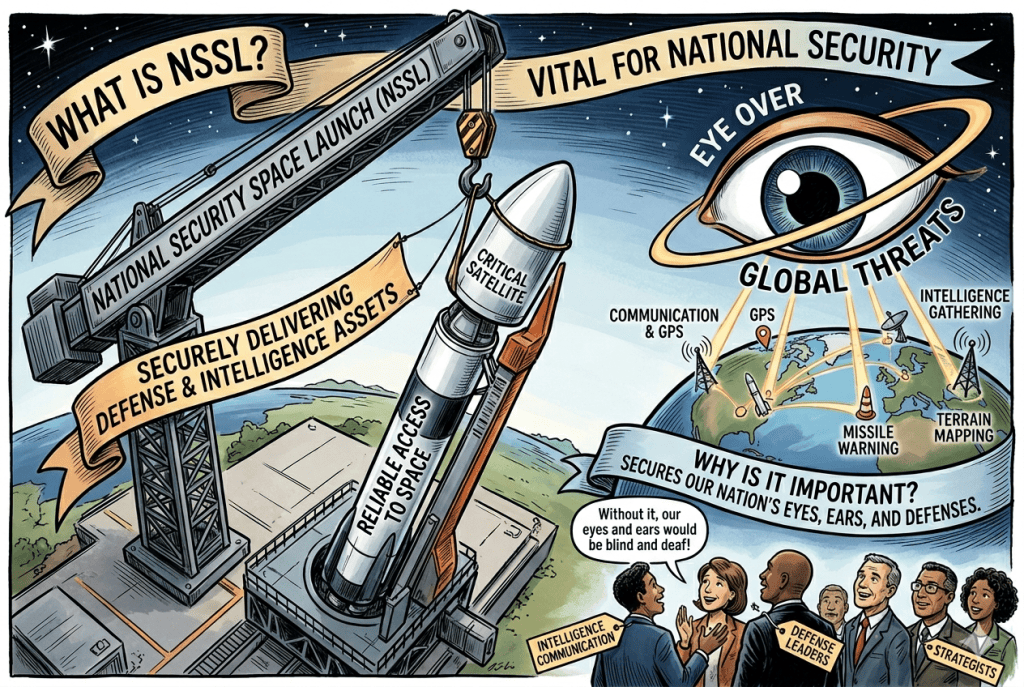
The National Security Space Launch program is the mechanism through which the Department of Defense acquires commercial launch services to place military and intelligence community satellites into orbit. These satellites serve a wide range of functions: communications, positioning, navigation and timing, missile warning and tracking, and space situational awareness, among others. The program is managed by the U.S. Space Force‘s Space Systems Command, headquartered at Los Angeles Air Force Base in California.
Congress established in statute, specifically 10 U.S.C. §2273, that it is U.S. policy to ensure access to space by maintaining at least two launch vehicles capable of delivering any national security payload to orbit. This dual-provider mandate drives much of what the program does and why it structures its contracts the way it does. NSSL has launched satellites for the Space Force, the Air Force, the Navy, and the National Reconnaissance Office, the intelligence community’s primary space-based collection agency. Launches take place at two ranges: the Eastern Range at Cape Canaveral Space Force Station in Florida, and the Western Range at Vandenberg Space Force Base in California.
NSSL providers must be capable of reaching a defined set of reference orbits, which include low Earth orbit, medium Earth orbit, geosynchronous transfer orbit, and highly elliptical orbits. These destinations serve very different missions. Communications satellites generally go to geostationary orbit, roughly 35,785 kilometers above Earth’s equator. GPS satellites operate in medium Earth orbit, while reconnaissance assets often use low Earth orbit or highly inclined trajectories for maximum ground coverage.
Phase 2 and the Transition to Competition
In August 2020, the Department of the Air Force announced the results of the NSSL Phase 2 Launch Service Procurement, a contract covering launches from fiscal year 2022 through 2027. The total value was approximately $3.5 billion. SpaceX and ULA won the competition; Blue Origin and Northrop Grumman, which had been developing its OmegA rocket, did not. Out of 48 missions covered under Phase 2, the Air Force assigned 22 to SpaceX and 26 to ULA. A firm-fixed-price, indefinite-delivery contract structure was used, which was a change from the cost-plus arrangements that had characterized the EELV era.
ULA brought two vehicles to Phase 2. Its Atlas V, which had been flying since 2002, was allocated its remaining manifest and then retired. The last Atlas V NSSL launch occurred on July 30, 2024. ULA also began developing its successor, the Vulcan Centaur, to serve as the primary vehicle for subsequent national security missions.
Meanwhile, SpaceX flew the majority of its Phase 2 missions on the reusable Falcon 9, with some larger payloads assigned to the Falcon Heavy. For the NRO alone, SpaceX launched nine missions in 2025, mostly on Falcon 9 variants. The final Phase 2 NRO mission of that calendar year, NROL-77, flew on December 9, 2025, from Space Launch Complex 40 at Cape Canaveral. The National Reconnaissance Office described it as part of Order Year 5 of the Phase 2 contract, announced in October 2023, and valued as part of a ten-mission package to SpaceX worth $1.236 billion.
Phase 3 and the Two-Lane Strategy
The Space Force released a draft request for proposal for Phase 3 in 2023, and the program’s structure introduced a genuinely different architecture for how launch services would be procured going forward. Phase 3 covers fiscal years 2025 through 2029 for contract awards, with actual launches taking place from fiscal year 2027 through 2032. The total program is valued at approximately $13.7 billion for roughly 54 missions.
What separates Phase 3 from its predecessors is a formal two-lane structure, designed to serve different mission profiles and, more importantly, to draw in a broader pool of commercial providers over time.
Lane 2 handles the most demanding missions, those requiring access to difficult orbits with complex security and integration requirements. To qualify, a provider had to demonstrate the capability to reach any reference orbit used by the national security community and meet stringent mission assurance standards. In April 2025, the Space Systems Command awarded Phase 3 Lane 2 contracts to three providers: SpaceX, ULA, and Blue Origin. SpaceX received the largest share, worth up to $5.9 billion, covering approximately 28 missions. ULA received contracts worth up to $5.4 billion for about 19 missions. Blue Origin, a relative newcomer to certified national security launches, was awarded up to $2.4 billion for approximately 7 missions, contingent on completing its certification process for the New Glenn rocket.
Lane 1 takes a different approach. It’s designed for less complex missions with higher risk tolerance, and it allows an unlimited number of providers to compete for individual task orders. Eligibility requires only that a company has completed a launch or has a credible plan to do so. The Space Force awarded initial Lane 1 contracts in June 2024 to SpaceX, ULA, and Blue Origin. In March 2025, Rocket Lab USA and Stoke Space received additional Lane 1 contract awards, allowing them to compete for task orders beginning in fiscal year 2026 once each completes its first successful launch. Rocket Lab’s Neutron vehicle and Stoke Space’s Nova rocket are the vehicles identified in those awards.
For fiscal year 2025, the Space Systems Command assigned nine missions under Phase 3 Lane 2 on April 4, 2025. SpaceX received seven of them for a total of $845.8 million, covering missions including NROL-96. ULA received the remaining two. The assignments for fiscal year 2026 were announced on October 3, 2025: SpaceX received five missions valued at $714 million, covering USSF-206 among others, while ULA received two missions valued at $428 million. Blue Origin received no FY2026 assignments, with the Space Systems Command noting that its next opportunity would come in fiscal year 2027 pending certification completion.
The SpaceX Concentration Question
There’s a structural tension at the heart of NSSL that’s difficult to resolve cleanly. The program exists, in part, to ensure redundancy, to guarantee that the loss or failure of any single provider doesn’t strand national security payloads on the ground. Congress enshrined this principle in statute. Yet the data emerging from Phase 3 suggests the program is concentrating heavily around a single company.
SpaceX holds approximately 60 percent of FY2025 mission assignments by count, roughly 52 percent of the total Phase 3 Lane 2 contract value, and the largest share of every annual mission allocation announced so far. FY2026 saw five of seven missions go to Falcon rockets. The FY2025 NRO manifest leaned almost entirely on Falcon 9. It’s difficult to argue, from the outside, that a program designed around dual-provider redundancy is achieving that goal when one provider consistently captures the overwhelming majority of actual launches.
Part of the explanation is straightforward: SpaceX has the lowest prices, the highest flight rate, and the most mature reusable hardware. Its Falcon 9 has an extraordinary reliability record. ULA’s Vulcan Centaur is still establishing its operational tempo, and Blue Origin hasn’t yet flown a certified national security mission. But the Senate Appropriations Committee in its report accompanying the Department of Defense Appropriations Act for 2025 explicitly encouraged the Space Force to “include a greater diversity of providers and more competition” in Phase 3. Whether the current allocation pattern reflects sound risk management or a slow drift toward a new kind of dependence is a genuinely open question.
The program’s history offers a cautionary note here. EELV was also designed with competition in mind, and it eventually produced a situation in which a single joint venture held an effective monopoly for nearly a decade. There’s nothing in the current Phase 3 structure that automatically prevents a similar outcome if Blue Origin’s certification drags on, Stoke Space fails to reach orbit on schedule, and Rocket Lab’s Neutron encounters development delays.
Vulcan Centaur and the 2026 Anomaly
ULA’s Vulcan Centaur is at the center of the most disruptive recent development in NSSL, one that has immediate consequences for the 2026 launch schedule and longer-term implications for the program’s dual-provider architecture.
Vulcan flew for the first time on January 8, 2024, and completed its initial certification flight successfully. Its second flight, in October 2024, encountered a significant problem when the nozzle of one of its two Northrop Grumman-built GEM 63XL solid rocket boosters separated during ascent. The vehicle compensated through its main engines and completed the mission, delivering its payload to the intended orbit. A subsequent investigation identified a manufacturing defect, which ULA said had been corrected before the next flight.
The rocket was certified for national security missions in March 2025 and flew its first NSSL mission in August 2025, delivering an experimental navigation satellite to geosynchronous orbit. That mission, USSF-106, went nominally. The fourth Vulcan flight came on February 12, 2026: the USSF-87 mission, which carried two Geosynchronous Space Situational Awareness Program satellites, GSSAP-7 and GSSAP-8, known informally as Hornet 7 and 8. Approximately 20 seconds after liftoff, one of the four solid rocket boosters again showed an irregular plume, a visible anomaly captured on cameras. The Vulcan core stage and Centaur upper stage compensated, and both satellites were delivered to geosynchronous orbit as planned.
But the Space Force noticed something it couldn’t ignore: a second anomaly involving the same component family in just four launches. On February 25, 2026, Col. Eric Zarybnisky, portfolio acquisition executive for space access at Space Systems Command, announced a halt. “We are going to work through this anomaly until we launch again on Vulcan,” he told reporters at the Air & Space Forces Association’s Air Warfare Symposium. “Until this anomaly is solved, we will not be launching Vulcan missions.” He described the investigation as a “many-months process,” a timeline that echoes the roughly ten-month gap between Vulcan’s second and third flights.
The grounding comes at a particularly difficult moment for ULA. The company had projected 18 to 22 launches for 2026 to begin clearing a backlog exceeding 80 missions, spanning military customers and commercial clients including Amazon’s Project Kuiper. More than half of those planned 2026 missions were expected to come from the Space Force. The anomaly has thrown that schedule into uncertainty. ULA’s CEO Tory Bruno, who had led the company since August 2014, departed unexpectedly in January 2026, leaving interim CEO John Elbon in charge during what is arguably the most consequential period in the company’s operational history.
The Space Force has already reassigned at least one imminent mission. The launch of GPS III SV-10, the final satellite in the initial ten-satellite Lockheed Martin GPS III series, was transferred to SpaceX. In exchange, ULA was awarded the USSF-70 mission, originally a SpaceX assignment for 2028 carrying a Northrop Grumman prototype refueling tanker called the Geosynchronous Auxiliary Support Tanker. As of late March 2026, Lt. Gen. Douglas Schiess, deputy chief of space operations, told lawmakers that the Space Force was actively reviewing additional upcoming launches, weighing options including extending current satellites on orbit and moving missions to other providers.
Blue Origin’s Long Path to Certification
Blue Origin occupies an interesting position within NSSL. The company, founded by Jeff Bezos and based in Kent, Washington, has won Phase 3 Lane 2 contracts worth up to $2.4 billion for approximately seven missions. It also won Lane 1 contracts. None of that work can proceed until New Glenn completes its national security certification, and that process requires multiple successful flights under government observation.
New Glenn flew for the first time in January 2025. The U.S. Space Force has said that Blue Origin selected a four-launch certification path for New Glenn’s National Security Space Launch clearance, rather than stating that the vehicle categorically requires four certification flights in every circumstance. By December 2025, public reporting on comments from Lt. Gen. Philip Garrant indicated that the company was roughly halfway through that process after two successful flights in 2025. A planned NASA Mars mission, ESCAPADE, had been identified as the next flight expected to advance the certification effort, and it ultimately launched on New Glenn’s second mission in November 2025. The company has also unveiled a more powerful New Glenn 9×4 variant with nine BE-4 engines on the first stage instead of the current seven, though public NSSL award announcements have not identified that configuration as a separately awarded vehicle.
Once New Glenn completes its certification flights, a data review and government assessment must follow before the company can actually fly a national security payload. The Space Force has described this as a collaborative process. Predicting exactly when Blue Origin will be certified, and how the certification timeline will interact with its FY2027 launch assignments, involves enough variables that even well-informed projections could miss the mark significantly. The certification timeline and the consequences of further delays remain genuinely unclear, and the government’s options for managing those delays will depend heavily on how the Vulcan situation resolves during the same period.
The Satellites That Fly
Understanding which payloads NSSL places on orbit gives texture to what the program actually delivers for the defense community.
Communications satellites are a core mission type. The Wideband Global Satcom constellation, built by Boeing, provides broadband communications for military users around the world. The 12th WGS satellite, designated WGS-12, is among the missions assigned to SpaceX under the FY2026 NSSL allocation. The Protected Tactical Satcom program is developing a follow-on communications architecture with jam-resistant capabilities for contested environments.
Missile warning is another fundamental mission. The Space Force is developing the Next Generation Overhead Persistent Infrared system, known as Next Gen OPIR, to eventually replace the legacy Space-Based Infrared System. Northrop Grumman is building the geosynchronous satellites for this program, and the first was slated to launch in May 2026 on a Vulcan mission before the February anomaly put that timing in question.
GPS III satellites occupy their own critical category. The final satellite in the initial tranche, SV-10, now assigned to SpaceX following the Vulcan grounding, carries advanced M-Code anti-jamming capabilities and represents a significant enhancement over earlier GPS blocks. Lockheed Martin builds the GPS III series, and its performance improvements over legacy satellites are substantial.
The National Reconnaissance Office uses NSSL for its most sensitive collection assets, though portions of its proliferated satellite architecture, particularly smaller reconnaissance spacecraft deployed in large constellations, are funded through separate budget lines and may fly on non-NSSL vehicles.
Infrastructure Bottlenecks
One aspect of NSSL that rarely dominates public coverage but carries real operational weight is infrastructure. The program depends not just on rockets and satellites but on the payload processing facilities where spacecraft are prepared for launch. These facilities are where satellites undergo final integration, testing, and encapsulation before they’re mated to their launch vehicles.
In a 2025 report, the Government Accountability Office noted that Space Force officials themselves describe payload processing capacity as “the greatest challenge facing DOD’s space launch efforts.” The bottleneck is not about which rocket launches, but about how many satellites can be physically prepared at once. As the government’s launch cadence increases across NSSL and other programs, the physical constraints of processing facilities at Cape Canaveral and Vandenberg become a practical ceiling on how quickly the mission queue can clear.
The challenge is compounding. SpaceX is developing new launch platforms at Cape Canaveral and Kennedy Space Center for Starship, its super-heavy-lift vehicle capable of carrying payloads up to 150,000 kilograms. Starship is not yet part of NSSL, but its projected commercial launch rate could add significantly to range scheduling demands. Some analyses have suggested that the combination of government and commercial launches at the Eastern Range could approach 300 annually by 2035, a figure that would represent an extraordinary strain on current infrastructure.
The Space Force is seeking to expand processing facility capacity and improve coordination for their use, but significant capital investment and construction timelines mean this is not a problem that resolves quickly. Congress has been flagged to consider oversight of these efforts, though specific appropriations for facility expansion remain in early stages.
Congressional Oversight and the Diversification Debate
Congress plays a direct role in shaping NSSL through both authorization and appropriations. The statutory requirement for at least two certified launch providers is the foundation, but legislators have repeatedly signaled that two providers may not be enough. The Senate Appropriations Committee’s report accompanying the 2025 defense appropriations bill used explicit language encouraging the Space Force to seek greater diversity and more competition in Phase 3.
One mechanism under discussion is the revival of Launch Service Agreements, the other transaction agreements the Air Force used in 2018 to fund development of next-generation rockets before the Phase 2 competition. Those agreements supported ULA’s Vulcan development and laid the groundwork for Blue Origin’s New Glenn. A similar program could accelerate the readiness of vehicles like Rocket Lab’s Neutron or Stoke Space’s Nova.
There are competing arguments. The Space Force and some analysts contend that the existing Lane 1 and Lane 2 structure already creates meaningful pathways for new entrants. Others point to the raw numbers: as of early 2026, SpaceX has flown the overwhelming majority of actual NSSL missions over the preceding 18 months, and the entry of Blue Origin and Rocket Lab into meaningful operational roles remains conditional on certification timelines that have yet to prove themselves. The debate over what “adequate competition” means in the context of a program where the stakes are this high, and where payload replacement costs run into billions of dollars per satellite, is one that the defense community hasn’t fully resolved.
Rocket Lab, Stoke Space, and the New Entrant Pipeline
The Lane 1 awards to Rocket Lab and Stoke Space in March 2025 represent the most expansive inclusion of new providers in the program’s history. Neither company has previously flown national security missions under NSSL, and both are at earlier stages of operational maturity than SpaceX or ULA.
Rocket Lab, based in Long Beach, California, has built a strong track record with its existing Electron small-launch vehicle. But Neutron, the medium-lift rocket that will compete for Lane 1 task orders, is still in development. The company has not yet published a confirmed first-flight date. Rocket Lab has been explicit that Neutron will feature reusable first-stage design, positioning it as a direct competitor to Falcon 9 in the medium-lift category.
Stoke Space, headquartered in Kent, Washington, is an even earlier-stage company. Its Nova rocket is designed with full reusability from the outset, including a unique reusable upper stage with a regeneratively cooled heat shield, a technical challenge no other operational rocket has yet solved. The Lane 1 contract award is contingent on completing a first successful launch, which as of early 2026 had not yet occurred. Stoke Space’s inclusion in NSSL signals the Space Force’s intention to build an early relationship with potentially transformative launch technologies, even if operational contributions remain years away.
Both companies add to what is theoretically a deep pipeline of future providers, but the pipeline’s actual contribution to near-term mission assurance is limited. The missions that need to fly in 2026 and 2027 will fly, or not fly, on the vehicles that are certified today.
Where the Program Stands in 2026
By any measure, NSSL is in a moment of genuine turbulence. The Phase 3 framework is operational. Two providers have active Lane 2 contracts. Five providers have Lane 1 contracts. But the practical reality is that a single launch vehicle, SpaceX’s Falcon 9, is carrying the bulk of actual national security missions while the program’s other certified provider, Vulcan Centaur, sits grounded by a second solid rocket booster anomaly, its third-provider entrant hasn’t completed certification, and its newest Lane 1 additions haven’t yet made their first flights.
The 2025 NRO launch record offers a snapshot of actual operational load. Of ten NRO missions that year, nine flew on Falcon 9. The one exception was NROL-174, which flew on a Northrop Grumman Minotaur 4. Falcon 9’s reliability justifies much of that concentration, but the program’s stated mission of assured access through provider diversity tells a different story than the manifest suggests.
What the Vulcan anomaly has clarified, perhaps more sharply than any policy document could, is how dependent the program becomes on SpaceX when its second provider is unavailable. The GPS III SV-10 reassignment from Vulcan to Falcon 9 was quick and operationally successful. But that agility came precisely because SpaceX has the capacity to absorb transfers on relatively short notice. If SpaceX were ever the vehicle experiencing anomalies rather than the fallback, the program’s redundancy calculations would look very different.
Summary
The National Security Space Launch program emerged from more than three decades of government effort to make military access to space reliable, affordable, and genuinely competitive. From the EELV program’s origins in 1994, through the decade-long ULA monopoly that followed the 2006 joint venture formation, through SpaceX’s certification in 2015 and the formal launch of Phase 3 in 2025, the program has moved from structural dependence on a single provider to a theoretically diverse multi-lane framework. The Phase 3 contracts, worth $13.7 billion across 54 missions through fiscal year 2032, represent the most ambitious version of that framework yet.
The friction points are real. ULA’s Vulcan Centaur program faces its second solid rocket booster anomaly in four flights, and the Space Force has made clear that no further national security missions will fly on that vehicle until the root cause is identified and corrected. Blue Origin’s New Glenn is partway through certification. Rocket Lab’s Neutron and Stoke Space’s Nova are further out. In the meantime, SpaceX is flying the queue. That’s not inherently a failure, but it does raise honest questions about whether a program designed around provider redundancy is achieving that objective in practice, rather than just on paper.
The Space Force, Congress, and the defense community will continue shaping the answers to those questions over the next several fiscal years, and the satellites that military commanders depend on every day will keep flying on whatever certified vehicle is available to carry them.
Appendix: Top 10 Questions Answered in This Article
What is the National Security Space Launch program?
The National Security Space Launch program is the mechanism through which the U.S. Department of Defense procures commercial launch services to place military and intelligence satellites into orbit. It is managed by the Space Force’s Space Systems Command at Los Angeles Air Force Base. The program covers communications, GPS, missile warning, reconnaissance, and space situational awareness satellites.
How did NSSL develop from the earlier EELV program?
The Evolved Expendable Launch Vehicle program began in August 1994 under a Clinton administration policy directive and produced the Atlas V and Delta IV rocket families. After the program experienced significant cost overruns and a period of single-provider dependence on United Launch Alliance, the Air Force certified SpaceX’s Falcon 9 in 2015 and officially renamed the program NSSL on March 1, 2019, expanding it to include reusable launch vehicles.
What are Phase 3 Lane 1 and Lane 2?
Phase 3 uses a two-lane contracting structure. Lane 2 handles the most demanding missions requiring access to complex orbits and meeting strict security requirements; it awarded contracts to SpaceX, ULA, and Blue Origin in April 2025. Lane 1 allows an unlimited number of providers to compete for less complex missions, and as of March 2025, five providers hold Lane 1 contracts: SpaceX, ULA, Blue Origin, Rocket Lab, and Stoke Space.
How much is the NSSL Phase 3 program worth?
The Phase 3 Lane 2 program is budgeted at approximately $13.7 billion for roughly 54 missions spanning fiscal years 2027 through 2032. SpaceX holds contracts worth up to $5.9 billion, ULA holds contracts worth up to $5.4 billion, and Blue Origin holds contracts worth up to $2.4 billion.
Why is SpaceX receiving the majority of NSSL missions?
SpaceX holds a dominant share of current NSSL assignments because its Falcon 9 and Falcon Heavy rockets have both the lowest prices and the highest flight rate among certified providers. SpaceX received five of seven FY2026 missions and seven of nine FY2025 missions. ULA’s Vulcan Centaur is still establishing its operational cadence, and Blue Origin’s New Glenn has not yet completed its national security certification.
What happened with the Vulcan Centaur in February 2026?
On February 12, 2026, ULA’s Vulcan Centaur launched the USSF-87 mission carrying two Space Force reconnaissance satellites. Approximately 20 seconds after liftoff, one of the rocket’s four Northrop Grumman-built GEM 63XL solid rocket boosters showed a visible anomaly. The mission was completed successfully, but because it was the second such anomaly in four Vulcan flights, the Space Force halted all future national security missions on the vehicle pending a multi-month investigation.
What is Blue Origin’s status within NSSL?
Blue Origin holds Phase 3 Lane 2 contracts worth up to $2.4 billion for approximately seven missions, but cannot fly any of them until its New Glenn rocket completes a four-flight national security certification process. As of late 2025, Blue Origin was roughly halfway through that certification sequence. The company’s first eligible NSSL mission window under Phase 3 opens in fiscal year 2027.
Which satellites does NSSL launch?
NSSL has placed a wide range of national security satellites on orbit, including Wideband Global Satcom communications satellites built by Boeing, GPS III navigation satellites built by Lockheed Martin, Geosynchronous Space Situational Awareness Program satellites, and classified National Reconnaissance Office payloads. The Space Force’s Next Generation Overhead Persistent Infrared missile warning satellites are also in the launch queue.
What is the biggest operational challenge NSSL currently faces?
The Government Accountability Office identified payload processing capacity as what Space Force officials describe as the greatest challenge facing national security space launch. These ground facilities, where satellites are prepared for launch, face growing demand as the overall launch cadence increases, and their physical capacity places a practical ceiling on how quickly the mission queue can be cleared regardless of how many rockets are available.
What role does Congress play in NSSL?
Congress authorizes and appropriates funding for NSSL and provides statutory requirements, including the mandate in 10 U.S.C. §2273 that the government maintain at least two launch vehicles capable of delivering any national security payload. Congress also exercises oversight of the program, and the Senate Appropriations Committee has explicitly encouraged the Space Force to include greater provider diversity and competition in Phase 3.