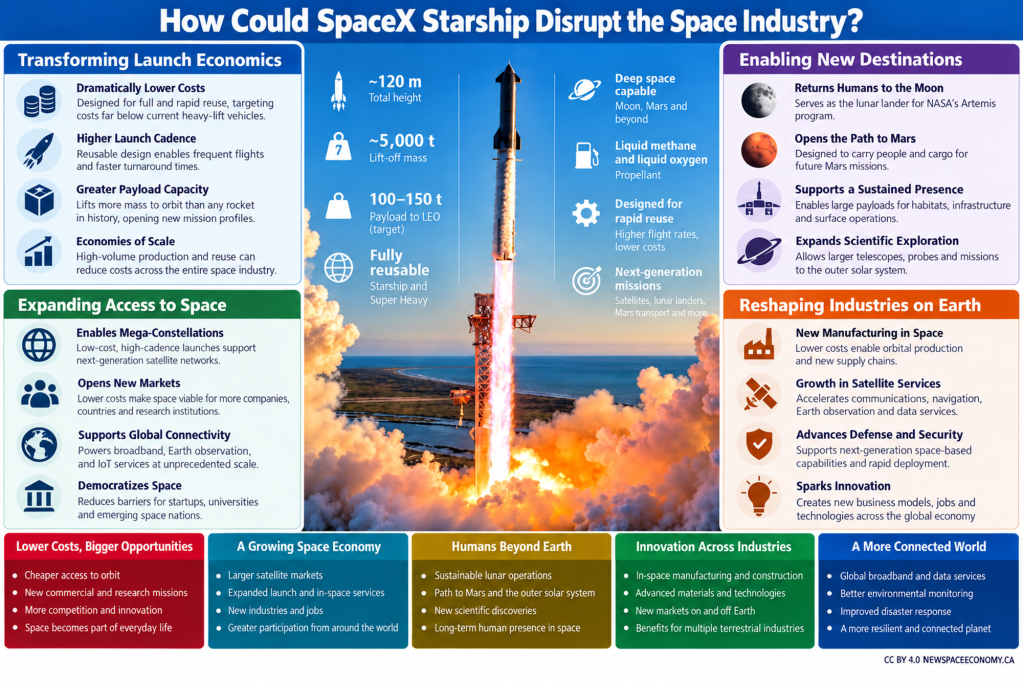
- Key Takeaways
- Starship Could Change the Economics of Building for Space
- Lower Launch Cost Is Only One Part of the Starship Disruption
- Satellite Design Could Shift From Mass Scarcity to Throughput
- Starlink Gives Starship an Unusual Anchor Customer
- Large Payload Volume Could Reshape Stations, Science, and Orbital Industry
- Orbital Refueling Could Turn Starship Into a Cislunar Logistics System
- Defense and Government Customers Could Use Different Transportation Concepts
- Competitors, Spaceports, Regulators, and Supply Chains Will Have to Adapt
- Summary
- Appendix: Useful Books Available on Amazon
- Appendix: Top Questions Answered in This Article
- Appendix: Glossary of Key Terms
Key Takeaways
- Starship’s largest effect may be changing what the space industry can afford to design, build, and operate.
- Flight 14 proved orbital payload delivery, but rapid full reusability and high launch cadence remain unproven.
- Disruption could spread from launch into satellites, stations, lunar logistics, defense, manufacturing, and spaceports.
Starship Could Change the Economics of Building for Space
On September 28, 2026, SpaceX’s Starship Flight 14 reached orbit and deployed 26 Starlink V3 satellites. That mission established something previous Starship flights had not: the enormous launch system could deliver a meaningful payload to orbit. It did not prove rapid full reusability, routine commercial service, or the exceptionally high flight rates envisioned for Starship, but it moved the vehicle from a largely developmental proposition toward an operational transportation system whose consequences the rest of the space industry increasingly has to consider.
The central thesis is broader than the familiar prediction that Starship will make launches cheaper. If SpaceX can combine very large payload capacity with reliable reuse and high flight frequency, Starship could change the economic assumptions around which spacecraft, constellations, space stations, exploration programs, launch companies, and even spaceports are designed. The important shift would be from an industry organized around scarce transportation capacity toward one in which some customers can contemplate substantially more mass, volume, hardware, propellant, and replacement capacity in orbit.
That distinction matters because launch cost is only the first-order effect. For decades, expensive and constrained transportation has influenced almost every upstream design decision. Satellite builders spend heavily to remove mass. Space telescopes use elaborate folding mechanisms to fit inside fairings. Space stations are divided into modules because complete facilities cannot fit on one conventional rocket. Lunar missions carry tightly constrained propellant and hardware. Constellation operators divide deployment among numerous launches. If transportation capacity becomes more abundant, some of those engineering and business decisions can be reconsidered.
The consequences could therefore propagate far beyond companies that build rockets. Starship could affect satellite architecture by making heavier and physically larger spacecraft practical. It could accelerate Starlink deployment and give SpaceX an internal source of launch demand. It could allow commercial stations such as Starlab to be designed around much larger integrated modules. Orbital refueling could turn Starship from a launch vehicle into part of a reusable cislunar logistics network. Government agencies could reconsider rapid deployment, large spacecraft, and cargo transportation. Competing launch providers could be pushed toward specialization, customer independence, sovereign access, or differentiated missions. Spaceports, regulators, insurers, manufacturers, and suppliers would have to adapt if launch frequency rises substantially.
The economics of mass and volume may ultimately matter as much as the nominal price of a launch. An industry that expects transportation to remain scarce designs differently from one that expects hundreds of metric tons of potential annual capacity from a reusable system. The second environment can favor larger spacecraft, simpler structures, greater redundancy, faster replenishment, more ambitious orbital infrastructure, and business models that would be difficult to justify under traditional launch constraints.
The rest of the analysis therefore follows the disruption outward from the rocket itself. It begins with launch economics and spacecraft design, then examines Starlink’s role as an anchor customer, commercial stations and scientific missions, orbital refueling and lunar logistics, government and defense applications, and finally the competitive, regulatory, infrastructure, and supply-chain effects that could spread through the wider space economy.
That roadmap also establishes an important boundary. Starship’s potential should not be confused with demonstrated capability. SpaceX describes the system as fully and rapidly reusable, but Flight 14 did not establish routine recovery and reflight of both stages. High-frequency economics still depend on operational reliability, launch-site throughput, regulatory approvals, payload demand, refurbishment requirements, and large-scale in-space propellant transfer. Starship could disrupt the industry precisely because those capabilities would alter existing constraints. Whether it does so, and how quickly, depends on SpaceX proving them repeatedly rather than merely designing for them.
SpaceX currently describes the Version 3 system as approximately 124 meters tall and designed to carry more than 100 metric tons to orbit in a fully reusable configuration. The company’s public information also makes clear that prospective customers must contact SpaceX for payload, schedule, and pricing details. Consequently, claims that Starship has already established a specific commercial cost per kilogram should be treated cautiously. The economic disruption depends on actual operational cost, selling price, utilization, mission profile, refurbishment requirements, insurance treatment, and customer demand rather than payload capacity by itself.
That distinction is consistent with New Space Economy’s analysis of launch economics and its comparison of Starship with competing launch vehicles. Launch markets sell transportation to particular orbits at particular times under specific technical, regulatory, and mission-assurance conditions. They do not sell kilograms as a perfectly interchangeable commodity.
Starship therefore enters its most consequential development phase after Flight 14. Reaching orbit establishes the foundation. Repeated orbital payload missions, successful upper-stage recovery, demonstrated reflights, higher payload loads, tanker operations, and predictable customer service would determine whether that foundation becomes a new industrial standard.
Lower Launch Cost Is Only One Part of the Starship Disruption
Most discussions of Starship begin with launch cost, but price is only one mechanism through which the vehicle could alter the industry. The deeper change would come from increasing the amount of mass, physical volume, and launch capacity that customers can plan around.
Traditional spacecraft engineering treats launch mass as expensive. Every kilogram added to a satellite can increase launch requirements, structural loads, propulsion requirements, and program cost. Engineers therefore invest heavily in lightweight materials, folding structures, compact mechanisms, miniaturized electronics, deployable antennas, and highly optimized spacecraft configurations.
A reliable vehicle capable of transporting 100 metric tons or more to low Earth orbit would not eliminate mass constraints. It could make them less dominant for missions that can use Starship. Designers might decide that a heavier fixed structure is less expensive or more reliable than a lightweight deployable one. Additional radiation shielding, redundant hardware, larger propellant tanks, bigger antennas, more powerful thermal systems, and commercial components could become economically reasonable in circumstances where launch mass formerly ruled them out.
New Space Economy’s analysis of Starship mass and volume examines this change in design philosophy. The potential shift is from paying substantial engineering costs to minimize launch mass toward optimizing the entire mission cost. Spending another $20 million to remove hundreds of kilograms from a spacecraft makes less economic sense if the available launch service has substantial unused mass capacity. That does not mean lightweight engineering disappears. Deep-space missions, maneuvering spacecraft, small launch vehicles, and missions with strict propulsion budgets will continue to value low mass.
Large capacity could also change launch purchasing. A spacecraft operator may purchase a dedicated launch, share a flight with other customers, buy deployment through an aggregator, or design an entire constellation around large batch launches. Starship could expand the upper end of that spectrum by making extremely large rideshare manifests or constellation deployments possible.
The result may be a market in which transportation becomes a smaller fraction of some projects’ total costs. That could shift investment toward payloads, sensors, communications hardware, ground infrastructure, data processing, and applications. It could also make some projects larger rather than cheaper. When transportation capacity expands, customers often consume part of the improvement by building more capable systems.
This is why the more meaningful measure of Starship disruption will not necessarily be the advertised price of a launch. It will be the projects that become economically or technically practical because customers can plan around more transportation capacity.
Satellite Design Could Shift From Mass Scarcity to Throughput
Satellite manufacturing may experience one of Starship’s earliest structural effects. Spacecraft architecture has been shaped for decades by the dimensions and performance of available launch vehicles. Starship increases both the mass and volume that designers can potentially work with.
The change is particularly relevant to communications constellations. SpaceX’s own Starlink V3 architecture provides a direct example. In its June 2026 corporate prospectus, SpaceX said each V3 broadband satellite was designed to provide about 1 terabit per second of downlink capacity and that Starship was expected eventually to deploy as many as 60 V3 spacecraft in one mission. The company estimated that such a load would deploy approximately 20 times the broadband downlink capacity of a Falcon 9 Starlink mission. Flight 14 carried 26 V3 satellites, demonstrating actual orbital deployment but not the stated maximum manifest.
That relationship between launcher and spacecraft illustrates a larger industry trend. Satellite builders can optimize a spacecraft around a larger transportation envelope instead of forcing every system into the limitations inherited from earlier rockets. Larger antennas can increase communications performance. Larger apertures can improve some remote-sensing systems. More power generation can support higher-capacity communications or processing equipment. More propellant can increase maneuverability or operating life.
The International Space University study summarized by New Space Economy in its Starship satellite communications report identified mass, payload volume, launch cadence, and lower transportation cost as factors capable of changing satellite design and telecommunications business models.
There is another possible effect: spacecraft can become easier to manufacture. Aerospace hardware is frequently expensive because it must provide exceptional performance with minimal weight and volume. If launch capacity becomes less scarce, manufacturers could sometimes choose thicker structures, commercially derived electronics with additional shielding, simpler mechanisms, or greater redundancy. The savings would come from reduced engineering complexity rather than launch price alone.
This would not make traditional satellite optimization obsolete. Geostationary spacecraft still face propulsion constraints. Interplanetary probes must accelerate substantial mass beyond Earth orbit. Constellations must consider deployment altitude, orbital planes, collision risk, and disposal. Some customers need precise launch times or dedicated trajectories that favor smaller launchers.
The more plausible outcome is diversification. Starship could create a new class of spacecraft optimized for abundant launch capacity, alongside satellites that remain optimized for low mass, dedicated launch, or specialized orbits.
Starlink Gives Starship an Unusual Anchor Customer
One of Starship’s strongest commercial advantages is that SpaceX does not need to wait for an external customer to generate every early operational mission. Starlink gives the company an internal payload with enormous deployment requirements.
Flight 14 demonstrated that relationship directly by carrying Starlink V3 satellites. SpaceX has designed V3 around Starship rather than treating the launch vehicle and satellite network as independent businesses. The company can therefore use Starlink demand to accumulate Starship flight experience, refine ground operations, test payload deployment systems, and increase production even when third-party demand remains immature.
This vertically integrated model can create an industrial feedback loop. More Starship capacity can accelerate Starlink deployment. More Starlink deployment can generate demand for Starship flights. More flights can generate operational data and potentially reduce unit costs. Greater network capacity can then support additional Starlink customers and services.
New Space Economy’s Starship commercial-market analysis identifies this internal demand as both an advantage and an analytical limitation. Starlink gives SpaceX a launch customer that competitors cannot easily replicate, but an internal transaction does not reveal the price an independent satellite operator will actually pay.
This distinction matters because Starship could disrupt the launch industry in two different ways. The first is conventional competition, where SpaceX sells attractive launch services to third parties. The second is vertical competition, where SpaceX uses Starship primarily to expand businesses that themselves compete with satellite operators.
That creates complicated incentives for the rest of the satellite sector. A communications provider may consider SpaceX both an important launch supplier and a competitor through Starlink. Reuters reported in August 2026 that growing Starlink demand was taking an increasing share of SpaceX’s Falcon 9 manifest and contributing to launch-capacity concerns among external customers. Starship could eventually relieve some of that pressure by moving Starlink deployment away from Falcon 9, but its own internal payload demand could also remain substantial.
The implication is that launch capacity alone does not determine market access. Allocation matters. If Starship achieves high flight rates, external customers could gain substantial new capacity. If internal SpaceX missions absorb much of that capacity, competing operators may continue to value alternative launch suppliers even if Starship offers exceptional performance.
Large Payload Volume Could Reshape Stations, Science, and Orbital Industry
Starship’s physical dimensions may be as consequential as its mass capacity. Large spacecraft are often difficult to launch because they must fit inside a payload enclosure and survive high vibration and acceleration. Designers compensate with folding mirrors, articulated solar arrays, deployable antennas, modular station components, and other mechanisms that add development work and potential failure modes.
Starship creates the possibility of designing some payloads closer to their operational configuration on Earth. That does not eliminate launch loads, qualification requirements, or deployment systems, but it can change the trade between ground integration and on-orbit assembly.
Starlab provides a concrete example. Airbus describes the planned commercial station as a large integrated facility designed to launch on a single Starship rather than being assembled from a long sequence of separately launched modules. Airbus currently lists 2029 as Starlab’s scheduled launch year. Its approximately 8-meter-diameter primary module reflects a design choice enabled by access to a super-heavy launcher.
This single-launch approach could influence future habitats, fuel depots, power platforms, orbital data centers, and research facilities. New Space Economy’s orbital infrastructure analysis describes how transportation, habitats, logistics, servicing, manufacturing, and return systems increasingly form an interconnected industrial stack.
Astronomy and planetary science could also benefit from a larger transportation envelope. Space telescopes frequently require expensive deployment systems because optical assemblies must fit inside conventional payload fairings. A larger launcher can give engineers more freedom to trade mass and volume against deployment complexity. It does not automatically make a large telescope inexpensive. Precision optics, thermal stability, detectors, spacecraft control systems, scientific instruments, testing, and program management remain expensive regardless of launch vehicle.
NASA’s decision in March 2025 to add Starship to the agency’s NASA Launch Services II contract is therefore notable. It allows Starship to compete for eligible future NASA launch-service requirements once mission-specific requirements are satisfied. It does not mean every NASA science payload is moving to Starship, but it places the vehicle inside the procurement framework used for civil science and exploration missions.
A related opportunity is physical return from orbit. If SpaceX eventually demonstrates routine recovery and reuse of the upper stage, Starship could provide substantial downmass capability. That could matter for manufacturing, biological research, equipment refurbishment, sample return, and hardware servicing. As of September 30, 2026 the industrial significance of that return capability remains prospective because routine orbital recovery of Starship has not yet been established.
Orbital Refueling Could Turn Starship Into a Cislunar Logistics System
Starship’s implications become much larger beyond low Earth orbit, but so do its technical dependencies. The central capability is large-scale cryogenic propellant transfer between spacecraft.
A Starship traveling beyond Earth orbit cannot simply treat every mission as a larger version of a conventional expendable launch. SpaceX’s architecture calls for tanker Starships to place methane and liquid oxygen into orbit and transfer propellant to another Starship. That approach effectively separates launch from long-distance transportation. Low Earth orbit becomes a staging location where spacecraft can be refueled before continuing toward the Moon or eventually Mars.
NASA has already supported related cryogenic fluid-management work. NASA TechPort describes a completed SpaceX demonstration involving the transfer of more than 3 metric tons of liquid oxygen between tanks aboard a Starship in space. That was an important fluid-management experiment, but it was not the full vehicle-to-vehicle transfer architecture required for operational lunar missions. NASA’s Office of Inspector General has identified large-scale vehicle-to-vehicle propellant transfer as a major remaining Starship Human Landing System development milestone.
The commercial implications extend beyond NASA. A reliable tanker architecture could support reusable lunar transportation, propellant depots, large robotic cargo missions, lunar infrastructure, and spacecraft that remain in space instead of carrying all mission propellant from Earth in one launch.
New Space Economy’s analysis of Starship orbital refueling explains why launch cadence becomes particularly important in this architecture. Propellant logistics require multiple launches, rendezvous operations, cryogenic storage, transfer hardware, orbital coordination, and dependable tanker availability. A deep-space Starship mission is therefore partly a transportation-network problem.
NASA’s Artemis architecture provides the first major institutional test. NASA revised the Artemis campaign in February 2026. Artemis III is now planned as a 2027 Earth-orbit mission intended to test systems that can include rendezvous and docking with commercial landers. NASA continues to target Artemis IV in 2028 for the first crewed lunar landing of the revised campaign. NASA identifies Starship Human Landing System as one of the commercial landers being developed for these missions.
If large-scale refueling becomes dependable, Starship’s disruption could therefore extend from launch services into transportation infrastructure. If it does not, much of the vehicle’s cislunar and Mars architecture remains constrained regardless of its low Earth orbit payload capacity.
Defense and Government Customers Could Use Different Transportation Concepts
Government demand is likely to influence Starship in ways that extend beyond conventional satellite launch. Civil agencies can use large launch capacity for science, exploration, and logistics. Defense organizations are also examining whether commercial reusable launch systems can provide new forms of rapid transportation.
The U.S. Department of the Air Force established Rocket Cargo to study the military utility of large reusable commercial rockets. Fiscal year 2027 budget documentation published in April 2026 shows that Rocket Cargo work continued in fiscal year 2026 under a transferred Space Force technology program. The research examines issues such as austere landing sites, cargo loading, communications, cargo environments, vulnerability, and the possible airdrop of cargo after reentry. The program is intended to assess the viability and business case rather than declare operational rocket cargo a completed capability.
Starship is relevant to that concept because its planned payload capacity and return architecture place terrestrial point-to-point transport within technical discussion. SpaceX itself describes point-to-point Earth transportation as a possible future capability. That should not be confused with an available scheduled service as of September 30, 2026.
The more immediate government effect may be on conventional space access. Large capacity can support bigger spacecraft, larger batches of satellites, rapid constellation replenishment, hosted payloads, and potentially reserve launch capacity. At the same time, government customers generally place substantial value on mission assurance, provider diversity, schedule confidence, secure integration, and access to more than one launch system.
The U.S. Space Force’s National Security Space Launch Phase 3 Lane 1 program illustrates that preference for supplier diversity. By July 2026, the service had on-ramped seven providers, including SpaceX, United Launch Alliance, Blue Origin, Rocket Lab, Stoke Space, Impulse Space, and Relativity. The existence of an exceptionally capable Starship would therefore not automatically eliminate government demand for other launch vehicles.
Starship could instead change the scale of what governments consider practical. A military or civil organization able to place tens of tons of hardware into orbit in one mission may design architectures that previously required several launches. Governments could also use commercial transportation services instead of owning all of the launch infrastructure themselves.
Those possibilities make Starship relevant to procurement strategy, responsive space, logistics, spacecraft design, and industrial policy. Actual adoption will depend on demonstrated reliability, certification, security requirements, mission economics, and whether alternative providers offer capabilities governments consider necessary for resilient access to space.
Competitors, Spaceports, Regulators, and Supply Chains Will Have to Adapt
Starship’s most consequential competitive effect may be the pressure it places on business models rather than the direct elimination of other rockets. A mature Starship would create a very large transportation category, but launch demand is segmented. Customers buy access to particular inclinations, altitudes, launch windows, integration environments, and risk profiles.
Smaller launch vehicles can still provide dedicated scheduling and orbit selection. Medium and heavy launch vehicles can compete on demonstrated reliability, existing infrastructure, government certification, customer independence, or mission-specific performance. New Space Economy’s reusable launch market analysis notes that demonstrated operational maturity matters alongside theoretical performance. Flight 14 improved Starship’s maturity significantly, but one orbital payload mission does not provide the flight history of an established operational fleet.
Starship may nevertheless change competitors’ investment decisions. A company considering a new heavy-lift rocket must evaluate whether enough customers will pay for another vehicle if SpaceX can offer abundant capacity. Other providers may emphasize missions Starship does not serve efficiently, sovereign launch requirements, specialized orbits, customer neutrality, national-security needs, or geographic access.
The ground segment faces an equally important adjustment. Rapid launch requires far more than reusable vehicles. Spaceports need propellant storage, processing areas, launch towers, power, water systems, payload integration facilities, transportation infrastructure, range coordination, and recovery operations. SpaceX has pursued a vertically integrated model at Starbase, a structure examined in New Space Economy’s Starbase industrial analysis.
Regulation creates another pacing mechanism. The Federal Aviation Administration’s environmental review for Starbase evaluated up to 25 annual orbital Starship/Super Heavy launches and corresponding landings. The FAA is also conducting the licensing and environmental processes associated with Starship operations from Launch Complex 39A in Florida. These processes illustrate why hardware capable of rapid reuse does not automatically translate into unrestricted launch frequency. Public safety, airspace, environmental review, infrastructure, and site-specific licensing remain part of the achievable cadence.
Supply chains would also feel the effect. High Starship production and launch rates would increase demand for engines, steel structures, valves, avionics, cryogenic equipment, methane and oxygen handling systems, launch infrastructure, payload adapters, logistics, and specialized workforce. Satellite companies might simultaneously shift spending away from extreme mass optimization and toward payload production.
The disruption would therefore spread far beyond SpaceX. Launcher manufacturers, satellite builders, component suppliers, spaceports, regulators, insurers, government customers, station developers, telecommunications companies, and investors would all have to decide which assumptions from the scarcity era of launch remain valid.
Summary
Starship’s potential impact cannot be reduced to the claim that one very large reusable rocket will make launches cheaper. Its more important effect could be to change the constraints around which much of the space industry has been designed.
Flight 14 established a new factual baseline on September 28, 2026: Starship can reach orbit and deploy operational payloads. That achievement removes one major uncertainty, but several others remain. SpaceX must still demonstrate that Starship can become a repeatable transportation service rather than an extraordinary developmental vehicle. Upper-stage recovery, rapid reflight, increasing payload performance, reliable engine operation, large-scale propellant transfer, ground turnaround, regulatory cadence, and customer scheduling remain central to the economic case.
If those capabilities mature, the effects could propagate through almost every upstream part of the space economy. Satellite engineers could trade less aggressively against mass. Constellations could be deployed in larger increments. Starlink could expand network capacity more quickly. Large space stations could launch substantially integrated. Science missions could consider larger instruments. Lunar transportation could develop around reusable tanker and depot concepts. Governments could evaluate new cargo and responsive-space architectures. Manufacturers could design spacecraft around larger physical envelopes. Spaceports and regulators would have to manage higher launch throughput.
The competitive outcome is unlikely to be a simple replacement of every existing rocket. Mission requirements differ, customers value supplier diversity, and smaller vehicles can provide scheduling or orbital access that a very large launcher may not optimize. The stronger possibility is segmentation: Starship establishes a new high-capacity transportation layer, forcing the rest of the industry to determine where dedicated, sovereign, specialized, or alternative launch services continue to provide value.
New Space Economy’s earlier analysis of Starship’s commercial potential and its satellite-industry assessment point toward the same underlying issue. The disruptive variable is not the rocket in isolation. It is what businesses, governments, engineers, and customers start designing once they believe high-capacity reusable transportation is dependable.
Starship reached orbit in September 2026. The next stage of disruption will be measured by whether the rest of the space economy begins designing around the assumption that it can keep doing so.
Appendix: Useful Books Available on Amazon
- Liftoff: Elon Musk and the Desperate Early Days That Launched SpaceX
- Reentry: SpaceX, Elon Musk, and the Reusable Rockets that Launched a Second Space Age
- The Space Barons: Elon Musk, Jeff Bezos, and the Quest to Colonize the Cosmos
- When the Heavens Went on Sale: The Misfits and Geniuses Racing to Put Space Within Reach
- Space 2.0: How Private Spaceflight, a Resurgent NASA, and International Partners are Creating a New Space Age
- Elon Musk
Appendix: Top Questions Answered in This Article
Has Starship Reached Orbit?
Yes. SpaceX’s Flight 14 reached orbit on September 28, 2026 and deployed 26 Starlink V3 satellites. It was Starship’s first orbital mission and its first delivery of meaningful payload into orbit. The flight nevertheless remained developmental, with engine issues and sea disposal rather than routine recovery and rapid reuse of both stages.
How Much Payload Is Starship Designed to Carry?
SpaceX currently describes Starship as designed to carry more than 100 metric tons to orbit in a fully reusable configuration. That is a design capability rather than a payload level demonstrated on Flight 14. Operational capacity will depend on vehicle configuration, destination orbit, recovery requirements, mission profile, and future vehicle development.
Will Starship Automatically Make Space Launch Much Cheaper?
No specific outcome is guaranteed. Full reuse, frequent flights, large payload capacity, and high vehicle utilization could reduce transportation cost substantially. Commercial economics will ultimately depend on actual manufacturing and operating costs, refurbishment, launch-site expenses, reliability, insurance, payload integration, demand, and the prices SpaceX charges external customers.
Why Is Starlink So Important to Starship?
Starlink gives SpaceX a large internal source of payload demand. That means SpaceX can fly Starship to expand its own communications network instead of depending exclusively on third-party launch customers. This can accelerate operational learning and utilization, although internal Starlink missions do not reveal the commercial price independent customers will eventually pay.
Could Starship Make Satellites Larger?
It could make larger and heavier spacecraft economically attractive for some missions. Engineers may gain freedom to use larger antennas, additional shielding, more propellant, greater redundancy, or simpler structures. Other missions will continue to require aggressive mass optimization because spacecraft propulsion, destination, dedicated launch requirements, or orbital mechanics still reward low mass.
Why Does Starship Matter to Commercial Space Stations?
Its large payload envelope permits station developers to consider launching bigger integrated structures. Starlab is being designed around a single Starship launch rather than extensive orbital assembly. That approach can move more integration and testing to the ground, although the station still depends on Starship achieving the required operational maturity before its planned launch.
Why Is Orbital Refueling So Important?
Refueling allows a Starship launched from Earth to receive additional methane and liquid oxygen in orbit before traveling farther into space. This is central to SpaceX’s lunar architecture because deep-space Starship missions require more propellant than can simply be carried through the initial ascent. Full vehicle-to-vehicle transfer remains a development requirement.
Could Starship Replace Smaller Rockets?
Starship could compete for payloads that might otherwise use several smaller launches, but it does not eliminate the reasons customers choose dedicated vehicles. Schedule control, orbital destination, sovereign access, mission assurance, integration requirements, and provider diversity can justify smaller or competing launch systems even in a market with inexpensive heavy-lift transportation.
Could Starship Be Used for Military Cargo Transport on Earth?
The concept is being studied, but it is not an operational transportation service. The U.S. Department of the Air Force and Space Force Rocket Cargo work examines whether commercial reusable rockets could rapidly transport military or humanitarian cargo and what technical, operational, and economic problems would need to be solved.
What Would Show That Starship Has Truly Become an Industry-Disrupting Transportation System?
The strongest evidence would be sustained orbital launches with predictable schedules, successful recovery and reflight of both stages, increasing useful payload, dependable customer missions, competitive pricing, demonstrated in-space propellant transfer, expanded launch infrastructure, and a regulatory framework capable of supporting substantially higher cadence. Those results would allow customers to design businesses around Starship rather than merely anticipate it.
Appendix: Glossary of Key Terms
Orbital Mission
A flight in which a spacecraft reaches sufficient horizontal velocity to remain in an orbit around Earth rather than following a trajectory that naturally returns to the atmosphere after one partial passage through space.
Payload Capacity
The mass of satellites, cargo, instruments, spacecraft, or other useful equipment that a launch vehicle can transport to a specified destination. Capacity changes according to orbit, vehicle configuration, recovery strategy, and mission requirements.
Full Reusability
A launch architecture in which both the booster and upper-stage spacecraft are designed to be recovered and flown again. The commercial value depends on recovery reliability, refurbishment requirements, turnaround time, vehicle lifetime, and the number of successful reflights.
Launch Cadence
The frequency at which a launch system can conduct missions. Cadence depends on more than rocket production. Launch pads, payload processing, range availability, weather, licensing, propellant supply, maintenance, customer readiness, and workforce capacity can all limit flight frequency.
Anchor Customer
A customer that provides enough recurring demand to support the development or regular operation of a service. Starlink functions as an internal anchor customer for Starship because SpaceX can use Starship missions to deploy its own communications satellites.
Payload Volume
The physical space available inside a launch vehicle for cargo. Some spacecraft reach the volume limit of a payload enclosure before reaching the launcher’s maximum mass, making dimensions as important as total payload weight.
Cryogenic Propellant Transfer
The movement of very cold liquid propellants such as liquid oxygen or methane between tanks or spacecraft. In microgravity, fluid positioning, temperature control, pressure management, boil-off, settling, connections, and transfer operations create engineering problems different from terrestrial refueling.
Human Landing System
NASA’s term for commercial spacecraft intended to transport astronauts between lunar orbit and the Moon’s surface as part of Artemis. SpaceX is developing a Starship-based Human Landing System, and Blue Origin is developing a separate commercial lunar lander architecture.
Rideshare
A launch arrangement in which multiple payload customers share the same rocket. Rideshare can reduce transportation costs but requires customers to coordinate schedules, deployment sequences, orbital destinations, interfaces, and integration requirements.
Mission Assurance
The engineering, testing, quality-control, risk-management, and verification activities used to increase confidence that a launch vehicle and payload will complete their intended mission. Government and high-value commercial missions may impose extensive mission-assurance requirements.
Downmass
Material transported from orbit back to Earth. Significant reusable downmass could support scientific sample return, equipment refurbishment, orbital manufacturing, biological research, and other businesses that require physical products or hardware to return from space.
Super Heavy
The reusable first-stage booster of the Starship launch system. It uses 33 Raptor engines and is designed to return toward its launch site for recovery by the launch tower, enabling eventual reuse as part of SpaceX’s full-reusability architecture.