As an Amazon Associate we earn from qualifying purchases.

- Key Takeaways
- Why Are Space Industry Intermediaries Becoming More Important?
- How Do Industrial Supply, Distribution, Procurement, and Manufacturing Intermediaries Work?
- Distributors and Authorized Resellers
- Manufacturers’ Representatives and Sales Agents
- Value-Added Resellers
- Procurement and Strategic Sourcing Firms
- Component Brokers
- Supplier Discovery Platforms
- Contract Manufacturers
- Raw-Material and Specialty-Material Distributors
- Inventory and Obsolescence Specialists
- Industrial Logistics Providers
- Which Engineering, Testing, Certification, Regulatory, and Technical Firms Serve Space Companies?
- Engineering Service Companies
- Systems Integrators
- Digital Engineering Firms
- CAD, CAE, and Simulation Consultants
- Environmental Test Laboratories
- Calibration and Metrology Companies
- Inspection and Quality-Assurance Firms
- Independent Verification and Validation
- Reliability and Failure-Analysis Consultants
- Standards and Quality Consultants
- Regulatory Consultants
- Spectrum Consultants
- Export-Control Specialists
- Environmental and Safety Consultants
- Cybersecurity Companies
- How Do Launch Brokers, Payload Integrators, Mission Managers, and Logistics Companies Create Value?
- What Roles Do Ground Networks, Cloud Platforms, Connectivity, and Data Intermediaries Play?
- Ground-Station Operators
- Ground-Station Aggregators
- Ground Station as a Service
- Mission-Control-as-a-Service Providers
- Teleport Operators
- Satellite Capacity Brokers
- Network Integrators
- Cloud Integrators
- Satellite Data Distributors
- Earth-Observation Marketplaces
- Data Aggregators
- Value-Added Analytics Companies
- API Aggregators
- Satellite Tasking Platforms
- Geospatial Cloud Platforms
- How Do Financial, Insurance, Legal, Investment, and Transaction Intermediaries Support Space Companies?
- Commercial Banks
- Venture-Capital Firms
- Placement Agents
- Investment Banks
- Mergers and Acquisitions Advisors
- Valuation Firms
- Commercial Due-Diligence Firms
- Technical Due-Diligence Firms
- Insurance Brokers
- Reinsurance Brokers
- Risk-Management Consultants
- Claims and Loss-Adjustment Specialists
- Space Law Firms
- Intellectual-Property Firms
- Government-Contracting Advisors
- Grant and Incentive Consultants
- Accounting and Tax Firms
- Fractional Financial Leadership
- How Do Workforce, Consulting, Sales, Marketing, Media, and Business-Development Companies Fit Into the Space Economy?
- Specialized Recruiting Firms
- Executive-Search Firms
- Engineering Staffing Firms
- Employer-of-Record Providers
- Training Companies
- Management Consultants
- Market-Research Firms
- Competitive-Intelligence Firms
- Expert Networks
- Sales Outsourcing Companies
- Business-Development Agencies
- International Market-Entry Firms
- Trade-Mission Organizers
- Commercial Matchmaking Companies
- Conference and Trade-Show Organizers
- Advertising Agencies
- Public-Relations Firms
- Investor-Relations Firms
- Content-Marketing Firms
- Lead-Generation Companies
- Industry Media and Publishing Companies
- Digital and Creative Agencies
- Which Digital Marketplaces, Aggregators, and Managed-Service Models Are Emerging?
- B2B Component Marketplaces
- Request-for-Quotation Platforms
- Launch Marketplaces
- Ground-Network Marketplaces
- Data Exchanges
- Cloud Marketplaces
- Managed-Service Providers
- Subscription Models
- Usage-Based Pricing
- Platform Business Models
- Technology-Transfer Marketplaces
- Innovation Brokers
- Patent and Technology-Scouting Firms
- Commercialization Accelerators
- Incubators
- Venture Studios
- Fractional Executive Services
- Shared Facilities
- Aerospace Real-Estate Specialists
- Equipment Leasing
- Which New Intermediaries Are Emerging Around In-Space Operations?
- Orbital Mobility Brokers
- Satellite Servicing Coordinators
- Refueling Networks
- Active Debris-Removal Contracting
- Space-Domain-Awareness Data Aggregators
- Conjunction-Assessment Services
- Space-Traffic Coordination Platforms
- Lunar Logistics Integrators
- Lunar Communications Brokers
- Lunar Navigation Services
- Commercial Space-Station Service Brokers
- In-Space Manufacturing Marketplaces
- Return-Logistics Providers
- Space Resource Service Intermediaries
- How Do Space Companies Decide Which Intermediaries to Buy From?
- What Is the Full Commercial Map of Companies Selling Into the Space Sector?
- Summary
- Appendix: Useful Books Available on Amazon
- Appendix: Top Questions Answered in This Article
- Appendix: Glossary of Key Terms
Key Takeaways
- Space companies rely on intermediaries connecting suppliers, capital, launch capacity, data, expertise, and customers.
- Strong intermediaries reduce technical, regulatory, procurement, financial, integration, or market-access friction.
- Managed services and marketplaces increasingly package fragmented capabilities into easier commercial offerings.
Why Are Space Industry Intermediaries Becoming More Important?
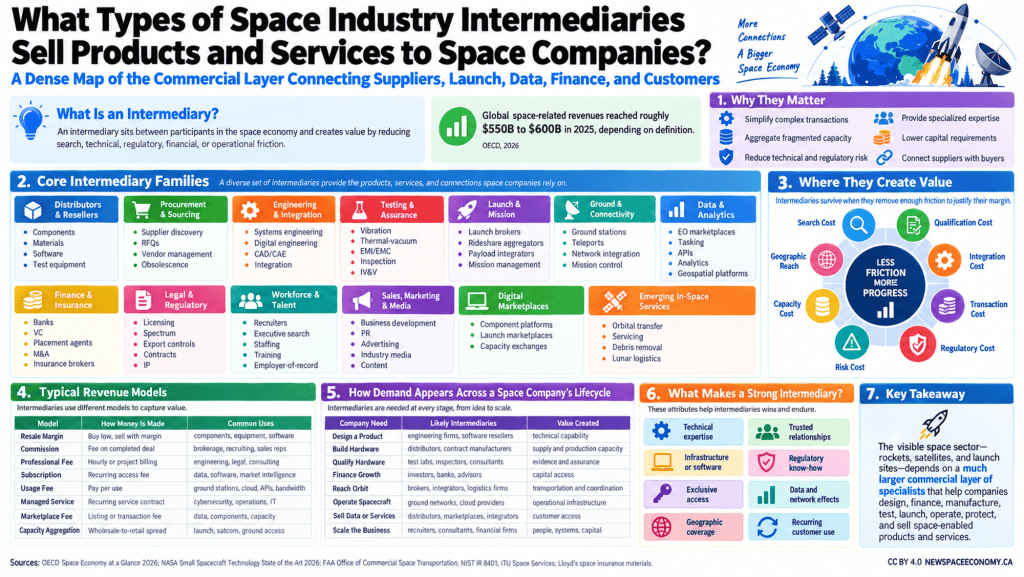
In September 2026, the Organisation for Economic Co-operation and Development estimated global space-related revenues at approximately $550 billion to $600 billion for 2025, depending on the definition used. The economic activity behind that figure extends far beyond companies that manufacture rockets or satellites. It includes engineering firms, component distributors, test laboratories, launch brokers, insurers, law firms, recruiters, ground-station networks, cloud companies, data platforms, logistics providers, consultants, financial institutions, cybersecurity companies, and many other businesses connecting the principal participants in the space economy.
These businesses can collectively be described as space industry intermediaries. An intermediary occupies a position between two or more participants in a commercial relationship and creates value by simplifying transactions, reducing uncertainty, combining fragmented services, supplying specialized knowledge, aggregating capacity, managing risk, or helping a customer gain access to capabilities it would otherwise have to develop internally.
The term does not imply that the intermediary is economically secondary. In some markets, the intermediary owns substantial infrastructure or intellectual property. A systems integrator may employ hundreds of engineers. A ground-network company may own antennas on several continents. An insurance broker may assemble coverage from multiple underwriters. A cloud platform may connect spacecraft operators to processing, storage, cybersecurity, and application-development services. A launch integrator can provide hardware, testing, documentation, regulatory coordination, mission planning, and physical spacecraft integration.
The OECD space-economy framework explicitly recognizes many such activities. Its upstream definition includes finance, insurance, legal services, consulting, engineering support, testing, materials, components, subsystem manufacturing, systems integration, and launch. The downstream economy includes ground operations, data distribution, telecommunications, navigation services, geospatial processing, software, devices, and value-added services. This classification helps explain why the commercial structure of space resembles a network rather than a simple sequence from rocket factory to launchpad.
The distinction between upstream, midstream, and downstream activity is useful but imperfect. A satellite manufacturer is normally upstream. A telecommunications or Earth-observation service delivered to an end user is downstream. Operations, ground infrastructure, data processing, orbital transportation, mission management, and similar activities are sometimes described as midstream because they connect physical space infrastructure to customers and terrestrial services.
Intermediaries can operate in any of these layers.
A component distributor may connect a semiconductor producer with a spacecraft manufacturer. A launch broker connects a satellite owner with available launch capacity. A ground-station aggregator connects an operator with antennas around the world. An insurance broker connects spacecraft owners with underwriting capacity. An investment bank connects a company with capital markets. An Earth-observation marketplace can connect imagery suppliers with customers that need geospatial information. A specialized recruiting firm connects aerospace employers with engineers.
The commercial importance of these relationships increases as the sector becomes more fragmented. A traditional vertically integrated aerospace prime might have performed engineering, manufacturing, testing, integration, procurement, mission management, and operations internally. A smaller commercial satellite company may instead purchase each capability from external specialists.
That creates demand for companies capable of making complexity easier to manage.
The resulting market can be understood through several broad intermediary functions.
Discovery intermediaries help buyers find suppliers, employees, technology, capital, customers, or data.
Transaction intermediaries help parties negotiate, contract, pay, insure, finance, or otherwise complete commercial exchanges.
Technical intermediaries integrate systems, verify performance, conduct testing, provide engineering expertise, or translate customer requirements into technical solutions.
Capacity aggregators combine unused or fragmented capacity, such as launch space, antenna time, computing capacity, satellite bandwidth, data, or specialist labor.
Risk intermediaries identify, quantify, transfer, or manage technical, financial, contractual, regulatory, cyber, and operational risk.
Regulatory intermediaries help companies understand licensing, spectrum, export controls, environmental requirements, government contracting, and related obligations.
Market-access intermediaries connect suppliers with customers through sales representation, distribution, government procurement, partnerships, conferences, media, advertising, and business-development services.
Operational intermediaries perform work that customers might theoretically conduct internally, including mission operations, ground communications, cybersecurity monitoring, cloud management, logistics, or satellite control.
This intermediary layer has become more visible as commercial space has expanded. The broader structure of the space economy now includes extensive professional services alongside launch, manufacturing, communications, Earth observation, navigation, and in-space services.
An important characteristic is that a company can occupy several positions simultaneously. A spacecraft-component manufacturer can sell directly, use distributors in foreign markets, operate through sales representatives, and provide engineering services. A satellite operator can sell raw data directly, distribute it through marketplaces, license it to analytics companies, and participate in cloud platforms. A launch company can sell dedicated missions directly yet rely on external integrators for secondary payloads.
The result is a commercial network with many routes between supplier and customer.
The following table summarizes the principal intermediary families.
| Intermediary Family | Primary Commercial Function |
|---|---|
| Distributors and Resellers | Connect equipment manufacturers with aerospace buyers |
| Procurement and Sourcing Firms | Find, qualify, and manage suppliers |
| Engineering and Integration Firms | Combine technologies into working systems |
| Testing and Assurance Providers | Verify performance, reliability, and compliance |
| Launch and Mission Intermediaries | Match payloads with transportation and integration services |
| Ground and Communications Providers | Connect spacecraft with terrestrial infrastructure |
| Data and Analytics Intermediaries | Aggregate and transform satellite-derived information |
| Financial and Insurance Firms | Provide capital and transfer financial risk |
| Legal and Regulatory Firms | Support licensing, contracts, compliance, and market entry |
| Workforce Intermediaries | Connect employers with specialized talent |
| Commercial and Marketing Firms | Connect suppliers with customers and partners |
| Digital Marketplaces | Digitize discovery, comparison, booking, and transactions |
| In-Space Service Intermediaries | Coordinate transportation, servicing, hosting, and orbital operations |
Understanding these companies requires examining what problem each intermediary removes from the transaction. The enduring commercial advantage is rarely mere presence between buyer and seller. Sustainable intermediaries usually reduce cost, time, uncertainty, technical difficulty, regulatory burden, search effort, or operational complexity.
How Do Industrial Supply, Distribution, Procurement, and Manufacturing Intermediaries Work?
Spacecraft and launch vehicles contain thousands of individual parts, materials, assemblies, software elements, and specialized processes. Few space companies manufacture every input themselves. The resulting industrial network creates opportunities for intermediaries that help buyers identify, qualify, purchase, manufacture, transport, and manage those inputs.
The space supply chain includes obvious items such as propulsion systems, solar arrays, radios, avionics, and structures, but it also depends on semiconductors, connectors, bearings, cables, valves, specialty gases, adhesives, coatings, optical materials, thermal-control products, machine tools, cleanroom equipment, test systems, packaging, and manufacturing software.
The OECD has highlighted supply-chain vulnerabilities associated with specialized manufacturing, demanding qualification requirements, constrained supplier bases, and dependence on certain strategic materials. Space hardware can face radiation, vacuum, vibration, thermal cycling, and long operational periods without physical repair, which can make substitution more difficult than in ordinary commercial manufacturing.
That creates a large role for specialized intermediaries.
Distributors and Authorized Resellers
Space industry distributors maintain relationships with multiple manufacturers and provide a consolidated purchasing channel for satellite manufacturers, propulsion companies, launch companies, payload developers, ground-equipment manufacturers, and research organizations.
They may distribute:
- electronic components;
- radiation-tolerant semiconductors;
- processors and field-programmable gate arrays;
- connectors and wiring products;
- sensors;
- relays and switches;
- RF components;
- antennas;
- test equipment;
- power electronics;
- batteries and cells;
- thermal-management products;
- composite materials;
- specialty alloys;
- optical components;
- fasteners;
- valves;
- motors and actuators;
- industrial computing equipment.
An authorized distributor can create value by consolidating inventory, managing manufacturer relationships, providing traceability, helping customers locate qualified parts, maintaining documentation, and reducing the number of suppliers a procurement department must administer.
Manufacturers’ Representatives and Sales Agents
A manufacturer’s representative sells products on behalf of one or more manufacturers, commonly within a defined territory or customer segment.
This business model is particularly useful for smaller technical suppliers that have strong engineering capabilities but lack an international sales organization.
The representative may introduce the manufacturer’s products to spacecraft primes, subsystem companies, government laboratories, launch companies, universities, or satellite operators. Compensation commonly involves commissions, retainers, territory agreements, or combinations of those structures.
Sales agents can also provide local language skills, knowledge of procurement customs, relationships with technical buyers, and understanding of government contracting environments.
Value-Added Resellers
A value-added reseller goes beyond transferring ownership of a product.
The reseller might package hardware with installation, configuration, software, engineering support, training, technical documentation, maintenance, or integration.
For example, a business selling test equipment might also design test fixtures, configure measurement software, train engineers, provide calibration, and integrate the equipment into a customer’s laboratory.
The same model applies to computing infrastructure, cybersecurity products, RF systems, simulation software, ground equipment, and engineering applications.
Procurement and Strategic Sourcing Firms
Some space companies outsource part of their purchasing function.
Procurement intermediaries can identify suppliers, issue requests for quotations, negotiate terms, evaluate alternatives, consolidate orders, monitor deliveries, manage supplier performance, and maintain documentation.
A procurement specialist can become particularly valuable during rapid growth. A startup moving from prototype production to constellation-scale manufacturing may suddenly need repeatable sourcing processes, approved-vendor lists, quality controls, inventory planning, and alternative suppliers.
This transition is one reason space supply-chain resilience has become an increasingly important business issue.
Component Brokers
Component brokers occupy a more specialized position. They locate products that may be scarce, discontinued, subject to long lead times, or unavailable through normal distribution.
This can include semiconductors, memory, processors, connectors, sensors, RF devices, and legacy parts designed into older spacecraft.
The benefit is access. The risk is provenance.
Space companies buying through brokers may require strong counterfeit-prevention procedures, traceability, testing, documentation, and independent inspection because an unverified electronic component can introduce mission risk.
Supplier Discovery Platforms
Digital supplier platforms attempt to reduce the search cost involved in locating aerospace products.
They can provide searchable product databases, requests for quotation, supplier directories, technical specifications, compliance information, lead times, and procurement workflows.
Some focus specifically on space hardware. Others serve the broader aerospace, defense, electronics, or industrial markets.
The commercial opportunity arises because the traditional aerospace supply chain remains relationship-intensive and fragmented. A searchable digital catalog can make it easier for an engineering team to identify possible components before entering a formal procurement process.
Contract Manufacturers
Contract manufacturers sit between design owners and physical production.
A satellite company can provide engineering drawings and specifications to an external company that performs machining, electronics assembly, composite fabrication, sheet-metal work, cable production, or complete subsystem assembly.
The categories include:
Electronics manufacturing services companies. These businesses fabricate printed circuit boards, assemble electronics, manage components, perform inspection, conduct testing, and sometimes provide design-for-manufacturing support.
Precision machining companies. These firms produce structures, propulsion components, housings, mounts, mechanisms, and other machined parts.
Cable and harness manufacturers. Spacecraft contain complex electrical interconnections that may require carefully documented assembly and inspection.
Composite manufacturers. These suppliers produce lightweight structures, panels, booms, pressure vessels, and related hardware.
Additive-manufacturing service bureaus. Customers can purchase metal or polymer additive manufacturing without owning the equipment.
Special-process suppliers. Heat treatment, plating, anodizing, coating, cleaning, nondestructive inspection, welding, and similar processes may be outsourced to approved specialists.
This arrangement allows a spacecraft company to concentrate internal resources on system architecture, intellectual property, software, mission design, and final integration.
Raw-Material and Specialty-Material Distributors
Space manufacturing also depends on intermediaries supplying aluminum, titanium, nickel alloys, high-performance polymers, ceramics, composites, lubricants, adhesives, coatings, specialty gases, and thermal materials.
These suppliers may offer certificates of conformity, material traceability, cutting services, controlled storage, small-order quantities, or technical consultation.
For small manufacturers, access to aerospace-grade material in manageable quantities can be as important as price.
Inventory and Obsolescence Specialists
Long spacecraft development cycles create another problem: technology can change faster than a program.
An electronic component selected during design may become obsolete before a later production batch is built. Intermediaries can monitor component lifecycle status, identify last-time-buy deadlines, source replacements, manage stored inventory, and help engineering teams evaluate alternatives.
This role becomes more significant for constellations and long-running government programs that must reproduce compatible hardware over many years.
Industrial Logistics Providers
Once hardware has been manufactured, it still has to reach the assembly plant, test facility, spaceport, or customer.
Space hardware can be unusually sensitive to contamination, shock, vibration, humidity, temperature, electrostatic discharge, export restrictions, and security requirements.
Specialized freight forwarders, customs brokers, hazardous-material carriers, secure logistics firms, and packaging companies therefore form part of the intermediary economy.
They may coordinate customs declarations, temporary imports, carnet documentation, export paperwork, controlled transportation, shock monitoring, climate-controlled containers, dangerous-goods handling, and final delivery.
The important economic principle is straightforward: the intermediary does not have to manufacture a satellite to become indispensable to its production. A company that reliably provides a scarce component, qualified manufacturing process, approved supplier network, or specialized logistical capability can occupy a defensible position in the space value chain.
Which Engineering, Testing, Certification, Regulatory, and Technical Firms Serve Space Companies?
Hardware becomes flight hardware only after engineering, verification, documentation, testing, and acceptance establish that it can perform its assigned function.
That creates another extensive intermediary market.
Engineering Service Companies
Engineering companies sell expertise rather than finished spacecraft.
Typical disciplines include:
- systems engineering;
- mechanical engineering;
- structural analysis;
- electrical engineering;
- avionics design;
- RF engineering;
- antenna engineering;
- thermal engineering;
- optics;
- propulsion engineering;
- guidance, navigation, and control;
- software engineering;
- embedded systems;
- mission analysis;
- orbital mechanics;
- reliability engineering;
- human factors;
- manufacturing engineering.
A customer can retain an entire engineering team or purchase a narrowly defined analysis.
This is particularly useful when demand is temporary. A spacecraft company may need thermal specialists during a design phase but may not need the same number of specialists after qualification.
Systems Integrators
Systems integrators occupy a broader position.
Their job is to make separately developed products work together as a complete system.
A ground-system integrator might combine antennas, RF equipment, networking, cybersecurity, cloud infrastructure, mission-control software, and operations tools. A spacecraft integrator might combine a bus, payload, flight computer, power system, propulsion system, communications equipment, software, and separation hardware.
Systems integration becomes commercially valuable whenever the customer prefers a single accountable contractor rather than managing many technical interfaces.
Digital Engineering Firms
Space programs increasingly rely on digital engineering methods.
These service companies may implement:
- model-based systems engineering;
- product lifecycle management;
- digital twins;
- simulation environments;
- requirements-management systems;
- configuration management;
- engineering-data platforms;
- automated testing;
- digital manufacturing workflows.
The intermediary’s value lies partly in connecting tools. Aerospace organizations often use software from several vendors, creating a need for implementation consultants capable of integrating data and workflows.
CAD, CAE, and Simulation Consultants
Computer-aided design and engineering tools are sophisticated enough to create their own service industry.
Consultants can support structural analysis, computational fluid dynamics, thermal modeling, electromagnetic simulation, orbital analysis, antenna design, manufacturing simulation, radiation analysis, and multiphysics modeling.
Software resellers frequently overlap with this category by selling licenses and providing implementation, customization, and training.
Environmental Test Laboratories
Space companies require specialized equipment to reproduce elements of the launch and orbital environments.
Independent laboratories may provide:
- vibration testing;
- shock testing;
- acoustic testing;
- thermal-vacuum testing;
- thermal cycling;
- electromagnetic compatibility testing;
- electromagnetic interference testing;
- radiation testing;
- materials testing;
- contamination testing;
- pressure testing;
- battery testing;
- mechanical load testing.
Access to shared facilities can save customers from purchasing equipment that might cost far more than occasional outsourced testing.
Calibration and Metrology Companies
Measurement is only useful when instruments are trustworthy.
Calibration providers verify and document the performance of sensors, RF instruments, electrical measurement systems, torque tools, environmental chambers, pressure equipment, temperature sensors, optical equipment, and other instruments.
Traceable calibration is particularly important where quality systems require proof that measurement equipment remains within specification.
Inspection and Quality-Assurance Firms
Independent quality specialists can perform:
- source inspection;
- supplier surveillance;
- manufacturing audits;
- workmanship inspection;
- receiving inspection;
- documentation review;
- process verification;
- failure investigations;
- acceptance testing.
A customer may place inspectors at a supplier’s factory instead of maintaining permanent staff at that location.
Independent Verification and Validation
Independent verification and validation providers evaluate whether software, hardware, systems, or processes meet their requirements.
The independence is the value proposition. A developer that created a system may not be the preferred party to provide the final independent assessment.
This is particularly relevant for safety-related software, mission-control systems, high-reliability hardware, cybersecurity systems, and government programs.
Reliability and Failure-Analysis Consultants
Reliability specialists conduct failure mode and effects analysis, fault-tree analysis, parts-stress analysis, probabilistic reliability assessments, root-cause investigations, and related technical work.
Failure-analysis laboratories can examine damaged electronics, structures, mechanisms, materials, coatings, solder joints, batteries, or propulsion hardware.
These services become particularly valuable following anomalies because the customer must determine whether a problem is isolated or systemic.
Standards and Quality Consultants
Space companies encounter aerospace, quality, cybersecurity, engineering, communications, and program-specific standards.
Consultants can help establish quality-management systems, prepare for audits, interpret requirements, build compliance matrices, improve documentation, and train employees.
Certification bodies and conformity-assessment organizations provide formal assessments where applicable.
Regulatory Consultants
Regulation creates another intermediary layer because a commercial space mission can intersect with several legal regimes.
In the United States, for example, the FAA commercial-space office licenses commercial launch and reentry activities and launch or reentry sites. Private remote-sensing systems can fall under the Office of Space Commerce licensing regime. Satellite communications may require national spectrum authorization, and international frequency coordination involves the International Telecommunication Union.
A regulatory consultant can help prepare applications, organize supporting documentation, coordinate engineering studies, respond to regulatory questions, and manage schedules.
Spectrum Consultants
Radio spectrum is fundamental to satellite communications.
Spectrum specialists can support frequency selection, interference studies, coordination, licensing, antenna characteristics, filings, and compliance.
The ITU Space Services Department maintains international processes associated with satellite networks and earth stations, making regulatory knowledge an important commercial capability for companies operating across jurisdictions.
Export-Control Specialists
Space technology can also be subject to export controls.
In the United States, the regulatory environment includes the International Traffic in Arms Regulations and the Export Administration Regulations, depending on the technology and transaction.
Consultants and law firms help companies classify products, evaluate destinations and end users, structure technology-sharing arrangements, obtain required authorizations, establish compliance programs, and train personnel.
Environmental and Safety Consultants
Launch sites, propulsion facilities, manufacturing operations, test locations, fuel handling, and infrastructure projects can require environmental or safety analysis.
Specialists may conduct environmental assessments, noise studies, hazard analyses, hazardous-material reviews, explosive-safety assessments, emergency planning, environmental permitting, and occupational-safety work.
Cybersecurity Companies
Spacecraft cannot be treated as isolated objects. They operate as connected systems incorporating spacecraft, ground stations, mission-control environments, terrestrial networks, cloud systems, suppliers, and user interfaces.
NIST’s satellite cybersecurity work treats the ground segment as part of an interdependent space cyber environment and has also addressed hybrid networks assembled from independently owned terminals, antennas, satellites, payloads, and other components.
Cybersecurity intermediaries may therefore provide:
- security architecture;
- penetration testing;
- vulnerability assessment;
- threat intelligence;
- security monitoring;
- incident response;
- identity management;
- supply-chain security;
- secure software development;
- network segmentation;
- compliance services;
- security operations centers.
The growth of space cybersecurity services demonstrates how a traditionally terrestrial professional-service market is becoming more specialized around spacecraft and ground infrastructure.
The common theme across engineering, testing, regulatory, and assurance services is trust. These businesses sell confidence that a product will work, comply, survive, integrate, or satisfy an external authority.
How Do Launch Brokers, Payload Integrators, Mission Managers, and Logistics Companies Create Value?
Launch is one of the clearest examples of intermediation because launch capacity has to be matched with spacecraft that differ in mass, dimensions, orbit, schedule, risk tolerance, documentation, and integration requirements.
NASA’s 2026 Small Spacecraft Technology State of the Art report explicitly distinguishes between a launch broker and a launch integrator. A broker matches a spacecraft with a launch opportunity. An integrator performs additional technical and physical integration services. NASA notes that rideshare customers may work directly with a launch provider or use brokers and integrators to facilitate manifesting and integration.
Launch Brokers
A launch broker acts somewhat like a specialist transportation broker.
The customer has a satellite that must reach orbit. The broker identifies potential launch opportunities, compares options, facilitates negotiations, and helps align mission requirements with available capacity.
The launch provider benefits because unused payload capacity can be sold. The satellite company benefits because it does not have to maintain relationships with every potential launch provider.
Services can include:
- launch-opportunity identification;
- schedule comparison;
- pricing support;
- contract negotiation;
- interface coordination;
- manifest management;
- documentation support.
A pure broker may have little or no physical integration role.
Rideshare Aggregators
Rideshare aggregators take the concept further.
Instead of representing one satellite, they can assemble multiple payloads into a consolidated mission package.
This model turns fragmented demand into a larger block of capacity.
The aggregator may purchase or reserve launch capacity, then sell portions to individual spacecraft customers. Economically, the company is converting a large wholesale transportation unit into smaller retail units.
Payload Integrators
Payload integrators perform the technical work needed to place spacecraft safely on a launch vehicle.
Services can include:
- mechanical interface analysis;
- electrical interface analysis;
- structural analysis;
- vibration requirements;
- dispenser selection;
- separation-system integration;
- mass-properties verification;
- safety documentation;
- compatibility analysis;
- physical integration;
- launch-site support.
Some integrators provide their own deployers, adapters, separation systems, or structures.
Mission Management Companies
Mission-management providers broaden the service further.
A customer can outsource coordination across satellite manufacturing, licensing, launch procurement, ground systems, testing, logistics, commissioning, and operations.
The mission manager becomes a central point of coordination.
This can be valuable for organizations launching their first satellite, universities, research programs, governments without substantial internal spacecraft infrastructure, and commercial companies seeking to concentrate on payload technology or downstream applications.
Mission-as-a-Service Providers
Mission-as-a-service extends this approach into an integrated commercial package.
Instead of purchasing a spacecraft, launch, ground network, operations team, and regulatory support separately, a customer purchases a mission outcome or defined service.
Packages can include:
- spacecraft platform;
- hosted payload;
- payload integration;
- launch;
- licensing support;
- ground communications;
- mission control;
- commissioning;
- operations;
- data delivery.
This model changes the customer’s procurement problem from “how should the mission be assembled?” to “what capability is required?”
It can reduce barriers for organizations that need space-based experimentation or data but do not want to become satellite operators.
Hosted-Payload Intermediaries
A hosted payload places one customer’s instrument or communications package aboard another organization’s spacecraft.
Intermediaries can connect payload owners with available spacecraft accommodation.
This can reduce the cost and time required to build an independent satellite.
The intermediary may manage interface standards, contracts, schedule coordination, integration, launch, and operations agreements.
Technology-Demonstration Brokers
Companies developing sensors, processors, communications equipment, materials, propulsion systems, or other technologies often need flight heritage.
A technology-demonstration intermediary can locate an available spacecraft, hosted payload position, suborbital flight, high-altitude balloon, parabolic aircraft, or orbital test opportunity.
NASA itself uses contracted providers for flight and payload integration across several test environments, illustrating how flight access can be purchased as a service rather than built internally.
Spaceport Service Companies
Spaceports create their own intermediary markets.
Support businesses can provide:
- payload processing;
- cleanrooms;
- secure storage;
- fueling;
- hazardous-material handling;
- range coordination;
- tracking;
- communications;
- transportation;
- security;
- temporary offices;
- launch-site logistics.
The spaceport itself may act as a platform connecting launch companies, payload owners, regulators, utilities, government agencies, and local service providers.
Specialized Logistics Firms
Terrestrial logistics remains essential before anything reaches space.
Spacecraft may travel internationally from manufacturing facilities to environmental-test laboratories and then to launch sites.
Freight forwarders can coordinate specialized containers, air or surface transport, customs clearance, controlled goods, insurance, escorts, environmental monitoring, and final delivery.
Propulsion systems introduce additional complexity because fuels, pressurized vessels, batteries, pyrotechnic devices, or other hazardous materials can require specialized procedures.
Orbital Transfer Services
A satellite deployed into one orbit may require transportation to another.
Orbital transfer vehicles create a new transportation layer between launch and final orbit.
A launch vehicle provides initial access to space. The transfer vehicle then changes altitude, inclination, local time, or another orbital parameter.
The commercial space logistics market increasingly includes orbital transfer, satellite life extension, lunar delivery, servicing, and other transportation services beyond the launch vehicle itself.
In-Space Logistics
The definition of logistics expands substantially once persistent orbital or lunar operations are considered.
The emerging in-space economy can require cargo transportation, refueling, inspection, repositioning, repair, assembly, storage, communications, navigation, waste handling, and eventually more extensive supply-chain services.
That creates opportunities for intermediaries coordinating capacity across several service providers.
For example, a future customer might contract with one company for launch, another for orbital transfer, another for docking, another for servicing, and another for disposal. A logistics integrator could combine those transactions under one service contract.
The progression resembles terrestrial logistics. Customers generally do not want to negotiate separately with every truck, warehouse, port, customs agent, airline, and delivery company involved in moving a shipment. Logistics companies simplify the chain.
Space transportation is beginning to develop the same commercial logic.
What Roles Do Ground Networks, Cloud Platforms, Connectivity, and Data Intermediaries Play?
A spacecraft has little commercial value if its information cannot reach users.
That makes ground infrastructure one of the most important intermediary layers in the space industry.
Ground-Station Operators
Ground stations provide the terrestrial link to satellites.
Services can include:
- telemetry reception;
- command uplink;
- tracking;
- payload-data downlink;
- radio-frequency monitoring;
- scheduling;
- antenna control;
- data forwarding.
A satellite operator can build proprietary ground stations, purchase access from an external provider, or use a mixture of both.
External networks reduce capital requirements and can provide geographic coverage that would be difficult for a small company to build independently.
Ground-Station Aggregators
A single ground network may not provide every location, frequency, antenna size, or availability window a customer needs.
Aggregators address this by combining access to multiple networks.
The customer interacts with one commercial or technical interface and gains access to a larger pool of antennas.
The value is similar to telecommunications roaming or cloud marketplaces: the intermediary reduces fragmentation.
Ground Station as a Service
Ground-station-as-a-service providers package antenna access into an on-demand service.
Customers can purchase contacts rather than owning sites.
AWS describes its Ground Station service in terms of reserving contacts with ground antennas, illustrating how infrastructure once treated as a dedicated capital asset can be consumed as a scheduled service.
This model can be attractive to startups, demonstration missions, universities, and operators with changing geographic requirements.
Mission-Control-as-a-Service Providers
The same concept extends from antennas to spacecraft operations.
A customer can outsource:
- telemetry monitoring;
- command execution;
- pass scheduling;
- flight dynamics;
- anomaly response;
- mission planning;
- software maintenance;
- operations staffing.
This can convert fixed staffing and infrastructure costs into contracted operating expenses.
Teleport Operators
Commercial teleports support satellite communications through antennas, RF equipment, terrestrial connectivity, gateways, network-management systems, and operating staff.
They connect satellite capacity with terrestrial communications networks.
Teleports may support broadcasters, telecommunications companies, maritime communications, government agencies, enterprise networks, mobility services, or other users.
Satellite Capacity Brokers
Communications satellites produce capacity that can be bought, sold, leased, bundled, or managed.
Capacity brokers connect satellite operators with customers requiring bandwidth.
The intermediary can compare coverage, frequencies, capacity, availability, service-level requirements, and pricing among operators.
In government markets, centralized procurement can perform a comparable aggregation role. The U.S. Space Force’s Commercial Satellite Communications Office functions as a centralized procurement organization for commercial SATCOM requirements within its remit, illustrating the value of consolidating demand and supplier access.
Network Integrators
Satellite communications increasingly operate as part of hybrid terrestrial networks.
A network integrator can combine:
- satellite connectivity;
- fiber;
- cellular connectivity;
- cloud infrastructure;
- Wi-Fi;
- cybersecurity;
- routers;
- traffic management;
- managed network services.
The end customer may therefore purchase “connectivity” rather than purchasing satellite capacity as a separate technical product.
This is an important form of intermediation because it hides the boundaries between space and terrestrial infrastructure.
Cloud Integrators
Cloud platforms have become important to mission operations and geospatial processing.
Cloud consultants and managed-service providers can help space companies design architectures, migrate applications, secure environments, integrate data pipelines, implement backup systems, automate infrastructure, and manage computing resources.
A spacecraft operator can increasingly connect satellite downlink directly to cloud storage and processing, reducing the need to maintain a completely separate terrestrial information architecture.
Satellite Data Distributors
Earth-observation operators can sell imagery directly to customers, but direct sales are not the only route.
Data distributors can license imagery from satellite operators and resell it into specific industries, regions, or customer groups.
A distributor may understand a local government procurement market, a language, an application sector, or a national security environment better than the original satellite operator.
Earth-Observation Marketplaces
A data marketplace goes further by presenting information from several suppliers through one platform.
Customers can search by:
- geographic area;
- date;
- resolution;
- sensor;
- spectral band;
- revisit rate;
- cloud cover;
- licensing terms;
- price.
Some marketplaces also support new satellite tasking.
This structure reduces the need for a customer to understand the technical and commercial interfaces of every constellation individually.
The growth of the Earth-observation industry increasingly reflects this shift from selling individual images toward recurring data, analytics, and information services.
Data Aggregators
A data aggregator can combine satellite information with non-space data.
For example, agricultural analysis might combine optical imagery, radar imagery, weather data, soil information, field boundaries, crop records, and machine data.
Maritime intelligence might combine satellite imagery, automatic identification system information, weather data, port information, and vessel databases.
The resulting product has greater value than any single data feed because the intermediary performs the integration.
Value-Added Analytics Companies
Analytics firms transform raw data into decisions.
Customers may not want satellite imagery. They may want answers such as:
- Has a pipeline corridor changed?
- Which fields show crop stress?
- Which buildings were damaged?
- Where is flooding occurring?
- How many vehicles are present?
- Which ships entered a specified area?
- Has construction progressed?
- Where are emissions changing?
The intermediary turns pixels, signals, or measurements into an operational output.
The availability of open Earth-observation data has lowered the cost of developing some data-based products because businesses can combine publicly available data with proprietary information, software, and analysis.
API Aggregators
Application programming interfaces can create another intermediary layer.
Instead of asking customers to integrate separately with several providers, an API aggregator can expose them through one technical interface.
The customer integrates once and gains access to several data sources or services.
This model is particularly powerful where the underlying suppliers offer similar capabilities but use different technical formats.
Satellite Tasking Platforms
Tasking platforms connect customers requiring new observations with satellite operators capable of collecting them.
The customer specifies location, time, sensor requirements, and other parameters.
The platform can identify compatible spacecraft, estimate collection opportunities, submit requests, and return the resulting product.
This resembles a booking platform for satellite observations.
Geospatial Cloud Platforms
Some intermediaries combine data catalogs, cloud computing, geospatial software, machine learning, visualization, APIs, and collaboration environments.
Such platforms can become a commercial operating layer between satellite operators and application developers.
The more fragmented the supply of data becomes, the greater the potential value of discovery, normalization, processing, and distribution.
The intermediary therefore becomes part of the product itself.
How Do Financial, Insurance, Legal, Investment, and Transaction Intermediaries Support Space Companies?
Space businesses often require substantial capital before they generate recurring revenue.
A launch vehicle may require years of development. A satellite constellation requires manufacturing and launch expenditure before the network reaches useful scale. Ground infrastructure requires sites, antennas, communications, and operations. Deep-technology companies may spend heavily on research and qualification before customers commit to large orders.
Finance therefore forms an important intermediary layer.
Commercial Banks
Banks provide familiar corporate services:
- transaction accounts;
- treasury services;
- working-capital facilities;
- equipment finance;
- letters of credit;
- foreign-exchange services;
- cash management;
- debt facilities.
The needs become more specialized when a company operates internationally, manages milestone-based government contracts, purchases equipment in several currencies, or handles large capital projects.
Venture-Capital Firms
Venture capital connects private investors with companies that may be too early or risky for traditional debt financing.
The intermediary does more than transfer funds. A venture firm can perform due diligence, structure investments, recruit directors, introduce customers, identify later investors, and support future fundraising.
Space-focused funds can add domain knowledge that general investors may lack.
Placement Agents
A placement agent helps a company raise private capital from institutional investors, family offices, corporations, or other qualified investors.
The company gains access to the intermediary’s investor network and fundraising expertise.
This service becomes more valuable as financing rounds increase in size or move beyond the founder’s existing relationships.
Investment Banks
Investment banks serve companies undertaking larger transactions.
Services can include:
- equity offerings;
- debt offerings;
- private placements;
- mergers and acquisitions;
- divestitures;
- restructuring;
- strategic advisory;
- public-market transactions.
A growing space company can move from venture financing to growth equity, strategic investment, debt, acquisition activity, and eventually public capital markets, creating different intermediary opportunities at each stage.
Mergers and Acquisitions Advisors
M&A intermediaries connect buyers and sellers.
A larger aerospace company may want a propulsion technology, satellite component supplier, software platform, ground network, customer base, manufacturing facility, or engineering team.
The intermediary can identify targets, value businesses, organize due diligence, negotiate terms, and coordinate closing.
Valuation Firms
Space companies may own intellectual property, launch assets, spacecraft, spectrum rights, customer contracts, manufacturing equipment, or intangible assets that require valuation.
Specialists can support transactions, accounting, taxation, litigation, financing, or strategic planning.
Commercial Due-Diligence Firms
Investors and acquirers frequently need independent answers to commercial questions.
A due-diligence firm might evaluate:
- market size;
- addressable customers;
- competition;
- pricing;
- customer concentration;
- sales pipeline;
- regulatory exposure;
- supplier dependence;
- business-model assumptions.
The intermediary provides an outside assessment rather than participating directly in the target company’s operations.
Technical Due-Diligence Firms
Technical due diligence addresses a different set of questions:
- Does the technology work?
- Is the design mature?
- Can it be manufactured?
- Are performance claims credible?
- What testing remains?
- How much capital might development require?
- Are there single-point technical risks?
- Does the intellectual property appear differentiated?
Space investment often requires both commercial and technical assessments because an attractive market cannot rescue a technology that cannot be delivered economically.
Insurance Brokers
Insurance is one of the oldest specialized intermediary services associated with commercial space.
Lloyd’s states that its market has insured satellites from manufacturing and launch through in-orbit operation, demonstrating the long-standing role of risk transfer in commercial space activity.
An insurance broker represents or assists the customer in finding coverage from insurers and underwriting markets.
Potential coverage can include:
- manufacturing risk;
- transportation;
- pre-launch operations;
- launch;
- orbit raising;
- commissioning;
- in-orbit operation;
- third-party liability;
- business interruption;
- cyber exposure;
- directors and officers liability;
- property;
- professional liability.
Specialized brokers can also help insurers understand technical risk.
Reinsurance Brokers
Large space losses can exceed the risk appetite of one insurer.
Reinsurance distributes part of an insurer’s exposure to other underwriting organizations.
Reinsurance brokers therefore provide another intermediary layer behind the primary insurance transaction.
Risk-Management Consultants
Insurance is only one method of addressing risk.
Risk consultants can analyze mission architecture, supplier exposure, contractual allocation, operational risk, cybersecurity, business continuity, and financial consequences.
The output may influence insurance purchasing, engineering decisions, contract terms, reserves, and contingency planning.
Claims and Loss-Adjustment Specialists
If a launch fails or a satellite underperforms, insurers and insured companies need technical evidence.
Specialist loss adjusters, engineers, lawyers, and claims consultants can investigate events, evaluate coverage, estimate financial loss, and support settlement.
Space Law Firms
Space companies operate across commercial contracts and specialized legal regimes.
Law firms may advise on:
- launch agreements;
- satellite procurement;
- hosted payload contracts;
- licensing;
- spectrum;
- insurance;
- intellectual property;
- export controls;
- sanctions;
- financing;
- mergers and acquisitions;
- corporate governance;
- liability;
- international transactions.
A firm does not have to describe itself exclusively as a “space law” firm. Major aerospace matters frequently draw on corporate, regulatory, telecommunications, intellectual-property, government-contracting, insurance, and international-trade practices.
Intellectual-Property Firms
Patents and trade secrets can be central to propulsion, communications, sensors, manufacturing, materials, software, robotics, and spacecraft systems.
Patent attorneys and IP consultants help protect inventions, evaluate freedom to operate, manage patent portfolios, structure licenses, and support technology transactions.
Government-Contracting Advisors
Government agencies remain important space customers.
Contracting advisors can help companies understand registrations, contract vehicles, cost requirements, bidding procedures, compliance obligations, subcontracting, accounting systems, and proposal processes.
This can be particularly valuable to commercial startups attempting to sell technology into defense, civil-space, intelligence, or research organizations for the first time.
Grant and Incentive Consultants
Governments use grants, research programs, tax incentives, loan programs, and regional development incentives to encourage technology investment.
Consultants can identify appropriate programs, prepare applications, document eligible expenses, and manage reporting.
Accounting and Tax Firms
Space companies require ordinary accounting services, but complex funding, international operations, R&D incentives, government contracts, acquisitions, stock compensation, and capital-intensive assets can create specialized requirements.
Accounting firms can provide audit, taxation, transaction advisory, cost accounting, financial controls, and compliance services.
Fractional Financial Leadership
Early companies may need experienced financial management before they can support a full executive team.
Fractional CFO firms can provide budgeting, forecasting, fundraising preparation, board reporting, accounting oversight, and financial controls.
The broader point is that capital itself is not sufficient. Space companies also need organizations capable of translating between engineering risk, commercial risk, financial risk, contractual risk, and investment requirements.
That translation is an intermediary function.
How Do Workforce, Consulting, Sales, Marketing, Media, and Business-Development Companies Fit Into the Space Economy?
Space companies compete for engineers, customers, suppliers, partners, investors, government contracts, and public attention.
That competition supports another large group of intermediaries that rarely own spacecraft but can materially influence commercial success.
Specialized Recruiting Firms
Aerospace recruiting companies connect employers with:
- aerospace engineers;
- electrical engineers;
- mechanical engineers;
- software engineers;
- RF engineers;
- propulsion specialists;
- systems engineers;
- technicians;
- program managers;
- sales executives;
- regulatory specialists;
- finance professionals;
- senior executives.
The recruiter reduces search time for the employer and helps candidates locate opportunities that may never appear through ordinary hiring channels.
Executive-Search Firms
Senior space-industry roles can require rare combinations of technical knowledge, government experience, commercial relationships, management ability, and security eligibility.
Executive-search firms identify candidates, conduct outreach, evaluate experience, coordinate interviews, and support negotiations.
Typical searches can involve chief executives, chief technology officers, chief financial officers, presidents, business-development leaders, board directors, and senior program executives.
Engineering Staffing Firms
Staffing companies supply temporary engineers, technicians, software developers, program managers, or other specialists.
This helps employers increase workforce capacity during development, manufacturing, integration, testing, or launch campaigns without converting every temporary requirement into permanent headcount.
Employer-of-Record Providers
International expansion can require local employment structures.
An employer-of-record company can employ personnel legally in a country on behalf of a customer that does not maintain its own local entity.
This can help a space company hire sales, engineering, or business-development personnel in a new market before establishing a subsidiary.
Training Companies
Training providers sell technical and professional development in areas such as:
- systems engineering;
- project management;
- spacecraft operations;
- cybersecurity;
- RF engineering;
- quality management;
- regulatory compliance;
- safety;
- software;
- leadership;
- sales.
Professional certification providers occupy an adjacent role.
Management Consultants
Management-consulting firms help space companies address strategy, organization, cost, operations, digital systems, market entry, acquisitions, product strategy, and growth.
The largest firms may serve the space sector as one part of broader aerospace, defense, telecommunications, technology, or public-sector practices.
Specialist boutiques can offer deeper sector knowledge with smaller teams.
Market-Research Firms
Market-research companies sell information about:
- satellite fleets;
- launch activity;
- customers;
- competitors;
- government budgets;
- supply chains;
- Earth observation;
- communications;
- navigation;
- investment;
- manufacturing;
- emerging technologies.
Research can be delivered as reports, databases, dashboards, consulting engagements, or subscription services.
The economic product is reduced information asymmetry.
Competitive-Intelligence Firms
Competitive intelligence focuses on specific competitors, suppliers, customers, contracts, technology, pricing, ownership, or market activity.
A company preparing to enter satellite communications in a new country might need information about incumbent operators, regulatory conditions, local partners, channel structures, customer demand, and competitor pricing.
A specialist intermediary can assemble that information faster than the company can establish its own permanent research team.
Expert Networks
Expert networks connect clients with individuals possessing specialized industry experience.
Investment firms, consulting companies, corporations, and researchers can use expert networks to conduct interviews about markets, technologies, procurement processes, or industry structure.
The network manages sourcing, screening, scheduling, payment, and compliance.
Sales Outsourcing Companies
A small technical supplier may have excellent products but limited commercial reach.
Outsourced sales firms can identify prospects, conduct outreach, schedule meetings, manage accounts, and represent products in specified markets.
Manufacturers’ representatives are a technically focused subset of this broader category.
Business-Development Agencies
Business-development specialists help companies identify customers, partnerships, strategic alliances, distributors, integrators, government programs, and new markets.
The intermediary can function as an extension of the customer’s internal commercial team.
International Market-Entry Firms
Selling space products internationally introduces questions involving export controls, procurement practices, language, government relationships, local business culture, taxes, corporate structure, and partnerships.
Market-entry consultants can help a company evaluate countries, identify distributors, establish entities, recruit local personnel, and approach prospective customers.
Trade-Mission Organizers
Government agencies, trade organizations, chambers of commerce, and private firms organize commercial delegations.
These programs connect companies with government agencies, local businesses, investors, suppliers, and potential customers.
The underlying product is curated access.
Commercial Matchmaking Companies
A more focused business model arranges one-to-one meetings between buyers and suppliers.
Matchmaking can occur independently or as part of conferences, trade missions, procurement programs, or investment forums.
A successful intermediary screens both sides so participants spend time on plausible commercial relationships.
Conference and Trade-Show Organizers
Industry conferences are commercial intermediaries because they assemble many otherwise separate actors in one environment.
Their customers can include:
- exhibitors;
- sponsors;
- speakers;
- delegates;
- governments;
- investors;
- suppliers;
- media organizations.
Revenue can come from registrations, exhibition space, sponsorship, advertising, hospitality, workshops, and related services.
The economic function is network formation.
Advertising Agencies
Advertising agencies help space companies buy attention.
Services can include:
- campaign planning;
- creative production;
- digital advertising;
- trade-publication advertising;
- search marketing;
- social media;
- performance measurement.
Specialist agencies can add knowledge of aerospace audiences and sales cycles.
Public-Relations Firms
PR firms connect companies with journalists and other external audiences.
They can support:
- product announcements;
- launch announcements;
- executive positioning;
- media outreach;
- press releases;
- crisis communications;
- interviews;
- thought leadership.
The value comes from communications expertise and media relationships rather than spacecraft technology.
Investor-Relations Firms
Publicly traded companies require sustained communication with investors, analysts, shareholders, and financial media.
Investor-relations consultants can help prepare earnings materials, presentations, investor meetings, financial messaging, disclosure processes, and market communication.
Content-Marketing Firms
Technical companies often need detailed content to explain complex products.
Content providers can produce:
- white papers;
- case studies;
- articles;
- technical explainers;
- newsletters;
- executive commentary;
- product literature.
This becomes an intermediary function when the content connects a technical supplier with prospective customers.
Lead-Generation Companies
Lead-generation firms identify organizations that may purchase a company’s products.
They can build prospect databases, conduct outreach, qualify interest, and schedule meetings.
The customer buys access to potential demand rather than merely purchasing advertising impressions.
Industry Media and Publishing Companies
Specialist publications connect companies with professional audiences.
Their commercial services can include advertising, sponsored reports, webinars, newsletters, research, subscriptions, recruitment advertising, and executive content.
Media companies therefore occupy an information-intermediation position between suppliers, investors, policymakers, researchers, and industry professionals.
Digital and Creative Agencies
Space businesses also purchase ordinary corporate communications services:
- website development;
- graphic design;
- animation;
- video;
- photography;
- presentation design;
- search optimization;
- social-media management;
- translation;
- localization.
These services become particularly valuable for technical companies attempting to explain products to investors, policymakers, customers, or nontechnical buyers.
The professional-services layer reinforces an important point about the space economy: many companies selling to space businesses do not need spaceflight assets. They need expertise that solves a recurring business problem inside a sector with specialized customers and requirements.
Which Digital Marketplaces, Aggregators, and Managed-Service Models Are Emerging?
Digitization changes intermediation because discovery and transactions can move from personal relationships and manual quotations to software platforms.
This does not eliminate intermediaries. It can create new ones.
B2B Component Marketplaces
A digital component marketplace can allow engineers and procurement teams to search hardware from multiple vendors.
Useful attributes can include:
- mass;
- dimensions;
- power;
- voltage;
- interface;
- radiation tolerance;
- heritage;
- environmental qualification;
- lead time;
- price;
- supplier location.
The marketplace can generate revenue through subscriptions, commissions, supplier fees, advertising, transaction fees, or software services.
Request-for-Quotation Platforms
RFQ systems digitize purchasing.
A buyer uploads technical requirements and several suppliers respond.
The platform can manage communication, quotations, documentation, supplier comparisons, and procurement records.
The value increases when the platform has enough qualified buyers and suppliers to create network effects.
Launch Marketplaces
Launch marketplaces seek to make launch opportunities searchable.
A customer can potentially compare:
- launch provider;
- vehicle;
- target orbit;
- launch window;
- available mass;
- payload dimensions;
- integration requirements;
- price.
The commercial challenge is that launch is less standardized than airline travel. Technical compatibility, regulation, schedule changes, interfaces, and mission-specific requirements limit full automation.
That creates an enduring role for human integrators alongside digital marketplaces.
Ground-Network Marketplaces
Ground-network platforms are better suited to digital scheduling because antenna contacts can be treated as time-based capacity.
A platform can potentially combine several networks and expose available passes through software interfaces.
The operator buys access instead of infrastructure.
Data Exchanges
Satellite data is highly suitable for marketplace models because the product can be delivered digitally.
Data exchanges can aggregate imagery, weather information, RF observations, positioning services, maritime information, or other satellite-derived products.
They can charge per image, per tasking request, per geographic area, per API call, by subscription, or through enterprise licensing.
Cloud Marketplaces
Cloud platforms increasingly distribute third-party software and data.
A space software provider can sell its product through a cloud marketplace, giving customers access through an existing procurement and billing relationship.
This can reduce contracting friction.
Managed-Service Providers
Managed services replace ownership with outcomes.
Instead of buying cybersecurity software, a customer can purchase security monitoring.
Instead of building mission control, the customer can purchase spacecraft operations.
Instead of constructing ground stations, the operator buys antenna contacts.
Instead of maintaining servers, the company buys cloud computing.
Instead of employing a permanent regulatory team, it can retain specialists.
The intermediary becomes responsible for delivering the capability continuously.
Subscription Models
Some space services are increasingly sold through recurring subscriptions.
Examples include:
- satellite data;
- analytics;
- orbital information;
- software;
- cybersecurity;
- market intelligence;
- mission-planning tools;
- connectivity;
- fleet-management platforms.
Subscription models can align revenue with continuing customer use rather than one-time hardware transactions.
Usage-Based Pricing
Other services naturally support metered pricing.
A company might pay according to:
- antenna minutes;
- gigabytes processed;
- images downloaded;
- API calls;
- satellite contacts;
- compute usage;
- bandwidth;
- monitoring hours;
- engineering hours.
Usage-based pricing can lower entry barriers by eliminating large initial purchases.
Platform Business Models
The most ambitious intermediary businesses attempt to create platforms connecting multiple groups simultaneously.
A platform might connect satellite operators, application developers, customers, data suppliers, cloud providers, and analytics companies.
The economics differ from ordinary reselling.
A reseller typically earns money from products it sells. A platform becomes more valuable if participation on one side attracts participation on the other.
This is difficult to build because aerospace markets are smaller and more specialized than mass consumer markets, but selected niches can support platform economics.
Technology-Transfer Marketplaces
Universities, government laboratories, research organizations, and companies hold patents that may have commercial applications.
Technology-transfer intermediaries connect intellectual property with businesses capable of licensing or commercializing it.
They can identify technologies, evaluate markets, manage licensing negotiations, and support spinouts.
Innovation Brokers
Innovation brokers connect established companies with startups, researchers, investors, and technology providers.
Large aerospace organizations can use them to scout technologies that would otherwise be difficult to identify through normal procurement processes.
Patent and Technology-Scouting Firms
Technology scouts search patents, startups, academic research, supplier networks, and international markets for technologies matching a customer’s requirement.
This turns technical discovery into a commercial service.
Commercialization Accelerators
Accelerators occupy a hybrid position between advisory firm, investor, training provider, and commercial network.
They can provide mentoring, customer introductions, investor access, workspace, technical resources, and structured business-development programs.
Incubators
Incubators commonly support earlier-stage businesses through facilities, mentoring, networks, shared equipment, and administrative support.
A space incubator located near a cluster of aerospace companies can additionally provide access to experienced engineers, research institutions, investors, and government programs.
Venture Studios
Venture studios take a more active role by creating companies, recruiting founders, providing shared staff, developing intellectual property, or supplying initial capital.
They effectively intermediate between ideas, talent, technology, and capital.
Fractional Executive Services
A startup might require an experienced chief financial officer, chief marketing officer, regulatory leader, or sales executive without needing the position full time.
Fractional-executive firms provide senior expertise across several clients.
Shared Facilities
Infrastructure itself can become a marketplace.
Shared facilities can include:
- cleanrooms;
- thermal-vacuum chambers;
- vibration tables;
- RF laboratories;
- machine shops;
- electronics laboratories;
- integration areas;
- secure facilities.
The intermediary monetizes specialized assets by distributing their cost across many users.
Aerospace Real-Estate Specialists
Specialized industrial real-estate firms connect companies with manufacturing facilities, test sites, cleanrooms, laboratories, secure offices, hangars, integration buildings, and spaceport property.
Location can matter substantially because aerospace clusters concentrate suppliers, employees, regulators, airports, spaceports, and government customers.
Equipment Leasing
A company may need expensive equipment temporarily.
Leasing firms can provide test equipment, computing systems, manufacturing equipment, vehicles, generators, environmental-control systems, and specialized instrumentation.
This converts capital expenditure into recurring operating expense.
Digitalization therefore does not imply the disappearance of intermediaries. It changes the mechanisms through which intermediation occurs, often converting manual brokerage into searchable platforms, recurring services, APIs, or managed infrastructure.
Which New Intermediaries Are Emerging Around In-Space Operations?
The intermediary layer becomes even more interesting when commercial activity moves beyond launch and into persistent orbital operations.
The commercial space logistics sector increasingly encompasses transportation, servicing, supply, information, and operational support across the mission lifecycle.
Several categories remain early markets, but their commercial logic is already visible.
Orbital Mobility Brokers
Orbital transfer vehicles may create markets in which launch to an initial orbit and transportation to a final orbit are separate purchases.
That separation creates space for brokers and logistics integrators capable of matching payloads with transfer capacity.
Satellite Servicing Coordinators
Satellite servicing can include:
- inspection;
- relocation;
- life extension;
- refueling;
- repair;
- component replacement;
- payload installation.
Customers may eventually need help comparing servicing vehicles, docking compatibility, timing, insurance, regulatory responsibilities, and mission economics.
That creates opportunities for service brokers and mission integrators.
Refueling Networks
If standardized satellite refueling develops, customers may need scheduling, fuel procurement, depot access, compatibility verification, transportation, and payment services.
A future intermediary could coordinate fuel suppliers, depots, servicing vehicles, and satellite operators.
Active Debris-Removal Contracting
Debris removal creates a complex relationship among spacecraft owners, governments, insurers, servicing companies, tracking providers, and regulators.
An intermediary could manage contracting, target identification, legal permissions, mission procurement, and verification.
Space-Domain-Awareness Data Aggregators
Satellite operators increasingly consume data about other objects in orbit.
Space-domain-awareness intermediaries can combine information from radar, optical telescopes, satellite sensors, government catalogs, commercial tracking networks, and operator ephemerides.
The product is improved situational awareness rather than the raw sensor observations.
Conjunction-Assessment Services
Tracking data can be processed into collision-risk assessments.
The service may include alerts, probability calculations, maneuver recommendations, communication with other operators, and post-maneuver assessment.
This function sits between raw tracking data and spacecraft operations.
Space-Traffic Coordination Platforms
As orbital populations grow, coordination may require software and services allowing operators to exchange information and reduce collision risk.
These systems could evolve into operational intermediaries analogous to scheduling or traffic-management services in terrestrial transportation.
Lunar Logistics Integrators
Lunar activity introduces more complex supply chains.
Commercial missions may eventually involve launch, translunar injection, lunar orbit, landing, surface mobility, communications, navigation, power, storage, and return transportation.
A customer attempting to deliver an instrument to a lunar site may prefer purchasing an integrated transportation service rather than coordinating every segment independently.
Lunar Communications Brokers
Future lunar operations can require communications relay infrastructure.
Intermediaries could resell capacity from multiple relay providers, providing customers with a single communications contract.
Lunar Navigation Services
Navigation and timing services may similarly be consumed through commercial interfaces rather than built individually by every mission operator.
Commercial Space-Station Service Brokers
Commercial space stations can support research, manufacturing, astronaut missions, media, technology demonstrations, and government activities.
Intermediaries could match customers with:
- station capacity;
- laboratory facilities;
- crew time;
- payload accommodation;
- launch seats;
- cargo transportation;
- return transportation;
- data services.
A researcher might eventually purchase a packaged microgravity experiment without negotiating independently with the launch provider, station operator, payload integrator, and return provider.
In-Space Manufacturing Marketplaces
If orbital manufacturing develops commercially, customers will need access to production capacity.
A marketplace could connect customers requiring microgravity manufacturing with operators providing equipment, station accommodation, power, crew support, launch, and return.
Return-Logistics Providers
Manufacturing in orbit has limited economic value for many products unless finished goods can return to Earth.
Return logistics therefore becomes a separate service opportunity involving reentry vehicles, landing recovery, customs, transportation, and customer delivery.
Space Resource Service Intermediaries
Resource extraction remains considerably less mature than terrestrial-orbit services.
If lunar or asteroid resource activity develops, intermediaries could eventually emerge around prospecting data, equipment leasing, transportation, processing, storage, trading, finance, insurance, and legal services.
Such markets should be treated as potential rather than established.
The important commercial lesson is that infrastructure creates secondary markets.
Railroads created freight forwarders, travel agencies, logistics companies, warehouses, insurance products, and distribution businesses. Telecommunications networks created resellers, systems integrators, managed-service companies, and software platforms. Cloud computing created consultants, marketplaces, managed providers, and cybersecurity ecosystems.
A more developed orbital economy is likely to generate comparable layers.
How Do Space Companies Decide Which Intermediaries to Buy From?
Intermediaries survive when they remove enough friction to justify their margin.
That sounds simple, but it provides a useful test for every category described above.
A spacecraft manufacturer can theoretically buy directly from every component producer. It uses a distributor because managing hundreds of direct supplier relationships may be inefficient.
A satellite company can theoretically build ground stations. It buys ground service because a shared network can provide global coverage with lower initial investment.
A payload owner can negotiate directly with launch companies. It uses an integrator because launch interfaces, documentation, testing, and manifest management require specialist expertise.
A company can approach investors directly. It hires an investment bank or placement agent when the intermediary’s relationships and transaction skills justify the cost.
A satellite operator can approach insurers directly. It hires a broker because policy structure, risk presentation, market capacity, and claims expertise matter.
The fundamental purchase decision therefore concerns the cost of internalization versus the cost of intermediation.
Search Cost
The first source of value is discovery.
How difficult is it to find the correct supplier, launch, engineer, investor, customer, data source, or insurance market?
The greater the search difficulty, the more valuable a trusted intermediary can become.
Qualification Cost
Finding a supplier is insufficient if the buyer cannot determine whether that supplier is capable.
Technical marketplaces, procurement firms, inspectors, consultants, and distributors can add value by screening suppliers.
Integration Cost
Complex products create interfaces.
A satellite must work with its launch vehicle. Mission-control software must work with spacecraft telemetry. Satellite data must work with enterprise applications.
The more interfaces exist, the more valuable systems integration becomes.
Transaction Cost
Negotiations, contracts, payments, export documentation, licensing, insurance, and procurement consume resources.
Intermediaries can standardize these transactions.
Regulatory Cost
A company entering space markets for the first time can encounter unfamiliar regulatory processes.
Specialists reduce the learning burden.
Risk Cost
Launch failures, satellite anomalies, cyber incidents, supply interruptions, contractual disputes, regulatory delays, and financial losses can have substantial consequences.
Insurance, technical assurance, cybersecurity, legal, and risk-management firms exist because those consequences can justify specialist intervention.
Capacity Cost
An individual customer may need less capacity than a supplier economically provides.
Rideshare launch is a clear example. A small satellite does not need an entire large launch vehicle.
Aggregation allows multiple customers to share capacity.
The same principle applies to ground stations, cloud infrastructure, laboratories, expensive test equipment, orbital transportation, office space, engineering staff, and specialist consultants.
Geographic Cost
Global industries create local knowledge problems.
Distributors, representatives, freight forwarders, regulatory consultants, recruiters, trade organizations, and market-entry firms can provide geographic reach without requiring every supplier to build local operations.
Trust
Technical markets depend heavily on reputation.
The intermediary may have no unique physical technology but can still possess an important asset: confidence that it will identify appropriate suppliers, protect confidential information, meet schedules, manage problems, and represent both sides accurately.
This becomes particularly important in space because missions can be expensive, schedules can be long, and failures can be irreversible.
Data and Network Effects
Digital intermediaries add another source of advantage.
A platform serving many buyers and suppliers can accumulate information about demand, capacity, pricing, schedules, technical requirements, and transaction behavior.
That information can improve matching.
Network effects may develop if additional suppliers attract more buyers and additional buyers attract more suppliers.
Recurring Relationships
The strongest intermediary models often extend beyond one transaction.
A component distributor can become an approved source across several spacecraft programs. A ground-network company can support every pass for years. A cybersecurity provider can continuously monitor infrastructure. A market-intelligence platform can renew annually. A recruiting firm can fill many positions.
Recurring relationships reduce customer-acquisition cost and make revenue more predictable.
The principal business models can be summarized as follows.
| Business Model | How Revenue Is Earned | Typical Applications |
|---|---|---|
| Resale Margin | Difference between purchase and sale price | Components, software, equipment |
| Commission | Percentage of completed transaction | Sales, brokerage, recruiting |
| Professional Fee | Hourly, daily, or project billing | Engineering, legal, consulting |
| Subscription | Recurring access fee | Data, software, intelligence |
| Usage Fee | Payment based on consumption | Ground stations, cloud, APIs |
| Managed Service | Recurring service contract | IT, operations, cybersecurity |
| Marketplace Fee | Transaction or listing charge | Data, components, capacity |
| Capacity Aggregation | Wholesale-to-retail capacity margin | Launch, bandwidth, ground access |
Where Intermediaries Face Pressure
Intermediaries also face structural risks.
Manufacturers can sell directly.
Large satellite companies can build internal engineering, legal, procurement, and ground capabilities.
Launch providers can create direct rideshare programs.
Cloud companies can absorb smaller software layers.
Marketplaces may fail to attract enough participants.
Customers can resist commissions when pricing becomes transparent.
The intermediary therefore needs some form of defensibility.
That can come from technical expertise, proprietary software, infrastructure, certifications, exclusive supplier relationships, geographic access, regulatory knowledge, customer relationships, data, integration capability, brand trust, or scale.
A company that merely inserts itself into a transaction without reducing friction is vulnerable to disintermediation.
A company that makes a difficult transaction substantially easier can become harder to replace than some physical suppliers.
This distinction is important when evaluating the space economy. The strongest intermediary opportunities are usually found where the transaction remains fragmented, specialized, regulated, risky, technically complex, geographically distributed, or expensive to internalize.
What Is the Full Commercial Map of Companies Selling Into the Space Sector?
The complete intermediary economy can be viewed as a series of commercial layers surrounding spacecraft manufacturers, launch companies, satellite operators, ground-system owners, and downstream application companies.
The first layer contains product-channel intermediaries: distributors, manufacturers’ representatives, authorized resellers, value-added resellers, electronic-component distributors, component brokers, raw-material distributors, software resellers, equipment dealers, and procurement platforms.
The second contains outsourced manufacturing and industrial specialists: contract manufacturers, electronics manufacturing services companies, additive-manufacturing bureaus, precision machine shops, cable and harness manufacturers, composite manufacturers, specialty-process suppliers, cleanroom providers, calibration laboratories, packaging companies, warehousing providers, and inventory-management firms.
The third contains technical-service intermediaries: engineering contractors, systems integrators, simulation consultants, digital-engineering companies, reliability engineers, test laboratories, inspection firms, verification specialists, failure-analysis laboratories, quality consultants, standards consultants, technical writers, and configuration-management providers.
The fourth contains regulatory and assurance specialists: licensing consultants, spectrum advisors, export-control consultants, environmental consultants, safety specialists, cybersecurity firms, compliance consultants, certification organizations, and conformity-assessment providers.
The fifth contains launch and mission intermediaries: launch brokers, rideshare aggregators, payload integrators, deployer providers, mission-management companies, mission-as-a-service providers, hosted-payload brokers, technology-demonstration brokers, launch-site service companies, freight forwarders, customs brokers, hazardous-material logistics firms, and orbital-transfer providers.
The sixth contains ground and connectivity intermediaries: ground-station operators, ground-network aggregators, ground-station-as-a-service providers, teleports, satellite-capacity brokers, communications resellers, network integrators, cloud integrators, mission-control providers, and managed IT companies.
The seventh contains data intermediaries: Earth-observation distributors, satellite-data marketplaces, data aggregators, satellite-tasking platforms, API aggregators, geospatial cloud platforms, analytics firms, weather-data companies, maritime-intelligence providers, RF-data platforms, and space-domain-awareness services.
The eighth contains financial intermediaries: banks, venture-capital firms, placement agents, investment banks, private-equity firms, M&A advisors, valuation companies, commercial due-diligence firms, technical due-diligence firms, equipment lessors, grant consultants, tax-incentive consultants, and outsourced finance teams.
The ninth contains risk intermediaries: insurance brokers, insurers, underwriting syndicates, reinsurance brokers, loss adjusters, risk consultants, claims specialists, and failure investigators.
The tenth contains legal and institutional intermediaries: space law firms, general corporate law firms with aerospace practices, patent firms, government-contracting advisors, government-relations firms, public-affairs agencies, economic-development organizations, technology-transfer offices, and standards organizations.
The eleventh contains workforce intermediaries: specialist recruiters, executive-search firms, staffing agencies, employer-of-record companies, payroll companies, benefits brokers, training providers, certification organizations, and fractional executive services.
The twelfth contains market-access intermediaries: business-development firms, sales representatives, channel partners, international market-entry advisors, trade missions, commercial matchmaking services, chambers of commerce, trade associations, defense-market advisors, and proposal consultants.
The thirteenth contains information and promotion intermediaries: research firms, business-information databases, market-intelligence platforms, competitive-intelligence companies, expert networks, media companies, advertising agencies, public-relations firms, investor-relations firms, content companies, lead-generation firms, video producers, photographers, visualization studios, translation firms, and website developers.
The fourteenth contains innovation intermediaries: accelerators, incubators, venture studios, innovation brokers, patent scouts, corporate partnership brokers, university commercialization offices, and research-development contractors.
The fifteenth contains infrastructure intermediaries: shared laboratories, cleanroom operators, aerospace real-estate firms, spaceports, fuel suppliers, specialty-gas suppliers, equipment-leasing businesses, security companies, and facility-management providers.
The sixteenth contains emerging orbital intermediaries: servicing brokers, refueling coordinators, orbital-transfer marketplaces, conjunction-assessment companies, traffic-coordination platforms, debris-removal integrators, commercial-station brokers, microgravity manufacturing coordinators, lunar logistics companies, and future resource-service platforms.
This full taxonomy reveals something important about commercial space.
The addressable supplier market around a satellite or launch company extends far beyond companies carrying a “space” label.
A global logistics company may earn a small percentage of its revenue from spacecraft transport. A cloud consultancy may serve hundreds of industries and a handful of satellite operators. A semiconductor distributor may sell primarily into industrial and automotive markets yet maintain a specialist aerospace team. A law firm may have several attorneys focused on satellite communications within a much larger telecommunications practice.
For that reason, any analysis limited to companies formally classified as “space companies” can miss a substantial share of the economic network supporting space activity.
The following buyer-oriented view illustrates how intermediary demand develops across a company’s lifecycle.
| Company Need | Likely Intermediaries | Value Created |
|---|---|---|
| Design a Product | Engineering firms, software resellers | Technical capability and tools |
| Build Hardware | Distributors, contract manufacturers | Supply and production capacity |
| Qualify Hardware | Test labs, inspectors, consultants | Evidence and assurance |
| Finance Growth | Investors, banks, advisors | Capital access |
| Reach Orbit | Brokers, integrators, logistics firms | Transportation and coordination |
| Operate Spacecraft | Ground networks, cloud providers | Operational infrastructure |
| Sell Data or Services | Distributors, marketplaces, integrators | Customer access |
| Scale the Business | Recruiters, consultants, financial firms | People, systems, and capital |
The commercial opportunity for intermediaries grows when the customer base grows faster than customers can build specialized internal capabilities.
A mature prime contractor may already have procurement departments, legal teams, quality laboratories, government-relations specialists, ground infrastructure, and engineering organizations.
A 40-person satellite startup cannot economically reproduce all of them.
That difference creates a market for outsourced expertise.
The same principle applies to governments, universities, research organizations, terrestrial companies entering satellite-enabled markets, and companies seeking occasional access to space.
A mining company interested in monitoring remote sites does not want to become an Earth-observation satellite operator.
An agricultural company does not want to master orbital mechanics.
A telecommunications company expanding into satellite connectivity may want an integrator capable of combining space and terrestrial networks.
A university researcher may want a payload delivered to orbit without establishing an internal launch-services organization.
Commercial maturation therefore tends to create more specialization, not less.
The intermediary economy expands because customers increasingly purchase outcomes instead of assembling every capability themselves.
Summary
Space companies are surrounded by an extensive commercial layer of intermediaries that connect them to technology, components, manufacturing capacity, engineering expertise, testing, launch opportunities, ground infrastructure, satellite data, capital, insurance, legal services, employees, customers, and partners.
Some intermediaries are recognizable as brokers or agents. Others own substantial infrastructure and provide services that would otherwise require the customer to make major capital investments.
Their common economic function is reducing friction.
Distributors reduce procurement friction. Systems integrators reduce technical-interface friction. Test laboratories reduce infrastructure requirements. Regulatory advisors reduce compliance complexity. Launch brokers reduce transportation search costs. Payload integrators reduce mission-interface complexity. Ground networks reduce infrastructure costs. Data marketplaces reduce discovery barriers. Analytics firms reduce the gap between raw satellite data and business decisions.
Banks and investment firms reduce capital-access friction. Insurance brokers reduce risk-transfer complexity. Recruiters reduce talent-search costs. Business-development companies reduce customer-acquisition barriers. Market-intelligence companies reduce information gaps. Freight forwarders reduce international logistics complexity.
The same pattern is extending into newer markets such as orbital transfer, in-space servicing, space-domain awareness, commercial stations, refueling, lunar logistics, and orbital manufacturing.
The most durable intermediary businesses are unlikely to be those that simply stand between buyer and seller. Digital procurement and direct sales can eliminate intermediaries that add little value.
The stronger commercial positions are those built around expertise, infrastructure, data, regulatory knowledge, trusted relationships, aggregation, network effects, or difficult technical integration.
This distinction makes intermediary companies an important component of any comprehensive description of the space economy.
The visible spacecraft, rockets, satellites, and launch facilities represent only part of the industrial system. Behind them sits a much larger network of specialists enabling companies to design, finance, manufacture, test, transport, insure, operate, protect, sell, and support space products.
As commercial activity becomes more specialized and interconnected, the number of economically meaningful positions between the original supplier and the final customer is likely to increase.
Appendix: Useful Books Available on Amazon
- The Space Economy: Capitalize on the Greatest Business Opportunity of Our Lifetime
- Space Is Open for Business: The Industry That Can Transform Humanity
- Space 2.0: How Private Spaceflight, a Resurgent NASA, and International Partners Are Creating a New Space Age
- When the Heavens Went on Sale: The Misfits and Geniuses Racing to Put Space Within Reach
- The Case for Space: How the Revolution in Spaceflight Opens Up a Future of Limitless Possibility
- The Future of Geography: How the Competition in Space Will Change Our World
- The Space Barons: Elon Musk, Jeff Bezos, and the Quest to Colonize the Cosmos
Appendix: Top Questions Answered in This Article
What Is a Space Industry Intermediary?
A space industry intermediary is a company or organization that connects participants in the space value chain or performs a specialized function between them. Examples include distributors, launch brokers, systems integrators, ground-network companies, insurance brokers, data marketplaces, recruiters, consultants, freight forwarders, and investment banks.
Do Intermediaries Have to Be Dedicated Space Companies?
No. Many suppliers serve aerospace alongside larger terrestrial markets. Banks, law firms, semiconductor distributors, cloud companies, logistics providers, engineering firms, recruiters, insurers, software companies, and advertising agencies can all earn revenue from space customers without deriving most of their business from space.
What Is the Difference Between a Distributor and a Broker?
A distributor generally purchases, stocks, represents, or resells products from manufacturers. A broker primarily connects buyers and sellers and may earn a commission or fee without taking ownership of the underlying product. The boundary can blur when companies add inventory, technical services, integration, or managed procurement.
What Does a Launch Broker Do?
A launch broker helps match a spacecraft with an appropriate launch opportunity. The broker can support discovery, pricing, scheduling, negotiation, and coordination. A launch integrator normally goes further by performing technical compatibility work, providing deployment hardware, managing documentation, or physically integrating the payload.
Why Do Satellite Companies Outsource Ground Infrastructure?
Building a global antenna network requires capital, suitable sites, communications links, equipment, maintenance, regulatory approvals, and operating staff. Purchasing ground-station access allows operators to share infrastructure and expand geographic coverage without constructing every station themselves.
How Do Data Intermediaries Add Value?
Data intermediaries aggregate, distribute, normalize, process, or analyze satellite information. Their customers may prefer an answer, alert, API, map, or business indicator instead of raw imagery or telemetry. This allows the intermediary to turn technically complex space data into products that fit ordinary business workflows.
Why Is Insurance an Intermediary Market in Space?
Space missions can expose owners, manufacturers, launch providers, and investors to large financial losses. Brokers and underwriters help evaluate, price, distribute, and transfer portions of that risk. Coverage can address manufacturing, transport, launch, commissioning, in-orbit operation, liability, and other exposures.
Which Intermediary Categories Can Serve Small Space Startups?
Startups can purchase outsourced engineering, manufacturing, testing, recruiting, accounting, legal services, regulatory support, cloud infrastructure, ground-station access, launch integration, insurance, logistics, marketing, and finance. Outsourcing lets a small company obtain specialized capabilities without employing every specialist or owning every facility.
Will Digital Marketplaces Eliminate Traditional Space Brokers?
Some transactions can become more automated, particularly data purchases, software, component discovery, cloud computing, and scheduled infrastructure access. Complex transactions involving technical compatibility, regulation, risk, custom contracts, or physical integration still benefit from specialist judgment. Digital platforms are therefore more likely to change intermediation than eliminate it.
Which New Intermediary Markets Could Develop as In-Space Activity Expands?
Potential markets include orbital-transfer brokerage, satellite-servicing coordination, refueling networks, space-traffic services, debris-removal contracting, commercial-station brokers, lunar logistics, microgravity manufacturing marketplaces, and return logistics. Many remain early-stage businesses whose development depends on sustained customer demand and supporting infrastructure.
Appendix: Glossary of Key Terms
Intermediary
An intermediary is an organization positioned between other market participants that reduces the difficulty or cost of completing a transaction. It may connect buyers and sellers, combine capacity, provide specialist expertise, perform integration, manage risk, supply infrastructure, or coordinate services from several providers.
Upstream Space Sector
The upstream sector includes activities required to create and deploy space infrastructure. Typical activities include research, engineering, component production, subsystem manufacturing, spacecraft manufacturing, launch-vehicle production, systems integration, testing, and launch services.
Downstream Space Sector
The downstream sector includes economic activity that uses space infrastructure, signals, or data to provide products and services. Satellite communications, navigation applications, Earth-observation services, geospatial analytics, broadcasting, positioning services, and many consumer or enterprise applications belong to this broad category.
Midstream
Midstream is an informal term used for activities connecting space infrastructure with downstream customers. Depending on the classification system, this can include spacecraft operations, ground stations, mission control, data distribution, orbital transportation, cloud processing, and related operational services.
Value-Added Reseller
A value-added reseller sells another company’s hardware or software together with additional services. Those services can include configuration, integration, installation, engineering, training, maintenance, customization, technical support, or complementary products that make the original technology easier for the customer to use.
Systems Integrator
A systems integrator combines separate hardware, software, communications, infrastructure, and technical subsystems into a functioning whole. The integrator assumes responsibility for managing interfaces between products that may have been created by several independent suppliers.
Qualification
Qualification is the process of demonstrating that hardware, software, materials, or systems can satisfy defined environmental, operational, performance, or reliability requirements. Space qualification can involve vibration, thermal-vacuum, radiation, shock, electromagnetic, mechanical, and other forms of testing.
Launch Broker
A launch broker connects a satellite or payload owner with an available launch opportunity. The broker commonly supports commercial matching, scheduling, negotiation, and coordination but may provide less physical integration work than a dedicated launch integrator.
Ground Segment
The ground segment consists of terrestrial infrastructure supporting spacecraft. It can include antennas, radio-frequency equipment, telemetry systems, mission-control centers, terrestrial networks, cloud infrastructure, data-processing systems, cybersecurity systems, and personnel responsible for communicating with and operating spacecraft.
Data Aggregator
A data aggregator combines information from multiple sources into a common product or service. In space markets, the sources can include satellite imagery, weather information, positioning signals, maritime data, terrestrial sensors, maps, customer records, and other datasets.
Underwriter
An underwriter evaluates risk and determines the conditions under which an insurer will accept it. For space insurance, underwriting can involve spacecraft design, launch vehicle history, mission architecture, operator experience, testing, redundancy, orbit, contract structure, and expected financial exposure.
Mission-as-a-Service
Mission-as-a-service packages several elements of a space mission into one commercial offering. Depending on the provider, the package can include spacecraft, payload accommodation, integration, launch, licensing support, ground communications, mission control, commissioning, operations, and delivery of resulting data.