
- Key Takeaways
- The February 2026 Structure Reframes Space Force Acquisition
- Space Access Begins With Spaceports and a Host Base
- The Space Sensing Split Separates Surveillance From Missile Warning
- Communications and Timing Form One Enterprise With Two Delivery Tracks
- Combat Power and Battle Management Sit at the Sharp End
- Test, Training, and Evaluation Appear as Acquisition Requirements
- The Structure Shows a Service Trying To Shorten the Distance Between Buying and Fighting
- Summary
- Appendix: Useful Books Available on Amazon
- Appendix: Top Questions Answered in This Article
- Appendix: Glossary of Key Terms
Key Takeaways
- The infographic image presents SSC as a mission-family acquisition command tied to operators
- Launch, sensing, communications, combat power, and training align with specific force elements
- The February 2026 structure links program authority, capability delivery, and field employment
The February 2026 Structure Reframes Space Force Acquisition
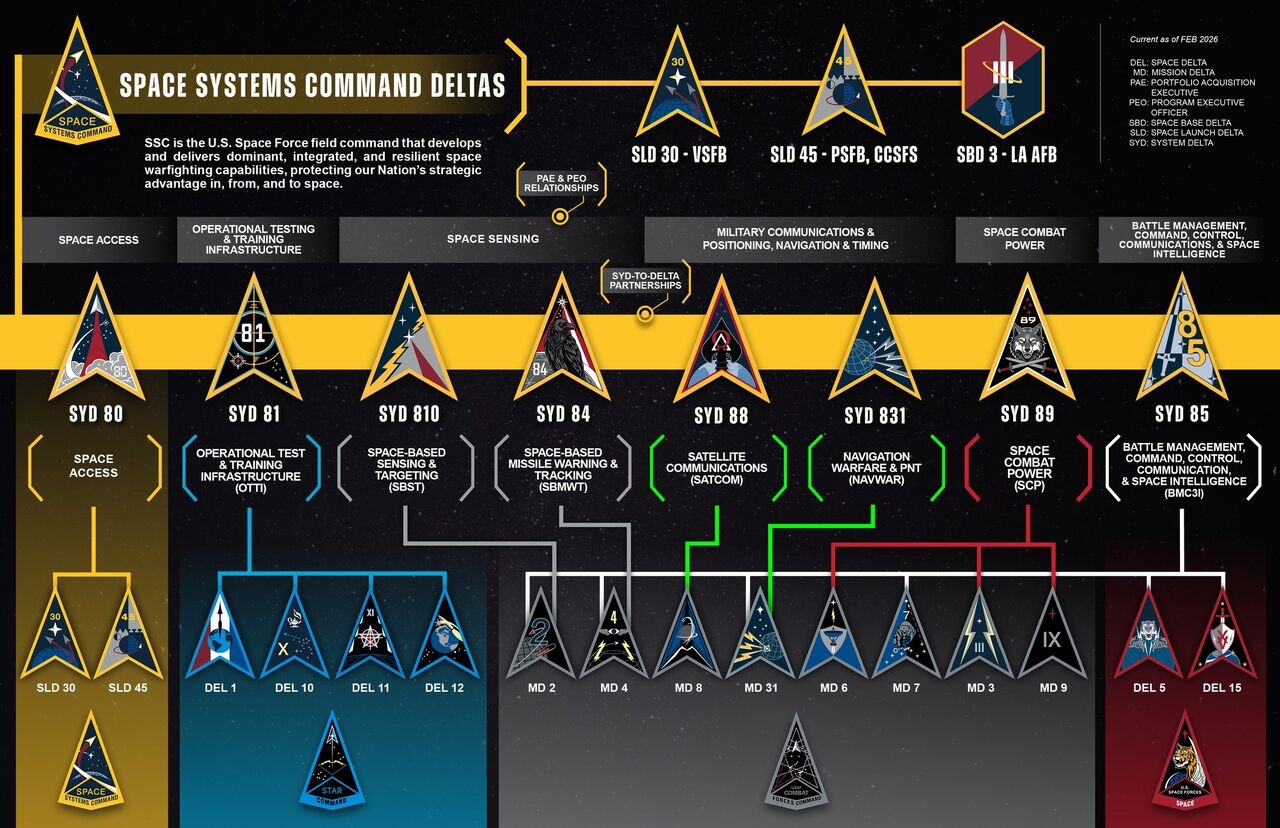
The infographic above presents the Space Systems Command Deltas Infographic as current in February 2026 and captures how Space Systems Command organized its mission-delivery structure at that point. SSC describes itself as the U.S. Space Force field command responsible for acquiring, developing, and delivering resilient space capabilities, and its official site says it manages a $15.6 billion annual space acquisition budget. The structure in the infographic matters because it reflects more than an internal office layout. It shows how SSC linked acquisition, launch, sensing, communications, combat power, and readiness to identifiable operating counterparts in early 2026.
Three layers sit inside that structure. At the top are the launch and installation elements: Space Launch Delta 30, Space Launch Delta 45, and Space Base Delta 3. In the middle are the eight System Deltas that group acquisition work by mission family. At the lower level are the operational and readiness organizations that receive, employ, sustain, test, or train around those capabilities. SSC’s 2026 Command Plan explains the underlying logic: the System Deltas report to the SSC commander and execute their acquisition mission in support of portfolio leaders and program executive officers.
That design sat inside a wider institutional shift. On November 3, 2025, Space Operations Command was redesignated as Combat Forces Command, an official move intended to align the operating command’s name with a combat-ready mission focus. SSC’s command plan describes its own transformation in similar terms, presenting a structure meant to narrow the distance between acquisition and warfighting. Instead of leaving program offices detached from operational communities, the 2026 model paired mission-focused acquisition organizations with the deltas and operating elements most dependent on their output.
The mission-family layout can be summarized as follows.
| SSC Element | Mission Family | Primary Operating Partners Shown or Stated in Official Material |
|---|---|---|
| SYD 80 | Space Access | SLD 30, SLD 45 |
| SYD 81 | Operational Test & Training Infrastructure | DEL 1, DEL 10, DEL 11, DEL 12 |
| SYD 810 | Space-Based Sensing & Targeting | Mission Delta 2 |
| SYD 84 | Missile Warning & Tracking | Mission Delta 4 |
| SYD 88 | Satellite Communications | Mission Delta 8 |
| SYD 831 | Navigation Warfare & PNT | Mission Delta 31 |
| SYD 89 | Space Combat Power | Mission Deltas 3, 6, and 9 |
| SYD 85 | Battle Management, Command, Control, Communications, and Space Intelligence | Mission Deltas 2, 4, 7, and 31, plus Delta 5 and Delta 15 |
That arrangement makes clear that SSC wanted to be understood less as a remote procurement bureaucracy and more as a field command organized around recognizable mission outcomes. Launch, missile warning, satellite communications, navigation warfare, and combat power each sit next to the operating communities that use them. The resulting structure is dense because it blends installation support, acquisition delivery, operational employment, and readiness development inside one command logic.
Space Access Begins With Spaceports and a Host Base
At the left side of the structure, System Delta 80 covers the mission family called Space Access. SSC’s official Assured Access to Space fact sheet describes that enterprise as consisting of the program office, SYD 80, Space Launch Delta 45, and Space Launch Delta 30. In practical terms, that means one layer develops and acquires launch and range capability, and two field units operate the national security spaceports that turn contracts and infrastructure into actual missions.
That same fact sheet says SYD 80 develops and delivers launch systems, range systems, and emerging servicing, mobility, and logistics systems. The operating side is anything but abstract. SSC said Space Launch Delta 45 recorded 109 orbital launches in 2025, and Space Launch Delta 30 oversaw 77 space launch, test, and aeronautical missions that same year. Those numbers show that space access is not a narrow contracting function. It is a living enterprise that joins launch procurement, range modernization, mission assurance, infrastructure, and day-of-launch execution.
Space Base Delta 3 appears smaller than the launch elements, yet its role is structural. Los Angeles Air Force Base is SSC’s home station, and the base delta provides installation and mission support services that keep the command’s acquisition workforce operating. That may sound routine, but acquisition commands depend on secure facilities, network access, workforce support, and specialized mission infrastructure. Without those foundations, the engineering, contracting, integration, and program management work associated with a large field command slows down fast.
Activity in April 2026 showed that this access enterprise remained central to current operations. Space Launch Delta 45 supported the Artemis II launch on April 1, 2026. Vandenberg supported the STP-S29A mission on April 7, 2026, and SSC later announced heavy-launch site development activity tied to Blue Origin at Vandenberg in mid-April. The broader point is straightforward. Access to orbit depends on launch systems, processing capacity, ranges, host-base support, and sustained national investment, all of which SSC grouped under one acquisition family.
The Space Sensing Split Separates Surveillance From Missile Warning
One of the most revealing choices in the 2026 arrangement is the split inside the sensing mission area. System Delta 810 covers space-based sensing and targeting. Its official fact sheet says it is aligned with Mission Delta 2 and handles environmental monitoring and tactical sensing. That sounds modest at first glance, yet the mission set reaches deeply into operational support. SSC says SYD 810 provides global terrestrial cloud forecasting, theater weather imagery, and environmental surveillance data used in planning and execution.
The operating side explains why those functions matter. Mission Delta 2 conducts space domain awareness operations, tracking objects in orbit and helping characterize activity that could affect friendly space operations. When paired with environmental and tactical sensing, that mission becomes broader than simple object cataloging. It feeds planning, warning, characterization, and operational awareness. SSC reinforced that direction in October 2025 when it announced a Phase III contract for dual-use weather and wildfire-related data products, a sign that commercial remote sensing and operational military needs were being tied together inside the same portfolio.
System Delta 84 handles a far more specialized mission family. Its fact sheet states that it develops and delivers persistent missile warning and tracking capability plus nuclear detection systems, aligned with Mission Delta 4. The same SSC material highlights three acquisition priorities that help explain why this organization stands apart: continued development of the Future Operationally Resilient Ground Evolution ground system, replacement of aging Space Based Infrared System satellites with next-generation overhead persistent infrared systems, and resilient medium Earth orbit missile warning and tracking capability for newer threats including hypersonic systems.
Mission Delta 4 operates missile warning, missile tracking, and related ground systems. That mission is distinct from tactical weather and space surveillance because the response timelines are shorter, the strategic consequences are larger, and the architecture depends on tight coordination between satellites, ground processing, warning networks, and national decision systems. By separating SYD 810 and SYD 84, SSC signaled that environmental surveillance and missile warning should not be treated as one generic sensing category. The technical burdens, operational tempo, and national command implications are too different for that.
Communications and Timing Form One Enterprise With Two Delivery Tracks
Military communications and positioning, navigation, and timing sit under a single SSC enterprise, yet the structure divides that enterprise into two delivery tracks: System Delta 88 for satellite communications and System Delta 831 for navigation warfare and PNT. SSC’s Military Communications and Positioning, Navigation, and Timing portfolio says that office delivers resilient commercial and military communications together with integrated positioning, navigation, and timing capability. That parent view makes sense because command and control, strike coordination, synchronization, and distributed operations depend on both communications and reliable timing.
System Delta 88 was activated in October 2025 and aligned with Mission Delta 8. SSC described the move as an effort to synchronize acquisition with the satellite communications operating community. That organizational logic showed immediate operational value. In March 2026, SSC and Combat Forces Command announced operational acceptance of Enhanced Polar System Recapitalization, a secure Arctic satellite communications capability acquired through SSC and operated by Mission Delta 8. The same period also brought formal training integration between acquisition personnel and the delta operating the systems they deliver.
System Delta 831 was also activated in October 2025 and tasked with delivering navigation warfare and positioning, navigation, and timing capability. SSC said the delta brought together program management, engineering, intelligence, logistics, contracting, and finance under a single organization focused on PNT. On the operating side, Mission Delta 31 provides, operates, and sustains PNT and satellite control missions. Its official fact sheet says the unit was designated in October 2024, absorbed the Satellite Control Network mission in February 2025, and later added cyber capability to defend those functions.
That pairing matters because GPS modernization is no longer treated as a stand-alone spacecraft replacement effort. In January 2026, a Falcon 9 launched GPS III SV09 from Cape Canaveral as part of the wider modernization path, and SSC’s broader PNT portfolio continues to tie space vehicles, user equipment, anti-jam upgrades, navigation warfare, satellite control, and cyber defense into one mission family. That framing better reflects operational reality. Timing signals, user receivers, on-orbit satellites, and network defense all affect whether PNT capability survives in a contested environment.
Combat Power and Battle Management Sit at the Sharp End
On the right side of the 2026 arrangement, System Delta 89 supports the Space Combat Power portfolio. SSC’s official fact sheet says SYD 89 develops, delivers, and sustains cyber, ground-based, and space-based combat power capabilities to contest and control the space domain through fires, movement, and maneuver. That wording matters because it shows the acquisition side treating combat power as a broad mission area rather than as a narrow hardware category. The same sheet says SYD 89 works with Mission Delta 3, Mission Delta 6, and Mission Delta 9.
Those operating deltas define the breadth of the mission family. Mission Delta 3 provides combat-ready electromagnetic warfare forces. Mission Delta 6 generates cyberspace warfare forces that defend space systems through the cyber domain. Mission Delta 9 generates orbital warfare forces for on-orbit military operations. Put together, those partnerships show that space combat power includes electronic attack, cyber operations, and orbital maneuver and defense, not simply one family of weapons or one orbital layer.
Beside SYD 89 sits System Delta 85, which handles battle management, command, control, communications, and space intelligence. SSC’s BMC3I portfolio says that office advances operational and tactical capability in the space domain and leads modernization and sustainment of the Satellite Control Network. The official fact sheet links SYD 85 to Mission Deltas 2, 4, 7, and 31, plus Delta 5 and Delta 15. That spread shows the mission family acting as connective tissue across surveillance, warning, intelligence, command and control, and satellite operations.
Delta 5 provides operational-level command and control of space forces. Delta 15 was established to provide command-and-control support, intelligence support, cyber mission defense support, and related support to the National Space Defense Center. That explains why battle management sits beside combat power in SSC’s structure. Sensors, communications links, command systems, and intelligence pipelines only matter if they help commanders understand the battlespace and direct forces at operational speed.
The resulting mission pairings can be summarized this way.
| System Delta | Primary Capability Delivered | Operational Side Paired in Official Sources |
|---|---|---|
| SYD 80 | Launch, range, and space access systems | SLD 30 and SLD 45 |
| SYD 81 | Test, training, and readiness infrastructure | DEL 1, DEL 10, DEL 11, and DEL 12 |
| SYD 810 | Environmental monitoring and tactical sensing | Mission Delta 2 |
| SYD 84 | Missile warning, tracking, and nuclear detection | Mission Delta 4 |
| SYD 88 | Military satellite communications capability | Mission Delta 8 |
| SYD 831 | GPS, PNT, and navigation warfare capability | Mission Delta 31 |
| SYD 89 | Counterspace and orbital combat power | Mission Deltas 3, 6, and 9 |
| SYD 85 | Battle management, C2, communications, and intelligence systems | Mission Deltas 2, 4, 7, and 31, plus Delta 5 and Delta 15 |
This pairing model shows a service architecture built around mission effects rather than around separate tribes of buyers, operators, and sustainers. The seams still exist. The structure is trying to make them matter less.
Test, Training, and Evaluation Appear as Acquisition Requirements
System Delta 81 may be easy to overlook beside launch and combat power, yet it reveals a great deal about how SSC thought about force design in 2026. The official Operational Test and Training Infrastructure fact sheet says OTTI and SYD 81 synchronize the acquisition, development, and sustainment of integrated test and training capability for the Space Force. That is an important organizational statement. It treats readiness infrastructure as capability that must be fielded, not as an afterthought that follows hardware procurement.
The same fact sheet describes a distributed enterprise of systems that sustain combat readiness across the spectrum of conflict, with emphasis on live, virtual, and constructive environments and on the HEAT3 initiative for high-end advanced test, training, and tactics development. That means spending on ranges, threat replication, digital environments, secure networks, synthetic battlespaces, and evaluation tools. Those elements are especially important for a service that depends heavily on software, remote links, classified mission data, and distributed command structures.
The lower operating partners explain who benefits from that infrastructure. Space Delta 1 manages training and education functions. Space Delta 10 handles doctrine, wargaming, experimentation, and lessons learned. Space Delta 11 provides range and aggressor support. Space Delta 12 leads integrated test and evaluation. Read together, those units show that SSC’s readiness logic reaches far beyond classroom training. It covers doctrine development, force experimentation, test realism, threat representation, and the validation of combat-credible systems and tactics.
That approach makes sense for a force expected to operate in contested orbital and networked environments. Missile warning crews, orbital warfare units, cyberspace defenders, and satellite communications operators all need representative mission environments before they enter real-world operations. By making OTTI an acquisition-aligned delta, SSC effectively treated readiness infrastructure as part of the delivered force design. That is a revealing choice because it suggests the service wanted training realism, experimentation, and evaluation built in at the beginning rather than bolted on later.
The Structure Shows a Service Trying To Shorten the Distance Between Buying and Fighting
SSC first began testing the system delta concept in late 2023 and expanded it through 2025. The SSC Command Plan states that the command had stood up eight new System Deltas as part of its modernization effort. Around the same time, the operating side of the Space Force was being recast around combat readiness through the redesignation of Combat Forces Command. Those changes pointed in the same direction. Acquisition was being organized around mission families, and operations were being organized around combat employment and sustainment.
The wager behind that model is easy to understand. A mission-focused acquisition delta should have tighter contact with operators, a better sense of actual operational friction points, and a clearer basis for setting priorities. A launch enterprise organized this way can connect range modernization, launch service procurement, processing capacity, and operational cadence. A missile warning enterprise can connect satellites, ground systems, sensor integration, and warning timelines. A PNT enterprise can connect GPS spacecraft, user equipment, anti-jam protection, satellite control, and cyber defense. Each of those links is easier to sustain when the structure is built around mission outcomes instead of narrower bureaucratic categories.
That does not mean the friction is gone. Battle management crosses surveillance, communications, intelligence, and command and control all at once. Navigation warfare overlaps with cyber defense and satellite control. Space combat power depends on electronic warfare, cyber effects, orbital maneuver, software, and increasingly on proliferated data and sensor layers. Reorganization can reduce delay and misunderstanding, but it can also generate new boundaries if budgets, authorities, sustainment lines, and software responsibilities drift out of alignment. That is the most important caution built into the model.
April 2026 activity suggested that the structure was being tested under real operational pressure rather than preserved as a static organizational theory. Artemis II, STP-S29A, EPS-R operational acceptance, and continuing space domain awareness acquisition activity all pointed to active mission lines inside the same framework. The structure was not describing an aspiration detached from events. It was organizing work that was underway.
Summary
The February 2026 SSC delta structure shows a command that wants to be understood through mission families rather than through isolated program offices. Space access is tied to the two national security spaceports. Space sensing is divided between environmental and tactical surveillance on one side and missile warning and nuclear detection on the other. Communications and timing stay inside one enterprise, yet flow through separate deltas aligned to distinct operating missions. Space combat power and battle management sit closest to force employment because they govern effects, command systems, and operational decision-making. Test, training, and evaluation are included because readiness in a space service depends on infrastructure that must be acquired and sustained like any other mission input.
The most important point is the logic binding the elements together. SSC’s model links acquisition decisions, capability delivery, operational employment, sustainment, and feedback more tightly than older arrangements did. That does not remove complexity, and it does not guarantee speed or coherence in every program. It does show a Space Force acquisition command trying to behave more like part of a warfighting system and less like a distant procurement headquarters.
Appendix: Useful Books Available on Amazon
- Spacepower: Doctrine for Space Forces
- Understanding Space Strategy
- Space Warfare in the 21st Century
- Security and Stability in the New Space Age
- War in Space
- Space Strategy in the 21st Century
Appendix: Top Questions Answered in This Article
What is a System Delta?
A System Delta is a mission-focused acquisition unit inside Space Systems Command responsible for developing and delivering capability inside a defined mission family. SSC’s 2026 Command Plan says these deltas report to the SSC commander and execute their acquisition mission in support of portfolio and program leadership.
How many top-level deltas appear in the February 2026 structure?
The structure shows eight System Deltas, two Space Launch Deltas, and one Space Base Delta. SSC’s official About Us page and its 2026 Command Plan align with that count.
Why are Space Launch Delta 30 and Space Launch Delta 45 separate from System Delta 80?
System Delta 80 develops and delivers launch, range, and related access capability, but Space Launch Delta 30 and Space Launch Delta 45 operate the actual launch ranges and spaceports. The enterprise is linked, but delivery and field execution remain distinct functions.
Why is space sensing divided between SYD 810 and SYD 84?
SYD 810 handles environmental monitoring and tactical sensing aligned with Mission Delta 2. SYD 84 develops missile warning, missile tracking, and nuclear detection capability aligned with Mission Delta 4, which is a different operational and technical problem.
How does satellite communications fit into the organization?
Satellite communications sits inside SSC’s MilComm and PNT portfolio and flows through System Delta 88 to Mission Delta 8. The EPS-R operational acceptance announcement in March 2026 showed that relationship operating in practice.
What does the structure say about GPS and navigation warfare?
The arrangement treats GPS, broader positioning, navigation, and timing, and navigation warfare as one connected mission set. System Delta 831 handles acquisition, and Mission Delta 31 operates and sustains the mission on the field side.
What role does Space Base Delta 3 play inside SSC?
Space Base Delta 3 operates Los Angeles Air Force Base, the home of SSC, and provides installation support that keeps the command functioning. That includes the facilities, services, and infrastructure needed by the acquisition workforce.
Why is System Delta 89 paired with more than one operational delta?
System Delta 89 supports a mission family that spans electromagnetic warfare, cyberspace warfare, and orbital warfare. One acquisition family therefore supports several operating communities.
Why are training and test organizations grouped with acquisition deltas?
SSC’s OTTI fact sheet treats test and training infrastructure as capability that must be acquired, integrated, and sustained. That is why SYD 81 is paired with readiness organizations such as Space Delta 10, Space Delta 11, and Space Delta 12.
What changed from earlier Space Force arrangements?
SSC began experimenting with the system delta concept in 2023 and expanded it through 2025, as reflected in the 2026 Command Plan. On the operating side, Combat Forces Command replaced Space Operations Command in November 2025, reinforcing the shift toward mission-focused, combat-oriented alignment between acquisition and operations.
Appendix: Glossary of Key Terms
System Delta
Within SSC, this is a mission-focused acquisition organization responsible for developing and delivering capability inside a defined mission family. The concept is intended to keep acquisition teams closely tied to the operators and sustainers who depend on the systems after fielding.
Mission Delta
On the operating side of the Space Force, this refers to a mission-centered unit responsible for generating, employing, sustaining, and improving forces in a defined operational area. The term reflects an effort to put readiness, operations, sustainment, and people inside one mission construct.
Space Domain Awareness
This term refers to identifying, tracking, characterizing, and understanding objects, activity, and conditions in space that could affect operations. It includes object tracking, attribution work, environmental awareness, and support to decision-making tied to security and safe spaceflight.
Overhead Persistent Infrared
This describes space-based sensing used to detect heat signatures associated with missile launches and related events of military importance. In the structure discussed here, it sits at the center of the missile warning and tracking mission family.
Navigation Warfare
This means protecting friendly PNT capability, strengthening its resilience, and reducing an adversary’s ability to interfere with or exploit it. In operational terms, it connects GPS modernization, anti-jam systems, satellite control, and mission use in contested conditions.
Operational Test and Training Infrastructure
This describes the ranges, networks, digital environments, models, trainers, and related systems needed to test capability realistically and train forces for combat use. The term signals that readiness support systems are treated as mission equipment rather than optional overhead.
Battle Management, Command, Control, Communications, and Space Intelligence
This mission family covers the systems, software, data, and intelligence functions used to understand the battlespace and direct forces. In practice, it links warning, surveillance, command systems, communications paths, and decision support across multiple operational communities.
