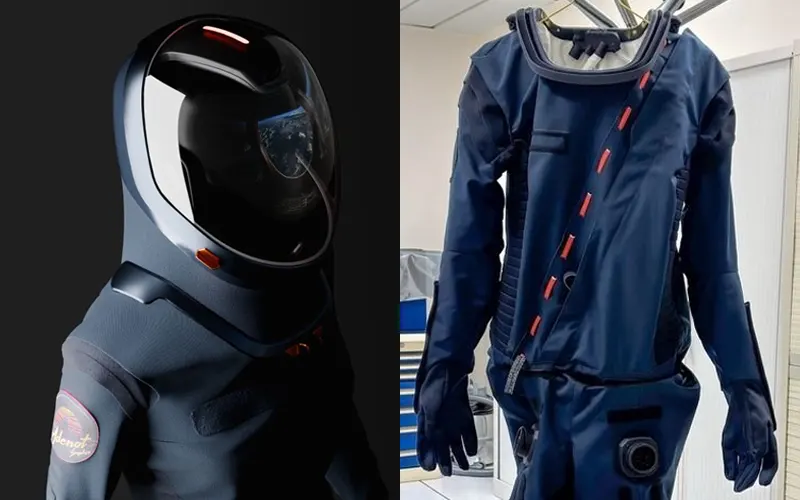
The European Space Agency (ESA) is advancing human spaceflight capabilities through collaborative efforts focused on crewed operations aboard the International Space Station (ISS). A notable development in this area is the recent arrival of a French-developed intra-vehicular activity (IVA) spacesuit prototype at the orbiting laboratory. This prototype forms part of a CNES-led initiative aligned with ESA’s human exploration objectives, marking progress toward enhanced European self-reliance in essential life-support technologies for future missions.
ESA astronaut Sophie Adenot will perform in-orbit evaluations of the suit in microgravity. As the first member of ESA’s 2022 astronaut class assigned to a long-duration ISS mission, her participation integrates these tests with broader European experiments addressing crew health, operational autonomy, and adaptation to weightlessness.
The prototype was delivered as cargo via a commercial resupply spacecraft and docked with the ISS for dedicated validation as an experimental payload, separate from standard crew personal equipment.
Development and Design of the Prototype
The IVA suit prototype originated from a CNES initiative under the Spaceship FR programme, launched to cultivate European expertise in human spaceflight systems for missions extending beyond low Earth orbit. A consortium led by Spartan Space as prime contractor, in partnership with the Institute of Space Medicine and Physiology (MEDES) and Decathlon, was responsible for the design and development.
IVA suits are intended for use inside pressurized spacecraft and habitats, offering protection during launch, re-entry, and normal station activities while emphasizing comfort, mobility, and ease of use. Conventional IVA suits often require several minutes for donning and doffing, which can be limiting in urgent situations. The prototype incorporates ergonomic advancements that allow a single crewmember to put on or remove the suit unaided in under two minutes.
Design priorities include improved mobility for precise tasks, such as manipulating small objects and operating touchscreen interfaces used for station systems and scientific payloads. MEDES-developed monitoring systems will gather real-time data on suit performance, astronaut biomechanics, and comfort levels during microgravity exposure.
Testing Objectives and Broader Implications
Testing aboard the ISS will involve structured protocols to evaluate the prototype’s ergonomics. These include repeated donning and doffing procedures, object-handling drills, and interactions with onboard touchscreen controls while wearing the suit. Results from these microgravity assessments will complement ground-based preparations and supply essential feedback for design refinements.
CNES oversees the in-orbit testing phase in coordination with ESA’s human and robotic exploration programmes. Data collected will support iterative improvements to the prototype and subsequent qualification activities. The long-term aim is to certify a fully operational European IVA suit for ESA astronauts, strengthening independent capabilities in crewed spaceflight.
This effort supports ESA’s strategic goals for sustainable human presence in space. As Europe advances preparations for lunar and Martian exploration, sovereign access to reliable IVA systems is fundamental for crew safety during transit and surface operations. The prototype contributes to this foundation by demonstrating innovative European industry solutions that reduce dependency on external providers while promoting technological sovereignty.
The successful delivery of the prototype to the ISS enables critical microgravity validation, yielding insights that will enhance crew performance and safety standards. These evaluations represent a practical demonstration of Europe’s expanding role in human spaceflight hardware development. As analysis of the test results progresses, they will guide enhancements to future systems, equipping ESA astronauts with optimized equipment tailored to the demands of current ISS operations and forthcoming deep-space endeavours. This project exemplifies Europe’s methodical approach to building comprehensive autonomy in crewed exploration technologies.