
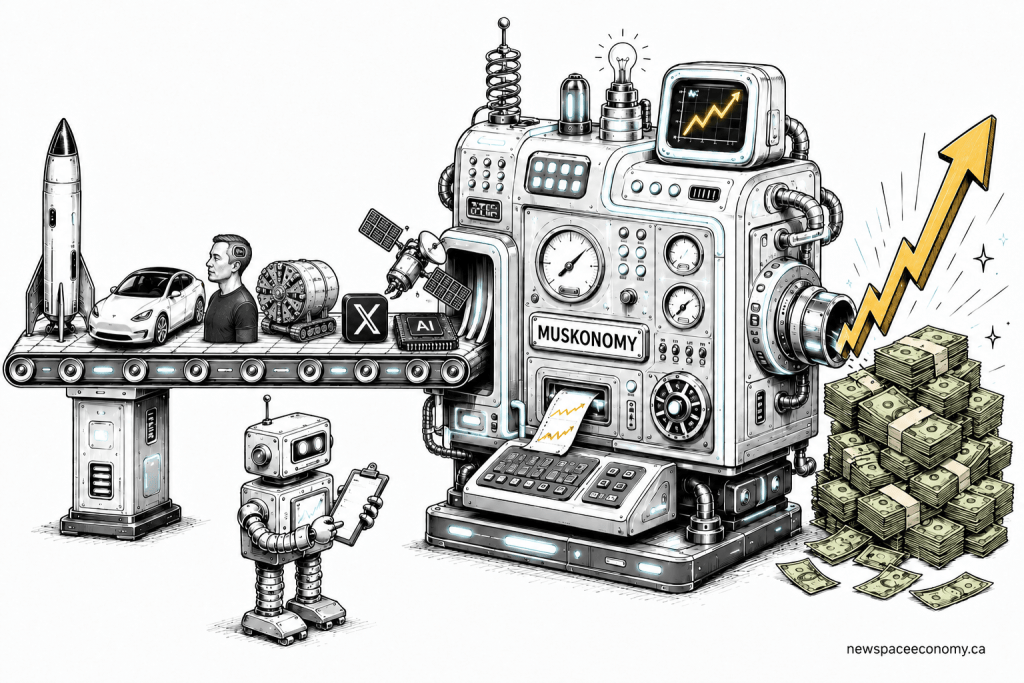
What Is The Muskonomy?
Muskonomy is an informal term for the business ecosystem built around Elon Musk, his companies, investors, technologies, customers, talent networks, data flows, infrastructure, and financing relationships. It is not a formal economic term. It is mostly used in media, investor commentary, and technology analysis to describe how Musk-linked ventures can reinforce one another across separate but overlapping markets.
It began as a loose description of cross-company influence around Musk’s ventures. It became visible in 2024 as an investor story around xAI. It became more concrete in 2025 when xAI acquired X. It became more structurally important in 2026 when SpaceX acquired xAI, turning artificial intelligence, social media distribution, compute infrastructure, and possible orbital data centers into a more direct part of the SpaceX-centered industrial system.
The Pre-2024 Foundation: Separate Companies With Overlapping Advantages
Before the word “Muskonomy” became visible in investor commentary, the underlying idea already existed. Musk’s companies operated in different industries but often shared a common pattern: large engineering teams, ambitious capital projects, strong brand attention, high-risk product timelines, and a tendency to connect one company’s capabilities with another company’s needs.
Tesla provided electric vehicles, batteries, manufacturing systems, robotics, autonomy software, AI training needs, and real-world machine data. SpaceX provided launch capability, spacecraft manufacturing, reusable rocket operations, and a growing satellite communications business through Starlink. Neuralink worked on brain-computer interface technology. The Boring Company developed tunneling and transportation infrastructure. X provided a social media platform with real-time public conversation and distribution.
In that early sense, the Muskonomy was less a formal corporate structure than a pattern of adjacency. Musk-linked ventures could create reputational benefits for one another, attract overlapping investor interest, compete for similar technical talent, and share a narrative of rapid engineering deployment. The companies were not the same business, but they were increasingly interpreted as parts of a larger economic and technological system.
The 2024 Comment: xAI As A Way To Buy Into The Musk Ecosystem
The 2024 comment about the “Muskonomy” came from investor-focused reporting about xAI, Musk’s artificial intelligence company. In May 2024, Axios reported that investing in xAI was being framed as an opportunity to participate in the broader Musk-linked ecosystem rather than only a standalone AI startup.
The important point was that xAI was not being presented simply as another company trying to build a chatbot. The pitch was that xAI could benefit from relationships across Musk’s other ventures. X could provide distribution and real-time user content. Tesla could provide experience in real-world AI, autonomy, robotics, and machine vision. Neuralink could add another frontier-technology association. SpaceX could contribute the broader engineering and infrastructure aura around Musk-led companies.
That is what the 2024 comment meant. It was an investor narrative. It suggested that xAI’s value might come not only from its own AI models, but also from being positioned inside a wider Musk-linked network of data, products, users, engineers, capital, and public attention. In 2024, the Muskonomy was mostly a story about adjacency and optionality: xAI might become more valuable because it could draw on the wider Musk business universe.
2025: xAI Acquired X And Made The Muskonomy More Concrete
The Muskonomy became more concrete on March 28, 2025, when xAI acquired X in an all-stock transaction. The deal valued xAI at $80 billion and X at $33 billion, based on Musk’s stated figures that X was valued at $45 billion less $12 billion in debt.
This was an important change because it moved one major part of the Muskonomy from loose association to formal consolidation. Before the deal, xAI and X were closely connected but still separate. After the deal, xAI had a more direct relationship with X’s platform, users, distribution channel, and data environment.
The logic was clear. Artificial intelligence companies need compute, talent, data, product access, and distribution. X could support xAI by giving Grok a built-in consumer platform and a real-time conversation environment. xAI could support X by adding AI features, content tools, search functions, and platform intelligence. The 2025 transaction turned the 2024 investor story into a more operational business structure.
2026: SpaceX Acquired xAI
The largest change came on February 2, 2026, when xAI announced that SpaceX had acquired xAI. This changed the meaning of the Muskonomy again. After that transaction, xAI was no longer best understood as a separate AI company with informal links to SpaceX. It became part of the SpaceX-centered business architecture.
That matters because SpaceX is not only a rocket company. It operates launch systems, spacecraft manufacturing, Starlink satellite broadband, ground infrastructure, customer terminals, orbital operations, and space-related engineering capabilities. By adding xAI, SpaceX moved closer to a combined structure that links physical space infrastructure with artificial intelligence infrastructure.
As of May 2026, the Muskonomy is no longer only about brand spillover or investor enthusiasm. It is also about the possible integration of launch, satellites, broadband, AI compute, AI software, social media distribution, data, and orbital infrastructure.
May 2026: SpaceXAI And The Compute Infrastructure Shift
By May 2026, xAI’s public communications were increasingly using the name SpaceXAI in relation to AI infrastructure and partnerships. On May 6, 2026, xAI announced that SpaceXAI had signed an agreement with Anthropic to provide access to Colossus 1, its large AI supercomputer.
That agreement showed how the Muskonomy had moved beyond consumer AI products. The relevant issue was no longer only Grok, X, or chatbot distribution. The more important strategic layer was compute infrastructure. AI companies need large-scale computing capacity for model training, fine-tuning, inference, coding tools, multimodal systems, and enterprise services. A Musk-linked AI infrastructure business can therefore become a supplier to other AI companies, including competitors or partial rivals.
The same announcement said Anthropic had expressed interest in partnering on multiple gigawatts of orbital AI compute capacity. This was important because it connected xAI’s compute ambitions directly to SpaceX’s space infrastructure capabilities. The idea of orbital compute is still an emerging and technically difficult concept, but it fits the newer version of the Muskonomy: artificial intelligence demand could create new markets for launch, power, satellite platforms, optical links, orbital operations, and space-based data center architectures.
SpaceX’s Changing Role In The Muskonomy
SpaceX was already the strongest industrial anchor in the Muskonomy because it controlled the launch and satellite communications assets. After the xAI acquisition, its role expanded. SpaceX became the company through which Musk’s space, connectivity, and AI infrastructure ambitions could be linked more directly.
Starlink remains an important part of this structure because it provides satellite broadband and a global customer-facing communications network. SpaceX launch systems provide access to orbit. SpaceX satellite manufacturing and operations provide practical experience in deploying and managing large spacecraft networks. xAI and SpaceXAI add AI models, compute demand, enterprise software, and possible future orbital compute concepts.
This makes SpaceX the center of gravity for the 2026 Muskonomy. Tesla remains important, especially for electric vehicles, batteries, autonomy, robotics, manufacturing, and real-world AI. X remains important as a distribution and data platform. Neuralink and The Boring Company remain part of the broader frontier-technology portfolio. But SpaceX now sits at the intersection of launch, satellites, broadband, AI infrastructure, and potential orbital data centers.
The New Time-Linear Meaning Of The Muskonomy
The meaning of the Muskonomy has changed over time.
In the pre-2024 period, it described an informal ecosystem of companies associated with Musk. The logic was based on shared leadership, shared public attention, overlapping engineering culture, and the belief that success in one venture could strengthen confidence in another.
In 2024, the term became more visible as part of the xAI investment story. The argument was that xAI could benefit from Musk’s wider business network, especially X’s real-time user platform and Tesla’s AI-related experience.
In 2025, the idea became more concrete when xAI acquired X. That transaction moved data, models, compute, distribution, and talent into a more unified AI-and-social-media structure.
In 2026, SpaceX’s acquisition of xAI changed the center of the system. The Muskonomy became less a loose set of Musk-linked ventures and more a SpaceX-centered industrial, digital, and AI infrastructure ecosystem.
Why The Muskonomy Matters
The Muskonomy matters because it combines businesses that operate in some of the largest and most capital-intensive technology markets: launch services, satellite broadband, electric vehicles, batteries, robotics, artificial intelligence, social media, brain-computer interfaces, tunneling, and possible orbital computing.
Supporters see this as a vertically integrated innovation system. SpaceX can provide launch capability, satellite systems, Starlink connectivity, orbital engineering, and capital-project execution. xAI can provide AI models, AI products, compute infrastructure, and enterprise services. X can provide social distribution, user interaction, product feedback, and real-time information flows. Tesla can provide manufacturing scale, robotics, autonomy, chips, batteries, and real-world AI experience.
Critics see important risks. The tighter structure raises questions about governance, related-party transactions, valuation, capital allocation, debt, shareholder protections, regulatory review, market concentration, platform influence, and the blending of public-facing communications systems with private industrial infrastructure. The 2026 SpaceX-xAI transaction made those issues more significant because it moved the Muskonomy from informal influence toward formal consolidation.
A Simple Definition
The Muskonomy is the informal name for the SpaceX-centered economic, technological, and financial ecosystem surrounding Elon Musk’s companies, where rockets, satellites, Starlink connectivity, artificial intelligence, social media distribution, compute infrastructure, electric vehicles, robotics, and frontier engineering increasingly support one another under a more consolidated business structure.
