This is not investment advice.
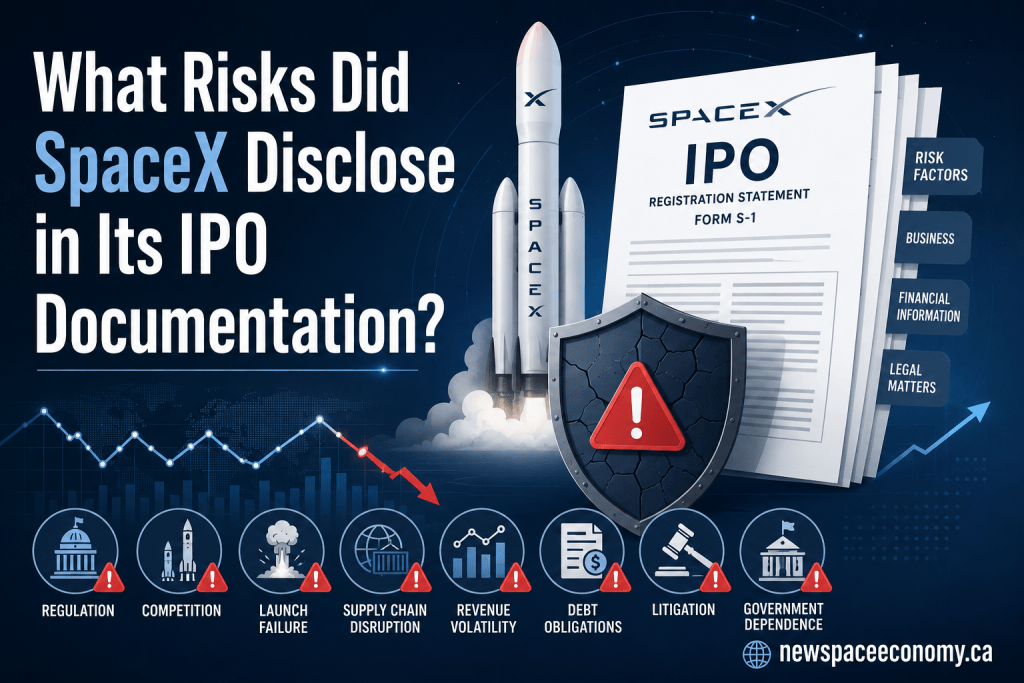
- Key Takeaways
- SpaceX IPO Risks Begin With a Three-Business Company
- Starship Concentrates the Engineering and Capital Risk
- Starlink Carries the Most Proven Business and Its Own Market Risks
- AI Ambitions Create the Largest Valuation Gap
- Government, Geopolitics, and Regulation Are Revenue Sources and Risk Sources
- Governance Risk Is Built Into the Share Structure
- Financial, Dilution, and Trading Risks Matter After the Debut
- Competition and Execution Risk Extend Beyond Launch
- Commentary From Outside the Filing Adds Four Checks
- How Investors Can Read the Disclosures Without Treating Them as Boilerplate
- Summary
- Appendix: Useful Books Available on Amazon
- Appendix: Top Questions Answered in This Article
- Appendix: Glossary of Key Terms
Key Takeaways
- SpaceX IPO risks center on Starship, Starlink, AI spending, regulation, and Musk control.
- The filing ties high growth to capital-heavy businesses with uneven profitability.
- Public buyers face dilution, lockup, governance, and valuation risks from day one.
SpaceX IPO Risks Begin With a Three-Business Company
SpaceX reported $18.674 billion in 2025 revenue, $21.263 billion in total costs and expenses, a $2.589 billion operating loss, and a $4.937 billion net loss in the prospectus materials issued for its 2026 public offering. That financial profile sits behind the central issue for investors reviewing SpaceX IPO risks: the company being sold to public markets is no longer a launch company with a satellite broadband division attached. It is a combined space, connectivity, and artificial intelligence business whose capital needs differ by segment and whose valuation depends on assumptions that do not all carry the same evidence base.
The SpaceX prospectus organizes the company around three operating stories. The Space segment includes Falcon 9, Falcon Heavy, spacecraft, Starship, launch services, government missions, and mission operations. The Connectivity segment centers on Starlink broadband, Starlink Mobile, enterprise services, and government connectivity. The AI segment includes xAI, Grok, X, terrestrial data centers, and proposed orbital compute infrastructure. Each segment carries a different risk profile, and combining them inside one issuer makes the investment case more complex than a simple bet on reusable rockets.
The public offering also arrived with large numbers attached. The SEC free-writing prospectus described related IPO materials, international offering documents, an IPO website, and roadshow content. The offering materials pointed to a U.S. expected offering price of $135 per Class A share, an option for underwriters to purchase up to 83,333,333 additional shares, and listing plans under the ticker SPCX. Those mechanics matter because investors were buying into a company where public float, lockup timing, overallotment activity, and share-class control could shape the trading price apart from operating performance.
The risk section in the European prospectus gives a useful map of what SpaceX considered material. It separates risk factors into Space, Connectivity, AI, legal and regulatory matters, corporate structure and ownership, operations and industry, and other risks. That structure signals that SpaceX sees its future as an interdependent system. Starship supports Starlink growth and future orbital compute. Starlink cash flow supports capital spending. AI ambitions support the valuation story but raise power, chip, water, content, legal, and competitive exposure. Government work supports revenue but adds procurement, security, export-control, and policy risks.
The table organizes the main risk categories disclosed in the prospectus materials.
| Risk Category | Core Issue | Investor Question |
|---|---|---|
| Space Segment | Launch reliability, Starship execution, customer concentration | Can SpaceX keep cadence, safety, and margins rising? |
| Connectivity Segment | Starlink growth, ARPU pressure, spectrum approvals | Will subscriber growth convert into cash flow? |
| AI Segment | Compute supply, model competition, legal exposure | Can AI justify its share of valuation? |
| Legal And Regulation | FAA, FCC, export controls, security rules | Can approvals keep pace with expansion? |
| Corporate Structure | Dual-class voting and Musk control | What rights do public holders have? |
It is important to note that not that all risks are equally likely. IPO documents list risks that may never materialize, and legal disclosure often uses broad language. The better test is linkage. A risk deserves more weight when it affects more than one segment, more than one timeline, or more than one path to valuation. Starship risk fits that test because it affects launch economics, Starlink satellite deployment, lunar missions, national-security services, and orbital AI compute. Governance risk also fits because it affects capital allocation, related-party activity, board accountability, and the ability of outside investors to influence strategy.
New Space Economy’s earlier coverage of SpaceX IPO valuation framed the public listing as a test of how markets price a company whose proven operations and speculative ambitions sit under one ticker. That framing is useful for risk review. Falcon and Starlink have operational evidence. Starship has test progress and high development risk. AI and orbital compute have larger market claims but less operating proof inside SpaceX’s public-company record.
Starship Concentrates the Engineering and Capital Risk
Starship is the largest technical dependency in the filing because SpaceX’s future story assumes a heavy-lift, fully reusable transportation system that can do more than launch payloads at a lower marginal cost. The prospectus describes Starship V3 as designed to carry 100 metric tons to space in a fully reusable configuration, with later versions potentially reaching 200 metric tons. It also ties Starship to Starlink V3 satellites, mobile services, orbital AI compute satellites, lunar missions, space station modules, tourism concepts, and future Mars plans.
That breadth creates a concentration problem. Falcon 9 lowered launch costs, built customer trust, and gave SpaceX a dominant position in U.S. orbital launch. Starship must do something different. It must carry heavier payloads, fly at much higher cadence, demonstrate upper-stage reentry and reuse, support orbital refueling, satisfy regulators, and operate economically enough to change the cost base of multiple SpaceX businesses. The company can remain a valuable launch and connectivity business without Starship reaching its most ambitious end state, but the IPO valuation becomes harder to defend if Starship does not deliver the throughput and cost reductions embedded in the growth story.
The filing’s launch-risk language covers mission failures, anomalies, loss of payloads, damage to launch vehicles, debris, environmental damage, suboptimal orbital placement, and regulatory delays after accidents. That disclosure is not abstract. Starship testing has already shown that development proceeds through hardware failures, flight pauses, range reviews, environmental scrutiny, and design changes. The risk for public investors is timing, not simply whether SpaceX can solve hard engineering problems. A vehicle that works five years later than expected may still be an engineering success, yet it can be a poor match for an IPO valuation that prices near-term scale.
SpaceX’s own business model raises the stakes. Starship is meant to lower internal deployment costs for Starlink and future compute satellites. That means SpaceX is both supplier and customer. A Starship delay can raise the cost of growing Starlink, slow mobile expansion, delay new satellites, and keep orbital compute in concept status. It can also push SpaceX to rely longer on Falcon 9, a highly capable rocket that may lack the mass, volume, and cost profile needed for the company’s most aggressive plans.
New Space Economy’s discussion of whether China is right to doubt Starship captured this tension. Skepticism about Starship does not require dismissing SpaceX’s record. It requires separating Falcon 9’s proven cadence from Starship’s still-developing architecture. A reusable booster catch is one milestone. Reliable upper-stage reuse, tanker operations, payload integration, rapid refurbishment, and repeated commercial service are separate milestones.
Government launch customers add another layer. The prospectus says SpaceX was the primary launch provider for the U.S. government and reported that about one-fifth of 2025 revenue came from U.S. federal agencies. Government customers care about schedule reliability, security, mission assurance, and procurement compliance. If SpaceX prioritizes its own Starlink or compute payloads over additional government or third-party missions, as the risk language contemplates, it could affect revenue growth, customer relationships, regulator perception, or litigation exposure.
SpaceX’s launch advantage remains real. Falcon 9, Falcon Heavy, Dragon, and Starlink deployment capacity give the company a vertical structure few competitors can match. New Space Economy’s global launch services market analysis shows why that matters. The launch market is not purely about rocket performance. It depends on price, schedule certainty, mission class, insurance, customer trust, government procurement, and available capacity. A launch provider can dominate one part of the market and still face limits in others.
For investors, Starship risk should be read as a portfolio of linked uncertainties: technical maturity, launch licensing, pad infrastructure, production rate, engine reliability, reuse economics, customer scheduling, and capital intensity. SpaceX has repeatedly turned difficult engineering into operating advantage. The filing asks public investors to pay for the next instance before that proof is complete.
Starlink Carries the Most Proven Business and Its Own Market Risks
Starlink is the strongest operating asset in the SpaceX IPO story. The prospectus materials said SpaceX operated about 9,600 Starlink broadband and mobile satellites in low Earth orbit and identified Connectivity as the business that includes consumer broadband, enterprise solutions, government services, and Starlink Mobile. New Space Economy’s Starlink market analysis described Starlink as a communications network, a launch-demand engine, a defense asset, a regulatory flashpoint, and a financing platform for SpaceX’s wider ambitions.
The 2025 segment figures reported by financial media show why investors paid close attention. SatelliteToday reported that SpaceX generated $18.7 billion in total 2025 revenue and that Starlink was the largest revenue driver. Yahoo Finance reported that the Connectivity segment generated $11.387 billion in 2025 revenue, $4.423 billion in income from operations, and $7.168 billion in adjusted earnings before interest, taxes, depreciation, and amortization. Those numbers make Starlink the clearest answer to the question of where SpaceX has already built a large commercial machine.
Growth does not eliminate risk. The most immediate Starlink issue is average revenue per user, often abbreviated as ARPU. ARPU measures service revenue divided by the average number of subscribers during a period. A business can add subscribers and still face margin pressure if each added user produces less revenue, uses more network capacity, or requires higher customer acquisition spending. Consumer broadband, maritime service, aviation connectivity, defense connectivity, direct-to-device messaging, and enterprise links each carry different pricing power.
Regulation shapes Starlink’s mobile future. The prospectus describes Starlink Gen1 mobile service as fully licensed in the United States and as needing country-by-country approvals internationally. It also says SpaceX signed mobile network operator partnerships for Gen1 service in about 30 countries and obtained required approvals in the United States, Canada, the United Kingdom, Japan, Australia, and several additional countries. For Gen2, the filing connects service to EchoStar spectrum assets, FCC approvals, country-level licensing, and satellite deployment. That means mobile Starlink revenue is linked to regulators, handset compatibility, carrier agreements, and spectrum coordination.
The EchoStar spectrum transaction adds strategic upside and execution risk. More spectrum can improve service capability, but spectrum rights do not automatically create customers or approvals. National regulators can apply country-specific conditions. Incumbent operators may resist. Device makers may need to support certain bands. International Telecommunication Union priority may help with coordination, but the filing says some countries have considered factors beyond ITU priority when licensing operators. That warning matters because SpaceX’s mobile ambition is global, but telecom authority remains national.
Starlink’s role in defense and crisis communications produces another risk class. The network has value because it can operate where terrestrial systems are weak, damaged, censored, or strategically exposed. That value can create government demand, but it can also make Starlink a target of cyberattacks, jamming, political retaliation, sanctions disputes, procurement controversy, and public concern over private control of communications in conflict settings. The same service can be viewed as a lifeline by one government and a threat by another.
Market risk also sits in the ordinary broadband business. Starlink competes with fiber, fixed wireless, cable, mobile broadband, geostationary satellite operators, and rival low Earth orbit constellations. The mix differs by country and customer type. In remote areas, Starlink may have strong pricing power. In dense urban markets, terrestrial networks may offer lower prices or better latency. In aviation and maritime markets, Starlink faces enterprise procurement cycles and incumbent service providers. In government markets, policy and national-security rules can override ordinary economics.
Starlink’s biggest advantage may also become a cost burden. Large constellations require satellite replenishment, gateway infrastructure, ground support, spectrum filings, orbital traffic coordination, customer hardware, and network upgrades. If Starship flies at scale, those costs may fall. If Falcon 9 remains the main deployment vehicle for longer, Starlink may still grow but at a different cost curve. That connection makes Starlink both the strongest evidence for SpaceX’s valuation and a major source of sensitivity to Starship progress.
AI Ambitions Create the Largest Valuation Gap
The AI segment produces the largest gap between market story and operating proof. SpaceX’s 2026 filing presented a quantifiable total addressable market of $28.5 trillion, with $26.5 trillion attributed to artificial intelligence. New Space Economy’s review of SpaceX’s AI market made the central distinction: a total addressable market is not revenue, profit, a serviceable market, or a market share that one company can win.
The filing’s AI risk language identifies power, water, AI processors, telecommunications services, and other components as dependencies. That list is familiar to terrestrial data-center operators. Large AI systems need chips, power contracts, cooling, land, network connectivity, engineering talent, and customer demand. SpaceX adds a distinct twist: the long-term plan includes future orbital AI compute infrastructure. That idea ties AI growth back to Starship, satellite manufacturing, thermal design, in-space power, radiation tolerance, downlink capacity, launch cadence, and space regulation.
Space-based compute may suit some workloads. Satellites with continuous solar access and radiative cooling could support specific processing tasks if launch costs fall, orbital hardware becomes cost competitive, and data movement does not erase the advantage. Yet most AI workloads still live close to users, data sets, enterprise systems, cloud regions, and compliance jurisdictions. Training large models in orbit would need major advances in hardware reliability, maintenance strategy, power conversion, heat rejection, secure communications, and customer trust.
New Space Economy’s orbital data center race described the proposed one-million-satellite concept as an infrastructure idea with legal, economic, and technical questions attached. That context matters for IPO risk. A large filing or concept can preserve regulatory options, frame a market narrative, and support investor imagination. It does not prove that the serviceable market will be large, that cost parity will arrive, or that enterprise buyers will move workloads off Earth.
The xAI merger intensifies the capital-allocation question. The prospectus materials explain how xAI preferred stock converted into SpaceX common stock and how xAI warrants and securities were handled. That gives public SpaceX holders exposure to AI model development, data-center buildout, consumer AI products, enterprise applications, and legal risks tied to AI outputs. It also means SpaceX’s rocket and Starlink cash flow may be evaluated partly through the needs of an AI business that competes against OpenAI, Anthropic, Google, Meta, Microsoft-backed infrastructure, Amazon Web Services, and other well-funded AI participants.
AI content and reputation risk also enter the filing. Public commentary highlighted disclosure around Grok features and the possibility that AI products could produce harmful, misleading, or legally risky outputs. For investors, the financial issue is broader than one chatbot mode. AI products can draw regulatory reviews, lawsuits, advertiser concern, platform restrictions, user backlash, and safety obligations. The costs may be direct, through litigation and compliance, or indirect, through lost trust and lower customer willingness to pay.
The positive case is that SpaceX has rare assets. It controls launch, satellite manufacturing, global connectivity, large-scale engineering teams, and a public brand tied to ambitious infrastructure. Those assets may support AI infrastructure in ways ordinary model companies cannot replicate. The risk is that investors pay a premium for integration before the integrated model has produced sustained earnings. Reuters described the IPO as laying bare losses and Musk control, with Starlink profitability offset by AI losses. That balance captures the issue: proven cash generation and capital-hungry expansion share one capital structure.
The AI segment should receive a higher risk discount than launch and Starlink. SpaceX has decades of launch execution and years of Starlink operations. The AI segment has less public-company history, less segment-level proof, heavier competition, and exposure to public-policy concerns outside the space sector. That does not mean it lacks value. It means its value should depend on milestones rather than market size alone.
Government, Geopolitics, and Regulation Are Revenue Sources and Risk Sources
SpaceX’s relationship with government is both an advantage and a risk. The prospectus says about one-fifth of 2025 revenue came from U.S. federal agencies. Government customers have funded launch services, crew and cargo transportation, national-security missions, satellite connectivity, and technology development. Those relationships validate SpaceX’s capabilities, create backlog visibility, and reinforce its importance to U.S. space policy. They also expose SpaceX to procurement rules, audits, funding shifts, contract disputes, export controls, sanctions, cybersecurity mandates, and security-clearance requirements.
The filing names the Federal Acquisition Regulation and Defense Federal Acquisition Regulation Supplement as part of the compliance environment. Those rules affect cost accounting, cybersecurity, ethics, national security, contracting conduct, and reporting. Noncompliance can lead to penalties, loss of business, suspension, or debarment. For a company with major defense and civil-space work, that is not boilerplate. Procurement risk can affect revenue, reputation, and strategic access.
Government customers can cancel, reduce, delay, or modify programs. Budget cycles, defense priorities, space policy shifts, mission failures, or political disputes can change expected revenue. SpaceX’s advantage is that it serves many government use cases. Its risk is that government business can be high-profile and policy-sensitive. A communications network that helps one ally may create diplomatic friction elsewhere. A launch provider tied closely to U.S. agencies may face greater barriers in some foreign markets.
Export controls matter because rockets, satellites, defense services, encryption, communications gear, and AI systems can all fall under strict rules. SpaceX must manage International Traffic in Arms Regulations, Export Administration Regulations, sanctions laws, and country-specific restrictions. Violations can restrict business, delay deliveries, produce investigations, or limit access to foreign customers. The AI segment may add further complexity because advanced chips, model weights, data-center hardware, and AI services face rising government scrutiny.
The Federal Aviation Administration controls launch and reentry licensing in the United States. The Federal Communications Commission controls spectrum and satellite communications authorizations. Environmental reviews can affect launch sites, pad infrastructure, and cadence. International regulators control market access for Starlink and mobile services. Space traffic coordination and orbital debris requirements can tighten as constellations grow. These rules can slow expansion even when SpaceX has the hardware ready.
Starbase, Texas, gives SpaceX a vertically integrated base for development and launch, but local infrastructure and environmental review remain part of the risk profile. Launch cadence depends on licensing, safety performance, range management, pad turnaround, weather, community impact, and regulator confidence. A single major mishap can pause future launches, delay approvals, or increase conditions on operations.
Geopolitics also affects user demand. Starlink’s use in conflict zones and disaster response strengthens the network’s case as resilient infrastructure. It also raises questions about service availability, private authority, allied coordination, and hostile targeting. Washington Post commentary on the IPO pointed to SpaceX’s government and disaster-response role as part of a wider debate over private infrastructure and public dependency. That debate can affect procurement, regulation, and public trust.
For investors, the lesson is not that government exposure is bad. It is that government exposure requires a different valuation lens. Revenue attached to national-security infrastructure may be sticky and strategically protected. It can also be exposed to policy conflict, compliance costs, and political scrutiny. SpaceX sits on both sides of that line.
Governance Risk Is Built Into the Share Structure
Elon Musk’s control is one of the clearest disclosed risks because it is structural, not cyclical. The prospectus materials said Musk held 84.3% of voting rights before the offering and would hold about 83.6% of voting power after the global offering at the expected U.S. price, or about 83.5% if the underwriters exercised the additional-share option in full. Class B shares carried ten votes per share, and holders of Class B shares had the right to elect a majority of the board as long as any Class B shares remained outstanding.
That structure means Class A public investors receive economic exposure without ordinary control rights. They can benefit if the share price rises. They can sell if they disagree. They cannot realistically change the board, force a strategy shift, block related-party activity, or remove Musk through normal shareholder voting. The company can qualify as a controlled company under exchange rules, which may permit exemptions from some corporate governance requirements that apply to companies with dispersed control.
Founder control can help a company pursue long-term projects. SpaceX’s record includes decisions that public-market boards might have resisted, including reusable launch development, Starlink deployment, and Starship testing. A long-term controller can reduce short-term pressure and allow a company to keep funding hard projects through setbacks. That is the strongest argument for the structure.
The risk is that public holders bear the outcome of decisions they cannot meaningfully influence. Capital allocation could favor Mars infrastructure, orbital AI compute, acquisitions, xAI expansion, Starlink growth, or government programs depending on controller preference. Related-party relationships across Musk-linked companies may create conflicts in procurement, technology sharing, staffing, branding, data, contracts, or financing. Even if each transaction receives legal review, public holders may have limited practical power to challenge strategic direction.
The filing also makes key-person risk direct. SpaceX identified Musk, Gwynne Shotwell, and Bret Johnsen as executive officers. Musk’s role is unusually large because he is founder, controller, public face, technical decision-maker, and capital-market symbol. Positive public attention can help SpaceX recruit talent, attract investors, win customers, and frame ambitious plans. Negative attention can create brand risk, regulatory attention, employee distraction, litigation risk, or customer hesitation.
External commentary has focused on this governance issue. Business Insider and other financial outlets described SpaceX as a public company whose minority holders must accept the terms of founder control. The Financial Times reported that MSCI assigned SpaceX a low environmental, social, and governance rating, citing governance concerns and controversies. ESG ratings are not investment verdicts, and many investors do not use them as a central screen. They still matter because some funds face mandate restrictions, and governance concerns can affect institutional demand.
New Space Economy’s review of SpaceX valuation history helps put the issue in context. The same founder-led model that created immense private value now asks public investors to accept limited voice. That trade is common in technology listings, but SpaceX adds national-security, telecom, AI, and space-policy dimensions that make governance more than a shareholder-rights footnote.
Financial, Dilution, and Trading Risks Matter After the Debut
The offering was large enough to create its own market risks. The prospectus materials indicated 555,555,555 shares offered at an expected U.S. price of $135 per share, equal to about $75 billion in gross proceeds before fees and expenses. The underwriters could purchase up to 83,333,333 additional shares for over-allotment coverage.
Public investors also faced immediate dilution. The European prospectus summary listed dilution of new shareholders at $126.13 per share, or 93.4%, and accretion of existing shareholders at $5.55 per share, or 167.2%. Dilution does not mean the stock must fall. It means the price paid by new investors exceeded pro forma net tangible book value per share by a large amount. For a high-growth company, investors may accept that spread because they value future cash flows. The risk is that future results must be strong enough to justify paying far above current book value.
Lockup timing can affect trading after an IPO. The prospectus described staged releases tied to earnings dates and time intervals after the final prospectus. Business Insider reported that public float was initially small and that staggered releases could expand tradable shares significantly over time. This does not make a selloff inevitable. It means supply can change sharply as employees, early investors, and insiders gain the ability to sell. A thin float can support a high price after debut; a larger float can test demand later.
The offering also used market-stabilization tools common in IPOs. Underwriters may use over-allotment, covering purchases, penalty bids, and stabilization activity within legal limits. Those tools can reduce short-term volatility or support orderly trading, but they do not determine long-term value. Once stabilization ends and lockups begin releasing, earnings quality, segment results, capital spending, and investor confidence carry more weight.
Credit commentary after the IPO offered a counterweight to equity skepticism. Reuters reported that major rating agencies assigned investment-grade ratings with stable outlooks after the IPO, citing confidence in financial stability, although they also watched the cost and uncertainty of AI expansion. That distinction matters. Credit investors focus on debt repayment capacity, liquidity, asset quality, and downside protection. Equity investors at a high valuation need growth and margin expansion. A company can be a solid credit and still be a demanding equity at a premium price.
The table summarizes key financial and offering metrics relevant to risk review.
| Metric | Disclosed Figure | Risk Meaning |
|---|---|---|
| 2025 Revenue | $18.674 Billion | Large scale, but still below mega-cap peers |
| 2025 Net Loss | $4.937 Billion | Growth spending still exceeds earnings power |
| Q1 2026 Revenue | $4.694 Billion | Growth must fund capital-heavy segments |
| Q1 2026 Net Loss | $4.276 Billion | AI and capex pressure remain visible |
| Base Shares Offered | 555,555,555 | Large new supply, partly offset by demand |
| New Holder Dilution | 93.4% | Future growth must validate premium pricing |
Valuation risk is the bridge between business quality and investor outcome. SpaceX can be an extraordinary company and still produce poor returns for investors who buy at too high a price. Morningstar’s lower valuation estimate, discussed in New Space Economy’s IPO pricing analysis, illustrates the margin-of-safety problem. A lower estimate does not prove the IPO price was wrong. It shows that reasonable analysts can assign very different values depending on how much they credit AI, Starship, Starlink margins, and long-term optionality.
Competition and Execution Risk Extend Beyond Launch
SpaceX’s risk profile does not end with rockets, satellites, and AI models. The company competes in markets where customers compare price, service quality, reliability, security, procurement rules, and strategic independence. Falcon 9 gave SpaceX a strong position in launch. Starlink gave it a global broadband network. Neither removes competition from rival launch providers, national space programs, telecom companies, cloud providers, AI labs, defense contractors, satellite operators, and regional connectivity champions.
Launch competition remains fragmented but active. Blue Origin, United Launch Alliance, Rocket Lab, Arianespace, China’s launch providers, India’s launch sector, Japan’s H3 program, and small-launch firms each serve different customers and orbits. SpaceX’s cadence and pricing have forced competitors to adapt, but government customers often preserve multiple providers for resilience and industrial-base reasons. That limits winner-take-all outcomes.
Starlink faces stronger competition outside remote consumer broadband. Amazon’s Project Kuiper, Eutelsat OneWeb, Telesat Lightspeed, regional satellite operators, terrestrial 5G providers, fiber networks, and managed connectivity companies all compete for parts of the market. Government customers may want sovereign or allied alternatives. Airlines and shipping companies may avoid dependence on one provider. Some countries may require local partners or reject foreign-operated networks. These dynamics do not erase Starlink’s lead, but they can shape margins and market access.
New Space Economy’s satellite ridesharing market shows how SpaceX can set market terms in one area yet still operate within a larger services chain. Customers may need brokers, orbital transfer vehicles, hosted payload arrangements, regulatory support, insurance, and mission integration. SpaceX benefits from launch scale, but space customers often buy mission outcomes rather than kilograms to orbit alone.
AI competition may be the hardest to quantify. SpaceX’s AI segment competes against companies with massive model-training budgets, deep enterprise relationships, cloud distribution, software platforms, developer tools, and regulatory teams. OpenAI, Anthropic, Google DeepMind, Meta, Microsoft, Amazon, and other companies are not waiting for orbital compute to become viable. They are scaling terrestrial systems, optimizing models, improving chips, building data centers, and signing enterprise customers.
SpaceX’s proposed advantage is integration: launch, satellites, power in space, communications, and AI under one corporate structure. The risk is that integration adds coordination burden. A company that tries to scale three capital-intensive businesses at once must allocate engineering talent, chips, cash, management attention, launch capacity, and regulatory bandwidth. Internal prioritization can become a hidden risk when every segment claims strategic value.
Supply-chain risk cuts through all segments. Rockets need engines, avionics, composites, propellants, launch-site infrastructure, and skilled labor. Satellites need semiconductors, solar arrays, antennas, optical links, and user terminals. AI needs graphics processing units, power equipment, cooling systems, network gear, and data-center construction capacity. A shortage in one layer can slow revenue in another.
Labor and culture also matter. SpaceX’s work intensity has helped it move fast. Public-company life adds disclosure obligations, investor scrutiny, litigation exposure, insider-trading controls, and governance demands. Maintaining speed under those conditions is an operating challenge. Talent retention may be affected by lockup releases, share-price swings, work demands, and competition from other technology employers.
Commentary From Outside the Filing Adds Four Checks
Credible commentary since the filing has focused on four broad checks: valuation discipline, AI risk, governance, and public-market mechanics. None of these sources replaces the prospectus. Their value lies in testing whether the filing’s own risks align with market concerns.
Reuters emphasized losses, Musk control, Starlink profitability, AI spending, and the IPO valuation. That framing matches the filing’s structure. It treats SpaceX as a company with a profitable connectivity engine and a set of capital-heavy expansion bets. SatelliteToday focused on the newly disclosed financials, Starlink’s revenue role, and Starship’s development record. Business Insider focused on lockup timing and share-supply risk. The Financial Times focused on ESG scoring, governance concerns, and institutional-investor constraints.
New Space Economy’s internal coverage adds a space-sector lens. Its SpaceX S-1 filing analysis described the IPO as a blueprint for a historically large offering. Its valuation work separated proven launch and Starlink operations from AI and orbital compute assumptions. Its Starlink coverage explained why the connectivity segment matters beyond consumer broadband. Its orbital compute coverage treated the one-million-satellite concept as a major space economy question rather than a simple AI story.
The most useful outside commentary does not reduce SpaceX to hype or greatness. It asks what must happen for the IPO price to make sense. Starlink must keep growing without severe margin compression. Starship must reach service at scale. AI must produce durable revenue and margins rather than only spending. Regulation must permit network expansion. Governance must not create a discount large enough to offset growth. Share supply must be absorbed as lockups release.
The table groups the commentary into investor risk checks.
| Commentary Theme | Main Concern | What To Watch |
|---|---|---|
| Valuation Discipline | Price may exceed operating proof | Revenue growth, margins, free cash flow |
| AI Spending | Losses may outrun adoption | AI segment revenue and capex |
| Governance | Public holders lack voting power | Board independence and related deals |
| Share Supply | Float expands after lockups | Unlock dates and insider sales |
| Regulatory Exposure | Approvals may slow growth | FAA, FCC, spectrum, export controls |
Optimistic commentary usually rests on SpaceX’s demonstrated execution record. Falcon 9 reuse, Starlink scale, Dragon reliability, and manufacturing speed are real achievements. Skeptical commentary focuses on extrapolation. It questions whether success in launch and broadband justifies assigning enormous value to AI, orbital compute, Mars infrastructure, and future Starship-dependent markets.
Both views can be true in part. A company can own unmatched assets and still expose new public investors to high valuation risk. A dominant launch business can support a premium, but a multi-trillion-dollar market capitalization requires more than launch dominance. It requires confidence in Starlink margins, AI monetization, Starship scale, capital allocation, governance, and regulatory access.
How Investors Can Read the Disclosures Without Treating Them as Boilerplate
IPO risk factors often look repetitive because securities law encourages broad disclosure. The SpaceX filing should still be read carefully because its risks are interconnected. A delay in Starship affects Starlink deployment and orbital AI. Spectrum approvals affect mobile revenue. AI capital spending affects free cash flow. Governance affects every capital-allocation decision. Government contracts create revenue but add public-policy exposure.
The most useful method is to classify each risk by time horizon. Near-term risks include IPO trading volatility, lockup releases, Q1 and Q2 earnings interpretation, AI losses, spectrum transaction completion, launch licensing, and Starship test cadence. Medium-term risks include Starlink ARPU, Gen2 mobile approvals, Starship operational use, government-contract mix, and data-center capital spending. Long-term risks include orbital compute viability, Mars-related capital allocation, constellation-scale regulation, space debris policy, and whether the AI segment can become profitable.
Another method is to classify risks by controllability. SpaceX can control engineering decisions, hiring, manufacturing, pricing, product design, and capital allocation. It cannot fully control regulators, geopolitical conflicts, interest rates, chip supply, government budget cycles, foreign telecom policy, investor sentiment, or public reaction to AI outputs. Risks outside management control usually deserve more conservative assumptions.
A third method is to separate operating risk from stock risk. Operating risk asks whether SpaceX can grow revenue, launch safely, deploy satellites, win customers, and manage costs. Stock risk asks whether investors paid a price that allows an acceptable return. The public debate often blends the two. Strong operations can still produce weak stock returns if the IPO price embeds too much success.
The filing gives investors a checklist. Starship must move from test program to commercial infrastructure. Starlink must keep turning satellites into high-quality revenue. AI must move from market claims to segment results. Regulators must grant approvals without imposing economics-changing conditions. Public holders must accept controller governance. The company must manage capital spending without relying endlessly on market enthusiasm.
SpaceX remains one of the most consequential companies in the space economy. Its IPO documentation does not weaken that point. It makes the trade visible. Public investors are being offered participation in a company with rare capabilities, unusual ambition, and high disclosed risk. The price paid determines whether that participation is attractive.
Summary
The SpaceX IPO risk disclosure is best read as a map of dependencies. Starship is the engineering and cost-curve dependency. Starlink is the revenue and cash-flow dependency. AI is the valuation-expansion dependency. Government work is the procurement and policy dependency. Regulation is the permission-to-scale dependency. Governance is the shareholder-rights dependency.
The public listing gives investors access to an enterprise that has changed launch economics, built the largest low Earth orbit broadband network, and tied space infrastructure to AI ambitions. It also asks investors to accept losses, capital intensity, dual-class control, lockup supply, international regulation, and a valuation that depends on future businesses reaching large scale.
The strongest case for SpaceX rests on execution. The strongest caution rests on price and concentration. SpaceX has shown that it can turn hard engineering into markets. The IPO documentation shows that the next stage requires multiple hard things to work at once.
Appendix: Useful Books Available on Amazon
Appendix: Top Questions Answered in This Article
What Are the Main SpaceX IPO Risks?
The main SpaceX IPO risks involve Starship development, Starlink growth, AI spending, regulation, government-contract exposure, founder control, dilution, and post-IPO share supply. The filing presents SpaceX as a combined launch, connectivity, and AI company, so the risks overlap rather than standing alone.
Why Does Starship Matter So Much to SpaceX’s Valuation?
Starship matters because SpaceX’s future plans rely on heavy payloads, rapid reuse, lower launch costs, Starlink expansion, lunar missions, and orbital compute. Falcon 9 supports today’s business, but Starship supports many of the growth assumptions that public investors are being asked to value.
Is Starlink the Most Proven Part of SpaceX?
Starlink appears to be the most proven growth business in the IPO story because it has large subscriber scale, global service, and meaningful revenue. Its risks include price pressure, satellite replacement costs, spectrum approvals, mobile partnerships, competition, and government-policy exposure.
Why Is AI a Higher-Risk Part of the SpaceX Story?
AI carries higher risk because it requires large spending on chips, power, water, data centers, talent, models, and software distribution. SpaceX’s proposed orbital compute strategy adds launch, satellite, thermal, power, and communications hurdles that have not yet been proven at commercial scale.
How Much Control Does Elon Musk Have?
The prospectus materials state that Elon Musk controlled most voting power through SpaceX’s dual-class share structure. Public Class A holders receive economic exposure but limited governance influence, meaning they cannot realistically direct strategy, board composition, or capital allocation.
Why Does Dilution Matter in the IPO?
Dilution matters because new investors paid far above pro forma net tangible book value per share. That can be reasonable for a high-growth company, but it raises the amount of future performance needed to justify the IPO price and later trading levels.
What Regulatory Risks Does SpaceX Face?
SpaceX faces launch licensing, reentry approval, spectrum licensing, telecom market access, export controls, sanctions rules, procurement rules, environmental review, cybersecurity obligations, and space-debris requirements. These rules affect launch cadence, Starlink expansion, mobile service, and government contracts.
Can SpaceX Still Be a Strong Company Despite These Risks?
Yes. Risk disclosure does not mean failure is likely. SpaceX has a strong record in launch, satellite manufacturing, Starlink deployment, and government missions. The question for public investors is whether the stock price fairly reflects the risks attached to future growth.
Why Do Lockups Matter After the IPO?
Lockups matter because they control when insiders, employees, and early investors may sell shares. A small initial float can support strong early trading, but later releases can increase supply and test whether public demand remains strong.
What Should Investors Watch After the IPO?
Investors should watch Starship test progress, Starlink ARPU, mobile approvals, AI segment losses, capital spending, free cash flow, government-contract trends, regulatory decisions, insider sales, and management’s use of IPO proceeds. These indicators will show whether the filing’s growth case is becoming an operating reality.
Appendix: Glossary of Key Terms
Adjusted EBITDA
Adjusted earnings before interest, taxes, depreciation, and amortization is a company-defined profitability measure that removes certain expenses from ordinary earnings. It can help compare operating performance, but it should be reviewed together with net income, cash flow, and capital spending.
ARPU
Average revenue per user measures service revenue divided by the average number of subscribers during a period. For Starlink, ARPU helps show whether subscriber growth is producing strong revenue or whether lower pricing is reducing revenue per customer.
Class A Common Stock
Class A common stock is the share class offered to public investors in the IPO. It gives holders economic exposure to SpaceX, but it carries much less voting power than Class B common stock under the company’s dual-class structure.
Class B Common Stock
Class B common stock carries higher voting power and gives its holders substantial control over company decisions. In SpaceX’s case, the Class B structure allows Elon Musk to retain control even after public investors buy Class A shares.
Direct-to-Device Service
Direct-to-device service connects ordinary mobile phones to satellites without requiring a separate satellite phone. SpaceX’s mobile strategy depends on spectrum rights, carrier partnerships, satellite deployment, device compatibility, and approvals from national telecom regulators.
Dual-Class Share Structure
A dual-class share structure gives different voting rights to different classes of stock. It can protect founder control and long-term strategy, but it limits the ability of public shareholders to influence board elections, management oversight, and major corporate decisions.
FAA
The Federal Aviation Administration licenses commercial launch and reentry activity in the United States. SpaceX depends on FAA approvals for launch operations, Starship testing, reentry activity, and launch-site cadence.
FCC
The Federal Communications Commission regulates spectrum and satellite communications in the United States. SpaceX depends on FCC approvals for Starlink operations, mobile satellite services, constellation changes, and spectrum-related transactions.
Free-Writing Prospectus
A free-writing prospectus is an offering communication filed with the SEC outside the main prospectus. It can include roadshow materials, offering website content, fact sheets, or other investor materials used during the IPO process.
Lockup Period
A lockup period restricts insiders and early shareholders from selling shares for a set period after an IPO. Lockups can limit early supply, but later releases can add selling pressure if many holders decide to sell.
Orbital Compute
Orbital compute refers to data-processing infrastructure placed in space rather than on Earth. SpaceX’s long-term concept depends on launch costs, satellite power, thermal control, radiation tolerance, secure communications, and customer demand.
Starlink
Starlink is SpaceX’s low Earth orbit satellite broadband network. It sells connectivity to consumers, enterprises, governments, maritime users, aviation customers, and mobile partners, making it one of the company’s central revenue engines.
Starship
Starship is SpaceX’s fully reusable heavy-lift launch system under development. The IPO case ties Starship to lower launch costs, larger payloads, Starlink expansion, lunar missions, Mars plans, and possible orbital AI infrastructure.
Total Addressable Market
Total addressable market describes the broad revenue opportunity available if a company could serve an entire market. It is not the same as the market a company can realistically serve, win, and convert into profitable revenue.