
- Key Takeaways
- China Space Industry Is No Longer a Latecomer
- BeiDou Turns Navigation Into Strategic Infrastructure
- Remote Sensing Moves the Contest Toward Persistent Awareness
- Counterspace Capabilities Complicate Deterrence Without Deciding the Race
- Commercial Policy Turns State Backing Into Production Capacity
- Why the United States Still Retains Important Advantages
- What the Space Economy Should Watch Next
- Summary
- Appendix: Top Questions Answered in This Article
- Appendix: Glossary Of Key Terms
Key Takeaways
- China’s BeiDou, remote sensing, and counterspace programs now shape military competition.
- U.S. launch scale remains a decisive advantage, despite China’s gains in satellite services.
- Commercial space policy may determine whether China turns capacity into market leadership.
China Space Industry Is No Longer a Latecomer
On June 8, 2026, the Information Technology and Innovation Foundation published How Innovative Is China’s Space Industry?, a detailed assessment arguing that China has narrowed the gap with the United States in important areas of space capability. The central finding is not that China has surpassed the United States as the leading space power. The stronger point is more specific: China’s space industry now has world-class strength in positioning, navigation, and timing; remote sensing; and counterspace systems, even as it still trails in reusable launch and low Earth orbit broadband.
That distinction matters. Space power is no longer measured by a single achievement such as sending astronauts to orbit, landing a probe on the Moon, or launching the most satellites in a calendar year. It now rests on a connected base of launch services, spacecraft manufacturing, navigation, Earth observation, broadband, ground stations, data processing, procurement, financing, and military integration. In that broader sense, the China space industry has become a strategic production system, not a narrow civil program.
China’s shift began before the current commercial boom. The state built the large launch, spacecraft, and ground-control institutions that made later expansion possible. The 2014 opening of parts of the space sector to private investment added a second layer. New companies entered launch, satellite manufacturing, Earth observation, and communications. State-owned firms remained central, but the private sector widened the industrial base and gave local governments a new way to turn national policy into regional investment.
New Space Economy’s review of China’s space program describes the same pattern from a market and infrastructure perspective. China has built space capacity through long-term planning, state direction, industrial clusters, and technology transfer from major national programs into commercial activity. This model can waste capital when firms receive money for political reasons rather than technical results. It can also scale capacity quickly when national goals, government procurement, and industrial planning align.
The United States still has advantages China has not matched. SpaceX’s Falcon 9 launch cadence, Starlink’s deployed scale, American venture capital, and the depth of the U.S. commercial satellite market give the United States a lead in launch frequency and proliferated low Earth orbit services. China’s challenge is different. It is building a parallel model in which state needs, commercial firms, and military requirements push in the same direction.
The result is a less familiar form of competition. China does not need to lead every sector to weaken U.S. space advantage. It needs enough capability in enough domains to reduce dependence on U.S. systems, support military operations, set technical standards for partner states, and create exportable space services. BeiDou, remote sensing, and counterspace systems sit near the center of that strategy.
BeiDou Turns Navigation Into Strategic Infrastructure
The BeiDou Navigation Satellite System gives China an independent source of positioning, navigation, and timing, often shortened to PNT. PNT is the invisible utility behind mapping apps, aircraft navigation, shipping, telecommunications networks, banking time stamps, electrical grid synchronization, and precision military operations. The U.S. Global Positioning System, better known as GPS, remains the best-known service, but China’s BeiDou has become a global system with civil, commercial, and security uses.
China’s official 2021 space white paper presents BeiDou as part of a broader applications program that includes navigation, remote sensing, communications, meteorology, and space-ground information networks. China’s own framing does not treat BeiDou as a stand-alone satellite constellation. It treats the system as national infrastructure that connects transportation, agriculture, disaster response, industrial logistics, mobile services, and security.
The strategic value is clear. Any country that depends entirely on a foreign navigation system accepts some political and operational exposure. BeiDou reduces China’s reliance on GPS and gives Beijing a service it can export, integrate, and promote through bilateral cooperation. The United States and China recognized the civil side of this issue in the 2017 GPS and BeiDou joint statement, which addressed compatibility and interoperability for public users. Compatibility helps users combine services, but sovereign control still matters in a crisis.
For the People’s Liberation Army, BeiDou supports military navigation, timing, command systems, and long-range precision operations. No public source can give a complete picture of how the system is integrated into Chinese targeting and command networks. Open assessments still support a cautious conclusion: BeiDou gives China a military utility that no longer depends on U.S.-operated infrastructure.
New Space Economy’s article on military satellites places BeiDou in the same category as GPS, Galileo, GLONASS, and NavIC: satellite navigation services that support civilian life and military operations at the same time. That dual-use character is central to the space economy. A navigation satellite can guide a fishing vessel, synchronize a financial network, support a logistics platform, or enable a military unit. The same broadcast can serve many communities.
The competition is not only technical. It is institutional. Countries that adopt BeiDou-compatible equipment, standards, receivers, and ground infrastructure may deepen their technical relationship with China. That creates export channels for Chinese firms, gives Beijing influence in global standards discussions, and supports foreign policy goals through infrastructure. It also gives developing space economies another option besides U.S., European, or Russian systems.
For commercial users, redundancy can be positive. Receivers that combine GPS, BeiDou, Galileo, and GLONASS can improve availability and resilience. For governments, the same multi-system world introduces policy questions about supply chains, cybersecurity, data assurance, and dependence on foreign-controlled infrastructure. BeiDou is a commercial product, a public utility, and a strategic instrument at the same time.
Remote Sensing Moves the Contest Toward Persistent Awareness
Remote sensing means collecting information about Earth from space using optical cameras, radar, infrared sensors, radio-frequency payloads, and related instruments. Civil users rely on it for weather, agriculture, climate monitoring, insurance, mining, shipping, urban planning, and disaster response. Military users rely on intelligence, surveillance, and reconnaissance, known as ISR, to detect ships, aircraft, troop movement, infrastructure, and operational patterns.
China has invested heavily in that domain. The U.S. Space Force’s space threat fact sheet says China conducted 93 launches in 2025, placed about 370 payloads into orbit, and had more than 1,353 satellites in orbit at the close of that year. It also states that the People’s Liberation Army benefits from more than 510 ISR-capable satellites using optical, multispectral, radar, and radio-frequency sensors.
Those figures show why remote sensing now occupies such an important place in the U.S.-China space contest. A single imaging satellite may offer periodic visibility. A large constellation can shorten revisit times, cover many regions, combine sensor types, and create a more complete picture of activity on land and at sea. The commercial value lies in more frequent and more diverse data products. The military value lies in making it harder for ships, aircraft, mobile launchers, and fielded forces to move without detection.
The Center for Strategic and International Studies has examined this issue through China’s geosynchronous surveillance activities and broader space rise. Its strategic trajectories analysis argues that China is fielding satellites and ground infrastructure that can identify, characterize, and track objects in the Indo-Pacific, move information through space-based networks, and support a future China-aligned space system. That framing helps explain why Earth observation is not just an imagery business. It is a data infrastructure business.
New Space Economy’s review of satellite applications makes the commercial side more visible. The orbital economy depends on turning raw observations into usable products. Customers rarely want satellite pixels by themselves. They want crop conditions, vessel movement, flood extent, wildfire risk, infrastructure change, or supply-chain monitoring. Artificial intelligence and cloud processing increase the value of these services by turning many observations into timely alerts and decisions.
China’s remote sensing strength has two related effects. It improves domestic services for government and commercial customers, and it gives the People’s Liberation Army better awareness of activity near China’s maritime approaches and beyond. That matters most in a Taiwan contingency, South China Sea crisis, or broader Indo-Pacific confrontation, where the ability to locate and track naval forces would affect deterrence and planning.
The United States retains important remote sensing advantages, including mature commercial providers, advanced analytics, allied data-sharing arrangements, and deep integration with military operations. Yet China’s scale changes the calculation. The issue is no longer whether China can see enough from space to matter. The issue is how quickly China can fuse space-based data with aircraft, ships, missiles, cyber operations, ground sensors, and command networks.
Counterspace Capabilities Complicate Deterrence Without Deciding the Race
Counterspace capabilities are tools intended to disrupt, deny, degrade, damage, or destroy space systems. They can affect satellites, ground stations, communications links, command networks, or data services. Public sources usually group them into several broad categories: direct-ascent interceptors, co-orbital systems, electronic interference, directed-energy systems, and cyber operations. That classification is useful for policy discussion, but it should not hide a more important point: counterspace competition is as much about deterrence and risk as it is about weapons.
The Secure World Foundation 2026 assessment says 13 countries are developing counterspace capabilities. It also stresses that active military conflicts have relied on non-destructive forms of interference rather than destructive satellite attacks. That distinction matters because destructive tests and attacks can create long-lived orbital debris, threatening many operators far beyond the states involved in a conflict.
China’s place in this debate is shaped by two facts. China has developed counterspace capabilities that concern U.S. and allied planners. China has also become more dependent on its own satellites. A country that depends more on space gains incentives to threaten adversary satellites and incentives to avoid a conflict that could damage the orbital environment. That dual incentive produces a tense form of restraint. Capabilities continue to grow, but their use carries costs.
New Space Economy’s discussion of dual-use space technologies explains why the boundary between servicing, inspection, debris removal, and counterspace activity is difficult to police. A spacecraft able to approach, inspect, or move another object in orbit can support maintenance and cleanup. The same physical ability can worry military planners if the spacecraft approaches a valuable satellite without consent. Intent, proximity, transparency, and operational behavior become as important as hardware.
The U.S. policy concern is not limited to a single Chinese system. It is the combination of ISR, BeiDou, communications, cyber forces, electronic warfare, and counterspace research. If these systems work together, they can reduce the operational freedom the United States has relied on for decades. American forces have long used satellites to coordinate global operations, guide weapons, communicate beyond line of sight, and understand distant battlefields. China has studied that dependence and built tools that could complicate it.
The counterspace issue can easily be overstated. A large and capable counterspace portfolio does not guarantee military success. Satellites are difficult to attack without escalation risk, attribution problems, debris consequences, and political cost. Many satellite services have backup paths. Commercial constellations can add resilience through numbers. Ground stations can be dispersed. Allied networks can share data. Software and encryption can be upgraded faster than satellites can be replaced.
Yet underestimating counterspace systems would be just as misleading. Even temporary interference with satellite communications or navigation can create confusion during a fast-moving crisis. A reversible action may avoid debris but still disrupt command, timing, or data flow. Cyber operations against ground networks could affect services without touching satellites in orbit. That is why the most important counterspace competition may occur in gray zones, below the level of open conflict but above routine peacetime activity.
Commercial Policy Turns State Backing Into Production Capacity
China’s commercial space sector cannot be separated from state policy. The ITIF assessment emphasizes that China’s commercial growth emerged from a deliberate government decision to open parts of the sector to private firms and investment. The policy shift widened participation, encouraged local industrial clusters, and allowed state-backed goals to move through newer companies as well as long-standing state-owned groups.
The 2025 to 2027 commercial space action plan, summarized by Georgetown’s Center for Security and Emerging Technology in China Commercial Space Plan, points toward deeper commercialization. The plan discusses access to state-funded technologies, test facilities, calibration assets, telemetry facilities, legal frameworks, insurance, and local government support. That agenda suggests China wants to remove some of the bottlenecks that slow private firms without loosening political control over national direction.
This approach can create high production capacity. If a province wants to support a satellite manufacturer, a launch company, or a ground-services firm, it can align funding with national plans. If a central agency identifies satellite internet, BeiDou services, or remote sensing as a priority, firms and local governments can move toward that target. If military demand exists, commercial firms may receive a clearer path to procurement or dual-use applications.
New Space Economy’s review of China’s launch infrastructure shows how physical infrastructure supports this model. Jiuquan, Taiyuan, Xichang, Wenchang, and sea-launch options give China several pathways to orbit, although reusable launch capacity and cadence remain weaker than the leading U.S. model. Launch sites are not just pads. They connect factories, testing facilities, transport networks, range control, ground stations, regulatory approvals, and mission operations.
The commercial weakness is also visible. State-backed investment can protect weak firms. Local governments may support companies because space aligns with national prestige, not because a firm has a credible path to profit. This can scatter capital, create duplicate projects, and keep inefficient companies alive longer than a market-led system would tolerate. China’s space sector may scale quickly, but scale does not always equal innovation.
The United States has the opposite risk. Its market incentives can create powerful firms and rapid experimentation, but procurement rules, export controls, budget cycles, and fragmented agency demand can slow adoption. American commercial space can move fast when a company has a strong business model and a government anchor customer. It can struggle when policy, licensing, spectrum access, or national security rules lag behind technology.
China’s model is likely to produce many firms, many prototypes, and many policy-backed projects. The U.S. model is likely to produce fewer but more globally competitive winners. Space competition through 2030 may hinge on which model can translate investment into reliable services, not just hardware demonstrations.
Why the United States Still Retains Important Advantages
The United States remains the leading space economy by many practical measures. It has the most successful reusable launch system, the largest deployed broadband satellite constellation, the deepest private capital base, unmatched civil and military experience, and a strong network of allies. China’s gains are real, but they do not erase those advantages.
Launch is the clearest example. SpaceX’s Falcon 9 has made high-cadence reusable launch routine. Starship remains under development, but even without full operational maturity it shapes expectations about future mass to orbit. China has capable Long March vehicles and ambitious commercial launch firms, yet it has not matched the proven U.S. combination of rapid reuse, frequent flights, and large commercial constellation deployment. Launch cadence affects every other subsector. A satellite firm that cannot get affordable, frequent, reliable launch will deploy slowly.
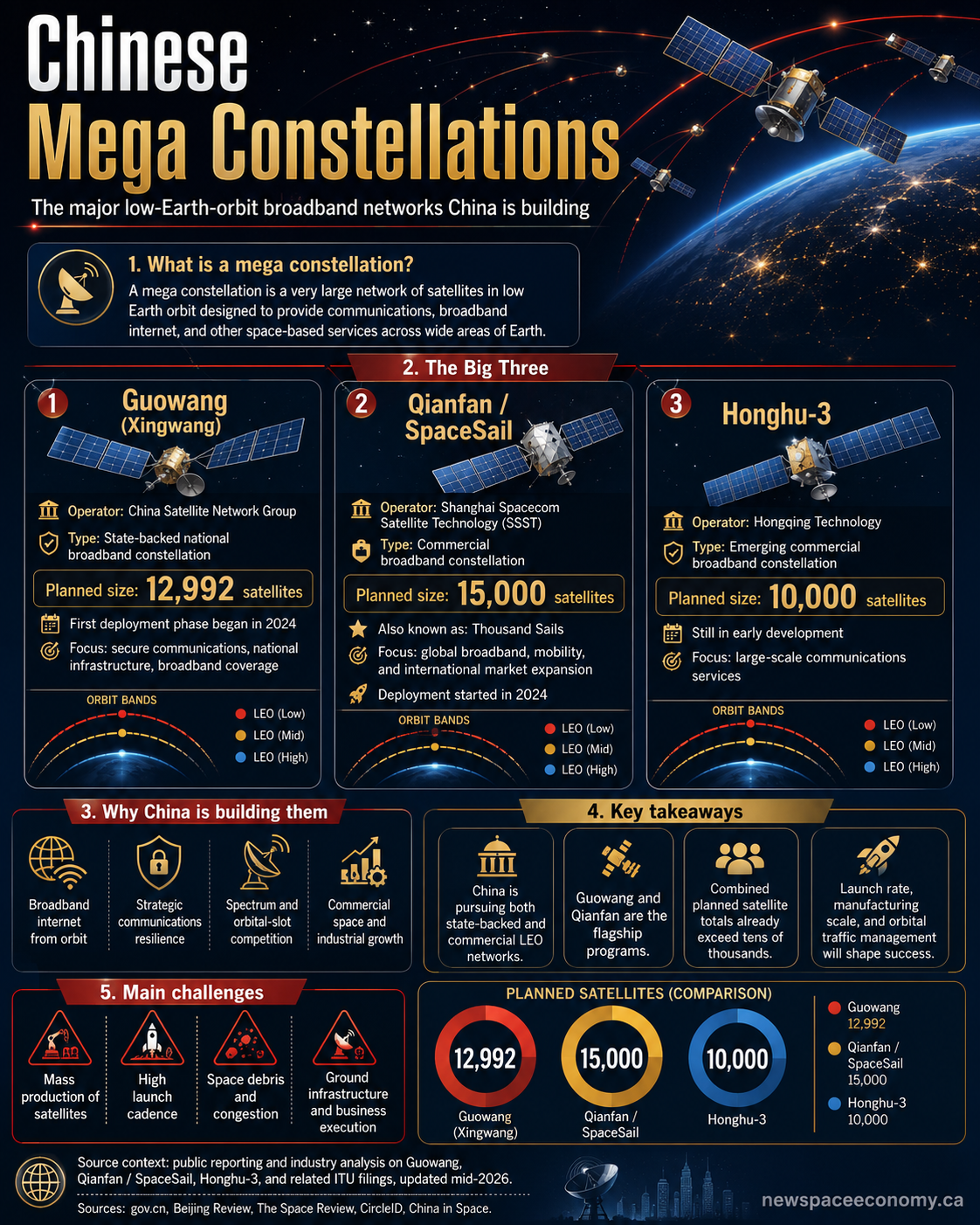
Low Earth orbit broadband is another U.S. strength. Starlink gives the United States a deployed commercial system with millions of users, a large manufacturing pipeline, and direct relevance to defense communications. China’s G60 and SatNet projects show serious intent, and the U.S. Space Force fact sheet reports substantial early deployment numbers by mid-February 2026. Yet planned constellations need sustained manufacturing, launch access, ground terminals, international landing rights, network management, cybersecurity, and customer adoption before they become comparable global services.
The United States also benefits from allied geography and commercial trust. Allied ground stations, data-sharing arrangements, defense partnerships, and common procurement standards extend U.S. space influence. The Artemis Accords, NATO space policy, bilateral defense ties, and commercial relationships give the United States a partnership structure China cannot easily replicate. China has space cooperation agreements and growing ties with partner states, but U.S. alliances remain deep and operational.
The Belfer Center’s emerging technologies index captures this asymmetry. It describes the United States as retaining a strong space advantage through public-private partnerships, launch frequency, payload capacity, and commercial strength, yet facing exposure because American military and economic systems depend heavily on space. That is the central paradox. U.S. leadership creates both power and vulnerability.
The Pentagon’s 2025 China military assessment also places space inside a wider strategic picture. It describes Chinese promotion of BeiDou and space cooperation in Africa, along with broader efforts to expand security influence. Space services can support diplomacy, development, military partnerships, and standards-setting. The space economy is part of foreign policy.
American advantage will depend on turning leadership into resilience. More launches, more satellites, and better sensors help, but the harder task is building systems that can keep working during interference, cyber pressure, spectrum congestion, and political crisis. That means diversified orbits, distributed ground infrastructure, protected software, allied integration, and commercial contracts that allow faster replacement of lost capacity.
China does not need to overtake the United States everywhere to make U.S. operations harder. The United States does not need to dominate every category to retain leadership. The contest is moving toward resilience, production speed, interoperability, and trust.
What the Space Economy Should Watch Next
The next phase of U.S.-China space competition will be measured less by symbolic milestones and more by operational density. The most revealing indicators will be launch cadence, satellite replenishment speed, constellation growth, insurance behavior, spectrum coordination, international customer adoption, and ground-network expansion. Space power will look less like a trophy cabinet and more like a supply chain.
BeiDou deserves close attention because navigation and timing services reach deep into civilian economies. If Chinese receiver manufacturers, industrial platforms, ports, logistics firms, and partner states build more services around BeiDou, the system’s influence will grow beyond satellite navigation. The commercial question is whether BeiDou-based services become default infrastructure in partner markets. The security question is whether dependence on Chinese equipment creates risks governments must manage.
Remote sensing may produce the most visible commercial growth. Earth observation firms can sell analytics into agriculture, climate risk, energy, infrastructure, maritime monitoring, and insurance. China’s domestic market gives its firms a large base for services. International customers may buy Chinese imagery and analytics where cost, access, or political relationships make them attractive. U.S., European, Japanese, Canadian, and Indian providers will compete through data quality, trust, revisit rates, transparency, and integration with customer workflows.
Counterspace developments will shape investment risk. Commercial satellite operators now operate in a domain that governments treat as strategically important. Investors, insurers, and customers will ask harder questions about resilience, cyber protection, space traffic coordination, and exposure to geopolitical crisis. The cost of capital for fragile systems may rise. Firms that can demonstrate redundancy and continuity may gain an advantage.
Commercial launch will remain a decisive bottleneck. China’s satellite plans require frequent access to orbit. If Chinese reusable launch firms mature, the gap with the United States could narrow faster. If they stumble, large broadband constellations and rapid replenishment plans will remain constrained. The United States has a lead here, but launch markets can change quickly when a new vehicle reaches high reliability.
Policy will matter as much as engineering. Export controls, spectrum rules, launch licensing, procurement reform, insurance regulation, debris mitigation standards, cybersecurity rules, and allied industrial policy will shape what companies can build and sell. New Space Economy’s discussion of space policy issues makes this clear: commercial growth and security rules now interact in nearly every part of the sector.
The China space industry has reached the point where dismissing it as a state-run imitation of the U.S. model misses the evidence. It is uneven, policy-driven, opaque in some areas, and still behind in important commercial categories. It is also large, funded, strategically directed, and strong in domains that matter for military power and civil infrastructure. That mix makes China the only space competitor able to challenge the United States across launch, satellites, data services, lunar plans, navigation, and security systems at the same time.
Summary
The most useful way to understand China’s space rise is to separate total leadership from domain-specific advantage. The United States remains ahead in reusable launch, low Earth orbit broadband, private capital, allied networks, and many high-end commercial services. China has built major strength in BeiDou, remote sensing, military integration, state-backed production capacity, and counterspace capabilities.
The policy problem is not panic. It is complacency. If the United States treats space leadership as a permanent inheritance, China’s patient buildout can erode American advantages sector by sector. If China treats state backing as a substitute for commercial discipline, it may create capacity without global trust or strong returns. Both systems have strengths. Both systems have weaknesses.
Commercial space firms should watch where customer adoption goes. Governments should watch resilience. Investors should watch launch cadence and constellation deployment. Military planners should watch how navigation, remote sensing, communications, and counterspace systems combine. The race is no longer about who can reach orbit. It is about who can keep useful services operating when space becomes crowded, contested, commercial, and politically charged.
Appendix: Top Questions Answered in This Article
What Does The ITIF Assessment Say About China’s Space Industry?
The ITIF assessment says China has narrowed the space innovation gap with the United States and now leads or competes strongly in selected domains. Its strongest claims concern positioning, navigation, and timing; Earth observation; and counterspace capabilities. It still identifies U.S. advantages in reusable launch and low Earth orbit broadband.
Does China Now Lead The United States In Space?
China does not clearly lead the United States as an overall space power. The United States retains strong advantages in launch cadence, reusable rockets, commercial broadband constellations, private capital, and allied networks. China’s position is more targeted: it has built important strengths in navigation, remote sensing, and military-linked space infrastructure.
Why Is BeiDou So Important?
BeiDou gives China sovereign positioning, navigation, and timing capability independent of GPS. That supports civil applications such as transportation, logistics, agriculture, and timing services. It also supports military operations that need accurate location, timing, and coordination without relying on a U.S.-operated system.
What Is Remote Sensing In This Context?
Remote sensing means collecting data about Earth from satellites using optical, radar, infrared, and radio-frequency instruments. Civil users apply it to weather, agriculture, insurance, and disaster response. Military users apply it to ISR, which helps detect ships, aircraft, infrastructure, movement, and patterns of activity.
Why Do Counterspace Capabilities Matter?
Counterspace capabilities matter because satellites support navigation, communications, banking, weather data, military operations, and disaster response. Disrupting those services can create economic and security effects without a direct attack on land infrastructure. Destructive actions can also create orbital debris that threatens many operators.
Does Commercial Space Reduce Military Risk?
Commercial space can improve resilience by adding more satellites, more providers, and more replacement capacity. It can also increase risk because commercial assets may support military users during conflict. That dual-use character makes transparency, norms, cyber protection, and insurance more important.
What Advantage Does The United States Still Have?
The United States has a strong advantage in reusable launch, deployed low Earth orbit broadband, private investment, allied partnerships, and commercial trust. SpaceX’s launch cadence and Starlink’s scale remain difficult for China to match. American firms also benefit from a deep customer base and strong export markets.
What Advantage Does China Have?
China has a state-directed model that can align national strategy, local funding, industrial clusters, and military requirements. That model supports rapid growth in selected sectors. It is most visible in BeiDou, remote sensing, launch infrastructure, commercial space policy, and integrated military applications.
Could China’s Commercial Space Sector Overtake The United States?
China could overtake the United States in selected commercial categories if it improves reusable launch, scales satellite internet, gains international customers, and turns state investment into reliable services. A complete commercial overtake remains difficult because U.S. firms retain strong advantages in launch, capital, software, and global trust.
What Should Space Companies Watch Through 2030?
Space companies should watch Chinese reusable launch progress, BeiDou-based export services, remote sensing analytics, G60 and SatNet deployment, counterspace risk, insurance pricing, and commercial space regulation. These indicators will show whether China is turning state-backed capacity into durable global market position.
Appendix: Glossary Of Key Terms
BeiDou Navigation Satellite System
BeiDou is China’s satellite navigation system. It provides positioning, navigation, and timing services for civilian, commercial, and government users. Its strategic value comes from giving China an independent alternative to GPS and a service that can be exported through equipment, standards, and partner infrastructure.
Counterspace Capabilities
Counterspace capabilities are tools that can disrupt, deny, degrade, damage, or destroy space systems. They may affect satellites, ground stations, communications links, software, or data services. Public policy discussions usually treat them as a mix of military systems, electronic interference, cyber operations, and orbital maneuvers.
Dual-Use Technology
Dual-use technology can serve civilian and military purposes. Space systems are often dual-use because navigation, communications, Earth observation, and launch services support commercial markets and military operations. This makes regulation difficult because the same capability can serve weather forecasting, shipping, disaster response, or defense.
Earth Observation
Earth observation is the collection of data about Earth from satellites or aircraft. It includes optical imagery, radar imagery, infrared measurements, weather data, and other sensor products. Commercial users apply it to agriculture, energy, insurance, climate risk, shipping, and infrastructure monitoring.
Intelligence, Surveillance, And Reconnaissance
Intelligence, surveillance, and reconnaissance, or ISR, refers to collecting and analyzing information for security or military decision-making. In space, ISR satellites can monitor land, sea, air, and infrastructure activity through imagery, radar, radio-frequency detection, and other sensor types.
Low Earth Orbit
Low Earth orbit, or LEO, is the region of space relatively close to Earth where many imaging, communications, and scientific satellites operate. LEO offers lower latency for broadband and better image resolution for many sensors, but satellites there move quickly over Earth’s surface.
Military-Civil Fusion
Military-civil fusion is China’s policy approach for connecting civilian industry, universities, research institutes, commercial firms, and military needs. In space, it can move commercial technologies into defense use and direct state-backed demand toward selected commercial capabilities.
Positioning, Navigation, And Timing
Positioning, navigation, and timing, or PNT, refers to services that tell users where they are, help them move accurately, and provide precise time. Satellite PNT supports transportation, telecommunications, financial systems, electrical grids, emergency services, and military operations.
Remote Sensing
Remote sensing means gathering information from a distance, usually through satellites or aircraft. In space markets, the term covers optical imagery, radar data, infrared data, environmental monitoring, and analytics that turn raw observations into usable information.
Reusable Launch
Reusable launch refers to rockets or rocket stages designed to fly more than once. Reuse can reduce costs, increase launch cadence, and make large satellite constellations easier to deploy. The United States currently has the strongest proven record in operational reusable orbital launch.