
- Key Takeaways
- The Public Space Economy Ranking Changed in June 2026
- How Space Economy Exposure Is Defined
- Company Profiles in the Top 10 Ranking
- How Products and Services Cluster Across the Ranking
- What Market Cap Reveals and Hides
- Why Defense, Connectivity, and Supply Chain Demand Shape the List
- Summary
- Appendix: Useful Books Available on Amazon
- Appendix: Top Questions Answered in This Article
- Appendix: Glossary of Key Terms
Key Takeaways
- SpaceX leads the ranking after its June 2026 listing and Starlink scale.
- Aerospace and defense primes still control much of the public space supply base.
- Space economy exposure spans launch, satellites, payloads, electronics, and data.
The Public Space Economy Ranking Changed in June 2026
SpaceX’s June 2026 public listing changed how public space economy companies are ranked by market capitalization. Before that listing, the largest publicly traded companies with space exposure were mainly aerospace and defense conglomerates, including RTX, Boeing, Honeywell, Lockheed Martin, and Northrop Grumman. After SpaceX entered public trading under the ticker SPCX, the scale of the ranking shifted from a defense-heavy table into a list dominated by a single launch, satellite broadband, and space systems company.
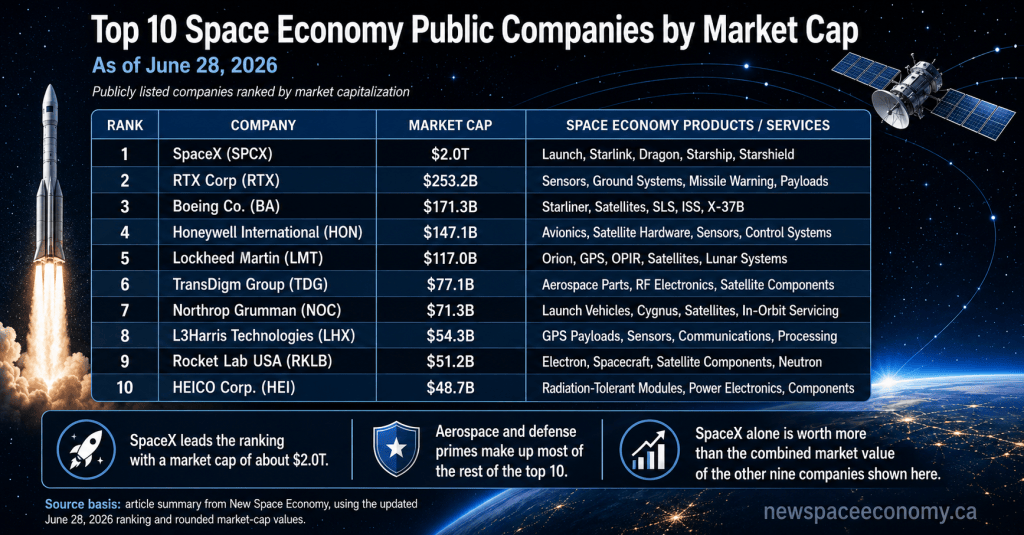
The ranking places SpaceX at about $2.0 trillion. That value puts it far above every other company in the group. The next company, RTX, stands at about $253.2 billion. Boeing follows at about $171.3 billion, then Honeywell at about $147.1 billion and Lockheed Martin at about $117.0 billion.
Market capitalization measures what public investors assign to a company’s equity at a given time. It does not measure space revenue, profitability, contract backlog, launch cadence, satellite count, or technological depth. A company with huge commercial aerospace exposure can outrank a more space-focused company, even if only part of its activity relates to space. That is why this ranking should be treated as a market-cap ranking of public companies with meaningful space exposure, rather than a purity test of companies whose revenue comes only from orbit.
A broader definition fits the space economy better. New Space Economy’s own discussion of space economy taxonomy separates backbone markets from downstream applications and emerging markets. That framework helps explain why the list contains launch providers, spacecraft manufacturers, defense primes, satellite payload suppliers, avionics companies, and electronics specialists. The money flowing through the space economy does not stop at rockets or satellites. It also reaches ground systems, secure communications, positioning services, spacecraft components, software, military procurement, data applications, and specialized manufacturing.
The infographic uses the following ranking and rounded market-cap values.
| Rank | Company | Market Cap | Space Economy Products |
|---|---|---|---|
| 1 | SpaceX (SPCX) | $2.0T | Launch, Starlink, Dragon, Starship, Starshield |
| 2 | RTX Corp (RTX) | $253.2B | Sensors, ground systems, missile warning, payloads |
| 3 | Boeing Co. (BA) | $171.3B | Starliner, satellites, SLS, ISS, X-37B |
| 4 | Honeywell International (HON) | $147.1B | Avionics, satellite hardware, sensors, control systems |
| 5 | Lockheed Martin (LMT) | $117.0B | Orion, GPS, OPIR, satellites, lunar systems |
| 6 | TransDigm Group (TDG) | $77.1B | Aerospace parts, RF electronics, satellite components |
| 7 | Northrop Grumman (NOC) | $71.3B | Launch vehicles, Cygnus, satellites, in-orbit servicing |
| 8 | L3Harris Technologies (LHX) | $54.3B | GPS payloads, sensors, communications, processing |
| 9 | Rocket Lab USA (RKLB) | $51.2B | Electron, spacecraft, satellite components, Neutron |
| 10 | HEICO Corp. (HEI) | $48.7B | Radiation-tolerant modules, power electronics, components |
How Space Economy Exposure Is Defined
The space economy includes more than launch providers and satellite operators. It covers the activities, infrastructure, services, and supply chains that create value through the use of space. A launch company belongs on the list because it moves payloads to orbit. A satellite manufacturer belongs because it builds spacecraft. A payload company belongs because its sensors, clocks, antennas, processors, or electronics allow spacecraft to perform useful work. A ground-systems contractor belongs because satellites cannot deliver value without command, control, data routing, processing, and user access.
That broad view matters because the largest public companies in the space economy rarely look like small launch startups. Many are defense and aerospace firms that earn revenue from aircraft, missiles, engines, avionics, software, and secure communications as well as space systems. Their space exposure can still be commercially meaningful. A missile-warning satellite constellation, a GPS payload, a weather satellite instrument, or a spacecraft avionics package sits directly inside the space value chain.
New Space Economy’s article on space economy viewpoints makes a useful point: narrow definitions miss how launch, satellites, data, defense, finance, insurance, and regulation connect. A satellite communications company depends on spectrum access, ground terminals, launch capacity, spacecraft buses, user equipment, insurance, regulatory filings, and government contracts. A spacecraft prime contractor depends on electronics firms, software teams, propulsion suppliers, thermal systems companies, optical payload makers, and test facilities.
Market-cap rankings also mix direct and indirect exposure. SpaceX and Rocket Lab sell launch and spacecraft services as central business lines. Boeing, Lockheed Martin, and Northrop Grumman run major space divisions inside larger defense and aerospace groups. Honeywell, TransDigm, and HEICO supply subsystems and components that make spacecraft and launch systems work. L3Harris and RTX sit closer to the payload, sensor, communications, and ground-system layers.
A classification that excludes suppliers would understate the market. The U.S. satellite manufacturing supply chain includes structures, electronics, propulsion, software, payloads, test equipment, launch integration, and mission operations. Public investors price many of those activities through companies whose space businesses are mixed with aviation and defense lines.
Company Profiles in the Top 10 Ranking
SpaceX
SpaceX is the clearest pure-play space economy company in the ranking. Its core business lines include launch services, crew and cargo spacecraft, satellite broadband, secured government space services, reusable rocket systems, and deep-space transportation development. Its Falcon 9 rocket supports commercial satellite launches, national security payloads, civil government missions, cargo deliveries, and crew flights. Falcon Heavy adds heavy-lift capacity for larger payloads and higher-energy missions.
Dragon gives SpaceX a crew and cargo spacecraft business that connects the company to the International Space Station, commercial human spaceflight, and cargo return. Starship and Super Heavy are under development as a fully reusable launch and transportation system intended for large payloads, lunar missions, Mars architecture, and high-cadence transport to orbit. Starship’s commercial value depends on technical success, regulatory progress, reusability, operational tempo, and demand for very large payload delivery.
Starlink turns SpaceX into a satellite operator and communications provider. It connects launch economics with recurring broadband revenue, ground terminals, user subscriptions, maritime service, aviation service, enterprise connectivity, and government connectivity. Starshield extends parts of that satellite and communications architecture into government use cases, including secured communications and national security missions.
SpaceX qualifies as a space economy company because its products and services sit directly in the launch, spacecraft, satellite communications, government space, and orbital infrastructure markets. Its June 2026 public offering, described by SpaceX investor relations, moved it from private-market space benchmark to public-market anchor. At a market capitalization of about $2.0 trillion, SpaceX is larger than the rest of the ranking combined.
RTX Corp
RTX is a diversified aerospace and defense company whose space exposure sits mainly in sensors, ground systems, command-and-control, communications, missile warning, and space security. Through Raytheon and Collins Aerospace, RTX supplies systems that connect satellites to users, help process orbital data, and support national defense missions.
The company’s space relevance comes less from building famous crew spacecraft and more from building the invisible infrastructure that lets governments use satellites for warning, surveillance, communications, and decision support. Raytheon describes its space work as extending from ground control systems to on-orbit sensors. That places RTX in both the space segment and the ground segment of the value chain.
Space-based missile warning is one of the strongest examples. Satellites detect launch events and track threats, but the value of that detection depends on ground systems that process data, send alerts, and connect operators to command networks. RTX also participates in Earth observation, space-based sensing, protected communications, and space-domain awareness, which means tracking objects and activities in orbit.
RTX qualifies as a space economy company because space is part of its defense and intelligence infrastructure business. The company’s market cap reflects many lines outside space, including engines, avionics, defense electronics, and missiles. Its inclusion still makes sense because modern space systems are deeply tied to aerospace and defense procurement, and RTX is one of the largest public companies supplying that layer.
Boeing Co.
Boeing Space gives Boeing a long connection to human spaceflight, satellites, launch systems, orbital platforms, and autonomous spacecraft. Boeing’s commercial aircraft business often dominates public attention, but its space work remains extensive. The company has built, integrated, or supported major civil and defense space systems for decades.
The CST-100 Starliner program connects Boeing to crew transportation. Starliner is designed as a reusable capsule for transporting astronauts and cargo. The program has faced delays and technical scrutiny, yet it remains part of NASA’s broader commercial crew architecture. Boeing also supports the International Space Station through systems, engineering, and operations-related work.
Boeing contributes to NASA’s Space Launch System through core stage and related launch vehicle work. It also builds satellites and provides services linked to resilient spacecraft, mission systems, software, and ground architecture. The X-37B adds another dimension: it is an uncrewed autonomous spaceplane used for orbital experimentation and technology testing.
Boeing qualifies because it operates across launch vehicles, crew spacecraft, satellites, space station systems, government missions, and orbital test vehicles. Its market capitalization includes commercial aviation, defense aircraft, services, and other businesses. The space economy portion is only part of the whole company, but that part touches several of the most visible and demanding space markets.
Honeywell International
Honeywell Aerospace is a systems and components supplier for satellites, spacecraft, and aerospace platforms. Honeywell’s space exposure is less visible than a launch vehicle or a crew capsule, but spacecraft depend on many high-reliability systems that operate in demanding environments. Those systems include avionics, sensors, navigation equipment, control systems, communications hardware, thermal management, and power-related components.
A satellite is a network of subsystems. It needs onboard computing, attitude control, power conditioning, data handling, communications, environmental tolerance, and integration with launch and mission operations. Honeywell’s aerospace capabilities sit within that supplier layer. The company’s space products and systems support spacecraft performance rather than public-facing services.
This supplier position matters because the space economy cannot scale only through new launchers or constellations. It also needs qualified components, long-life hardware, manufacturing capacity, testing standards, and engineering teams familiar with flight heritage. Satellite operators and spacecraft primes reduce program risk when they can use suppliers with experience in aviation, defense, and space.
Honeywell qualifies as a space economy company because its aerospace technologies support spacecraft, satellites, and mission systems. Its market capitalization reflects a broader industrial portfolio, including automation and energy-related businesses. Space is not the whole story, but space hardware is part of the company’s aerospace identity.
Lockheed Martin
Lockheed Martin Space is one of the largest space prime contractors. Its portfolio includes civil exploration spacecraft, military satellites, missile-warning systems, weather and environmental systems, navigation satellites, lunar systems, spacecraft buses, and mission operations. This gives the company one of the deepest space portfolios among public aerospace and defense firms.
The Orion spacecraft is a major civil-space example. Lockheed Martin is the prime contractor for Orion, the crew spacecraft designed for NASA’s Artemis lunar missions. The company also builds GPS satellites for the United States Space Force, giving it a direct connection to positioning, navigation, and timing services used by military and civilian users.
National security space is another large part of the business. Lockheed Martin works on early-warning, missile-warning, space-based infrared, and resilient satellite systems. Programs such as Next-Generation Overhead Persistent Infrared connect the company to space-based warning architecture. Those systems show how the space economy includes government procurement and defense infrastructure, not just commercial services.
Lockheed Martin qualifies because it designs and builds spacecraft, satellites, payload architectures, and mission systems that operate in orbit and support users on Earth. The company’s market cap includes aircraft, missiles, and defense systems outside space. Its space segment remains large enough and broad enough to justify its position among public space economy leaders.
TransDigm Group
TransDigm Group is primarily an aerospace components company. Its products include engineered parts, systems, and subsystems used in aviation and defense platforms. That makes its space economy exposure more indirect than SpaceX, Rocket Lab, Boeing, or Lockheed Martin. The company enters the space economy mainly through aerospace supply chains and specialized electronics tied to satellites and defense systems.
The Stellant Systems transaction gives the space connection more weight. Arlington Capital Partners announced the sale of Stellant Systems to TransDigm for $960 million. Stellant produces high-power radio frequency and microwave amplification products used in aerospace, defense, satellite, and communications applications. Those technologies can support payloads, communications links, radar systems, and space-related mission equipment.
TransDigm’s inclusion should be understood carefully. It is not a space operator. It does not sell satellite broadband to consumers or launch rockets. Its place in the ranking reflects the supplier economics of aerospace and defense components, plus acquisitions that bring satellite-related electronics into its portfolio.
The company qualifies as space-exposed because spacecraft and satellite systems depend on specialized components, electronics, and high-reliability hardware. TransDigm’s public value comes from a larger aerospace business model, but parts of that model serve the same manufacturing and electronics base used by the space sector.
Northrop Grumman
Northrop Grumman Space sits across launch systems, spacecraft, satellites, missile-warning payloads, science missions, cargo vehicles, ground systems, and in-orbit servicing. The company’s Cygnus spacecraft gives it a direct link to International Space Station cargo delivery. Its solid rocket motors and launch vehicle work connect it to civil and defense launch markets.
Northrop Grumman also has a strong role in national security space. It supports missile-warning systems, tracking architectures, protected communications, ground systems, and space-domain awareness. New Space Economy’s coverage of operational ISR satellites helps frame why this matters. Intelligence, surveillance, and reconnaissance from space require spacecraft, sensors, secure data paths, and ground processing. Defense primes such as Northrop Grumman sit near the center of that demand.
The company’s SpaceLogistics business adds an unusual space-economy product category: satellite life extension and in-orbit servicing. Mission Extension Vehicles dock with aging satellites and provide propulsion and attitude control support. That capability turns satellite servicing into a commercial service rather than a mission concept alone.
Northrop Grumman qualifies because it produces launch systems, spacecraft, satellites, sensors, cargo vehicles, ground systems, and servicing technologies. Its market cap reflects many defense and aerospace programs outside space, but its space business covers both civil and national security markets.
L3Harris Technologies
L3Harris Space supplies payloads, communications systems, positioning, navigation and timing technology, weather satellite instruments, space-domain awareness systems, mission processing, and ground equipment. The company often appears in the space economy as a payload and systems supplier rather than a vehicle prime contractor.
Positioning, navigation, and timing is a strong example. L3Harris says its payloads and components have flown on every United States GPS satellite, covering more than 70 missions since the 1970s. That connects the company to one of the most economically valuable satellite services in daily use. GPS supports transportation, finance, agriculture, emergency response, logistics, telecommunications timing, and defense operations.
L3Harris also participates in satellite communications, Earth observation, weather sensing, space-domain awareness, and mission data processing. These are not peripheral activities. Satellites need payloads to gather data, communications systems to move it, software to process it, and ground infrastructure to turn it into operational information.
The company qualifies as a space economy company because it builds the mission payload and communications layers that make satellites useful. New Space Economy’s discussion of satellite applications shows why payloads matter: satellite value comes from services such as communications, Earth observation, navigation, weather monitoring, and defense sensing.
Rocket Lab USA
Rocket Lab is the other space-focused pure-play company in the top 10. Its business spans launch services, spacecraft design, satellite components, flight software, and mission operations. Electron gives the company an operational small-launch vehicle. Neutron, under development, is intended to move Rocket Lab into a larger launch class with reusable architecture.
Rocket Lab’s value proposition is not limited to launch. The company markets itself as an end-to-end space company, delivering launch, spacecraft, components, software, and on-orbit services. This vertical structure lets it serve customers that need more than a ride to orbit. A customer can buy a spacecraft bus, components, integration support, launch, and mission operations from a single provider.
The company’s satellite components business includes items such as reaction wheels, solar power systems, separation systems, star trackers, and software. Those products put Rocket Lab into the same supply chain that supports commercial constellations, defense missions, science spacecraft, and Earth-observation platforms. The company also serves tactically responsive space requirements, where speed from order to orbit can matter for defense customers.
Rocket Lab qualifies because launch and spacecraft are central to its business. Its market cap is much smaller than SpaceX’s, but its space purity is high. Among public companies, it remains one of the clearest examples of a space systems business built for the commercial and government markets at the same time.
HEICO Corp.
HEICO is a diversified aerospace, defense, and electronics company with space exposure through high-reliability components and specialized subsidiaries. Its 3D PLUS subsidiary produces radiation-tolerant products for space applications, including memory modules, computer cores, interfaces, power converters, peripherals, protection devices, and camera heads. These are not consumer-facing space services, but they are essential to spacecraft reliability.
Space electronics must survive radiation, vibration, launch loads, thermal cycling, and long service lives. A memory device, power component, sensor interface, or electronics module can determine whether a satellite keeps working in orbit. HEICO’s space connection sits in that high-reliability electronics layer.
The company also has subsidiaries connected to power electronics, microwave systems, electro-optical components, and other aerospace technologies. These products can serve aircraft, defense platforms, satellites, and spacecraft. HEICO’s exposure is supplier-based, similar to Honeywell and TransDigm, but with a strong electronics and component emphasis.
HEICO qualifies because space missions require specialized parts that are qualified for the orbital environment. New Space Economy’s treatment of satellite manufacturing reinforces the point that suppliers are part of the market, even when they do not operate satellites or launch vehicles themselves.
How Products and Services Cluster Across the Ranking
The top 10 companies cluster into four commercial categories: pure-play space systems, large space primes, payload and mission systems suppliers, and component specialists. Those categories explain why the ranking contains both SpaceX and HEICO. They participate in different layers of the same space economy.
SpaceX and Rocket Lab sit in the pure-play category. Their brand identity, investor story, and operating model are directly tied to launch, spacecraft, satellites, and orbital services. SpaceX combines launch, crew transport, broadband, government satellite services, and Starship development. Rocket Lab combines small launch, spacecraft, components, software, and mission support.
Boeing, Lockheed Martin, and Northrop Grumman are large space primes. They design and deliver major spacecraft, satellites, launch systems, and government space architectures. Their work usually involves long program cycles, large customers, strict technical standards, and significant government oversight. They are not pure space stocks, but their space portfolios are deep.
RTX and L3Harris sit close to mission systems, payloads, communications, and ground infrastructure. Their products help satellites detect, communicate, process, and connect. They are part of the defense and intelligence side of the space economy, where the value often appears in sensors, secure networks, and command systems rather than public-facing applications.
Honeywell, TransDigm, and HEICO show the supplier layer. Spacecraft need avionics, electronics, power conversion, communications components, memory, sensors, interfaces, mechanisms, and tested parts. These companies gain space exposure through the supply chain. Their products can be small compared with a rocket or satellite, but they can carry high technical value.
New Space Economy’s review of orbital satellite applications makes the connection clear. Communications, Earth observation, navigation, weather, science, defense, and commercial services all depend on hardware and software far beyond the satellite bus itself. A ranking that includes only operators would miss much of the value chain.
What Market Cap Reveals and Hides
Market capitalization reveals investor expectations and relative public-market scale. It does not reveal which company earns the most revenue from space. It also does not show margin, backlog quality, government dependence, technical risk, regulatory risk, or the split between space and non-space businesses.
SpaceX’s $2.0 trillion valuation reflects a combination of launch dominance, Starlink subscription potential, government demand, Starship optionality, manufacturing scale, and investor appetite for large growth platforms. That makes it a distinct case. Its market cap is tied to space services, but also to expectations about future growth that may or may not develop as investors currently expect.
RTX, Boeing, Honeywell, Lockheed Martin, Northrop Grumman, and TransDigm have large market caps because their businesses span aerospace, defense, aviation, components, services, and electronics. Space is part of their value, but not always the largest part. A space revenue ranking would look different.
Rocket Lab illustrates the opposite pattern. It is much smaller than the defense primes, but its space concentration is high. The company’s market cap prices a more focused bet on launch, spacecraft, components, and medium-lift expansion. HEICO has a larger market cap than many small public satellite firms because investors value its aerospace and electronics model, even though its space activity is supplier-based.
A market-cap table also hides ownership and float issues, valuation swings, and short-term trading moves. Public-company values can change quickly after earnings, contract wins, launch failures, mergers, regulatory actions, or broader market shifts. That volatility matters for SpaceX after its IPO because post-listing prices can move sharply as investors reassess growth, risk, and liquidity.
The ranking still has value. It shows which public companies investors currently price as the largest space-exposed platforms. It also shows that the space economy is no longer a small collection of launch startups and satellite operators. Public equity exposure now runs through megacap launch and connectivity, defense primes, payload suppliers, and specialized electronics firms.
Why Defense, Connectivity, and Supply Chain Demand Shape the List
Defense demand helps explain why so many companies on the list are established aerospace and defense firms. Space is now central to missile warning, communications, positioning, navigation, surveillance, reconnaissance, weather monitoring, and command networks. Governments need satellites, payloads, secure ground systems, protected communications, and resilient architectures. That demand supports RTX, Lockheed Martin, Northrop Grumman, Boeing, and L3Harris.
Connectivity demand explains SpaceX’s scale and the continuing relevance of satellite communications. Starlink transformed SpaceX from a launch company into a recurring-service provider. Satellite broadband, direct-to-device services, aviation connectivity, maritime connectivity, enterprise service, and government communications all create new demand for orbital networks. New Space Economy’s article on satellite applications places communications inside a wider set of services that satellites can provide.
Supply-chain demand explains why companies such as Honeywell, TransDigm, and HEICO appear beside launch providers. Space hardware must be manufactured, qualified, tested, integrated, and supported. The companies that make electronics, avionics, sensors, memory, power systems, and specialized components can capture value without owning a constellation.
The ranking also reflects the merger of commercial and government space markets. SpaceX sells to consumers, enterprises, NASA, the United States Department of Defense, and international customers. Rocket Lab sells to commercial and government users. Lockheed Martin, Northrop Grumman, Boeing, RTX, and L3Harris serve civil agencies and defense customers. The same industrial base can support scientific missions, national security missions, and commercial services.
That overlap is one reason space-economy analysis should include adjacent markets. Finance, insurance, spectrum regulation, export controls, launch ranges, standards, ground infrastructure, procurement policy, and workforce capacity all affect the companies in the ranking. The public market may price companies through ticker symbols, but the operating reality is a connected industrial system.
Summary
The top public space economy companies by market cap show a sector that has moved beyond a simple launch-versus-satellite story. SpaceX dominates the ranking because it combines reusable launch, Starlink, Dragon, Starshield, and Starship development inside one public company. At about $2.0 trillion, SpaceX sits in a different valuation category from every other public company on the list. Rocket Lab provides the clearest smaller pure-play comparison, with launch, spacecraft, components, and mission services under one roof.
The rest of the list shows where much of the space economy’s industrial weight still sits. RTX, Boeing, Lockheed Martin, Northrop Grumman, and L3Harris connect public-market space exposure to defense, sensing, communications, ground systems, exploration spacecraft, and national security architectures. Honeywell, TransDigm, and HEICO show that supplier companies can be space economy companies when their hardware, electronics, and systems flow into spacecraft, satellites, and mission infrastructure.
Market capitalization is not a perfect measure of space activity. It mixes future expectations with current operations and includes non-space business lines for many companies. Yet the ranking is useful because it reveals how investors see the public side of the space economy: a market led by SpaceX, supported by defense and aerospace primes, and reinforced by suppliers whose products may be small in size but essential in function.
Appendix: Useful Books Available on Amazon
Appendix: Top Questions Answered in This Article
Why Is SpaceX Ranked Above Every Other Public Space Economy Company?
SpaceX is ranked at the top because its market capitalization is far larger than the other companies in the list. Its value reflects launch services, Starlink, Dragon, Starshield, and Starship development. The ranking uses public-market value rather than space-only revenue.
Are All Companies on the List Pure Space Companies?
No. SpaceX and Rocket Lab are the clearest pure-play space companies. The other companies are broader aerospace, defense, electronics, or industrial firms with meaningful space exposure through satellites, spacecraft, payloads, ground systems, avionics, or components.
Why Is RTX Included in a Space Economy Ranking?
RTX is included because its Raytheon and Collins Aerospace businesses support space sensing, ground systems, missile warning, communications, and mission technologies. Its space activity is tied to defense and intelligence infrastructure rather than consumer satellite services.
Why Is Boeing Considered a Space Economy Company?
Boeing qualifies because it works on crew spacecraft, satellites, launch systems, the International Space Station, and the X-37B autonomous spaceplane. Its commercial aircraft business is larger in public attention, but Boeing’s space portfolio remains significant.
Why Does Honeywell Appear on the List?
Honeywell appears because it supplies aerospace and space systems, including satellite hardware, avionics, sensors, and control technologies. It is a supplier rather than a launch operator, but supplier companies form an essential part of the space economy.
What Makes Lockheed Martin a Space Economy Company?
Lockheed Martin builds and supports Orion, GPS satellites, missile-warning spacecraft, lunar systems, and national security space infrastructure. Its space business connects civil exploration with defense, navigation, and space-based sensing.
Why Is TransDigm Included if It Is Mainly an Aerospace Components Company?
TransDigm is included because space systems depend on high-reliability aerospace components and specialized electronics. Its planned Stellant Systems acquisition adds satellite and space-related radio frequency and microwave electronics exposure.
What Is Northrop Grumman’s Space Economy Role?
Northrop Grumman works on launch systems, Cygnus cargo spacecraft, satellites, ground systems, missile-warning systems, and in-orbit servicing. Its SpaceLogistics business gives it a direct connection to satellite life extension and servicing.
What Does L3Harris Provide to the Space Economy?
L3Harris provides GPS payloads, communications systems, sensors, space-domain awareness technologies, weather satellite instruments, and mission processing. These systems help satellites deliver navigation, observation, communications, and defense services.
Why Is Rocket Lab Important Despite Its Smaller Market Cap?
Rocket Lab is important because it is a focused public space company with launch, spacecraft, components, software, and mission operations. Its market cap is smaller than the defense primes, but its space concentration is high.
Appendix: Glossary of Key Terms
Market Capitalization
Market capitalization is the public market value of a company’s equity. It is calculated by multiplying the share price by shares outstanding. It changes with trading prices and does not directly measure revenue, profit, backlog, or space-only business activity.
Space Economy
The space economy includes activities, infrastructure, products, and services that create value through the use of space. It includes launch, satellites, ground systems, communications, navigation, Earth observation, defense space systems, supply chains, insurance, finance, regulation, and downstream data services.
Pure-Play Space Company
A pure-play space company earns its identity and value mainly from space-related products or services. SpaceX and Rocket Lab fit this category better than diversified aerospace companies because launch, spacecraft, satellite services, and mission operations sit close to their core business.
Space Prime Contractor
A space prime contractor leads major spacecraft, satellite, launch system, or mission architecture programs. Prime contractors often manage design, integration, suppliers, testing, delivery, and customer requirements for civil, commercial, or defense space missions.
Payload
A payload is the mission equipment carried by a spacecraft or satellite. It may include sensors, communications equipment, radar, cameras, navigation instruments, scientific instruments, or defense mission hardware. Payloads often determine what economic value a satellite can create.
Ground Segment
The ground segment includes antennas, control centers, data systems, user terminals, command equipment, and processing infrastructure used to operate satellites and deliver services. Satellites depend on the ground segment to receive commands and return useful information.
Satellite Broadband
Satellite broadband uses spacecraft to deliver internet connectivity to users on Earth. Low Earth orbit constellations can reduce latency compared with traditional geostationary systems, but service quality depends on satellite density, spectrum, terminals, gateways, and network management.
Space-Domain Awareness
Space-domain awareness is the detection, tracking, and understanding of objects and activity in orbit. It supports collision avoidance, military operations, satellite protection, launch tracking, debris monitoring, and assessment of behavior in space.
In-Orbit Servicing
In-orbit servicing involves repairing, refueling, relocating, inspecting, or extending the life of satellites after launch. Northrop Grumman’s Mission Extension Vehicles show how servicing can become a commercial space service rather than only a government demonstration.
Radiation-Tolerant Electronics
Radiation-tolerant electronics are designed to keep working in the orbital environment, where particles can damage ordinary components. Satellites and spacecraft use such electronics for memory, computing, power control, sensing, and mission operations.
