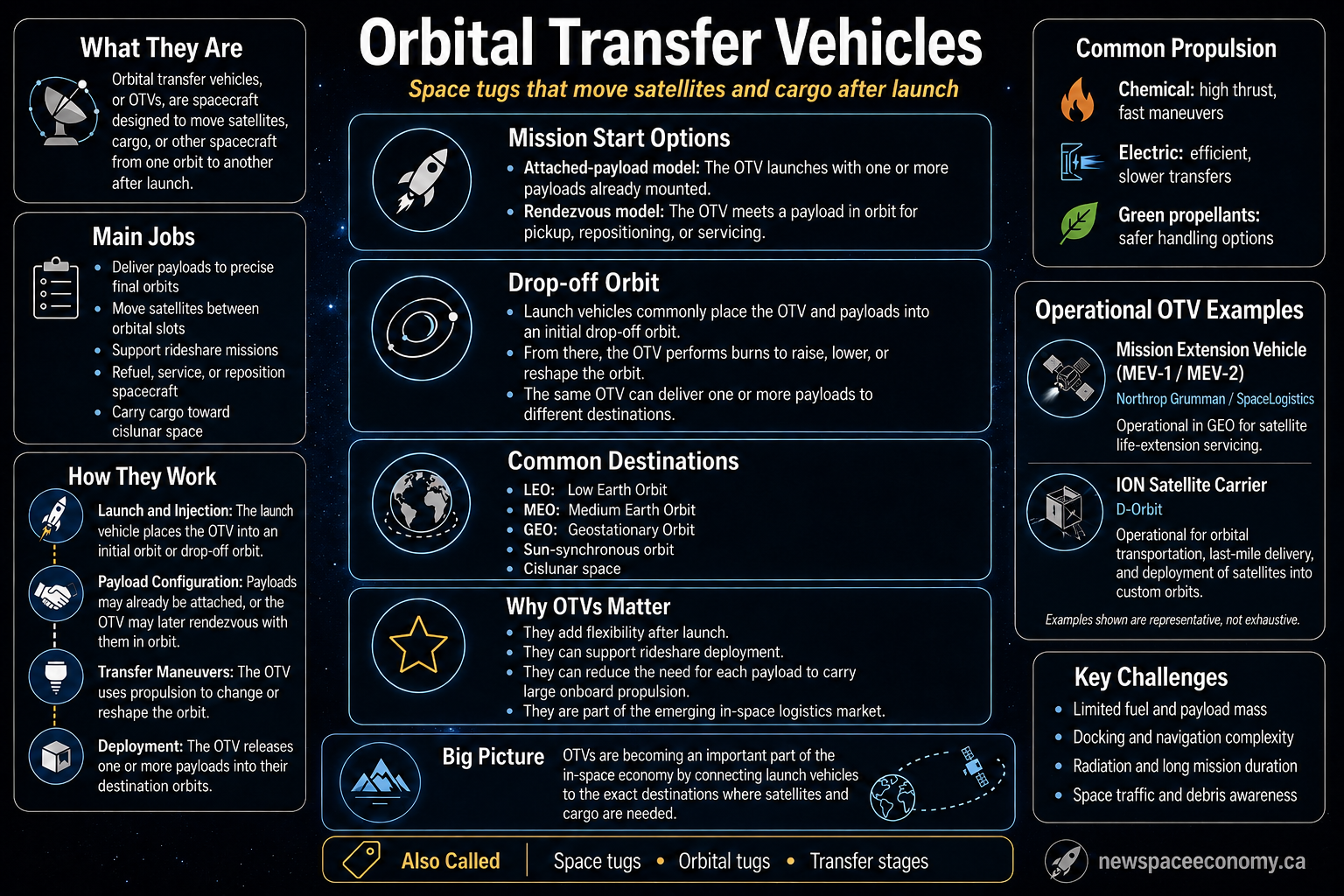
- Key Takeaways
- A Market Once Hidden Inside Launch Missions
- Agena, PAM, IUS, and TOS Built the Early Template
- Servicing Missions Proved That Transfer Craft Could Return to Work
- The Business Case Shifted From Delivery to Mobility
- The Current Orbital Transfer Vehicles Flying or Near Flight
- Reusability Changes the Economics but Raises the Bar
- Refueling, Docking Standards, and On-Orbit Warehousing
- Cislunar Routes Are Becoming the Next Test
- Summary
- Appendix: Useful Books Available on Amazon
- Appendix: Top Questions Answered in This Article
- Appendix: Glossary of Key Terms
Key Takeaways
- Orbital transfer vehicles began as expendable upper stages and are turning into space logistics craft
- The strongest 2026 programs pair mobility with hosting, servicing, inspection, or refueling paths
- Refuelable interfaces and docking standards may matter more than raw propulsion performance
A Market Once Hidden Inside Launch Missions
On March 30, 2026, D-Orbit launched the 22nd commercial mission of its ION Satellite Carrier, a sign of how far orbital transfer vehicles have moved from specialist government studies into routine commercial service. The phrase still sounds narrow. It suggests a machine that takes one payload from one orbit to another and then disappears. That description fits part of the field, though it no longer captures the full business. In April 2026, orbital transfer vehicles include classic kick stages, last-mile rideshare dispensers, inspection craft, life-extension servicers, hosted-payload buses, and early orbital refueling shuttles.
The best way to understand the segment is to start with the job rather than the hardware. An orbital transfer vehicle exists to change where another spacecraft can operate after launch. That can mean a fast push from low Earth orbit to geostationary orbit, a gradual series of plane changes for small satellites, a reboost of a space station, or a docking mission that lets an aging satellite borrow propulsion from a servicer. Older programs tended to do one of those jobs once. Newer systems often combine transport with power, communications, mission operations, and long-duration hosting. NASA’s Small Spacecraft State of the Art material already treats vehicles such as Impulse Space’s Mira as part of a broader launch, deployment, and orbital transport stack rather than as a footnote to launch.
That shift matters because launch and in-space mobility solve different economic problems. A launch vehicle sells access to orbit in large chunks. An orbital transfer vehicle sells precision after separation. It can spare a customer the cost of a dedicated launch, shorten the time between deployment and revenue service, improve constellation phasing, or keep a satellite alive after its original fuel plan runs out. Northrop Grumman’s Mission Extension Vehicle program showed that operators would pay for orbit control and attitude support in geostationary orbit. Exotrail’s spacevan service and Momentus’s Vigoride were built around another demand curve: getting small payloads to the right orbit after a low-cost rideshare launch.
A good review of orbital transfer vehicles has to cover three overlapping eras. The first ran from the early space age through the Shuttle period, when most OTV work was folded into upper stages and government transportation architecture studies. The second began when autonomous rendezvous, robotic servicing, and station logistics turned transfer craft into orbital workers. The third is unfolding now. It is commercial, modular, and more ambitious about reuse, though “reuse” in this field often means serving more than one client in orbit rather than landing back on Earth.
Agena, PAM, IUS, and TOS Built the Early Template
Long before “space tug” became a commercial sales term, launch systems were already handing off payloads to in-space propulsion stages that did the real mission shaping. In the 1960s, the Agena upper stage gave NASA and the U.S. military a practical way to reach higher-energy missions. Mariner 4 was sent toward Mars after an Agena-D boost, and the same family of vehicles appeared in Gemini Agena target vehicle operations that mixed propulsion, rendezvous, and on-orbit mission support. These systems were not sold as a separate logistics market. They were still orbital transfer vehicles in the basic sense that mattered most: launch alone did not place the spacecraft in its useful operating path.
By the late 1970s and 1980s, the United States was treating orbital transfer more explicitly as a transportation layer. NASA and the Air Force developed the Inertial Upper Stage for missions from low Earth orbit to geosynchronous orbit and interplanetary trajectories. Chandra is a useful example because the Shuttle only got the observatory into low orbit; the IUS then performed two firings to place it on its highly elliptical operational path. A few years later, the Transfer Orbit Stage pushed Mars Observer onto its interplanetary route. NASA studies from that era also examined broader OTV families, including the Orbital Maneuvering Vehicle, a reusable teleoperated concept for delivery, retrieval, reboost, and deorbit jobs.
That earlier generation left three design ideas that still define the field. First, the transfer layer has value because launch providers optimize for reaching a reference orbit, not for every customer’s final mission geometry. Second, delta-v alone does not make an OTV useful. Guidance, control, payload interfaces, and safe separation procedures decide whether the spacecraft is commercially relevant. Third, an OTV becomes much more valuable when it can support a sequence of jobs rather than one burn and disposal. Shuttle-era planners understood that point even when the industrial base and budgets could not yet support it at scale.
The old programs also carried constraints that held the segment back for decades. Propulsion stages were often single-purpose. Payloads were built around custom interfaces. On-orbit autonomy was still limited. Insurance and customer procurement were geared toward launch and satellite manufacturing, not a separate mobility provider. That is why the field advanced in bursts instead of a smooth commercial rise. The technical logic for space tugs existed early. The business structure arrived much later.
| Era | Representative System | Main Job | Reuse Model | Typical Destination |
|---|---|---|---|---|
| 1960s | Agena | Post-launch injection and maneuver support | Expendable | Higher Earth orbit and planetary transfer |
| 1980s | Inertial Upper Stage | High-energy delivery from parking orbit | Expendable | GEO transfer and deep space |
| 1990s | Transfer Orbit Stage | Mission-specific transfer burn | Mostly expendable | GEO transfer and interplanetary missions |
| 1980s studies | Orbital Maneuvering Vehicle | Delivery, retrieval, reboost, deorbit | Planned reusable in orbit | LEO operations |
Servicing Missions Proved That Transfer Craft Could Return to Work
A second thread developed outside the pure upper-stage line. Instead of pushing a payload once, some spacecraft were built to arrive, dock, reposition, and keep working. Human servicing came first. Hubble was designed for repair and upgrade in orbit, and five servicing missions kept it scientifically productive far beyond its original plan. Those Shuttle flights were not orbital transfer vehicles by themselves, yet they proved a larger point: mission value in orbit could be changed after launch if interfaces, access, and operations were designed with that in mind.
Robotic demonstrations followed. Japan’s ETS-VII tested remote manipulation and rendezvous in the late 1990s. The U.S. then flew Orbital Express, which demonstrated autonomous rendezvous, propellant transfer, and module exchange with the ASTRO and NextSat spacecraft. That mission mattered far beyond its own hardware. It showed that a transfer craft could be more than a propulsion package. It could be a service node.
Station logistics added another branch to the same family tree. ESA’s Automated Transfer Vehicle docked with the International Space Station and performed cargo delivery, attitude support, and reboost maneuvers. Russia’s Progress spacecraft still does regular station reboosts, and Northrop Grumman’s Cygnus showed in 2022 that a commercial cargo vehicle could take on part of that task. Those craft were built around station support, not free-flying satellite logistics. Even so, they strengthened the case for persistent in-space mobility vehicles that could maneuver large masses safely and predictably.
The most commercially important proof arrived in geostationary orbit. MEV-1 docked with Intelsat 901 in February 2020, and MEV-2 docked with IS-10-02 in April 2021. Those missions changed the market discussion. Operators no longer had to treat the original fuel load of a GEO satellite as a hard end date. A servicer could assume orbit-keeping and pointing duties and add years of revenue service. Northrop Grumman’s own description is simple: the MEVs act as additional engines with fuel. That simplicity is part of the lesson. The early commercial win in orbital transfer did not come from glamorous interplanetary mobility. It came from solving a balance-sheet problem for expensive communications satellites.
The Business Case Shifted From Delivery to Mobility
For decades, the question around orbital transfer vehicles was mostly technical: can the spacecraft deliver enough delta-v with enough precision to make the mission work. By 2026, the stronger question is commercial: what mix of transport, hosting, servicing, and responsiveness can produce repeat demand. The answer differs by orbit.
In low Earth orbit, the strongest demand comes from rideshare disaggregation. Launch services such as Falcon 9 Transporter missions offer cheap access to a common drop-off orbit. Customers then need separation into distinct planes, altitudes, local times of ascending node, or operational schedules. That is where systems such as ION, spacevan, Mira, and Vigoride try to make money. Their value rests on time, geometry, and flexibility. A satellite that reaches its working orbit faster can begin imaging, communications, or science work sooner. A constellation operator that avoids a dedicated launch may cut upfront cost even after paying for orbital transfer.
Geostationary orbit creates a different market. Here the cargo is usually expensive, large, and revenue-producing from the day service begins. The mobility layer is less about constellation deployment and more about asset preservation, orbit raising, and responsive access. Impulse Space’s Helios is pitched around rapid delivery from LEO to MEO, GEO, cislunar space, and beyond. Exotrail plans a late-2026 demonstration from GTO to GEO on Ariane 6. Blue Ring is designed around high delta-v and hosted missions in GEO, xGEO, cislunar space, and beyond. Each of those efforts is chasing customers who care less about the cheapest ride to a parking orbit than about operational speed and mission freedom after separation.
A third business case has become more visible since 2024: defense responsiveness. Governments now want maneuverable spacecraft that can reposition payloads, host sensors, inspect other objects, and support space domain awareness on short notice. Firefly’s Elytra missions for the Defense Innovation Unit’s Sinequone project fit that pattern, and Impulse won contracts tied to responsive GEO and SDA operations. In that market, an orbital transfer vehicle is closer to a maneuverable satellite bus than to a classic upper stage.
That change explains why NASA’s own servicing roadmap started to talk in broader terms about in-space servicing, assembly, and manufacturing. It also helps explain why NASA ended OSAM-1 in 2024. The agency concluded that cost, schedule, and technical issues combined with a market shift away from refueling unprepared spacecraft. That was not a rejection of orbital servicing. It was a signal that the field had chosen a different path. The stronger path now runs through prepared clients, standard interfaces, and commercial operators that can sell routine mobility rather than one-off demonstrations.
The Current Orbital Transfer Vehicles Flying or Near Flight
The April 2026 field has enough real hardware in orbit, in integration, or in late-stage development to justify talking about an industry rather than a concept cluster. It is still a small industry. It is no longer theoretical.
D-Orbit has the most visible operational cadence in commercial last-mile delivery. The company describes itself as a space logistics and transportation provider, and its ION Satellite Carrier has now flown enough missions to make cadence part of its product. By March 2026, Wayfinder marked the 22nd commercial ION mission. That matters because operators looking at OTV services care about reliability and repetition more than renderings. ION is less glamorous than some larger tug concepts, though it has been far more useful in proving that orbital delivery can be bought as a recurring service.
Impulse Space has taken a different path. Mira has already flown and demonstrated hosted payload operations, deployment, collision avoidance, and major burns in low Earth orbit. Helios is the company’s bigger play. Impulse says the vehicle can carry up to 4,000 kg from LEO to GEO in less than 24 hours, and its 2024 STRATFI award tied the system directly to responsive access to high-energy orbits. That combination is one of the more ambitious in the market because it tries to join fast orbital transfer with defense demand and commercial rideshare economics.
Exotrail occupies an important European position. The company’s first spacevan delivery mission separated a customer satellite in orbit in March 2024, giving Europe a real commercial orbital transfer case rather than a paper study. Exotrail says its first spacevan GEO mission is due in late 2026, carrying payloads from GTO to GEO. That gives the company relevance in both constellation-style LEO logistics and the much harder climb toward commercially useful GEO transfer.
Momentus remains in the field, though with a more complicated narrative. The company still promotes Vigoride as an orbital service vehicle for hosted payloads, last-mile delivery, and servicing. Its March 31, 2026 mission update described Vigoride-7 as carrying 10 payloads after launch on Transporter-16, and the company reported on April 13, 2026 that all thrusters had fired and key milestones had been met. The long-term differentiator is still its water-based propulsion approach, though the immediate commercial test is simpler: can the company deliver dependable operations and customer outcomes often enough to compete with better-capitalized rivals.
Firefly Aerospace has built one of the more interesting mobility families because Elytra is framed less as a one-time transfer stage and more as a maneuverable spacecraft line. Elytra Dawn, Dusk, and Dark cover LEO, higher-energy maneuvering, and cislunar missions. In the defense market, Elytra Mission 3 supports responsive on-orbit tasks for the Defense Innovation Unit. In lunar operations, Blue Ghost Mission 2 and later Blue Ghost missions use Elytra as a transfer craft, relay node, and imaging platform. That is exactly where the field is headed: a tug that earns money before and after the transfer burn.
Northrop Grumman’s SpaceLogistics remains the reference case for GEO life extension. MEV-1 and MEV-2 are operational proof, and the next step is the Mission Robotic Vehicle, which is meant to place Mission Extension Pods onto client spacecraft. That is important because it turns the servicer from a single large attachment into a tool carrier that can support smaller add-on propulsion packages.
| System | Organization | Status as of April 2026 | Main Offer | Orbit Focus |
|---|---|---|---|---|
| ION Satellite Carrier | D-Orbit | Operational with repeated missions | Last-mile delivery and hosted payloads | LEO and SSO |
| Mira | Impulse Space | Flight proven | Fast maneuvering and payload hosting | LEO |
| Helios | Impulse Space | In development with government backing | Rapid delivery to high-energy orbits | MEO, GEO, cislunar |
| spacevan | Exotrail | Flight demonstrated, GEO mission planned | Orbital insertion and rideshare dispersion | LEO to GEO |
| Vigoride | Momentus | Operational mission in progress | Hosted payloads and last-mile delivery | LEO |
| Elytra | Firefly Aerospace | Defense and lunar missions in work | Mobility, relay, imaging, servicing roles | LEO to cislunar |
| MEV and MRV | Northrop Grumman | MEV operational, MRV advancing | Life extension and robotic servicing | GEO |
| Blue Ring | Blue Origin | Pathfinder flown, first integrated mission pending | High delta-v hosted mobility platform | GEO, xGEO, cislunar |
Reusability Changes the Economics but Raises the Bar
The word reuse means something different in orbital transfer than it does in launch. A reusable booster lands, gets refurbished, and flies again. A reusable orbital transfer vehicle may never return to Earth at all. Its reuse case is more like a service truck than a rocket stage. It stays on orbit, preserves propellant margins, supports hosted payloads between burns, docks with another spacecraft, or moves from one client to the next. MEV is the strongest operational example. ESA’s future in-space logistics work uses the same logic when it talks about reusable tugs docking in parking orbits and refueling from depots.
That model changes the economics in at least four ways. Propellant becomes working capital. Interface standards become market access. Autonomy becomes labor efficiency. Ground software becomes part of the product, not a support function. A customer buying transfer service wants to know more than the delta-v number. It needs to know how the provider handles collision avoidance, conjunction data, licensing, mission assurance, hosted-payload integration, and end-of-life disposal. Impulse’s LEO Express-1 updates made collision avoidance a selling point. D-Orbit markets mission control and integrated logistics, not propulsion alone. Those details show where the margins may sit.
Reusability also raises the bar on design discipline. An expendable kick stage can optimize for one short performance window. A multi-mission servicer needs long-life avionics, fault management, thermal margins, safe proximity operations, and business models that justify years on orbit. That is one reason so many announced OTV concepts have taken longer than expected to mature. The spacecraft is being asked to do work that sits between launch, satellite operations, and space traffic management. That is a harder category to certify and sell than a pure upper stage.
Launch dependence remains a hidden risk. The tug may be ready even when the launch system is not. Blue Origin markets Blue Ring as a multi-mission mobility platform with 3,000 to 4,000 m/s of delta-v, and the company had said its first integrated mission was expected in spring 2026. Yet the FAA required a mishap investigation after New Glenn’s April 19, 2026 NG-3 anomaly, showing how tightly in-space mobility businesses can be tied to launcher performance and schedule stability. The tug market wants to look independent. In practice, it remains entangled with launch cadence, rideshare availability, and regulatory timing.
Refueling, Docking Standards, and On-Orbit Warehousing
A decade from now, the most important dividing line in orbital transfer may not be thrust class. It may be interface compatibility. If client spacecraft do not have common docking and fueling provisions, every servicing or refueling mission becomes semi-custom work. That pushes cost up and flight rate down. The field has started to respond.
Orbit Fab’s RAFTI interface is the clearest commercial example. The company describes it as an open-license cooperative docking and refueling interface, and in 2024 the U.S. Space Force accepted RAFTI as a preferred refueling standard. In 2026 Orbit Fab moved beyond ports and depots into network language, unveiling RAVEN and NEST, a shuttle-and-depot architecture for orbital refueling. That matters because refueling turns an OTV from a finite consumable into infrastructure. The same logic appears in Astroscale Japan’s January 2026 selection under JAXA’s Space Strategy Fund, which combines orbital transfer vehicle work with refueling technology and interface standardization.
Europe is moving in the same direction through public programs rather than a single dominant commercial supplier. ESA’s InSPoC work covers rendezvous, docking, refilling, cryogenic propellant management, and shared intelligence. In late 2025, ESA said The Exploration Company had moved into consolidation for InSPoC-1, focused on orbital rendezvous, docking, and non-cryogenic refilling. By March 2026, ESA was also running InSPoC-4 work on cargo transfer, in-orbit maintenance, and orbital warehouse concepts. Those are not finished systems. They are signs that Europe has accepted the same market logic seen in the United States and Japan.
Warehousing sounds abstract until it is translated into operational needs. Launches arrive in batches. Payloads have different readiness dates. Defense customers want prepositioned hardware. Cislunar missions may need staged propellant, spare parts, or communications nodes at parking orbits rather than direct launch to final destination. Once those conditions exist, a tug becomes part of a supply chain. It carries, stores, inspects, hands off, refuels, and may even dispose of obsolete gear. That is a much larger role than the old kick-stage model ever claimed.
Cislunar Routes Are Becoming the Next Test
Low Earth orbit and geostationary orbit gave the orbital transfer vehicle market its first practical customers. Cislunar space may decide whether the segment remains a useful niche or becomes a larger transportation layer. The reason is simple. The Moon creates long distances, awkward communications geometry, weak existing infrastructure, and a need for relay services that can stay on station for years.
Firefly’s Elytra Dark shows one version of that model. On Blue Ghost Mission 2, Elytra is set to act as a transfer vehicle and long-haul relay before remaining in lunar orbit for years. Blue Ghost Mission 4 takes the same pattern further, with Elytra deploying the lander into lunar orbit and then staying on orbit for communications and imaging. That is no longer a brief transfer assist. It is a persistent orbital service platform attached to a transportation mission.
Blue Ring is marketed with a similar multi-destination pitch, spanning GEO, xGEO, cislunar, Mars, and beyond. Impulse’s Helios also points past Earth orbit by advertising payload drops to MEO, GEO, heliocentric, lunar, and other planetary orbits. Europe has its own long-view concept in LightShip, which ESA describes as an electric-propulsive tug that could deliver passenger spacecraft to Mars and provide communications and navigation support around the planet. LightShip is farther from service than the commercial Earth-orbit tugs. Even so, it shows how quickly the logic of orbital transfer expands once mobility becomes a service layer rather than a one-burn event.
NASA’s 2024 Mars commercial services study awards fit the same pattern. The agency asked companies to study payload delivery, communications relay, surface imaging, and payload hosting as purchasable services. That framing would have been unusual in the classic upper-stage era. It is normal now. The tug is becoming one component in a menu of in-space services that can be bought separately from the launch and from the payload itself.
That does not guarantee a huge market. Cislunar demand can still stall if lunar launch cadence slips, if relay demand stays thin, or if governments decide to buy integrated mission packages instead of separate mobility services. Even so, cislunar space is the right next proving ground because it forces orbital transfer vehicles to justify themselves on more than rideshare convenience. A craft that can move cargo, host instruments, relay data, and remain on station for years has a stronger case than a vehicle that only performs one burn and drifts away.
Summary
Orbital transfer vehicles began as a hidden layer inside larger launch architectures. Agena, IUS, and TOS proved the physical need. Hubble servicing, Orbital Express, ATV, Progress, and MEV showed that transfer hardware could become working infrastructure rather than expendable assistance. The commercial systems of April 2026 have pushed the idea further. D-Orbit sells recurring last-mile delivery. Impulse is trying to compress trip times to high-energy orbits. Exotrail is extending Europe’s reach from LEO logistics toward GEO insertion. Firefly is tying transfer work to cislunar relay and imaging. Northrop Grumman has already turned orbital mobility into life-extension revenue for satellite operators.
The next sorting mechanism is likely to be standards. A tug with excellent propulsion but no common refueling or docking ecosystem may end up trapped in custom work. A more modest vehicle with accepted interfaces, dependable software, and repeat customers may shape the market. That is why 2026 feels less like the start of a propulsion race and more like the start of a logistics race. The winners may be the companies and agencies that make orbital mobility routine, modular, and easy to buy.
Appendix: Useful Books Available on Amazon
- Orbital Mechanics for Engineering Students
- Space Mission Analysis and Design
- Fundamentals of Space Systems
- Space Vehicle Design
- Elements of Spacecraft Design
Appendix: Top Questions Answered in This Article
What is an orbital transfer vehicle?
An orbital transfer vehicle is a spacecraft or stage that changes the orbit of another payload after launch. Its job may be a one-time injection burn, repeated maneuvers for several payloads, or long-duration support such as docking, life extension, hosting, inspection, or relay service.
How is an orbital transfer vehicle different from a launch vehicle upper stage?
An upper stage is usually part of the launch vehicle and often ends its work immediately after payload deployment. An orbital transfer vehicle is a separate mobility layer that can add precision, repeat maneuvers, carry hosted payloads, or stay in service long after launch.
Why are orbital transfer vehicles getting more attention now?
Cheap rideshare launches have made post-separation maneuvering more valuable because many satellites are no longer dropped into their ideal orbit. Operators also want faster revenue start, constellation phasing, hosted payload options, and new life-extension services for expensive spacecraft already on orbit.
Which companies are most visible in the April 2026 market?
The most visible names include D-Orbit, Impulse Space, Exotrail, Momentus, Firefly Aerospace, Northrop Grumman SpaceLogistics, Blue Origin, Orbit Fab, and Astroscale. Their products differ widely, ranging from LEO rideshare dispersion systems to GEO servicers and cislunar mobility platforms.
Are orbital transfer vehicles usually reusable?
Some are reusable in orbit, though that does not mean they land and fly again like a booster. A reusable tug may serve several payloads, move to a new client, host instruments between missions, or refuel and continue operations without returning to Earth.
What made MEV important to the industry?
Northrop Grumman’s Mission Extension Vehicles proved that a servicer could dock with an aging GEO satellite and take over orbit and attitude support. That turned orbital mobility into a revenue-preservation tool for satellite operators rather than a purely experimental capability.
Why did NASA end OSAM-1 if servicing remains important?
NASA ended OSAM-1 after cost, schedule, and technical problems combined with a market shift away from refueling spacecraft that were not built for servicing. The broader servicing field did not disappear. It moved toward prepared interfaces, commercial services, and more modular mobility architectures.
What role does refueling play in the next phase of the market?
Refueling can change a tug from a finite consumable into infrastructure. Once vehicles and clients share accepted interfaces, operators can plan for repeat missions, depot-based logistics, longer station time, and reduced pressure to launch a brand-new spacecraft every time mobility is needed.
Why is cislunar space a useful test for orbital transfer vehicles?
Cislunar missions need more than one burn. They often need relay support, long stays in orbit, flexible delivery timing, and repeated maneuvering around the Moon. Those conditions favor vehicles that can combine transport, communications, hosting, and persistence in a single system.
What is the biggest risk for orbital transfer vehicle companies?
The biggest risk is that technical promise does not always convert into repeat demand. Launch delays, interface incompatibility, licensing burdens, collision-avoidance obligations, thin early markets, and customer preference for integrated mission packages can all slow adoption even when the spacecraft works.
Appendix: Glossary of Key Terms
Delta-v
In mission design, this term means the total change in velocity a spacecraft can produce with its propulsion system. It is one of the main ways engineers estimate how much orbit changing, rendezvous work, or mission extension a transfer vehicle can provide.
Geostationary Transfer Orbit
In launch operations, this is the elongated path commonly used as an intermediate step on the way to geostationary orbit. A spacecraft released into this orbit still needs its own propulsion, or a tug, to circularize and reach its final station.
Geostationary Orbit
Far above Earth’s equator, this orbit lets a satellite match Earth’s rotation and appear fixed over one longitude. Communications operators value it because antennas on the ground can keep pointing at the same spot in the sky.
Hosted Payload
Instead of flying as a fully independent spacecraft, a sensor or experiment can ride on another vehicle that supplies power, communications, pointing, or data handling. Many modern orbital transfer vehicles use hosted payload service to earn revenue between transport tasks.
Kick Stage
After launch vehicle separation, this extra propulsion element performs one or more burns to raise orbit or inject a payload onto another trajectory. The term usually implies a simpler, more mission-specific system than a long-life reusable tug.
Rendezvous and Proximity Operations
During servicing or inspection missions, spacecraft must navigate toward another object and maneuver safely nearby. The phrase covers guidance, sensing, approach logic, and control actions needed to avoid collision and complete docking or close inspection tasks.
xGEO
In defense and commercial mobility discussions, this label refers to orbital regions beyond geosynchronous orbit. It is used as a planning term for missions that need more energy, longer lines of communication, and different logistics than standard GEO operations.
Propellant Depot
Within an in-space logistics architecture, this is a storage and transfer node that holds fuel for visiting spacecraft. A depot can support tugs, servicers, or client satellites and can turn one-off mobility missions into a repeat transportation network.