- Key Takeaways
- How Large Is the Space Economy and What Does It Include?
- Defining the Space Economy
- Core Space Activity
- Space-Enabled Economic Activity
- Public and Private Activity
- Why Space Economy Estimates Differ
- Revenue, Gross Output, and GDP
- Direct, Indirect, and Induced Effects
- Market Size and Economic Value
- Measuring Consumer Space Activity
- Measuring Government Space Activity
- Comparing Measurement Frameworks
- Interpreting Market Figures
- How Does the Space Economy Value Chain Turn Technology Into Services?
- Research and Technology Development
- Component and Subsystem Manufacturing
- Spacecraft Design and Integration
- Launch Vehicle Manufacturing
- Payload Integration
- Launch and Orbital Delivery
- Commissioning
- Mission Operations
- Ground Stations
- Cloud Computing and Data Infrastructure
- Data Processing
- Analytics and Value-Added Services
- Customer Integration
- End-of-Life Management
- Circular Space Economy Concepts
- Linear Chains and Networked Markets
- Where Value Accumulates
- Which Core Space Markets Generate Revenue?
- Satellite Manufacturing
- Satellite Platforms and Payloads
- Launch Services
- Dedicated Launch and Rideshare
- Reusable and Expendable Launch Systems
- Spaceports
- Satellite Communications
- Consumer Broadband
- Direct-to-Device Connectivity
- Maritime Communications
- Aviation Connectivity
- Earth Observation
- Resolution, Revisit, and Latency
- Earth Observation Data Products
- Positioning, Navigation, and Timing
- Timing Services
- Ground Equipment
- Weather Services
- Space Situational Awareness
- Space Sustainability Services
- Orbital Servicing
- Commercial Human Spaceflight
- Commercial Space Stations
- In-Space Manufacturing
- Space-Based Research Services
- Space Tourism
- Space Insurance
- Professional Services
- Comparing Core Market Characteristics
- How Do Space-Enabled Applications Create Value on Earth?
- Agriculture
- Forestry
- Fisheries
- Maritime Shipping
- Aviation
- Road Transportation
- Rail Transportation
- Logistics
- Energy
- Oil and Gas
- Mining
- Construction
- Insurance
- Banking and Finance
- Telecommunications
- Media and Broadcasting
- Retail
- Emergency Management
- Wildfire Management
- Flood Management
- Search and Rescue
- Climate Monitoring
- Environmental Compliance
- Urban Planning
- Smart Infrastructure
- Public Health
- Education
- Development and Humanitarian Assistance
- Economic Development
- Who Buys Space Products and Services and How Do Business Models Work?
- Civil Governments
- Defense and Intelligence Customers
- Government as an Anchor Customer
- Prime Contractors
- Satellite Operators
- Telecommunications Companies
- Agriculture Companies
- Insurance Companies
- Energy and Mining Companies
- Maritime and Aviation Customers
- Research Institutions
- Consumers
- Sovereign Customers
- Business-to-Government Models
- Business-to-Business Models
- Business-to-Consumer Models
- Product Sales
- Service Sales
- Subscription Models
- Usage-Based Pricing
- Capacity Agreements
- Data Licensing
- Software Licensing
- Infrastructure-as-a-Service
- Satellite-as-a-Service
- Mission-as-a-Service
- Ground-Station-as-a-Service
- Launch-as-a-Service
- Data-as-a-Service
- Analytics-as-a-Service
- Marketplace Models
- Platform Models
- Advertising and Sponsorship
- Intellectual Property Licensing
- Vertical Integration
- Specialization
- Product-Market Fit
- Market Creation
- Customer Concentration
- Revenue Quality
- How Are Space Companies Financed, Valued, and Insured?
- Founder Financing
- Friends, Family, and Angel Investment
- Grants
- Prizes and Competitions
- Incubators and Accelerators
- Venture Capital
- Preferred Equity
- Strategic Investment
- Corporate Partnerships
- Government Contracts
- Other Transaction Agreements
- Advance Purchase Commitments
- Deposits and Preorders
- Debt
- Venture Debt
- Equipment Finance
- Project Finance
- Export Credit
- Development Banks
- Public Markets
- Special-Purpose Acquisition Companies
- Acquisitions
- Valuation
- Revenue Multiples
- Discounted Cash Flow
- Backlog
- Market Forecasts
- Total Addressable Market
- Serviceable Available Market
- Serviceable Obtainable Market
- Unit Economics
- Gross Margin
- Cash Burn and Runway
- Insurance Fundamentals
- Pre-Launch Insurance
- Launch Insurance
- In-Orbit Insurance
- Liability Insurance
- Human Spaceflight Insurance
- Cyber Insurance
- Contractual Risk Allocation
- Why Space Companies Fail
- How Do Policy, Law, Security, and Sustainability Shape the Space Economy?
- International Space Law
- Non-Appropriation
- Liability
- Registration
- National Space Laws
- Launch and Reentry Licensing
- Satellite Communications Licensing
- Remote-Sensing Licensing
- Spectrum
- Orbital Resources
- Interference
- Export Controls
- Sanctions
- Foreign Investment Review
- Procurement Law
- Intellectual Property
- Data Rights
- Privacy
- Cybersecurity
- Defense and Dual Use
- Space Domain Awareness
- Orbital Debris
- Debris Mitigation
- Active Debris Removal
- Space Traffic Coordination
- Environmental Review
- Atmospheric Effects
- Astronomy
- Ethics and Equity
- Governance and Economic Effects
- How Do Countries, Regions, Workforces, and Supply Chains Build Space Capacity?
- National Space Strategies
- United States
- Europe
- China
- India
- Japan
- Canada
- Australia
- United Kingdom
- United Arab Emirates
- New Zealand
- Emerging Space Nations
- Regional Space Clusters
- Universities
- Colleges and Technical Schools
- Research Laboratories
- Incubators
- Spaceports and Regional Development
- Manufacturing Facilities
- Ground Stations
- Regional Incentives
- Workforce Composition
- Systems Engineering
- Software Careers
- Manufacturing Careers
- Operations Careers
- Data and Analytics Careers
- Business Careers
- Legal and Policy Careers
- Insurance Careers
- Education Pathways
- Workforce Shortages
- Accessibility
- Supply Chains
- Single-Source Risk
- Counterfeit Components
- Inventory Strategy
- Export-Dependent Supply Chains
- Quality Management
- Standards
- Interoperability
- International Partnerships
- Distribution of Benefits
- How Are Artificial Intelligence, Robotics, Reusability, and New Infrastructure Changing Space Economics?
- Artificial Intelligence in Design
- Artificial Intelligence in Operations
- Artificial Intelligence in Scheduling
- Artificial Intelligence in Earth Observation
- Onboard Processing
- Autonomous Navigation
- Robotics
- Robotic Servicing
- Robotic Construction
- Reusable Launch Systems
- Reusable Spacecraft
- Small Satellites
- Constellations
- Software-Defined Satellites
- Digital Engineering
- Digital Twins
- Additive Manufacturing
- Advanced Materials
- Electric Propulsion
- Nuclear Power
- Laser Communications
- Inter-Satellite Links
- Cloud-Native Ground Systems
- Standardized Spacecraft Platforms
- Modular Spacecraft
- In-Space Assembly
- In-Space Manufacturing
- Reentry Services
- Orbital Transfer Vehicles
- Propellant Depots
- Space-Based Computing
- Space-Based Solar Power
- Technology Readiness and Commercial Readiness
- Learning Curves
- Economies of Scale
- Network Effects
- Commoditization
- What Could Commerce Beyond Earth Become?
- The Low Earth Orbit Economy
- Commercial Stations
- Microgravity Research
- Orbital Manufacturing
- Orbital Tourism
- Orbital Servicing
- Orbital Logistics
- Lunar Transportation
- Lunar Landing Services
- Lunar Communications
- Lunar Navigation
- Lunar Power
- Lunar Mobility
- Lunar Construction
- Lunar Resource Prospecting
- Lunar Water
- Oxygen From Regolith
- Lunar Metals and Construction Materials
- Lunar Science
- Sovereign Lunar Missions
- Lunar Tourism
- Lunar Governance
- Asteroid Prospecting
- Asteroid Resources
- Deep-Space Communications
- Deep-Space Navigation
- Mars Transportation
- Mars Settlements
- Mars Agriculture
- Mars Manufacturing
- Mars Communications
- Interplanetary Finance
- Interplanetary Trade
- Economic Maturity Stages
- Scenarios Through 2035
- Scenarios Through 2050
- Conditions for Sustainable Beyond-Earth Commerce
- Summary
- Appendix: Top Questions Answered in This Article
- Appendix: Glossary of Key Terms
Key Takeaways
- The space economy connects spacecraft, ground infrastructure, data, finance, regulation, workers, and customer applications.
- Most economic value is created through recurring services, user equipment, software, analytics, and space-enabled business activity.
- Sustainable growth depends on paying customers, reliable infrastructure, skilled labor, orbital safety, and workable governance.
How Large Is the Space Economy and What Does It Include?
During 2025, 296 commercially procured launches placed about 4,434 satellites into orbit, according to the Satellite Industry Association. By the end of that year, the association counted 14,266 operational satellites. Commercial satellite industry revenue reached $303 billion, representing 71% of the $429 billion global space economy measured under its methodology.
Those figures offer a concrete starting point for examining the space economy as of August 6, 2026. They do not establish a universally accepted market total. Other organizations use broader boundaries and count economic activity that the Satellite Industry Association excludes or categorizes differently.
The Space Foundation estimated that the global space economy reached $613 billion in 2024, with commercial activity accounting for 78% of the total. The World Economic Forum and McKinsey & Company estimated a $630 billion space economy for 2023 and projected that it could reach $1.8 trillion by 2035.
The difference between $429 billion, $613 billion, and $630 billion does not necessarily mean that one estimate is correct and the others are wrong. Each organization answers a different measurement question. One may concentrate on satellite industry revenue and government spending. Another may count a broader group of commercial sectors. A third may include part of the value generated by industries that use satellite communications, positioning, timing, Earth observation, weather information, or other space-enabled services.
Any serious treatment of the space economy must define its measurement boundary before presenting a total. Without that definition, a large headline figure can create more confusion than understanding.
Defining the Space Economy
The Organisation for Economic Co-operation and Development defines the space economy as the complete set of activities and uses of resources that create value and benefits through the exploration, research, understanding, management, and use of space. This definition includes public and private organizations involved in research, manufacturing, launch, operations, infrastructure, applications, and knowledge.
The definition reaches far beyond activities performed in orbit. It includes the laboratories that develop sensors, the factories that manufacture spacecraft components, the launch sites that support missions, the ground stations that communicate with satellites, and the software companies that process space-derived information.
It also includes customer-facing services. Satellite broadband, weather forecasts, mapping platforms, navigation devices, crop-monitoring systems, maritime communications, and disaster-response tools depend on space infrastructure even though customers use them on Earth.
Several institutional groups participate in the space economy:
- Civil space agencies
- Defense and intelligence organizations
- Commercial satellite operators
- Launch providers
- Spacecraft and component manufacturers
- Telecommunications companies
- Ground-network operators
- Software and cloud providers
- Earth observation companies
- Universities and research institutions
- Investors and lenders
- Insurance companies and brokers
- Regulators and standards organizations
- Professional-service companies
- Industries that purchase space-enabled services
- Consumers who buy connectivity, navigation, or media services
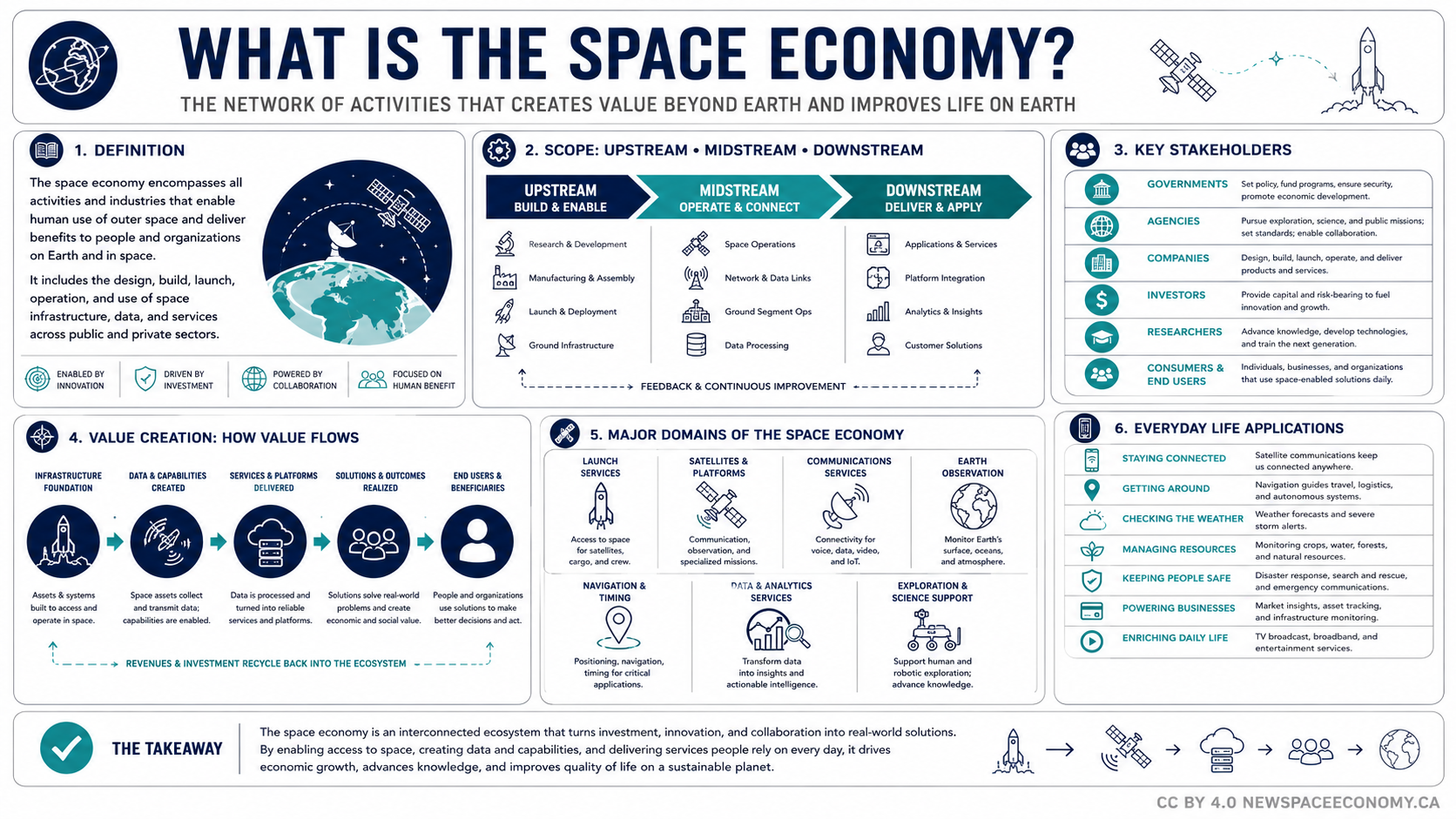
The space economy taxonomy can be understood through three broad layers. Backbone markets create and operate space infrastructure. Reach markets apply that infrastructure to economic activity on Earth. Emerging markets seek to provide services in orbit, near the Moon, on the lunar surface, or farther from Earth.
This layered model helps prevent a common misunderstanding. The space economy is not a collection of unrelated rocket and satellite companies. It is a connected production and service system in which organizations exchange hardware, software, data, infrastructure access, professional expertise, financing, risk protection, and customer outcomes.
Core Space Activity
Core space activity includes products and services that directly depend on access to space. Remove spacecraft and orbital operations, and these activities would lose their commercial purpose.
Core activities include:
- Space science and engineering research
- Satellite and spacecraft manufacturing
- Rocket and propulsion manufacturing
- Launch and reentry services
- Payload integration
- Spaceport operations
- Mission control
- Satellite communications
- Earth observation
- Positioning, navigation, and timing
- Space surveillance and tracking
- Orbital transportation
- Human spaceflight
- Space station operations
- Satellite servicing
- Space debris mitigation
- In-space manufacturing
- Lunar transportation and surface services
These activities create direct revenue through contracts, product sales, subscriptions, capacity agreements, data licensing, service fees, and government procurement.
A spacecraft manufacturer receives revenue for delivering a satellite. A launch provider receives payment for transporting it. A ground-station company receives recurring fees for communications access. A data company earns revenue from imagery or analytical products. A broadband operator charges customers for connectivity.
Core activity is easier to measure than broader space-enabled value because the organizations involved usually identify themselves as part of the space sector. Even then, classifications remain difficult. A semiconductor company may sell chips to automobile, telecommunications, medical, and spacecraft customers. Only the space-related share belongs in a narrow space economy account.
A cloud provider may process satellite data but earn most of its revenue from other industries. A telecommunications company may combine terrestrial and satellite services in one contract. Analysts need a method for separating the space-related portion without counting the same transaction twice.
Space-Enabled Economic Activity
Space-enabled activity occurs when another industry uses satellite signals, data, communications, timing, or infrastructure as an input. The customer may not consider itself part of the space industry, yet part of its operation depends on space systems.
Agriculture provides a clear example. Satellite navigation guides farm machinery. Earth observation helps monitor crops. Weather satellites support forecasts. Communications satellites connect remote farms. The agricultural company remains part of the food economy, but its productivity may depend partly on space-based services.
Aviation uses positioning, communications, weather data, timing, emergency beacons, and tracking. Maritime commerce uses navigation, satellite communications, vessel monitoring, weather routing, and Earth observation. Financial systems use precise timing. Energy companies use satellite communications and imagery to monitor remote assets.
The distinction between direct space revenue and enabled economic activity is important. Suppose an agricultural analytics provider earns $5 million from a satellite-supported crop-monitoring service. That $5 million may count as direct downstream space revenue. If customers use the service to improve crop output by $40 million, the larger amount represents an economic effect. Counting the full agricultural revenue as space revenue would exaggerate the size of the direct market.
The broader economic structure can be divided into three layers.
Direct Space Markets
These include spacecraft, launch, ground systems, operations, communications capacity, imagery, navigation services, and other space-specific products.
Space-Enabled Markets
These include services in agriculture, aviation, shipping, energy, finance, insurance, construction, telecommunications, emergency management, and environmental monitoring.
Broader Economic Effects
These include productivity gains, avoided losses, new employment, technology transfers, scientific knowledge, regional development, public safety, and improved decision-making.
The distinction explains why broad estimates of the space economy can be much larger than satellite industry revenue.
Public and Private Activity
Government and commercial activity cannot be separated into two independent systems. They interact at almost every stage.
Governments fund scientific research, operate weather and navigation satellites, purchase launch services, regulate private activity, develop standards, support education, and award defense contracts. Commercial companies manufacture government spacecraft, operate communications networks, process public data, and provide transportation.
Government agencies may own a satellite but purchase its components, launch, ground communications, and software from private companies. A commercial operator may own a constellation but rely on publicly funded research, government spectrum filings, national launch licensing, and government customers.
Public institutions also create early demand. A new technical service may have no immediate mass market, yet a government agency may purchase it for science, defense, weather, disaster response, or infrastructure monitoring. That contract can help the supplier prove performance and attract private customers.
Commercial involvement does not mean that public spending disappears. It changes the contractual relationship. A government may purchase transportation or data as a service instead of designing, owning, and operating every part of the system.
Government commonly provides:
- Research funding
- Early-stage procurement
- National security demand
- Public infrastructure
- Regulatory authority
- Spectrum coordination
- International representation
- Education and workforce programs
- Public scientific data
- Liability and safety frameworks
Commercial organizations commonly provide:
- Product design and manufacturing
- Launch capacity
- Satellite operations
- Network services
- Ground infrastructure
- Data products
- Analytics
- Customer support
- Capital investment
- Market distribution
Both groups can own infrastructure, conduct research, employ engineers, provide services, and carry operational risk. Commercialization is therefore better understood as a change in ownership, procurement, competition, and service delivery than as a complete withdrawal of government.
Why Space Economy Estimates Differ
Economic estimates differ because analysts make different choices about scope, geography, timing, currency, inflation, public budgets, intermediate transactions, and enabled services.
One study may count satellite television subscriptions. Another may count television receivers as well. A broader study may include advertising or media distribution enabled by satellite television. Each added layer expands the estimate.
Ground equipment creates another difference. Some reports count navigation chips, smartphones, automobile receivers, antennas, satellite terminals, and network equipment. Other reports count only specialized space-sector hardware.
Government spending can be measured through agency budgets, contract obligations, actual expenditures, military programs, or public research. Classified defense spending may be incomplete. International comparisons can be difficult because governments categorize their programs differently.
Currency conversion affects global totals. A market measured in U.S. dollars changes when exchange rates move, even if local activity remains the same. Inflation also affects comparisons between years.
Company revenue may cross borders. A satellite operator headquartered in one country may serve customers in dozens of markets. Analysts must decide whether to assign revenue to the operator’s headquarters, the customer location, the satellite owner, or the site where value is produced.
Market publications may include forecasts as well as historical data. Forecasts depend on assumptions about customer adoption, satellite deployment, launch supply, pricing, regulation, competition, and economic growth.
Any responsible comparison should identify:
- The organization producing the estimate
- The year represented by the data
- The categories included
- The categories excluded
- Whether government activity is included
- Whether ground equipment is included
- Whether enabled economic activity is included
- Whether the figure is historical or forecast
- Whether values are nominal or adjusted for inflation
Revenue, Gross Output, and GDP
Revenue measures money received from the sale of products or services. It is useful for examining market demand and company activity. It does not equal economic contribution.
Gross output measures the total value of goods and services produced, including intermediate inputs. Gross domestic product measures value added after subtracting the intermediate goods and services used in production.
Consider a satellite operator that pays a manufacturer, launch provider, insurer, ground-network company, and software supplier. Adding the full revenue of every participant can count the same economic value at several points. GDP accounting reduces this duplication by measuring value added.
The U.S. Bureau of Economic Analysis created a space economy satellite account covering 2012 through 2023. Its 2023 estimates placed the United States space economy at $142.5 billion in current-dollar GDP and $240.9 billion in gross output. The account measured more than 373,000 private-sector jobs and $57.9 billion in private compensation.
In March 2026, the Bureau of Economic Analysis announced that it would no longer produce those statistics on a regular schedule. The 2023 estimates remain the latest regular release in that series as of August 6, 2026.
The difference between $142.5 billion in GDP and $240.9 billion in gross output demonstrates why labels matter. Neither figure is automatically more correct. Each answers a different question.
The measures can be defined as follows:
Revenue
Money that organizations receive from customers.
Gross Output
The value of all goods and services produced before removing intermediate inputs.
GDP Contribution
The value created after subtracting intermediate goods and services.
Employment
The number of jobs associated with the activities included in the measurement.
Compensation
Wages, salaries, and employer contributions paid to workers.
Economic Impact
Direct activity plus supplier and household-spending effects, depending on the study.
Societal Benefit
Economic or public value that may not appear in market transactions.
Direct, Indirect, and Induced Effects
Regional economic studies often divide effects into direct, indirect, and induced categories.
Direct effects occur within the organization or industry being studied. A satellite factory directly employs engineers, technicians, quality inspectors, managers, procurement staff, and administrators.
Indirect effects occur through suppliers. The factory purchases electronics, machined parts, test equipment, software, logistics, security, facility maintenance, and professional services.
Induced effects occur when workers spend their income. Employee spending supports housing, retail, transportation, food services, entertainment, and local government revenue.
These categories help explain why a space facility can affect businesses outside aerospace. They can also produce inflated claims when analysts use optimistic assumptions.
Economic impact depends on how much spending remains in the region. If a factory imports most components, the local indirect effect may be limited. If highly paid employees live elsewhere, part of the household-spending effect leaves the area.
A complete assessment should examine:
- Public subsidies
- Construction costs
- Permanent employment
- Temporary employment
- Local supplier participation
- Imported inputs
- Employee residence
- Tax revenue
- Infrastructure requirements
- Environmental effects
- Opportunity costs
- Long-term operating demand
Gross activity and net public benefit are not the same. A project may create jobs and still impose public costs that need to be included in a balanced assessment.
Market Size and Economic Value
Market size estimates the revenue available to suppliers. Economic value measures the benefit received by customers or society. They are related, but they are not interchangeable.
A government weather satellite may produce limited direct revenue. Its data can still support aviation, agriculture, energy, shipping, emergency response, and public safety.
A navigation signal may be available without a direct charge to ordinary users. Companies build devices, maps, logistics systems, timing tools, and mobility services on top of it. The revenue earned by those companies is distinct from the broader value created by navigation availability.
This difference explains why some of the most economically important space systems are public infrastructure. Their value appears through avoided loss, productivity, reliability, scientific knowledge, and customer applications rather than through an invoice from the satellite operator.
Three economic questions should remain separate:
- How much revenue does the space supplier earn?
- How much value does the customer receive?
- How much benefit reaches the wider economy or public?
These questions may produce very different numbers.
Measuring Consumer Space Activity
Consumers participate in the space economy through satellite television, broadband, navigation, weather applications, emergency messaging, location services, and connected devices.
Many consumer services hide the space component. A smartphone may use signals from several global navigation satellite systems, yet the customer buys the phone rather than a separate navigation subscription.
Analysts must decide how much of the device value belongs to the space economy. Counting the full price of every smartphone would overstate the contribution of navigation. Excluding navigation hardware and services entirely would understate it.
One method estimates the value of the space-specific receiver, chip, service, or software component. Another counts the full device category when satellite capability is considered central. Different publications make different choices.
Consumer markets can generate high revenue because of scale. A small space-related component multiplied across billions of devices can exceed the revenue of specialized spacecraft manufacturing.
This pattern explains why ground equipment appears as the largest category in the Satellite Industry Association’s 2025 industry estimate. The economic weight sits partly in devices and networks used on Earth.
Measuring Government Space Activity
Government space activity includes civil agencies, defense programs, intelligence systems, weather organizations, scientific laboratories, regulatory offices, and publicly funded research.
Budget figures can be difficult to compare. Some governments publish a consolidated space budget. Others distribute spending across ministries. Defense spending may be classified or only partly identified.
A budget authorization does not equal actual expenditure. A contract ceiling does not equal committed work. A multiyear program total does not equal annual spending.
Public spending can support:
- Scientific missions
- Weather and climate monitoring
- Navigation systems
- Communications
- National security
- Launch infrastructure
- Human spaceflight
- Exploration
- Research grants
- Industrial development
- Education
- Regulation
- International cooperation
Government agency budgets should be distinguished from commercial revenue generated through government contracts. The same money can appear in both datasets when analysts fail to account for overlap.
Comparing Measurement Frameworks
The table below summarizes four common approaches to measuring the space economy.
| Measurement Frame | Included Activity | Best Use |
|---|---|---|
| Core Industry Revenue | Hardware, Launch, Operations, Ground Systems | Company And Sector Analysis |
| Space-Enabled Services | Connectivity, Navigation, Timing, Imaging, Weather | Application And Demand Analysis |
| Economic Contribution | GDP, Employment, Compensation, Output, Trade | National And Regional Policy |
| Societal Impact | Avoided Losses, Productivity, Science, Public Benefits | Program And Public-Value Assessment |
Interpreting Market Figures
A market figure should identify its source organization and data year. It should also state whether the figure represents revenue, spending, GDP, output, economic impact, or forecast value.
Narrow and broad definitions should not be treated as interchangeable. A narrow estimate may include spacecraft, launch, and direct operations. A broader measure may include ground systems, customer services, and space-enabled activity.
Forecasts should be treated differently from historical data. The text should use terms such as forecast, estimate, projection, or scenario.
Comparing forecasts from two organizations requires a methodological qualification. A $1 trillion forecast based on satellite industry revenue cannot be directly compared with a $1.8 trillion forecast that includes large space-enabled markets.
Five questions help assess any space economy figure:
- What period does the figure represent?
- What activity is included?
- Is the number historical or forecast?
- Which organization produced it?
- What should not be inferred from it?
These questions are necessary because the space economy is an economic category assembled from several sectors rather than a single market with one accounting definition.
How Does the Space Economy Value Chain Turn Technology Into Services?
A satellite-supported crop recommendation begins years before a farmer receives it. Researchers develop sensors. Component suppliers manufacture electronics. Engineers design and test a spacecraft. A launch provider transports it to orbit. Operators command it. Ground stations receive data. Software corrects and analyzes the measurements. An agricultural platform combines the result with weather, soil, and farm records.
The space economy value chain describes how scientific knowledge, physical infrastructure, operations, data, and customer services combine to create economic value.
The chain is often divided into upstream, midstream, and downstream activity. That structure helps explain sequence, but commercial relationships frequently cross the boundaries. A company may manufacture satellites, operate a constellation, process data, and sell customer applications from one organization.
Research and Technology Development
Research begins with a scientific, operational, defense, or commercial question. Engineers and scientists study whether a new instrument, material, propulsion system, communications method, or software capability can address it.
Research organizations include universities, government laboratories, corporate laboratories, nonprofit institutes, and small technology companies. Funding may come from grants, contracts, internal research budgets, defense programs, venture investment, or partnerships.
Basic research expands knowledge without requiring an immediate commercial product. Applied research seeks a defined capability. Technology development moves a concept toward repeatable performance.
Space research often involves long development cycles because systems must survive vacuum, temperature extremes, radiation, vibration, and limited repair access. A promising laboratory result may require years of qualification before customers accept it.
The commercial value of research can appear through:
- Patents
- Licensing
- New products
- Company formation
- Government procurement
- Supplier capability
- Workforce training
- Scientific data
- Manufacturing methods
- Technical standards
Research institutions also absorb risk that private customers may not fund. Astronomy, planetary science, climate observation, and fundamental physics often produce public knowledge rather than direct commercial revenue.
One discovery can support spacecraft, medical devices, industrial sensors, communications systems, or terrestrial software. The path from research to economic value can branch across several industries and may continue for decades.
Component and Subsystem Manufacturing
Spacecraft and rockets contain structures, electronics, sensors, propulsion equipment, power systems, thermal hardware, communications equipment, mechanisms, software, and protective materials.
Component suppliers may produce:
- Processors
- Memory
- Power-control units
- Batteries
- Solar cells
- Antennas
- Transmitters
- Receivers
- Star trackers
- Reaction wheels
- Propulsion valves
- Tanks
- Thrusters
- Optical systems
- Cables
- Connectors
- Structural panels
- Thermal coatings
- Radiation shielding
Space components often require detailed traceability. Manufacturers record material batches, production processes, inspections, tests, and configuration changes. A failure investigation may need to reconstruct the history of one small part.
Qualification demonstrates that a component can survive expected conditions. Acceptance testing confirms that the delivered unit meets requirements.
Flight heritage can influence purchasing. A component that has operated successfully in space may be preferred over a newer design, even when the new design promises better performance.
This preference creates barriers for new suppliers. They need a mission willing to accept limited heritage. Government technology demonstrations and lower-cost small satellites can provide an entry path.
Supplier concentration can create schedule risk. Some radiation-tolerant chips, precision sensors, and propulsion components have few qualified sources. A production problem at one company can affect several missions.
Spacecraft Design and Integration
A spacecraft bus provides power, structure, thermal control, communications, command, data handling, attitude control, and propulsion. The payload performs the mission’s principal task.
Systems engineering connects mission needs with technical requirements. Engineers must balance mass, power, data rate, pointing, reliability, schedule, and cost.
A larger payload may require more power. More power may require larger solar arrays. Larger arrays increase mass and affect structural design. Added mass may require a more expensive launch.
Spacecraft integration combines components into a complete system. Teams verify electrical connections, mechanical interfaces, communications, software, deployment mechanisms, and environmental performance.
Configuration management records which hardware and software versions are installed. This work prevents teams from testing one design and launching another.
Digital models support design and verification. They can simulate thermal behavior, structural loads, orbital conditions, communications links, and mission operations.
Testing cannot reproduce every event. Engineers choose tests based on mission risk, expected conditions, available facilities, and budget.
A highly customized spacecraft may provide unique performance but require expensive engineering. Standardized platforms can reduce cost and schedule. They may limit payload flexibility.
Launch Vehicle Manufacturing
Launch vehicles include engines, tanks, structures, guidance systems, avionics, separation hardware, fairings, and ground-support equipment.
Manufacturing methods vary by provider. Some companies build vehicles in low volumes. Others seek production lines capable of frequent launches.
Engine production requires precision materials, machining, welding, additive manufacturing, inspection, and testing. Propellant choice affects vehicle design, ground systems, storage, performance, and operations.
Reusable stages require recovery equipment, added propellant, landing systems, inspection, and refurbishment. Expendable stages avoid recovery hardware but are discarded.
Production economics depend on flight rate. A factory designed for dozens of vehicles per year may carry high fixed costs if demand supports only a few launches.
Launch-vehicle suppliers face long lead times and strict quality requirements. A defective valve or sensor can delay a mission worth far more than the part.
The launch vehicle factory is connected to engine test sites, transportation systems, launch pads, range services, regulatory processes, and recovery operations. Manufacturing therefore represents one part of a larger operating system.
Payload Integration
Payload integration ensures that the spacecraft fits the launch vehicle and can survive the mission.
Engineers analyze mass, center of gravity, vibration, acoustic loads, electromagnetic compatibility, deployment, separation, and safety.
The payload may require clean-room handling, hazardous-material procedures, battery monitoring, temperature control, or fueling.
Rideshare missions can carry dozens of spacecraft. Integrators coordinate deployment order, separation timing, communications, and collision prevention.
A hosted payload shares a spacecraft with another mission. It reduces the need to build a complete satellite but creates dependence on the host’s schedule, orbit, power, pointing, and lifetime.
Integration can become a commercial service. Customers pay specialists to manage interfaces, documentation, testing, regulatory coordination, and launch-provider communication.
Launch and Orbital Delivery
Launch services sell more than rocket capacity. They include mission design, integration, scheduling, safety analysis, regulatory support, tracking, deployment, and delivery to a defined orbit.
Price depends on:
- Payload mass
- Payload volume
- Destination
- Inclination
- Integration requirements
- Schedule priority
- Mission complexity
- Dedicated or shared launch
- Insurance
- Regulatory work
- Special handling
Cost per kilogram is a useful comparison but not a complete customer price. A small satellite may need a deployment system, integration service, ground support, and transportation after launch.
A rideshare mission lowers cost by dividing launch capacity among customers. The customer receives less control over launch date and orbital destination.
Orbital transfer vehicles can move spacecraft from the launch drop-off point to another orbit. This service can improve flexibility but adds cost and another mission stage.
Launch failure produces concentrated loss. It can destroy spacecraft, delay revenue, interrupt scientific programs, and affect the launch provider’s schedule.
Commissioning
After separation, the spacecraft must establish communications, deploy equipment, stabilize its orientation, confirm power, and begin testing.
Commissioning verifies that the satellite performs as expected in orbit. Operators test communications, propulsion, payloads, pointing, software, and data quality.
A satellite may require orbit raising before service begins. Electric propulsion can reduce propellant mass but may take weeks or months to reach the final orbit.
Commissioning delays revenue. Investors and customers often watch this period closely because a successful launch does not guarantee a functioning satellite.
Insurance policies may define the end of launch coverage and the beginning of in-orbit coverage according to commissioning milestones.
Launch success, deployment success, commissioning success, and commercial service are separate events. A mission can complete one stage and fail at another.
Mission Operations
Operations continue through the life of the spacecraft. Teams monitor telemetry, plan commands, manage power, update software, maintain orbit, respond to anomalies, and protect mission objectives.
Routine activity can be automated. Human operators remain responsible for unusual conditions, safety decisions, and mission planning.
Fleet operations differ from single-spacecraft operations. A constellation may contain thousands of satellites, making automation necessary.
Operations include:
- Telemetry monitoring
- Command preparation
- Orbit determination
- Collision screening
- Maneuver planning
- Payload scheduling
- Ground-station scheduling
- Software updates
- Data management
- Anomaly response
- Customer service
- Regulatory reporting
The operations business can create recurring revenue. A company may operate satellites for customers that own the hardware but lack internal staff.
Mission operations require cybersecurity. Unauthorized access to command systems can threaten the spacecraft and surrounding orbital environment.
Ground Stations
Ground stations communicate with spacecraft through antennas, radios, modems, timing systems, networks, and software.
A satellite in low Earth orbit may pass over one station for only a few minutes. Operators use networks of stations to increase contact opportunities.
Ground-station-as-a-service allows customers to purchase antenna access instead of building dedicated facilities. This model converts a capital expense into a recurring operating expense.
Station location matters. Geography affects orbital coverage. Fiber connections affect data delivery. Weather affects optical links. Spectrum rules affect operations.
A ground network must manage scheduling conflicts when several satellites require the same antenna.
Customer contracts may specify contact time, data volume, latency, availability, and support.
The path from spacecraft to customer can pass through an antenna, communications network, cloud platform, processing system, application, and customer database before the service produces an economic outcome.
Cloud Computing and Data Infrastructure
Cloud platforms store satellite data, run processing software, support mission operations, host customer applications, and distribute products.
Cloud use can reduce the need for each operator to own a large data center. Customers can increase computing capacity during periods of high demand.
Satellite data may require calibration, geometric correction, atmospheric correction, compression, indexing, and archiving.
Application programming interfaces allow software systems to request data or analytical results automatically. This capability helps integrate space-derived information into customer workflows.
Cloud platforms also create dependence. Outages, pricing changes, data-location rules, cybersecurity, and vendor concentration can affect operations.
Some customers require sovereign or secure computing environments. Defense and government users may impose stricter controls than commercial customers.
Data Processing
Raw data often contains instrument effects, noise, missing values, geometric distortion, or atmospheric influence. Processing converts it into usable information.
Earth observation products may be organized into levels. Lower levels retain data close to the instrument measurement. Higher levels provide corrected imagery, physical variables, maps, or analytical results.
Communications networks process signals, route traffic, manage capacity, and enforce service priorities.
Navigation services combine satellite signals with correction data, maps, inertial sensors, or terrestrial networks.
Data quality depends on calibration, validation, metadata, and consistent processing.
A visually attractive image is not automatically accurate. Commercial products need documented methods, known limitations, and repeatable results.
Analytics and Value-Added Services
The value-added service layer turns space-derived inputs into outputs customers can use.
A raw image may become:
- A flood map
- A crop-health score
- A vessel alert
- A wildfire boundary
- A construction-progress estimate
- A methane-emission record
- A damaged-building classification
- A road-access assessment
Satellite capacity may become a managed network with installation, cybersecurity, support, and performance guarantees.
Navigation signals may become a precision-guidance service or verified timing product.
Value-added providers earn revenue through interpretation, reliability, speed, integration, and domain expertise. Customers pay for reduced uncertainty rather than for the existence of a satellite.
Customer Integration
The value chain does not end when a data product is delivered. Customers need the information incorporated into business processes.
A utility may want satellite-derived vegetation alerts inside its asset-management system. An insurer may want flood data connected to policy records. A shipping company may want weather routing linked to fleet software.
Integration requires:
- Data standards
- APIs
- Identity management
- Cybersecurity
- User interfaces
- Training
- Technical support
- Contractual permissions
- Data governance
- Workflow redesign
A technically accurate product can fail commercially if employees cannot use it or if it does not connect with existing systems.
Customer integration can create switching costs. Once a service becomes embedded in operations, replacement may require data migration, retraining, testing, and new contracts.
End-of-Life Management
Every satellite reaches the end of its useful life because of fuel depletion, component failure, payload obsolescence, regulatory requirements, or economic replacement.
End-of-life planning should begin during design. The spacecraft may need propulsion for disposal, passive drag devices, controlled-reentry capability, or movement to a graveyard orbit.
Passivation removes stored energy by venting propellant, discharging batteries, or depressurizing tanks. This reduces fragmentation risk.
Operators need enough remaining capability to perform disposal. A satellite that fails unexpectedly may become uncontrollable.
End-of-life costs are often incurred after the main revenue period. Companies need financial and regulatory incentives to preserve disposal capability.
Circular Space Economy Concepts
A circular space economy seeks to reduce waste through repair, reuse, refurbishment, recycling, and material recovery.
On-orbit servicing could extend satellite life. Modular spacecraft could allow replacement of failed components. Reusable transportation could reduce discarded hardware.
Recycling objects in orbit remains technically difficult. Debris may be fragmented, tumbling, uncooperative, or made from materials that are hard to process.
Circularity must be evaluated through full lifecycle cost. A servicing mission that uses more resources than replacing the satellite may not provide an economic or environmental benefit.
Design standards could make future spacecraft easier to capture, refuel, repair, and recycle.
Linear Chains and Networked Markets
A value chain suggests a sequence, but the space economy behaves more like a network.
A satellite operator can manufacture its own spacecraft. A launch company can operate a communications service. A cloud provider can host ground systems. A telecommunications company can own satellites and terrestrial networks.
Customer demand feeds back into design. Regulation influences business models. Insurance pricing influences engineering. Launch capacity influences constellation size.
Platforms connect many participants. A data marketplace may aggregate products from several satellite operators. A launch broker may combine customer demand. A ground network may serve hundreds of spacecraft.
The customer is not located only at the end. Customer requirements influence every earlier stage, from payload specifications and orbit selection to processing latency and contractual rights.
Where Value Accumulates
Value does not accumulate evenly.
Manufacturing produces large contract payments but may carry low margins when work is highly customized. Launch creates concentrated revenue around missions. Ground services and subscriptions can create recurring income.
Software and analytics may achieve higher margins because one product can serve many customers. They still depend on reliable physical infrastructure and data rights.
Customer-facing providers may capture significant value because they understand the buyer’s problem. A satellite operator selling raw data may receive less revenue than a company that converts the data into a compliance or risk product.
Vertical integration can keep more revenue inside one organization. It also increases capital needs and managerial complexity.
The table below organizes the value chain by output, payment pattern, and commercial exposure.
| Value Layer | Primary Output | Payment Pattern | Commercial Exposure |
|---|---|---|---|
| Research And Components | Knowledge, Parts, Subsystems | Grants, Sales, Milestones | Qualification And Demand |
| Manufacturing And Launch | Spacecraft And Orbital Delivery | Contracts And Mission Fees | Schedule And Technical Failure |
| Operations And Networks | Control, Connectivity, Data Delivery | Recurring Service Fees | Outage, Collision, Cyberattack |
| Applications And Analytics | Decisions, Alerts, Customer Outcomes | Subscriptions, Usage, Licensing | Adoption And Competition |
Which Core Space Markets Generate Revenue?
The satellite industry remains the largest measurable commercial component of the space economy. Under the Satellite Industry Association’s 2025 framework, ground equipment generated $165.2 billion, satellite services generated $105 billion, satellite manufacturing generated $20.4 billion, and commercial launch services generated $12.4 billion.
These figures challenge the public image of the space economy. Rockets receive intense attention because launches are dramatic. Ground equipment, customer terminals, navigation chips, software platforms, network services, and subscriptions produce less visual spectacle, yet they account for far more revenue.
Satellite Manufacturing
Satellite manufacturing includes complete spacecraft, payloads, platforms, subsystems, components, testing, engineering, and integration.
The market contains several production models:
- One-of-a-kind scientific spacecraft
- Customized government satellites
- Standard commercial communications platforms
- Small satellites produced in batches
- High-volume constellation spacecraft
- Hosted payload platforms
- CubeSats assembled from standardized components
A scientific observatory may take more than a decade to design and build. Its instruments may require custom optics, cryogenic systems, radiation protection, or pointing accuracy.
A communications constellation may prioritize rapid production, common components, automated testing, and replacement capacity. The manufacturer expects to build many similar units.
Standardization can reduce cost, but it does not eliminate mission-specific work. Payloads, frequencies, orbits, security needs, and customer requirements still differ.
Manufacturing revenue depends on order volume, contract structure, delivery schedule, and the portion of the spacecraft built internally.
A company that manufactures its own constellation may not report an external spacecraft sale. The manufacturing cost appears as capital investment inside the operator’s business.
This distinction complicates market estimates. Internal production can create real industrial activity without producing a third-party sale.
Satellite Platforms and Payloads
A satellite platform supports the mission. The payload delivers the customer function.
Platform suppliers can offer standardized buses in several sizes. Customers select power, propulsion, communications, pointing, and payload capacity.
Payloads include:
- Communications transponders
- Optical cameras
- Radar instruments
- Weather sensors
- Navigation transmitters
- Scientific instruments
- Radio-frequency sensors
- Infrared detectors
- Missile-warning sensors
- Technology demonstrations
Payload value may exceed platform value when the instrument is highly specialized.
A standardized platform can shorten development by allowing the payload team to avoid designing common spacecraft functions.
Compatibility remains important. The bus must supply the payload with power, data handling, thermal control, pointing, and communications.
Launch Services
Launch services transported thousands of satellites during 2025. Commercial launch revenue increased to $12.4 billion under the Satellite Industry Association’s methodology.
Launch is a small revenue category compared with ground equipment or communications, yet it influences every orbital market. No satellite can earn revenue before it reaches a usable orbit.
Launch economics depend on fixed and variable costs. Fixed costs include factories, launch pads, engineering teams, test sites, software, regulatory staff, and management. Variable costs include propellant, mission-specific hardware, range support, refurbishment, and labor connected to each flight.
High flight rates spread fixed costs across more missions. Low flight rates increase the cost carried by each launch.
Price is only one customer concern. Reliability, schedule, destination, integration, responsiveness, and insurance affect the decision.
A satellite operator may pay more for a launch that reaches the desired orbit sooner. Delayed revenue can exceed the difference in launch price.
Dedicated Launch and Rideshare
Dedicated launch gives one customer greater control over orbit and schedule. It can be expensive for a small payload.
Rideshare launch distributes cost among several customers. Payloads accept a shared destination and integration calendar.
Rideshare programs have lowered entry barriers for universities, startups, research organizations, and small satellite operators.
Customers may use propulsion or a transfer vehicle to move from the shared drop-off orbit to a preferred destination.
Rideshare introduces coordination demands. Delays caused by one payload can affect others. Deployment planning must reduce collision risk.
Dedicated and shared launch can be compared through price, schedule control, orbital precision, integration complexity, and mission risk. Neither option is superior for every customer.
Reusable and Expendable Launch Systems
Reusable systems recover hardware for another flight. Expendable systems discard stages after use.
Reusability can lower recurring cost when recovery is reliable, refurbishment is limited, and hardware flies frequently.
Recovery hardware adds mass and operational complexity. A reusable stage may carry less payload than an expendable version of the same vehicle.
Expendable systems may remain competitive for missions requiring maximum performance or for vehicles with low production cost.
The economic question is not whether hardware is recovered. It is whether the recovered hardware can fly again at a lower total cost than producing a replacement.
A complete comparison should include:
- Development cost
- Manufacturing cost
- Recovery equipment
- Lost payload performance
- Inspection
- Refurbishment
- Turnaround time
- Flight rate
- Reliability
- Insurance
- Infrastructure
Spaceports
Spaceports provide launch pads, integration facilities, range safety, communications, tracking, storage, transportation access, emergency response, and regulatory support.
Geography influences launch options. Locations closer to the equator can gain rotational assistance for eastward launches. Polar missions need paths that avoid populated areas.
A spaceport may serve orbital launches, suborbital flights, reentry, testing, research, or aircraft-supported systems.
Revenue can come from facility fees, leases, launch support, payload processing, tourism, training, and government funding.
Public investment in a spaceport should be evaluated against realistic launch demand. Facilities with few customers may struggle to cover maintenance and staffing.
Local effects include construction, employment, supplier purchases, tourism, noise, land use, and environmental review.
Satellite Communications
Satellite communications generate revenue through television, radio, broadband, mobile services, enterprise networks, maritime connectivity, aviation connectivity, government services, emergency communications, and network backhaul.
Geostationary satellites remain useful for broadcasting, wide coverage, government communications, and mobility. Low Earth orbit constellations offer lower latency and can provide broad geographic coverage.
The architectures have different economics.
A geostationary satellite provides large capacity from one orbital position but requires expensive spacecraft and launch. Signal delay is higher because of distance.
A low Earth orbit network requires many satellites, continuous replacement, gateways, inter-satellite links, user terminals, and automated operations.
Customer density affects network performance. Demand may be concentrated in cities, shipping corridors, aircraft routes, or military regions. Capacity over empty areas cannot automatically be moved to high-demand areas unless the system is designed for flexible allocation.
Consumer Broadband
Satellite broadband serves homes, businesses, ships, aircraft, government users, and remote facilities.
The operator must finance satellites, launches, gateways, spectrum, network software, terminals, customer support, and replacement spacecraft.
Customer economics include:
- Terminal cost
- Installation cost
- Monthly subscription
- Customer acquisition
- Network capacity
- Support
- Churn
- Equipment replacement
- Billing
- Regulatory fees
A growing subscriber base does not guarantee profit. The provider must recover capital investment and maintain enough network capacity.
Terminal subsidies can accelerate adoption but increase cash requirements. A provider may sell hardware below cost and recover the subsidy through subscription revenue.
Direct-to-Device Connectivity
Direct-to-device services connect satellites with mobile phones or similar devices. Some systems require specialized hardware. Others seek compatibility with ordinary cellular standards.
The business involves satellite operators, mobile network operators, spectrum rights, device manufacturers, regulators, and roaming systems.
Early services may concentrate on messaging, emergency communication, or limited data. Voice and broadband require more capacity.
Commercial agreements must define customer ownership, billing, service areas, network priority, and revenue sharing.
Regulators need to manage interference between satellite and terrestrial services.
The market can expand coverage in remote areas, but performance depends on device power, antenna limitations, satellite capacity, and spectrum availability.
Maritime Communications
Ships use satellite communications for navigation support, weather, operational data, voice, crew connectivity, safety, and regulatory reporting.
Maritime providers often bundle connectivity with cybersecurity, vessel management, entertainment, and technical support.
A shipping company may use more than one satellite network. Multi-orbit systems can combine coverage and performance.
Terminal installation is an important cost. Ships may require antennas designed for motion, salt, vibration, and weather.
Crew connectivity influences recruitment and welfare. Operational connectivity supports maintenance, routing, cargo monitoring, and port coordination.
Aviation Connectivity
Aircraft connectivity requires antennas, onboard networks, satellite capacity, ground systems, certification, installation, maintenance, and airline integration.
Passenger internet is one part of the market. Airlines also use communications for flight operations, maintenance data, crew services, and safety.
Aircraft installation creates downtime and certification cost. Hardware must meet weight, aerodynamic, electromagnetic, and safety requirements.
Network demand changes by route and time. Providers need capacity over busy corridors.
Airlines compare passenger satisfaction, equipment cost, service reliability, bandwidth, weight, and revenue options.
Earth Observation
Earth observation includes optical, radar, infrared, hyperspectral, atmospheric, ocean, and radio-frequency sensing.
The EU Space Market Report 2026 estimated global Earth observation market revenue at €3.5 billion in 2024 and forecast €7.9 billion by 2034.
Earth observation revenue comes from data sales, subscriptions, tasking, analytics, monitoring, platforms, and government contracts.
Optical sensors provide imagery that resembles photography. Clouds and darkness can limit collection.
Synthetic-aperture radar transmits radio energy and measures the return. It can operate at night and through clouds.
Infrared sensors measure heat and other wavelength-dependent characteristics. Hyperspectral sensors collect many narrow spectral bands that can help identify materials or biological conditions.
Radio-frequency monitoring satellites detect emissions from ships, communications equipment, radar, or other transmitters.
Resolution, Revisit, and Latency
Customers often concentrate on spatial resolution, which describes the ground area represented by a pixel. Commercial usefulness depends on several other measures.
Revisit describes how often a satellite or constellation can observe the same location.
Latency describes the time between collection and delivery.
Accuracy describes how closely the product represents the measured condition.
Coverage describes the geographic area available.
Consistency describes whether data remains comparable over time.
Archive depth describes the historical record available for change analysis.
A lower-resolution product delivered quickly may be more valuable for disaster response than a sharper image delivered days later.
Earth Observation Data Products
Raw imagery is rarely the final product. Providers sell corrected images, mosaics, maps, measurements, detections, alerts, and forecasts.
A customer may buy:
- Crop-condition indicators
- Flood extent
- Fire boundaries
- Vessel detections
- Building change
- Construction progress
- Ground movement
- Methane observations
- Forest loss
- Coastal change
- Snow and ice conditions
- Weather variables
Data licensing affects revenue. A customer may receive rights for internal use, redistribution, public release, or model development.
Government programs often provide open data. Commercial companies compete through higher resolution, faster delivery, specialized sensors, customer support, or analytical products.
Positioning, Navigation, and Timing
Global navigation satellite systems provide signals used by phones, vehicles, ships, aircraft, farms, financial networks, telecommunications systems, emergency services, and scientific instruments.
The EU Space Market Report 2026 estimated global navigation satellite system revenue at more than €300 billion in 2024 and forecast more than €580 billion by 2034.
Most value is created through devices, software, maps, mobility platforms, logistics systems, timing services, and customer applications.
Positioning identifies location. Navigation combines location with movement and destination. Timing synchronizes systems.
High-precision services use correction information to improve accuracy. Surveying, agriculture, construction, autonomous machinery, and scientific work may require centimeter-level performance.
Timing Services
Precise timing supports telecommunications, financial transactions, energy networks, data centers, and scientific systems.
A timing receiver may use satellite signals to synchronize clocks. Networks depend on accurate ordering of events.
Timing disruption can create operational and regulatory problems. Companies may purchase monitoring, backup timing, authenticated signals, or holdover clocks.
Timing is an example of space infrastructure becoming invisible. Users may depend on it without knowing that a satellite contributes to the service.
Ground Equipment
Ground equipment generated the largest revenue category in the Satellite Industry Association’s 2025 estimate.
The category includes:
- Navigation receivers
- Satellite television equipment
- Broadband terminals
- Maritime antennas
- Aviation antennas
- Network gateways
- Ground-station equipment
- Consumer electronics
- Modems
- Tracking antennas
- Timing devices
High production volume can make ground equipment economically larger than spacecraft manufacturing.
A navigation chip may cost far less than a satellite component. Billions of devices create a large total market.
User terminals can determine whether a communications network succeeds. Expensive, power-hungry, or difficult-to-install equipment limits adoption.
Weather Services
Weather satellites observe clouds, temperature, moisture, oceans, land, ice, and atmospheric conditions.
Forecast centers combine satellite observations with radar, aircraft data, ground stations, balloons, and computer models.
Weather information supports aviation, shipping, agriculture, energy, emergency management, construction, retail, and public safety.
Commercial providers package public and private data into specialized forecasts. A utility may purchase demand forecasts. An airline may purchase route-specific turbulence information. A farm may purchase field-level weather guidance.
The customer pays for relevance, timing, reliability, and integration rather than for a satellite image.
Space Situational Awareness
Space situational awareness describes knowledge of objects and activity in space. Services include tracking, orbit determination, conjunction assessment, reentry analysis, and operational intelligence.
Government networks provide much of the foundational tracking data. Commercial companies operate telescopes, radars, software, and analytical platforms.
Customers include satellite operators, insurers, governments, launch companies, and researchers.
The market grows as orbital populations increase. Operators need accurate warnings without excessive false alerts.
Space Sustainability Services
The Satellite Industry Association estimated approximately $500 million in commercial space sustainability revenue during 2025.
Services include:
- Debris tracking
- Collision-risk analysis
- Maneuver planning
- Disposal systems
- Deorbit devices
- Inspection
- Life extension
- Active debris removal
- Compliance software
- Environmental modeling
Some services have direct customers. Others provide shared benefits that are difficult to monetize.
Active debris removal illustrates the problem. Removing an abandoned object reduces risk for many operators, but no single operator may want to pay the full cost.
Government procurement or regulatory obligations may support early markets.
Orbital Servicing
Orbital servicing can inspect, relocate, refuel, repair, upgrade, or dispose of satellites.
Life-extension vehicles can provide propulsion to a satellite that still has a functioning payload.
Inspection vehicles can help diagnose damage or deployment problems.
Refueling requires compatible interfaces, safe proximity operations, propellant transfer, and customer demand.
Repair is more complex because most satellites were not designed for component replacement.
Commercial viability depends on the value of the client satellite. Replacing a small, inexpensive spacecraft may cost less than servicing it.
Commercial Human Spaceflight
Commercial human spaceflight includes crew transportation, private missions, training, life support, medical services, research, tourism, and station operations.
Customers include governments, research institutions, companies, wealthy individuals, media organizations, and national astronaut programs.
Human spaceflight carries higher safety and liability requirements than uncrewed missions.
Training, medical screening, emergency procedures, life support, and crew support add cost.
A sustainable market requires repeat demand rather than a small number of publicity missions.
Commercial Space Stations
Commercial stations seek revenue from government astronaut missions, research, national programs, tourism, manufacturing, media, and technology testing.
NASA is pursuing a transition from the International Space Station toward commercially owned destinations. As of July 6, 2026, NASA was seeking industry input concerning the next development phase rather than treating a complete replacement market as established.
Station economics depend on utilization. Laboratories, crew quarters, power, communications, and transportation must generate enough demand.
Government purchases may support early operations. Providers still need commercial or international customers to reduce dependence on one agency.
In-Space Manufacturing
In-space manufacturing uses microgravity, vacuum, or other space conditions to produce materials, biological products, structures, or components.
Research has examined pharmaceuticals, protein crystals, optical fibers, alloys, semiconductors, tissue, and advanced materials.
A commercial product must provide enough added value to cover launch, operation, quality control, and return to Earth.
Producing a unique sample in orbit proves technical capability. It does not prove repeatable manufacturing economics.
Markets may develop where a small quantity of high-value material produces a large customer benefit.
Space-Based Research Services
Companies sell access to microgravity through orbital platforms, suborbital flights, parabolic aircraft, sounding rockets, and drop facilities.
Customers include universities, pharmaceutical companies, materials researchers, technology developers, and government agencies.
Services may include experiment design, payload integration, operations, data collection, and sample return.
Standardized experiment containers can reduce cost. Customers need reliable scheduling and clear ownership of results.
Space Tourism
Space tourism includes suborbital flights, orbital missions, future station visits, training, and hospitality.
Suborbital service offers a shorter experience and lower technical burden than orbital missions.
Orbital tourism requires launch, reentry, life support, training, accommodation, and longer mission operations.
Demand depends on price, safety, schedule, customer experience, and public confidence.
A few wealthy customers do not establish a mass market. Lower prices require high flight rates and dependable operations.
Space Insurance
Space insurance supports launch, satellite operations, liability, facilities, cyber exposure, and human missions.
Insurance does not create the spacecraft service, but it helps allocate financial loss.
Underwriters need technical data, launch history, operator experience, mission design, and exposure information.
The insurance market can influence engineering. Higher premiums may encourage added testing or design changes.
Large losses can reduce underwriting capacity and increase prices.
Professional Services
Law firms, consultants, accountants, recruiters, trainers, logistics providers, marketing companies, and engineering specialists support the space economy.
These firms help organizations obtain licenses, negotiate contracts, manage programs, raise capital, recruit workers, and enter markets.
Professional services grow as the sector becomes more commercially complex.
A startup may need regulatory advice before launch, export-control advice before sharing data, and contract expertise before selling to government.
Comparing Core Market Characteristics
The table below compares several core markets by customer, payment model, capital intensity, and stage of commercial development.
| Market | Primary Customer | Payment Model | Capital Need | Market Stage |
|---|---|---|---|---|
| Satellite Communications | Consumers And Enterprises | Subscription And Capacity | High | Established |
| Earth Observation | Government And Business | Licensing And Analytics | Medium To High | Expanding |
| Launch Services | Satellite Operators | Mission Fee | Very High | Established |
| Orbital Servicing | Operators And Government | Mission And Service Fee | High | Early Commercial |
| Lunar Services | Government And Research | Delivery And Infrastructure Fees | Very High | Demonstration And Early Service |
How Do Space-Enabled Applications Create Value on Earth?
Space-enabled applications convert orbital capabilities into economic outcomes on Earth. Their value comes from better information, wider communications coverage, accurate positioning, synchronized timing, and the ability to observe large or remote areas.
A customer rarely buys space capability as an abstract product. A farmer buys better field management. A shipping company buys safer and more efficient voyages. An insurer buys improved risk information. An airline buys connectivity and operational support.
The economic analysis should therefore begin with the decision or problem and then trace the enabling technology, service provider, payment mechanism, and resulting benefit.
Agriculture
Agriculture uses positioning, Earth observation, weather information, communications, and timing.
Navigation-guided machinery supports planting, spraying, fertilizing, cultivation, and harvesting. Accurate guidance can reduce overlapping passes.
Correction services improve positional accuracy. High-precision systems support controlled traffic, row alignment, and repeatable machine paths.
Earth observation provides information about vegetation, moisture, crop development, flooding, drought, and storm damage.
Satellite data cannot diagnose every field problem. Crop stress may result from water, disease, nutrients, pests, or soil conditions. Farmers combine imagery with field inspection and agronomic knowledge.
Weather information affects planting, irrigation, harvest, livestock, storage, and transportation.
Satellite communications connect farms beyond terrestrial broadband coverage. Connectivity supports equipment monitoring, market information, education, telemedicine, and safety.
Governments use satellite information for crop estimates, drought response, food security, and agricultural policy.
Across a single growing season, navigation, imagery, weather, communications, and analytics can enter at different points, from field preparation to harvest and insurance settlement.
Forestry
Forestry applications use imagery to map land cover, measure change, identify fire damage, estimate biomass, monitor roads, and support certification.
Optical imagery provides visual evidence of clearing and regrowth. Radar can collect information through cloud cover.
Analysts compare observations over time to identify change. Automated detection needs validation because seasonal changes, shadows, and agricultural activity can resemble forest loss.
Fire monitoring uses thermal observations, weather data, smoke information, and vegetation conditions.
Forestry companies use satellite communications in remote areas. Navigation supports crews, machinery, and asset mapping.
Governments and environmental organizations use satellite records to monitor concessions, protected areas, and restoration.
Fisheries
Fisheries management combines vessel tracking, satellite imagery, ocean conditions, licensing data, and patrol information.
Satellite data can help identify vessels operating in restricted areas or near protected zones. A vessel that stops transmitting its identity is not automatically engaged in illegal activity, so analysts need supporting evidence.
Ocean-color and temperature data can help estimate conditions associated with fish distribution.
Communications support crew safety, weather routing, reporting, and coordination.
Governments use satellite-supported tools to allocate patrol resources. Fishing companies use them to improve operations.
Observation, suspicion, verification, enforcement, and legal proof are separate stages. Satellite information can support each stage without replacing human investigation or judicial standards.
Maritime Shipping
Commercial shipping depends on navigation, communications, weather, timing, tracking, and port coordination.
Satellite navigation supports position and route planning. Weather services help vessels avoid dangerous conditions and reduce fuel consumption.
Satellite communications connect ships with companies, ports, families, maintenance specialists, and emergency services.
Vessel-tracking data supports ports, insurers, governments, commodity traders, and logistics companies.
Earth observation can monitor sea ice, oil spills, vessel activity, port congestion, and coastal conditions.
Shipping companies may combine several networks to achieve coverage and redundancy.
The economic outcome appears through fuel savings, safety, schedule reliability, maintenance, and cargo visibility.
Aviation
Aviation uses satellite navigation for route planning and approaches. Communications connect aircraft beyond terrestrial coverage.
Weather satellites contribute observations used in forecasts. Airlines alter routes and altitude based on storms, winds, turbulence, and volcanic ash.
Satellite tracking improves awareness over oceans and remote areas.
Passenger connectivity creates a direct commercial service. Operational connectivity supports maintenance data, crew communication, and airline systems.
Search-and-rescue satellites receive emergency beacon signals and relay distress information.
An aircraft functions as a mobile node connected with navigation satellites, communications satellites, weather systems, airline operations, and ground control.
Road Transportation
Road transportation uses navigation, mapping, fleet tracking, timing, traffic information, and emergency services.
Fleet operators monitor vehicle position, estimated arrival, fuel use, driver hours, and route performance.
Navigation data combines with terrestrial maps and traffic information. The satellite signal provides position, but the commercial service comes from software and data integration.
Road tolling, usage-based insurance, and delivery verification may use location information.
Autonomous and driver-assistance systems combine satellite positioning with cameras, radar, lidar, inertial sensors, and maps.
Satellite service provides one input. Safe operation depends on sensor fusion and system design.
Rail Transportation
Rail operators use positioning, communications, timing, weather information, and Earth observation.
Navigation supports asset tracking and maintenance. Timing supports network coordination.
Earth observation can monitor landslides, flooding, vegetation, construction, and ground movement near rail corridors.
Satellite communications may provide backup links in remote regions.
The economic benefit comes from improved safety, maintenance planning, and service reliability.
Logistics
Logistics companies use location, timing, connectivity, and weather data to coordinate movement.
Satellite navigation helps determine where an asset is. Software estimates arrival, identifies delay, assigns routes, and updates customers.
Warehouses use precise timing and positioning for automation, inventory, and yard management.
Satellite communications connect remote assets and provide backup connectivity.
Earth observation can monitor ports, roads, canals, storage areas, and construction.
The customer-facing value is supply-chain visibility rather than the navigation signal.
Energy
Energy companies operate pipelines, power lines, offshore platforms, wind farms, solar farms, mines, and remote facilities.
Satellite communications connect sites beyond terrestrial networks. Earth observation monitors land change, vegetation, water, flooding, subsidence, and construction.
Weather forecasts support demand planning and renewable-energy output estimates.
Utilities monitor vegetation near transmission lines. Radar measurements can identify ground movement near infrastructure.
Navigation supports field crews, surveying, and asset records.
Satellite information complements ground sensors and inspections. It does not replace them.
Oil and Gas
Oil and gas companies use imagery to monitor pipelines, facilities, construction, land movement, and environmental conditions.
Methane-monitoring satellites seek to detect large emissions. Performance depends on concentration, weather, sensor capability, and revisit.
Offshore facilities use satellite communications for operations and crew support.
Commodity analysts use imagery to estimate storage or activity. Physical appearance does not always equal production, so commercial analysis requires caution.
Regulators can use satellite observations to prioritize inspection.
Mining
Mining companies use mapping, imagery, positioning, communications, weather information, and environmental monitoring.
Satellite data supports exploration, road planning, site development, waste monitoring, water management, and rehabilitation.
Remote mines need dependable communications for operations and worker welfare.
High-precision positioning supports surveying and machinery.
Investors and governments may use imagery to track physical activity, but production estimates require additional data.
Construction
Construction companies use surveying, machine guidance, imagery, communications, and weather information.
Precise positioning supports grading, excavation, layout, and asset mapping.
Earth observation can monitor large infrastructure projects, roads, pipelines, ports, and urban development.
Satellite data is less suited to detailed interior work. Drones and ground sensors provide closer views.
A combined monitoring system can compare planned and actual progress.
The economic value comes from reduced rework, improved scheduling, documentation, and risk management.
Insurance
Insurers use imagery, weather data, environmental records, and location information.
Before a policy is issued, satellite information can help assess flood, wildfire, storm, agricultural, or infrastructure exposure.
After an event, imagery can support damage mapping and inspection planning.
Automated detection can speed assessment, but high-stakes claims may require human or ground verification.
Parametric insurance pays according to a measured trigger. Satellite rainfall, vegetation, flood, wind, or temperature data may help define it.
Basis risk occurs when the trigger differs from the customer’s actual loss.
Banking and Finance
Financial networks use precise timing to order transactions and synchronize systems.
Banks and investors use geospatial data for property, commodities, infrastructure, climate exposure, and market analysis.
Satellite observations can provide independent evidence of construction, port activity, crop conditions, retail traffic, or industrial operations.
Interpretation can be uncertain. An image may reveal physical change without explaining its cause or financial importance.
Financial users need provenance, repeatability, legal rights, and clear error rates.
Telecommunications
Terrestrial telecommunications companies use satellites for backhaul, backup, rural service, emergency restoration, and direct-to-device connectivity.
A mobile operator can connect a remote tower through satellite links.
Hybrid networks can switch between terrestrial and satellite capacity.
Timing signals help synchronize network equipment.
Satellite systems may extend coverage, but they do not remove the need for devices, local distribution, power, customer support, and affordable service.
Media and Broadcasting
Satellite broadcasting distributes television, radio, and live events across large regions.
The business includes content providers, satellite operators, ground stations, broadcasters, advertisers, and consumer equipment.
Streaming has changed media consumption, but satellites remain useful for distribution and remote coverage.
News organizations use satellite communications for live reporting from locations without dependable terrestrial networks.
Media companies also purchase Earth imagery and astronaut content.
Retail
Retail businesses use weather data, navigation, logistics, mapping, and location analysis.
Weather influences inventory, staffing, advertising, and distribution.
Location services support delivery, store finding, and customer applications.
Satellite imagery can help analyze construction, urban growth, parking use, or disaster damage.
The space contribution is usually embedded in a larger software service.
Emergency Management
Emergency organizations use imagery, weather, navigation, communications, and search-and-rescue systems.
Before a disaster, satellite-supported maps help identify hazards and plan evacuation.
During response, imagery can reveal flooding, fire, blocked roads, damaged infrastructure, and isolated communities.
Portable terminals restore communications when terrestrial networks fail.
Navigation supports field teams and supply delivery.
Speed determines operational value. Data delivered after the immediate emergency may still support recovery.
Wildfire Management
Weather, thermal sensors, optical imagery, communications, and navigation support wildfire management.
Satellites can detect heat, smoke, vegetation conditions, and burn extent.
Low-resolution systems may detect broad events frequently. High-resolution systems provide more detail but may revisit less often.
Fire agencies combine satellite data with aircraft, towers, ground crews, cameras, and weather stations.
Detection, confirmation, response, and recovery are separate stages supported by different forms of information.
Flood Management
Weather forecasts and Earth observation support flood preparation and response.
Radar imagery is useful because clouds often accompany floods.
Analysts map water extent and compare it with buildings, roads, utilities, and population.
Navigation and communications support emergency teams.
Insurers use post-event imagery to plan claims assessment.
Flood maps depend on terrain data, sensor timing, and interpretation. A single image may miss rapidly changing conditions.
Search and Rescue
Emergency beacons transmit distress signals that satellites can detect and relay.
Navigation supports rescue teams. Weather information affects response planning.
Satellite communications maintain contact in remote regions.
Search-and-rescue systems demonstrate public value that cannot be measured through ordinary subscription revenue alone.
A distress signal passes from the beacon to a satellite, ground station, coordination center, and rescue team, connecting orbital infrastructure with a life-saving terrestrial response.
Climate Monitoring
Climate monitoring requires stable observations over long periods.
Satellites measure sea level, ice, ocean temperature, atmospheric gases, vegetation, land cover, radiation, and water.
A long data record requires calibration between successive instruments. Changes in sensors can create apparent trends that do not reflect the environment.
Public missions produce much of the underlying data. Commercial providers offer specialized measurements, higher revisit, or faster delivery.
Climate information supports public policy, infrastructure planning, finance, insurance, and scientific research.
Environmental Compliance
Companies and regulators use satellite data to monitor land disturbance, emissions, water, forests, mining, construction, and protected areas.
Observations can support inspection planning. They do not automatically establish legal liability.
Evidence needs documented collection, processing, accuracy, and chain of custody.
Commercial providers may sell compliance dashboards, alerts, and audit records.
The value lies in recurring monitoring across large areas.
Urban Planning
Cities use imagery, navigation, environmental data, and mapping.
Satellite observations help monitor land use, heat, vegetation, subsidence, water, urban expansion, and construction.
High-resolution data can support planning, but privacy and fairness need consideration.
City departments often need updated maps and asset records rather than raw imagery.
Integration with local data determines usefulness.
Smart Infrastructure
Infrastructure operators use positioning, timing, communications, and observation.
Digital twins may combine design records, sensors, maintenance history, and satellite data.
Ground-motion measurements can support monitoring of dams, bridges, tunnels, and buildings.
Satellite communications can provide backup links for important facilities.
The commercial service needs to produce alerts that engineers can trust.
Public Health
Satellite data supports environmental health, disaster response, logistics, and remote care.
Weather and land observations can help map heat, smoke, standing water, vegetation, or access routes.
Satellite communications support telemedicine and health services in remote locations.
Health analysis requires ground data and medical expertise. Satellite observations alone cannot establish disease causation.
Education
Satellite communications connect remote schools and research stations.
Educational institutions use satellite data for science, geography, agriculture, climate, and engineering.
Student satellite programs provide practical training.
Space missions can encourage participation in science and technology, but education benefits require sustained teaching resources.
Development and Humanitarian Assistance
Humanitarian organizations use satellite communications, imagery, navigation, and weather information.
Maps support refugee response, disaster assessment, food security, and infrastructure planning.
Data can be incomplete or politically sensitive. Organizations need ethical rules for privacy and security.
Access to imagery does not guarantee local capacity to use it. Training, computing, language, and institutional knowledge affect results.
Economic Development
Countries without launch systems can participate through applications, data analysis, ground stations, education, regulation, components, and services.
Space-enabled development can support agriculture, communications, public health, mapping, weather, and emergency response.
A national strategy should begin with local needs rather than prestige.
Several entry paths exist into the space economy, and a domestic rocket is not a requirement for meaningful participation.
Who Buys Space Products and Services and How Do Business Models Work?
The space economy becomes commercially sustainable when an identifiable customer pays for a product, service, or outcome. A technical demonstration can prove that something works. It does not prove that enough customers will purchase it at a price that covers cost.
The space customer segmentation framework separates government, defense, enterprise, scientific, institutional, consumer, and emerging off-Earth buyers.
Civil Governments
Civil governments purchase scientific missions, weather systems, Earth observation, communications, navigation, launch, research, and exploration services.
A civil agency may own the spacecraft or purchase data from a commercial operator.
Government demand often supports services with public benefits that private customers would not finance independently.
Procurement can provide:
- Research funding
- Technology demonstrations
- Development milestones
- Advance purchases
- Long-term service contracts
- Shared infrastructure
- Anchor-customer commitments
Government buyers need transparency, safety, compliance, and public accountability. Procurement can take longer than ordinary commercial sales.
Budgets change with political priorities. Companies dependent on one program face concentration risk.
Defense and Intelligence Customers
Defense customers buy secure communications, imagery, warning, tracking, navigation, launch, weather, and analytical services.
Requirements may include encryption, assured access, supply-chain controls, geographic restrictions, cybersecurity, and operation under hostile conditions.
Commercial systems can supplement government-owned assets. Distributed constellations may provide resilience.
Dual-use technology serves both civil and defense customers. The same Earth observation satellite can support agriculture, disaster response, border monitoring, and military analysis.
Defense demand can provide large contracts. It can also limit exports or commercial partnerships.
Government as an Anchor Customer
An anchor customer commits to buying enough service to support development of infrastructure.
A government may need a service before private demand reaches scale. Its commitment can reduce investment risk.
NASA’s Commercial Lunar Payload Services initiative purchases lunar delivery from commercial providers. NASA supplies payload demand rather than owning every lander.
The provider may seek other customers for remaining capacity.
An anchor contract does not guarantee a wider market. Other customers must value the service and accept its price.
Prime Contractors
Prime contractors manage large government or commercial programs. They purchase components, subsystems, software, engineering, and professional services.
Suppliers may gain steady work through a prime contractor. They may also become dependent on one customer.
Prime contractors coordinate requirements, schedules, integration, and compliance.
Small companies need to understand procurement standards, quality systems, cybersecurity, and contract flow-down terms.
A contract with a prime may offer less margin than a direct customer sale but can provide market access and flight experience.
Satellite Operators
Satellite operators buy spacecraft, launch, ground services, insurance, software, spectrum support, and analytics.
A communications operator may purchase terminals, gateways, network management, and customer support.
An Earth observation operator may purchase cloud processing and data distribution.
Operators also buy replacement satellites and collision-risk services.
They evaluate suppliers according to reliability, price, schedule, compatibility, and long-term support.
Telecommunications Companies
Telecommunications companies purchase satellite capacity, backhaul, terminals, gateways, software, and managed services.
They may integrate satellite service into mobile, fiber, or enterprise networks.
A telecom provider can become a distribution partner for a satellite operator.
Commercial agreements define coverage, customer ownership, branding, support, and revenue sharing.
Agriculture Companies
Agricultural customers purchase imagery, weather, navigation corrections, connectivity, and analytical software.
The buyer may be a farmer, cooperative, equipment manufacturer, insurer, seed company, government, or commodity trader.
A service needs to connect with farm decisions. A map that does not change planting, irrigation, or risk management may have limited value.
Pricing may be based on acreage, subscription, equipment, or season.
Insurance Companies
Insurers purchase risk maps, weather data, imagery, damage detection, and monitoring.
They evaluate accuracy, coverage, historical consistency, and legal defensibility.
An analytical product must fit underwriting and claims processes.
Insurance customers may prefer recurring access rather than one-time images.
Energy and Mining Companies
These customers purchase communications, imagery, positioning, weather, and monitoring.
Their assets may be remote and expensive. Avoiding one failure can justify substantial service cost.
Sales require domain knowledge and integration with operational systems.
Contracts may include security, data ownership, and service availability.
Maritime and Aviation Customers
Ships and aircraft purchase connectivity, navigation, weather, tracking, and operational services.
Mobility creates technical requirements for antennas, handover, coverage, and certification.
Customer contracts may be based on vehicle, voyage, flight hour, capacity, or data use.
Service interruptions can affect passengers and operations.
Research Institutions
Universities and laboratories purchase launch access, satellite platforms, microgravity research, data, software, and technical support.
Research budgets may be smaller than commercial contracts but can support specialized markets.
Academic customers need access to methods and data. Commercial confidentiality may conflict with scientific openness.
Research missions provide flight experience for new technology.
Consumers
Consumers buy satellite television, broadband, navigation devices, emergency messaging, and spaceflight experiences.
Mass consumer markets require affordable hardware, simple installation, reliable service, support, and recognizable value.
Customer acquisition and churn matter. A network can add subscribers and still lose money if equipment subsidies and service costs are too high.
Consumers may use space-enabled services without realizing it. Navigation and weather are often bundled into devices and applications.
Sovereign Customers
Countries purchase satellites, launch, ground stations, astronaut missions, data, training, and technical assistance.
A sovereign customer may seek scientific capability, communications independence, national security, prestige, education, and industrial development.
Some countries buy complete systems. Others purchase services.
Technology transfer and local participation may be part of the contract.
Sovereign projects can create long-term partnerships but involve political and financing risk.
Business-to-Government Models
Business-to-government companies sell through contracts, grants, framework agreements, and service purchases.
Government sales often require registration, procurement compliance, accounting systems, cybersecurity, and reporting.
Sales cycles can be long. Contracts can be large and stable.
A government contract may include options that are not funded. Companies should distinguish total ceiling from committed work.
Government customers may terminate or reduce contracts according to legal terms.
Business-to-Business Models
Business-to-business companies sell components, infrastructure, data, software, and services to other organizations.
Enterprise customers expect measurable operational or financial benefit.
Sales may require pilots, security reviews, legal negotiation, and integration.
Recurring business-to-business revenue can be attractive because customers remain after a service becomes embedded.
Customer concentration remains a risk.
Business-to-Consumer Models
Business-to-consumer companies sell subscriptions, devices, media, connectivity, safety services, or experiences.
The market can scale quickly but requires marketing, support, billing, and distribution.
Price sensitivity is higher than in many government markets.
Consumer brands need trust. A high-profile technical failure can affect adoption.
Product Sales
A product model sells hardware or software.
Examples include:
- Satellite components
- User terminals
- Antennas
- Ground equipment
- Navigation receivers
- Mission software
- Testing equipment
Product revenue may occur at delivery. Manufacturers need inventory, production capacity, quality control, and warranty support.
Custom products can create high engineering cost. Standard products can serve more customers.
Service Sales
A service model sells access or an outcome without transferring ownership of the infrastructure.
Examples include launch, communications, imagery, ground-station access, mission operations, and analytics.
Service models can create recurring revenue.
The provider remains responsible for infrastructure maintenance and replacement.
Customers avoid a large capital purchase but depend on the provider.
Subscription Models
Subscriptions charge customers monthly or annually.
Satellite broadband, monitoring, software, analytics, and data access commonly use subscriptions.
Predictable recurring revenue helps planning and valuation.
Customer churn reduces lifetime value. Providers need ongoing service quality.
Pricing tiers can reflect coverage, users, data volume, resolution, latency, or support.
Usage-Based Pricing
Usage pricing charges according to consumption.
A provider may charge by image, square kilometer, gigabyte, minute, API call, ground contact, or tasking request.
Usage pricing aligns customer cost with activity. Revenue can be less predictable.
Customers may reduce use when prices are hard to forecast.
Hybrid models combine a base subscription with usage fees.
Capacity Agreements
Capacity agreements reserve satellite bandwidth, payload mass, launch space, antenna time, or station resources.
Long-term commitments can help finance infrastructure.
Customers may negotiate priority, availability, geographic coverage, and performance.
Unused reserved capacity can reduce customer efficiency. Providers may permit resale or flexible allocation.
Data Licensing
Data providers grant customers rights to use data under defined conditions.
Licenses can control:
- Geographic area
- Number of users
- Duration
- Redistribution
- Publication
- Model training
- Commercial use
- Government use
- Archiving
- Derived products
A restrictive license may protect revenue but make integration difficult.
Open data can expand innovation. Commercial providers differentiate through speed, detail, support, or specialized collection.
Software Licensing
Software companies may sell perpetual licenses, subscriptions, or usage access.
Mission planning, simulation, operations, processing, and analytics use software licensing.
Customers need updates, cybersecurity, documentation, and support.
Cloud software can reduce installation burden. Some customers require local deployment for security or regulation.
Infrastructure-as-a-Service
Infrastructure-as-a-service allows customers to rent access to expensive systems.
Examples include:
- Ground stations
- Satellite platforms
- Hosted payloads
- Cloud processing
- Orbital transfer
- Space station laboratories
- Power systems
- Lunar communications
The model lowers customer capital needs.
The provider must maintain utilization. Idle infrastructure still carries cost.
Standard interfaces improve economics.
Satellite-as-a-Service
Satellite-as-a-service providers may supply the spacecraft, launch coordination, operations, and data delivery.
The customer provides a payload or mission requirement.
The model helps organizations without internal spacecraft teams.
Contracts must define mission control, data rights, failure, replacement, and schedule.
Customization can weaken the cost advantage.
Mission-as-a-Service
Mission-as-a-service covers a larger portion of the program. The provider may handle design, manufacturing, launch, licensing, operations, and data.
The customer purchases an outcome rather than a spacecraft.
This model can shorten market entry.
The provider assumes more technical and schedule risk.
A standardized mission architecture supports repeatability.
Ground-Station-as-a-Service
Ground networks sell antenna contact, scheduling, data transfer, and mission support.
Customers pay according to contact time, data volume, or service plan.
The provider spreads infrastructure cost across many satellites.
Coverage, availability, security, and integration determine value.
Operators may use several networks to reduce dependence on one supplier.
Launch-as-a-Service
Launch providers sell transportation and integration.
The service may include mission design, payload processing, regulatory support, and deployment.
Brokerages and aggregators help customers find capacity.
Standardized interfaces and published schedules can simplify purchasing.
Launch remains exposed to delays caused by weather, hardware, range, payload, and regulation.
Data-as-a-Service
Data-as-a-service provides recurring access to satellite data through files, platforms, or APIs.
Customers avoid owning a satellite.
The provider manages collection, processing, storage, and distribution.
Revenue depends on data uniqueness, quality, frequency, and customer use.
Public datasets can create price pressure. Commercial data can compete through performance or service.
Analytics-as-a-Service
Analytics providers deliver measurements, alerts, scores, or forecasts.
The customer buys a decision-support output.
Domain expertise matters. A crop model, maritime alert, and insurance damage estimate require different knowledge.
Validation and transparency influence trust.
A provider may combine data from several satellite operators.
Marketplace Models
Marketplaces connect buyers and sellers of launch capacity, data, ground services, components, or expertise.
They reduce search and transaction costs.
A marketplace needs enough supply and demand. Early growth can be difficult.
Products are not always standardized. Expert review may still be required.
Revenue can come from transaction fees, subscriptions, or service charges.
Platform Models
Platforms provide tools, standards, distribution, or integration for other companies.
A geospatial platform may host several datasets and analytical services.
A mission platform may connect satellites, ground networks, and cloud processing.
Platforms can benefit from network effects when more suppliers attract more customers.
The operator must maintain trust and avoid unfair competition with participants.
Advertising and Sponsorship
Advertising has appeared in broadcasts, mission naming, media content, and branded payloads.
Commercial value depends on audience size and public interest.
Advertising cannot finance most expensive infrastructure by itself.
Regulation and public acceptance may limit some forms of space advertising.
Sponsorship can support education, media, or research missions.
Intellectual Property Licensing
Companies can license patents, software, designs, manufacturing methods, or data-processing technology.
Licensing provides revenue without building every product.
The owner must protect intellectual property and support implementation.
Government-funded inventions may carry licensing conditions.
International licensing involves export and legal considerations.
Vertical Integration
A vertically integrated company controls several stages of production and service.
It may manufacture satellites, launch them, operate the network, build terminals, and sell directly to customers.
Integration can reduce coordination delay and supplier dependence.
It increases capital requirements and managerial complexity.
Internal production may hide whether each unit is competitive.
Specialization
A specialist company concentrates on one component or service.
It can build expertise and sell to several customers.
Specialists depend on market access and standard interfaces.
Customer concentration can be high.
A vertically integrated buyer may prefer internal suppliers.
Product-Market Fit
Product-market fit exists when customers repeatedly pay for a product because it solves a valued problem.
Technical success is not enough.
A satellite launch proves access to orbit. It does not prove demand.
A pilot project provides limited evidence. A paid renewal provides stronger evidence. Expansion within an existing customer provides more.
Companies should examine:
- Customer retention
- Sales cycle
- Pricing
- Usage
- Gross margin
- Support cost
- Contract renewal
- Customer concentration
- Competitive alternatives
Market Creation
Some space companies enter markets that do not yet have established customers.
Government procurement can create early demand.
Market creation requires education, standards, infrastructure, regulation, and demonstrated value.
A company may spend years explaining the product before earning recurring revenue.
Investors need to distinguish a technical possibility from a developing commercial market.
Customer Concentration
A company with one large customer can appear successful but remain financially exposed.
Government budget changes, mergers, procurement decisions, or contract completion can remove revenue.
Customer diversification reduces dependence.
Serving several industries can spread risk, but each industry may require different sales and support.
Revenue concentration matters more than the number of customer logos presented in marketing material.
Revenue Quality
Revenue quality depends on recurrence, margin, enforceability, customer diversity, and payment risk.
A one-time development contract differs from a multiyear subscription.
Backlog needs careful interpretation. Funded orders are stronger than unfunded options.
Contract ceilings do not guarantee revenue.
Revenue can grow without positive cash flow when infrastructure spending remains high.
How Are Space Companies Financed, Valued, and Insured?
Space companies often spend money years before receiving stable revenue. Hardware development, facilities, testing, licensing, launch, and constellation deployment require capital.
The financing method depends on technical maturity, customers, contracts, collateral, management, market size, and risk.
Founder Financing
Founders may finance company formation, prototypes, research, and customer discovery.
Personal funding provides control but is limited.
Founders also contribute unpaid labor, intellectual property, and professional networks.
Early decisions affect later financing. An unclear ownership structure or undocumented intellectual property can create problems.
Friends, Family, and Angel Investment
Early investors may provide capital before institutional firms are willing to participate.
Angel investors can contribute industry knowledge and introductions.
The company needs clear agreements concerning ownership, governance, and risk.
Space ventures may require more capital than ordinary early investors can provide.
Grants
Government grants fund research, prototypes, education, regional development, or small-business innovation.
Grants do not require repayment or equity in many cases.
They include eligibility, reporting, cost, and intellectual-property conditions.
Grant funding may not cover sales, marketing, or commercial operations.
A company can become dependent on grants without building customer demand.
Prizes and Competitions
Prizes reward achievement rather than reimbursing every expense.
They can encourage teams to attempt technical goals.
Participants often spend more collectively than the prize amount.
A prize can attract attention and demonstrate capability. It may not create a continuing customer.
Incubators and Accelerators
Incubators provide workspace, mentoring, networks, and technical support.
Accelerators provide a structured program and may invest capital.
Programs can connect startups with agencies, suppliers, investors, and customers.
Quality differs. Companies should assess sector knowledge, terms, and follow-on support.
Venture Capital
Venture capital funds companies expected to grow and produce a future return through sale or public markets.
Investors receive equity and governance rights.
They examine:
- Team capability
- Technology maturity
- Intellectual property
- Market size
- Customer evidence
- Revenue model
- Capital requirements
- Competition
- Regulation
- Exit possibilities
A space software company may reach revenue with less capital than a launch provider.
Hardware ventures need milestones that reduce risk between financing rounds.
Preferred Equity
Venture investors often receive preferred shares.
Preferred terms may include:
- Liquidation preference
- Board representation
- Voting rights
- Information rights
- Anti-dilution protection
- Participation rights
- Approval rights
These terms affect founders and earlier shareholders.
A high valuation can create pressure if later progress does not support it.
Strategic Investment
Large aerospace, defense, telecommunications, technology, energy, and industrial companies invest for strategic reasons.
They may seek access to technology, suppliers, markets, talent, or future acquisition options.
A strategic investor can provide customers, facilities, manufacturing, and credibility.
Exclusivity can limit sales to competitors.
Corporate priorities can change after leadership or budget shifts.
Corporate Partnerships
A partnership may involve joint development, distribution, manufacturing, or market access.
Companies share cost and capability.
Contracts need to define intellectual property, customer ownership, decision authority, and termination.
Unequal partners can create dependence.
A large company may move more slowly than a startup expects.
Government Contracts
Government contracts can fund development or purchase services.
Cost-reimbursement contracts pay allowable costs and may include a fee.
Fixed-price contracts pay an agreed amount. The supplier bears more cost-overrun risk.
Milestone contracts pay when defined work is completed.
Service contracts purchase delivery, data, transportation, or access.
Companies must separate contract ceilings, options, and funded orders.
Other Transaction Agreements
Some agencies use flexible agreements outside conventional procurement structures.
Terms may support shared investment, prototypes, and rapid development.
Intellectual-property and cost-sharing provisions vary.
An agreement is not automatically easier. It still requires performance, reporting, and negotiation.
Advance Purchase Commitments
A customer commits to buying a future product or service if requirements are met.
This commitment can help a company raise financing.
The contract needs clear conditions, price, quantity, and termination rights.
An expression of interest is weaker than a binding purchase obligation.
Deposits and Preorders
Customers may pay deposits for launch, terminals, capacity, or missions.
Deposits provide working capital and demand evidence.
Refund obligations create liabilities.
A large preorder list can be misleading when deposits are small or easily refundable.
Debt
Debt provides capital that must be repaid.
Lenders prefer predictable cash flow, collateral, guarantees, or strong customers.
Pre-revenue space companies may struggle to qualify.
Interest and principal payments continue even when schedules slip.
Debt can reduce ownership dilution but increase insolvency risk.
Venture Debt
Venture debt supplements equity funding.
It may extend cash runway between financing rounds.
Terms can include warrants, covenants, and security interests.
The company needs a realistic repayment or refinancing path.
Venture debt is dangerous when the next equity round is uncertain.
Equipment Finance
Equipment loans or leases fund machinery, test systems, terminals, and facilities.
The equipment may provide collateral.
Specialized space equipment can have limited resale value.
Leasing spreads payment over time.
Ownership, maintenance, and tax treatment affect the choice.
Project Finance
Project finance relies on cash flow from a defined asset or infrastructure project.
It works best with proven technology, long-term contracts, predictable operation, and enforceable rights.
A satellite communications system with committed capacity buyers may qualify.
A speculative resource-extraction concept without established customers is unlikely to attract ordinary project debt.
Lenders analyze construction, operation, demand, regulation, insurance, and counterparty risk.
Export Credit
Export-credit agencies support international sales through loans, guarantees, or insurance.
They can help domestic manufacturers compete for foreign satellite or infrastructure contracts.
Support may require national content.
Political and sovereign risk affect terms.
Development Banks
Development banks may finance communications, Earth observation, climate, or infrastructure projects.
They consider economic and social benefits as well as financial return.
Projects need governance, procurement, environmental, and repayment plans.
Satellite connectivity for remote regions may qualify when it supports development goals.
Public Markets
Public companies can raise capital through shares and bonds.
They must meet disclosure, governance, accounting, and audit requirements.
Investors examine revenue, margins, cash flow, backlog, debt, dilution, and capital expenditure.
Public prices can react sharply to launch failure, contract loss, or financing news.
A public listing does not solve weak business economics.
Special-Purpose Acquisition Companies
Several space companies entered public markets through mergers with special-purpose acquisition companies.
The structure provided access to capital and public investors.
Some companies presented optimistic forecasts that were difficult to achieve.
Public-market scrutiny exposed gaps between projections and actual revenue.
The experience demonstrates the importance of realistic schedules and market assumptions.
Acquisitions
A larger company may acquire a startup for technology, workers, contracts, customers, or market access.
Acquisition value depends on strategic fit and competition among buyers.
A company can create technical value without producing a strong shareholder return if it raised capital at a high valuation.
Integration can cause employee loss or product changes.
Valuation
Valuation estimates the worth of a company or ownership interest.
Methods include:
- Comparable companies
- Comparable transactions
- Revenue multiples
- Earnings multiples
- Discounted cash flow
- Replacement cost
- Asset value
- Strategic value
- Negotiated financing price
Early-stage valuations depend heavily on assumptions.
A company with no revenue may be valued according to team, technology, contracts, and market potential.
Revenue Multiples
A revenue multiple compares company value with annual revenue.
The method is simple but incomplete.
Two companies with equal revenue can have different margins, growth, customer quality, and capital needs.
Hardware revenue may carry lower margins than software revenue.
One-time government development revenue differs from recurring subscriptions.
Discounted Cash Flow
Discounted cash flow estimates the present value of future cash.
The model requires forecasts for revenue, cost, capital spending, taxes, and discount rate.
Small changes in assumptions can produce large valuation changes.
The method is difficult for early-stage space ventures because future demand and schedules are uncertain.
Backlog
Backlog represents contracted work not yet recognized as revenue.
Backlog quality depends on funding, cancellation rights, customer credit, margin, schedule, and performance conditions.
A large contract ceiling is not the same as funded backlog.
Options may never be exercised.
Investors should examine how much backlog is enforceable and profitable.
Market Forecasts
Market forecasts estimate future spending or revenue.
They depend on definitions and assumptions.
The World Economic Forum and McKinsey forecast a $1.8 trillion space economy by 2035. That broad figure should not be treated as the addressable market for every space company.
A launch provider serves only part of the market. A lunar company serves a much smaller developing segment.
A defensible market model begins with customer count, purchase frequency, price, geography, competition, and adoption.
Total Addressable Market
Total addressable market represents the maximum revenue if a company captured all demand within a defined market.
It is often exaggerated.
A company may cite the entire space economy even though its product serves one narrow group.
A better estimate identifies the exact buyers and purchasing behavior.
Serviceable Available Market
Serviceable available market represents the portion that the company can serve with its product, geography, regulation, and distribution.
A satellite operator may lack spectrum or licenses in some countries.
A sensor may be unsuitable for certain applications.
A serviceable market is smaller than a broad global category.
Serviceable Obtainable Market
Serviceable obtainable market estimates what the company can realistically capture.
It considers competition, sales capacity, financing, production, and customer adoption.
This is the most useful market estimate for near-term planning.
A credible model explains the path from potential customers to contracted revenue.
Unit Economics
Unit economics examine revenue and cost for one customer, satellite, launch, terminal, image, or mission.
A broadband operator may calculate:
- Terminal cost
- Installation
- Customer acquisition
- Monthly revenue
- Support cost
- Network cost
- Churn
- Customer lifetime
- Replacement cost
An Earth observation operator may calculate cost per satellite, usable collection, processing, sales, and revenue per customer.
A launch provider may calculate revenue per mission, variable cost, refurbishment, labor, and fixed-cost allocation.
Gross Margin
Gross margin is revenue remaining after direct service costs.
It does not include all research, sales, administration, interest, or capital replacement.
A company can report positive gross margin and remain unprofitable.
Infrastructure businesses need enough margin to replace satellites and equipment.
Customized engineering can reduce margin.
Cash Burn and Runway
Cash burn measures the amount of cash used during a period.
Runway estimates how long available cash can support operations.
A company may approach a technical milestone and still fail if financing arrives too late.
Growth can increase burn through hiring, manufacturing, launch deposits, and terminals.
Management needs contingency plans for delay.
Insurance Fundamentals
Insurance transfers defined financial loss to an underwriter in exchange for a premium.
Coverage depends on policy language, exclusions, limits, deductibles, and conditions.
Space insurance includes pre-launch, launch, in-orbit, liability, property, cyber, and human-flight exposure.
Insurance does not remove engineering risk. It changes who bears financial loss.
Pre-Launch Insurance
Pre-launch coverage can protect spacecraft during transport, storage, processing, integration, and testing.
Damage can occur before the rocket leaves the ground.
Policies define custody, location, and covered events.
Manufacturers and customers need to coordinate responsibility.
Launch Insurance
Launch insurance covers total or partial failure during launch and an agreed early-operation period.
Premiums depend on vehicle history, mission profile, payload, and market conditions.
A launch failure can produce a large claim.
Insurance capacity may tighten after several losses.
In-Orbit Insurance
In-orbit insurance covers failure during operational life.
Coverage may be renewed annually.
Underwriters examine satellite health, design, redundancy, orbit, and operator performance.
A partial failure may reduce capacity without destroying the spacecraft. Policies define how loss is measured.
Liability Insurance
Liability coverage addresses claims for damage to third parties.
National licensing may require financial responsibility.
Coverage can include launch, reentry, facilities, and operations.
Policy limits may be linked to estimated exposure.
Human Spaceflight Insurance
Human missions create life, accident, medical, liability, and property exposure.
Participants may sign informed-consent documents.
Consent does not remove every legal risk.
Insurance availability depends on mission profile, regulation, and experience.
Cyber Insurance
Cyber policies may address data breach, business interruption, response cost, and extortion.
Space systems present unusual exposure because cyber incidents can affect physical assets.
Policies may exclude war, infrastructure failure, or inadequate security.
Customers and underwriters increasingly examine cybersecurity controls.
Contractual Risk Allocation
Contracts assign responsibility for delay, failure, damage, data loss, and third-party claims.
Tools include:
- Warranties
- Indemnities
- Liability caps
- Insurance requirements
- Acceptance tests
- Service levels
- Termination rights
- Force majeure
- Cross-waivers
- Data rights
A technically successful deal can become financially weak if the contract assigns excessive risk to the supplier.
Why Space Companies Fail
Space companies fail through combinations of technical, financial, commercial, regulatory, and managerial problems.
Technology may take longer than expected. Suppliers may miss deliveries. Testing may reveal design changes. Launch schedules may slip.
Customers may delay purchase. Pricing may fail to cover cost. A government program may change.
Management may pursue too many products or hire faster than revenue growth.
Capital markets may close. Debt may become unaffordable.
Competition may reduce price or capture customers.
A failure should not be explained through one dramatic event when several connected weaknesses were present.
How Do Policy, Law, Security, and Sustainability Shape the Space Economy?
Space commerce depends on international treaties, national authorization, spectrum coordination, launch licensing, remote-sensing rules, export controls, environmental review, insurance, contracts, and technical standards.
Regulation is not external to the market. It determines who may operate, where service may be provided, how interference is managed, and which risks organizations must address.
International Space Law
The United Nations space treaties provide the international framework for state activity in space.
The Outer Space Treaty entered into force in 1967. It addresses freedom of exploration, peaceful use, national responsibility, non-appropriation, liability principles, and harmful contamination.
States bear international responsibility for national activities, including those conducted by private entities.
This responsibility supports national licensing and continuing supervision.
The treaty does not provide a complete commercial code. National law and contracts address many operational details.
Non-Appropriation
The Outer Space Treaty prevents national appropriation of outer space and celestial bodies through sovereignty, use, occupation, or other means.
This rule does not answer every question about extracting resources.
Some countries have adopted laws recognizing rights over extracted resources without claiming sovereignty over the celestial body.
Legal debate concerns how resource activity can proceed consistently with international obligations.
Commercial operators need clarity concerning possession, transfer, financing, and dispute resolution.
Liability
The Liability Convention addresses international liability for damage caused by space objects.
Launching states can be liable under different standards depending on where damage occurs.
International liability operates between states. Private contracts and national laws address responsibility among companies.
A launch can involve several launching states through territory, facilities, procurement, or registration.
Insurance and indemnification help allocate financial exposure.
Registration
The Registration Convention supports identification of objects launched into space.
States maintain national registries and provide information to the United Nations.
Registration connects a space object with a state of registry.
Large numbers of satellites increase administrative demands.
Accurate registration supports transparency, responsibility, and space traffic coordination.
National Space Laws
Countries authorize and supervise private space activity through national legislation.
The UNOOSA national space law database provides access to laws from many jurisdictions.
National frameworks may address:
- Launch
- Reentry
- Satellite operation
- Registration
- Insurance
- Liability
- Remote sensing
- Resource activity
- Debris mitigation
- National security
- Foreign ownership
- Enforcement
Companies compare jurisdictions according to market access, legal predictability, cost, and regulatory capacity.
Launch and Reentry Licensing
In the United States, the Federal Aviation Administration licenses commercial launches, reentries, and nonfederal launch or reentry sites within its jurisdiction.
Licensing examines public safety, property, national security, foreign policy, environmental requirements, and financial responsibility.
The transition of licensed operators to the performance-based Part 450 framework reached its March 2026 deadline.
A license can cover an operator and range of missions when requirements are satisfied.
Regulatory efficiency matters, but safety review remains necessary.
Satellite Communications Licensing
The Federal Communications Commission Space Bureau handles United States policy and licensing for satellite and space-based communications within its authority.
Satellite operators need authority for space stations, earth stations, spectrum use, and market access.
Applications undergo technical and public review.
Licensing interacts with international frequency coordination.
A company may have a functioning satellite and still lack authority to serve a market.
Remote-Sensing Licensing
Private remote-sensing systems can be subject to national authorization.
In the United States, the Department of Commerce, through NOAA, licenses private remote-sensing systems under applicable law and regulation.
Rules consider system capability and national security.
Operators may face conditions concerning data, cybersecurity, or operational control.
A company needs regulatory planning before launch because licensing affects customers and data distribution.
Spectrum
Satellites use radio-frequency spectrum for command, telemetry, communications, navigation, radar, and science.
Spectrum is shared among terrestrial and space services.
The International Telecommunication Union coordinates the international framework for radio-frequency spectrum and satellite orbit resources.
National administrations submit filings and coordinate with other administrations.
Operators need domestic licenses as well as international coordination.
Orbital Resources
Geostationary orbital positions have economic value because satellites appear fixed relative to Earth.
Non-geostationary constellations use moving orbital shells.
Spectrum and orbit coordination seeks to prevent harmful interference and support equitable access.
Filings do not guarantee commercial success. Operators need financing, deployment, licenses, and customers.
Deadlines discourage indefinite reservation without use.
Interference
Interference can reduce service quality or prevent operation.
Sources include other satellites, terrestrial transmitters, equipment faults, or intentional jamming.
Coordination may require power limits, antenna patterns, frequency separation, geography, and operating procedures.
Interference disputes can affect investment and market entry.
Monitoring services help operators identify sources.
Export Controls
Space hardware, software, sensors, propulsion, encryption, and technical data may be controlled for export.
A license may be required to share technical information with a foreign person or company.
Compliance affects hiring, travel, cloud systems, factory access, and collaboration.
Export controls protect security interests but can restrict international sales.
Companies need classification and authorization before transferring controlled items.
Sanctions
Economic sanctions can prohibit transactions with designated countries, organizations, or individuals.
Satellite services, launch contracts, components, financing, and insurance may be affected.
Sanctions can change quickly in response to geopolitical events.
Companies need screening and contract provisions.
A technically permissible transaction may still be prohibited by financial restrictions.
Foreign Investment Review
Governments review some foreign investments in space companies because of technology, infrastructure, data, or defense concerns.
Review can delay transactions or impose conditions.
Investors need to understand ownership restrictions and national security policy.
A company serving government customers may face stricter requirements.
Procurement Law
Government procurement determines how public agencies buy space products and services.
Rules address competition, evaluation, cost, conflicts, protests, and contract administration.
Small companies can struggle with administrative burden.
Framework contracts and service purchases can lower barriers.
Transparent procurement supports competition and public accountability.
Intellectual Property
Space projects create patents, software, data, designs, trade secrets, and technical knowledge.
Contracts define ownership and licensing.
Government-funded work may carry rights for the agency.
Joint projects need clear rules concerning background and newly created intellectual property.
Data ownership can be separate from hardware ownership.
Data Rights
Satellite data contracts define collection, access, copying, redistribution, publication, storage, and model training.
Government customers may require broad rights.
Commercial providers may protect exclusivity.
Privacy and national security affect distribution.
Clear rights are necessary for financing and customer integration.
Privacy
High-resolution imagery, location data, and communications can affect privacy.
Laws differ by jurisdiction.
A satellite image may reveal activity at a property without identifying an individual directly. Combined datasets can increase sensitivity.
Companies need data governance, access controls, and lawful use.
Public acceptance affects market access.
Cybersecurity
Space cybersecurity covers spacecraft, ground systems, networks, terminals, software, cloud infrastructure, and suppliers.
Threats include:
- Credential theft
- Malware
- Unauthorized commands
- Data manipulation
- Service disruption
- Supply-chain compromise
- Eavesdropping
- Denial of service
- Insider activity
Security must be designed into systems.
A long-lived satellite may outlast the encryption or software environment available at launch.
Secure updates, authentication, monitoring, segmentation, and response plans reduce exposure.
Defense and Dual Use
Commercial communications, imagery, navigation, and tracking can support defense operations.
Dual-use capability expands demand but creates export and policy constraints.
Commercial operators may become involved in conflict through customer use.
Governments may purchase priority access or reserved capacity.
Contracts should define service during emergencies.
Space Domain Awareness
Space domain awareness includes knowledge of objects, capabilities, behavior, and events in space.
It extends beyond collision avoidance.
Defense organizations use it for security. Civil operators use tracking and coordination.
Commercial providers contribute sensors, data, and analysis.
Data sensitivity can limit sharing.
Orbital Debris
The European Space Agency’s space environment statistics estimated 54,000 objects larger than 10 centimeters in orbit, including approximately 9,300 active payloads, based on its model reference population. It also estimated 1.2 million debris objects between 1 and 10 centimeters and 140 million between 1 millimeter and 1 centimeter.
The ESA active-payload figure differs from the Satellite Industry Association’s 14,266 operational-satellite count because the organizations use different datasets, definitions, and reference dates.
Objects travel at high relative speed. Small fragments can damage or disable a spacecraft.
Debris sources include explosions, collisions, mission-related objects, abandoned satellites, and rocket bodies.
Debris Mitigation
Mitigation seeks to reduce creation of new debris.
Measures include:
- Preventing explosions
- Limiting object release
- Reliable disposal
- Collision avoidance
- Passivation
- Controlled reentry
- Design for demise
- Post-mission maneuver capability
Mitigation is less expensive than removing uncontrolled objects later.
Compliance depends on operator design and performance.
A disposal plan is useful only when the spacecraft retains the ability to execute it.
Active Debris Removal
Active debris removal seeks to capture or alter the orbit of existing objects.
Targets may be large rocket bodies or satellites that create high collision risk.
Technical challenges include detection, approach, capture, control, and disposal.
Legal challenges include ownership, authorization, liability, and consent.
The market has a public-good problem because removal benefits many operators.
Government contracts may support early missions.
Space Traffic Coordination
Space traffic coordination includes trajectory screening, warning, communication, and maneuver planning.
No single global authority directs every spacecraft.
Operators use government and commercial data.
Warnings include uncertainty. A predicted close approach may later appear safe as tracking improves.
Too many warnings can waste fuel and staff time. Missed warnings can cause loss.
Standards for messages and operator contacts improve coordination.
Environmental Review
Launch sites and missions can affect noise, air, water, wildlife, land use, and communities.
Environmental review examines construction, operations, accidents, and cumulative activity.
Launch frequency matters. A site supporting hundreds of missions has different effects from one supporting a few.
Reentry adds atmospheric and ground-safety considerations.
Environmental approval can affect schedule and cost.
Atmospheric Effects
Launch emissions depend on propellant, engine, altitude, and frequency.
Reentering spacecraft and stages deposit material into the atmosphere.
Scientific understanding is developing as launch and reentry rates grow.
Policy needs measurement rather than assumptions based only on individual missions.
Operators may need environmental monitoring and reporting.
Astronomy
Satellite brightness and radio emissions can interfere with astronomy.
Large constellations increase the number of satellite trails in observations.
Operators can reduce brightness through design, orientation, and operational changes.
Radio astronomy requires protection from interference.
The economic value of communications needs to be balanced with scientific use of the sky.
Ethics and Equity
Space infrastructure can provide communications, weather, navigation, and disaster services. Access remains uneven.
Affordability, devices, power, training, and local institutions influence who benefits.
Earth observation can support public safety or intrusive surveillance.
Lunar and orbital activity raises questions about scientific preservation and resource access.
Governance should consider communities affected by launch sites, ground facilities, and environmental effects.
Governance and Economic Effects
The table below connects governance subjects with their economic function.
| Governance Subject | Economic Function | Failure Exposure | Commercial Response |
|---|---|---|---|
| Licensing | Authorizes Operations | Delay Or Market Exclusion | Compliance And Jurisdiction Planning |
| Spectrum Coordination | Protects Communications Access | Interference And Capacity Loss | Filings, Negotiation, Technical Controls |
| Debris Mitigation | Preserves Orbital Access | Collision And Insurance Loss | Disposal, Tracking, Maneuver Services |
| Export Control | Protects Sensitive Technology | Supply And Sales Restrictions | Licensing And Supply Diversification |
How Do Countries, Regions, Workforces, and Supply Chains Build Space Capacity?
Space activity tends to cluster near skilled workers, suppliers, research institutions, customers, test facilities, launch sites, and investment.
A national or regional space economy cannot be created through branding alone. It requires organizations that receive repeat business, workers who can move between employers, and institutions that retain knowledge.
National Space Strategies
A national strategy identifies how space capabilities support public needs, security, science, industry, and economic development.
It should address:
- National priorities
- Existing strengths
- Customer demand
- Public budgets
- Industrial capability
- Workforce
- Regulation
- International partnerships
- Infrastructure
- Procurement
- Research
- Data policy
A strategy that lists ambitions without funding or implementation has limited effect.
Countries do not need to pursue every market. Specialization can create stronger results.
United States
The United States combines civil agencies, defense programs, intelligence organizations, universities, established contractors, startups, capital markets, and large technology companies.
NASA, the Department of Defense, the National Oceanic and Atmospheric Administration, the Federal Aviation Administration, and the Federal Communications Commission influence demand and regulation.
The country has major launch sites, manufacturing centers, research laboratories, and customer markets.
Its commercial strength is connected to public procurement and long-term government research.
Regional clusters include California, Florida, Texas, Colorado, Alabama, Virginia, Washington, and other states.
Europe
Europe combines national programs with the European Space Agency and European Union institutions.
Countries maintain different industrial strengths in launch, satellites, components, Earth observation, navigation, science, and applications.
The European Union operates programs including Galileo and Copernicus.
European policy places attention on strategic autonomy, competition, sustainability, and industrial capacity.
Coordination across countries creates scale but can complicate procurement and geographic distribution of work.
China
China has developed extensive launch, satellite, navigation, human-spaceflight, lunar, and planetary capabilities.
Government institutions remain central. Commercial launch and satellite companies have expanded.
The BeiDou navigation system supports domestic and international applications.
Industrial policy and state procurement influence company development.
Information concerning budgets and company finances may be less transparent than in public-market systems.
India
India’s space capability developed through the Indian Space Research Organisation and public research institutions.
The country has strengths in launch, satellites, applications, remote sensing, navigation, and science.
Private participation is expanding through manufacturing, launch, data, and services.
Policy reform has opened more activity to companies.
India’s large domestic market creates demand for communications, agriculture, weather, mapping, and development applications.
Japan
Japan maintains capability in launch, spacecraft, robotics, science, Earth observation, communications, and industrial technology.
Government programs support research and exploration.
Japanese companies contribute components, satellites, launch services, and robotic systems.
International partnerships are an important part of the national program.
Commercial development seeks to connect established industrial expertise with new markets.
Canada
Canada has longstanding strengths in communications, radar Earth observation, robotics, science, and space medicine.
The Canadian Space Agency’s 2024 sector report stated that Canada’s space workforce reached 13,888 jobs in 2023. The report estimated that the wider economic effects supported a total of 26,480 jobs.
Canada’s sector includes large companies, small businesses, universities, and government programs.
Geography creates demand for communications, remote sensing, navigation, and Arctic monitoring.
Canadian companies participate in international supply chains and government missions.
Australia
Australia has strengths in ground infrastructure, research, communications, remote operations, Earth observation applications, and developing launch activity.
Its geography supports ground stations and southern-hemisphere observation.
Mining, agriculture, maritime activity, and remote communities create demand for space-enabled services.
National regulation and government programs support commercial development.
The sector remains smaller than those of established space powers, making specialization important.
United Kingdom
The United Kingdom has capability in small satellites, communications, applications, science, finance, insurance, and regulation.
London provides access to financial and insurance services.
The country has pursued domestic launch capability and regional space clusters.
Universities and research institutions support technical development.
Policy needs to connect launch ambitions with recurring payload demand.
United Arab Emirates
The United Arab Emirates has used science missions, education, international partnerships, and government investment to build capability.
Its Mars mission increased scientific and institutional experience.
The country seeks commercial and research participation through partnerships and investment.
Long-term development requires local workforce growth and industrial depth.
New Zealand
New Zealand established an orbital launch market through private-sector activity and national regulation.
Its geographic location supports certain launch trajectories.
The sector demonstrates how a smaller country can participate through specialized infrastructure and policy.
Dependence on a small number of companies remains a regional risk.
Emerging Space Nations
Many countries begin with satellite applications rather than launch.
They may invest in:
- Communications
- Earth observation
- Weather
- Navigation
- Ground stations
- Education
- Data analysis
- Regulation
- Small satellites
- International missions
This approach can produce benefits sooner than developing a domestic rocket.
A country can participate through several pathways, including applications, components, research, education, and ground services.
Regional Space Clusters
A regional cluster contains companies, research institutions, workers, customers, suppliers, and facilities.
An anchor organization often begins the process. It may be a space agency center, prime contractor, launch site, university, or satellite operator.
Suppliers locate nearby when demand is repeatable.
Workers prefer regions with several employers because career options reduce personal risk.
Clusters grow through relationships as much as through buildings.
Universities
Universities provide research, graduates, laboratories, and startup formation.
They can operate small satellites, observatories, robotics laboratories, and data programs.
Industry partnerships give students practical experience.
Research funding attracts specialists.
Commercialization offices help move inventions into companies.
A university cannot replace customer demand, but it can support long-term capability.
Colleges and Technical Schools
Space manufacturing needs technicians, machinists, welders, inspectors, electronics specialists, network staff, and facility operators.
Technical education provides these skills.
Programs should be developed with employers.
Hands-on training matters because space hardware requires documentation and quality control.
Apprenticeships connect education with paid work.
Research Laboratories
Government and private laboratories provide specialized equipment, scientists, and test capability.
Facilities may include vacuum chambers, vibration systems, thermal testing, clean rooms, propulsion stands, and electromagnetic testing.
Shared facilities lower entry barriers for small companies.
Scheduling and access can become bottlenecks.
Regional investment in facilities should reflect real demand.
Incubators
Incubators support company formation through workspace, mentoring, legal help, customer introductions, and technical resources.
Space incubators can connect startups with agencies and established firms.
The best programs address procurement and regulation as well as technology.
A large number of startups does not guarantee successful companies.
Follow-on capital and customers remain necessary.
Spaceports and Regional Development
Spaceports can create construction, operations, logistics, security, and tourism activity.
Economic benefit depends on flight frequency.
A facility with several launches per year has different economics from one with occasional tests.
Public agencies should examine operating subsidies and infrastructure cost.
Community effects need consideration.
The relevant measures include announced jobs, permanent jobs, supplier jobs, public expense, and the durability of operating demand.
Manufacturing Facilities
A satellite or rocket factory can support high-skilled employment and supplier spending.
The local effect depends on whether components are purchased nearby.
Factories need reliable power, transportation, skilled labor, and testing access.
Large programs can attract suppliers.
Dependence on one product creates risk when orders decline.
Ground Stations
Ground stations can be located in regions with favorable coverage, clear spectrum, fiber, power, and security.
They create fewer jobs than large factories but can connect a region with global missions.
A network of stations can support several operators.
Optical stations need suitable weather.
Ground infrastructure can support education and research.
Regional Incentives
Governments use grants, tax credits, land, training, and infrastructure to attract space companies.
Incentives should be tied to measurable performance.
A company announcement may not produce the promised jobs.
Agreements can include repayment provisions when commitments are not met.
Public agencies should compare the project with alternative uses of funding.
Workforce Composition
The space workforce includes more than astronauts and aerospace engineers.
Technical occupations include:
- Electrical engineering
- Mechanical engineering
- Software development
- Systems engineering
- Materials science
- Physics
- Astronomy
- Geology
- Biology
- Data science
- Cybersecurity
- Manufacturing
- Quality assurance
- Mission operations
Nontechnical occupations include:
- Finance
- Law
- Policy
- Procurement
- Sales
- Marketing
- Communications
- Human resources
- Education
- Insurance
- Administration
Systems Engineering
Systems engineers connect requirements, subsystems, schedules, and risk.
They manage interfaces and tradeoffs.
The occupation is important because spacecraft are integrated systems.
A change in power affects mass, thermal design, and operation.
Systems engineers need technical breadth and communication skills.
Software Careers
Software supports spacecraft, launch vehicles, ground systems, data processing, simulation, cybersecurity, and customer applications.
Flight software requires high reliability.
Ground software manages missions and networks.
Data software processes large datasets.
Customer software delivers services through dashboards and APIs.
Demand for software skills connects the space sector with the broader technology labor market.
Manufacturing Careers
Manufacturing occupations include machinists, technicians, welders, assemblers, inspectors, and production engineers.
Workers need precision and documentation.
High-volume satellite production creates different skills from one-off spacecraft assembly.
Automation changes tasks but does not remove the need for skilled oversight.
Quality problems can have expensive consequences.
Operations Careers
Mission controllers, flight dynamics specialists, network operators, payload planners, and support engineers keep systems functioning.
Constellation operations rely on automation and exception management.
Human judgment remains important during anomalies.
Operations occur around the clock for many services.
Shift design and employee fatigue affect safety.
Data and Analytics Careers
Earth observation and navigation markets need geospatial analysts, machine-learning engineers, data engineers, scientists, and product specialists.
Domain knowledge matters.
A wildfire analyst needs different expertise from a maritime analyst.
Data quality and validation require specialized work.
Customer communication is part of the occupation.
Business Careers
Space companies need finance, accounting, contracts, procurement, sales, strategy, and program management.
Government contracting knowledge is valuable.
Sales teams need to understand technical products and customer industries.
Financial managers must plan for long development cycles.
Business skills influence whether technical capability becomes revenue.
Legal and Policy Careers
Lawyers and policy specialists address licensing, contracts, export controls, spectrum, liability, intellectual property, privacy, and international law.
Regulatory knowledge can affect company strategy.
Government policy roles shape procurement and national programs.
Legal work increases as commercial activity expands.
Insurance Careers
Underwriters, brokers, actuaries, claims specialists, and technical advisers assess space risk.
They need knowledge of launch vehicles, satellites, contracts, and operations.
Loss data is limited compared with mature insurance sectors.
Technical judgment remains important.
Education Pathways
Students enter through engineering, science, software, business, law, communications, and technical programs.
Practical experience can come from CubeSats, robotics, observatories, internships, and software projects.
Employers value teamwork and systems thinking.
Mid-career workers can transfer skills from aviation, telecommunications, automotive, energy, defense, and manufacturing.
Workforce Shortages
Shortages can occur in systems engineering, cybersecurity, radio-frequency engineering, manufacturing, and experienced program management.
Competition with other industries affects hiring.
Security requirements can limit the available labor pool.
Regions need housing, transportation, accessibility, and quality of life to attract workers.
Training takes time, so workforce planning should begin before facilities open.
Accessibility
Accessible workplaces expand the labor pool.
Remote operations, adaptive technology, flexible schedules, and inclusive facilities allow more people to contribute.
Physical disability does not prevent work in software, analysis, engineering, finance, policy, management, or communications.
Accessibility should be built into facilities and digital systems.
Supply Chains
Space supply chains include raw materials, electronics, structures, software, test equipment, logistics, and professional services.
A spacecraft may contain parts from several countries.
Each part needs documentation and quality control.
Long lead times can affect the entire program.
Supplier failure can delay launch and revenue.
Single-Source Risk
A single-source component has no readily qualified alternative.
The supplier may have pricing power.
A factory disruption or export restriction can stop production.
Companies can reduce exposure through second sources, inventory, redesign, or internal production.
Qualification of an alternative takes time.
Counterfeit Components
Counterfeit or unauthorized parts can enter complex supply chains.
They may fail under space conditions.
Traceability, inspection, testing, and approved suppliers reduce risk.
Small companies can struggle with compliance cost.
A low-price part can create a much larger mission loss.
Inventory Strategy
Inventory protects against shortages but ties up cash.
Electronic parts can become obsolete.
Propellants and materials may require special storage.
Just-in-time procurement reduces inventory but increases schedule exposure.
Companies need risk-based inventory plans.
Export-Dependent Supply Chains
International suppliers provide specialized capability.
Export licensing can delay delivery.
Sanctions and political disputes can remove access.
Currency changes affect cost.
Companies may seek domestic or allied suppliers for sensitive components.
Quality Management
Quality systems document processes, inspections, testing, and corrective action.
Customers may require certification.
Quality is not the same as maximum expense. It is controlled production that meets requirements.
Poor documentation can prevent acceptance even when hardware appears functional.
Standards
Standards define interfaces, processes, data formats, safety, and testing.
They reduce the need to redesign every connection.
CubeSat standards helped create a market for compatible components and deployment systems.
Docking, refueling, communications, and lunar infrastructure also need interoperability.
A standard becomes useful when buyers and suppliers adopt it.
Interoperability
Interoperability allows systems from different organizations to work together.
It supports competition and customer choice.
Proprietary interfaces can create lock-in.
Open interfaces may expand the supplier base.
Safety and cybersecurity still require control.
International Partnerships
International missions share cost, expertise, and political support.
Partners may contribute instruments, launch, operations, or science.
Partnerships create schedule dependence.
Export and data rules need agreement.
Long relationships can strengthen industry and diplomacy.
Distribution of Benefits
Space investment can concentrate in established centers.
Remote communities may use satellite services without receiving industrial jobs.
Regional policy can connect procurement with local suppliers and education.
Small-business participation needs manageable compliance.
Economic development should be measured through lasting capability rather than publicity.
How Are Artificial Intelligence, Robotics, Reusability, and New Infrastructure Changing Space Economics?
Technology changes the space economy when it lowers cost, improves reliability, expands capacity, or creates a product that customers purchase.
A technical advance does not guarantee commercial success. It must connect with demand, financing, regulation, production, and operations.
Artificial Intelligence in Design
Artificial intelligence can help engineers search design options, analyze test data, estimate performance, and identify patterns.
Models can reduce manual analysis.
Engineering decisions still require verification.
Training data may not represent new designs or extreme conditions.
A model recommendation needs explanation when safety is involved.
Artificial Intelligence in Operations
Mission operations generate telemetry from spacecraft and ground systems.
Automated systems can identify unusual behavior, prioritize alerts, and recommend actions.
Constellations need automation because human teams cannot manage every routine event manually.
Operators must prevent an automated error from spreading across a fleet.
Human authorization may remain necessary for high-risk commands.
Artificial Intelligence in Scheduling
Satellite scheduling involves orbits, ground stations, customer requests, weather, power, storage, and communications.
Optimization software can allocate resources.
Earth observation operators need to decide which locations to collect and when.
Communications networks route capacity among users.
Scheduling value can be measured through higher utilization and faster delivery.
Artificial Intelligence in Earth Observation
Machine-learning systems classify land, detect objects, identify change, and estimate conditions.
Training data needs geographic and seasonal diversity.
False detections create customer cost.
Model performance should be measured against the customer task.
Human review remains useful for ambiguous or high-impact decisions.
Onboard Processing
Satellites can process data before transmission.
An Earth observation satellite may discard cloudy images or detect an event.
This reduces downlink demand and delivery time.
Onboard computing uses power and creates heat.
Software updates need security and verification.
Autonomous Navigation
Spacecraft use autonomy for rendezvous, landing, rovers, and deep-space missions.
Communication delay prevents immediate human control far from Earth.
Autonomous systems detect hazards and make local decisions.
Reliability is important because intervention may be impossible.
Simulation and testing cover many scenarios but cannot reproduce every condition.
Robotics
Robots inspect, assemble, collect samples, move cargo, and support science.
Robotic arms operate on space stations.
Rovers explore the Moon and Mars.
Servicing spacecraft approach and interact with satellites.
Commercial economics depend on repeat use and mission success.
Robotic Servicing
A servicing robot may inspect, capture, refuel, or repair a satellite.
Client spacecraft need compatible features.
Approach and capture involve navigation and safety.
A failed servicing attempt can damage both spacecraft.
Customers compare service cost with replacement cost.
Robotic Construction
Future lunar robots may prepare landing pads, move regolith, deploy power, and assemble structures.
Teleoperation can supplement autonomy near the Moon because communication delay is short.
Dust, temperature, terrain, and darkness affect equipment.
Construction demand depends on repeated missions.
A demonstration is not the same as an operating construction market.
Reusable Launch Systems
Reusable launch vehicles seek to fly hardware more than once.
The economic benefit depends on recovery, refurbishment, turnaround, reliability, and flight rate.
A reusable stage needs landing equipment and propellant.
Recovery can reduce payload performance.
Frequent missions are needed to spread infrastructure cost.
The customer benefits when savings produce lower prices or better availability.
Reusable Spacecraft
Crew and cargo spacecraft can also be reused.
Reentry exposes vehicles to heat and mechanical stress.
Inspection and refurbishment determine turnaround.
Reuse can reduce manufacturing demand for replacement vehicles but increase maintenance activity.
Safety standards remain demanding.
Small Satellites
Small satellites reduce the cost of individual missions.
Standard components and shared launch improve access.
They can support communications, observation, science, and technology tests.
Small size limits power, aperture, propulsion, and lifetime.
Constellations can compensate through numbers.
Constellations
Constellations provide frequent coverage, distributed capacity, and redundancy.
They require manufacturing volume, launch cadence, ground networks, spectrum, and automation.
Capital spending occurs before full service.
Partial deployment may provide limited revenue.
Replacement is continuous because satellites have finite life.
Software-Defined Satellites
Software-defined satellites can change routing, processing, coverage, or mission behavior after launch.
Flexibility helps operators respond to customer demand.
Software complexity creates cybersecurity and verification exposure.
Updates need testing and rollback options.
A software platform can support recurring revenue after launch.
Digital Engineering
Digital engineering connects requirements, models, designs, tests, and configuration.
It can reduce error and rework.
Shared data improves supplier coordination.
Tool incompatibility can create problems.
Cybersecurity and intellectual-property protection matter.
Digital Twins
A digital twin represents a physical system through models and data.
Operators can use it to evaluate performance and maintenance.
Accuracy depends on model quality and telemetry.
A digital twin is not a perfect copy of reality.
Commercial value comes from better decisions.
Additive Manufacturing
Additive manufacturing produces parts layer by layer.
It enables complex shapes and lower part count.
Rocket engines use printed components.
Spacecraft use printed structures and ducts.
Parts still require qualification and inspection.
Advanced Materials
Advanced materials reduce mass, withstand heat, resist radiation, or improve strength.
Composites reduce structural mass.
High-temperature alloys support propulsion.
Radiation-tolerant materials protect electronics.
Commercial use depends on production cost and repeatability.
Electric Propulsion
Electric propulsion uses electrical energy to accelerate propellant.
It provides high efficiency but lower thrust than many chemical systems.
Satellites use it for station keeping and orbit raising.
Long orbit-raising periods can delay service.
Power availability limits performance.
Nuclear Power
Radioisotope systems provide long-duration power for missions far from the Sun.
Fission systems could support higher-power lunar or planetary operations.
Nuclear systems involve safety, regulation, security, and public acceptance.
They may enable activity where solar power is insufficient.
Commercial markets remain connected to government programs.
Laser Communications
Optical communications can transmit large amounts of data.
Narrow beams require precise pointing.
Clouds can block optical ground links.
Networks may need geographically distributed stations.
Radio and optical systems can complement one another.
Inter-Satellite Links
Inter-satellite links route data between spacecraft.
They reduce dependence on immediate ground contact.
Constellations can send data to a satellite with access to a gateway.
Links require pointing, network management, and spectrum or optical systems.
They can reduce latency for some services.
Cloud-Native Ground Systems
Cloud-native ground systems use scalable computing and software services.
Operators can deploy processing without owning every server.
Customers can access data through APIs.
Cloud dependence creates pricing and outage exposure.
Secure customers may require specialized environments.
Standardized Spacecraft Platforms
Standard platforms reduce custom engineering.
Customers can integrate different payloads.
Manufacturers gain learning through repeated production.
Standardization may limit unique performance.
A family of platform sizes can address several missions.
Modular Spacecraft
Modular spacecraft separate functions into replaceable or configurable units.
Modules can support upgrade, repair, or manufacturing flexibility.
Connections need mechanical, electrical, data, and thermal standards.
Modularity can add mass and complexity.
Commercial benefit depends on actual reuse.
In-Space Assembly
Assembly in orbit can create structures larger than launch fairings.
Components can be launched separately.
Robots or crews perform connection and verification.
Assembly adds operational risk.
Applications may include antennas, telescopes, stations, and power systems.
In-Space Manufacturing
The in-space economy includes manufacturing, servicing, stations, logistics, and utilities conducted beyond Earth.
Microgravity can change fluid behavior, crystal growth, and material processing.
Commercial products need quality control and customer demand.
Return transportation is necessary for products sold on Earth.
Infrastructure products may be used in orbit.
Reentry Services
In-space manufacturing and research need a method for returning products.
Reentry capsules provide heat shielding, guidance, recovery, and payload protection.
Customers need predictable schedules.
Regulators address public safety and landing areas.
Recovery logistics affect cost.
Orbital Transfer Vehicles
Transfer vehicles move payloads between orbits.
They can serve rideshare customers needing a different destination.
Services may include deployment, hosted operations, or disposal.
Vehicle utilization determines economics.
Standard payload interfaces help.
Propellant Depots
Propellant depots would store fuel or oxidizer for spacecraft.
They could extend mission range and support reusable transportation.
Challenges include storage, transfer, boil-off, interfaces, and demand.
A depot needs enough customers to justify deployment.
Government missions may provide early demand.
Space-Based Computing
Space-based computing concepts propose processing data in orbit.
Potential benefits include lower latency for satellite data and reduced downlink volume.
Power, radiation, thermal management, maintenance, and launch cost create constraints.
Data centers on Earth benefit from inexpensive power and easy repair.
Commercial value needs comparison with terrestrial alternatives.
Space-Based Solar Power
Space-based solar power would collect sunlight in orbit and transmit energy to Earth.
It requires large structures, power conversion, transmission, receiving stations, and safety controls.
The concept could provide continuous generation under some architectures.
Cost and scale remain significant barriers.
Demonstrations do not establish utility-scale economics.
Technology Readiness and Commercial Readiness
Technology readiness measures technical development.
Commercial readiness measures customer demand, production, regulation, and economics.
A technology can be mature without a viable market.
A market can exist before technology reaches reliable performance.
Both dimensions are needed to assess a business opportunity.
Learning Curves
Repeated production can reduce cost as workers, suppliers, and processes improve.
Learning is not automatic. Design changes can interrupt it.
High-volume satellite production benefits from standardization.
Launch operations can improve through repetition.
A stable production program supports supplier investment.
Economies of Scale
Economies of scale occur when unit cost falls as production increases.
Fixed costs are spread across more units.
Large factories can become inefficient when demand is lower than capacity.
Scale works best when products remain similar.
Customized missions limit the benefit.
Network Effects
A service may become more valuable as participation grows.
A tracking network improves with more sensors.
A marketplace attracts buyers when it has more sellers.
A data platform gains value when it adds datasets and users.
Network effects can create concentration and competition concerns.
Commoditization
A product becomes more standardized and price-driven when several suppliers offer similar performance.
Basic satellite capacity, components, or data may face price pressure.
Companies respond through service, integration, brand, reliability, or specialization.
Commoditization can expand adoption by lowering price.
It can reduce supplier margins.
What Could Commerce Beyond Earth Become?
Most space economy revenue serves customers on Earth. Commerce beyond Earth remains smaller and more dependent on government demand.
Future development is likely to occur in stages. Transportation, communications, navigation, power, and operations must exist before large settlements or resource markets can function.
The Low Earth Orbit Economy
Low Earth orbit supports communications, observation, research, human spaceflight, servicing, and planned manufacturing.
Its proximity reduces communication delay and transportation energy compared with the Moon.
The region also has atmospheric drag, congestion, and debris.
Commercial stations, free-flying laboratories, servicing vehicles, and reentry capsules may expand activity.
Government purchases remain an important source of demand.
Commercial Stations
Commercial stations seek customers for research, astronaut missions, national programs, tourism, media, and manufacturing.
NASA’s strategy involves purchasing services rather than owning every future destination.
As of August 6, 2026, the next development phase remained under procurement and industry consultation.
Station operators need transportation, cargo, life support, power, communications, maintenance, and emergency capability.
A station without high utilization can become financially unsustainable.
Microgravity Research
Researchers study biology, materials, fluids, combustion, and human health in microgravity.
Commercial platforms can sell experiment access.
Standard containers and repeat flights reduce cost.
Researchers need dependable schedules and data.
Scientific success does not guarantee a commercial product.
Orbital Manufacturing
Manufacturing in orbit may produce materials or biological products with useful properties.
Products intended for Earth need reentry.
Products intended for space avoid return cost but need an in-space customer.
Quality control is difficult in a remote environment.
A market needs repeat production rather than isolated experiments.
Orbital Tourism
Tourism can provide station revenue.
Customers require transportation, training, accommodation, safety, and support.
High prices limit demand.
Insurance and medical requirements add cost.
Tourism can supplement other revenue rather than support a station alone.
Orbital Servicing
Servicing can extend satellite life and reduce replacement demand.
Inspection and life extension have demonstrated early commercial activity.
Refueling and repair require compatible spacecraft.
The market grows when client assets are valuable and service is cheaper than replacement.
Regulation and liability need clear allocation.
Orbital Logistics
Logistics includes transportation, storage, deployment, refueling, repair, and disposal.
Transfer vehicles can move payloads after rideshare launch.
Depots could store supplies or propellant.
Logistics networks need nodes, schedules, standards, and customers.
Early services may depend on government missions.
Lunar Transportation
The lunar economy begins with transportation from Earth.
Payloads need launch, transfer, lunar orbit, landing, and surface delivery.
NASA’s Commercial Lunar Payload Services initiative purchases delivery for science and technology payloads.
Commercial providers assume substantial mission risk.
A regular market needs repeated missions and customers beyond one agency.
Lunar Landing Services
Lunar landers sell payload mass, power, communications, mobility, or data.
Landing is technically difficult because the vehicle must guide itself without a dense terrestrial navigation network.
Terrain, lighting, dust, and communications affect mission design.
Customers need clear delivery conditions and data rights.
Failure rates influence insurance and pricing.
Lunar Communications
Lunar missions need communication with Earth and other lunar assets.
Relay satellites can support areas without direct Earth visibility.
A commercial network could charge for data, coverage, priority, or availability.
Deployment comes before a large customer base.
Government procurement may support early infrastructure.
Lunar Navigation
Navigation services could support landers, rovers, astronauts, and construction.
A shared system would reduce the need for each mission to build independent capability.
Standards for signals and receivers are necessary.
Customers may pay for accuracy and service guarantees.
International coordination can prevent incompatible systems.
Lunar Power
Power supports communications, instruments, vehicles, habitats, processing, and life support.
Solar energy is available, but local lighting varies.
Long lunar nights create storage challenges.
Nuclear systems may support continuous power.
Power-as-a-service could reduce the equipment each customer brings.
Lunar Mobility
Rovers move instruments, cargo, and people.
Small robotic rovers serve science and prospecting.
Larger vehicles could transport cargo between landing sites and facilities.
Maintenance, dust, terrain, and energy affect operations.
A mobility market needs several destinations and repeat users.
Lunar Construction
Construction may prepare landing pads, roads, berms, shielding, and habitats.
Landing pads reduce dust and surface damage.
Local regolith could provide material.
Robotic equipment would likely perform much early work.
Commercial demand depends on permanent or repeated surface activity.
Lunar Resource Prospecting
Prospecting measures the location, concentration, depth, and physical form of resources.
Remote sensing provides broad indicators.
Surface instruments and drilling provide local evidence.
Commercial mining decisions need detailed information.
Prospecting can become a service before extraction becomes a market.
Lunar Water
Water ice may support drinking water, oxygen, industrial processing, and propellant.
Economic value depends on accessibility, concentration, extraction, purification, storage, and customer location.
Water in difficult terrain may be expensive to recover.
A propellant market needs vehicles designed to buy and use the product.
Resource estimates should not be treated as proven reserves.
Oxygen From Regolith
Lunar minerals contain oxygen bound in chemical compounds.
Extraction requires energy and processing equipment.
Oxygen could support life support or propulsion.
The remaining material may have construction uses.
Commercial viability depends on equipment reliability and demand.
Lunar Metals and Construction Materials
Regolith contains silicon, aluminum, iron, titanium, and other elements.
Processing in space is energy intensive.
Using material locally may be more economical than returning it to Earth.
Construction uses do not require the same purity as electronics.
A local materials market requires active infrastructure projects.
Lunar Science
Science remains a likely lunar customer.
Governments and universities may purchase delivery, communications, mobility, drilling, and sample services.
Commercial providers can support several payloads on one mission.
Scientific sites may need protection from contamination or disturbance.
Research demand can support infrastructure that later serves other customers.
Sovereign Lunar Missions
Countries can purchase lunar payload delivery or astronaut participation.
A sovereign mission can support science, diplomacy, education, and national industry.
Purchasing service is less expensive than developing a complete transportation system.
Demand may be irregular.
Commercial providers need customers with funded programs.
Lunar Tourism
Tourism would require safe transportation, habitats, life support, medical support, and emergency planning.
Prices would remain high under early systems.
Historic sites may attract interest but need protection.
Tourism should not be assumed to finance extensive infrastructure.
A market depends on reliable flights and customer willingness.
Lunar Governance
Lunar operations raise questions about coordination, interference, resource use, safety zones, registration, and environmental protection.
No organization owns the Moon.
Operators need enough separation to protect landing and equipment.
Safety arrangements should not become territorial claims.
Standards and information sharing can reduce conflict.
Asteroid Prospecting
Asteroid missions can study composition, structure, rotation, and accessibility.
Remote observations identify candidate targets.
Close inspection and sample return provide better evidence.
Asteroids differ greatly. Some are solid bodies. Others are loose collections of material.
Commercial planning needs mission-specific data.
Asteroid Resources
Asteroids may contain water, metals, and industrial material.
Water could support in-space propellant or life support.
Metals could support manufacturing under a developed orbital industrial base.
Returning bulk resources to Earth faces high transportation and market risk.
Precious-metal supply could affect terrestrial prices.
Large-scale asteroid mining remains unproven.
Deep-Space Communications
Lunar, asteroid, and Mars missions need commands, tracking, navigation, and data return.
Government networks provide much current capacity.
Commercial relay services may develop as mission count grows.
Optical communications can increase data rates under suitable conditions.
Customers need compatible terminals and service guarantees.
Deep-Space Navigation
Deep-space navigation uses tracking, radio measurements, optical observations, and onboard autonomy.
Navigation services could become shared infrastructure.
Greater mission traffic may create demand for standardized support.
Accuracy needs differ by flyby, orbit, landing, and rendezvous.
Government agencies are likely early customers.
Mars Transportation
Mars missions require launch windows determined by planetary geometry.
Travel takes months.
Cargo and crew systems need life support, radiation protection, power, and reliable propulsion.
Return capability adds difficulty.
A commercial market would depend heavily on government or settlement financing.
Mars Settlements
A Mars settlement would need energy, water, food, habitats, medicine, communications, transportation, maintenance, and governance.
Early activity would depend on Earth.
Local production could reduce imported mass.
Information and intellectual property are easier to export than physical goods.
A settlement economy would begin as a supported outpost rather than an independent market.
Mars Agriculture
Food production would require controlled environments, water, nutrients, light, energy, and biological management.
Local agriculture reduces resupply needs.
Equipment failure could threaten survival.
Agricultural systems would need redundancy and recycling.
Commercial exchange may develop among settlement operators.
Mars Manufacturing
Local manufacturing could produce tools, replacement parts, structures, and containers.
Raw materials need extraction and processing.
Additive manufacturing may reduce inventory but still needs feedstock and design data.
Complex electronics would remain difficult to produce locally.
Repair and remanufacturing may be more important than new production.
Mars Communications
Mars communications experience delays of several minutes each way.
Real-time control from Earth is impossible.
Local autonomy becomes necessary.
Relay satellites could provide surface coverage.
Communication outages occur when the Sun blocks the line between Earth and Mars.
Interplanetary Finance
Conventional finance depends on contracts, enforcement, communication, and predictable cash flow.
Long delays and high risk make ordinary lending difficult.
Government funding, equity, philanthropy, and prepaid services may dominate early projects.
Property and resource rights need clarity.
Insurance would require substantial performance history.
Interplanetary Trade
Physical trade between Earth and distant settlements faces transportation cost and delay.
High-value, low-mass products are more plausible than bulk goods.
Digital exports include research, software, media, design, and intellectual property.
Local production reduces the need for imports.
A trade network needs repeat transport and payment systems.
Economic Maturity Stages
Beyond-Earth markets can be organized into maturity stages.
Scientific Demonstration
A mission proves that a task can be performed.
Government Service
An agency purchases the capability.
Repeated Procurement
Several missions purchase similar services.
Commercial Diversification
Nongovernment customers appear.
Infrastructure Market
Power, communications, transportation, and logistics serve several users.
Self-Reinforcing Demand
Customers create demand for one another’s products.
Most lunar and in-space markets remain in the early stages.
Scenarios Through 2035
The largest space economy growth through 2035 is likely to remain connected to Earth-facing services.
Communications, navigation, Earth observation, defense, ground equipment, software, and data will continue to generate substantial revenue.
Commercial stations, servicing, reentry, and lunar delivery may grow from smaller bases.
A $1.8 trillion space economy does not require asteroid mines or large lunar cities.
Broad forecasts count expansion in ordinary industries using space services.
Scenarios Through 2050
By 2050, repeated lunar missions could support communications, power, mobility, and construction services.
Commercial stations may host research, manufacturing, tourism, and national missions.
Orbital servicing could become common if spacecraft are designed for it.
Resource extraction may progress through demonstration and limited local use.
Mars settlement activity remains more uncertain because of distance and cost.
Conditions for Sustainable Beyond-Earth Commerce
Beyond-Earth commerce needs:
- Paying customers
- Repeat transportation
- Reliable power
- Communications
- Navigation
- Maintenance
- Standard interfaces
- Legal authority
- Insurance
- Skilled workers
- Finance
- Safety
- Supply chains
- Disposal and environmental practices
Announcements do not establish a market.
The strongest evidence is repeated transactions at prices that support continued service.
Summary
The space economy is a connected system of research, manufacturing, launch, operations, ground infrastructure, software, data, customer applications, finance, insurance, regulation, and labor.
Its reported size depends on methodology. The Satellite Industry Association measured a $429 billion global space economy for 2025 through a framework centered on satellite industry revenue and government activity. Space Foundation measured $613 billion for 2024 under a broader structure. The World Economic Forum and McKinsey estimated $630 billion for 2023 and forecast $1.8 trillion by 2035.
These totals should not be compared without examining what each includes. Revenue, gross output, GDP, spending, enabled economic value, and forecasts answer different questions.
The largest commercial value is not confined to rockets and spacecraft. Ground equipment, communications, navigation, timing, Earth observation, software, and customer services produce recurring revenue and large economic effects.
Government remains a customer, investor, regulator, operator, and provider of public infrastructure. Commercial organizations increasingly supply transportation, satellite capacity, data, and operations. Neither side functions independently.
The value chain begins with research and manufacturing but continues through operations, ground networks, processing, analytics, integration, and customer decisions. A satellite image has limited commercial value until a service converts it into information a customer can use.
Business models include product sales, subscriptions, capacity agreements, data licensing, mission services, infrastructure rental, analytics, and government contracts. Commercial success requires product-market fit, customer retention, and unit economics.
Finance determines whether companies survive long development cycles. Venture capital, strategic investment, grants, government procurement, debt, project finance, and public markets suit different stages. Valuation should reflect realistic customers and capital needs rather than broad market forecasts.
Insurance and contracts allocate risk. Regulation determines authority, spectrum access, remote-sensing rights, launch approval, and responsibility. Debris mitigation and traffic coordination protect the orbital environment on which future revenue depends.
Countries and regions build capacity through research institutions, skilled workers, suppliers, customers, infrastructure, regulation, and repeat procurement. Spaceports and factories create lasting benefits only when they receive continuing work.
Artificial intelligence, robotics, reusable systems, standardized spacecraft, cloud platforms, digital engineering, and in-space infrastructure can lower cost or create services. Technical achievement must still connect with customers and sustainable economics.
Commerce beyond Earth will develop through stages. Low Earth orbit has the closest connection to established demand. Lunar transportation, communications, power, navigation, science, and mobility may develop through government-backed procurement. Resource extraction and permanent settlements require infrastructure and customers that do not yet exist at commercial scale.
The space economy should therefore be understood as a collection of interconnected markets at different levels of maturity. Some, including satellite communications, navigation equipment, weather services, ground systems, and launch, already support substantial revenue. Others, including orbital servicing, commercial stations, lunar logistics, resource extraction, and interplanetary trade, remain dependent on demonstrations, public procurement, technical progress, and the development of repeat customers.
Appendix: Top Questions Answered in This Article
What Is the Space Economy?
The space economy includes public and private activities that create value through space research, manufacturing, launch, operations, infrastructure, data, applications, and knowledge. It also includes ground equipment and customer services that depend on satellite communications, positioning, timing, Earth observation, weather information, or other space capabilities.
Why Do Estimates of the Space Economy Differ?
Estimates differ because organizations count different activities. Some concentrate on satellite industry revenue and government spending. Others include ground equipment, consumer devices, or economic activity enabled by space services. Data year, currency conversion, inflation, geography, and accounting methods also affect the result.
Is the Space Economy Mainly About Rockets?
Launch is necessary, but it represents a relatively small share of measured commercial revenue. Ground equipment, satellite services, communications, navigation, data, software, and customer applications generate much larger revenue totals. Rockets provide access to orbit, and the larger economic value often develops after deployment.
What Is the Difference Between the Space Industry and the Space Economy?
The space industry consists mainly of organizations that directly produce space hardware, data, services, or operations. The space economy includes those organizations plus institutions, customer industries, infrastructure, knowledge, and economic effects connected to space-enabled activity.
Who Pays for Space Products and Services?
Customers include civil governments, defense organizations, satellite operators, telecommunications companies, insurers, agricultural businesses, energy companies, airlines, shipping companies, researchers, national programs, and consumers. Each group has different purchasing requirements, budgets, risk tolerance, and service expectations.
How Do Space Companies Make Money?
Space companies earn revenue through product sales, subscriptions, capacity agreements, launch fees, data licensing, analytics, infrastructure access, government contracts, mission services, professional services, and customer support. The strongest business models connect technical capability with a recurring customer problem.
Why Is Government So Important to the Space Economy?
Government funds research, operates infrastructure, purchases services, regulates private activity, coordinates spectrum, supports education, and provides early demand. Commercial companies often depend on government contracts or technology even when they own and operate the final service.
How Does Satellite Data Create Economic Value?
Satellite data creates value after processing, interpretation, and integration. An image can become a crop indicator, flood map, vessel alert, construction measurement, emissions record, or insurance assessment. Customers pay for useful decisions rather than raw measurements alone.
What Limits Space Economy Growth?
Limits include weak customer demand, high capital requirements, technical failure, launch delay, spectrum constraints, regulation, supply shortages, workforce gaps, cyber exposure, debris, insurance cost, and uncertain financing. Growth depends on solving several connected problems rather than one technical barrier.
Will the Lunar Economy Become Self-Sustaining?
A self-sustaining lunar market would need repeated transportation, communications, navigation, power, mobility, maintenance, resource use, and customers beyond one government program. Current activity remains dominated by public procurement, scientific missions, and technical demonstrations.
Appendix: Glossary of Key Terms
Anchor Customer
An anchor customer commits to purchasing enough of a service to support development or operation of infrastructure. Government agencies often serve this function in new space markets where private demand has not reached sufficient scale.
Backlog
Backlog is contracted work that a company has not yet recognized as revenue. Its financial value depends on funding, cancellation rights, customer credit, profit margin, performance conditions, and the likelihood that the work will be completed.
Commercial Space
Commercial space refers to space-related activity conducted through market transactions by private or commercially operated organizations. Government agencies can remain customers, regulators, partners, or investors within a commercial program.
Constellation
A constellation is a group of satellites designed to operate as a coordinated system. Constellations can provide frequent coverage, distributed capacity, redundancy, or continuous service, but require manufacturing, launch, operations, spectrum, and replacement planning.
Direct Economic Effect
A direct economic effect occurs within the organization or industry being studied. Examples include employees hired by a satellite manufacturer, revenue received by a launch company, or spending by a space agency.
Downstream Activity
Downstream activity converts space infrastructure, signals, or data into customer services. It includes communications, navigation applications, Earth observation analytics, weather products, mapping, logistics tools, and other services used on Earth.
Earth Observation
Earth observation is the collection of information about Earth’s land, oceans, atmosphere, infrastructure, and human activity through satellites or other sensing systems. Commercial services convert the measurements into imagery, maps, alerts, and analytical products.
Economic Impact
Economic impact describes direct activity and, depending on the methodology, supplier and household-spending effects. It is not identical to company revenue, gross output, GDP contribution, or public benefit.
Geostationary Orbit
A geostationary orbit is a circular orbit above Earth’s equator in which a satellite appears fixed over one longitude. It is widely used for communications, broadcasting, weather observation, and other services requiring continuous regional coverage.
Global Navigation Satellite System
A global navigation satellite system is a constellation that provides positioning, navigation, and timing signals. Examples include GPS, Galileo, BeiDou, and GLONASS. Devices combine these signals with software, maps, corrections, or other sensors.
Gross Domestic Product
Gross domestic product measures the value added within an economy after subtracting intermediate goods and services. A space economy GDP estimate differs from revenue or gross output because it seeks to avoid counting the same value several times.
Gross Output
Gross output measures the total value of goods and services produced, including intermediate inputs. It is normally larger than GDP because it includes transactions between suppliers and producers.
Ground Segment
The ground segment includes antennas, gateways, control centers, networks, computing infrastructure, user terminals, software, and staff that communicate with spacecraft and deliver services to customers.
Indirect Economic Effect
An indirect economic effect occurs through suppliers that sell goods or services to the organization being studied. Examples include electronics, software, logistics, facility maintenance, testing, and professional services purchased by a spacecraft manufacturer.
Induced Economic Effect
An induced economic effect results from employee household spending. Workers supported by direct or supplier activity spend income on housing, food, transportation, retail, and other parts of the economy.
In-Space Economy
The in-space economy includes services and production conducted in orbit or farther from Earth. Examples include satellite servicing, orbital transportation, commercial stations, in-space manufacturing, logistics, power, communications, and resource use.
Launch Service
A launch service transports a payload toward a specified destination and may include mission design, integration, regulatory coordination, payload processing, deployment, tracking, and customer support.
Low Earth Orbit
Low Earth orbit generally refers to orbits relatively close to Earth. Satellites in this region can provide lower communications delay and detailed observation but experience atmospheric drag and require larger constellations for continuous coverage.
Mission-as-a-Service
Mission-as-a-service allows a customer to purchase a mission outcome from a provider that may handle spacecraft design, manufacturing, launch, licensing, operations, and data delivery.
Orbital Debris
Orbital debris consists of human-made objects in space that no longer serve a useful function. It includes inactive spacecraft, spent rocket bodies, fragments, and smaller objects created by collisions, explosions, or degradation.
Orbital Servicing
Orbital servicing includes inspection, relocation, life extension, refueling, repair, upgrade, or disposal of spacecraft. Its economics depend on client-asset value, technical compatibility, regulation, and service reliability.
Positioning, Navigation, and Timing
Positioning, navigation, and timing services help determine location, guide movement, and synchronize systems. They support transportation, telecommunications, finance, energy, construction, agriculture, emergency services, and consumer devices.
Product-Market Fit
Product-market fit exists when customers repeatedly pay for a product or service because it solves a valued problem at an acceptable price. Technical performance alone does not establish product-market fit.
Satellite Communications
Satellite communications use spacecraft to relay television, radio, voice, broadband, enterprise data, government communications, maritime service, aviation service, emergency links, and network backhaul.
Satellite Industry
The satellite industry includes spacecraft manufacturing, launch services, ground equipment, satellite operations, communications, Earth observation, navigation-related equipment, and associated services under the scope selected by a measurement organization.
Space Economy
The space economy includes activities and resources that create value through research, exploration, management, and use of space. It covers public programs, commercial markets, infrastructure, knowledge, applications, and space-enabled economic activity.
Space-Enabled Activity
Space-enabled activity occurs when an organization outside the core space industry uses satellite data, signals, communications, timing, or infrastructure as an operational input.
Space Situational Awareness
Space situational awareness describes knowledge of objects, conditions, behavior, and events in space. It supports collision avoidance, mission safety, security, and operational planning.
Space Traffic Coordination
Space traffic coordination includes trajectory screening, conjunction warnings, operator communication, and maneuver planning intended to reduce collision risk and improve safe orbital operations.
Spectrum
Spectrum refers to radio-frequency ranges used for communications, navigation, radar, telemetry, command, and science. Satellite operators require regulatory authority and international coordination to use assigned frequencies.
Upstream Activity
Upstream activity includes research, components, spacecraft, launch vehicles, payload integration, testing, and other work that creates access to and infrastructure in space.
Value-Added Service
A value-added service converts a raw space-derived input into a customer output through processing, interpretation, integration, reliability, support, or domain expertise. Examples include flood maps, crop alerts, managed connectivity, and verified timing.
Vertical Integration
Vertical integration occurs when one organization controls several stages of production or service, such as satellite manufacturing, launch, operations, ground equipment, and customer distribution.