- Key Takeaways
- Earth’s First Contact Scenarios Begin With Asymmetry
- Taíno, Mexica, and the Biology of Contact
- Hawaiʻi, Aotearoa, and the Cost of Misread Rituals
- Kongo, Japan, and the Power of Strategic Agency
- Australia, North Sentinel, and the Ethics of No Contact
- Patterns That Matter for Extraterrestrial Intelligence Contact
- Response Design for a Confirmed Extraterrestrial Encounter
- Applying Earth’s Lessons Without Forcing the Analogy
- Summary
- Appendix: Useful Books Available on Amazon
- Appendix: Top Questions Answered in This Article
- Appendix: Glossary of Key Terms
Key Takeaways
- Contact outcomes depend on power, biology, translation, timing, and restraint.
- Earth’s contact record warns against treating curiosity as consent.
- An extraterrestrial reply would need shared authority before transmission.
Earth’s First Contact Scenarios Begin With Asymmetry
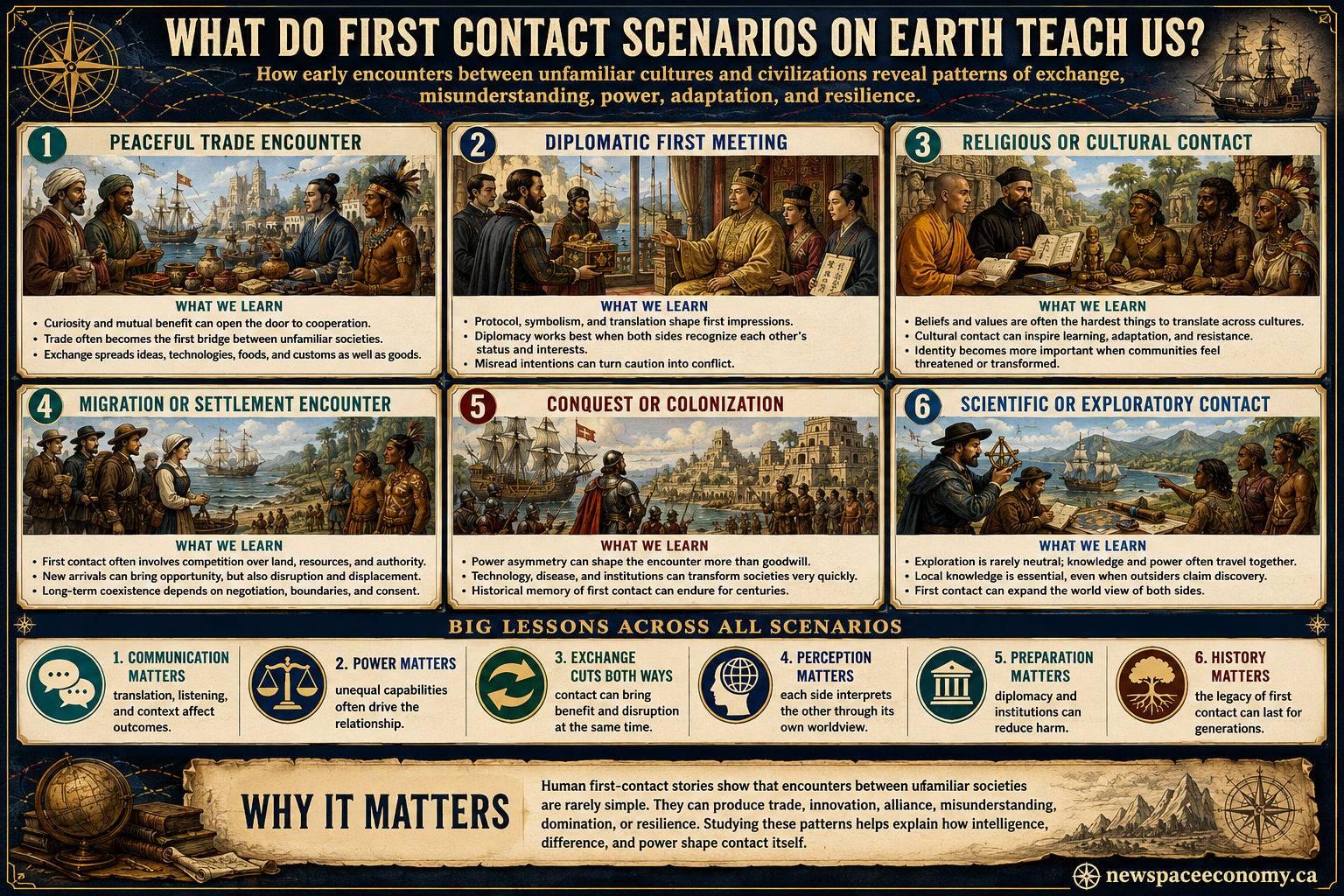
On October 12, 1492, Christopher Columbus reached the Caribbean and encountered the Taíno, one of the most numerous Indigenous peoples of the region. That encounter did not stay a meeting of ships, gifts, and interpretation. It became conquest, forced labor, demographic collapse, cultural survival under pressure, and a long dispute over memory. For any discussion of first contact scenarios involving extraterrestrial intelligence, Earth’s own record begins with a hard lesson: contact is rarely a neutral event once power, disease, territory, fear, trade, and misunderstanding enter the same room.
The phrase “first contact” often sounds clean. It suggests a moment, a greeting, a single exchange, or a handshake across distance. Historical contact between civilizations and cultures rarely worked that way. Contact more often unfolded as a chain of stages: sighting, rumor, cautious exchange, translation, bargaining, curiosity, status testing, fear, alliance, coercion, lawmaking, trade, missionary activity, disease, land pressure, and reinterpretation by later generations. By the time chroniclers named the encounter, both sides had already made assumptions that shaped every later decision.
Earth’s history also shows that contact can take more than one form. Some meetings began with diplomacy, as in early exchanges between the Kingdom of Kongo and Portugal after 1483. Some began with armed coercion, as with Commodore Matthew Perry’s 1853 arrival in Japan’s Tokyo Bay. Some began with exploration framed as science, such as James Cook’s voyages in the Pacific. Some began with settler expansion, as in British colonization of Australia after 1788. Some should not begin at all, as the continuing case of North Sentinel Island shows.
The table organizes several terrestrial contact cases by the contact pattern that later became most relevant to extraterrestrial intelligence planning.
| Contact Case | Initial Pattern | Outcome | ETI Lesson |
|---|---|---|---|
| Taíno And Spanish | Exploration And Extraction | Population collapse and cultural survival under colonial rule | Biological and political effects can outrun intent |
| Mexica And Spanish | Diplomacy, Alliance, And War | Fall of Tenochtitlán in 1521 | Local politics shape contact outcomes |
| Kongo And Portugal | Diplomacy And Conversion | Elite exchange followed by long power entanglement | Agency can coexist with unequal systems |
| Japan And United States | Gunboat Diplomacy | Treaty pressure and state transformation | Technological display changes decision space |
| North Sentinel Island | Protected No Contact | Legal exclusion zone and limited distant observation | Restraint can be a contact policy |
A comparison with extraterrestrial intelligence must avoid one easy mistake. Human contact cases occurred within one species on one planet. Humans share biology, gravity, atmosphere, sensory ranges, evolutionary ancestry, and many social needs. Extraterrestrial intelligence may share none of those. The historical analogy still matters because contact is never just technical. A radio transmission, a robotic probe, a decipherable artifact, or a detectable technosignature would enter human institutions. Governments, observatories, companies, media organizations, religious communities, financial markets, defense agencies, and the public would all interpret it through existing interests.
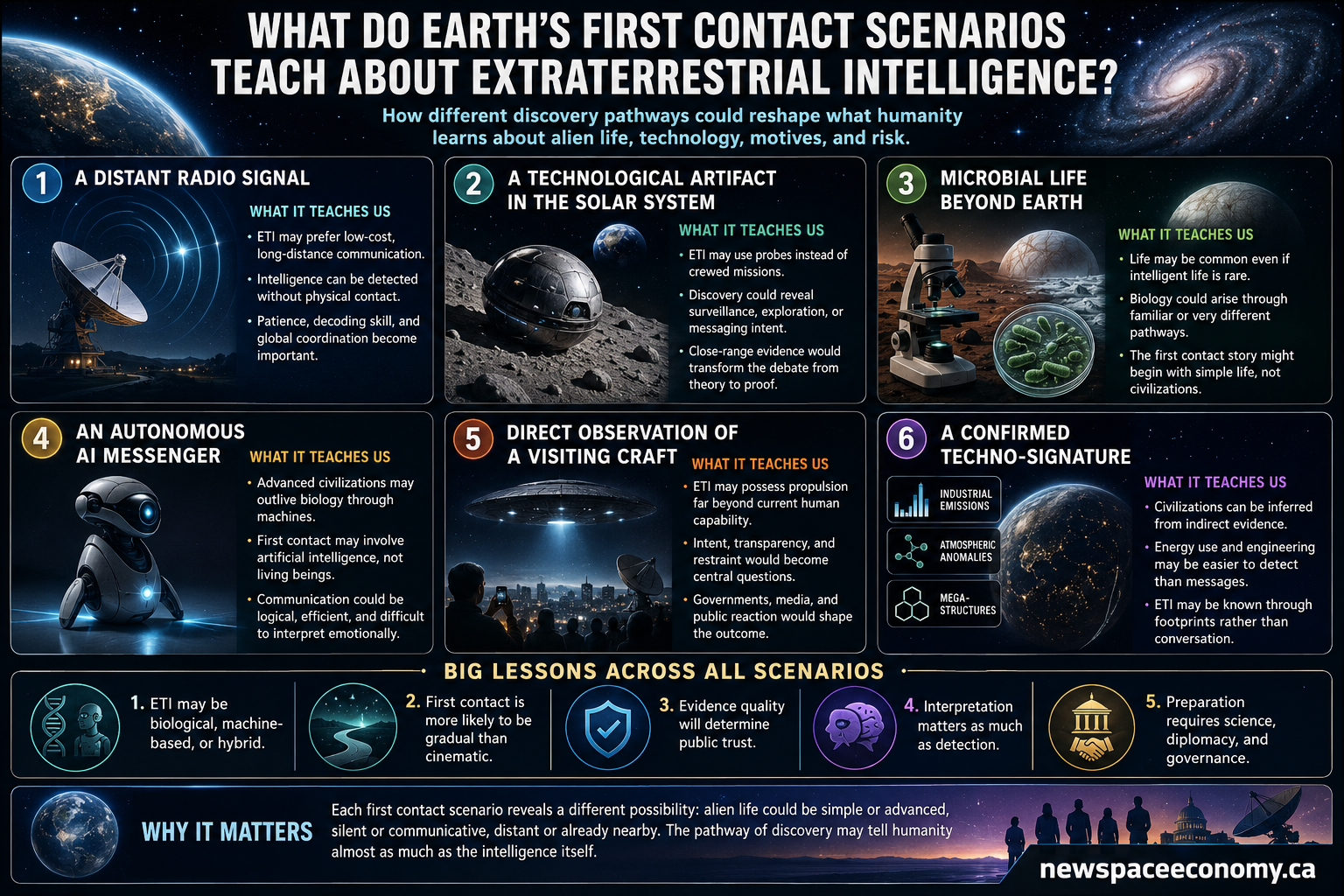
That institutional layer makes terrestrial history useful. The question is less whether alien contact would repeat Columbus, Cook, Perry, or the Treaty of Waitangi. It would not. The better question is what patterns keep appearing when two societies meet under uncertainty and unequal knowledge. The answer includes misread intentions, uneven vulnerability, translation failure, strategic behavior, uncontrolled secondary effects, and competition inside each society over who gets to speak.
Earth’s record also challenges the clean separation between “contact” and “response.” Once knowledge of another intelligence exists, response has already started. Public statements, data release, military monitoring, market reaction, cultural interpretation, and attempts to decode evidence all become part of the contact event. That is why post-detection planning cannot wait for a perfect script. History shows that delays, secrecy, and confusion often create their own consequences.
Taíno, Mexica, and the Biology of Contact
The Taíno case shows how contact can become irreversible before either side grasps its biological consequences. The Library of Congress notes that the Taíno inhabited what are now Cuba, Jamaica, Haiti, the Dominican Republic, Puerto Rico, and the Virgin Islands, and that by 1550 they were close to extinction after disease and Spanish colonization. That outcome did not come from one cause. Epidemic disease, forced labor, violence, displacement, hunger, and social disruption interacted.
For extraterrestrial intelligence, the biological lesson is not that aliens would carry human pathogens. The deeper lesson concerns hidden incompatibilities. Contact can transfer risks that neither side intends. In a radio-only contact, the risk would not be infection. It could be informational contamination, political panic, military misinterpretation, religious exploitation, fraudulent claims, or rushed technological imitation. In a physical encounter, biosecurity would become a central public safety issue, even if any shared pathogen pathway seemed unlikely.
The conquest of the Mexica capital Tenochtitlán deepens the point. The Battle of Tenochtitlán in 1521 involved Hernán Cortés, Spanish forces, and Indigenous allies who had their own reasons to oppose Mexica power. Smallpox weakened the city during the conflict. A simple story of advanced outsiders defeating passive locals misses the political reality. Contact activated preexisting rivalries, resentments, alliances, and calculations.
An extraterrestrial discovery would enter a divided humanity. No “humanity” currently exists as a single decision-making actor. States compete. Companies compete. Scientific groups compete for credit and funding. Religious and ideological communities interpret meaning differently. Any verified extraterrestrial transmission would become part of domestic politics, international diplomacy, defense planning, and public identity. A civilization beyond Earth would not need to divide humanity. Human institutions could do that on their own.
The Mexica case also shows that interpretation under pressure can be fatal to strategy. Translation occurred through intermediaries, and both sides filtered messages through expectations about rulers, tribute, omens, status, war, and diplomacy. In an extraterrestrial context, translation problems would be much larger. Mathematical sequences, physical constants, redundant encoding, and error correction may help with technical decoding, but meaning would still require caution. A message can be decoded without being understood.
Earth’s experience with epidemic collapse also warns against using contact success as proof of wisdom. Spanish power in the Americas grew from a mixture of maritime technology, coercion, alliances, legal claims, religious ideology, disease, and opportunism. Success did not mean moral insight. A technologically advanced extraterrestrial civilization might not be ethically advanced in any human sense. The reverse could also be true. A civilization with modest detectable technology might have social norms that restrain harm.
A verified extraterrestrial transmission would also create a scale problem. One observatory may detect evidence. One research group may decode a candidate pattern. One government may classify some data. One billionaire-funded project may fund follow-up work. None of those actors can credibly claim authority to answer for Earth. The historical record shows that small groups often made decisions with consequences for whole populations who had no seat at the table.
The same pattern appears in modern SETI and technosignature debates. A telescope team can detect a candidate. A public conversation can begin within hours. A national government may become involved for defense or diplomatic reasons. Yet the affected community is planetary. That mismatch between detecting party and affected party is one of the central governance problems of extraterrestrial contact.
Hawaiʻi, Aotearoa, and the Cost of Misread Rituals
Captain James Cook reached Hawaiʻi in 1778, an encounter that connected one of the most isolated Pacific societies with expanding European maritime systems. A Smithsonian Magazine history of epidemics in Hawaiʻi describes Cook’s arrival as a point after which outside disease became catastrophic for the islands. Trade, curiosity, ceremony, power testing, and disease moved together.
Hawaiʻi also shows how ritual and politics can be misread by outsiders. Cook and his crew entered a society with its own sacred calendar, rank systems, resource rules, and diplomatic expectations. European observers interpreted events through European categories of kingship, worship, property, and command. Hawaiians interpreted Europeans through their own categories. Contact did not fail because one side lacked intelligence. It became unstable because both sides acted from systems the other side could not fully read.
Aotearoa New Zealand provides another case in which language, mediation, and treaty interpretation shaped contact outcomes. The New Zealand History account of 1769 to 1914 describes Cook’s arrival in Te Tairāwhiti in October 1769 and the later growth of European contact, trade, mission activity, and settlement. The 1840 Treaty of Waitangi, described by Te Ara, involved English and te reo Māori texts whose meanings did not align cleanly. More than 500 rangatira Māori eventually signed, but interpretations of sovereignty, governance, and authority diverged.
For extraterrestrial intelligence, the treaty problem matters because decoded language may still hide incompatible assumptions. Humans may believe they have understood a message because they can parse its units. They may miss the social meaning attached to the message. A transmission that appears to be a greeting could be a legal claim, a warning, a test, a ritual marker, a request for proof of intelligence, or an automated artifact with no living sender. Human response teams would need to separate syntax from intent.
The Pacific contact cases also show that contact can produce dependency through trade. Metal tools, textiles, weapons, ships, and new market goods altered local politics. Groups with access to external goods gained advantage over rivals. The result was not one simple line from meeting to domination. It was a changing field of alliances, adaptations, resistance, and bargaining. For extraterrestrial contact, even information alone could act like a trade good. A mathematical method, energy concept, biological insight, or engineering hint could shift human power balances before anyone built a device.
The animal communication analogy also matters here. Humans struggle to understand whales, primates, birds, and cephalopods despite shared Earth biology. Contact with extraterrestrial intelligence may involve minds shaped by a different planet, different senses, different time scales, and different social organization. If Cook’s crews and Polynesian societies misread one another despite shared human embodiment, humans should expect far more severe interpretive limits in extraterrestrial communication.
That does not mean communication would be impossible. It means humility needs to be operational, not decorative. Message design would need redundancy, public peer review, slow interpretation, and explicit uncertainty labels. Claims such as “they are peaceful,” “they want contact,” “they are warning us,” or “they are inviting a reply” should face heavy scrutiny unless the evidence supports them in more than one way.
The more distant the sender, the slower the correction loop. A misunderstanding with a ship offshore could be corrected through repeated encounter, interpreters, and observation. A misunderstanding with a civilization 100 light-years away could take two centuries to test through question and answer. That time scale pushes first contact scenarios away from cinematic dialogue and toward institutional patience.
Kongo, Japan, and the Power of Strategic Agency
The Kingdom of Kongo complicates the idea that contact always begins with helplessness. Portuguese explorers arrived on the Kongo coast in 1483. The AfricaMuseum describes Kongo as a centralized kingdom, and it notes that King Nzinga a Nkuwu converted to Catholicism in 1491. The Metropolitan Museum of Art describes royal gift exchanges and the arrival of Christian art through court diplomacy. Kongo elites engaged Portugal through religion, literacy, education, diplomacy, and prestige exchange.
Agency did not prevent unequal entanglement. Over time, Kongo’s relationship with Portugal became tied to Atlantic commerce, internal politics, and the slave trade. The lesson for extraterrestrial intelligence is that agency and vulnerability can coexist. A less technologically advanced society may still make strategic choices, interpret the other side, appropriate useful symbols, and bend contact to local purposes. Yet unequal access to transport, weapons, information, or markets can reshape that agency.
Japan’s encounter with Perry in 1853 offers a different pattern. The Office of the Historian states that Commodore Matthew Perry led four ships into Tokyo Bay on July 8, 1853, seeking to restore regular trade and discourse between Japan and the West after more than 200 years of limited contact. Perry’s mission used diplomatic ceremony backed by visible naval power. Japan did not collapse. It assessed the pressure, negotiated, and later pursued rapid state transformation during the Meiji period.
The Japan case matters for extraterrestrial contact because technology display changes bargaining. If humanity detected an artifact in the Solar System, a probe near Earth, or a transmission showing physics far beyond current science, the event would not be a neutral discovery. It would demonstrate capability. Even without any threat, capability would shape human interpretation. States would ask whether the sender can observe Earth, reach Earth, influence infrastructure, or access information systems.
The strategic lesson is not to respond with fear. It is to avoid pretending that fear can be removed by reassurance alone. Contact planning needs separate channels for scientific verification, public explanation, defense assessment, diplomacy, and ethical review. Mixing all of those functions inside one secret committee would invite mistrust. Leaving them entirely uncoordinated would invite confusion.
Kongo and Japan also show that contactees can learn quickly. Earth after a verified extraterrestrial discovery would not remain the same planet intellectually. Scientific research agendas would shift. Funding priorities would change. Space agencies would reframe exploration. Public institutions would face demands for openness. Companies tied to space, communications, artificial intelligence, cybersecurity, and defense would adjust strategy. Confirmed alien contact could affect capital allocation and industrial planning even without a reply.
Contact also changes internal legitimacy. In Japan, pressure from outside fed debates over governance and modernization. In Kongo, foreign religious and diplomatic ties became part of court politics. In an extraterrestrial context, political leaders may try to present themselves as protectors, interpreters, or authorized speakers for humanity. Scientists may resist political control. Public groups may suspect secrecy. Private actors may seek status by claiming privileged access to evidence.
A stable response architecture would need to recognize those incentives before any event occurs. It should define what counts as a candidate, what counts as verified artificial evidence, what counts as confirmed extraterrestrial origin, and what actions require international consent. Without such categories, the most aggressive narrator may win the opening public argument.
Australia, North Sentinel, and the Ethics of No Contact
British colonization of Australia after 1788 shows a contact pattern where settlement, legal fiction, disease, and land seizure moved together. The National Museum of Australia describes the 1789 smallpox outbreak around Sydney as a defining moment after the arrival of the First Fleet. The doctrine later called terra nullius treated land as belonging to no one in a way that erased Indigenous law, land relationships, and political authority.
For extraterrestrial intelligence, Australia’s contact history warns against declaring another world, system, artifact, or communication channel as “empty” because its owners or makers do not resemble human expectations. A dormant probe, ancient beacon, silent megastructure, or encoded archive could belong to a culture that is absent, extinct, hidden, distributed, or uninterested in dialogue. Human explorers have often mistaken unfamiliar tenure for no tenure and unfamiliar authority for no authority.
North Sentinel Island presents the opposite lesson: contact refusal can be meaningful communication. The Sentinelese live on North Sentinel Island in the Andaman and Nicobar Islands and reject outside contact. Survival International argues that their wish to remain uncontacted should be respected, citing the danger of outside diseases. Britannica explains that India restricts access to protect the tribe and its way of life.
The United Nations Department of Economic and Social Affairs states that Indigenous Peoples in voluntary isolation and initial contact face severe threats from disease exposure, due to limited immunological defenses against common illnesses. That policy field has direct relevance to extraterrestrial contact ethics. Respecting separation may be safer than forced engagement.
No-contact ethics can apply in more than one direction. Humanity may be the vulnerable party. An extraterrestrial civilization may be the vulnerable party. A third possibility is that neither side can know vulnerability at contact onset. If a distant transmission reveals no invitation, humanity should not assume that reply is automatically acceptable. If a Solar System artifact appears passive, touching or altering it may be more like trespass than science.
This principle intersects with Messaging Extraterrestrial Intelligence, or METI. METI refers to deliberate attempts to send messages to possible extraterrestrial civilizations. Supporters see it as active participation in possible cosmic communication. Critics argue that no small group should decide to broadcast on behalf of Earth. Terrestrial no-contact cases do not settle that debate, but they make one claim hard to defend: curiosity alone does not create consent.
The North Sentinel analogy also warns against spectacle. Modern attempts to approach isolated peoples for attention reveal how media incentives can undermine ethics. An extraterrestrial candidate event would create similar incentives at larger scale. Influencers, hoaxers, political actors, and commercial promoters could claim access, decode fake messages, sell certainty, or demand immediate response. Public education and data transparency would help, but only if scientific institutions communicate quickly and carefully.
No-contact does not mean no knowledge. Distant observation, legal protection, public restraint, and independent review can coexist. For extraterrestrial intelligence, a cautious posture might include monitoring, verifying, publishing evidence, inviting global analysis, and withholding reply until an open international process reaches a decision. Such restraint is not passivity. It is a policy choice shaped by historical memory.
Patterns That Matter for Extraterrestrial Intelligence Contact
Earth’s contact cases differ in location, time, culture, technology, and outcome, yet several patterns recur. Initial meetings often look manageable to the people present, then consequences expand through biology, trade, law, religion, migration, alliance, rumor, and conflict. The people who make contact are often not the people who bear its full cost. The people who record contact often control the archive. Later generations inherit both the results and the stories.
First contact scenarios involving extraterrestrial intelligence would amplify those patterns. Distance would slow clarification. Scientific uncertainty would complicate public trust. Government interest would raise fears of secrecy. Private observatories and citizen scientists could publish data before states understand it. Artificial intelligence tools might help classify patterns, but they could also produce false confidence. A candidate transmission could become a political object before it becomes a verified discovery.
The table connects terrestrial patterns with ETI response planning.
| Historical Pattern | Earth Example | ETI Planning Need |
|---|---|---|
| Hidden Vulnerability | Disease exposure in the Caribbean and Pacific | Biosecurity, information safety, and staged disclosure |
| Translation Failure | Treaty meanings in Aotearoa New Zealand | Uncertainty labels for decoded content |
| Strategic Display | Perry’s naval mission to Japan | Separate scientific proof from security assessment |
| Internal Division | Alliances during the fall of Tenochtitlán | Open global governance before reply |
| Consent Dispute | North Sentinel Island protection policy | No automatic right to transmit back |
The category distinction between candidate, verified artificial evidence, and confirmed extraterrestrial origin would be essential. A candidate is an observation that merits review. It may be interference, instrument error, natural astrophysics, data artifact, hoax, or incomplete measurement. Verified artificial evidence would mean the phenomenon appears technological, structured, or engineered after major ordinary explanations have been tested. Confirmed extraterrestrial origin would require location, repeatability, independent observation, and exclusion of human or near-Earth sources at a level strong enough for broad scientific acceptance.
This distinction protects credibility. The history of pulsars shows why. Cambridge radio astronomers in 1967 briefly considered whether regular radio pulses might indicate intelligence before neutron stars provided the explanation. That episode is now part of SETI culture because it shows responsible caution. It was not a failure to ask the alien question. It would have been a failure to announce alien contact before the evidence supported it.
Modern post-detection planning has moved in that direction. The SETI Institute presents updated principles connected to the International Academy of Astronautics for evaluating and sharing evidence of extraterrestrial intelligence. The 2026 update emphasizes confirmation, transparency, public access to data, protection of relevant frequencies, and structured advice after a confirmed detection. That framework speaks directly to the media and misinformation risks that historical contact analogies cannot address by themselves.
Misinformation would be one of the fastest secondary effects. During historical contact, rumor traveled by ship, messenger, sermon, court report, and printed pamphlet. In an ETI event, claims would travel through social platforms, automated accounts, synthetic media, and commercial content systems. A false translation could reach millions before the scientific team completes follow-up observation. A fake government memo could move markets. A fabricated “reply” could trigger public pressure for action.
The remedy is not total secrecy. Secrecy may give conspiracy claims more oxygen. A better approach combines phased disclosure, public evidence, clear uncertainty labels, and independent verification pathways. Scientific teams should state what was observed, what remains unknown, what tests are underway, what data can be released, and what data may require temporary protection because of observatory scheduling, privacy, or frequency management.
Response Design for a Confirmed Extraterrestrial Encounter
A confirmed extraterrestrial encounter would force humanity to separate detection from reply. Detecting evidence does not settle whether to answer. Answering does not settle who speaks. Speaking does not settle what should be said. A premature reply could become the extraterrestrial version of an unauthorized treaty, signed by the loudest faction rather than the affected community.
The SETI Institute and related SETI discussions have long treated reply as a governance problem, not just a technical one. The International Academy of Astronautics reply principles have historically pointed toward broad consultation, including the United Nations Committee on the Peaceful Uses of Outer Space. The United Nations would not magically create unity, but it offers a recognized forum where states can debate legitimacy in public.
Governments would still be involved early. A verified nonhuman technology claim would touch national security, telecommunications regulation, space law, scientific funding, export controls, emergency communication, and diplomatic posture. Yet government awareness should not mean government monopoly. Observatories, universities, scientific unions, space agencies, Indigenous representatives, ethicists, communication experts, legal scholars, religious communities, civil society organizations, and the public would all have claims to participation.
A response timeline should be slow unless evidence indicates immediate danger, and even danger would need careful proof. If a transmission came from 100 light-years away, there would be no practical need to answer within days. A rush would mostly reflect human politics. Time should be used to verify the evidence, publish data, run independent decoding attempts, assess risks, build international process, and invite public comment. The longer the distance, the stronger the case for patience.
A physical artifact in the Solar System would present a different timeline. Safety assessment, non-contamination procedures, and jurisdiction would matter. Space agencies such as the National Aeronautics and Space Administration, the European Space Agency, the Japan Aerospace Exploration Agency, the Indian Space Research Organisation, and the China National Space Administration might all have technical capacity or political interest. Private companies could also possess relevant spacecraft, sensors, or launch services. Government disclosure planning would need to define how these actors share data.
The content of any reply should be minimal at the start. A careful initial message would confirm receipt, describe the evidence observed, state that humanity is conducting public consultation, and avoid claims of planetary consensus that do not exist. It should not disclose sensitive military capabilities, biological vulnerabilities, infrastructure dependencies, or internal conflict details without reason. It should avoid threats, worshipful language, promises, resource offers, or claims of obedience.
The table outlines a staged response model for an extraterrestrial contact event.
| Stage | Main Action | Governance Test |
|---|---|---|
| Candidate | Internal review and interference checks | Prevent premature claims |
| Verification | Independent observation and peer review | Keep science ahead of spectacle |
| Disclosure | Public data release and plain explanations | Build trust without claiming certainty beyond evidence |
| Consultation | Scientific, legal, cultural, and state review | Avoid small-group authority over Earth |
| Reply Decision | Open international vote or consensus process | Treat silence as a legitimate option |
Public data release deserves special attention. Historical contact records often came from the more powerful side, producing archives that later scholars had to challenge, reread, and supplement. For ETI, data transparency can reduce that imbalance. Raw observational data, processing methods, telescope metadata, uncertainty estimates, and independent analyses should be made public as soon as practical. Classified or restricted handling should require specific reasons, not habit.
Humanity should also prepare for silence after detection. A one-way artifact, ancient beacon, or distant broadcast may not permit dialogue. That possibility changes expectations. Contact may be less like diplomacy and more like archaeology. The proper response may be preservation, study, and public stewardship rather than immediate communication.
Historical first contact scenarios suggest a final design principle: authority should be distributed, but responsibility should be explicit. Everyone can debate. Not everyone should transmit. A radio telescope, deep-space transmitter, laser facility, or powerful radar system can act before global consent catches up. National licensing, scientific norms, institutional commitments, and international agreements should discourage unilateral replies to confirmed ETI evidence.
Applying Earth’s Lessons Without Forcing the Analogy
Historical analogies can mislead if treated as prophecy. Extraterrestrial intelligence contact would not repeat terrestrial colonization in costume. An alien civilization would not be Spain, Britain, Kongo, Japan, Hawaiʻi, or the Taíno. Earth’s examples are useful because they identify recurring contact pressures, not because they predict the other side’s character.
One pressure is narrative capture. The party that frames the event early can shape public memory. Columbus’s journals, missionary accounts, colonial records, naval logs, and official treaties shaped contact stories for centuries. Indigenous accounts, oral histories, archaeology, and later scholarship have challenged those records. In an ETI event, whoever controls initial data and language will influence public belief. That makes open data and independent analysis central to fairness.
Another pressure is moral projection. Humans often treat technological difference as moral hierarchy. European empires used that assumption to justify domination. Some modern ETI speculation repeats the same mistake in cosmic form, imagining that advanced technology means superior wisdom or inevitable benevolence. Technosignatures can show technology; they cannot by themselves show ethics.
A third pressure is institutional rivalry. Earth’s contact history often involved multiple outside actors competing with one another. Spanish, Portuguese, Dutch, French, British, Russian, American, and other expansion systems often shaped local outcomes through rivalry. In an ETI case, rivalry might arise among states, observatories, companies, media platforms, scientific disciplines, and ideological groups. The sender may remain passive, yet human competition could still produce harm.
A fourth pressure is asymmetrical knowledge. One side may know more about the other before open contact. European sailors often collected intelligence through maps, scouts, trade networks, captives, and interpreters. Humanity has already leaked radio, radar, atmospheric, and industrial evidence into space, although detectability depends on distance and receiver capability. A civilization able to detect Earth may know much more about human technology than humans know about it. Breakthrough Listen and related projects show how systematic searches can collect immense data; a more advanced observer could do the same at higher sensitivity.
The best analogy may not be one event. It may be a composite. From the Taíno, humanity learns that contact can overwhelm vulnerable societies. From the Mexica, it learns that internal divisions shape outcomes. From Hawaiʻi and Aotearoa, it learns that ritual, translation, and treaty meaning matter. From Kongo, it learns that agency can exist inside unequal systems. From Japan, it learns that technological display changes state decisions. From North Sentinel Island, it learns that non-contact can be an ethical position.
Applied to ETI, those lessons suggest five operating rules. Verify before declaring. Share evidence before interpreting too far. Consult before replying. Protect the vulnerable, including unknown others and humanity itself. Treat silence, delay, and restraint as valid choices.
The current search for extraterrestrial intelligence remains a scientific effort without confirmed alien evidence. That status matters. No government has publicly confirmed extraterrestrial intelligence as of June 2026. Planning for contact should not become a claim that contact has occurred. It is a risk-management exercise, a governance exercise, and a test of whether humanity can learn from its own record before facing a larger unknown.
Summary
Earth’s contact history does not offer a script for extraterrestrial intelligence. It offers warnings about speed, power, translation, consent, biology, and authority. Contact between civilizations often began with curiosity or diplomacy, then moved through systems that nobody present fully controlled. Disease spread, markets shifted, alliances formed, laws were imposed, stories hardened, and the people most affected often lost control over the record.
For extraterrestrial intelligence, that record argues for restraint before reply. A candidate discovery should move through verification, independent observation, public explanation, and global consultation. A confirmed extraterrestrial message should not be treated as an invitation for a small group to answer for Earth. A physical artifact should not be touched or exploited before safety, ownership, scientific, and ethical questions receive public review.
The hardest lesson may be psychological. Humanity tends to treat contact as a test of the stranger. History suggests it is also a test of the contacted society. If humanity detects another intelligence, the event will reveal how humans handle uncertainty, power, fear, fame, secrecy, and disagreement. The other civilization may remain silent. Earth’s response will still speak.
Appendix: Useful Books Available on Amazon
- 1491
- Seven Myths of the Spanish Conquest
- When Montezuma Met Cortés
- The Other Slavery
- We Are the Ocean
- The Dawn of Everything
Appendix: Top Questions Answered in This Article
What Are First Contact Scenarios?
First contact scenarios are possible ways two societies encounter one another for the initial time, ranging from peaceful exchange to coercion, accidental exposure, or deliberate avoidance. In extraterrestrial intelligence studies, the term refers to possible discovery modes such as radio transmissions, artifacts, probes, technosignatures, or direct observation of another technological civilization.
Why Does Earth’s Contact History Matter for ETI?
Earth’s contact history shows that contact is shaped by power, translation, disease, trade, law, and internal politics. Extraterrestrial contact would differ in biology and scale, but human institutions would still handle evidence, interpretation, public communication, and response. The analogy helps identify risks in human behavior.
Was Historical First Contact Usually Peaceful?
Some encounters began with peaceful exchange, ceremony, or diplomacy. Many later became harmful because disease, coercion, land pressure, trade imbalance, or military force entered the relationship. The initial mood of a contact event does not reliably predict its long-term consequences.
What Is the Main Lesson From the Taíno Encounter?
The Taíno case shows that contact can become catastrophic through combined biological, political, and economic pressures. It warns ETI planners that harm can occur even when some participants begin with curiosity or exchange. Hidden vulnerabilities must be treated as part of any contact risk model.
What Does the Treaty of Waitangi Teach About Communication?
The Treaty of Waitangi shows that translation can fail even when both sides use human language and formal negotiation. Words about authority, sovereignty, land, and governance carried different meanings. In an extraterrestrial context, decoding a message would not guarantee understanding its social meaning.
Why Is North Sentinel Island Relevant to ETI Contact?
North Sentinel Island shows that refusal of contact can be a meaningful position. Modern protection policies treat isolation as a right and a safety measure. For ETI, this supports the principle that curiosity alone does not authorize intrusion, reply, landing, or interference.
Should Humanity Reply to an Extraterrestrial Message?
A reply should not be automatic. Humanity would need verified evidence, public data, international consultation, risk assessment, and a legitimate decision process. A small team, company, state, or private transmitter should not claim authority to speak for Earth without broad consent.
Who Should Make an ETI Reply Decision?
No current institution has universally accepted authority to speak for humanity. A legitimate process would likely involve the United Nations, scientific unions, space agencies, governments, Indigenous and cultural representatives, legal experts, ethicists, and public participation. Technical ability to transmit is not the same as moral authority.
Could ETI Contact Cause Panic?
Panic is possible but not inevitable. Public reaction would depend on evidence quality, institutional trust, communication clarity, misinformation control, and whether officials appear transparent. Clear categories such as candidate, verified artificial evidence, and confirmed extraterrestrial origin would help reduce confusion.
What Is the Safest Initial Response to ETI Evidence?
The safest initial response is verification, data preservation, independent review, and clear public communication. A reply should wait until evidence has been confirmed and a legitimate consultation process has occurred. Silence can be a responsible policy choice when knowledge is incomplete.
Appendix: Glossary of Key Terms
First Contact Scenarios
First contact scenarios are possible pathways through which two societies encounter one another for the initial time. In this article, the term covers terrestrial history and extraterrestrial intelligence planning, including detection, interpretation, public disclosure, and decisions about response.
Extraterrestrial Intelligence
Extraterrestrial intelligence means intelligent life beyond Earth capable of behavior that humans might recognize through technology, communication, artifacts, or other detectable evidence. The term does not imply confirmed discovery, since no public scientific confirmation exists as of June 22, 2026.
SETI
The Search for Extraterrestrial Intelligence is the scientific effort to detect evidence of technology or communication beyond Earth. SETI work includes radio astronomy, optical searches, technosignature studies, data analysis, and follow-up observation of unusual candidate evidence.
METI
Messaging Extraterrestrial Intelligence means deliberately sending messages intended for possible alien civilizations. METI is debated because transmission could be symbolic, scientific, diplomatic, or risky, and because no small group has clear authority to speak for Earth.
Technosignature
A technosignature is detectable evidence that may indicate technology, such as a narrowband radio transmission, laser pulse, artificial atmospheric chemical, waste heat pattern, probe, or engineered structure. A technosignature candidate requires careful testing before any claim of extraterrestrial origin.
Candidate Detection
A candidate detection is an observation that appears unusual enough to study further. It may still result from human interference, instrument behavior, natural astrophysics, incomplete data, or error. Responsible analysis treats candidates as questions, not announcements.
Verified Artificial Evidence
Verified artificial evidence means an observation appears technological or engineered after careful review. It does not automatically mean extraterrestrial origin, because human activity, satellites, aircraft, software artifacts, or deliberate hoaxes may still explain the evidence.
Confirmed Extraterrestrial Origin
Confirmed extraterrestrial origin means independent evidence supports a source beyond Earth and rules out ordinary terrestrial, near-Earth, instrumental, and natural explanations to a high scientific standard. Such confirmation would require multiple institutions and transparent analysis.
Post-Detection Protocol
A post-detection protocol is a set of principles for what researchers and institutions should do after possible extraterrestrial intelligence evidence appears. It covers verification, data sharing, public communication, international consultation, and decisions about reply.
No-Contact Policy
A no-contact policy restricts approach, intrusion, or communication with an isolated society to protect autonomy and safety. In ETI planning, the concept supports restraint when consent, vulnerability, or intent cannot be established.