- Key Takeaways
- How Cognitive Biases and the Space Economy Interact in 2026
- Why Market Forecasts Invite Anchoring and Overconfidence
- How Technology Narratives Distort Commercial Judgment
- Why Procurement and National Security Magnify Status Quo Bias
- How Bias Alters Risk, Safety, and Space Sustainability
- Where Bias Appears in Finance, Insurance, and Customer Adoption
- How Decision Discipline Can Improve Space Economy Choices
- Summary
- Appendix: Useful Books Available on Amazon
- Appendix: Top Questions Answered in This Article
- Appendix: Glossary of Key Terms
Key Takeaways
- Bias can distort space forecasts, funding choices, procurement, and orbital risk.
- Better decisions need outside data, red teams, and measured forecasts.
- The space economy rewards ambition, but punishes wishful thinking.
How Cognitive Biases and the Space Economy Interact in 2026
The Space Foundation’s 2025 analysis reported that the global space economy reached $613 billion in 2024, with commercial activity accounting for 78% of the total. That number gives cognitive biases and the space economy a shared operating field: large markets, long timelines, hard-to-price risk, and intense pressure to select winners before the evidence fully matures. The larger the claim, the more tempting it becomes to replace careful judgment with a story that feels coherent.
Cognitive bias means a systematic pattern in judgment that can steer people away from accurate assessment. Amos Tversky and Daniel Kahneman described three influential mental shortcuts in their 1974 Science paper: representativeness, availability, and anchoring. These shortcuts help people move quickly through uncertainty, but they can also misread probabilities, overvalue vivid examples, and cling to early estimates. Space activity contains many of the ingredients that make such shortcuts attractive: rare events, technical opacity, heroic narratives, national prestige, and forecasts extending many years into the future.
The space economy also resists simple measurement. The OECD Handbook on Measuring the Space Economy promotes improved data collection among public agencies, incumbent firms, and newer participants. That methodological need matters because bias often enters through classification. A satellite manufacturer, launch provider, weather-data user, defense customer, navigation chipset supplier, and analytics firm may all connect to space activity, but their revenues, margins, risks, and adoption curves differ. A single total can conceal more than it explains.
New Space Economy’s guide to space economy market reports captures the problem in publication terms: method shapes meaning. A report written to support investment, policy, sales, or public communication may define boundaries in different ways. People who accept a headline number without asking what it includes invite anchoring bias, category error, and forecast confusion. For a sector built on supply chains, data services, launch logistics, government procurement, insurance, manufacturing, communications, navigation, and defense demand, the boundary question is not clerical. It shapes capital allocation.
Bias does not make the space economy irrational by default. Many space businesses solve real problems. Weather forecasting, precision timing, Earth observation, satellite communications, disaster response, national security, and scientific exploration all depend on space infrastructure. Bias enters when decision makers treat one success story as a template for every company, one spectacular failure as proof that the whole sector is unsound, or one market-size estimate as a substitute for customer evidence. A better approach asks which claim is being made, what evidence would disprove it, and which similar projects provide an outside reference point.
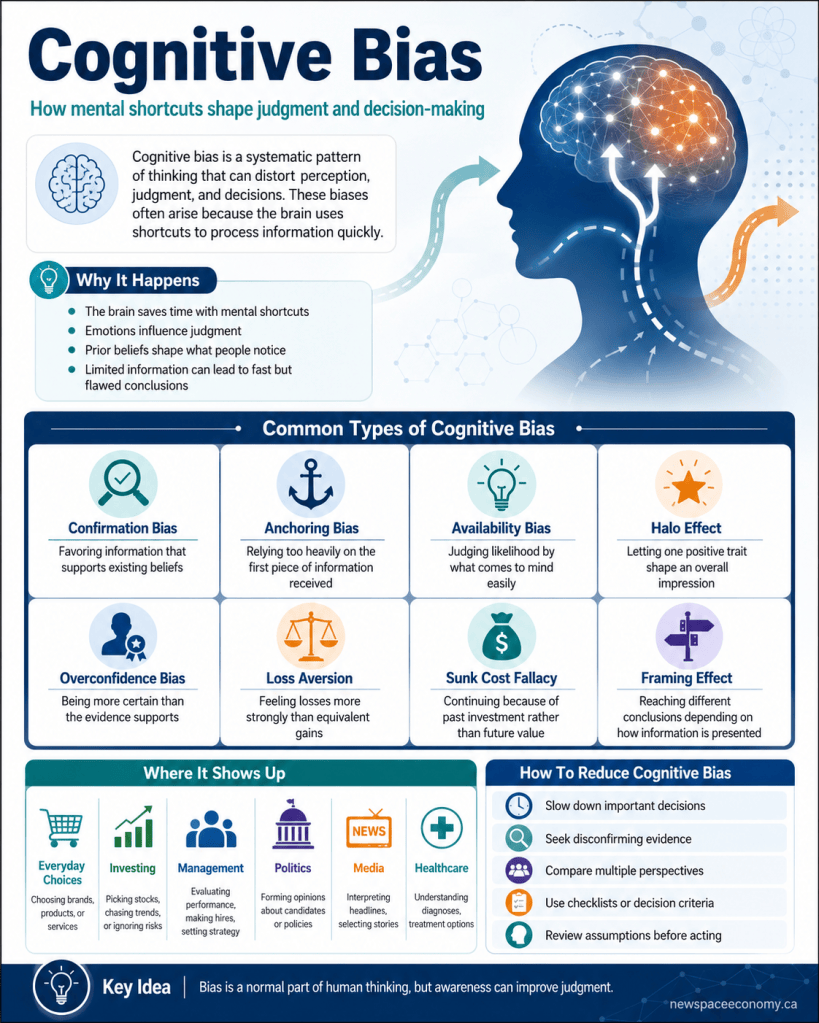
The table below organizes common cognitive biases by their likely effects on space economy decisions.
| Bias | Likely Effect | Space Economy Exposure |
|---|---|---|
| Anchoring Bias | Early Numbers Frame Later Judgment | Market Size, Launch Cost, Revenue Targets |
| Availability Bias | Vivid Events Outweigh Base Rates | Launch Failures, Crewed Missions, Stock Moves |
| Optimism Bias | Schedules and Budgets Look Too Clean | Spaceports, Stations, Lunar Systems |
| Survivorship Bias | Visible Winners Hide Failed Peers | Startups, Launch Firms, Satellite Ventures |
| Status Quo Bias | Legacy Choices Survive Weak Evidence | Procurement, Standards, Mission Design |
Why Market Forecasts Invite Anchoring and Overconfidence
A forecast can become an anchor before anyone checks its denominator. In space markets, this often happens when a total addressable market estimate blends upstream hardware, downstream services, government budgets, consumer devices, defense spending, and data-enabled industries. The figure may be useful in its original report. It becomes misleading when copied into investment memoranda, grant applications, industrial strategies, and media headlines without the original definition.
New Space Economy’s article on space economy segmentation gives a practical warning. Launch, manufacturing, analytics, bandwidth, positioning, navigation, timing, space insurance, mission operations, and downstream applications operate under different demand structures. A launch provider faces capital expenditure, vehicle reliability, regulatory clearance, and manifest risk. A software company using Earth observation data faces customer acquisition, data licensing, analytics quality, and integration with terrestrial workflows. Treating both as parts of one fast-growing pool can obscure the business model that decides whether revenue becomes margin.
Overconfidence enters when forecasts look precise. A chart with decimal points can create a false sense of measurement, even when the underlying model depends on assumptions about launch cadence, terminal costs, spectrum access, defense demand, lunar schedules, or enterprise adoption. Forecasts can also inherit survivorship bias. Analysts may emphasize firms that raised large rounds, won contracts, or reached orbit, then undercount teams that folded before public visibility. In a sector where private companies, defense customers, and national space agencies often disclose uneven information, missing cases matter.
The Q1 2026 Seraphim Space Index reported $8 billion of SpaceTech investment during the quarter and $18.8 billion over the trailing 12 months. Those figures show active capital flows, but they do not prove that every funded category has lasting customer demand. Funding can measure confidence, fear of missing out, strategic positioning, or liquidity conditions. It can also reflect late-stage round size more than an expanding count of viable firms. Seraphim reported 159 deals during Q1 2026, indicating that the quarterly record resulted primarily from larger transactions rather than a comparable increase in deal volume.
The Space Capital framework organizes the space economy into infrastructure, distribution, and application layers. That structure can help explain how space-enabled services connect to the wider economy. Its breadth can also invite category inflation when applied carelessly. A company that uses satellite data as one input does not carry the same risk profile as a spacecraft manufacturer. An application-layer business may benefit from space without facing launch, radiation, debris, or spacecraft operations risk.
Forecasting also suffers from the planning fallacy. Reference class forecasting responds by comparing a proposed project with actual outcomes from similar projects rather than relying on internal plans alone. That method fits space projects because schedules often depend on hardware maturity, environmental testing, launch availability, licensing, ground infrastructure, insurance, and customer integration. A lunar lander, commercial station module, or national spaceport should not rely only on a bottom-up schedule created by the sponsoring organization. It should also be compared with relevant missions, infrastructure programs, and public procurement histories.
Anchoring becomes more costly when public policy absorbs market narratives. Regional development agencies, national governments, and universities may see a space cluster as a path to high-value employment. That may be accurate in some cases. It becomes risky when a region copies another region’s assets without matching talent, buyers, industrial capacity, export channels, launch geography, or defense relationships. New Space Economy’s discussion of space economy development makes this distinction useful: a headline global number does not automatically convert into local employment or local revenue.
How Technology Narratives Distort Commercial Judgment
A compelling technology narrative can move faster than proof of customer demand. Reusable launch, satellite-to-phone services, lunar infrastructure, in-space servicing, orbital data centers, commercial stations, and direct Earth observation analytics all contain real engineering and business potential. Bias enters when narrative coherence substitutes for evidence about cost, demand, regulation, integration, and reliability.
Representativeness bias is common in space investment. A startup that sounds like a known winner can receive more confidence than its evidence supports. A pitch deck that resembles the language of SpaceX, Planet, Rocket Lab, Maxar, or Starlink may feel familiar, even when the business model, capital needs, customer timing, and technical path differ. The mind prefers pattern recognition. Space markets punish false pattern recognition because hardware programs consume cash long before broad revenue appears.
Availability bias also shapes public and investor judgment. A successful launch webcast can make the entire sector feel less risky. A failed lander can make lunar commerce look premature. Neither reaction is sufficient. Space activity generates vivid images, but vividness does not equal base-rate evidence. A landing attempt can fail for a mission-specific technical reason without disproving a market category. A dramatic success can leave unsolved questions about repeatability, price, regulatory burden, supply-chain maturity, and who pays for the service after a demonstration ends.
NASA’s Commercial Lunar Payload Services initiative illustrates the tension. NASA acquires lunar delivery services from American companies for scientific, exploration, and technology payloads rather than developing every delivery system internally. That model can create operational learning and competition. It can also tempt outside observers to overread a contract award as proof of an independent commercial lunar market. A government customer can validate a capability without proving broad private demand.
Narrative fallacy affects lunar business plans in a related way. The Moon can be framed as a destination, a proving ground, a resource base, a geopolitical marker, or a future industrial platform. Each frame supports a different investment thesis. The story becomes misleading when all frames are blended into one near-term business case. Scientific payload delivery, national prestige, communications relays, mobility, power systems, mining concepts, tourism, and settlement are not interchangeable revenue streams. The stronger the story, the more pressure there is to separate plausible phases from speculative ones.
New Space Economy’s article on irrational markets connects this problem to stock pricing. Public markets can reward an exciting story ahead of operating evidence. Space companies with long development cycles may receive valuations driven by future possibilities rather than present margins. That does not make the optimism false. It means valuation becomes vulnerable to narrative reversal when schedules slip, capital becomes more expensive, or a customer delays procurement.
Loss aversion can distort judgment after money has been committed. Kahneman, Knetsch, and Thaler’s work on loss aversion and the endowment effect helps explain why decision makers may protect a space project after its evidence weakens. Canceling a mission, factory, launch vehicle, constellation, or public-private program can feel like admitting a loss. Continuing can feel like preserving an option. The danger is that sunk costs are treated as reasons to continue, even though future spending should depend on future expected value.
Commercial judgment improves when technology stories face staged evidence. A company can be asked to define what would change its plan: one successful test, repeated production, regulatory approval, insured operations, customer renewal, gross margin, replacement cycle, or independent demand outside government anchor contracts. A public agency can apply the same discipline before treating a project as industrial policy. The question is not whether the technology is exciting. The question is which claim has been tested.
Why Procurement and National Security Magnify Status Quo Bias
Government demand gives the space economy stability, but it also creates decision traps. Public procurement can pull technology into use, fund infrastructure that private buyers cannot yet support, and create anchor demand for launch, Earth observation, communications, space domain awareness, and lunar services. It can also preserve legacy suppliers, extend programs with weak cost evidence, or reward bids that fit an agency’s familiar mental model.
Novaspace reported that global government space investments reached approximately $135 billion in 2024, representing an increase of about 10% from 2023, with defense expenditures driving much of the growth. That spending matters because government is not a background customer in space. It is often the market maker, regulator, technical standard-setter, and geopolitical sponsor. Bias in public decision processes can move entire supplier networks.
Status quo bias appears when agencies prefer known procurement paths because they reduce administrative uncertainty. A legacy contractor, familiar contracting vehicle, or established mission architecture can feel safer than an alternative commercial service. Sometimes that preference is justified. National security missions may require assurance, classified integration, cyber controls, trusted supply chains, and continuity that a newer firm cannot provide. Bias enters when familiarity substitutes for performance evidence or when risk is defined only as the risk of changing suppliers.
The U.S. Space Force Commercial Space Strategy and the Department of Defense Commercial Space Integration Strategy document a policy shift toward deeper commercial integration. That shift can reduce one form of status quo bias by forcing institutions to consider outside capability. It can also introduce a newer bias: assuming that commercial automatically means faster, cheaper, or more resilient for every mission. Commercial integration needs mission-by-mission judgment, not a blanket preference.
Sovereign capability adds another layer. Governments may pay more for national launch access, domestic manufacturing, independent positioning, secure communications, or local Earth observation capacity. New Space Economy’s discussion of sovereign space capability frames this as more than symbolism. Assured access can reduce external veto risk and protect mission continuity. Sovereignty arguments can still shield weak projects from scrutiny when prestige, employment, or strategic fear overrides comparative cost and capability analysis.
Procurement bias can also arise from confirmation bias. A government office may prefer market studies that support a preselected strategy. A regional agency may favor studies showing local cluster potential. A defense customer may weigh vendor claims differently after a geopolitical shock. The response is not cynicism. Public buyers need structured tests that require disconfirming evidence, independent cost assessment, and explicit comparison between owning a system, buying a service, partnering with allies, and using terrestrial alternatives.
The Blind Men and the Elephant metaphor used by New Space Economy applies directly to procurement. Each institution touches a different part of the sector: launch, payloads, ground systems, spectrum, software, defense missions, research, regional development, or export policy. Bias grows when a partial view becomes an institutional whole. Better governance makes these partial views visible before funding locks in.
How Bias Alters Risk, Safety, and Space Sustainability
Space risk has a physical side and an organizational side. The physical side includes launch failure, radiation, debris, propulsion failure, thermal-control problems, software errors, cyber intrusion, and spectrum interference. The organizational side includes schedule pressure, cost pressure, authority gradients, optimism bias, and acceptance of small anomalies after repeated survival. A safe system can fail when human judgment slowly normalizes weak evidence.
The space shuttle Challenger disaster remains a strong case study because it connects engineering risk with organizational judgment. Diane Vaughan’s account of the normalization of deviance describes how repeated acceptance of deviations can make unsafe conditions feel routine. That pattern matters to the space economy because commercial cadence can create production pressure. More launches, larger constellations, and faster procurement cycles increase the value of speed. Speed without independent review can teach organizations the wrong lesson from near misses.
Orbital debris shows how bias can affect a shared environment. The NASA Orbital Debris Program Office measures and models the debris environment, supports mission risk assessments, and develops technical guidance for debris mitigation. The United Nations adopted long-term sustainability guidelines through the Committee on the Peaceful Uses of Outer Space in 2019. Space sustainability is an economic issue because debris risk can raise insurance costs, complicate licensing, reduce usable orbital capacity, and damage assets that provide communications, weather data, navigation, Earth observation, and security services.
Optimism bias appears when operators assume end-of-life disposal will work because the nominal plan says it will. The Federal Communications Commission’s five-year rule requires covered spacecraft ending their missions in, or passing through, the low-Earth orbit region below 2,000 kilometers and using uncontrolled atmospheric reentry to complete post-mission disposal as soon as practicable and no later than five years after mission completion. The rule applies to covered U.S.-licensed systems and foreign systems seeking access to the U.S. market. Compliance still depends on design, fuel margin, operational reliability, tracking, licensing, and enforcement. A disposal plan is not the same as disposal performance.
Availability bias can swing sustainability debates in both directions. A collision, debris strike, or near miss can create public alarm that outpaces policy design. A long period without a spectacular accident can produce complacency. Neither is a sound guide. Debris risk is probabilistic, cumulative, and unevenly distributed across orbits. The absence of a disaster does not prove the environment is safe. One dramatic event does not identify the best policy instrument by itself.
Cybersecurity and space security add another bias problem. Space systems connect spacecraft, ground stations, cloud services, user terminals, supply chains, and data customers. The Space Information Sharing and Analysis Center describes itself as an all-threats security information source for the public and private space sector. Its work reflects the movement of space systems from comparatively isolated mission assets toward networked infrastructure. Overconfidence bias can lead teams to assume legacy mission assurance covers cyber, supplier, insider, and data-integrity risks. It often does not.
The space economy needs risk language that resists both panic and complacency. A launch anomaly, satellite failure, debris event, or cyber intrusion should change probability estimates in proportion to evidence. Teams should ask whether the event reveals a systemic weakness, a one-off failure, a vendor-specific issue, or a known risk already priced into operations. That habit sounds simple, yet it runs against the human preference for vivid stories and clean explanations.
Where Bias Appears in Finance, Insurance, and Customer Adoption
Finance converts belief into cost of capital. When investors overestimate technical readiness, customer demand, or exit paths, firms can raise money at valuations that later become difficult to support. When investors overreact to failures, strong companies may lose access to capital after a sector-wide shock. Cognitive biases and the space economy meet most visibly in these valuation cycles, where uncertainty is high and comparable public companies remain limited.
Herd behavior can push capital into crowded themes. Direct-to-device communications, space-based data centers, lunar infrastructure, and in-space servicing each have real technical foundations. They also attract copycat pitches when the market narrative becomes fashionable. The risk is not that every crowded theme fails. The risk is that capital allocation begins to reward category membership before evidence separates strong execution from weak imitation. New Space Economy’s analysis of space economy discussions in 2026 reflects the breadth of debate, including regulation, defense, data markets, connectivity, commercial stations, and lunar plans. Breadth can enrich analysis, but it can also scatter attention.
Insurance exposes optimism bias in a different language. Underwriters must price launch risk, on-orbit risk, satellite replacement value, debris exposure, maneuver capability, operator experience, and coverage exclusions. If customers expect premiums to validate a business plan, they misunderstand the function of insurance. Insurance prices risk transfer, not market demand. A constellation can be insurable and still lack strong customer adoption. A risky mission can find coverage at a price that destroys project economics.
Customer adoption is where many space narratives meet reality. Earth observation provides an example. Satellite imagery can support agriculture, finance, maritime activity, disaster response, climate analysis, and infrastructure monitoring. Adoption still depends on workflow integration, data freshness, resolution, analytics quality, buyer budgets, trust, and clear return on spending. A space company may sell imagery, but the customer often wants a decision product. Bias arises when suppliers mistake technical capability for customer value.
The endowment effect can appear inside companies after a technology path is chosen. A firm that has invested in a sensor, bus, propulsion system, ground network, or analytics platform may overvalue that path because it owns it. The market may want a cheaper, simpler, or more integrated service. Managers may respond by adding features rather than changing the product. That protects the chosen architecture but may widen the gap with customer need.
Space business models also depend on adjacent markets. New Space Economy’s article on space economy business models points toward a useful distinction: many space firms do not sell space as such. They sell communications, data, mission assurance, access, logistics, resilience, or compliance. Bias enters when the romance of space obscures the buyer’s ordinary procurement question: does the product solve a problem better than the next available substitute?
Adoption evidence should be separated into stages. A memorandum of understanding is weaker than a signed contract. A demonstration is weaker than repeat use. Government grant revenue is different from recurring commercial revenue. A pilot project can show technical fit without proving procurement fit. A press release can be true and still provide limited evidence. Space companies that make these distinctions explicit earn more trust, even when their plans remain ambitious.
How Decision Discipline Can Improve Space Economy Choices
Better space economy decisions do not require people to become bias-free. They require decision processes that make biased judgment easier to detect and harder to hide. That distinction matters because many space choices involve uncertainty that cannot be eliminated. A launch vehicle, satellite network, lunar service, defense architecture, or regional space cluster will always require judgment. The goal is to make judgment auditable.
Decision hygiene starts with independent estimates. Before a group meeting, engineers, finance staff, policy officials, market analysts, and customer-facing teams should write down their estimates separately. Group discussion can then compare differences before seniority, optimism, or narrative dominance collapses the range. This protects against anchoring and authority effects. It also reveals whether disagreement sits in technical risk, customer adoption, schedule, financing, regulation, or scope.
Reference classes should become routine. A proposed commercial station should be compared with actual station development, life-support programs, crew-safety certification, launch integration, and demand for microgravity research. A spaceport should be compared with real launch cadence, airspace restrictions, local infrastructure, environmental review, and anchor customers. A lunar service should be compared with prior lunar mission outcomes and actual payload demand. This method cannot guarantee accuracy, but it reduces the chance that the internal plan becomes the only plan.
The table below lists practical controls that can reduce bias in space economy decisions.
| Decision Control | Bias Addressed | Space Use Case |
|---|---|---|
| Independent Estimates | Anchoring, Authority Effects | Schedule, Cost, Risk Reviews |
| Reference Classes | Optimism, Planning Fallacy | Stations, Spaceports, Lunar Systems |
| Premortem Review | Confirmation, Groupthink | Mission Approval, Venture Funding |
| Kill Criteria | Sunk Cost, Loss Aversion | Technology Gates, Funding Tranches |
| Forecast Scoring | Overconfidence, Hindsight Bias | Market, Demand, Launch Cadence |
Premortems are useful because they reverse the burden of proof. Instead of asking why a project will succeed, the team assumes failure occurred and asks what caused it. A launch startup might identify engine-production yield, certification delay, range access, or insufficient repeat customers. A satellite analytics firm might identify poor integration with customer systems. A lunar venture might identify insufficient payload demand after anchor missions end. These failure paths can then be tested before money is locked in.
Kill criteria protect against sunk-cost escalation. A firm can define the evidence that would end a project, slow a program, change an architecture, or produce a search for a partner. Public agencies can do the same. The criteria should be set before pride, employment, politics, and prior expenditure make withdrawal painful. Good criteria do not punish ambition. They preserve capital and credibility for projects with stronger evidence.
Forecast scoring also matters. Teams should record probabilistic forecasts about launch dates, unit cost, customer conversion, contract-award timing, regulatory clearance, and operating margin. Later, the organization should compare forecasts with outcomes. This practice reduces hindsight bias because people can no longer rewrite their earlier confidence after events unfold. It also reveals which teams estimate well and which ones need stronger outside review.
The human side remains important. Space organizations need cultures where dissent is treated as mission protection rather than disloyalty. Engineers, market analysts, compliance staff, and customer teams should be able to raise concerns without being labeled negative. Space attracts ambitious people, and ambition is valuable. The danger comes when ambition blocks disconfirming evidence. In an economy where one faulty assumption can cost years of work, better argument is an asset.
Summary
Cognitive biases and the space economy share the same fuel: uncertainty, ambition, scarce information, large numbers, public prestige, and long timelines. Bias can lift weak projects by making them resemble past winners. It can suppress strong projects after vivid failures. It can turn forecasts into anchors, contracts into proof of markets, and technology demonstrations into overstated business cases.
The sector does not need less ambition. It needs better filters. The most useful filters are ordinary but demanding: define the market carefully, separate government validation from private demand, use reference classes, score forecasts, test claims against customer behavior, and make dissent visible before decisions harden. Space activity will remain expensive, technically difficult, strategically sensitive, and commercially attractive. That combination rewards organizations that treat judgment as a system to be designed, not an instinct to be trusted.
Appendix: Useful Books Available on Amazon
- Thinking, Fast and Slow
- Superforecasting
- How Big Things Get Done
- Noise
- Misbehaving
- The Undoing Project
- Fooled by Randomness
- The Black Swan
Appendix: Top Questions Answered in This Article
What Are Cognitive Biases?
Cognitive biases are systematic patterns in judgment that can steer people away from accurate assessment. In space markets, they affect forecasts, funding, procurement, safety reviews, and customer-demand analysis. They matter because space decisions often involve rare events, limited data, long schedules, and large commitments.
Why Do Space Market Forecasts Attract Bias?
Space market forecasts often combine many activities under one label, including manufacturing, launch, data services, defense spending, navigation, communications, and downstream applications. A large total can become an anchor even when the included markets have different business models. The safest use of a forecast is to inspect its definitions before using its numbers.
How Does Anchoring Bias Affect Space Investment?
Anchoring bias appears when early estimates shape later judgment. A market-size number, launch-cost target, or projected launch date can remain influential after evidence changes. Investors and public agencies can reduce anchoring by comparing new claims with independent data, comparable projects, and updated customer evidence.
How Does Optimism Bias Affect Space Projects?
Optimism bias makes schedules, budgets, and technical paths look cleaner than they are likely to be. Space projects face testing, licensing, environmental, supply-chain, launch, and insurance constraints that often interact. Reference class forecasting helps by comparing the proposed project with actual outcomes from similar efforts.
Why Can Government Procurement Increase Bias?
Government procurement can reduce market risk by creating anchor demand, but it can also protect familiar suppliers and mission designs. Status quo bias favors known approaches because they feel safer administratively. Better procurement asks whether the mission needs ownership, service purchase, allied cooperation, or a terrestrial substitute.
How Does National Security Change Space Economy Judgment?
National security adds secrecy, urgency, sovereign-access concerns, and resilience needs. These factors can justify higher costs in some missions. They can also make weak assumptions harder to challenge when programs are framed as strategic necessities. Decision discipline requires mission-specific evidence rather than blanket confidence.
Why Is Orbital Debris a Bias Problem?
Orbital debris is a bias problem because humans react poorly to cumulative probabilistic risk. Long periods without disaster can create complacency, and dramatic events can produce poorly designed responses. Better policy depends on disposal performance, tracking quality, operator behavior, and shared standards.
How Can Space Companies Reduce Confirmation Bias?
Space companies can assign teams to search for evidence that would disprove the business case. They can separate technical milestones from customer adoption, record forecasts, and review failed assumptions. Premortems are useful because they turn possible failure paths into testable claims before substantial spending occurs.
Why Do Space Narratives Influence Valuation?
Space narratives influence valuation because the sector combines advanced technology, national prestige, visible launches, and large future markets. Public and private investors may reward a coherent story before margins, renewal revenue, or operational proof exist. Valuation discipline separates a possible future from a demonstrated business.
What Is the Best Defense Against Bias in the Space Economy?
The best defense is a decision system that makes uncertainty visible. Independent estimates, reference classes, red teams, premortems, kill criteria, and forecast scoring reduce the power of overconfidence. These methods do not eliminate risk, but they make weak assumptions harder to hide.
Appendix: Glossary of Key Terms
Cognitive Bias
A cognitive bias is a systematic pattern in judgment that can distort how people evaluate probability, evidence, risk, or value. In space economy decisions, cognitive bias can affect investment choices, mission planning, procurement, forecasting, and safety reviews.
Anchoring Bias
Anchoring bias occurs when an early number or claim shapes later judgment too strongly. Space market estimates, launch-cost goals, schedule targets, and valuation benchmarks can become anchors even after new evidence suggests that the starting point was weak.
Availability Bias
Availability bias occurs when vivid or memorable events influence judgment more than base-rate evidence. A launch failure, dramatic landing, large contract, or public stock surge can distort how people assess the probability of future outcomes.
Optimism Bias
Optimism bias is the tendency to underestimate costs, delays, and obstacles. Space projects can be vulnerable because they involve complex hardware, test programs, licensing, supply chains, launch schedules, insurance, and customer integration.
Status Quo Bias
Status quo bias favors existing choices, suppliers, procedures, or architectures. In space procurement, it can preserve familiar approaches even when commercial services, allied cooperation, or updated mission designs deserve consideration.
Survivorship Bias
Survivorship bias occurs when visible winners receive too much attention and failed or hidden cases receive too little. Space startup analysis can suffer from this when studies focus on funded or successful companies without accounting for firms that disappeared.
Reference Class Forecasting
Reference class forecasting compares a proposed project with actual outcomes from similar projects. It helps reduce optimism bias by shifting attention from internal plans to real evidence about schedules, budgets, failures, and demand.
Premortem
A premortem is a structured exercise in which a team assumes a project failed and then identifies the likely causes. It helps reveal hidden risks before a program absorbs too much funding, status, or political commitment.
Sunk-Cost Fallacy
The sunk-cost fallacy occurs when past spending influences future spending decisions even though prior costs cannot be recovered. Space projects can face this problem when cancellation feels like failure after years of investment.
Space Sustainability
Space sustainability means maintaining safe and usable orbital environments over time. It involves debris mitigation, traffic coordination, responsible operations, disposal reliability, data sharing, standards, and policy measures that protect space-based services.